

In-Depth News Analysis7 Items
Core TopicImportantConcise
Polity, Governance & JusticeGS Paper II
01SC push to raise district judiciary retirement age to 62
Economy & StatisticsGS Paper III
02MoSPI National Accounts Statistics 2026 — new base year 2022-23
Science & TechnologyGS Paper III
03GSLV-F17 / EOS-05 — India's first geosynchronous imaging satellite04Stegodyphus sarasinorum venom — drug discovery leads
Environment, Ecology & ClimateGS Paper III
05Hanging glaciers in Alaknanda basin — Nepal flood warning for India06UN report — 1.5°C breached, carbon removal now necessary
Society, Heritage & ConservationGS Paper I & III
07Saptakoteshwar Temple relics — Goa Divar island
Polity, Governance & JusticeGeneral Studies Paper II
01
Supreme Court pushes States to raise district judiciary retirement age from 60 to 62 as pending cases cross 5 crore
GS-II · Polity — Judiciary, Structure of District Courts, Access to JusticePrelims + MainsThe Hindu · Indian Express · 5 Sep 2026
With 5.18 crore cases pending in district courts, a Supreme Court bench led by the Chief Justice has directed States to decide within two weeks on raising the retirement age of judicial officers, after only seven have agreed so far.
◈ Background & Context
India's district judiciary — the first point of contact with justice for most citizens — faces a dual crisis: a backlog of over 5 crore cases and a chronic shortage of sitting judges caused by slow recruitment and attrition of experienced officers.
- The Supreme Court has previously advocated raising the retirement age of district judicial officers from 60 to 62 years as an interim measure while longer-term judicial infrastructure is built. A September 1 order now converts this from suggestion to direction.
- A three-judge bench headed by CJI Surya Kant directed seven agreeing States — Chhattisgarh, Karnataka, Madhya Pradesh, Maharashtra, Sikkim, Tamil Nadu and West Bengal — to amend service rules within two months.
- Enhancement is subject to a suitability assessment at age 60 — officers of proven integrity and competence continue; the rest retire on schedule. The Madras High Court model of a pre-condition assessment was specifically commended as preventing "deadwood" from benefiting.
Why States are hesitant — and why the court says they are wrong
- Stated objection 1 — financial burden: States fear the additional cost of maximum-scale salaries and enhanced retiral benefits for two extra years. The court quoted a 1992 judicial precedent holding this burden "negligible" against the societal benefit of experienced justice administration.
- Stated objection 2 — parity demands: States worry that other government employees will demand equivalent extension. The court called this "entirely misconceived" — judicial officers perform a specialised constitutional function that is not analogous to general services.
- The court's arithmetic: retaining an officer at 60 means paying retiral dues to the superannuated officer and simultaneously the salary of a newly recruited replacement. Extending service to 62 defers those retiral dues, yielding a net saving in the short run.
- Recruitment failures: the court noted that "most recruitment drives have not resulted in optimum recruitment or the filling up of sanctioned cadre strength" — vacancies persist even after drives, so losing experienced officers compounds the crisis.
The states that have not agreed — and the court's response
- States directed to decide within two weeks include: Andhra Pradesh, Arunachal Pradesh, Assam, Bihar, Goa, Gujarat, Haryana, Himachal Pradesh, Jharkhand, Keralam, Manipur, Meghalaya, Mizoram, Nagaland, Odisha, Punjab, Rajasthan, Telangana, Tripura, Uttarakhand, Uttar Pradesh, NCT of Delhi, Jammu & Kashmir and Puducherry.
- Their responses ranged from outright refusal to "fence-sitting" — the court recorded both. The case is listed again in October.
The bigger picture — judicial vacancy and pendency data
- District and subordinate courts carry the bulk of India's judicial backlog — estimated at 5.18 crore pending cases as of the September order.
- Supreme Court: ~80,000 pending cases. High Courts: over 60 lakh. Together, the combined national figure exceeds 5 crore.
- The All India Judges Association case (multiple rounds since 1992) is the constitutional spine of the Supreme Court's jurisdiction over service conditions of district judges.
- The Law Commission of India (230th Report) and DAKSH/Vidhi reports have all flagged vacancy-to-pendency links; the court has consistently held that vacancies cause delay rather than the reverse.
✎ Mains Practice Question
The Supreme Court has characterised judicial pendency as a crisis threatening access to justice as a fundamental right. Analyse the structural causes of this crisis in India's district judiciary and evaluate the measures — including raising the retirement age of judicial officers — proposed to address it. 15 marks · 250 words
Economy & StatisticsGeneral Studies Paper III
02
MoSPI releases National Accounts Statistics 2026 with base year 2022-23, updating GDP with new PPI, IIP and BkSPI series
GS-III · Economy — National Income, GDP Measurement, Statistical SystemsPrelims + MainsPIB · MoSPI · 31 Aug 2026
The Ministry of Statistics and Programme Implementation has released the National Accounts Statistics 2026, shifting the price-index inputs for GDP estimation from the old WPI-based series to the new PPI, IIP and BkSPI series, all with base year 2022-23 — revising GDP figures for 2022-23 through 2025-26.
◈ Background & Context
National income accounting in India uses price indices to separate real growth from inflation effects.
The older Wholesale Price Index (WPI) was used as a deflator in multiple sectors, but WPI measures producer prices at the first point of sale and has a basket that had become outdated.
Replacing it with the Producer Price Index (PPI), which better captures price movements across the production chain, improves the accuracy of real GDP estimates.
- Three new indices, all base year 2022-23, released June 2026:
- PPI — Producer Price Index: replaces WPI in national accounts; updated commodity basket dropping obsolete items, adding emerging ones; better maps price measures to national accounts activities.
- IIP (Index of Industrial Production) — new base 2022-23; uses PPI instead of WPI; wider coverage of items and quotations.
- BkSPI (Banking Services Price Index) — measures growth in actual volume and transactional activity of banking services over time; first-of-its-kind for India's financial sector.
- The publication covers 60 statements including Final Estimates for 2022-23 and 2023-24, First Revised Estimates for 2024-25, and Provisional Estimates for 2025-26.
- Supply and Use Tables (SUTs) for 2022-23 and 2023-24 have also been updated.
What changed in the GDP numbers — and why
- At constant prices: revisions are most visible where PPI replaces WPI — primarily manufacturing, mining & quarrying, and trade services. The new IIP (mining) changes the constant-price GVA of Mining & Quarrying.
- At current prices: revisions in GVA are primarily linked to General Government and Departmental Enterprises — driven by updated Net Fixed Capital Stock and Consumption of Fixed Capital (CFC) estimates using the PPI series.
- 2025-26 revisions are broader because they additionally incorporate benchmark updates from the prior year, compounding the effect of new indices.
- Key aggregates covered: GDP, National Income, Per-Capita Income, Private Final Consumption Expenditure (PFCE), Government Final Consumption Expenditure (GFCE), Savings, and Gross Capital Formation broken down by asset type and institutional sector.
Figure 1 — India's GDP deflation chain: old vs. revised methodology
Old Methodology (pre-2026)WPI (Base 2011-12) as deflatorIIP (Base 2011-12) — older basketNo banking volume index→ Outdated baskets, WPI not production-stage specific2026revisionRevised Methodology (NAS 2026)PPI (Base 2022-23) — updated basketIIP (Base 2022-23) — uses PPI, widerBkSPI (Base 2022-23) — banking volume→ Aligns with international standards; better sectoral mapping
The shift from WPI to PPI is the central methodological change; PPI measures prices at each stage of production rather than at first-point-of-sale, giving a more accurate deflator for sectoral GVA.
Key terms for Prelims
- GVA (Gross Value Added) = GDP at market prices − product taxes + product subsidies. GVA is the building block; GDP is derived from it.
- Base year revision changes the reference point for constant-price calculations; both the level and growth rate of GDP can change when the base shifts.
- First Revised Estimates vs. Provisional Estimates vs. Advance Estimates: the sequence is Advance (Jan/Feb of the same year) → Provisional → First Revised → Second Revised → Final.
- CFC (Consumption of Fixed Capital) — the wearing out of fixed assets; NNP = GNP − CFC. Accurate CFC requires up-to-date capital stock estimates.
- SUTs (Supply and Use Tables) — input-output tables matching total supply of goods/services to their uses; used to cross-check consistency of national accounts.
- MoSPI — Ministry of Statistics and Programme Implementation; the nodal ministry for national accounts, CPI, WPI/PPI and other data.
✎ Mains Practice Question
What is the significance of using the Producer Price Index (PPI) instead of the Wholesale Price Index (WPI) as a deflator in India's national income accounting? Discuss the implications of the base-year revision to 2022-23 for the measurement and interpretation of India's GDP growth rates. 10 marks · 150 words
Science & TechnologyGeneral Studies Paper III
03
ISRO's GSLV-F17 successfully launches EOS-05, India's first dedicated imaging satellite in geosynchronous orbit
GS-III · S&T — Space Technology, ISRO Missions, Earth ObservationPrelims + MainsThe Hindu · Indian Express · 5 Sep 2026
ISRO's Geosynchronous Satellite Launch Vehicle successfully placed the 2,367-kg EOS-05 into sub-geosynchronous transfer orbit on 5 September 2026 — India's first dedicated imaging satellite designed to operate from geosynchronous orbit at ~36,000 km, ending an eight-month launch hiatus after two consecutive PSLV failures.
◈ Background & Context
Geosynchronous orbit (GEO) satellites remain stationary relative to the Earth's surface, enabling continuous coverage of the same region — unlike Low Earth Orbit (LEO) satellites which pass overhead for minutes at a time.
A GEO imaging satellite provides near-real-time, persistent imagery of a fixed area, which is strategically valuable for disaster response, border surveillance, crop monitoring and weather forecasting.
- ISRO's recent launch failures: PSLV-C61 (18 May 2025) and PSLV-C62 / EOS-N1 (12 January 2026) both failed. Seven missions were scheduled for Q1 2026 but none took place as ISRO adopted a "cautious approach" and conducted failure reviews.
- EOS-05 also compensates for the loss of EOS-03 (GISAT-1), which was lost in the GSLV-F10 failure in August 2021 — another GEO imaging attempt that failed at the cryogenic stage.
- This was the 19th GSLV mission and the 107th launch from Sriharikota (Satish Dhawan Space Centre).
Figure 2 — EOS-05: mission profile and key facts
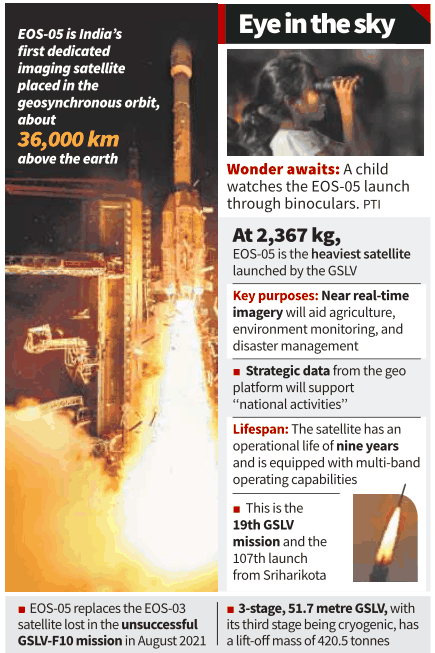
EOS-05 is at sub-GTO immediately after launch; ISRO will raise the orbit in stages to place it on the geo platform. Image courtesy The Hindu, 5 September 2026; reproduced with credit for educational use.
Technical details — the GSLV and its cryogenic stage
- Vehicle: GSLV (Geosynchronous Satellite Launch Vehicle) — a three-stage rocket. Stage 1 solid, Stage 2 liquid (Vikas engine), Stage 3 cryogenic (CE-7.5 engine using liquid hydrogen and liquid oxygen).
- Height: 51.7 metres. Lift-off mass: 420.5 tonnes. Payload to GTO: ~2,500 kg.
- EOS-05 at 2,367 kg is the heaviest satellite ever launched by GSLV — exceeding earlier payloads by progressively optimising structural mass and propulsion systems.
- Sub-GTO (sub-geosynchronous transfer orbit) is the initial parking orbit; ISRO will use the satellite's onboard propulsion to raise it to GEO (~35,786 km, 0° inclination).
- The satellite's solar panels have deployed; all valves are confirmed operating; health is described as nominal by ISRO.
What EOS-05 does — and why GEO imaging matters
- Near real-time imaging from a fixed vantage point; unlike polar-orbit satellites that image a location every few days, GEO imaging provides continuous or near-continuous coverage of the same area.
- Applications: agriculture (crop health, irrigation monitoring), environment (vegetation, floods, fires), disaster management (near-real-time imagery during cyclones, floods), and strategic / "national activities" — the phrase ISRO uses for defence-related earth observation.
- Multi-band capability and a nine-year operational life.
- India's imaging satellite fleet now includes LEO satellites (Resourcesat, Cartosat series) for detailed mapping and the newly added GEO layer for continuous monitoring — complementary, not competing, capabilities.
The GSLV's cryogenic history — context for Prelims
- India developed its own cryogenic engine (CE-7.5) after technology denial by Russia under US pressure in the 1990s — the episode directly fuelled India's indigenous cryogenic programme.
- GSLV's first successful cryogenic flight was GSLV-D5 (January 2014). GSLV-F10 (August 2021) was a cryogenic-stage failure.
- The GSLV-Mk III (LVM3) is a separate, heavier vehicle using the CE-20 cryogenic engine; it is not the same as the GSLV used for EOS-05. The distinction is frequently tested.
✎ Mains Practice Question
Discuss the strategic and developmental significance of India placing an imaging satellite in geosynchronous orbit. How does EOS-05 complement India's existing earth observation capability, and what does it reveal about the role of indigenous launch vehicle development in India's space security? 15 marks · 250 words
04
Indian researchers produce first molecular profile of social spider Stegodyphus sarasinorum venom, finding anti-cancer and antimicrobial leads
GS-III · S&T — Biotechnology, Drug Discovery, BiodiversityPrelims + MainsThe Hindu · 5 Sep 2026
Indian researchers from Sree Neelakanta Government Sanskrit College, Pattambi (Keralam), have published the first comprehensive molecular inventory of the venom gland of Stegodyphus sarasinorum — a permanently social colonial spider found across South Asia — identifying over 100 bioactive compounds with potential anti-cancer, antimicrobial and immune-related properties.
Figure 3 — Stegodyphus sarasinorum: profile of a social spider

S. sarasinorum is one of the few permanently social spider species worldwide; its colonial lifestyle makes it both an evolutionary curiosity and a rich source of bioactive venom compounds.
◈ Background & Context
- S. sarasinorum (family Eresidae) lives in permanent colonies in arid and semi-arid South Asia, constructs communal silk nests and hunts cooperatively — behaviours seen in fewer than 25 of the world's ~50,000 known spider species.
- The study was published in Scientific Reports (Springer Nature, open-access). It used three complementary analytical techniques: transcriptomics, proteomics and UHPLC-MS metabolomics — together covering proteins, their precursor transcripts and small-molecule metabolites.
- Key findings: 31 proteins identified by transcriptomics, 32 by proteomics, and 81 metabolites (amino acids, biogenic amines, organic acids) by UHPLC-MS. Venom gland extracts showed dose-dependent cytotoxicity against Dalton's Lymphoma Ascites (DLA) cancer cells in laboratory experiments.
- The researchers caution that laboratory cytotoxicity does not establish clinical efficacy; extensive validation including in-vivo studies and toxicity profiling would be required before any drug development.
Why it matters for drug discovery
- Spider venoms are among the most complex biological mixtures known — products of millions of years of co-evolution with prey. They are an underexplored source of molecular scaffolds for drugs.
- India's biodiversity, including arachnid fauna, represents an underutilised resource for natural product chemistry. This study is part of a broader push to characterise Indian biodiversity at the molecular level before it is lost.
✎ Mains Practice Question
India's biodiversity is often described as a strategic asset for biotechnology and drug discovery. Examine the steps needed to translate findings from biodiversity-based research — such as venom profiling of spider species — into commercially viable drugs, and the role of intellectual property and benefit-sharing frameworks in enabling this translation. 10 marks · 150 words
Environment, Ecology & ClimateGeneral Studies Paper III
05
Hanging glaciers in Alaknanda basin: what the Nepal GLOF disaster tells India about its own Himalayan risk
GS-III · Environment — Glaciology, Disaster Management, Climate Change ImpactsGS-I · Geography — Indian Rivers, Himalayan GeomorphologyPrelims + MainsIndian Express · Nature (Apr 2026) · 5 Sep 2026
Devastating flash floods in Nepal — triggered by a glacial collapse — have refocused attention on an April 2026 Nature study that mapped 219 hanging glaciers in the Alaknanda basin alone, with avalanche simulations projecting flows exceeding 50 metres in the Badrinath-Mana sector and a 120% increase in buildings at risk by 2030.
◈ Background & Context
A "hanging glacier" is an ice mass perched on a steep slope, detached from the valley floor, typically above a cliff face. Unlike valley glaciers that flow slowly to lower altitudes, hanging glaciers can detach suddenly — releasing ice, rock and entrapped water in one catastrophic mass movement.
- The Nepal disaster of late August 2026 — involving a glacial collapse that triggered downstream flooding — is the immediate news peg. It resembles four major Indian incidents of the last fifteen years, most directly the Chamoli disaster of February 2021 in which a wall of ice and rock collapsed into the Rishiganga valley, destroying hydropower plants, sweeping bridges and killing over 200 people.
- The April 2026 study, led by Ashim Sattar (IIT Bhubaneswar) and Nandu Krishnan (IISc Bengaluru), is the first basin-scale hanging-glacier inventory for the Central Himalaya. It found 219 hanging glaciers in the Alaknanda basin, covering 71.7 ± 3.5 sq km with an estimated ice volume of 2.39 ± 0.42 km³.
- Nearly one-third of the unstable ice is concentrated in the Upper Alaknanda basin — the Badrinath-Mana sector.
Figure 4 — Distribution of glaciers in the Alaknanda basin (Garhwal Himalaya)
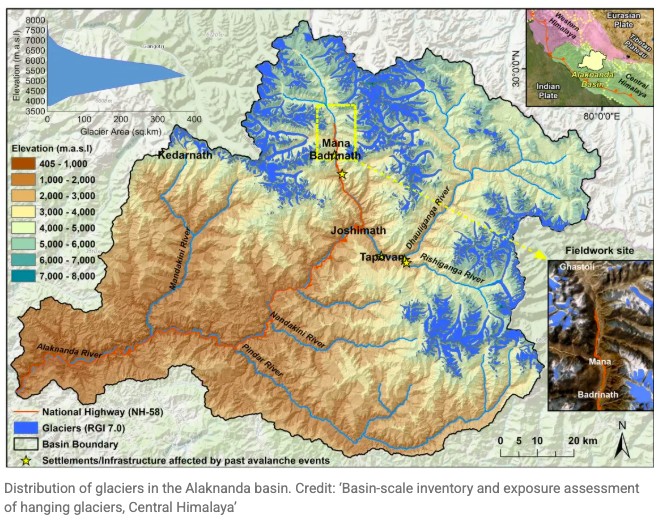
NH-58 (the Badrinath highway) passes through some of the highest glacier-risk zones in the basin — infrastructure lying directly in potential avalanche and GLOF pathways. Image: 'Basin-scale inventory and exposure assessment of hanging glaciers, Central Himalaya', Nature, April 2026; reproduced with credit for educational use.
Figure 5 — Types of hanging glaciers identified in the Alaknanda basin
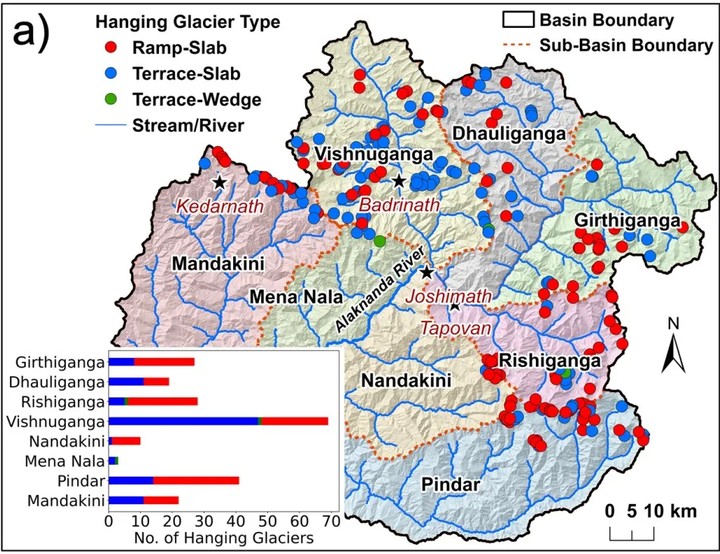
Ramp-Slab and Terrace-Slab are the most numerous types; the Vishnuganga sub-basin (which includes the Badrinath-Mana sector) has the highest concentration. Image: 'Basin-scale inventory and exposure assessment of hanging glaciers, Central Himalaya', Nature, April 2026; reproduced with credit for educational use.
How hanging glaciers form and why they are dangerous
- Formation: Climate warming causes valley glaciers to develop geometric instability — velocity can change by an order of magnitude over a short period, redistributing ice mass. Ice migrates to steep cliffs above valley floors, decoupling from the main glacier body to form hanging masses.
- Three types in the study: Ramp-Slab (inclined surface), Terrace-Slab (stepped terrain) and Terrace-Wedge (wedge-shaped, rarest). Ramp-Slab and Terrace-Slab are most numerous in the Alaknanda basin.
- Break-off mechanism: permafrost thaw beneath the glacier removes the frozen substrate that anchors ice to bedrock. When this "freeze glue" goes, the hanging mass detaches without warning. The Nepal event appears to involve exactly this mechanism — at a scale previously observed only in Greenland and Antarctica.
- Cascade of hazards: the initial ice avalanche entrains rock debris and water, reaching speeds that make evacuation impossible once underway. Where glacial lakes exist downstream, the impact wave can trigger a Glacial Lake Outburst Flood (GLOF), amplifying the disaster's downstream reach far beyond the immediate avalanche zone.
Risk exposure in India — the numbers that matter
- Avalanche-related risk exposure in the Alaknanda basin is projected to increase with a 120% rise in buildings and infrastructure land at risk by 2030 compared to 2000.
- Population in at-risk areas is projected to grow by 17% over the same period — driven by development of pilgrimage and tourism infrastructure along NH-58 and associated valley settlements.
- Simulated avalanche flows in the Badrinath-Mana sector could exceed 50 metres in height — high enough to overtop most existing settlements and infrastructure.
The Chamoli lesson vs. the Blatten contrast
- Chamoli 2021 (India): a massive ice-rock avalanche, likely from Raunthi peak, collapsed into the Rishiganga valley. Killed 200+. No prior monitoring; no early warning; no evacuation.
- Blatten 2025 (Switzerland): a large ice-rock avalanche buried most of the village of Blatten. One person died. Authorities and residents acted on precursory slope-instability signs months before — near-complete evacuation achieved.
- A March 2026 Nature study (Bhardwaj et al.) compared these two events and concluded: the difference was "not luck, but preparedness, monitoring, and rapid response."
- India's gaps: anticipatory monitoring systems are limited; the Himalaya's transboundary nature (India–Nepal–China) complicates joint early-warning infrastructure; attributing cascading hazards mid-event is still not standard practice in disaster response.
Institutions and terms for Prelims
- GLOF — Glacial Lake Outburst Flood; occurs when a glacial lake (moraine-dammed or ice-dammed) catastrophically drains. NDMA has issued guidelines for GLOF risk reduction.
- Alaknanda River — one of the two headstreams of the Ganga (the other is Bhagirathi); joins at Devprayag. The basin covers major pilgrimage sites: Badrinath, Kedarnath, Joshimath.
- NH-58 — now NH-7 — the highway to Badrinath; passes through glacier-risk zones flagged in the study.
- ICCI — International Cryosphere Climate Initiative, Burlington, Vermont; the body that flagged the April 2026 study as a warning.
- Indus Suture Zone — the tectonic boundary between the Indian and Eurasian plates; the heat and deformation along this zone create both geothermal resources and cryospheric instability in Ladakh and the Garhwal-Kumaon arc.
✎ Mains Practice Question
"The Himalayan cryosphere is moving from a predictable, slowly changing system to one characterised by sudden, catastrophic release events." In light of this shift, critically examine India's preparedness for glacial disasters, drawing on recent events and the gaps in monitoring, early warning and transboundary risk-management. 15 marks · 250 words
06
UN Environment Programme: 1.5°C target definitively breached, carbon removal at scale now the only remaining pathway
GS-III · Environment — Climate Change, Paris Agreement, Carbon RemovalGS-II · IR — Global Environmental GovernancePrelims + MainsNew York Times · UNEP · 2–3 Sep 2026
A 141-page UNEP report formally declares that the world will breach the 1.5°C Paris target within "the next few years" and outlines a fallback pathway: limit the temperature overshoot to a peak of 1.8°C, then remove CO₂ from the atmosphere at an unprecedented scale to bring temperatures back down — a task scientists warn could take decades to achieve even a single decade of excess warming.
◈ Background & Context
The Paris Agreement (2015) committed countries to limit warming to "well below 2°C" above pre-industrial levels, while "pursuing efforts to limit the temperature increase to 1.5°C".
Scientists have warned for several years that 1.5°C was effectively unachievable without immediate, steep global emissions cuts that have not materialised.
- Current warming: global average temperature is approximately 1.4°C above pre-industrial levels. Carbon dioxide from fossil fuel combustion has been the primary driver.
- Current trajectory: based on existing national policies, the UNEP report projects warming of 2.6°C by end of century — far above both Paris targets.
- The policy-science disconnect: international climate conferences have continued to use "keeping 1.5 alive" rhetoric even as scientists privately concluded it was lost. This report — described as the "UN system catching up with reality" — formally ends that disconnect.
- UNEP Emissions Gap Reports have annually quantified the gap between pledged action and the action needed; this report goes further by changing the stated target itself.
The new fallback framework — overshoot and removal
- Step 1 — limit the overshoot: keep peak warming at 1.8°C or below. The report describes even this as unlikely under current trends.
- Step 2 — remove carbon at scale: after peaking, draw down atmospheric CO₂ through Carbon Dioxide Removal (CDR) at a colossal rate to bring temperatures back down to 1.5°C eventually — potentially over 50 years to reverse a decade of excess warming.
- The UN calls this pathway "by no means an acceptable or preferred pathway. It is simply the best remaining option."
Carbon removal: methods, scale and controversies
- Nature-based CDR: afforestation and reforestation — but at the scale required, tracts of land larger than entire US states would need to be forested. Conflicts with agriculture, reduced efficiency at higher temperatures, and wildfire risk all constrain this.
- Technology-based CDR:
- Bioenergy with Carbon Capture and Storage (BECCS) — burning biomass for energy, capturing the CO₂ emissions and storing them underground. Requires vast land for biomass and proven geological storage.
- Direct Air Capture (DAC) — machines that chemically extract CO₂ from ambient air. Current industrial capacity is extremely limited and cost per tonne is very high.
- Enhanced weathering — spreading silicate minerals on cropland to absorb CO₂ via chemical reactions. Promising but unproven at scale.
- The moral hazard critique: Climate Analytics and others warn the CDR pathway risks becoming a "call to apathy" — it could reduce pressure to cut emissions now. The report has also been criticised for not explicitly calling for a fossil fuel phase-out, even as countries committed to pivoting away from oil, gas and coal at COP28 in 2023.
- US withdrawal: the Trump administration's departure from Paris Agreement commitments removes the largest historical emitter from the global framework at the moment when the most ambitious action is needed.
Impacts already locked in at current warming levels
- Intensifying heat waves, droughts, floods and wildfires are present at 1.4°C. At 1.5°C: coral bleaching will be near-total; extreme heat events will be significantly more frequent and intense.
- Irreversible changes: glacial loss, sea-level rise, and certain species extinctions are effectively locked in regardless of future mitigation.
- Tipping points: the report flags risks including weakening or collapse of the Atlantic Meridional Overturning Circulation (AMOC) — which carries warm tropical water northward — with potential to "reshape the world forever."
Key terms for Prelims
- UNEP — United Nations Environment Programme, headquartered in Nairobi; publishes the annual Emissions Gap Report and the Adaptation Gap Report.
- Carbon overshoot — temporarily exceeding a temperature target before bringing temperatures back down through CDR.
- AMOC — Atlantic Meridional Overturning Circulation; a large ocean-current system that redistributes heat globally; weakening is already observed.
- DAC — Direct Air Capture; the technology-based CDR route currently at small scale; the US company Climeworks operates the largest plant in Iceland.
- COP28 (Dubai, 2023) — the climate summit at which countries agreed to "transition away" from fossil fuels; first explicit mention in a COP decision text.
✎ Mains Practice Question
The UN has formally acknowledged that the 1.5°C Paris Agreement target will be breached and has proposed a framework of "overshoot and carbon removal." Critically examine the feasibility of this approach and its implications for global climate governance, with particular reference to the equity concerns of developing countries. 15 marks · 250 words
Society, Heritage & ConservationGeneral Studies Paper I & III
07
Restoration at Saptakoteshwar Temple site in Goa's Divar island unearths relics spanning Kadamba and Vijayanagara periods (14th–16th century)
GS-I · History & Culture — Medieval Dynasties, Goa, Temple Architecture, Colonial ImpactGS-III · Governance — Heritage Conservation, Kotiteerth CorridorPrelims + MainsIndian Express · 4–5 Sep 2026
Restoration work on Goa's Divar island at the site of the ancient Saptakoteshwar temple has yielded archaeological relics — including a Kirtimukh doorway motif, a carved pillar capital and parts of a Dev Khostam (idol platform) — confirming successive reconstructions from the Kadamba period through Vijayanagara rule before Portuguese destruction in the 16th century.
Figure 6 — Artefacts from the Saptakoteshwar temple excavation, Divar, Goa
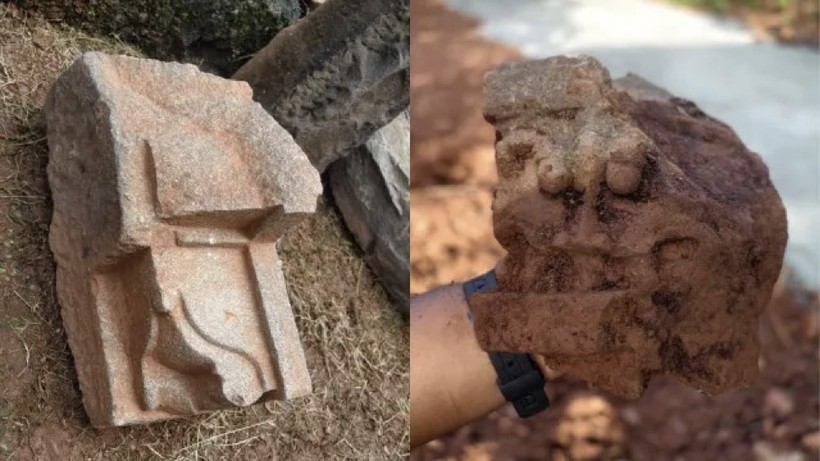
The variety of stone typologies indicates reconstructions by different builders across centuries — Kadamba laterite succeeded by Vijayanagara-period stonework. Image courtesy Goa Chief Minister's Office / ANI; reproduced with credit for educational use.
◈ Background & Context
Goa's pre-Portuguese history is among the most archaeologically understudied chapters of Indian heritage — partly because the Portuguese colonial administration and the Goa Inquisition systematically destroyed temples, converted sites and erased records.
The discovery of multi-period relics at a single site is therefore significant for reconstructing that history.
- Saptakoteshwar is a major Shaiva deity; the original temple at Naroa, Divar Island, was associated with the Kadamba dynasty (10th–14th century), which ruled Goa from its capital at Chandrapur (modern Chandor).
- The temple was destroyed by the Bahmani Sultanate and rebuilt in 1391 by a minister in the Vijayanagara kingdom — the relics bear markers of both periods.
- Portuguese authorities destroyed the Vijayanagara-era temple in the 16th century during systematic temple demolitions in the "Old Conquests" (Tiswadi, Bardez, Salcete talukas). The deity's idol was secretly carried across the Mandovi River to Bicholim, where Chhatrapati Shivaji Maharaj established a new shrine in 1668 during his Surat expedition — this is the active temple today.
- The Goa government's Kotiteerth Corridor Development Project is developing the Divar site as a pilgrimage memorial, with a new temple proposed on 10,000 sq m. An expert committee recommends a Smarak Devalaya (temple memorial) in the erstwhile Old Conquests area.
The artefacts and what they reveal
- Kirtimukh — a fierce, disembodied face motif traditional in Indian temple architecture; typically placed above door-frames (torana) as an apotropaic guardian. Its presence confirms this was a significant temple entrance.
- Carved pillar capital — the top portion of a structural column; the carving style can be dated and attributed to specific regional traditions.
- Dev Khostam — the platform on which a temple idol was placed; Konkani architectural term.
- Stone typologies: different stone types across the finds confirm successive phases of construction — Kadamba builders used local laterite; Vijayanagara patrons brought granite traditions from the Deccan.
- The finds were located along the old pathway between Koti Tirth (the sacred tank) and Madhavachi Talli, confirming the historical descriptions of a temple complex with a sacred corridor.
Historical lineage: dynasties and their Goa connections
- Kadamba dynasty — the earliest historically attested Goa rulers; their inscriptions and temples date from the 10th–14th centuries; their capital Chandrapur gave Goa its oldest urban history.
- Bahmani Sultanate — the Deccan sultanate that controlled Goa in the 14th–15th centuries before the Portuguese arrival.
- Vijayanagara Empire — the South Indian empire whose patronage kept temple culture alive in Goa before Portuguese annexation; the 1391 reconstruction is a documented example.
- Goa Inquisition — Portuguese ecclesiastical court active in Goa from 1561 to 1812; enforced conversion, banned Hindu and Muslim practices, and oversaw systematic destruction of temples. Over 1,000 temples were destroyed in the Old Conquests according to the expert committee.
✎ Mains Practice Question
Archaeological discoveries at pre-colonial temple sites reveal the layered civilisational history of India's coastal regions. Discuss the historical significance of the Saptakoteshwar temple site in Goa, tracing its trajectory from the Kadamba period through Vijayanagara patronage and Portuguese destruction, and examine the heritage challenges posed by colonial erasure of such sites. 15 marks · 250 words