
In-Depth News Analysis8 Items
Core TopicImportantConcise
Polity & GovernanceGS Paper II
01Internet Access as a Fundamental Right — Children02Immigration & Foreigners (Exemption) Amendment Order, 202603Public Accounts Committees — Outcome-Based Scrutiny
International RelationsGS Paper II
04US Midterm Elections 2026 — Basics & Significance
Science & TechnologyGS Paper III
05Tokamaks & Nuclear Fusion — ITER, EAST, India
Health & Social SectorGS Paper II & III
06TB Drug Patent Rejection — BPaL Regimen07e-Sanjeevani — 50 Crore Teleconsultations
Internal Security & DefenceGS Paper III
08Pralay Quasi-Ballistic Missile — User Trial
Polity & GovernanceGeneral Studies Paper II
01
Internet Access as a Fundamental Right: Balancing Children’s Freedom and Online Safety
GS-II · Polity — Fundamental Rights, Judiciary, Vulnerable Sections (Children)Prelims + MainsThe Hindu · Letter & Spirit
The Supreme Court has expressly held that the right to access and use the internet is a fundamental right of every individual, children included. It has also declined to endorse blanket age-based bans as the answer to online harm.
◈ The Ruling — What the Court Said
In Just Rights for Children Alliance v. S. Harish, an order dated 15 October 2026, a Bench of two judges located internet access in Article 21 (life and personal liberty) read with Article 19(1)(a) (speech and expression).
- Origin of the case: the order came on applications seeking enforcement of the Court’s 23 September 2024 judgment in the same case. That judgment held that viewing, storing or possessing child sexual abuse material is an offence under POCSO and the IT Act, and urged replacing “child pornography” with “Child Sexual Exploitative and Abuse Material” (CSEAM).
- Children as rights-holders: children, irrespective of age, enjoy this right; protecting them from harm cannot justify denying access altogether.
- No copy-paste of foreign bans: India should calibrate its own balance rather than imitate international approaches to restriction.
- Platform accountability: the Court pressed for stronger detection and removal of CSEAM, including a national hash and URL database to identify such content across platforms.
Static Anchor — How Courts Built the Right to Internet Access
- Cricket Association of Bengal (1995): Article 19(1)(a) includes the right to know and to receive and impart information. Airwaves are public property.
- Shreya Singhal v. Union of India (2015): struck down Section 66A of the IT Act as vague and over-broad, confirming that online speech gets full Article 19 protection.
- K.S. Puttaswamy (2017): recognised privacy as a fundamental right and laid down the proportionality test (legality, legitimate aim, necessity, balancing).
- Faheema Shirin v. State of Kerala (Kerala HC, 2019): held internet access to be part of the right to education and privacy.
- Anuradha Bhasin v. Union of India (2020): speech and trade through the internet are protected under Articles 19(1)(a) and 19(1)(g); internet suspensions must be temporary, proportionate and published.
- Pragya Prasun v. Union of India (2025): held that excluding persons with disabilities from digital KYC violates Article 21; digital access is intrinsic to the right to life.
Figure 1 — The constitutional architecture of a child’s right to internet access
CONSTITUTIONAL ANCHORSArt. 19(1)(a)Speech, right to knowArt. 19(1)(g)Trade, profession onlineArt. 21Life, dignity, privacyArt. 21AEducation (6–14 yrs)Right to access and use the internetEvery individual — children irrespective of ageLIMITS — MUST PASS PROPORTIONALITYArt. 19(2) reasonable restrictionsDecency, morality, public order, security …Child-safety statutesPOCSO · IT Act & IT Rules 2021 · DPDP Act 2023Test: least restrictive, age-appropriate safeguards — not blanket denial
The right stands on several Fundamental Rights at once. Any curb must be a proportionate restriction, not a blanket ban.
▤ Legal & Global Framework on Children Online
- DPDP Act, 2023 — Section 9: a “child” is anyone under 18; platforms need verifiable parental consent and may not undertake tracking, behavioural monitoring or targeted advertising directed at children. The DPDP Rules were notified in November 2025.
- POCSO Act, 2012 and Section 67B, IT Act, 2000 criminalise child sexual abuse material. The IT Rules, 2021 impose due-diligence duties on intermediaries.
- UN Convention on the Rights of the Child (1989), ratified by India in 1992. Its General Comment No. 25 (2021) applies children’s rights to the digital environment.
- International contrast: Australia set a minimum age of 16 for social-media accounts from December 2025. Brazil requires children’s accounts to be linked to a legal guardian; several other countries use screen-time limits.
- Within India: Andhra Pradesh and Karnataka are reported to be considering screen-time curbs for children.
Why It Matters — Freedom and Safety Are Not Opposites
- Capability lens: in Amartya Sen’s capability approach, development means expanding real choices. For a child, the internet widens access to learning, expression and opportunity.
- Digital divide: blanket bans hurt most those children whose only route to quality content is online, especially in rural and low-income homes.
- Risks are real: cyberbullying, grooming, sextortion, privacy violations, financial fraud and addictive design call for layered safeguards.
- “Authority–liberty coordination”: constitutionalism limits both State overreach (which tends towards authoritarianism) and unrestrained liberty (which tends towards disorder).
The Critical View
- Age verification dilemma: verifying age at scale can mean collecting more personal data, creating new privacy risks for the children it aims to protect.
- Implementation gap: without enforceable platform duties and quick takedowns, recognising a right does not by itself make the online space safer.
- Federal questions: State-level screen-time curbs may sit uneasily with a Supreme Court ruling on Fundamental Rights and with Union laws on IT and telecom.
- Shared responsibility: the balance depends on parents, schools, platforms and the State together, through digital literacy, safety-by-design and grievance redress.
✎ Mains Practice Question
“Protecting children online does not require restricting their freedom online.” In light of the Supreme Court’s recognition of internet access as a fundamental right, discuss how the State can secure children’s safety in the digital space without resorting to blanket restrictions. 15 marks · 250 words
02
Visa Requirement for Minority Migrants from Three Neighbours: Amendment to the Immigration and Foreigners (Exemption) Order
GS-II · Polity — Citizenship, Government Policies; IR — NeighbourhoodPrelims + MainsThe Hindu
The Ministry of Home Affairs has amended the Immigration and Foreigners (Exemption) Order, 2025. Members of six minority communities from Afghanistan, Bangladesh and Pakistan who entered without valid documents must now obtain an “appropriate visa” for their continued stay.
◈ The Basics — Who Is a “Foreigner” and How Entry Is Regulated
- Constitutional base: Entry 17 (citizenship, naturalisation and aliens) and Entry 19 (admission into and expulsion from India; passports and visas) of the Union List. Article 11 empowers Parliament to regulate citizenship.
- Immigration and Foreigners Act, 2025: in force from 1 September 2025, it consolidated and replaced four laws — the Passport (Entry into India) Act, 1920, the Registration of Foreigners Act, 1939, the Foreigners Act, 1946 and the Immigration (Carriers’ Liability) Act, 2000.
- Exemption Order (2 September 2025): exempted Hindus, Sikhs, Buddhists, Jains, Parsis and Christians from the three countries who entered on or before 31 December 2024 from the requirement of holding passports or visas, shielding them from prosecution.
What the November 2026 Amendment Changes
- Visa for continued stay: those who came without documents, or whose documents have expired, must obtain an appropriate visa. The earlier protection from penal action for entry is reported to be retained.
- “Visa Manual” defined: the Central Government’s manual of instructions on visas and immigration now has a formal definition.
- Nepal and Bhutan: Indian citizens travelling to Nepal or Bhutan, and Nepali and Bhutanese citizens entering or leaving India, must produce the identity documents specified in the Visa Manual. This does not affect the visa-free regime under the India–Nepal Treaty of Peace and Friendship (1950) and the India–Bhutan Treaty (1949, revised 2007).
- Unchanged: registered Sri Lankan Tamil refugees who arrived up to 9 January 2015 stay protected from penal provisions; categories covering Tibetan refugees are reorganised.
▤ Two Cut-off Dates — Do Not Confuse
- Citizenship (Amendment) Act, 2019: fast-track citizenship for the six communities who entered on or before 31 December 2014; naturalisation residency cut from 11 to 5 years; Rules notified in March 2024. Sixth Schedule tribal areas and Inner Line Permit areas are excluded.
- Exemption Order, 2025: protection from prosecution (not citizenship) for those who entered on or before 31 December 2024.
- Refugee law: India is not a party to the 1951 Refugee Convention or its 1967 Protocol and has no national refugee law. Refugees are handled through administrative orders. Articles 14 and 21 still protect foreigners (NHRC v. State of Arunachal Pradesh, 1996, on the Chakmas).
Assessment
- Regularisation and records: requiring visas brings the stay of a large undocumented population into a formal, trackable framework while their status is decided.
- Humanitarian burden: many such migrants are poor and may struggle with paperwork and costs. Clear procedures and outreach will determine whether the change protects them or creates new insecurity.
- Legal debate: the religion-specific design of the CAA framework is under challenge before the Supreme Court on Article 14 grounds. Aligned executive orders are likely to be read in that light.
- Border management: specifying ID documents on the open borders with Nepal and Bhutan may tighten security checks, but must not hamper the people-to-people movement those treaties protect.
✎ Mains Practice Question
In the absence of a national refugee law, India regulates forced migrants through executive orders. Examine the merits and limitations of this approach in the context of recent changes to the immigration framework. 10 marks · 150 words
03
Public Accounts Committees: From Auditing Spending to Scrutinising Outcomes
GS-II · Polity — Parliament, Parliamentary Committees, Constitutional Bodies (CAG)Prelims + MainsPress reports
At a Conference of Chairpersons of Public Accounts Committees (PACs) of Parliament and State/UT legislatures in Thiruvananthapuram, the Lok Sabha Speaker urged committees to scrutinise outcomes, not just outlays. He also called for time-bound clearance of audit objections that have been pending for 10–20 years.
◈ Static Anchor — The Public Accounts Committee
- Origin: first set up in 1921 under the Government of India Act, 1919 (Montagu–Chelmsford Reforms). It is the oldest of Parliament’s financial committees.
- Composition: 22 members — 15 from Lok Sabha and 7 from Rajya Sabha, elected each year by proportional representation through the single transferable vote. Ministers cannot be members; the term is one year.
- Chairperson: appointed by the Speaker. By convention since 1967, the chair goes to a member of the Opposition.
- Function: examines the Appropriation Accounts, Finance Accounts and the audit reports of the CAG laid under Article 151. The CAG is often called the PAC’s “friend, philosopher and guide”.
- Sister committees: Estimates Committee (30 members, all Lok Sabha) and Committee on Public Undertakings (22 members).
Key Points from the Conference
- Outcome over outlay: spending should be judged by its impact on citizens — for example, site visits to check infrastructure quality and beneficiary-level assessment of welfare schemes.
- Clear the backlog: a systematic action plan for long-pending audit paras, with stronger monitoring and follow-up by the Union and State governments.
- Technology: use AI and data analytics to scan expenditure data, spot irregularities and track pending observations.
- Complex delivery models: scrutiny of Centre–State schemes and public–private partnerships within each committee’s mandate.
- Floor time: the Lok Sabha PAC’s chairperson proposed that at least one PAC report, with the Government’s action taken on it, be discussed every session.
Limitations of the PAC
- Post-mortem nature: it examines spending after it has occurred.
- No policy review: it cannot question policy, only how money was spent.
- Advisory only: recommendations are not binding, and Action Taken Notes are often delayed.
- Little House debate: reports are seldom debated on the floor, which weakens their public impact.
✎ Mains Practice Question
“Financial accountability of the Executive is only as strong as the follow-up on audit findings.” Examine the role and limitations of the Public Accounts Committee, and suggest measures to make legislative financial oversight outcome-oriented. 15 marks · 250 words
International RelationsGeneral Studies Paper II
04
US Midterm Elections 2026: How America Votes Between Presidential Elections, and Why It Matters
GS-II · IR — Effect of Policies of Developed Countries on India; Polity — Comparison with Other ConstitutionsPrelims + MainsThe Hindu · Agencies
The United States held its midterm elections on 3 November 2026. Media projections indicate that the party of the incumbent President lost ground, with the opposition projected to win the House of Representatives and reported to have taken the Senate. The elections also produced several firsts in representation.
◈ The Basics — What Is a Midterm Election?
A midterm election is the US general election held halfway through a President’s four-year term. The President is not on the ballot, but voters choose the Congress that will make laws and oversee the administration for the next two years.
- When: by federal law, the Tuesday after the first Monday in November of an even-numbered year — hence 3 November 2026.
- House of Representatives: all 435 voting seats are elected every two years; the number has been fixed since the Permanent Apportionment Act, 1929. Seats are shared among States by population after each decennial census; 218 is a majority.
- Senate: 100 seats (two per State) with six-year, staggered terms, so about one-third are elected every two years. In 2026, 35 seats were contested, including special elections. Senators have been directly elected since the 17th Amendment (1913).
- States too: governors (directly elected, unlike India’s appointed Governors), State legislatures and ballot measures are decided on the same day.
Figure 2 — The US electoral cycle and the structure of Congress
ONE PRESIDENTIAL TERM (4 YEARS)Year 0PresidentialelectionYear 2 — MIDTERMAll House seats + ~⅓ Senate + many governorsPresident not on ballotYear 4Next presidentialelectionHOUSE OF REPRESENTATIVES• 435 voting members · majority 218• 2-year term · all seats every 2 years• Seats by population (census)• Originates revenue bills; impeachesSENATE• 100 members · 2 per State · majority 51• 6-year term · ⅓ elected every 2 years• Vice-President breaks ties• Treaties (⅔) and appointmentsOpposition control of either chamber = “divided government”
The midterm falls in year two and is widely read as a referendum on the sitting President, although he is not a candidate.
Why Midterms Matter — Powers of Congress
- Law-making: a bill must pass both chambers in identical form. Revenue bills must originate in the House (Article I, Section 7).
- Power of the purse: Congress passes appropriations. Deadlock can lead to a government shutdown.
- Oversight: committees can hold hearings, issue subpoenas and investigate the Executive. The House impeaches, while the Senate tries the case and needs a two-thirds vote to convict.
- Senate’s special role: advice and consent on treaties (two-thirds) and on Cabinet, ambassadorial and judicial appointments. The filibuster means most bills need 60 votes to end debate.
- Historic pattern: the President’s party usually loses seats in midterms. Exceptions such as 1934, 1998 and 2002 are rare.
▤ 2026 at a Glance (as reported; some races still being counted)
- House: media projections show the opposition party winning a majority.
- Senate: several outlets report the opposition has also gained a majority.
- Firsts in representation (as reported): the first Black woman elected governor of a US State (Georgia); the first Native American woman governor (New Mexico); the first Native American woman in the Senate (Minnesota); the first Muslim US Senator (Michigan); and the first openly gay man in the Senate (New Hampshire). The House may also elect its first Black Speaker.
- Next steps: the new 120th Congress convenes on 3 January 2027 under the 20th Amendment. Until then the outgoing Congress sits as a “lame duck”.
Comparative Polity — US Presidential vs Indian Parliamentary System
- Separation of powers: the US President is not a member of Congress and cannot be removed by a no-confidence vote. In India, the Council of Ministers is collectively responsible to the Lok Sabha (Article 75(3)).
- Fixed terms: Congress cannot be dissolved. India’s Lok Sabha can be dissolved before its five-year term ends.
- Staggered upper house: both the US Senate and India’s Rajya Sabha renew one-third every two years (Article 83(1)). Rajya Sabha members, however, are indirectly elected by State legislators.
- Divided government is possible in the US, where the Executive and the legislature can be controlled by different parties. India’s system fuses them, since the Government must command a Lok Sabha majority.
Implications for India
- Trade: Congress holds the constitutional power over trade and tariffs (Article I, Section 8). A changed Congress may affect India–US trade negotiations and scrutiny of tariff actions.
- Immigration and skills: legislation on H-1B and other high-skill visas matters directly to Indian professionals and the IT sector.
- Strategic continuity: support for the India–US Comprehensive Global Strategic Partnership, the Quad and defence and technology cooperation has broadly cut across party lines in Congress.
- Diaspora: greater diversity in US politics, including Indian-origin legislators, widens channels of engagement.
✎ Mains Practice Question
Midterm elections in the United States often produce a “divided government”. Explain the constitutional significance of these elections in a presidential system, and compare them with the mechanisms of executive accountability in India’s parliamentary democracy. 15 marks · 250 words
Science & TechnologyGeneral Studies Paper III
05
Tokamaks and the Quest for Fusion Power: How Magnetic Confinement Works and Why Net Energy Remains Elusive
GS-III · S&T — Nuclear Technology, Energy, Indigenisation of TechnologyPrelims + MainsThe Hindu · Science
A tokamak uses powerful magnetic fields to hold plasma hotter than the Sun’s core inside a ring-shaped chamber, so that atomic nuclei can fuse. Decades of progress have not yet produced a tokamak that delivers net energy for commercial power.
◈ The Basics — Fission vs Fusion
- Fission (today’s nuclear power) splits heavy nuclei such as uranium-235 in a controlled chain reaction. Fusion joins light nuclei into a heavier one, releasing energy because the product weighs slightly less (E = mc²).
- Fuel of choice: deuterium (D) and tritium (T), isotopes of hydrogen, fuse into helium-4 plus a fast neutron, releasing 17.6 MeV. About 80% goes to the neutron and 20% to the helium nucleus (alpha particle).
- Plasma: the fourth state of matter — a gas so hot that electrons are stripped from atoms, leaving charged particles that magnetic fields can steer.
- Why so hot: positively charged nuclei repel each other (the Coulomb barrier). The Sun overcomes this with immense gravity and density at about 15 million °C; on Earth, reactors need around 100–150 million °C.
- Lawson criterion (1955): fusion produces net energy only if plasma density × temperature × confinement time exceeds a threshold. Containment is therefore the central problem.
Figure 3 — The deuterium–tritium reaction and where its energy goes
D1p + 1n+T1p + 2n~150 M °C⁴Heα particle3.5 MeV (20%)stays in plasma, keeps it hotn14.1 MeV (80%)escapes magnetic field → hits wallBlanket absorbs neutronsHeat → coolant → steam→ turbine (as in any plant)Lithium in blanketn + Li → tritiumPlant breeds its own fuelEnergy density1 kg D-T ≈ 3.4 × 10¹⁴ J~10 million × same mass of coal
The plasma is kept off the walls, but the neutron energy must reach them. That is how a fusion plant would make heat, electricity and fresh tritium.
How a Tokamak Works
- Name and origin: a Russian acronym for a toroidal chamber with magnetic coils. It was conceived in the USSR in the early 1950s (credited largely to Igor Tamm and Andrei Sakharov), and the first machines ran at the Kurchatov Institute, Moscow, in the late 1950s.
- Why a ring: charged particles spiral along magnetic field lines. In a straight tube they would leak out at the ends, so bending the tube into a doughnut (torus) removes the ends.
- Why a twist: the field is stronger on the inner side of the ring, which makes ions and electrons drift apart and push the plasma into the wall. A large current driven through the plasma, induced by a central solenoid acting like a transformer, adds a second field that twists the field lines into a helix and cancels the drift.
- Two fields combined: a toroidal field from external coils plus a poloidal field from the plasma current. Additional poloidal-field coils shape and position the plasma.
Figure 4 — Inside a real tokamak: China’s EAST in cross-section and 3D
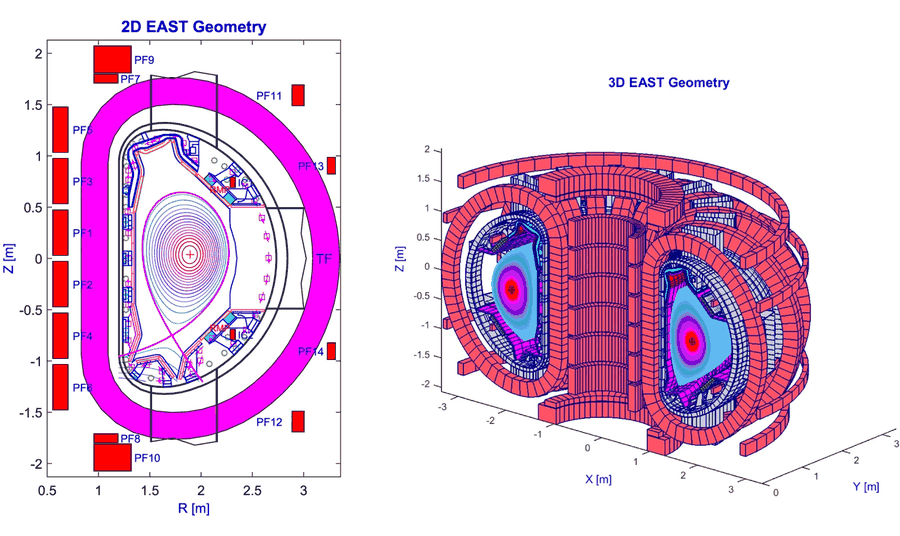
The D-shaped plasma (centre) sits inside the vacuum vessel, ringed by the toroidal-field coil (TF) and positioned by poloidal-field coils (PF1–PF14). Image: EAST tokamak geometry; reproduced with credit to the original publisher for educational use.
▤ The Global Landscape
- ITER (International Thermonuclear Experimental Reactor), being assembled at Cadarache, France, has seven members: China, the EU, India, Japan, South Korea, Russia and the US, together representing over 30 countries. It aims for Q = 10, ten times the heating power fed into the plasma.
- ITER’s delays: estimated costs have risen at least four-fold from €5 billion (2005). A 2024 re-baseline moved research operations to 2034 and D-T operation to 2039. ITER is a physics experiment and will not generate electricity.
- EAST (Experimental Advanced Superconducting Tokamak), Hefei, China: sustained a high-confinement plasma for a record 1,066 seconds (January 2025). In January 2026 it reported operating above the long-standing empirical density limit.
- India: the Institute for Plasma Research (IPR), Gandhinagar, under the Department of Atomic Energy, runs ADITYA (India’s first tokamak, 1989; rebuilt as ADITYA-U, 2017) and SST-1 (Steady State Superconducting Tokamak; first plasma 2013). India also manufactures ITER components, including the giant cryostat.
Alternative Routes to Fusion
- Stellarator: creates the twisted field entirely with complex external coils and needs no plasma current. It allows steadier operation but is harder to build; Germany’s Wendelstein 7-X is the leading example.
- Inertial confinement: lasers compress a tiny fuel pellet so fast that it fuses before flying apart. The US National Ignition Facility reported target gain above 1 in December 2022, though not net gain at the level of the whole facility.
- Others: mirror machines (open-ended fields) and field-reversed configurations (compact, with no central hole), many pursued by private start-ups.
Promise and Problems
- Promise: no runaway chain reaction, no carbon emissions, abundant fuel (deuterium from seawater, lithium for tritium) and no long-lived high-level waste of the kind fission produces.
- Materials: 14 MeV neutrons damage reactor walls and make them radioactive over time.
- Tritium supply: tritium is rare and radioactive (half-life about 12.3 years); breeding it at scale is unproven.
- Plasma stability: disruptions and other instabilities can damage the machine.
- Cost and time: first-of-a-kind machines face repeated cost overruns and schedule slips, and commercial electricity remains decades away.
✎ Mains Practice Question
Nuclear fusion is often described as the “ultimate clean energy source”, yet commercial fusion power remains elusive. Explain the principle of magnetic confinement in a tokamak, and discuss the scientific and engineering challenges along with India’s role in global fusion research. 15 marks · 250 words
Health & Social SectorGeneral Studies Papers II & III
06
Patent Office Rejects BPaL Combination Patent: What It Means for Drug-Resistant TB and India’s Patent Law
GS-II · Health — Communicable Diseases, Government ProgrammesGS-III · IPR — Patents, Access to MedicinesPrelims + MainsThe Indian Express · Explained
The Indian Patent Office has rejected an application for a patent on BPaL, a combination of three drugs used against drug-resistant tuberculosis. This removes one barrier to generic competition for a shorter, all-oral regimen.
◈ The Basics — TB and Drug Resistance
- Tuberculosis is caused by the bacterium Mycobacterium tuberculosis, mainly affects the lungs, and spreads through the air.
- Drug-resistant TB: MDR-TB resists the two most powerful first-line drugs, isoniazid and rifampicin; RR-TB resists rifampicin. Treatment used to need 18–24 months, often with painful injections and severe side-effects.
- India’s burden: India accounts for nearly a quarter of the world’s TB cases. Its incidence was 187 per lakh population in 2024, against a WHO baseline of 237 in 2015.
- National response: the National TB Elimination Programme (NTEP) (renamed from RNTCP in 2020) aimed to end TB ahead of the SDG 3.3 deadline of 2030. Support schemes include Ni-kshay Poshan Yojana (nutrition DBT) and Ni-kshay Mitra community support.
Figure 5 — BPaL: a shorter, all-oral course
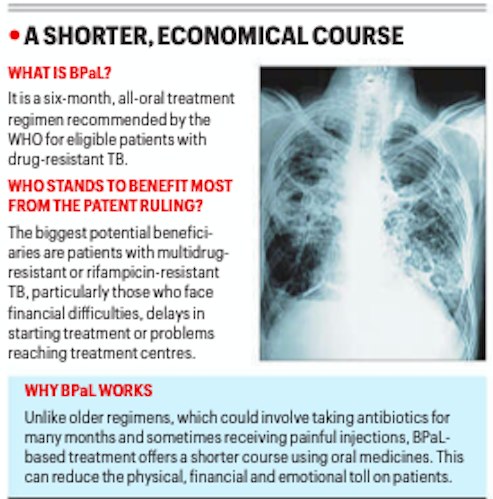
The regimen replaces long, injection-based treatment with six months of oral drugs. Image courtesy The Indian Express, 6 November 2026; reproduced with credit for educational use.
▤ Regimen at a Glance — BPaL / BPaLM
- BPaL: Bedaquiline + Pretomanid (Pa) + Linezolid. BPaLM adds Moxifloxacin.
- Duration: six months, all-oral, recommended by the WHO for eligible drug-resistant TB patients.
- Outcomes: BPaLM recorded a treatment success rate of 89%, against 52–75% for older regimens. More than 15,000 patients have started it under the national programme.
- Cost: a six-month BPaLM course now costs about US$ 284, down from US$ 588 in 2022.
- Applicant: the US-based Global Alliance for TB Drug Development (TB Alliance), which developed pretomanid.
- Opposers: pre-grant oppositions filed in 2020 by patient and civil-society groups, including the Delhi Network of Positive People (DNP+).
Static Anchor — India’s Patent Law and Access to Medicines
- Patents Act, 1970: recognised only process patents for pharmaceuticals, which helped build India’s generic industry. Product patents returned in 2005 to comply with WTO-TRIPS.
- Section 3(d): new forms of known substances (salts, polymorphs, combinations) are not patentable unless they show enhanced therapeutic efficacy. It was upheld in Novartis v. Union of India (2013), the Glivec case.
- Section 25(1): pre-grant opposition — any person may oppose before a patent is granted. Section 25(2) allows post-grant opposition within one year.
- Section 84: compulsory licensing. India’s first was granted to Natco for Bayer’s cancer drug Nexavar in 2012.
- Doha Declaration (2001): affirmed that TRIPS should be interpreted to protect public health and access to medicines.
- Evergreening: seeking fresh patents for minor changes or new formulations of existing drugs to extend monopoly. Bedaquiline-related claims on the salt form (2023), a paediatric formulation (2024) and a long-acting injectable have also been rejected in India.
Figure 6 — Shorter and cheaper: BPaLM against older regimens
Treatment success rate (%)89%BPaLM52–75%Older regimensCost of a six-month course (US$)$5882022$284Now
Older-regimen bar shows the range (52–75%), with the lighter band marking the upper end. Course cost has more than halved since 2022.
What the Ruling Does — and Does Not Do
- Does: removes a potential legal barrier to multiple manufacturers producing the combination, which could lower prices and reduce dependence on a few suppliers.
- Does not: automatically make drugs cheaper or available. A patent decides exclusive rights; separate marketing approval from the CDSCO decides whether a medicine is safe, effective and of good quality.
- Public system: patients in the NTEP already receive drugs free. Lower prices mainly let the Government treat more patients within the same budget.
- Quality of generics: generics contain the same active ingredients and must meet regulatory standards. WHO prequalification is a separate global quality benchmark.
The Critical View
- Innovation incentives: firms and product-development partnerships argue that weak patent protection may discourage investment in new TB drugs, a field with limited commercial returns.
- Resistance risk: wider use of bedaquiline without drug-susceptibility testing could breed resistance to the backbone drug of modern regimens.
- Last-mile gaps: delays in diagnosis, stock-outs and patients’ difficulty reaching treatment centres limit gains from cheaper drugs.
- Scale-up: health experts’ priority is to extend BPaL/BPaLM to every eligible rifampicin-resistant patient.
✎ Mains Practice Question
“India’s patent law strikes a balance between rewarding innovation and ensuring access to affordable medicines.” Examine this statement with reference to the recent rejection of a patent for a drug-resistant TB regimen and the provisions of the Patents Act, 1970. 15 marks · 250 words
07
e-Sanjeevani Crosses 50 Crore Consultations: Telemedicine and Last-Mile Healthcare
GS-II · Health — Government Schemes, e-GovernancePrelims + MainsThe Times of India
The national telemedicine service e-Sanjeevani has facilitated over 50 crore consultations since its launch in November 2019, reaching remote places from the Andaman Islands to Lakshadweep and Zanskar.
◈ The Basics — What Is e-Sanjeevani?
- Developer: C-DAC Mohali, for the Ministry of Health and Family Welfare.
- Two models: e-Sanjeevani AB-HWC (November 2019) is a doctor-to-doctor, hub-and-spoke model linking Ayushman Arogya Mandirs with specialists. e-Sanjeevani OPD (April 2020) is patient-to-doctor and was launched during the COVID-19 lockdown.
- Legal basis: the Telemedicine Practice Guidelines (March 2020) for the first time allowed registered medical practitioners to practise via telemedicine.
- Digital link: integrated with the Ayushman Bharat Digital Mission (ABDM, 2021) and ABHA health IDs.
▤ The Numbers
50 crore+Consultations since 2019
2.5–3 lakhConsultations per day
57.1%Share of women users
6,30,315Peak single-day consultations
- Available in all 36 States and UTs, in 15 languages.
- People aged 46 and above account for 40.1% of consultations, and those 60 and above for 16.2%.
- About 1.9 lakh Ayushman Arogya Mandirs act as the spokes bringing care closer to villages.
Why It Matters
- Specialist shortage: rural Community Health Centres face a large shortfall of specialists, and telemedicine lets a remote doctor guide local health workers.
- Equity: the service reaches Particularly Vulnerable Tribal Groups such as the Jarawa, island populations and high-altitude communities. The majority-women user base points to reduced barriers of travel, cost and time.
- Constitutional link: Article 47 (Directive Principle on raising public health) and Article 21 (right to health, as read by the courts). Health remains a State subject (Entry 6, State List).
Challenges
- Connectivity and digital literacy gaps in remote areas.
- No physical examination, which limits diagnosis for some conditions.
- Weak continuity of care, including follow-up, diagnostics and medicine supply at the spoke.
- Data protection of health records under the DPDP Act, 2023.
✎ Mains Practice Question
Telemedicine can bridge India’s rural–urban health divide only if it is embedded in a strong primary health-care system. Discuss with reference to e-Sanjeevani. 10 marks · 150 words
Internal Security & DefenceGeneral Studies Paper III
08
Pralay Clears User-Evaluation Trial: India’s Quasi-Ballistic Missile Nears Induction
GS-III · Security — Defence Technology, IndigenisationPrelims + MainsThe Hindu · PIB
The DRDO successfully flight-tested the indigenous quasi-ballistic missile Pralay from Dr. APJ Abdul Kalam Island, off the Odisha coast, as part of user-evaluation trials. The test clears the way for its induction into the armed forces.
Figure 7 — Pralay lifts off from its launcher
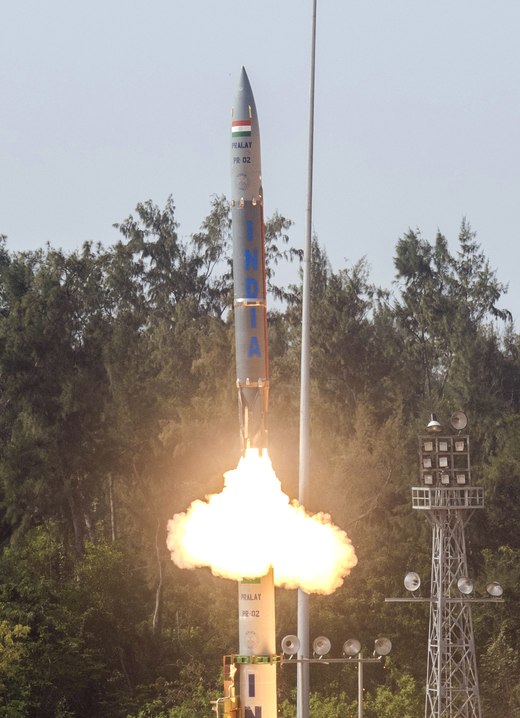
A solid-fuelled, surface-to-surface missile fired from a mobile launcher. Photo: DRDO / Ministry of Defence (file); reproduced with credit for educational use.
◈ The Basics — Ballistic, Cruise and Quasi-Ballistic
- Ballistic missile: rocket-powered only in the initial phase, then follows a high, arcing, largely predictable trajectory under gravity. Examples: Prithvi, Agni.
- Cruise missile: powered throughout flight, flies low and level like an aircraft. Example: BrahMos.
- Quasi-ballistic: follows a flatter, lower trajectory and can manoeuvre in flight, which makes it harder for missile-defence systems to track and intercept.
▤ Pralay at a Glance
- Type: surface-to-surface, solid-propellant, conventionally armed tactical missile.
- Range: reported at about 150–500 km; meant for battlefield and tactical targets.
- Lineage: draws on technologies from the Prithvi Defence Vehicle (an exo-atmospheric interceptor of India’s ballistic missile defence programme). First flight-tested in December 2021.
- Test range: the Integrated Test Range (ITR), Chandipur, tracked the flight. Abdul Kalam Island was formerly Wheeler Island and was renamed in 2015.
Significance
- Conventional deterrence: gives the forces a precision, non-nuclear long-range strike option, filling the gap between artillery rockets and strategic missiles.
- Survivability: mobile launch and manoeuvrability improve its chances against air and missile defences.
- Atmanirbharta in defence: developed with industry partners, it strengthens the indigenous missile ecosystem that began with the Integrated Guided Missile Development Programme (1983).
- Export controls: India has been a member of the Missile Technology Control Regime (MTCR) since 2016. The regime’s strictest category covers systems carrying 500 kg to 300 km or more.
✎ Mains Practice Question
How do conventionally armed tactical missiles strengthen India’s deterrence posture along its contested borders? Discuss with reference to recent indigenous missile developments. 10 marks · 150 words