
Published on May 7, 2026
Daily Current Affairs
Current Affairs 07 May 2026

Content
- When does a CM cease to hold office?
- What is Karnataka’s new gig worker grievance system?
- CJI’s role in CEC, EC appointments was temporary, pending new law: SC
- Overall crime rate drops 6%; cybercrime up by 17%: NCRB
- India to host first Big Cat Summit in June; 95 countries set to participate
- Invasive species may be the wrong enemy in a changing subcontinent
- SO₂ Emissions from Coal Power Plants
- Why SC expanded definition of ‘acid attack victim’ in Disabilities Act
When does a CM cease to hold office?
Why in News?
- Following electoral developments in West Bengal, questions have arisen regarding whether a Governor can remove a Chief Minister, bringing focus to Article 164, constitutional conventions, and judicial interpretation of executive authority in India’s parliamentary system.
Relevance
- GS Paper II (Polity)
- Governor–Council of Ministers relations (Article 164)
- Constitutional conventions vs textual provisions
- Federalism and misuse of gubernatorial discretion
- GS Paper II (Governance)
- Role of constitutional morality
- Judicial review in political processes (floor test jurisprudence)
Practice Question
- “The ‘pleasure of the Governor’ doctrine is subordinate to legislative majority in India’s parliamentary system.”Examine with reference to constitutional provisions and judicial interpretation. (250 words)
Issue in Brief
- The situation highlights tension between the textual provision of “pleasure of Governor” and the democratic principle that a Chief Minister’s legitimacy depends on majority support in the Legislative Assembly, not unilateral gubernatorial discretion.
Static Background & Basics
- Article 164(1): Chief Minister is appointed by the Governor and holds office during the “pleasure of the Governor”, but in practice this is subject to legislative majority, not personal discretion of the Governor.
- Article 172: State Legislative Assembly tenure = 5 years, after which it automatically dissolves, leading to automatic cessation of the Council of Ministers, including the Chief Minister.
- B. R. Ambedkar clarified that “pleasure doctrine” is subordinate to legislative confidence, even if not explicitly written, aligning India with parliamentary democracy norms.
Can the Governor Remove a Chief Minister?
- Despite the phrase “pleasure of the Governor”, the Governor cannot arbitrarily remove a CM who enjoys majority support in the Assembly, as per constitutional conventions and judicial precedents.
- In A.G. Perarivalan v. State (2022), the Supreme Court reaffirmed that the Governor acts on “aid and advice” of the Council of Ministers, limiting independent discretionary authority.
When Can a Chief Minister Be Removed?
- If there is doubt over majority, the Governor can order a floor test, which is the only constitutional method to verify legislative confidence.
- If the CM fails to prove majority, resignation becomes mandatory, and the Governor may invite another leader who can demonstrate majority support in the Assembly.
What Happens After Assembly Tenure Ends?
- After completion of 5-year tenure (Article 172), the Assembly stands dissolved automatically, and the Chief Minister ceases to hold office, even without formal resignation.
- The Governor initiates formation of a new Assembly, while a caretaker government may function temporarily to ensure administrative continuity.
Floor Test as Constitutional Safeguard
- The floor test ensures that determination of majority remains within the Legislative Assembly, preventing arbitrary dismissal and upholding legislative supremacy.
- It is a key mechanism to maintain constitutional stability, transparency, and democratic legitimacy, especially during political uncertainty or regime transitions.
Legal Remedies for Electoral Disputes
- Under Section 100 of Representation of the People Act 1951, election results can be challenged within 45 days on grounds such as corrupt practices, improper conduct, or statutory violations.
- Writ petitions may be filed for violation of fundamental rights or systemic issues like arbitrary voter deletion, impacting the integrity of the electoral process.
Overview
- The issue reflects the balance between constitutional text vs democratic conventions, where courts have ensured that formal powers do not override legislative majority.
- It highlights the importance of constitutional morality, ensuring institutions act with restraint and uphold democratic legitimacy over political expediency.
Challenges
- Ambiguity in “pleasure doctrine” may enable misinterpretation or politicisation, especially in fractured mandates or politically sensitive situations.
- Increasing politicisation of the Governor’s office raises concerns about federal balance, neutrality, and institutional credibility in India’s quasi-federal structure.
Way Forward
- Codify clear guidelines on gubernatorial discretion based on Sarkaria and Punchhi Commission recommendations to prevent arbitrary interpretation.
- Ensure time-bound floor tests, strengthen judicial oversight, and reinforce constitutional conventions to uphold democratic governance.
Prelims Pointers
- Article 164 → CM holds office during Governor’s pleasure (qualified by majority support).
- Article 172 → Assembly tenure = 5 years.
- Floor Test → Only valid method to prove majority.
- Section 100, RPA 1951 → Grounds for election disputes.
Mains Enrichment
Intro Options
- “In a parliamentary democracy, executive legitimacy flows from legislative confidence, not formal constitutional wording.”
- “The Governor’s role illustrates the tension between constitutional text and democratic conventions.”
Conclusion Frameworks
- “Constitutional morality ensures that power is exercised in line with democratic principles, not textual literalism.”
- “Legislative supremacy remains the cornerstone of India’s federal parliamentary system.”
What is Karnataka’s new gig worker grievance system?
Why in News?
- On May 1, 2026 (International Workers’ Day), Karnataka operationalised a government-backed grievance redressal system for platform-based gig workers, marking the first formal institutional mechanism in India integrating gig work into a statutory governance framework.
Relevance
- GS Paper II (Governance)
- Labour welfare; regulatory innovation
- Digital governance (IPGRS integration)
- State-level policy innovation
- GS Paper III (Economy)
- Gig economy; informalisation of labour
- Platform economy regulation
Practice Question
- “Gig economy has created new employment opportunities but also new vulnerabilities.”
Analyse with reference to recent regulatory initiatives. (250 words)
Issue in Brief
- Gig workers face precarious employment conditions, including arbitrary deactivation, payment issues, and lack of legal recourse, as platform grievance systems remain non-transparent and outside formal dispute resolution frameworks, necessitating State intervention and regulatory oversight.
Static Background & Basics
- The Karnataka Platform-Based Gig Workers (Social Security and Welfare) Act, 2025 provides a legal framework for gig worker protection, including welfare measures, grievance redressal, and institutional oversight.
- Gig workers fall outside traditional labour definitions, leading to exclusion from labour protections under existing laws, despite their growing share in the digital platform economy.
- The Gig Workers Welfare Board (2026) was constituted to implement schemes, regulate platforms, and ensure data-driven governance of informal digital labour.
How the Mechanism Works ?
- Complaints are filed through Integrated Public Grievance Redressal System (IPGRS), a centralised digital platform, ensuring formal recognition and traceability of grievances.
- Grievances are routed to Internal Dispute Resolution Committees (IDRCs) of platforms, which must attempt resolution within 15 days, with a maximum 45-day timeline for final order.
- Appeals can be made to the Karnataka Gig Workers Welfare Board within 30 days, creating a multi-tier quasi-judicial dispute resolution system.
Scope of Grievances
- Workers can raise issues related to account suspension, termination, payment delays, unfair penalties, discrimination, unsafe working conditions, and violations of rights under the Act.
- This expands coverage beyond contractual disputes to include labour welfare and dignity-related concerns, signalling a shift toward rights-based regulation of gig economy.
Key Policy Features
- Platforms must share worker data (Aadhaar, UAN, bank details, demographics), enabling creation of a comprehensive gig worker database for targeted welfare delivery.
- Around 12 platforms covering ~12 lakh workers have been onboarded, though duplication due to multi-platform work remains a challenge pending unique worker ID system.
- A 1% welfare fee on each transaction is mandated, creating a dedicated Gig Workers Welfare Fund for financing social security schemes.
Welfare Provisions
- Proposed benefits include life insurance, accidental cover, disability benefits, medical assistance, maternity support, and old-age protection, aligning gig workers with elements of formal social security architecture.
- Welfare schemes are being tailored based on nature of platform work, recognising heterogeneity across ride-hailing, delivery, and service-based gig sectors.
Overview
- The reform represents a shift from platform self-regulation to State-led governance, embedding gig workers within formal institutional frameworks without fully classifying them as employees.
- It strengthens digital governance and accountability, using IPGRS to bridge gaps between informal labour and formal grievance systems, enhancing transparency and enforceability.
- Economically, it balances platform flexibility with worker protection, but raises concerns over compliance costs and platform business models.
- Socially, it addresses labour precarity and asymmetry of power, improving worker dignity, bargaining capacity, and legal visibility in the gig economy.
Challenges
- Enforcement capacity constraints may limit effectiveness of grievance timelines and oversight of platform compliance.
- Data privacy concerns arise due to mandatory sharing of sensitive worker information across platforms and government systems.
- Multi-platform employment overlap complicates identification, benefits delivery, and accountability mechanisms.
- Risk of increased operational costs for platforms, potentially leading to reduced incentives or lower earnings for workers.
Way Forward
- Develop unique digital worker IDs linked with Aadhaar/UAN to eliminate duplication and improve targeted welfare delivery.
- Ensure data protection safeguards aligned with Digital Personal Data Protection framework to prevent misuse of worker information.
- Expand model nationally through central legislation or harmonised state frameworks, ensuring portability of benefits across states.
- Strengthen institutional capacity of Welfare Board, including monitoring, audits, and grievance tracking using AI-based dashboards.
Prelims Pointers
- IPGRS → Centralised grievance portal for citizens and now gig workers.
- 1% welfare fee → Levied on aggregator transactions.
- IDRC → Platform-level dispute resolution body.
- Gig Workers Welfare Board (2026) → Implements schemes.
Mains Enrichment
Intro Options
- “The gig economy represents a new frontier of labour, requiring innovative governance frameworks balancing flexibility with security.”
- “Digital labour platforms have transformed employment, but exposed workers to regulatory and social protection gaps.”
Conclusion Frameworks
- “Institutionalising gig worker rights marks a transition from platform capitalism to regulated digital labour markets.”
- “Sustainable gig economy growth requires aligning innovation with social justice and worker protection.”
CJI’s role in CEC, EC appointments was temporary, pending new law: SC
Why in News?
- The Supreme Court is hearing challenges to the Chief Election Commissioner and Election Commissioners (Appointment, Conditions of Service, and Term of Office) Act, 2023, which altered the selection committee composition, raising concerns about executive dominance in appointments.
Relevance
- GS Paper II (Polity)
- Article 324; Election Commission independence
- Separation of powers; judicial vs legislative roles
- Basic structure doctrine (free & fair elections)
Practice Question
- “The method of appointment determines the independence of constitutional bodies.”Critically examine in the context of Election Commission appointments. (250 words)
Issue in Brief
- The core issue revolves around whether the 2023 Act undermines independence of the Election Commission by removing the Chief Justice of India from the selection panel and restoring executive primacy, potentially affecting electoral neutrality.
Static Background & Basics
- Article 324(2) empowers the President to appoint CEC and ECs, subject to any law made by Parliament, indicating a legislative vacuum historically filled by executive practice.
- In Anoop Baranwal v. Union of India (2023), SC mandated a 3-member selection committee (PM, LoP, CJI) to ensure institutional independence, operative until Parliament enacts a law.
- The 2023 Act replaced CJI with a Union Cabinet Minister, effectively shifting balance toward the political executive, raising concerns over checks and balances.
Evolution of Appointment Mechanism
- Pre-2023: Appointments made by President on advice of Prime Minister, implying executive monopoly without statutory backing.
- March 2023 Judgment: Introduced judicial oversight via CJI, aligning process with CBI Director-style collegium model, ensuring neutrality.
- Post-2023 Act: Committee now comprises PM + LoP + Cabinet Minister, reintroducing executive majority (2:1) in decision-making.
Supreme Court’s Observation
- The Court clarified that CJI’s inclusion was an interim measure, not a permanent constitutional requirement, meant to address the absence of parliamentary law.
- It raised a key constitutional question: whether courts can direct Parliament to legislate in a particular manner, reinforcing separation of powers doctrine.
Overview
- The issue reflects tension between judicial innovation vs legislative supremacy, where courts fill gaps but Parliament retains final authority under Article 324(2).
- Governance-wise, independence of Election Commission is central to free and fair elections, a basic feature of the Constitution, making appointment process critical.
- The 2023 Act prioritises executive accountability over judicial participation, but risks perception of bias or politicisation in electoral oversight.
- Comparatively, institutions like CBI and Lokpal involve multi-stakeholder selection, indicating a broader trend toward institutional checks.
Challenges
- Executive dominance (2:1 majority) may compromise perceived neutrality of Election Commission.
- Absence of clear eligibility criteria and transparent selection procedures reduces accountability.
- Potential conflict with basic structure doctrine (free & fair elections) if independence is diluted.
- Lack of judicial or independent oversight weakens institutional credibility in politically sensitive elections.
Way Forward
- Introduce a balanced collegium system including judiciary, executive, and opposition to ensure institutional independence and neutrality.
- Establish transparent criteria and selection procedures, including public disclosure and scrutiny mechanisms.
- Consider constitutional or statutory safeguards ensuring security of tenure and protection from arbitrary removal.
- Strengthen parliamentary oversight and committee scrutiny to enhance accountability without undermining separation of powers.
Prelims Pointers
- Article 324(2) → Parliament can regulate appointment of CEC and ECs.
- Anoop Baranwal Case (2023) → Interim 3-member committee including CJI.
- 2023 Act → Replaced CJI with Cabinet Minister.
- Election Commission → Constitutional body ensuring free and fair elections.
Mains Enrichment
Intro Options
- “The independence of the Election Commission is foundational to India’s democratic integrity.”
- “Appointment mechanisms of constitutional bodies reflect the balance between accountability and autonomy.”
Conclusion Frameworks
- “Ensuring neutrality of electoral institutions requires balancing executive authority with institutional safeguards.”
- “A credible democracy depends not only on elections, but on the independence of the institutions that conduct them.”
Overall crime rate drops 6%; cybercrime up by 17%: NCRB
Why in News?
- National Crime Records Bureau released “Crime in India 2024”, highlighting a 6% decline in overall crime rate alongside a sharp 17.9% rise in cybercrime, signalling a structural shift in India’s crime landscape toward technology-driven offences.
Relevance
- GS Paper III (Internal Security)
- Cybercrime; economic offences
- Law enforcement capacity
- GS Paper II (Governance)
- Criminal justice system; policing reforms
Practice Question
- “India’s crime landscape is undergoing a structural shift from conventional crimes to cyber and economic offences.”Analyse with implications for internal security. (250 words)
Issue in Brief
- India’s crime profile is transitioning from conventional crimes to cyber and economic offences, while persistent challenges remain in women’s safety, child protection, and socio-economic distress, reflecting deeper governance, institutional, and developmental gaps beyond policing.
Static Background & Basics
- NCRB, under the Ministry of Home Affairs, compiles nationwide data on cognisable crimes, cyber offences, and ADSI (Accidental Deaths & Suicides), serving as the primary database for policy formulation and criminal justice planning.
- Crime rate is measured as cases per 1 lakh population, reflecting intensity rather than volume, and includes offences under IPC/BNS and Special & Local Laws, enabling comparative and trend-based analysis.
Key Data Highlights (2024)
Overall Crime Trends
- Total cognisable crimes stood at 58.86 lakh (↓ 6%), with 35.44 lakh under IPC/BNS and 23.41 lakh under special laws, indicating relative stabilisation in traditional crime categories despite population growth and reporting improvements.
- Crime rate declined to 418.9 from 448.3, suggesting moderation in crime intensity, though this may partly reflect improved enforcement, reporting practices, and classification changes rather than substantive reduction in criminal activity.
Cybercrime Surge
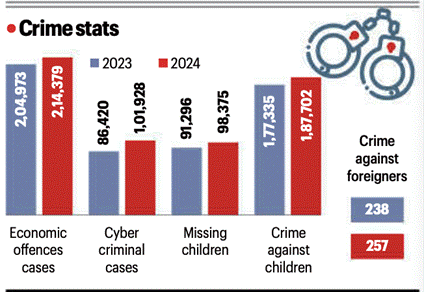
- Cybercrime cases increased to 1,01,928 (↑ 17.9%), highlighting rapid expansion of digital vulnerabilities linked to financial digitisation, internet penetration, and weak cybersecurity awareness among users and institutions.
- Fraud accounted for 72.6% (73,987 cases), followed by sexual exploitation (3.1%) and extortion (2.5%), indicating financial crimes as the dominant cyber threat with significant economic and social implications.
Economic Offences
- Economic offences rose to 2.14 lakh cases (↑ 4.6%), with forgery, cheating, and fraud constituting nearly 90%, reflecting systemic weaknesses in financial oversight, compliance enforcement, and regulatory mechanisms.
Crimes Against Women
- Crimes against women declined marginally to 4.41 lakh (↓ 1.5%), but structural concerns persist, with domestic cruelty, kidnapping, and assault remaining dominant categories.
- Delhi recorded 13,396 cases and crime rate of 176.8, the highest among metros, highlighting severe urban safety and policing challenges.
Crimes Against Children
- Crimes against children rose to 1.87 lakh, while 98,375 children went missing (↑ 7.8%), with girls forming a majority (75,603 cases), indicating heightened vulnerability to trafficking and exploitation.
- Delhi’s crime rate of 138.4 vs national average 42.3 underscores significant urban concentration and governance gaps in child protection mechanisms.
SC/ST Crime Trends
- Crimes against SCs decreased to 55,698 (↓ 3.6%), while crimes against STs declined sharply to 9,966 (↓ 23.1%), though absolute numbers remain significant, reflecting persistent social inequalities and vulnerabilities.
Crimes “Against the State”
- 5,194 cases recorded (↑ 6.6%), with 84.6% under Prevention of Damage to Public Property Act and 12.5% under UAPA, indicating rising concerns related to public order, protests, and internal security dynamics.
Suicide & Social Distress
- Total suicides reached 1,70,746, with daily wage workers accounting for ~31%, followed by unemployed (14,778), students (14,488), and homemakers (22,113), highlighting socio-economic stress and mental health challenges.
- Agriculture-related suicides stood at 10,546 (6.2%), indicating continued distress in rural livelihoods despite policy interventions.
Drug Overdose Deaths
- Drug overdose deaths increased sharply to 978 (↑ 50%) from 650 in 2023, reflecting growing substance abuse challenges linked to urbanisation, unemployment, and weak rehabilitation frameworks.
- Highest fatalities reported in Tamil Nadu (313 cases), followed by Punjab, Madhya Pradesh, Rajasthan, and Mizoram, indicating regional concentration.
Overview
- The data indicates a structural transformation toward digital and economic crimes, requiring a shift from traditional policing to technology-driven law enforcement and cyber governance frameworks.
- Persistent high crime rates in urban centres reflect urbanisation pressures, inequality, and governance deficits, while rural distress is evident through suicides and economic vulnerability indicators.
- Declining trends in some categories may reflect improved reporting and legal awareness, but underlying socio-economic and institutional challenges continue to shape crime patterns.
Challenges
- Limited cyber policing capacity, including shortage of trained personnel and advanced forensic infrastructure, constrains effective response to rising digital crimes.
- Underreporting and data inconsistencies reduce accuracy of crime statistics, particularly in gender and caste-based crimes.
- Weak inter-state coordination hampers tackling organised and cybercrime networks operating across jurisdictions.
- Rising mental health issues and socio-economic stress remain inadequately addressed within governance frameworks.
Way Forward
- Strengthen cybercrime infrastructure, including specialised police units, digital forensics labs, and AI-based monitoring systems for proactive crime detection.
- Integrate mental health services with social welfare and employment policies to address root causes of suicides and substance abuse.
- Enhance urban policing reforms, focusing on community policing, gender-sensitive approaches, and smart surveillance systems.
- Develop integrated real-time crime databases for predictive policing and better inter-agency coordination across states.
Prelims Pointers
- NCRB functions under Ministry of Home Affairs.
- Crime rate measured per lakh population.
- Cybercrime dominated by fraud (72.6%).
- ADSI report includes suicides and accidental deaths.
Mains Enrichment
Intro Options
- “India’s crime profile reflects a transition toward digital-era vulnerabilities alongside persistent socio-economic challenges.”
- “Crime data serves as a mirror to both governance capacity and societal stress.”
Conclusion Frameworks
- “Addressing crime requires a multi-dimensional approach integrating policing, technology, and social policy.”
- “Future-ready governance must prioritise digital security, social resilience, and institutional capacity building.”
India to host first Big Cat Summit in June; 95 countries set to participate
Why in News?
- India will host the first IBCA Summit (June 1–3, 2026, New Delhi), expected to adopt the “Delhi Declaration”, marking the first global framework dedicated exclusively to big cat conservation with participation from ~95 countries.
Relevance
- GS Paper III (Environment)
- Biodiversity conservation; flagship species
- GS Paper II (IR)
- Environmental diplomacy; global governance
Practice Question
- “Conservation of apex predators is critical for ecosystem stability and climate resilience.”Discuss in the context of IBCA. (250 words)
Issue in Brief
- Big cat species face habitat loss, poaching, human-wildlife conflict, and climate change pressures, necessitating transboundary, landscape-level conservation approaches beyond national boundaries through coordinated global action.
Static Background & Basics
- IBCA (launched 2023) is an inter-governmental platform initiated by India to conserve seven big cats—lion, tiger, leopard, snow leopard, cheetah, jaguar, puma—across their global range.
- Big cats are apex predators, maintaining trophic balance, biodiversity stability, and ecosystem resilience, making them keystone species in terrestrial ecosystems.
- India hosts 4 of the 7 big cats (tiger, lion, leopard, snow leopard) and plays a leading role in global conservation through programmes like Project Tiger (1973) and Project Lion.
Key Features of IBCA Summit
- Adoption of “Delhi Declaration” to define shared priorities, conservation targets, and global cooperation mechanisms for big cat protection across ecosystems.
- Participation of Heads of State, policymakers, scientists, multilateral agencies, reflecting a multi-stakeholder global conservation governance model.
- Theme: “Save Big Cats, Save Humanity, Save Ecosystem”, linking conservation with climate resilience, biodiversity protection, and sustainable development.
Institutional Architecture
- IBCA includes 24 member countries, 3 observer countries, and multiple range countries, facilitating knowledge sharing, capacity building, and coordinated conservation strategies.
- Focus areas include habitat conservation, prey base restoration, anti-poaching measures, research, innovation, and financing mechanisms for conservation.
India’s Role in Big Cat Conservation (Key Data)
- India hosts ~75% of global tiger population (~3,167 as per 2022 assessment), making it the largest stronghold of wild tigers globally.
- Asiatic lions (~674) are confined to Gir landscape, reflecting both success and vulnerability of single-population conservation model.
- Leopard population (~13,874) shows wide distribution but faces rising human-wildlife conflict.
- India reintroduced cheetahs (2022) under Project Cheetah, marking world’s first intercontinental large carnivore translocation.
Overview
- The summit represents environmental diplomacy, positioning India as a global leader in biodiversity governance and South-South cooperation.
- Conservation is linked to economic benefits through eco-tourism, livelihoods, and ecosystem services, aligning with SDGs (13, 15).
- Landscape-based approach recognises that wildlife corridors transcend political borders, requiring regional cooperation (e.g., India-Nepal, India-Bhutan).
- IBCA also addresses climate change mitigation, as big cat habitats (forests, grasslands) act as carbon sinks and biodiversity hotspots.
Challenges
- Habitat fragmentation due to infrastructure and land-use change disrupts migration corridors.
- Rising human-wildlife conflict, especially in buffer zones, threatens both communities and wildlife.
- Poaching and illegal wildlife trade networks remain persistent despite enforcement mechanisms.
- Limited financial resources and capacity in developing countries constrain conservation efforts.
Way Forward
- Promote transboundary conservation corridors and regional cooperation agreements for habitat connectivity.
- Strengthen community-based conservation models, ensuring livelihood support and reducing conflict.
- Leverage technology (AI, drones, satellite tracking) for monitoring and anti-poaching operations.
- Establish global conservation financing mechanisms under IBCA for sustainable funding.
Prelims Pointers
- IBCA launched in 2023, headquartered in India.
- Covers 7 big cats globally.
- India hosts 4 big cats.
- Project Tiger (1973) → flagship conservation programme.
Mains Enrichment
Intro Options
- “Big cat conservation reflects the health of entire ecosystems, making it central to global biodiversity governance.”
- “India’s leadership in IBCA marks a shift toward collaborative environmental diplomacy.”
Conclusion Frameworks
- “Conserving apex predators is essential for sustaining ecological balance and climate resilience.”
- “Global biodiversity challenges require collective action beyond national boundaries, as exemplified by IBCA.”
Invasive species may be the wrong enemy in a changing subcontinent
Why in News?
- Intensifying State-led eradication drives and judicial scrutiny against IAS like Prosopis juliflora and Lantana camara have triggered debate on whether species removal alone ensures ecological restoration, or whether deeper structural ecological drivers must be addressed.
Relevance
- GS Paper III (Environment)
- Biodiversity; ecosystem restoration
- Land-use change and ecological degradation
Practice Question
- “Invasive species are often symptoms of deeper ecological imbalances rather than the primary problem.”Critically examine. (250 words)
Issue in Brief
- Policy focus on large-scale removal of invasive species assumes automatic ecological recovery, but evidence suggests IAS proliferation is driven by land-use change, grazing pressure, climate shifts, and nutrient enrichment, making current approaches partial and potentially ineffective.
Static Background & Basics
- Invasive Alien Species (IAS) are non-native organisms that spread aggressively, outcompeting native biodiversity, altering nutrient cycles, and disrupting ecosystem balance, often in already disturbed environments.
- Key IAS in India include Prosopis juliflora (introduced 1877), Lantana camara, and Senna spectabilis, which thrive under disturbance-tolerant conditions such as degraded forests, altered soils, and high grazing intensity.
- IAS governance aligns with Biological Diversity Act, 2002 and international commitments under the Convention on Biological Diversity (CBD), focusing on prevention, control, and ecosystem restoration.
Overview
- India’s ~500 million livestock population exerts sustained grazing pressure on forests and commons, selectively eliminating palatable native species, while enabling thorny, chemically defended IAS to dominate and restructure vegetation patterns.
- Historical transformations through colonial forestry, plantation expansion, mining, and infrastructure development degraded ecosystems before IAS spread, indicating invasions are consequences of prior ecological simplification and fragmentation.
- Post-Green Revolution changes—irrigation expansion, waterlogging, aquifer stress, fertiliser use—altered soil chemistry and hydrology, creating niches where species like Prosopis juliflora could rapidly proliferate.
- India’s use of 35–40 million tonnes of urea annually and atmospheric nitrogen deposition of 10–30 kg/ha enrich soils, favouring fast-growing, nitrogen-fixing invasive species over native flora adapted to low-nutrient conditions.
- Rapid urbanisation has doubled India’s urban footprint in three decades, creating fragmented, disturbed landscapes that extend into rural ecosystems, accelerating IAS spread through edge effects and ecological instability.
- IAS often act as ecological “first responders”, stabilising degraded soils, storing carbon, and enabling initial succession, suggesting that their role is complex and not purely destructive in altered ecosystems.
- Removal efforts without restoring ecological processes often create vacant niches, leading to re-invasion or colonisation by other invasive species, reflecting limitations of species-centric conservation strategies.
Challenges
- Treating IAS as the primary ecological problem rather than a symptom of deeper land-use, climatic, and anthropogenic changes leads to policy misdirection and ineffective long-term restoration outcomes.
- Large-scale mechanical removal programmes often prioritise visible outputs (area cleared) over ecological recovery, lacking evidence of sustained biodiversity restoration or ecosystem stability post-intervention.
- Economic incentives linked to biomass extraction and contracts risk commercialising eradication, diverting conservation focus from ecological integrity to short-term economic gains.
- Weak integration of local ecological knowledge and community participation reduces effectiveness, as restoration requires site-specific understanding of ecosystems, species interactions, and livelihood dependencies.
Way Forward
- Shift towards ecosystem-based restoration approaches, addressing root causes such as soil degradation, altered hydrology, grazing intensity, and nutrient imbalances rather than focusing solely on species removal.
- Promote landscape-level planning integrating forests, agriculture, and commons to ensure ecological connectivity, resilience, and sustainable coexistence between human activity and biodiversity conservation.
- Implement controlled grazing and livestock management strategies to reduce pressure on native vegetation and allow regeneration of ecologically valuable species.
- Adopt phased and site-specific removal strategies combined with assisted natural regeneration and native species reintroduction, ensuring ecological succession pathways are restored.
- Strengthen community-led conservation models, aligning ecological restoration with livelihoods, traditional knowledge, and long-term stewardship to ensure sustainable and adaptive ecosystem management.
Prelims Pointers
- IAS are regulated under Biological Diversity Act, 2002 and global frameworks like CBD.
- Prosopis juliflora introduced in 1877 in India.
- High nitrogen input → favours invasive nitrogen-fixing species over native flora.
Mains Enrichment
Intro Options
- “Invasive species often reflect deeper ecological imbalances rather than isolated biological threats.”
- “India’s IAS challenge highlights the need to move beyond species removal towards systemic ecological restoration.”
Conclusion Frameworks
- “Effective conservation must address underlying ecological processes, not just visible manifestations like invasive species.”
- “Sustainable restoration lies in integrating ecological science with community participation and long-term landscape management.”
SO₂ Emissions from Coal Power Plants
Why in News?
- A recent study by IIT Delhi (published in Nature) estimates that full mitigation of SO₂ emissions from coal-fired power plants could prevent 1,24,564 deaths annually in India, highlighting major health and policy implications.
Relevance
- GS Paper III (Environment)
- Air pollution; emission norms
- Energy–environment trade-offs
- GS Paper II (Governance)
- Public health policy
Practice Question
- “Air pollution control requires integration of environmental regulation with public health priorities.”Analyse with reference to SO₂ emissions from coal power plants. (250 words)
Issue in Brief
- Coal-fired power plants (CFPPs) remain a dominant energy source but emit significant SO₂, contributing to secondary PM2.5 pollution, leading to high disease burden, regulatory debates, and uneven implementation of emission norms.
Static Background & Basics
- SO₂ (Sulphur Dioxide) is a major pollutant released from burning coal; it forms secondary aerosols (sulphates, nitrates, ammonium) that significantly contribute to PM2.5 pollution and associated health risks.
- Flue Gas Desulphurisation (FGD) is a key emission-control technology that removes SO₂ from exhaust gases, mandated under India’s 2015 emission norms issued by Ministry of Environment, Forest and Climate Change.
- Global Burden of Disease (GBD) framework is used to estimate health impacts of air pollution, linking exposure to cardiovascular and respiratory mortality across populations.
Overview
- India’s SO₂ emissions increased from 2.36 to 5.05 thousand kilotonnes (2005–2021) with further ~30% rise in 2023, contrasting with global decline, reflecting heavy dependence on coal-based energy.
- SO₂ contributes indirectly by forming secondary PM2.5, increasing exposure by 0.3–12 µg/m³, thus amplifying health impacts beyond direct gaseous pollution, especially during winter pollution episodes.
- Full mitigation could prevent 14,777 cardiovascular and 8,476 respiratory deaths annually, highlighting strong public health co-benefits of emission control policies.
- Regional disparities: Maharashtra, Tamil Nadu, Karnataka show highest avoidable mortality due to population exposure, while Chhattisgarh and Odisha show maximum air quality gains due to concentration of coal plants.
- Study highlights environmental inequality—benefits disproportionately accrue to SC/ST, OBC, and lower-income groups, who face higher exposure and vulnerability, linking air pollution to social justice concerns.
- Policy reversal in 2025 (FGD exemption for ~79% plants) reflects tension between economic cost considerations vs public health benefits, despite evidence that health gains outweigh compliance costs.
- Implementation gaps: emission norms remain slow, localised, uneven, undermining effectiveness of regulatory framework and delaying transition toward cleaner energy systems.
Challenges
- Regulatory dilution (2025 relaxation) weakens enforcement of emission norms, reducing incentives for adoption of FGD and undermining long-term air quality improvements despite strong scientific evidence.
- High capital cost of FGD installation and financial stress of DISCOMs and power producers create resistance, particularly given India’s reliance on low-sulphur but high-volume coal usage.
- Fragmented governance and weak monitoring lead to uneven compliance across states, with pollution hotspots persisting despite national standards.
- Lack of integration between energy policy and public health planning results in underestimation of health costs in decision-making.
Way Forward
- Ensure strict enforcement of 2015 emission norms, reversing dilution measures and mandating FGD installation in all high-emission CFPPs, especially in densely populated and polluted regions.
- Promote cost-benefit-based policymaking, incorporating health economics to demonstrate that mortality reduction and productivity gains outweigh compliance costs.
- Develop domestic manufacturing and technological capacity for pollution-control systems to reduce costs and improve scalability of FGD adoption.
- Prioritise pollution hotspot regions through targeted interventions, integrating satellite monitoring, real-time emission tracking, and stricter compliance mechanisms.
- Complement SO₂ mitigation with broader measures such as clean energy transition, EV adoption, and reduced biomass burning, ensuring holistic air quality improvement.
Prelims Pointers
- SO₂ → precursor of secondary PM2.5 (sulphates, nitrates, ammonium).
- FGD technology removes sulphur dioxide from power plant emissions.
- India’s SO₂ emissions increased (2005–2023) unlike global declining trend.
Mains Enrichment
Intro Options
- “Air pollution control in India increasingly demands integration of energy policy with public health outcomes.”
- “Coal-based growth has imposed hidden health costs through pollutants like SO₂ and secondary particulates.”
Conclusion Frameworks
- “Balancing energy security with environmental health requires evidence-based, equitable policy interventions.”
- “Effective air quality governance must internalise health externalities and prioritise vulnerable populations.”
Why SC expanded definition of ‘acid attack victim’ in Disabilities Act
Why in News?
- Recently , The Supreme Court of India expanded the definition of acid attack victims under the Rights of Persons with Disabilities Act, 2016 to include victims of forced acid ingestion, ensuring access to disability rights and welfare benefits.
Relevance
- GS Paper II (Polity)
- Fundamental Rights (Article 14)
- Judicial activism; welfare legislation
- GS Paper IV (Ethics)
- Dignity; substantive equality
Practice Question
- “Judicial interpretation plays a crucial role in advancing substantive equality in welfare legislation.”Examine in the context of acid attack victims. (250 words)
Issue in Brief
- The existing law restricted recognition to externally “disfigured” victims, excluding those with severe internal injuries, thereby denying them disability certificates, compensation, and rehabilitation support, raising concerns of legal inconsistency and exclusion.
Static Background & Basics
- The Rights of Persons with Disabilities Act, 2016 includes acid attack survivors as a specified disability, enabling access to reservation, compensation, and rehabilitation schemes through disability certification.
- Under Schedule 2(zc), an acid attack victim was defined as one “disfigured due to acid attack”, implicitly limiting coverage to visible external injuries, excluding internal damage cases.
- Criminal law under Bharatiya Nyaya Sanhita, 2024 treats acid throwing and acid ingestion as equivalent offences, highlighting inconsistency between penal and welfare frameworks.
Overview
- The Court recognised that forced ingestion of acid causes severe internal injuries—burns to the oesophagus, stomach, and digestive system, often leading to lifelong medical complications, thereby qualifying as disability despite absence of visible scars.
- By expanding the definition, the Court aligned the Act with Article 14 (Right to Equality), removing arbitrary classification based on method of attack, and focusing on extent of harm and disability impact.
- The judgment ensures retrospective applicability, meaning previously excluded victims can now claim benefits, strengthening substantive justice and welfare access.
- The ruling addresses legal incoherence, where criminal law recognises equal severity of both forms of attack, but welfare law previously denied equal protection.
- The Court flagged rising acid attack cases and weak deterrence, suggesting stricter measures such as shifting burden of proof and liability of acid sellers, indicating gaps in enforcement.
Challenges
- Narrow statutory drafting led to exclusion of a vulnerable category, reflecting lack of comprehensive disability assessment frameworks in welfare legislation.
- Implementation gaps persist in granting disability certificates, compensation, and rehabilitation, even for recognised victims, due to bureaucratic delays and lack of awareness.
- Weak regulation of acid sale and inadequate enforcement of existing laws reduce deterrence against acid-related crimes, contributing to continued incidence.
- Large pendency of cases (e.g., UP 198, WB 160) indicates systemic delays, undermining timely justice and rehabilitation.
Way Forward
- Amend statutory definitions in disability laws to adopt a harm-based and functional disability approach, rather than relying on visible physical indicators like disfigurement.
- Strengthen institutional mechanisms for certification and rehabilitation, ensuring time-bound delivery of compensation, healthcare, and social security benefits.
- Tighten regulation of acid sale, enforce licensing norms, tracking mechanisms, and accountability of vendors to prevent misuse.
- Expedite trials through fast-track courts and judicial monitoring, ensuring timely justice and deterrence.
- Integrate victim support systems with healthcare, legal aid, and psychosocial rehabilitation, ensuring holistic recovery and dignity.
Prelims Pointers
- RPwD Act, 2016 → includes acid attack victims as disability category.
- Definition earlier limited to “disfigurement” → now expanded judicially.
- BNS 2024 treats acid throwing and ingestion equally as offences.
Mains Enrichment
Intro Options
- “Judicial interpretation plays a crucial role in expanding the scope of welfare legislation to ensure substantive equality.”
- “Disability law must evolve to reflect the lived realities of victims beyond visible physical harm.”
Conclusion Frameworks
- “Inclusive legal frameworks must prioritise impact over form to uphold dignity and equality.”
- “Bridging gaps between criminal law and welfare law is essential for a coherent justice system.”