

In-Depth News Analysis8 Items
Core TopicImportantConcise
Polity & GovernanceGS Paper II
01Forest Rights Act & Gram Sabha Consent Dispute
International RelationsGS Paper II
02Yarlung Zangbo Mega Dam & Transboundary River Concerns03SCO Bishkek Summit — 25 Years of the Grouping04AYUSH in India's Health & Trade Diplomacy
Environment & EcologyGS Paper III
05Striped Hyenas — Conservation Status & Ecological Role06Dragonflies as Ecological Indicators07Bhutan Eliminates Dog-Transmitted Rabies08Rajghat Excavation — Kashi's Ancient Urban Settlement
Polity & GovernanceGeneral Studies Paper II
01
No Provision in Forest Rights Act to Obtain Gram Sabha Consent for Projects: Ministry of Tribal Affairs
GS-II · Governance — Statutory Bodies, Centre–State/Inter-Ministerial CoordinationPrelims + MainsThe Hindu · The Indian Express
A jurisdictional stand-off between the Ministry of Tribal Affairs and the Power Ministry over "gram sabha consent" for forest clearance has surfaced a genuine gap between what the Forest Rights Act says and how it is administratively implemented — with major hydropower projects like Teesta-IV stalled as a result.
◈ Background & Context
The Ministry of Tribal Affairs told the Power Ministry's NHPC desk on 31 August that the Scheduled Tribes and Other Traditional Forest Dwellers (Recognition of Forest Rights) Act, 2006 (FRA) has "no provision" for obtaining gram sabha consent for Stage-II forest clearance, and that such matters therefore do not fall under its purview — despite the FRA naming it as the nodal ministry for the law's implementation.
Legally, the FRA's text does not use the phrase "gram sabha consent" for diverting forest land.
But the Forest Conservation Act, 1980 rules require all FRA processes — identifying claimants, recognising and vesting their rights, then securing a no-objection certificate (NOC) from the gram sabhas concerned — to be completed before forest diversion can be formally certified.
This NOC process is what has come to be known, in practice, as "gram sabha consent."
What triggered the dispute
- A Parliamentary Standing Committee on Public Undertakings report (3 August, chaired by BJP MP Baijayanta Panda) on NHPC Limited found the average forest-clearance time for under-construction projects to be 106 months.
- The committee identified the gram sabha consent requirement as the "single most critical bottleneck" — citing the Teesta-IV Hydro-Electric Project as indefinitely stalled over pending consent from a small minority of Gram Panchayats.
- NHPC's own recommendation, endorsed by the committee: replace unanimous consent with a "qualified super-majority" — 70–75% of affected gram sabhas — for hydropower projects of national importance.
- The Power Ministry was accordingly asked to discuss this proposal's feasibility with the Ministry of Tribal Affairs — whose reply effectively disclaimed jurisdiction over the very question.
Figure 1 — Where "gram sabha consent" actually sits in the forest-clearance process
Identify FRAclaimantsRecognise &vest rightsGram sabha NOC("consent") —disputed jurisdiction100% vs 70–75%DiversioncertificateThe dispute: who owns the NOC stage?Ministry of Tribal Affairs — nodal ministry for FRA under law,but disclaims role in "such matters" of consentPower Ministry / NHPC — seeks a lower consent thresholdto unblock stalled hydropower projects like Teesta-IV
The FRA's text is silent on "consent," but the Forest Conservation Act rules effectively make the gram sabha NOC a mandatory gate — the exact stage now caught in an inter-ministerial jurisdictional dispute.
▤ Facts worth remembering
- Nodal ministry for FRA: Ministry of Tribal Affairs (by statute).
- Governing laws: FRA, 2006 (rights recognition) + Forest Conservation Act, 1980 and its rules (clearance procedure).
- Average clearance time (under-construction NHPC projects): 106 months, per the Standing Committee report.
- NHPC's proposed fix: "qualified super-majority" consent of 70–75% of affected gram sabhas, instead of the current de facto 100% requirement.
- Precedent pattern: the Ministry has taken a similar "no role" position in other cases, including the Great Nicobar mega-infrastructure project and FRA implementation disputes in Madhya Pradesh and Karnataka.
The critical view
- Accountability vacuum: if the nodal ministry disclaims responsibility for the consent stage, no Union body is left clearly accountable for resolving genuine grievances of forest-dwelling communities at that stage.
- Dilution risk: a shift to a 70–75% super-majority threshold would let large infrastructure projects proceed over the objection of a substantial minority of directly affected gram sabhas — a real tension between "ease of clearance" and the FRA's rights-based design.
- Precedent of the Act's intent: the FRA was itself enacted (2006) to correct historical injustice from decades of forest-dwellers' rights being overridden without consultation; recurring calls to dilute the consent stage risk re-creating the very problem the law addressed.
Terms to know
- Stage-I / Stage-II forest clearance — in-principle and final approval stages under the Forest Conservation Act for diverting forest land to non-forest use.
- Gram sabha — the village assembly of all adult residents of a revenue village; distinct from the elected gram panchayat.
- No-Objection Certificate (NOC) — the gram sabha's formal clearance that FRA processes are complete, required before forest diversion.
✎ Mains Practice Question
The Forest Rights Act, 2006 does not explicitly mandate "gram sabha consent," yet it has become a de facto requirement in forest-clearance procedure. Discuss the implications of diluting this requirement for a "qualified super-majority" in the context of balancing infrastructure development with tribal rights. 15 marks · 250 words
International RelationsGeneral Studies Paper II
02
Glacial Collapse Unlikely to Halt China's Mega Dam on the Yarlung Zangbo (Brahmaputra)
GS-II · IR — India–China Relations, Transboundary RiversPrelims + MainsThe Hindu
China is proceeding with construction of what it calls the "project of the century" — a mega hydropower dam on the lower Yarlung Zangbo in a seismically active stretch of Tibet near the Indian border — despite fresh concerns raised by a devastating glacial-lake collapse on the Nepal–China border.
◈ Background & Context
The Yarlung Zangbo Lower Reaches Hydropower Project was included in China's 15th Five-Year Plan for renewable energy, released on 23 July — a month before the 26 August glacial-lake outburst flood and mudslides that renewed downstream safety concerns.
Construction began at a groundbreaking ceremony in July 2025, led by Premier Li Qiang, with a total announced investment of 1.2 trillion Yuan (roughly ₹14 lakh crore) for five power stations. A new State-run entity, the China Yajiang Group, has been set up to run the project.
Figure 2 — The Yarlung Zangbo/Brahmaputra's course from Tibet into India
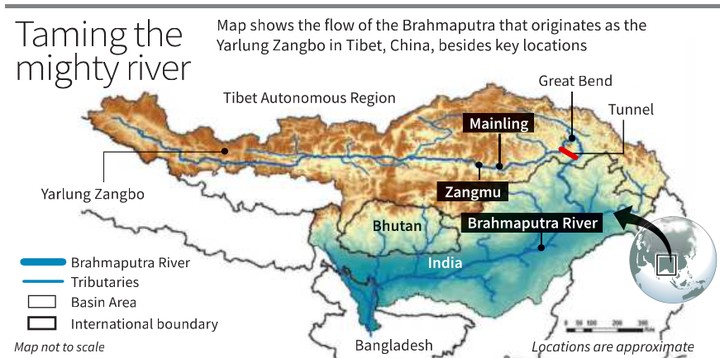
The dam site sits near the river's "Great Bend," just before it drops sharply in elevation and enters Arunachal Pradesh as the Siang/Brahmaputra. Map courtesy source newspaper graphic; reproduced with credit for educational use.
Why India is watching closely
- The project sits in a seismically active zone near the India border, on a river that becomes the Siang/Brahmaputra on entering Arunachal Pradesh and later Assam — a lifeline river for both agriculture and flood management in India's Northeast.
- Key unknowns for India: how much water the reservoir will store, how the associated tunnel will affect downstream flows, and the project's broader ecological footprint — compounded by a persistent lack of public information from Beijing.
- China's Vice Premier Zhang Guoqing visited Nyingchi, near the border, in April, stressing "quality first, safety as the foundation" and strict adherence to construction and ecological-protection standards — assurances India cannot independently verify given the information gap.
The critical view
- No binding water-sharing treaty: unlike the Indus Waters Treaty with Pakistan, India and China have no treaty governing the Brahmaputra's waters — cooperation rests on non-binding data-sharing MoUs, last renewed periodically and vulnerable to suspension during periods of tension.
- Seismic risk compounding downstream risk: the region's seismic activity, combined with the recent glacial-lake collapse on the Nepal-China border, raises the stakes of any future dam-related mishap for downstream Arunachal Pradesh and Assam.
- Strategic leverage concern: upstream control over a shared river's flow is a long-standing strategic-vulnerability concern for India, independent of whether current Chinese assurances on ecological safeguards hold.
Terms to know
- Yarlung Zangbo — the Tibetan name for the river that becomes the Siang in Arunachal Pradesh and the Brahmaputra in Assam.
- Glacial Lake Outburst Flood (GLOF) — a sudden release of water from a glacier-dammed or moraine-dammed lake, a growing Himalayan hazard linked to glacial retreat.
- 15th Five-Year Plan — China's current national economic plan (2026–2030 cycle), under which this project is formally listed.
✎ Mains Practice Question
Examine the strategic and ecological concerns for India arising from China's upstream hydropower projects on the Yarlung Zangbo. In the absence of a bilateral water-sharing treaty, what mechanisms are available to India to safeguard its interests? 15 marks · 250 words
03
SCO's 26th Summit at Bishkek Marks 25 Years of the Grouping
GS-II · IR — International Groupings and AgreementsPrelims + MainsThe Hindu
The Shanghai Cooperation Organisation's 26th summit at Bishkek, Kyrgyz Republic (31 August–1 September), marked 25 years since the grouping's founding and was the first SCO summit since the U.S.–Israel military action against Iran that killed Supreme Leader Ayatollah Ali Khamenei.
◈ Background & Context
The SCO was launched on 15 June 2001 by the "Shanghai Five" — China, Russia, Kazakhstan, the Kyrgyz Republic and Tajikistan. India and Pakistan joined as full members in 2017. The grouping now runs 29 charter bodies, including the Council of Heads of State, the Council of Heads of Government, and over 40 working mechanisms.
Key outcomes of the Bishkek Declaration
- Expressed "deep concern," condemned the military strikes on Iran, reaffirmed support for Iran's "sovereignty and territorial integrity," and criticised the U.S. and Israel for violating international law and the UN Charter.
- Condoled the assassination of Ayatollah Khamenei and welcomed the multi-country-mediated peace process (including SCO member Pakistan).
- Advocated members' "inalienable right" to develop atomic energy for peaceful purposes — an indirect signal of support for Iran in its nuclear negotiations with the U.S.
- Asserted that lasting West Asian stability requires a "just settlement" of the Palestine question.
- Flagged the "unilateral and unlimited build-up of global missile defence systems" as destabilising, and termed unauthorised satellite internet services on member states' territory a violation of international law (widely read as a reference to Starlink's presence in eastern Ukraine and Iran).
- Called for an "inclusive government" in Afghanistan; announced steps toward an SCO Development Bank and continued advocacy for greater use of local currencies in trade.
- Included strong language "strongly condemning" terrorism, separatism and extremism.
India's diplomatic engagement
- PM Modi called for "no double standards" in fighting terrorism and urged peace and stability in Afghanistan, citing India's continued relief-material supply to Taliban-controlled Afghanistan.
- He spoke in favour of greater connectivity between SCO members' markets "while respecting sovereignty and territorial integrity" — read as an implicit reference to India's objection to the China–Pakistan Economic Corridor (CPEC), which runs through Pakistan-occupied Kashmir.
- India stayed away from endorsing China's Belt and Road Initiative (BRI), even as other member states supported it and called for BRI–Eurasian Economic Union alignment — a point of visible dissonance within the grouping.
- The SCO has also served India's China outreach: the 2024 Kazan Summit began re-engagement after the Galwan setback, followed by a Tianjin meeting (2025) where both sides agreed on an "Early Harvest" proposal on boundary delimitation and resumed border trade through three points — notable given continuing strain from Operation Sindoor (May 2025).
▤ Facts worth remembering
- Founded: 15 June 2001, Shanghai — by China, Russia, Kazakhstan, Kyrgyz Republic, Tajikistan.
- India & Pakistan: joined as full members in 2017.
- Charter bodies: 29, including Council of Heads of State/Government, Council of National Coordinators.
- 2026 summit: 26th summit, Bishkek, Kyrgyz Republic, 31 August–1 September.
- Next chair: Pakistan, which will host the next SCO summit.
- No collective-defence component — unlike NATO; the SCO functions primarily as a political, security and economic dialogue platform.
The critical view
- Internal dissonance: India's non-endorsement of BRI amid broader member support for BRI–EAEU alignment underlines that SCO consensus often papers over real strategic divergence among members.
- Pakistan's incoming chairship raises an unresolved question of whether India will attend the next summit at the head-of-government/state level, given post-Pahalgam, post-Sindoar strain and India's suspension of the Indus Waters Treaty.
- The SCO's continuing utility for India lies less in binding outcomes and more in providing a structured venue for engaging China and Russia multilaterally amid an unsettled India-U.S. tariff relationship.
✎ Mains Practice Question
"The Shanghai Cooperation Organisation offers India a platform for engagement more than a mechanism for binding outcomes." Discuss with reference to India's objectives at the SCO amid its evolving relations with China and Pakistan. 15 marks · 250 words
04
Yoga and Ayurveda Become Part of India's Global Health Diplomacy
GS-II · IR — Bilateral/Trade Agreements, Health DiplomacyPrelims + MainsThe Hindu
AYUSH has moved from a wellness-sector identity to a formal strand of India's trade diplomacy, with recent Free Trade Agreements building in dedicated provisions for practitioner mobility, standards and market access.
◈ Background & Context
The India–Oman Comprehensive Economic Partnership Agreement (CEPA), operationalised in June 2026, contains what the government calls its first comprehensive commitment on traditional medicine across all modes of supply.
The India–New Zealand FTA has a dedicated "health and traditional medicine" annex, including a visa quota for AYUSH practitioners.
The India–EU FTA, signed in January 2026, goes further — allowing AYUSH practitioners to use Indian qualifications in EU states with no existing regulatory framework, and providing for AYUSH wellness centres and clinics abroad.
▤ Facts worth remembering
- AYUSH visa: introduced 2023; 3,375 foreign nationals travelled on AYUSH/e-AYUSH visas (Jan 2023–Dec 2025), plus 579 on attendant visas.
- Earlier data: 1,646 AYUSH visas issued to nationals of 75 countries (Jan 2024–Feb 2025).
- Foreign medical arrivals (overall, not AYUSH-specific): rose from 1.83 lakh (2020) to 6.44 lakh (2024).
- AYUSH Fellowship Scheme: 260 students from 32 countries studying AYUSH in Indian institutions.
- Key source markets cited: Bangladesh, Nepal, Sri Lanka, UAE, US, Germany, Russia, Malaysia, Mauritius, Saudi Arabia.
The critical view
- Data gap: the government does not publish a consolidated, AYUSH-specific patient count — the widely cited 6.44 lakh figure is for overall foreign medical arrivals, making it difficult to assess AYUSH's actual share of India's medical-value-travel market.
- Standards question: experts cited in the report stress that formal trade recognition will not translate into real international demand without credible standards, regulation and practitioner-quality assurance in destination markets.
✎ Mains Practice Question
Discuss the significance of incorporating AYUSH provisions into India's Free Trade Agreements. What challenges must be addressed for AYUSH to gain credibility in regulated global healthcare markets? 10 marks · 150 words
Environment & EcologyGeneral Studies Paper III
05
Striped Hyenas Help Keep India Clean, But Remain Misunderstood
GS-III · Environment — Species ConservationPrelims + MainsThe Hindu · Opinion (Prarthana Sen)
Despite enjoying the highest legal protection under India's wildlife law, the striped hyena — a keystone scavenger and one of the country's least-studied carnivores — lacks a unified national conservation plan.
Figure 3 — Indian striped hyena (Hyaena hyaena)
Representative image.
▤ Facts worth remembering
- Global population estimate: 5,000–14,000; India's share: 1,000–3,000 — possibly the largest national population anywhere, though India lacks an official census.
- Legal status: highest protection category under the Wildlife (Protection) Act, 1972.
- State-level efforts cited: West Bengal's Wildlife Information and Nature Guide Society (awareness drives, Wildlife Trust of India-funded); Tamil Nadu's ₹14 lakh allocation for lesser-known endangered species including the striped hyena.
- No national action plan currently unites these fragmented State-level efforts.
Why the hyena matters ecologically
- As an obligate/facultative scavenger of carrion, it removes decaying meat — a hotbed of pathogens — functioning as a natural public-health agent; its decline risks destabilising local ecosystems.
- Cultural beliefs (e.g., hyenas as "mounts of witches" in some folklore, per Wildlife SOS) actively hamper conservation efforts and awareness-building.
The critical view
- Inadequate population and distribution data is the core roadblock — without it, safe havens cannot be scientifically identified; the animal's shy, nocturnal, elusive nature makes standard census methods difficult to apply.
- The piece points to India's successful nationwide snow leopard population assessment as proof that a similarly ambitious hyena census is technically feasible if prioritised.
✎ Mains Practice Question
Despite enjoying the highest legal protection, several lesser-known Indian species like the striped hyena lack a coordinated national conservation strategy. Discuss the challenges in mainstreaming conservation for such "unglamorous" species. 10 marks · 150 words
06
Dragonflies Are Bellwethers of Earth's Ecosystems
GS-III · Environment — Biodiversity, Ecological IndicatorsPrelims + MainsThe Hindu
India is home to roughly 600 Odonata species (dragonflies and damselflies), whose split aquatic-then-aerial life cycle makes them unusually sensitive indicators of water and land-use quality — even as ecological surveys report shrinking populations and missing species.
Figure 4 — Dragonflies (order Odonata) in a wetland habitat

Representative image.
Why they are bellwethers
- Odonata split their life cycle: nymphs live in wetlands, ponds or streams; adults are aerial. A healthy nymph population signals well-managed water bodies and farming with limited pesticide use.
- Nymphs are voracious predators — a single growing nymph can consume around 100 mosquito larvae a day; in paddy fields, they also prey on aquatic stages of crop pests, while adults hunt leafhoppers and other pests.
- They are highly vulnerable to systemic pesticides such as fipronil, which are absorbed by plants and render the whole plant toxic to insects — a key driver of population decline.
▤ Facts worth remembering
- India's Odonata diversity: ~600 species; new species most often reported from the Northeast and the Western Ghats (Karnataka–Kerala–Tamil Nadu tri-junction).
- Ancient lineage: ancestral dragonfly relatives existed ~300 million years ago, with wingspans up to 72 cm.
- Vision: dragonflies have 16+ genes coding for visual opsins (colour/light-detecting proteins) versus just four in humans — giving extremely sensitive vision including ultraviolet perception (research published in PNAS).
- Climate-vulnerable endemic example cited: the blue hawklet (Hylaeothemis apicalis) of the Western Ghats, affected by shifting drought–flood cycles.
✎ Mains Practice Question
Explain why indicator species such as dragonflies are important for ecosystem monitoring. Discuss the anthropogenic pressures threatening Odonata populations in India. 10 marks · 150 words
07
Bhutan Leads Southeast Asia Region in Eliminating Rabies
GS-III · Environment/Health — Zoonotic Disease, One HealthPrelims + MainsThe Hindu
Bhutan has become the first country in the WHO South-East Asia Region to be validated as having eliminated dog-transmitted human rabies, with its last rabies death recorded in June 2023.
Figure 5 — Bhutan, sandwiched between India and China
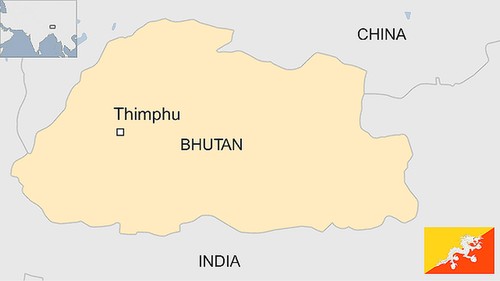
Map: WHO/public reference cartography; reproduced for educational use.
▤ Facts worth remembering
- Global rabies toll: ~59,000 deaths/year; about a third occur in India.
- Endemic in India except the Andaman & Nicobar and Lakshadweep islands; ~96% of mortality/morbidity linked to dog bites.
- India's target: National Rabies Control Programme aims for zero rabies deaths by 2030 (aligned with the WHO's global goal).
- WHO validation criteria: at least two years without human deaths from dog-transmitted rabies, plus demonstrated capacity to prevent re-emergence.
- Two-pronged global strategy: mass dog vaccination (source control) + Post-Exposure Prophylaxis (PEP — wound-washing, vaccine course, immunoglobulin where needed).
- Bhutan's approach: a One Health collaboration between Health and Agriculture/Livestock Ministries, with "De-suung" (Guardians of Peace) volunteers supporting dog vaccination, population management and community awareness.
Why it matters for India
India bears the largest single-country share of global rabies deaths, and its own elimination target (2030) mirrors the WHO's global goal.
Bhutan's success — achieved via sustained inter-ministerial coordination rather than any single intervention — offers a directly relevant regional model given persistent gaps in India's local-body-run animal birth control and vaccination programmes.
✎ Mains Practice Question
India accounts for nearly a third of global rabies deaths despite having a National Rabies Control Programme with a 2030 elimination target. Drawing lessons from Bhutan's WHO-validated elimination of dog-transmitted rabies, suggest measures to strengthen India's response. 10 marks · 150 words
08
Rajghat Artefacts: A 1950s Excavation Sheds New Light on Varanasi's Ancient Past
GS-I · Art & Culture — Ancient Indian History, ArchaeologyPrelims + MainsThe Indian Express
Banaras Hindu University has begun the first organised documentation of over 10,000 artefacts — excavated from Rajghat, the identified capital of the ancient Kashi Janapada, between 1957 and 1969 — including a previously unopened box containing a human skeleton.
Figure 6 — Artefacts from the Rajghat excavation
A painted pottery vessel and excavated brick structural remains from the site. Photographs: Rajghat excavation archives, BHU Department of Ancient Indian History, Culture and Archaeology.
◈ Background & Context
Rajghat, on Varanasi's northeastern outskirts near the Ganga–Varana confluence, is identified as the capital of the Kashi Janapada — one of the 16 mahajanapadas named in early Buddhist and Jain texts. Unlike Sarnath, which developed as a pilgrimage site, Rajghat emerged as Kashi's main urban centre.
Excavation history
- First noticed in 1940 during railway construction; trial excavation by Krishna Deva (ASI) followed the same year.
- Main excavations: 1957–1969, across four phases, led by A. K. Narain and colleagues from BHU's Department of Ancient Indian History, Culture and Archaeology.
- The lowest layer yielded pre-Northern Black Polished Ware (pre-NBPW) pottery, associated with an earlier Iron Age phase; the settlement's origin was dated to around 800 BCE — later confirmed by scientific re-analysis of lower layers by Vidula Jaiswal and B. R. Mani in the early 2000s.
- Notable finds: hundreds of seals and sealings (several bearing Greek inscriptions and administrative-official names), ivory and iron objects, punch-marked coins, and terracotta figurines.
▤ Facts worth remembering
- Settlement dated to: ~800 BCE.
- Artefacts documented so far: ~4,000 of an estimated close to 10,000, since documentation began in January 2026.
- Janapada: Kashi — one of the 16 mahajanapadas of the Indo-Gangetic plain by the 6th century BCE.
- Other excavated Kashi-region sites: Aktha, Ramnagar, Sarnath (pilgrimage centre, unlike Rajghat's urban role).
Why it matters
The find is significant for tracing the development of early urbanisation and administrative organisation in the Indo-Gangetic plain. Advances in DNA sampling now offer the possibility of extracting new information — age, ancestry, lifestyle — from the previously unanalysed human skeleton recovered in the 1960s.
✎ Mains Practice Question
Discuss the significance of the Rajghat excavations in reconstructing the urban and administrative history of the Kashi Mahajanapada. How can modern scientific techniques enhance the value of legacy archaeological collections? 10 marks · 150 words