

In-Depth News Analysis11 Items
Core TopicImportantConcise
Polity & GovernanceGS Paper II
01Appointing the Election Commission — From the Constituent Assembly to the 2023 Act
International RelationsGS Paper II
02Kaliningrad & the Suwałki Gap — Russia–NATO Flashpoint
Economy & InfrastructureGS Paper III
03RBI MPC Hikes Repo to 5.5%; Stance Shifts to ‘Calibrated Tightening’04India’s Trade Bind — US Surplus vs China Deficit & the Rupee05Integrated Transport & Logistics Authority (ITLA)06Development Council for Textile Industry — First Meeting
Science & TechnologyGS Paper III
07Nobel Prize in Chemistry 2026 — Chirality & Asymmetric Synthesis
Environment & EcologyGS Paper III
08Project Cheetah — Veerangana Durgavati TR Becomes Third Site09GPS Tracking of Elephants & Human–Elephant Conflict in Assam
Society, Health & Social JusticeGS Paper I · II
10WHO Guidelines on Childhood & Adolescent Obesity
Ethics, Integrity & AptitudeGS Paper IV
11Case Study — Weight-Loss Drugs for Children & the Thalidomide Lesson
Polity & GovernanceGeneral Studies Paper II
01
Who Picks the Referee? Constituent Assembly Debates on Appointing the Election Commission and Today’s Controversy
Core TopicGS-II · Polity — Constitutional Bodies, Appointment to Constitutional PostsPrelims + MainsThe Indian Express · Expert Explains
A revisit of the June 1949 Constituent Assembly debates shows that the central question in today’s debate on the Chief Election Commissioner and Other Election Commissioners Act, 2023 — whether the government should dominate the choice of the body that referees its own elections — was foreseen and left open by the framers.
◈ Basics First — The Election Commission of India
The Election Commission of India (ECI) is a permanent, independent constitutional body set up on 25 January 1950 (observed as National Voters’ Day since 2011).
It conducts elections to Parliament, State Legislatures and the offices of the President and Vice-President; elections to panchayats and municipalities are run by State Election Commissions (Articles 243K and 243ZA).
- Article 324(1) — vests superintendence, direction and control of elections in the ECI.
- Article 324(2) — ECI consists of the CEC and such number of ECs as the President fixes; appointment by the President, “subject to the provisions of any law made in that behalf by Parliament”.
- Article 324(5) — the CEC can be removed only like a Supreme Court judge; ECs can be removed only on the CEC’s recommendation; service conditions cannot be varied to the CEC’s disadvantage after appointment.
- Multi-member body — two ECs were first added in October 1989 (reverted in 1990); the three-member structure became permanent in 1993 and was upheld in T.N. Seshan v. Union of India (1995).
The Static Anchor — What the Framers Debated (June 1949)
- The objection (15 June 1949) — a member argued that in a parliamentary system, appointment “by the President” really means appointment by the government of the day, which could install a partisan referee; he proposed that appointment require a two-thirds majority in Parliament. The amendment was defeated.
- The structural warning (16 June 1949) — another member noted that provincial governments had been kept out of election machinery for fear of bias, and asked why the Central Government should be presumed immune; without trustworthy machinery, he warned, democracy would be “poisoned at the source”.
- Dr B.R. Ambedkar called the issue one of the Drafting Committee’s “greatest headaches”; he considered the US model of Senate confirmation but feared it would import political bargaining.
- The compromise — the Constitution would create the ECI and protect the CEC from easy removal, but leave the appointment mechanism to a future law of Parliament.
Figure 1 — How the Appointment Question Evolved
1949195019911993Mar 2023Dec 2023CA debates2/3 Parliamentvote proposed— rejectedArticle 324ECI set upappointment lawleft to ParliamentService Actpay, tenureof CEC/ECs —no selection panelMulti-memberECI madepermanent;upheld 1995Anoop Baranwalinterim panel:PM + LoP+ CJICEC & ECs Actpanel: PM + LoP+ Union CabinetMinisterFor 74 years no appointment law was made; the Court filled the gap, then Parliament legislated
The constitutional “door” left open in 1949 — a law on appointments under Article 324(2) — was used only after the 2023 Supreme Court judgment.
The Current Hook — Judgment and Statute
- Anoop Baranwal v. Union of India (March 2023) — a five-judge Constitution Bench held that, until Parliament legislated, the CEC and ECs would be appointed on the advice of a committee of the Prime Minister, the Leader of the Opposition (or leader of the largest Opposition party) and the Chief Justice of India.
- CEC and Other ECs (Appointment, Conditions of Service and Term of Office) Act, 2023 — a Search Committee under the Law Minister shortlists five names; a Selection Committee of the PM, LoP and a Union Cabinet Minister nominated by the PM recommends the appointment. The CJI is not on the panel.
- Other features: tenure of six years or till age 65; salary equal to a Supreme Court judge; protection from legal proceedings for acts done in official duty.
- The critique — with two of three members drawn from the executive, the government holds a structural majority in choosing the referee — the very concern raised in 1949.
▤ How Other Watchdogs Are Chosen — A Comparison
- CBI Director (DSPE Act, as amended in 2013) — PM, LoP, CJI (or a judge nominated by the CJI).
- Lokpal (Lokpal and Lokayuktas Act, 2013) — PM, Lok Sabha Speaker, LoP, CJI and an eminent jurist.
- Central Vigilance Commissioner (CVC Act, 2003) — PM, Home Minister, LoP.
- Chief Information Commissioner (RTI Act, 2005) — PM, LoP, a Union Cabinet Minister nominated by the PM.
- Reform recommendations — Dinesh Goswami Committee (1990): consultation with the CJI and LoP; 2nd ARC (2007): a collegium headed by the PM; Law Commission, 255th Report (2015): a panel of the PM, LoP and CJI.
Analysis — Independence in Fact and in Appearance
The argument is structural, not personal: individual Commissioners may act with complete integrity, yet a design that lets one contestant shape the choice of referee weakens public confidence. For institutions of electoral integrity, the appearance of independence matters almost as much as its substance.
- For the Act — appointments are an executive function under separation of powers; the Court itself left the field to Parliament; inclusion of the LoP provides a check.
- Against — it reverses a balanced interim panel; it gives the executive a 2:1 majority; it departs from the model used for the CBI Director and Lokpal; it bears on free and fair elections, part of the basic structure.
- Way forward — a neutral member on the panel, transparent shortlisting criteria, publication of reasons, and extending removal protection to Election Commissioners on par with the CEC.
✎ Mains Practice Question
“The Constituent Assembly foresaw the risk of executive control over the Election Commission but left the appointment mechanism to Parliament.” Critically examine the appointment framework introduced by the 2023 Act in the light of the Constituent Assembly debates and the Anoop Baranwal judgment. 15 marks · 250 words
International RelationsGeneral Studies Paper II
02
Kaliningrad: Why Russia’s Baltic Exclave Has Become a New Russia–NATO Flashpoint
Core TopicGS-II · IR — Effect of Policies of Developed Countries; Global Groupings · GS-I GeographyPrelims + MainsThe Hindu
Moscow has sent a formal diplomatic note to NATO accusing it of militarily pressuring and trying to isolate Kaliningrad; NATO calls its Baltic activities “defensive”. The row follows the Russian President’s warning at the Valdai Discussion Club (1 October 2026) that a direct attack on Russia would bring “all types of weapons” onto the agenda.
◈ Basics First — What Is an Exclave?
An exclave is a part of a country that is geographically separated from its main territory and surrounded by other States (or by States and sea). Kaliningrad Oblast is Russia’s westernmost region, wedged between Poland (south) and Lithuania (north and east), with the Baltic Sea to the west.
- History — formerly Königsberg, capital of East Prussia; transferred to the USSR under the Potsdam Agreement (1945) and renamed in 1946.
- Size — about 15,000 sq km with roughly one million people; became an exclave when Lithuania regained independence in 1990–91.
- Military value — hosts the headquarters of Russia’s Baltic Fleet at Baltiysk; an ice-free port; Russia has stationed Iskander short-range missile systems there.
- Not a separate country — it is a federal subject (oblast) of Russia; India-relevant trap: it is not part of Belarus.
Figure 2 — Kaliningrad, the Suwałki Gap and the Baltic Theatre
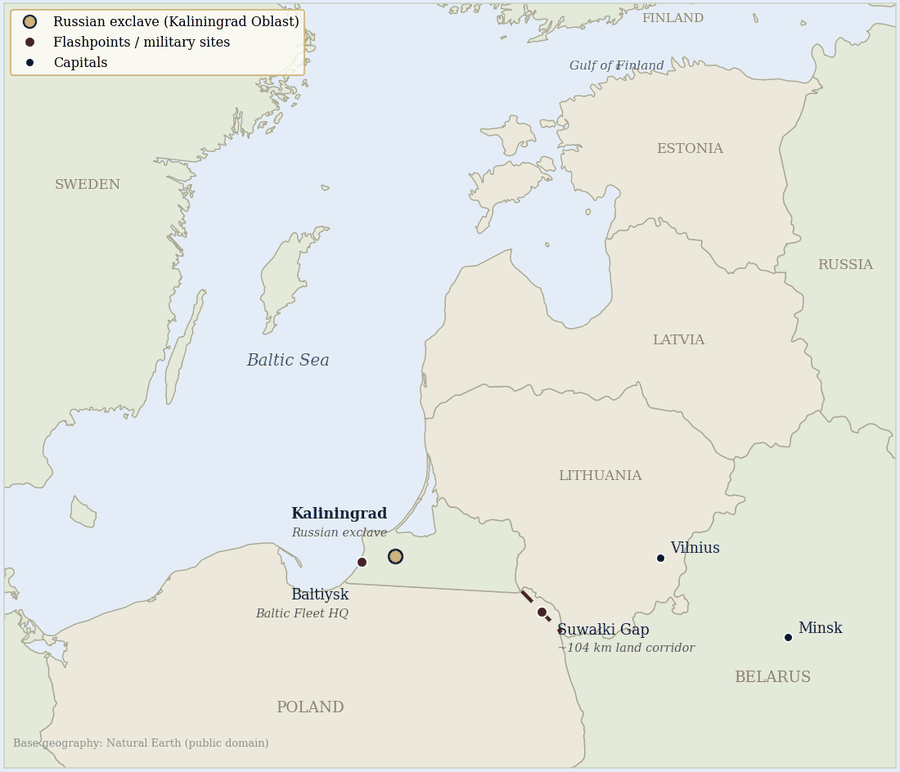
The Suwałki Gap (dashed) is the Polish–Lithuanian border strip between Kaliningrad and Belarus — NATO’s only land link to the Baltic states. Base geography: Natural Earth 1:10m, public domain.
Why It Is a Flashpoint Now
- The Suwałki Gap — a roughly 104-km stretch along the Poland–Lithuania border; if closed by Russian and Belarusian forces, the Baltic states (Estonia, Latvia, Lithuania) would be cut off by land from the rest of NATO.
- A “NATO lake” — after Finland (April 2023) and Sweden (March 2024) joined NATO, almost the entire Baltic coastline belongs to NATO members except Russia’s St Petersburg area and Kaliningrad.
- Transit frictions — Kaliningrad depends on land transit through Lithuania; in 2022, Lithuania’s curbs on rail transit of EU-sanctioned goods triggered a sharp dispute.
- Hybrid incidents — damage to undersea cables and pipelines and GPS jamming in the Baltic have led NATO to step up maritime patrols such as Baltic Sentry (2025).
- Nuclear signalling — Russia’s revised nuclear doctrine (November 2024) treats aggression by a non-nuclear State backed by a nuclear power as a joint attack; Russian tactical nuclear weapons have also been placed in Belarus.
◈ Static Background — NATO
- North Atlantic Treaty Organization — founded by the Washington Treaty (4 April 1949); HQ Brussels; 32 members after Sweden’s accession.
- Article 5 — collective defence: an armed attack on one is an attack on all; invoked only once, after 9/11 (2001).
- Article 4 — consultations when a member feels its security is threatened (invoked by Poland and the Baltic states in recent crises).
- Enhanced Forward Presence — multinational battlegroups in the Baltic states and Poland since 2017.
India Angle
- Defence-industrial link — the Indian Navy’s stealth frigates INS Tushil (December 2024) and INS Tamal (July 2025) were commissioned at the Yantar Shipyard in Kaliningrad.
- Strategic autonomy — India balances its Special and Privileged Strategic Partnership with Russia against deepening ties with European NATO members; escalation would test this balance.
- Economic exposure — any wider Russia–NATO conflict would hit energy prices, sanctions compliance for Indian firms and the INSTC trade route.
- India consistently favours dialogue and diplomacy and opposes the threat or use of nuclear weapons.
✎ Mains Practice Question
The expansion of NATO in the Baltic region has turned Kaliningrad into a strategic flashpoint. Discuss the geopolitical significance of Kaliningrad and the Suwałki Gap, and examine the implications of rising Russia–NATO tensions for India’s strategic autonomy. 15 marks · 250 words
Economy & InfrastructureGeneral Studies Paper III
03
RBI Raises Repo Rate by 25 bps to 5.5% and Shifts Stance to ‘Calibrated Tightening’
Core TopicGS-III · Economy — Monetary Policy, Inflation, Mobilisation of ResourcesPrelims + MainsThe Hindu
The Monetary Policy Committee (MPC) raised the policy repo rate by 25 basis points to 5.5% and moved its stance from neutral to calibrated tightening — signalling that rate cuts are off the table and the next move can only be a hike or a pause.
◈ Basics First — How Monetary Policy Works
Monetary policy is the central bank’s management of the cost and availability of money to keep prices stable while supporting growth. The main lever is the policy repo rate — the rate at which the RBI lends overnight to banks against government securities under the Liquidity Adjustment Facility (LAF).
- Rate hike → costlier bank funds → higher lending rates → lower borrowing and spending → demand and inflation cool; a stronger rate differential can also support the rupee.
- Policy corridor — floor: Standing Deposit Facility (SDF) at repo − 25 bps (introduced April 2022); ceiling: Marginal Standing Facility (MSF) at repo + 25 bps, aligned with the Bank Rate.
- Transmission — faster since the External Benchmark-Based Lending Rate (EBLR, October 2019) linked many floating loans directly to the repo rate.
◈ Static Background — The MPC Framework
- Statutory basis — Section 45ZB, RBI Act, 1934, inserted by the Finance Act, 2016; Flexible Inflation Targeting (FIT) framework.
- Six members — three from the RBI (the Governor chairs and has a casting vote) and three external members appointed by the Centre for four years; meets at least four times a year.
- Inflation target — set by the Centre in consultation with the RBI (Section 45ZA); it has been 4% CPI inflation with a ±2% band.
- Stance vocabulary — accommodative (ready to cut), neutral (either way), calibrated tightening (no cuts; hikes possible). The RBI last used “calibrated tightening” in October 2018.
5.50%Policy repo rate
5.25%SDF (floor)
5.75%MSF & Bank Rate
+25 bpsFirst hike since Feb 2023
Figure 3 — Repo Rate Cycle, May 2022 to October 2026
4%5%6%7%4.406.50% — held for two years (Feb 2023–Feb 2025)5.25 (Dec 2025)5.50 ▲TighteningEasing −125 bpsMay 22Jan 23Jan 24Jan 25Jan 26Oct 26Repo rate at each policy change; held at 5.25% for four meetings before the October 2026 hike
After a 250-bps post-pandemic tightening (4.00% → 6.50%) and a 125-bps easing cycle (6.50% → 5.25%), the MPC has turned again on an external shock. Recreated from RBI policy data.
Why the RBI Turned Hawkish
- West Asia re-escalation (September 2026) — hardening and volatile crude oil prices; India imports over 85% of its crude, so oil shocks feed imported inflation and widen the current account deficit.
- Rupee pressure — higher oil bills raise demand for dollars; a rate hike helps stem capital outflows.
- Global risks flagged by the Governor — tightening of global financial conditions, uncertainty over the valuation of AI stocks, and an unresolved West Asia conflict.
- Anchoring expectations — a pre-emptive move prevents a supply shock from becoming second-round inflation via wages and prices.
Implications & Critical View
- Borrowers — EBLR-linked loans (home, MSME) become costlier; depositors may gain.
- Growth trade-off — monetary tightening cannot lower global oil prices; it works only by reducing domestic demand, which may slow investment.
- Policy mix — fuel excise and VAT adjustments, strategic petroleum reserves and supply-side measures must complement monetary action.
- Credibility — a clear forward-guiding stance strengthens the FIT framework and limits market volatility.
✎ Mains Practice Question
“Monetary policy is a blunt instrument against supply-side inflation.” In the light of the RBI’s recent shift to calibrated tightening amid an oil-price shock, examine the effectiveness and limitations of the flexible inflation targeting framework. 15 marks · 250 words
04
Caught in the Middle: India’s Trade Surplus with the US, Structural Deficit with China, and the Pressure on the Rupee
Core TopicGS-III · Economy — External Sector, Balance of Payments, Exchange RatePrelims + MainsThe Hindu · Economic Notes
India’s surplus with the United States offsets a structural deficit with China. With US tariff pressure and AI-driven disruption threatening export earnings, and crude import costs rising, that cushion — and the rupee — are at risk.
◈ Basics First — Balance of Payments and the Exchange Rate
The Balance of Payments (BoP) records all transactions between residents and the rest of the world. The current account covers trade in goods and services, primary income (factor income) and secondary income (remittances); the capital and financial account covers FDI, FPI, external borrowing and NRI deposits.
- Demand for dollars — imports + capital outflows (outward FDI/FPI). Supply of dollars — exports, capital inflows, remittances, Net Factor Income from Abroad, external borrowing and deposits.
- Depreciation of the rupee = more rupees per dollar: imports become dearer, exports cheaper abroad.
- Managed float — India’s rate is market-determined since the unification of exchange rates in March 1993, but the RBI intervenes — selling dollars from reserves to resist sharp falls, buying to curb sharp rises — without targeting a fixed level.
- Forex reserves comprise foreign currency assets, gold, SDRs and the Reserve Tranche Position in the IMF.
Figure 4 — The Forex Market, the Rupee and India’s Trade with the US and China
Higher oil bills shift dollar demand right; lower US exports shift supply left — together they push the rupee toward the edge of the RBI’s preferred range. Image courtesy The Hindu, October 2026 (charts: Azad & Chowdhury); reproduced with credit for educational use.
▤ The Numbers
- Net exports with China widened from −$36.2 bn (FY14) to −$112.1 bn (FY26) — imports of electronics, machinery, chemicals, APIs and solar inputs are not easily substitutable in the short run.
- Net exports with the US rose from $16.6 bn (FY14) to a peak of $40.9 bn (FY25), before easing to $33.9 bn (FY26).
- India’s surplus with the US is much larger in goods than in services — exactly the balance US tariffs seek to reverse.
- Autonomous dollar demand exceeded supply in four of the last nine quarters, with a sharp spike after the closure of the Strait of Hormuz.
The Mechanism of Risk
- Oil shock → dollar demand rises → rupee depreciates → RBI sells reserves to defend the range.
- US tariff and AI substitution → fewer goods and IT-service exports → dollar supply falls → further depreciation pressure.
- Vicious cycle risk — heavy reserve use can trigger expectations of depreciation, prompting more capital outflows; beyond a point, dollar demand may even rise as the rupee falls.
- Twin exposure — India is squeezed between a structural import dependence (China, oil) and concentrated export dependence (US).
Way Forward — Diversify Markets and Products
- Market diversification — deepen access via the India–UAE CEPA (2022), India–Australia ECTA (2022), India–EFTA TEPA and the India–UK CETA, and expand into Africa, Latin America and ASEAN (Global South).
- Product diversification — move up value chains in electronics, engineering, chemicals, pharmaceuticals; support through PLI schemes and RoDTEP.
- Reduce structural imports — domestic capacity in APIs, solar modules, electronic components; energy diversification and renewables to cut the oil bill.
- Rupee trade settlement — Special Rupee Vostro Accounts (2022) and local-currency settlement pacts (e.g. with the UAE) to reduce dollar dependence.
✎ Mains Practice Question
India’s trade surplus with the US and its structural deficit with China make its external sector vulnerable to tariff and oil shocks. Examine how these shocks transmit to the rupee and suggest a strategy of market and product diversification. 15 marks · 250 words
05
Centre Approves the Integrated Transport & Logistics Authority (ITLA) and a Long-Term National Transport Master Plan
Core TopicGS-III · Economy — Infrastructure (Roads, Railways, Ports, Airports), Investment ModelsPrelims + MainsPIB
The Union Government on 6 October 2026 approved the Integrated Transport & Logistics Authority (ITLA) — an apex institution for research, planning, appraisal, monitoring and impact assessment across all transport modes, tasked with a National Transport Master Plan of 10 years or more.
◈ Basics First — Why Integrated Transport Planning?
Logistics is the movement and storage of goods from origin to consumption. When roads, railways, ports, airports and waterways are planned by separate ministries in silos, the result is missing links, poor first- and last-mile connectivity and high costs. Multimodal planning treats the network as one system.
- Logistics cost — a DPIIT–NCAER study estimated India’s logistics cost at about 7.8–8.9% of GDP (2021–22).
- Modal imbalance — freight is heavily road-dependent, though rail and waterways are cheaper and greener per tonne-km.
- Logistics Performance Index (World Bank, 2023) — India ranked 38th of 139 countries.
◈ Static Background — The Existing Architecture ITLA Complements
- PM GatiShakti National Master Plan (October 2021) — a GIS-based digital platform integrating seven engines: railways, roads, ports, waterways, airports, mass transport and logistics infrastructure. Institutional layers: Empowered Group of Secretaries, Network Planning Group (NPG) and a Technical Support Unit; infrastructure projects above ₹500 crore are examined by the NPG.
- National Logistics Policy (September 2022) — aims to bring logistics costs to global benchmarks by 2030 and place India in the top 25 of the LPI; tools include ULIP (Unified Logistics Interface Platform) and the Comprehensive Logistics Action Plan.
- LEADS (Logistics Ease Across Different States) — annual State-wise logistics assessment by the Ministry of Commerce and Industry.
Figure 5 — ITLA at a Glance
ITLA is designed as a Special Purpose Vehicle covering the full project cycle — from research to post-implementation impact assessment. Image courtesy PIB / Ministry of Commerce and Industry; reproduced with credit for educational use.
Roles and Responsibilities
- National Transport Master Plan — horizon of 10+ years covering roads, railways, ports and shipping, civil aviation, inland waterways, coastal shipping, urban mobility and logistics.
- Integrated planning framework — evaluates five-year sectoral plans and annual plans of transport ministries for alignment with the Master Plan.
- Technical appraisal of central infrastructure projects costing ₹500 crore or more; financial appraisal stays with existing mechanisms.
- Monitoring and impact assessment of projects above ₹500 crore, with an issue-resolution mechanism and post-implementation evaluation.
- National Transport Data Repository (NTDR) — integrates GSTN e-way bills, FASTag, Vahan, GPS systems and urban traffic data for freight-flow and origin–destination analysis.
- Policy and capacity — advise on review of the National Logistics Policy (2022); training, skilling, research and innovation.
Significance
- Closes the planning–outcome loop — India has strong project-execution tools, but few systematic ex-post evaluations of whether projects delivered promised benefits.
- Evidence-based planning — real-time freight data can guide corridor selection and modal shift to rail and waterways.
- Global practice — similar national transport research and planning bodies exist in Korea, Japan, the US, China and Australia.
- Viksit Bharat 2047 — lower logistics costs raise export competitiveness and support manufacturing.
Challenges
- Institutional overlap with the NPG under PM GatiShakti and ministry planning wings — roles must be clearly delineated.
- Federal coordination — urban mobility, State highways and ports involve States; their buy-in is essential.
- Data governance — FASTag and Vahan data raise privacy issues under the Digital Personal Data Protection Act, 2023.
- Teeth — an advisory appraisal body is effective only if ministries are bound to act on its findings.
✎ Mains Practice Question
Siloed sectoral planning has kept India’s logistics costs high. Examine how the proposed Integrated Transport & Logistics Authority can complement PM GatiShakti and the National Logistics Policy, and discuss the challenges in operationalising it. 15 marks · 250 words
06
First Meeting of the Development Council for Textile Industry Charts a Whole-of-Value-Chain Roadmap
ConciseGS-III · Economy — Industrial Policy, Changes in Industrial PolicyPrelims + MainsPIB
The newly constituted Development Council for Textile Industry (DCTI) — an apex consultative platform of Government, industry and stakeholders — held its first meeting on 6 October 2026 in New Delhi, chaired by the Secretary, Ministry of Textiles.
◈ Static Background
- Development Councils are provided for under Section 6 of the Industries (Development and Regulation) Act, 1951 — bodies of industry, labour, consumers and experts that advise on production targets, efficiency and coordination for a scheduled industry.
- Sector weight — textiles and apparel are among India’s largest employers after agriculture and a major source of export earnings; India is the world’s largest jute producer and second-largest silk producer.
- Key schemes — PM MITRA (seven integrated textile parks), PLI for MMF apparel, MMF fabrics and technical textiles (2021), National Technical Textiles Mission (2020), SAMARTH (skilling) and the “5F” vision — Farm to Fibre to Factory to Fashion to Foreign.
Focus Areas Deliberated
- Production and productivity — capacity addition and modernisation across fibre, yarn, fabric, processing and apparel.
- R&D — industry–research linkages, new-age fibres and technical textiles, faster commercialisation via Textile Research Associations.
- Exports — product and market diversification, leveraging trade agreements, addressing quality and logistics constraints.
- Raw materials — stable, competitive supply of cotton, man-made fibres, yarn, dyes and chemicals.
- Investment, skilling and sustainability — MSME support, circular practices; working groups will be formed on priority themes.
✎ Mains Practice Question
India’s textile sector suffers from a fragmented value chain and a skewed fibre mix. Discuss the measures needed to make it globally competitive, highlighting the role of institutional industry–government platforms. 10 marks · 150 words
Science & TechnologyGeneral Studies Paper III
07
Chemistry Nobel 2026: Henri B. Kagan and Kenso Soai Honoured for Amplifying ‘Handedness’ in Molecules
ImportantGS-III · S&T — Developments and their Applications; Indigenisation of TechnologyPrelims + MainsThe Hindu · Indian Express
The 2026 Chemistry Nobel goes to Henri B. Kagan (France, 96) and Kenso Soai (Japan, 76) “for the discovery of non-linear effects and autocatalysis in asymmetric organic synthesis” — work showing how tiny molecular asymmetries can be amplified, with direct gains for drug manufacture.
◈ Basics First — Chirality
- Chirality — a molecule that is a non-superimposable mirror image of another, like the left and right hands. The term was coined by Lord Kelvin; Louis Pasteur (1848) first separated mirror-image crystals of tartaric acid.
- Enantiomers — the two mirror-image forms; same atoms, same connections, different 3-D arrangement. A 50:50 mixture is a racemic mixture.
- Homochirality of life — proteins use almost only L-amino acids; DNA and RNA contain D-sugars. Enzymes and receptors are themselves chiral, so the two forms of a drug can act very differently.
- Thalidomide (late 1950s) — sold as a sedative and for morning sickness; by 1961 it was linked to severe birth defects (phocomelia) in thousands of babies across 46 countries. One enantiomer was harmful; the forms also interconvert in the body.
Figure 6 — The Laureates and the Thalidomide Lesson
Thalidomide showed why producing the right enantiomer matters. Image courtesy The Indian Express, October 2026; reproduced with credit for educational use.
What the Laureates Discovered
- The early clue — in the early 1900s, Willy Marckwald used a chiral catalyst to obtain a slightly unequal mix of enantiomers, but the effect could not be scaled or explained.
- Kagan — non-linear effects (1986) — it was assumed that a product’s enantiomeric excess would rise in proportion to the catalyst’s. Kagan showed the relationship is non-linear: a mildly chiral catalyst can yield a strongly asymmetric product, and he explained the internal dynamics.
- Soai — asymmetric autocatalysis (1990s) — he designed a reaction in which the product itself acts as the catalyst and copies its own handedness; the final product was about 99.5% one enantiomer — comparable to selectivity in living systems.
Significance
- Pharmaceuticals — earlier, drugs were made as racemic mixtures and the desired form separated in a costly, wasteful step; asymmetric synthesis gives the right form directly.
- Wider uses — agrochemicals, flavours and fragrances that interact with living organisms.
- Origin of life — shows that homochirality can arise without biology, offering a plausible route to how life came to prefer one form.
- Lineage — continues earlier Nobels in asymmetric chemistry: 2001 (Knowles, Noyori, Sharpless — asymmetric catalysis) and 2021 (List, MacMillan — asymmetric organocatalysis).
- India link — as a leading generic and API producer, India gains from green, enantiopure synthesis that cuts waste and cost.
✎ Mains Practice Question
What is chirality? Explain why the ability to synthesise a single enantiomer is important for the pharmaceutical industry, citing the lessons of the thalidomide tragedy. 10 marks · 150 words
Environment & EcologyGeneral Studies Paper III
08
Project Cheetah Expands: Two Cheetahs Released in Veerangana Durgavati Tiger Reserve, Madhya Pradesh’s Third Cheetah Site
ImportantGS-III · Environment — Conservation; GS-I Geography (Places in News)Prelims + MainsThe Hindu (PTI)
Two cheetahs, named Vyom and Neera, were released into the Veerangana Durgavati Tiger Reserve in Sagar district (Bundelkhand), making it the third cheetah habitat in Madhya Pradesh after Kuno National Park and Gandhi Sagar Wildlife Sanctuary. The State’s Vulture Population Estimation 2026 report was also released.
◈ Static Background — The Cheetah in India
- Extinction — the cheetah was declared extinct in India in 1952, the only large carnivore to go extinct in independent India.
- Species — African cheetah (Acinonyx jubatus jubatus) is Vulnerable (IUCN); the Asiatic cheetah survives only in Iran and is Critically Endangered.
- Project Cheetah — launched on 17 September 2022 at Kuno with eight cheetahs from Namibia, followed by 12 from South Africa (2023); the world’s first intercontinental translocation of a large wild carnivore. Nodal agency: NTCA, with WII as technical partner.
- Second site — Gandhi Sagar Wildlife Sanctuary (Mandsaur–Neemuch, along the Chambal) received cheetahs in April 2025.
- Veerangana Durgavati TR — notified in 2023 as MP’s seventh tiger reserve by merging the Nauradehi and Rani Durgavati sanctuaries; named after the 16th-century Gond queen Rani Durgavati.
Why a Third Site Matters
- Metapopulation approach — spreading cheetahs across several sites reduces the risk of disease or disaster wiping out a single population and allows gene flow through managed movement.
- Grassland restoration — cheetahs act as a flagship for neglected savanna and open-forest ecosystems.
- Challenges — early mortality (heat stress, infections linked to thick winter coats), limited prey base and space, competition with leopards, and conflict when cats stray outside reserves.
✎ Mains Practice Question
Evaluate the progress of Project Cheetah. Is a multi-site metapopulation strategy the right approach for reintroducing a large carnivore into India’s landscapes? 10 marks · 150 words
09
Five-Year GPS Study Maps Elephant Movement to Curb Human–Elephant Conflict in Assam
ImportantGS-III · Environment — Conservation, Human–Wildlife ConflictPrelims + MainsThe Hindu
A satellite-tracking study by the Assam Forest Department and WWF-India — Tracking the Giants — followed four female-led herds and a solitary male in Udalguri, Sonitpur and Biswanath (north bank of the Brahmaputra) from April 2021 to June 2026, generating over 38,000 GPS locations.
◈ Static Background — The Asian Elephant
- Status — Endangered (IUCN), Schedule I of the Wild Life (Protection) Act, 1972, CITES Appendix I; declared India’s National Heritage Animal (2010).
- Project Elephant (1992) — merged with Project Tiger in 2023 under the Project Tiger and Elephant division; India has 33 Elephant Reserves.
- Population — the 2025 Synchronised All India Elephant Estimation (DNA-based) put Assam’s count at 4,149, the stronghold of the Northeast.
- Telemetry — GPS radio-collars record location at fixed intervals, revealing home ranges, corridors and seasonal patterns that one-time counts cannot.
Key Findings
- Core habitats — Sonai-Rupai, Behali and Bornadi Wildlife Sanctuaries were used extensively.
- Tea plantations act as movement pathways and secondary habitat, bringing elephants close to people.
- Seasonality — home ranges of female-led herds expand during the paddy season, which coincides with peak conflict.
- Toll — human–elephant conflict has claimed 1,147 human lives and 246 elephants in Assam since 2016.
Conflict Mitigation — What Works
- Corridor protection and land-use planning around tea estates; wildlife-friendly infrastructure (underpasses on highways and railways).
- Early-warning systems using GPS alerts and AI-based intrusion detection on railway tracks; community response teams.
- Crop protection — bee fences, solar fencing, crop choices; prompt ex-gratia compensation to reduce retaliation.
✎ Mains Practice Question
Human–elephant conflict in India is largely a problem of fragmented landscapes. Discuss how technology-driven tools like GPS telemetry can support landscape-level solutions. 10 marks · 150 words
Society, Health & Social JusticeGeneral Studies Papers I & II
10
WHO Flags Surge in Child Obesity; Advises Against Weight-Loss Drugs and Surgery Below Age Nine
ImportantGS-II · Social Justice — Health; Issues Relating to Children · GS-I SocietyPrelims + MainsThe Indian Express
New WHO guidelines recommend against weight-loss drugs and bariatric surgery for children below nine, urge restraint for adolescents (10–19), and make diet, physical activity and behaviour change the foundation of obesity care.
◈ Basics First — Measuring Obesity in Children
- Adults use BMI (kg/m²) with fixed cut-offs; children use BMI-for-age against WHO growth references because body composition changes with growth.
- For ages 5–19, WHO defines overweight as BMI-for-age above +1 SD and obesity above +2 SD of the reference median.
- GLP-1 receptor agonists (e.g. semaglutide) mimic a gut hormone that boosts satiety and insulin release — effective for weight loss, but long-term data in children are lacking.
▤ The Numbers
- Global obesity prevalence among 5–19-year-olds rose from 2% (1990) to 8% — a fourfold rise.
- In 2024, 170 million children and adolescents had obesity — 70 million aged 5–9 and 100 million aged 10–19.
- India — projections cited put children and adolescents with obesity at about 27 million by 2030; NFHS data show under-five overweight/obesity up 127% between 2005–06 and 2019–21, and 125% (girls) and 288% (boys) among adolescents.
What the Guidelines Say
- Under 9 — no weight-loss drugs or bariatric surgery.
- 10–19 — drugs or surgery only for severe obesity with related conditions, or where lifestyle interventions fail after six months.
- Foundation — structured diets, physical activity and behaviour change, with family and school support.
India’s Response Framework
- POSHAN Abhiyaan (2018) and Mission Poshan 2.0 address the double burden of malnutrition — undernutrition alongside obesity.
- Eat Right India (FSSAI, 2018); FSSAI’s 2020 school regulations bar sale and advertisement of high fat, sugar and salt (HFSS) foods in and within 50 metres of schools.
- Fit India Movement (2019); CBSE’s “sugar boards” in schools to build awareness.
- Paediatric bodies are drafting guidance on GLP-1 use in children to prevent overuse while ensuring access for those who need it.
✎ Mains Practice Question
India faces a “double burden of malnutrition”. Discuss the drivers of rising childhood obesity and evaluate the adequacy of current policy responses. 15 marks · 250 words
Ethics, Integrity & AptitudeGeneral Studies Paper IV
11
Case Study: Prescribing New Weight-Loss Drugs to Children — Innovation vs Precaution
ConciseGS-IV · Ethics — Ethical Issues in Public Health; Case StudiesMains-orientedThe Indian Express
A drug regulator receives pressure from clinics and manufacturers to widen the use of new GLP-1 weight-loss drugs among adolescents, while long-term paediatric safety data are absent. Parents of children with severe obesity demand access; WHO urges restraint.
◈ Ethics Toolkit
- Beneficence vs non-maleficence — help children with serious co-morbidities without exposing healthy growth to unknown risks.
- Precautionary principle — the thalidomide tragedy led to stricter drug-testing laws such as the US Kefauver–Harris Amendments (1962).
- Autonomy and consent — parental informed consent and the child’s assent; the Declaration of Helsinki (1964) on research ethics.
- Justice — access must not depend on ability to pay; avoid a market for cosmetic weight loss in minors.
- Institutional tools — New Drugs and Clinical Trials Rules, 2019; post-marketing surveillance via the Pharmacovigilance Programme of India (2010).
✎ Mains Practice Question
As the head of the drug regulator in the above case, identify the ethical issues involved and the stakeholders affected. What course of action would you adopt, and why? 20 marks · 250 words