

Content
- Global Space Activity & India’s Space Assets (ISSAR 2025)
- Fast Breeder Reactor (FBR) & PFBR Criticality
- Elephanta Island Excavation – Stepped Reservoir Discovery
- New Pulsar-Based Distance Measurement Technique (India, 2026)
- Subansiri Lower Hydel Project – Tariff Concerns & State Refusal
- Forensic Science Push in Criminal Justice System (MHA Directive, 2026)
- Land Inequality in Rural India – Key Findings (World Inequality Lab Study)
- India Withdraws from Hosting COP33 (2028)
Global Space Activity & India’s Space Assets (ISSAR 2025)
Why in News?
- The Indian Space Situational Assessment Report (ISSAR) 2025 highlights record global space activity, with 315 launches and over 4,600 objects placed in orbit.
- The report raises concerns over space congestion, debris growth, and collision risks, impacting sustainability of outer space operations.
Relevance
- GS Paper III (Science & Technology)
- Space technology, space debris, satellite systems, SSA
- GS Paper II (IR & Governance)
- Global commons governance, outer space regulation
Practice Question
Q1.“Rapid commercialisation of outer space has intensified challenges of space debris and sustainability.”Discuss in light of recent global space activity trends.(250 Words)
Key Global Trends (2025)
1. Record Space Launches
- A total of 315 successful space launches globally, marking a significant increase in space activity and commercial participation.
- Around 4,651 objects were placed in orbit, the highest annual deployment recorded so far.
2. Space Debris Growth
- About 1,911 objects re-entered the atmosphere, but net orbital growth remained high at ~74.5% increase.
- Indicates rising accumulation of space debris and inactive objects, increasing risks for satellites and missions.
3. Orbital Traffic Management
- 563 manoeuvres in Low Earth Orbit (LEO) and 519 in Geostationary Orbit (GEO) conducted to maintain satellite positioning and avoid collisions.
- Collision avoidance actions:
- 14 in LEO
- 4 in GEO
India’s Space Assets (2025)
1. Satellite Deployment
- India launched 8 satellites and placed 4 rocket bodies into orbit during 2025.
- 12 Indian objects re-entered atmosphere, reflecting ongoing orbital decay and debris management.
2. Total Indian Space Objects
- Total satellites in orbit: 86
- Operational → 27
- Defunct (inactive but orbiting) → 23
- Decayed (re-entered) → 36
3. Launch Vehicle Status
- LVM-3:
- 3 in orbit
- 5 decayed
- PSLV:
- 42 in orbit
- 19 decayed
- GSLV:
- 4 in orbit
- 10 decayed
- SSLV:
- 4 decayed
4. Satellite Decommissioning
- IRNSS-1D satellite was decommissioned and moved to a graveyard orbit ~600 km above geosynchronous orbit.
Key Observations
- Rapid increase in launches reflects commercialisation of space (private players, mega-constellations).
- Rising orbital objects indicate a space traffic management challenge, requiring global coordination.
- High share of defunct satellites shows inadequate debris mitigation and end-of-life disposal practices.
Implications
1. Space Sustainability
- Growing debris increases probability of Kessler Syndrome (collision cascade), threatening long-term usability of orbits.
2. Security Concerns
- Congested space environment complicates military surveillance, satellite tracking, and anti-satellite risks.
3. Technological Demand
- Need for advanced space situational awareness (SSA), tracking systems, and collision avoidance technologies.
4. Governance Challenges
- Absence of binding international norms on debris management highlights need for global space governance frameworks.
Key Takeaways
- Space activity is entering a phase of exponential growth, driven by commercial and strategic competition.
- Sustainability of outer space is emerging as a critical global commons issue, similar to climate change and oceans.
- India is steadily expanding its presence but must focus on debris mitigation and space traffic management capabilities.
Prelims Pointers
- ISSAR → Indian Space Situational Assessment Report
- Launches (2025) → 315
- Objects placed → 4,651
- Re-entry → 1,911
- Net growth → ~74.5%
- LEO → Low Earth Orbit
- GEO → Geostationary Orbit
Fast Breeder Reactor (FBR) & PFBR Criticality
Why in News?
- India’s Prototype Fast Breeder Reactor (PFBR), Kalpakkam achieved criticality (April 2026), marking the first step in a sustained nuclear chain reaction.
- The milestone advances India’s three-stage nuclear programme aimed at long-term fuel security using thorium resources.
Relevance
- GS Paper III (Science & Technology)
- Nuclear energy, reactor technology, fuel cycle
- GS Paper III (Environment & Energy)
- Clean energy transition, energy security
Practice Question
Q1.Discuss the role of Fast Breeder Reactors (FBRs) in India’s three-stage nuclear programme.(250 Words)
What is Criticality?
- A reactor achieves criticality when the nuclear fission chain reaction becomes self-sustaining, i.e., each fission produces at least one more fission.
- It represents a stable but low-power operational state, not commercial operation or full capacity electricity generation.
- After criticality, reactors undergo extended testing at low power levels to validate safety and design parameters.
How does a Fast Breeder Reactor (FBR) work?
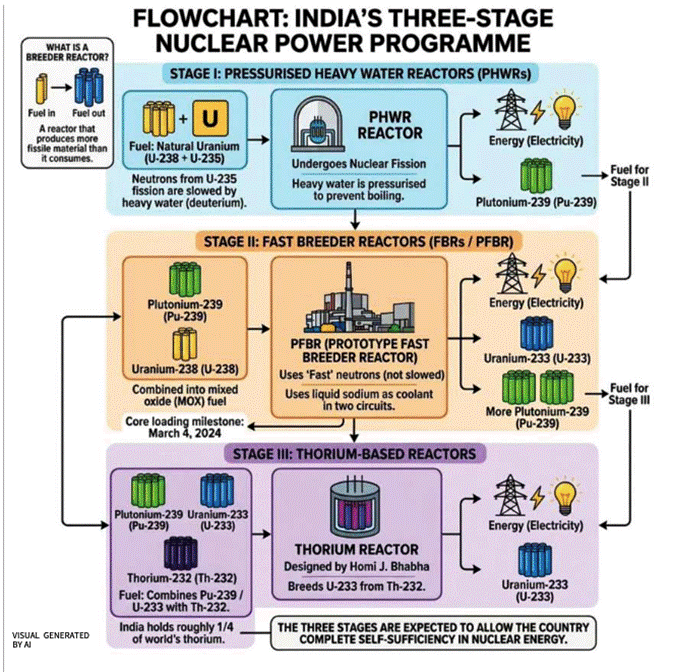
- FBR uses plutonium as fuel and fast neutrons (no moderator) to sustain fission reactions.
- Core is surrounded by a “blanket” of depleted uranium (U-238), which absorbs neutrons and converts into plutonium.
- Thus, FBR produces more fuel than it consumes, achieving higher fuel efficiency (~10% vs ~1% in PHWRs).
FBR vs PHWR (Key Differences)
- Fuel type:
- PHWR → Natural uranium
- FBR → Plutonium + depleted uranium
- Neutron speed:
- PHWR → Slow neutrons (moderator used)
- FBR → Fast neutrons (no moderator)
- Fuel efficiency:
- PHWR → ~1% utilisation
- FBR → ~10% or higher
- Breeding capability:
- PHWR → Limited plutonium generation
- FBR → Produces more plutonium (breeder reactor)
- Coolant:
- PHWR → Heavy water
- FBR → Liquid sodium
India’s Three-Stage Nuclear Programme
Stage 1: PHWR
- Uses natural uranium (U-235)
- Produces electricity + plutonium + depleted uranium
Stage 2: FBR
- Uses plutonium (from Stage 1)
- Converts U-238 → plutonium (breeding)
- Acts as a bridge stage for fuel multiplication
Stage 3: Thorium-based Reactors
- Uses thorium (Th-232 → U-233)
- Enables long-term energy security due to India’s large thorium reserves
Why are FBRs difficult?
1. Technological Complexity
- Use of liquid sodium coolant, which reacts violently with air and water, requires perfect sealing and leak-proof systems.
2. Safety Challenges
- High-temperature operations and fast neutrons require advanced safety protocols and monitoring systems.
3. Economic Viability Issues
- High capital cost, delays, and maintenance complexity reduce economic competitiveness compared to other energy sources.
4. Global Experience
- Japan’s Monju reactor and France’s Superphénix faced shutdowns due to technical failures and high costs.
- Only Russia maintains a limited operational fleet of FBRs.
5. Fuel Cycle Complexity
- Requires advanced reprocessing and fuel fabrication infrastructure, increasing regulatory and technological burden.
India’s Approach to FBRs
- Driven by Department of Atomic Energy (DAE) under direct PMO oversight, ensuring policy continuity across political cycles.
- PFBR designed by Indira Gandhi Centre for Atomic Research (IGCAR) and built by BHAVINI.
- However, faced:
- Cost escalation (₹3,500 crore → ₹6,800 crore)
- Repeated delays in commissioning
What happens after Criticality?
- Reactor operates at low power levels for months to test behaviour under various operating conditions.
- Engineers monitor:
- Temperature stability
- Neutron flux
- Safety parameters
- After validation, reactor moves to power escalation phase before commercial approval.
What next for PFBR?
- Gradual increase in power output after safety validation and performance checks.
- Approval from Atomic Energy Regulatory Board (AERB) required for commercial operation.
- Transition from experimental reactor → commercial electricity generation plant.
- Parallel development of:
- Fuel reprocessing facilities
- Future breeder reactors
Key Takeaways
- FBRs are crucial for fuel multiplication and long-term nuclear sustainability, especially given India’s limited uranium and abundant thorium.
- Despite technical feasibility, challenges in cost, safety, and scalability limit widespread adoption.
- PFBR criticality marks a strategic milestone, but commercial success will determine viability of India’s nuclear vision.
Prelims Pointers
- PFBR → Kalpakkam
- Criticality → self-sustained chain reaction
- FBR fuel → plutonium
- Blanket → depleted uranium
- Output → more fuel than consumed
- PHWR fuel → natural uranium
- Moderator → present in PHWR, absent in FBR
Elephanta Island Excavation – 1,500-Year-Old Stepped Reservoir Discovery
Why in News?
- A 1,500-year-old stepped reservoir has been discovered on Elephanta Island near Mumbai during excavations by the Archaeological Survey of India.
- The discovery highlights advanced water management systems and maritime linkages of early historic India, particularly during the Kalachuri period.
Relevance
- GS Paper I (History & Culture)
- Ancient Indian history, archaeology, water management
- GS Paper I (Geography)
- Human-environment interaction
Practice Question
Q1.Discuss the significance of recent archaeological findings at Elephanta Island in understanding ancient Indian water management systems.(250 Words)

Key Findings
1. Stepped Reservoir Structure
- A large T-shaped stepped reservoir measuring approximately 14.7 m length and 6.7–10.8 m width, excavated up to 5 metres depth with 20 visible steps.
- Constructed using carefully aligned stone blocks transported from the mainland, indicating advanced planning and resource mobilisation.
2. Water Management Significance
- Built to address low groundwater retention due to rocky terrain, where rainwater quickly runs off into the sea despite heavy monsoon rainfall.
- Represents a sophisticated rainwater harvesting system, showcasing early engineering solutions adapted to local ecological constraints.
3. Associated Archaeological Finds
- Discovery of a brick structure (possibly dyeing vat) suggests textile-related economic activity on the island.
- Artefacts include terracotta figurines, beads (carnelian, quartz), glass and stone bangles, indicating a vibrant cultural and artisanal economy.
4. Maritime Trade Evidence
- Around 3,000 amphorae sherds (Mediterranean origin) and torpedo jars from West Asia, including Mesopotamia, were found at the site.
- These containers were used for wine, oil, and fish sauce, indicating extensive long-distance maritime trade networks.
5. Numismatic Evidence
- Around 60 coins (copper, lead, silver) discovered, including coins of Kalachuri ruler Krishnaraja (6th century CE).
- Identified through motifs like seated bull and temple symbol with inscription, helping establish chronology and political context.
6. Excavation Details
- Excavation initiated in November 2025, with 19 trenches (10×10 m each) explored so far by ASI’s Mumbai Circle.
- Findings indicate a multi-functional settlement combining water systems, trade, and habitation activities.
Key Observations
- Demonstrates integration of hydraulic engineering + maritime economy + cultural activity, reflecting a complex settlement rather than a purely religious site.
- Confirms Elephanta Island’s role as a strategic node in ancient Indian Ocean trade networks connecting India with Mediterranean and West Asia.
- Shows continuity of indigenous water management traditions, adapted to challenging ecological conditions like rocky islands.
Historical Significance
- Links the site to the Kalachuri period (6th century CE), enriching understanding of early medieval political and economic structures.
- Enhances the importance of Elephanta beyond its famous rock-cut cave temples, adding a dimension of settlement archaeology.
Key Takeaways
- The discovery highlights advanced ancient engineering and water conservation practices, crucial for sustaining settlements in difficult terrains.
- Strong evidence of global maritime trade networks, reinforcing India’s historical role in trans-regional commerce.
- Combines archaeology, economy, and ecology, providing a holistic understanding of early historic coastal settlements.
Prelims Pointers
- Location → Elephanta Island (Mumbai coast)
- Discovery → stepped reservoir
- Age → ~1500 years
- Structure → T-shaped
- Depth → ~5 metres
- Steps exposed → 20
- Built with → stone blocks (imported)
- Dynasty → Kalachuri
- Ruler → Krishnaraja
New Pulsar-Based Distance Measurement Technique
Why in News?
- Indian scientists, including researchers from IIT-Kanpur, developed a new method to measure cosmic distances using pulsars, improving accuracy beyond traditional models.
- The method combines dispersion and scattering effects in pulsar signals, refining distance estimation in complex regions like the Gum Nebula.
Relevance
- GS Paper III (Science & Technology)
- Space science, astrophysics, observational techniques
Practice Question
Q1.Explain how pulsars are used in measuring cosmic distances. Discuss recent advancements in this field.(250 Words)
Key Concept: Pulsars
About
- Pulsars are rapidly rotating neutron stars, remnants of dead stars, emitting beams of radio waves like a lighthouse sweeping across space.
- They have extremely stable rotation rates, making them precise cosmic clocks used in astrophysical measurements.
Pulsar Timing
- Millisecond pulsars spin hundreds of times per second, producing highly regular signals used to detect phenomena like gravitational waves.
- Any variation in signal arrival time indicates disturbances or intervening astrophysical effects.
Existing Method: Dispersion Measure (DM)
- Dispersion occurs when radio waves pass through ionised gas (plasma), causing lower frequencies to slow more than higher frequencies.
- By measuring time delays between frequencies, astronomers estimate the number of free electrons along the path, giving a rough distance.
- Limitation: Depends on models of electron distribution, which are unreliable in complex regions like nebulae.
New Method: Combining Dispersion + Scattering
1. Scattering Effect (Scintillation)
- Irregular plasma causes radio waves to scatter and take multiple paths, leading to signal distortion and brightness variation.
- This results in scatter broadening, where pulses appear stretched due to delayed arrival times.
2. Integrated Approach
- Scientists combined dispersion measure (DM) with scatter broadening to improve distance estimation accuracy.
- This dual-method approach helps identify location and density of turbulent plasma along the line of sight.
3. k-Factor Innovation
- Introduced a parameter called k-factor to simplify complex scattering dependencies such as turbulence and electron density.
- Estimated using nearby pulsars and applied as a range of values to account for uncertainties in different regions.
Key Findings
- The method showed that scattering in the Gum Nebula dominates pulsar signal distortion, refining understanding of interstellar medium structure.
- Determined that the Vela Pulsar lies behind the nebula’s front shell, improving spatial mapping accuracy.
- Study used 10 pulsars in a single region, with plans to expand analysis to ~300 pulsars across the galaxy.
Advantages of the New Method
- Provides more accurate distance estimates in regions where traditional DM-based models fail due to complex plasma structures.
- Helps map the interstellar medium (ISM) more precisely, improving astrophysical models of the Milky Way.
- Unlike parallax methods, it has no strict distance limitation, enabling measurement of distant or extragalactic objects.
Limitations
- Still less precise than parallax-based methods, which remain the gold standard for nearby astronomical distance measurements.
- Requires complex modelling and estimation of k-factor, especially in highly turbulent regions of space.
Future Applications
- Can be applied to study fast radio bursts (FRBs) and other distant cosmic phenomena beyond the Milky Way.
- Enhances understanding of galactic structure, plasma distribution, and cosmic signal propagation.
Key Takeaways
- The study marks a shift from single-parameter (dispersion) to multi-parameter (dispersion + scattering) distance estimation models.
- It strengthens India’s role in advanced astrophysical research and radio astronomy.
- The method bridges gaps in measuring distances in complex astrophysical environments, improving cosmic mapping capabilities.
Prelims Pointers
- Pulsars → rotating neutron stars
- Emit → radio wave beams
- Act as → cosmic clocks
- Dispersion → delay due to plasma
- DM → measures electron density
- Scattering → signal distortion
- Scintillation → twinkling effect
Subansiri Lower Hydel Project – Tariff Concerns & State Refusal
Why in News?
- Assam and Meghalaya have refused to procure additional power from the Subansiri Lower Hydroelectric Project citing high tariffs and consumer cost burden.
- The issue highlights tensions between project cost escalation and affordable power procurement in India’s hydropower sector.
Relevance
- GS Paper III (Economy & Infrastructure)
- Power sector, hydropower, tariff economics
- GS Paper II (Polity & Governance)
- Centre-State relations, cooperative federalism
Practice Question
Q1.“Cost overruns in infrastructure projects undermine economic viability and federal cooperation.”Examine with reference to hydropower projects in India.(250 Words)
Subansiri Lower Hydroelectric Project
About
- Subansiri Lower is a 2000 MW hydropower project located on the Assam–Arunachal Pradesh border and developed by NHPC.
- Conceived in 2005 as India’s largest hydel project, it faced prolonged delays due to protests, environmental concerns, and legal challenges.
Power Allocation Structure
- Power is allocated as firm share, free power, and unallocated central pool, distributed among northeastern states and other beneficiaries.
- Assam and Meghalaya are refusing only the additional allocation from the unallocated central share, not their mandatory firm allocation.
Key Issue: Tariff Escalation
1. Cost Overruns
- Project cost increased from ₹6,285 crore (2002 estimate) to ~₹26,000 crore, driven by delays, escalation, and interest during construction.
- This has sharply increased the tariff from ~₹2/unit (initial estimate) to ₹7–7.7/unit in 2026, making it economically unviable.
2. Comparison with Market Tariffs
- Average NHPC hydropower tariff stood at ~₹3.15/unit (2023–24), significantly lower than Subansiri’s projected tariff.
- Higher tariff makes procurement non-competitive compared to other power sources, including renewables and existing hydel projects.
State-Level Concerns
1. Consumer Cost Burden
- States argue that purchasing high-cost power will increase power purchase costs, ultimately passed on to consumers through higher tariffs.
- Regulatory bodies emphasise economical procurement and consumer interest, rejecting costly power agreements.
2. Adequate Power Availability
- Assam and Meghalaya have indicated they have sufficient long-term power arrangements, reducing the need for expensive additional supply.
- Meghalaya expects additional capacity from upcoming domestic hydropower projects, ensuring self-sufficiency.
3. Precedent of Refusal
- Punjab earlier declined its share citing high tariff and regulatory disapproval, indicating broader resistance across states.
Operational & Structural Challenges
1. Delays and Disruptions
- Construction was stalled between 2011–2019 due to local protests, dam safety concerns, and environmental litigation.
- Only 3 out of 8 units (750 MW) have been commissioned so far, delaying full project benefits.
2. Environmental Concerns
- Issues related to downstream ecological impact, hydro-peaking restrictions, and wildlife movement (elephants) remain unresolved.
- These factors contribute to regulatory uncertainty and operational constraints.
3. Federal Coordination Issues
- Disputes between states and central agencies reflect challenges in cooperative federalism in energy sector planning and allocation.
- Final decisions require intervention by bodies like the Central Electricity Authority (CEA) and Ministry of Power.
Key Takeaways
- The Subansiri case highlights the economic viability challenge of large hydropower projects, especially with cost overruns and delays.
- There is a growing shift towards cost-sensitive procurement, with states prioritising affordability over long-term allocation commitments.
- The issue underscores the need for better project planning, tariff rationalisation, and Centre-State coordination in infrastructure projects.
Prelims Pointers
- Subansiri Lower → hydropower project
- Capacity → 2000 MW
- Location → Assam–Arunachal border
- Developer → NHPC
Forensic Science Push in Criminal Justice System (MHA Directive, 2026)
Why in News?
- The Union Ministry of Home Affairs has directed states to fill vacancies in Forensic Science Laboratories and clear pending forensic cases within 90 days.
- The move aims to strengthen forensic capacity in line with the new criminal laws, improving investigation quality and conviction rates in serious crimes.
Relevance
- GS Paper II (Governance)
- Criminal justice reforms, institutional capacity
- GS Paper III (Internal Security)
- Forensic technology, policing reforms
Practice Question
Q1.“Strengthening forensic science is essential for improving conviction rates in India.”
Discuss.(250 Words)
Key Directives by MHA
1. Clearing Backlog & Filling Vacancies
- States have been directed to eliminate forensic backlogs within three months through special drives and institutional monitoring mechanisms.
- Urgent recruitment, including contractual hiring, has been emphasised to address acute manpower shortages in forensic laboratories.
2. Capacity Building
- Focus on strengthening manpower, infrastructure, and technology through coordination with the Directorate of Forensic Science Services.
- Regular training programmes mandated for forensic experts, police investigators, and judicial officers to ensure proper evidence handling and analysis.
3. Infrastructure Expansion
- States are required to expand regional and district-level FSLs, improving accessibility and reducing delays in forensic examination processes.
- Deployment of advanced equipment for physical, biological, chemical, and digital evidence has been prioritised for modern investigations.
4. Mobile Forensic Units
- Increased use of Mobile Forensic Vans for on-site evidence collection to ensure scientific accuracy and prevent contamination during crime scene investigation.
- Dedicated forensic evidence collection teams to be established at district and sub-divisional levels for timely response.
5. Recruitment Reforms
- Review of recruitment rules to recognise specialised forensic degrees from institutions like National Forensic Sciences University.
- Distinction between traditional science graduates and forensic specialists to improve quality and expertise in investigations.
6. Institutional Autonomy
- FSLs to be granted administrative independence from police departments to ensure scientific neutrality and credibility of forensic evidence.
- Separation aims to strengthen objectivity and reliability of forensic reports in judicial proceedings.
7. Standardisation & Accreditation
- Mandatory adherence to DFSS Standard Operating Procedures (SOPs) for evidence handling and forensic analysis.
- All laboratories to obtain national and international accreditation, ensuring global standards in forensic practices.
8. Digital Integration
- Integration of forensic systems with the e-Forensics module under the Interoperable Criminal Justice System (ICJS) for seamless data flow.
- Enables faster transmission of forensic reports to courts, reducing procedural delays in justice delivery.
9. Innovation & Collaboration
- Encouragement of collaboration with IITs, NITs, and universities to promote innovation in forensic technologies and methodologies.
- Initiatives like hackathons to develop advanced forensic tools and solutions for modern investigative challenges.
10. Monitoring & Funding
- States directed to allocate dedicated budgets alongside central assistance for forensic infrastructure and manpower development.
- DFSS and its Central Forensic Science Laboratories tasked with monitoring progress and providing technical support to states.
Context: Need for Reform
- Conviction rates in serious crimes remain low (~30–40%), often due to weak forensic support and poor evidence handling practices.
- Rising complexity of crimes, including cyber and digital offences, necessitates technology-driven investigative systems.
Key Takeaways
- The directive reflects a shift towards science-based, technology-driven policing, strengthening the evidentiary foundation of criminal justice.
- Focus on capacity, autonomy, and standardisation indicates systemic reform rather than incremental improvements in forensic infrastructure.
- Integration of digital systems and specialised expertise aims to reduce delays, improve conviction rates, and enhance public trust in justice delivery.
Prelims Pointers
- FSL → Forensic Science Laboratory
- DFSS → Directorate of Forensic Science Services
- CFSL → Central Forensic Science Laboratories
- ICJS → Interoperable Criminal Justice System
- e-Forensics → digital evidence module
- NFSU → National Forensic Sciences University
- SOP → Standard Operating Procedure
Land Inequality in Rural India
Why in News?
- A working paper by the World Inequality Lab highlights severe land concentration in rural India, with top 10% households owning 44% of total land.
- The findings revive concerns about agrarian inequality, landlessness, and structural rural distress, impacting inclusive growth and agricultural productivity.
Relevance
- GS Paper I (Society)
- Inequality, agrarian structure
- GS Paper III (Economy & Agriculture)
- Land reforms, inclusive growth
Practice Question
Q1.“Land inequality remains a major constraint to inclusive rural development in India.”
Critically examine.(250 Words)
Key Findings
1. Land Concentration
- Top 10% rural households own 44% of total land, indicating high concentration of land ownership in a small elite segment.
- Top 5% households own 32%, while the top 1% alone control 18% of total land, reflecting extreme inequality at the top.
2. Landlessness
- Around 46% of rural households are landless, highlighting widespread exclusion from productive agricultural assets.
- Punjab records the highest landlessness at 73%, despite being a highly productive agricultural state.
3. Village-Level Concentration
- The largest landholder in a village owns ~12.4% of total land on average, indicating dominance of large farmers in local agrarian structures.
- In 3.8% of villages, a single landlord controls more than 50% of land, reflecting quasi-feudal concentration patterns.
4. State-Level Inequality
- Bihar shows the highest concentration, with top household owning up to 20.1% of land, followed by high inequality in Kerala and Punjab.
- Kerala has the highest Gini coefficient (~90), followed by Bihar, Punjab, Tamil Nadu, and West Bengal (~80 levels).
5. Relative Equality States
- Karnataka and Rajasthan show relatively lower inequality with Gini below 65, indicating more balanced land distribution compared to other states.
- Uttar Pradesh records the lowest top-holder share (~7.3%), suggesting comparatively dispersed ownership patterns.
6. Role of Landlessness
- Excluding landless households significantly reduces Gini coefficients, indicating that landlessness is a major driver of inequality in rural India.
7. Landholding Size Distribution
- Average landholding size among landed households is 0.62 hectares, indicating predominance of small and marginal farmers.
- About 77.5% of land is held by small holdings (below 2 hectares), reflecting fragmentation despite concentration at the top.
Key Observations
- Coexistence of high land concentration and high fragmentation reflects a dual agrarian structure with both large landlords and marginal farmers.
- Land inequality persists despite decades of land reforms, indicating implementation gaps and structural rigidity in rural land markets.
- High landlessness suggests limited asset ownership, reinforcing rural poverty, informal labour dependence, and migration pressures.
Implications
1. Economic
- Concentrated land ownership limits productive efficiency and equitable agricultural growth, as small farmers lack scale while large holdings may remain underutilised.
2. Social
- Land inequality reinforces caste and class hierarchies, perpetuating socio-economic exclusion and rural power imbalances.
3. Governance
- Weak land records, tenancy restrictions, and poor reform implementation hinder equitable land redistribution and efficient land markets.
4. Developmental
- High landlessness increases dependence on wage labour and government welfare schemes, limiting pathways for sustainable livelihood creation.
Key Takeaways
- Rural India exhibits deep structural land inequality, with significant concentration at the top and widespread landlessness at the bottom.
- The agrarian system reflects a dual challenge of inequality and fragmentation, constraining productivity and inclusive development.
- Addressing land inequality remains critical for achieving inclusive growth, rural transformation, and social justice objectives.
Prelims Pointers
- Top 10% land ownership → 44%
- Top 5% → 32%
- Top 1% → 18%
- Landless households → ~46%
- Punjab landlessness → ~73%
- Average holding size → 0.62 ha
- Largest landholder → ~12.4% village land
- Villages with >50% land → 3.8%
- Highest Gini → Kerala (~90)
India Withdraws from Hosting COP33
Why in News?
- India has withdrawn its candidature to host COP33 (2028), which was earlier proposed by the Prime Minister during COP28 Dubai 2023.
- The decision comes after internal review of commitments, surprising experts as India was positioning itself as a climate leader of the Global South.
Relevance
- GS Paper II (International Relations)
- Climate diplomacy, global governance
- GS Paper III (Environment)
- Climate change, global negotiations
Practice Question
Q1.“India’s withdrawal from hosting COP33 reflects a balancing act between domestic priorities and global climate leadership.”Examine.(250 Words)
COP (Conference of Parties) – Context
About
- COP is the annual summit under the UNFCCC, where countries negotiate climate action on mitigation, adaptation, and finance.
- Hosting rotates among UN regional groups, with COP33 scheduled to be hosted by a country from the Asia-Pacific region.
Key Developments
1. Withdrawal Decision
- India formally withdrew its candidature via communication to the Asia-Pacific Group after reviewing its commitments for the year 2028.
- The decision was taken at the highest level, though official reasons have not been publicly detailed by the government.
2. Background of Candidature
- India announced its intent to host COP33 during COP28 in Dubai (2023) as part of its commitment to global climate processes.
- The candidature had received support from BRICS nations, reflecting India’s emerging leadership role in climate diplomacy.
3. Hosting Context
- India has hosted a climate COP only once earlier (2002), making COP33 an opportunity to reassert leadership in global climate governance.
- Following India’s withdrawal, South Korea remains the primary contender for hosting COP33 in 2028.
Possible Reasons
1. Administrative and Logistical Burden
- Hosting COP involves ~200 countries and ~75,000 participants over two weeks, requiring massive administrative, diplomatic, and logistical coordination.
- Government may prioritise other major events (e.g., Commonwealth Games 2030) and avoid overlapping commitments near election cycles.
2. Climate Commitment Pressures
- Hosting COP could increase international scrutiny and pressure on India to enhance climate ambition, especially regarding updated NDC targets.
- Withdrawal may reflect a strategic choice to avoid binding expectations in global climate negotiations.
3. Domestic Political Considerations
- Timing close to 2029 general elections could make hosting a large global summit politically and administratively sensitive.
- Government may prefer domestic agenda prioritisation over international event commitments during this period.
Implications
1. Global Climate Leadership
- Withdrawal weakens India’s effort to project itself as a leader of the Global South in climate negotiations and climate justice advocacy.
- India loses an opportunity to shape global climate discourse from a position of host leadership.
2. Strategic and Diplomatic Impact
- Hosting COP provides leverage to influence agenda-setting, negotiation framing, and coalition-building, which India now forfeits.
- May affect India’s positioning in forums like BRICS and developing country coalitions on climate issues.
3. Regional Representation
- South Asia, being highly climate-vulnerable, loses a platform to highlight regional concerns such as heat stress, floods, and adaptation finance needs.
- Limits visibility of developing country priorities in global negotiations.
4. Economic and Soft Power Loss
- Hosting COP could have showcased India’s achievements in renewable energy, electric mobility, and climate initiatives, enhancing global soft power.
- Missed opportunity for investment attraction and climate technology partnerships.
Key Takeaways
- India’s withdrawal reflects a trade-off between global climate leadership and domestic administrative priorities, highlighting complexities in international commitments.
- The decision signals a cautious approach towards high-stakes global negotiations involving accountability and ambition escalation.
- It underscores the evolving nature of India’s climate diplomacy, balancing developmental priorities with global expectations.
Prelims Pointers
- COP → Conference of Parties
- COP under → UNFCCC
- COP28 → Dubai (2023)
- COP33 → scheduled for 2028
- Hosting rotation → UN regional groups
- Region for COP33 → Asia-Pacific
- India hosted COP → 2002