

01
Mali’s Army Retakes Kidal: The Tuareg Question, Jihadist Insurgency and Russia’s Role in the Sahel
ImportantGS-II · IR — Africa, Effect of Policies of Other Countries · GS-I Places in NewsPrelims + MainsNews reports (Oct 2026)
Mali’s armed forces, supported by Russia’s Africa Corps, have reportedly re-entered Kidal after the Tuareg separatist Azawad Liberation Front (FLA) announced a “strategic withdrawal” following heavy air strikes. The town had fallen to separatists and the al-Qaeda-linked JNIM in April 2026.
◈ Basics First — Mali, the Sahel and the Tuareg
- Mali — a landlocked West African country, former French colony (independent 1960); capital Bamako; the Niger River runs through its centre.
- The Sahel — the semi-arid belt south of the Sahara, stretching from Senegal to Sudan; marked by drought, weak state presence and armed groups.
- Kidal — a desert town in the far north-east, near the Algerian border and the Adrar des Ifoghas massif; the political centre of the Tuareg demand for an independent “Azawad”.
- The Tuareg — a Berber-speaking, traditionally nomadic people spread across Mali, Niger, Algeria and Libya; they rebelled in 1963, 1990, 2006 and 2012.
Figure 1 — Mali and the Location of Kidal
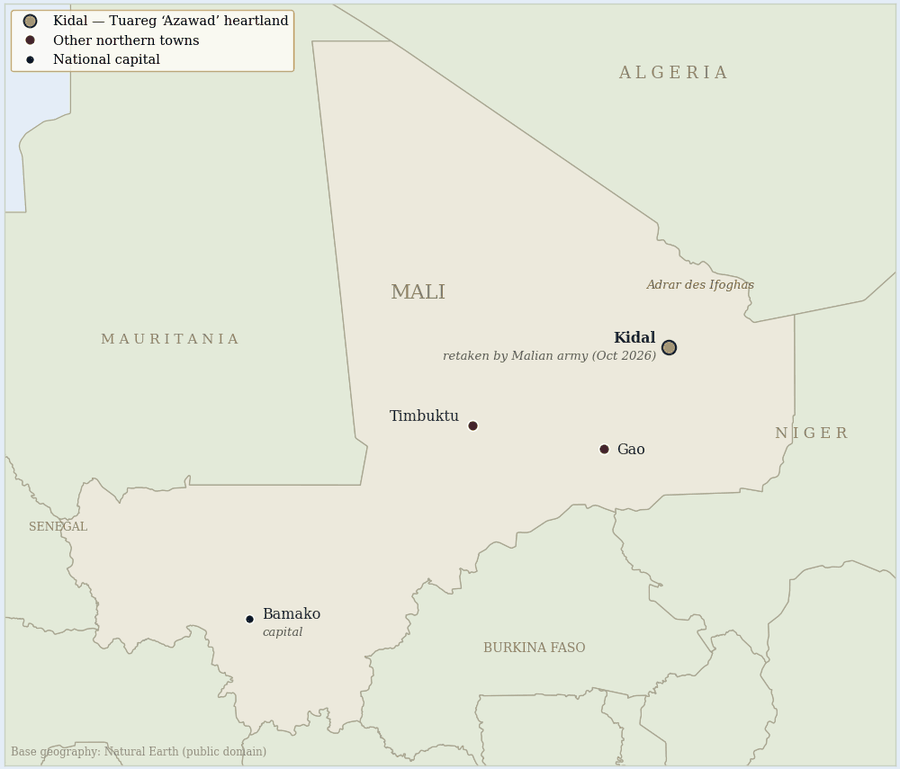
Kidal lies about 1,500 km north-east of Bamako — closer to Algeria than to the capital. Base geography: Natural Earth 1:10m, public domain.
Static Background — A Conflict Timeline
- 2012 — a Tuareg rebellion declares “Azawad” independent; jihadist groups seize the north; a military coup in Bamako.
- 2013 — French Operation Serval (later Barkhane, to 2022) and the UN mission MINUSMA (2013–2023) deploy.
- 2015 — Algiers Peace Agreement with northern armed groups; Mali’s junta terminated it in January 2024.
- 2020 and 2021 — two coups bring a military government; ties with France rupture and Russian Wagner forces arrive, later replaced by the state-controlled Africa Corps (2025).
- November 2023 — the army first retook Kidal; separatists regained it in April 2026, before its recapture now.
- Alliance of Sahel States (AES) — Mali, Burkina Faso and Niger (2023), which left ECOWAS in January 2025.
Significance and India Angle
- Symbolic capital — control of Kidal is a test of the junta’s claim to territorial integrity; separatists retain mobility in the desert.
- Jihadist threat — JNIM (al-Qaeda) and the Islamic State Sahel Province exploit the conflict; the Sahel has become a leading region for terrorism deaths.
- Great-power shift — the exit of France and the UN, and the rise of Russia, reshape the region; reported civilian casualties from air strikes raise human-rights concerns.
- India — interests in the safety of Indian workers (three Indian nationals were kidnapped in western Mali in July 2025), counter-terrorism cooperation, development partnership through lines of credit and ITEC, and access to West African resources.
✎ Mains Practice Question
The Sahel has emerged as a hub of separatism, jihadist insurgency and great-power rivalry. Examine the factors behind instability in the region, with reference to Mali, and discuss its implications for India’s Africa policy. 15 marks · 250 words
Science & TechnologyGeneral Studies Paper III
02
ARIES-Led Global Study Tracks a Decade of Flickering in OJ 287, a Rare Binary Supermassive Black Hole System
ImportantGS-III · S&T — Space, Achievements of Indians in S&TPrelims + MainsPIB · Department of Science & Technology
A campaign coordinated by the Aryabhatta Research Institute of Observational Sciences (ARIES), Nainital — 106 scientists from 18 countries and 48 institutions, using about two dozen telescopes — has produced the densest optical record of the blazar OJ 287 in 150 years, covering 2015–2025.
◈ Basics First — Black Holes, Quasars and Blazars
- Supermassive black holes (SMBHs) — of millions to billions of solar masses, sitting at the centres of most large galaxies.
- Active Galactic Nucleus (AGN) — a galactic centre where matter falling into the SMBH forms a hot accretion disc and can launch relativistic jets of plasma.
- Blazar — an AGN whose jet points almost directly at Earth; it shows strong, rapidly varying emission from radio waves to gamma rays.
- Binary SMBH — formed when galaxies merge; two black holes orbit each other and eventually coalesce, releasing gravitational waves.
Figure 2 — The Binary Black Hole Model of OJ 287

In the established model, the smaller black hole crosses the bigger one’s accretion disc twice per 12-year orbit, producing double-peaked flares. The illustration’s 18.35-billion-solar-mass primary comes from earlier orbital modelling; the new spectral estimate (≥3.89 billion) is far lower — a live scientific debate. Image as released with the PIB note; reproduced with credit for educational use.
Key Findings
- About OJ 287 — roughly 4 billion light years away; its 12-year double-peaked brightness cycle was identified in 1988 by Finnish astronomers using optical records going back to 1880.
- Data — the most extensive multiband optical time series of the object, supported by observations across the electromagnetic spectrum.
- Black hole mass — spectra from the Steward Observatory (USA), using the width of the [O III] emission line, put the central black hole at at least 3.89 billion solar masses.
- Science gained — tracking the relative positions of the two black holes, changes in brightness, spectrum and polarisation, and searching for emission from the smaller black hole.
▤ Institutions & Terms to Know
- ARIES, Nainital — autonomous institute of the DST; operates the 3.6-m Devasthal Optical Telescope, India’s largest optical telescope, and the International Liquid Mirror Telescope at Devasthal.
- Multi-messenger astronomy — studying one source through light, gravitational waves, neutrinos and cosmic rays.
- Gravitational waves — first directly detected by LIGO in 2015; LIGO-India (Hingoli, Maharashtra) was approved in 2023. Binary SMBHs are prime sources of the low-frequency waves sought by pulsar timing arrays, including India’s InPTA.
✎ Mains Practice Question
What is multi-messenger astronomy? Explain how long-term monitoring of objects such as binary supermassive black holes can advance our understanding of the universe, highlighting India’s contribution. 10 marks · 150 words
03
Why Nuclear Power Is Central to the Race for Permanent Moon Bases
ImportantGS-III · S&T — Space Technology · GS-II International TreatiesPrelims + MainsThe Hindu · Analysis
NASA plans to install a nuclear fission reactor near the Moon’s south pole by 2030, while Russia is developing a reactor for the China-led International Lunar Research Station (ILRS). Power for a semi-permanent base has become the first test of the US–China lunar race.
◈ Basics First — Why Not Solar?
- Lunar night — a location on the Moon gets about 14 Earth days of darkness at a time, and temperatures plunge far below freezing.
- South pole — attractive because permanently shadowed craters may hold water ice, but they receive no sunlight at all.
- Fission reactor — splits uranium nuclei to produce steady heat and electricity regardless of sunlight; NASA tested a small prototype (KRUSTY, 2018) under its Kilopower project.
- RTG (Radioisotope Thermoelectric Generator) — converts heat from the natural decay of plutonium-238; reliable but produces only hundreds of watts, suited to probes and rovers rather than bases.
The Legal Framework
- Outer Space Treaty (1967) — bans nuclear weapons in orbit and on celestial bodies and any national appropriation of the Moon, but does not prohibit nuclear power.
- UN Principles Relevant to the Use of Nuclear Power Sources in Outer Space (1992) — non-binding safety guidelines.
- Moon Agreement (1979) — declares the Moon the common heritage of mankind; few space powers have ratified it (India signed but has not ratified).
- Artemis Accords (2020) — US-led principles; provide for temporary “safety zones” to avoid harmful interference. India signed in June 2023. Critics fear such zones could become de facto territorial claims.
Significance and the India Angle
- Two blocs — the Artemis programme and the ILRS (China–Russia, 2021) are competing for the same resource-rich polar region; whoever establishes power infrastructure first gains a practical edge.
- Safety concerns — launch accidents, radiation shielding and disposal of spent fuel need international norms.
- India — Chandrayaan-3 landed near the south pole (August 2023); India aims to set up the Bharatiya Antariksh Station by 2035 and land an Indian on the Moon by 2040, making long-duration power technology strategically relevant.
✎ Mains Practice Question
Plans for nuclear reactors on the Moon highlight the gaps in the international legal regime governing outer space. Discuss, with reference to the Outer Space Treaty and the Artemis Accords, and suggest a position India should take. 15 marks · 250 words
Environment & EcologyGeneral Studies Paper III
04
Why Stubble Fires Keep Coming Back: Water Law, Procurement Incentives and the Measurement Problem
Core TopicGS-III · Environment — Pollution; Agriculture — Cropping Patterns, MSPPrelims + MainsThe Hindu · Full Context
Every October–November, burning of paddy straw in Punjab and Haryana worsens air quality across North India. The analysis argues that the practice persists because of a combination of groundwater law, assured procurement, free power and a narrow window between crops — and that official claims of a sharp decline rest on flawed measurement.
◈ Basics First — What Is Stubble Burning?
- Stubble — the lower stalks left in the field after harvest. Combine harvesters, in use since the late 1970s, leave about a foot of stubble.
- Scale — Punjab and Haryana together produce around 29 million tonnes of paddy straw a year.
- Harm — releases PM2.5, carbon monoxide, VOCs and carcinogens that form smog; burns away soil nitrogen, sulphur, phosphorus, potash, organic matter and moisture, raising fertiliser use for the next crop.
- Why it peaks in winter — calm winds and temperature inversion in the Indo-Gangetic plain trap pollutants near the ground.
The Root Causes
- Punjab Preservation of Sub-Soil Water Act, 2009 — to save groundwater, it barred paddy nursery sowing before 10 May and transplanting before 10 June. This pushed harvest to late October, leaving only a 10–15 day window before wheat sowing.
- The groundwater crisis — a 2009 NASA GRACE satellite study found that Punjab, Haryana and Rajasthan lost about 109 cubic km of groundwater in 2002–2008.
- Long-duration varieties — high-yield PUSA-44 (150–160 days) further squeezed the window.
- Incentive structure — assured MSP procurement and free or near-free farm power lock farmers into the water-intensive rice–wheat cycle.
Figure 3 — Procurement as a Share of Production, Average 2012–2024
0%50%100%37%87%74%30%70%63%PaddyWheatIndiaPunjabHaryanaNational averages include Punjab and Haryana; excluding them, the gap would be wider
Assured procurement of more than four-fifths of Punjab’s paddy makes switching to other crops economically unattractive. Data as cited in the article.
Solutions and Their Limits
- In-situ — crop residue management (CRM) machines (Happy Seeder, Super Seeder, rotavators), short-duration varieties such as PR-126, direct seeding of rice (DSR), and IARI’s PUSA bio-decomposer. But seeders need a costly 60-HP tractor; hiring costs around ₹10,000.
- Ex-situ — using straw for compressed biogas, bio-ethanol, biomass power and co-firing; collection costs ₹1,500–2,500 per acre.
- Haryana’s incentive model — ₹1,000/acre for CRM use, ₹4,000/acre for DSR, ₹7,000/acre for crop diversification, plus panchayat incentives; Punjab has relied mainly on in-situ machinery.
- Enforcement — CPCB flying squads were deployed in 2025; a Parliamentary committee recommended that penalising farmers be the last resort, with a minimum price for selling straw.
▤ The Measurement Problem
- Official claim — Punjab and Haryana together recorded a 90% reduction in fire incidents in 2025 compared with 2022.
- Method — the CREAMS protocol (IARI) counts active fires from NASA’s polar-orbiting MODIS and VIIRS sensors, which pass over India only around 10:30 am–1:30 pm.
- Evidence of evasion — an ISRO-led study using geostationary satellites found farmers shifting burning to evening hours; a multi-satellite estimate of burnt area showed a decline of only about 30%.
- Implication — combine polar and geostationary data and measure burnt area, not just fire counts.
◈ Institutions & Law to Know
- Commission for Air Quality Management in NCR and Adjoining Areas Act, 2021 — created the CAQM (replacing the EPCA); farmers are kept out of its penal provisions but liable to environmental compensation for stubble burning.
- Graded Response Action Plan (GRAP) — staged anti-pollution measures in Delhi-NCR linked to AQI levels.
- Crop Residue Management scheme (2018) — central subsidy for CRM machinery in Punjab, Haryana, UP and Delhi.
- Judicial signals — the NGT (2018) held that farmers who burn stubble could be excluded from MSP benefits, a view the Supreme Court upheld in 2023.
Way Forward
- Short term — affordable access to CRM machines through custom hiring centres, assured straw purchase for CBG plants, promotion of short-duration varieties.
- Medium to long term — diversification away from paddy through price and procurement support for pulses, maize and oilseeds, and rational power pricing.
- Honest measurement — penal targets can create perverse incentives for farmers and officials to show rather than achieve reductions.
✎ Mains Practice Question
“Stubble burning is less a farmer’s choice than the outcome of policy incentives.” Critically examine this statement and suggest a mix of technological, economic and institutional measures to end the practice. 15 marks · 250 words
05
Living Planet Report 2026: Monitored Wildlife Populations Down 73% Since 1970, but Recovery Is Possible
Core TopicGS-III · Environment — Biodiversity Conservation, Reports & IndicesPrelims + MainsWWF · The Indian Express
WWF’s biennial Living Planet Report 2026 finds that the average size of monitored vertebrate populations fell by 73% between 1970 and 2022. Freshwater species fared worst, and the food system is named the single largest driver of biodiversity loss — yet about half of the tracked populations are stable or increasing.
◈ Basics First — Reading the Living Planet Index Correctly
- Living Planet Index (LPI) — tracks the average rate of change in the relative abundance of monitored vertebrate populations (amphibians, birds, fish, mammals, reptiles).
- What 73% does not mean — it is not the loss of 73% of individual animals, nor of 73% of populations or species; it is the average decline in population size.
- Data base (2026) — 35,803 populations of 5,790 species.
- History — developed by WWF in 1998; managed with the Zoological Society of London (ZSL) since 2006; used as an indicator under the CBD and the Kunming–Montreal Global Biodiversity Framework.
- WWF — founded in 1961; headquartered at Gland, Switzerland (also home to the IUCN).
Figure 4 — Average Decline in Monitored Wildlife Populations, 1970–2022
Global average−73%BY ECOSYSTEMFreshwater−85%Terrestrial−69%Marine−59%BY REGIONLatin America & Caribbean−95%Africa−80%Asia & the Pacific−49%
Freshwater ecosystems — hit by dams, pollution, over-abstraction and invasive species — show the steepest decline. Data: WWF Living Planet Report 2026.
Drivers and Signs of Recovery
- Main drivers — habitat loss and degradation, overexploitation, climate change, invasive species, pollution and disease.
- Food system — the leading cause of habitat destruction and overharvesting, and a major source of greenhouse gas emissions.
- Recoveries — green turtles, bluefin tuna, southern African elephants and tigers: global wild tiger numbers rose from about 3,200 (2010) to around 5,700 (2025).
- India’s share — India holds about three-quarters of the world’s wild tigers; the 2022 estimate was 3,682, reflecting Project Tiger (1973) and the NTCA.
- Positive tipping points — rapid growth of solar, wind and EVs shows systems can change fast; similar shifts are needed in food and finance.
◈ Static Background — The Convention on Biological Diversity
- CBD — opened for signature at the Rio Earth Summit (1992), alongside the UNFCCC; in force from 1993; India became a Party in 1994. Three objectives: conservation, sustainable use, and fair and equitable sharing of benefits.
- Cartagena Protocol on Biosafety — adopted 2000, in force 2003; regulates transboundary movement of living modified organisms.
- Nagoya Protocol on Access and Benefit-Sharing — adopted 2010, in force 2014.
- India’s law — the Biological Diversity Act, 2002 (amended 2023) and the National Biodiversity Authority; the CBD COP meets every two years.
- Kunming–Montreal GBF (2022) — 23 targets for 2030, including protecting 30% of land and sea (“30×30”).
✎ Mains Practice Question
The Living Planet Report identifies the global food system as the largest driver of biodiversity loss. Discuss this link and examine how India can align its agricultural practices with the goals of the Kunming–Montreal Global Biodiversity Framework. 15 marks · 250 words
Internal Security & Disaster ManagementGeneral Studies Paper III
06
SAREX-2026: Coast Guard Rehearses a Mass Maritime Rescue off Paradip, with Observers from 30 Countries
ImportantGS-III · Security — Maritime Security; Disaster Management · GS-II Regional GroupingsPrelims + MainsPIB · Ministry of Defence
The Indian Coast Guard (ICG) conducted the 12th National Maritime Search & Rescue Exercise (SAREX-2026) off Paradip, Odisha on 7–8 October 2026, simulating a mass rescue operation, and hosted the 24th National Maritime SAR (NMSAR) Board meeting at Bhubaneswar. 32 observers from 30 countries attended.
◈ Basics First — What Is Search and Rescue (SAR)?
- Search and rescue — locating people in distress and delivering them to a place of safety; at sea it covers ship sinkings, fires, man-overboard cases and aircraft ditchings.
- Search and Rescue Region (SRR) — the ocean area for which a country accepts SAR responsibility. India’s maritime SRR covers about 4.6 million sq km of the Indian Ocean.
- Mass Rescue Operation (MRO) — an incident where the number of people in distress exceeds the immediately available rescue capacity, demanding coordination of many agencies.
- Aeronautical–maritime link — air crashes at sea are handled jointly; procedures are harmonised in the IAMSAR Manual, issued jointly by the IMO and ICAO.
▤ Exercise at a Glance
- Scenario: a passenger aircraft with 228 people ditching at sea and colliding with a container vessel — concurrent aeronautical and maritime distress.
- Assets: 15 ICG ships, two Dornier aircraft, three Advanced Light Helicopters and a Chetak, IAF C-130J and Mi-17, two Navy ships, plus civil and State assets.
- International: 32 observers from 30 countries.
- NMSAR Board agenda: SAR preparedness, distress-alert management, faster mobilisation through technology integration and inter-agency coordination.
Static Background — India’s Maritime SAR Architecture
- Indian Coast Guard — set up on an interim basis in February 1977 and given statutory form by the Coast Guard Act, 1978; an armed force of the Union under the Ministry of Defence.
- Coordinating authority — the ICG coordinates maritime SAR in the Indian SRR through Maritime Rescue Coordination Centres (MRCCs) at Mumbai, Chennai and Port Blair.
- NMSAR Board — the apex national body for maritime SAR policy, chaired by the Director General, ICG, bringing together ministries, the armed forces, ports and shipping agencies.
- Distress alerting — the satellite-based COSPAS-SARSAT system (India’s mission control centre is at ISTRAC, Bengaluru) and ISRO-developed distress alert transmitters for fishing boats.
- Legal obligations — SOLAS Convention (1974) and the International Convention on Maritime Search and Rescue (1979) under the IMO; aeronautical SAR under Annex 12 of the Chicago Convention (ICAO).
Significance
- Preparedness — rising sea and air traffic, and the cyclone-prone east coast, make large-scale rescue capability essential.
- Maritime diplomacy — foreign observers support India’s role as a first responder in the Indian Ocean, in line with SAGAR (2015) and MAHASAGAR (2025).
- Interoperability — joint drills among the ICG, Navy, IAF, ports, airlines and State agencies test command, communication and handover procedures.
- Challenges — the vast SRR, safety of small fishing craft, and integration of alerts from multiple systems into a single picture.
✎ Mains Practice Question
India is responsible for search and rescue across a vast area of the Indian Ocean. Discuss the institutional framework for maritime SAR in India and examine how it supports India’s aspiration to be a first responder in the region. 10 marks · 150 words
Art, Culture & PersonalitiesGeneral Studies Paper I
07
Nobel Prize in Literature 2026: Canadian Poet-Classicist Anne Carson Honoured for Remaking Literary Forms
ImportantGS-I · Art & Culture — Literature; Awards & Personalities in NewsPrelims + MainsThe Indian Express
Anne Carson (76, Canada) — poet, classicist, essayist and translator — received the 2026 Nobel Prize in Literature “for her bold and inventive oeuvre that, in playful dialogue with the classical tradition, has created new forms for contemporary literature”.
◈ Basics First — The Nobel Prizes
- Origin — established by the will (1895) of Swedish chemist Alfred Nobel, inventor of dynamite; first awarded in 1901 in Physics, Chemistry, Medicine, Literature and Peace.
- Economics — the Sveriges Riksbank Prize in Economic Sciences, added in 1968, is not one of the original five.
- Awarding bodies — Literature: the Swedish Academy (est. 1786); Physics and Chemistry: Royal Swedish Academy of Sciences; Medicine: Nobel Assembly at the Karolinska Institutet; Peace: the Norwegian Nobel Committee in Oslo.
- Recent Literature laureates — Han Kang (South Korea, 2024) and László Krasznahorkai (Hungary, 2025).
Figure 5 — The Laureate and Her Notable Works

Image courtesy The Indian Express, October 2026; reproduced with credit for educational use.
The Laureate and Her Work
- Background — born in Toronto (1950); studied Classics at the University of Toronto; her doctoral thesis (1981) was on the ancient Greek poet Sappho.
- Eros the Bittersweet (1986) — her first book, on desire as created by distance and longing, read through classical texts.
- Autobiography of Red (1998) — a novel in verse recasting the Greek myth of Geryon, the red-winged monster killed by Herakles, as a modern coming-of-age story.
- The Beauty of the Husband (2001) — made her the first woman to win the T.S. Eliot Prize.
- Nox (2010) — an accordion-fold book of grief combining photographs, letters and translation; later works include Float (2016) and Wrong Norma (2024).
- Translations — Sappho (If Not, Winter), Euripides and other Greek classics.
Why She Stands Out
- Genre-blending — a poem becomes an essay, an essay a translation, a translation an autobiography; she rejects fixed literary categories.
- Classics as contemporary — uses ancient Greek myth and fragments to explore modern themes of desire, loss and grief.
- Restraint — writes about intense emotion with deliberate detachment rather than confessional warmth.
▤ India Connect — Prelims Pegs
- Rabindranath Tagore (1913) — the first non-European Literature laureate, for Gitanjali.
- Alice Munro (2013) — the previous Canadian Literature laureate.
- International Booker Prize 2025 — Banu Mushtaq’s Heart Lamp, translated by Deepa Bhasthi, the first Kannada work to win.
✎ Mains Practice Question
Translation and re-interpretation of classical traditions can give old literatures a new life. Discuss with reference to India’s classical and regional literary heritage and its recent global recognition. 10 marks · 150 words
Ethics, Integrity & AptitudeGeneral Studies Paper IV
08
Case Study: A District Collector Confronts Segregated Water Taps — Persuasion, Punishment or Both?
ConciseGS-IV · Ethics — Attitude, Social Influence & Persuasion; Case StudiesMains-orientedThe Hindu · Parley
As District Collector, you learn that in several villages, Dalit families are informally barred from a common water tap and their children sit separately at the anganwadi. Registering cases may provoke a backlash; ignoring it violates Article 17 and your oath.
◈ Ethics Toolkit
- Rule of law and constitutional morality — enforcement under the PCR Act and SC/ST (PoA) Act is a duty, not an option.
- Attitude change — attitudes have cognitive, affective and behavioural parts; law changes behaviour, while contact, persuasion and role models change beliefs and feelings.
- Persuasion tools — credible local leaders, school-level interventions, shared village functions, and public recognition of inclusive panchayats.
- Values — dignity, fraternity, empathy and courage; Ambedkar’s idea of constitutional morality versus social morality.
- Approach — immediate restoration of equal access and protection for complainants, combined with sustained community engagement.
✎ Mains Practice Question
Identify the ethical issues in the above case. As the District Collector, outline your course of action, explaining how you would combine legal enforcement with persuasion to bring lasting change in social attitudes. 20 marks · 250 words