

In-Depth News Analysis10 Items
Core TopicImportantConcise
Polity, Governance & Social JusticeGS Paper II
01Census 2027 & the Personal-Data Questions
International RelationsGS Paper II
02Killer Robots: 128 Nations Agree LAWS Definition03UN Adopts Equal Earth Map Projection
EconomyGS Paper III
04Districts as Export Hubs (DEH) Initiative05Sugar Price Spike & Supply Forecasting
Science & TechnologyGS Paper III
06Khagantak-243 Long Range Glide Bomb07CosmoCube & the Search for the First Radio Signal
Environment & EcologyGS Paper III
08Nepal Seeks Climate Compensation After GLOF Disaster09Swachh Vayu Sarvekshan & NCAP Progress10Orangutans Rescued in Odisha — Wildlife Trafficking
Polity, Governance & Social JusticeGeneral Studies Paper II
01
Census 2027 Questionnaire Draws Scrutiny Over Personal-Identifier Questions
GS-II · Polity — Statutory Bodies, Governance, Right to PrivacyPrelims + MainsThe Hindu
The 40-question population enumeration schedule notified for Census 2027 asks for parents' and spouses' details, nationality, bank account numbers, mobile number, and Aadhaar, Voter ID, passport and driving-licence details — a marked departure from earlier censuses that has drawn concern over purpose and confidentiality.
◦ Background & Context
A population census is conducted under the Census Act, 1948, through State-appointed enumerators, and is meant to generate aggregate statistics for policy and planning — not to record identifiable personal data.
- The UN's Principle 6 of the Fundamental Principles of Official Statistics requires individual census data to stay strictly confidential and used only for statistical purposes; India has adopted these principles.
- Indian censuses have historically never computerised names — names are enumeration placeholders only, unlike in countries such as the US, which opens name-linked Census data after 72 years.
What is new in the 2027 schedule
- Names and details of an individual's parents and, for married persons, their spouse.
- Nationality as declared — a question dropped after the 1961 Census and never revived since 1971.
- Permanent residential address and place of COVID-19 vaccination.
- Number of bank accounts, mobile number, and (if available) Aadhaar, Voter ID, passport number and driving-licence status.
▪ The Numbers
- Total questions: 40, applied to every individual in a household
- Enumerator strength cited: over 30 lakh Census enumerators nationally
- Legal basis: Census Act, 1948 — enumerators appointed under Section 4(2) by State Governments
- US comparator: Census name data released for genealogical use only after 72 years; India has no such rule
Figure 1 — What changed: statistical-purpose questions vs. individual-identifier questions
Traditional (statistical use)New (individual-identifier)Age, sex, marital statusEducation, occupation, migrationHousehold amenities, disabilityReligion, mother tongue, SC/ST statusParents' & spouse's namesAadhaar, Voter ID, Passport, DLBank accounts & mobile numberNationality as declaredConcern: identifier data overlaps with NPR fields,raising confidentiality and purpose questions
The new fields closely mirror National Population Register (NPR) data requirements, which is the core of the concern.
The critical view
- Purpose mismatch: identifier numbers (Aadhaar, Voter ID, passport) cannot generate any additional aggregate statistic beyond "available/not available" — a simple yes/no question would suffice for that purpose.
- NPR overlap: parental details, permanent address and nationality are precisely the fields needed to update the National Population Register, which feeds into the NCR framework; several States had objected to using Census machinery for NPR updation before the 2021 round.
- Federalism concern: enumerators are State-appointed under the Census Act; using them for NPR-linked data collection without a transparent legal process raises Centre-State friction.
- Respondent fatigue & data quality: a 40-question, descriptive-answer schedule for every household member risks casual or inaccurate answers, particularly from institutional households (hostels, jails, old-age homes) and for absent family members.
✎ Mains Practice Question
The Census exercise is meant to generate aggregate statistics, not individual records. Critically examine the implications of including personal-identifier questions in the Census 2027 schedule for the principle of statistical confidentiality. 15 marks · 250 words
International RelationsGeneral Studies Paper II
02
128 Countries Agree on a Text Defining Lethal Autonomous Weapons Systems
GS-II · IR — International Groupings & DisarmamentPrelims + MainsAgence France-Presse
Nearly 130 countries, in talks overseen by the Netherlands, agreed on a text defining Lethal Autonomous Weapons Systems (LAWS) — a first step towards possible treaty negotiations at the November session of the Convention on Certain Conventional Weapons (CCW).
Key points
- The agreed text has not been made public; campaign groups say the definition and protective measures for civilians appear to have been watered down.
- The International Committee of the Red Cross (ICRC) has called unconstrained development of autonomous weapons a serious legal, ethical and humanitarian challenge.
- Per advocacy group Lex International, the US, Russia, India and Israel are among the key opponents of moving to binding treaty negotiations, while Brazil, Ireland and Norway are pushing to start them in November.
- Countries are already deploying weapons that can select and engage targets without human intervention.
Why it matters
This links to India's long-standing position at the CCW: supporting a discussion on LAWS while opposing a premature, legally binding instrument, citing the need to preserve legitimate military R&D and the difficulty of defining "meaningful human control" precisely.
✎ Mains Practice Question
Examine the ethical and strategic dilemmas that autonomous weapons systems pose for international humanitarian law, and discuss India's position on their regulation. 10 marks · 150 words
03
UN General Assembly Adopts the Equal Earth Map, Moving Away from Mercator
GS-I/II · Geography & International OrganisationsPrelims + MainsThe Indian Express
At a recent UN General Assembly session, 164 countries including India voted for a Togo-led, non-binding resolution adopting the 2018 Equal Earth design as the preferred world map, replacing the centuries-old Mercator projection; the US voted against and six countries abstained.
Understanding map projections
- Conformal projections (e.g. Mercator, 1569) preserve angles — useful for navigation, but exaggerate size at high latitudes (Greenland appears similar in size to Africa, though Africa is about 14 times larger).
- Equal-area projections (e.g. Equal Earth, 2018) preserve relative land area — ideal for thematic/statistical maps (population density, climate, land cover).
- Equidistant projections preserve distance; compromise projections (Robinson, Winkel Tripel) balance shape and area distortion for general reference maps.
- Azimuthal/planar projections suit polar regions and flight-distance studies.
Figure 1 — Choosing a projection by purpose
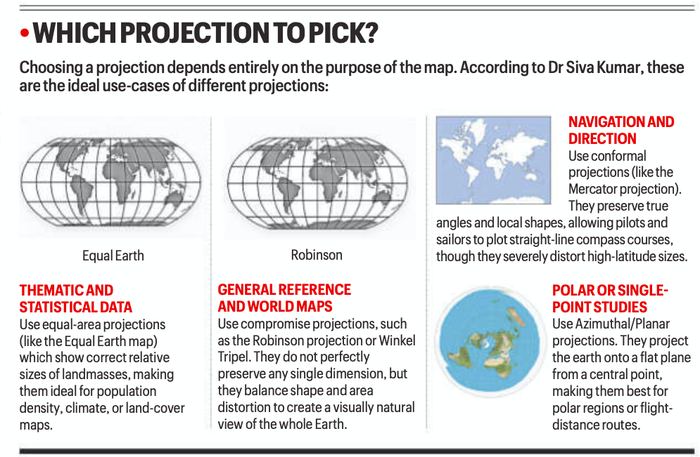
Each projection trades off area, shape, distance or direction differently — the right choice depends on the map's purpose. Image courtesy the source publication; reproduced with credit for educational use.
Why it matters
Every flat map distorts at least one of area, shape, distance or direction, since the Earth is not a true sphere. Critics argue the Mercator's exaggeration of high-latitude landmasses has visually diminished the Global South; supporters of Equal Earth say it corrects this.
The resolution is non-binding — adoption by governments, agencies and classrooms will take time, if it happens at all.
✎ Mains Practice Question
"No map projection can be free of distortion." Discuss this statement with reference to the recent UN resolution adopting the Equal Earth projection. 10 marks · 150 words
EconomyGeneral Studies Paper III
04
Districts as Export Hubs: Taking India's Exports to Every District
GS-III · Economy — Export Promotion, Growth & EmploymentPrelims + MainsPIB · Department of Commerce (DGFT)
The Districts as Export Hubs (DEH) initiative treats every district as a unit of export planning, converging existing central and state schemes to build district-specific export ecosystems; the DEH framework now covers over 770 districts as India's exports touch record levels.
▪ Initiative at a Glance
- Nodal agency: Directorate General of Foreign Trade (DGFT), Department of Commerce
- Nature: a convergence framework, not a standalone funding scheme — leverages existing central/state schemes
- Coverage: 770+ districts as of January 2026
- Planning tool: District Export Action Plans (DEAPs) — 590 drafted, 249 formally adopted (as of March 2026)
- Institutional layers: State Export Promotion Committees (SEPCs) and District Export Promotion Committees (DEPCs)
- Phased rollout: outcome-oriented Phase 1 from 1 June 2026, across 27 States/UTs, 24 DGFT Regional Authorities and 11 partner agencies
- Stated ambition: supporting India's US$ 1 trillion export target (government projection)
Lineage — from ODOP to DEH
DEH builds on the One District One Product (ODOP) programme, which branded and promoted a single distinctive product per district. DEH broadens this from product promotion to a full export ecosystem — market access, quality compliance, logistics and digital-export enablement.
Figure 2 — India's district export journey
2018ODOP launched(Uttar Pradesh)2019DEH conceptintroducedFTP 2023DEH institutionalised2026770+ districts,590 DEAPs, 249 notified2030US$2 trillionexport target
DEH scales up the district-led export approach from a single-product identity to a full export ecosystem strategy.
Why it matters
India's total goods-and-services exports touched a record US$ 825.25 billion in 2024-25, estimated to rise to US$ 863.11 billion in 2025-26. Export activity had stayed concentrated in established clusters and port cities; DEH aims to bring remote and rural districts — producers of goods like Bastar's iron craft or Meghalaya's Mandarin oranges — into export supply chains.
- Digital-export enablement partners with platforms such as Amazon, Shiprocket and DHL, plus Dak Ghar Niryat Kendras for low-cost postal export of small consignments.
- Six districts — Anantapur, Raipur, Solan, Tiruppur, Kanpur, Kolhapur — are supported under EXIM Bank's GRID (Grassroots Initiatives for Development) programme.
The critical view
- As a convergence framework rather than a funded scheme, DEH's success depends on coordination across multiple existing schemes — execution risk is higher than for a single dedicated programme.
- Only 249 of 590 drafted DEAPs are formally adopted so far, suggesting institutional follow-through at the district level remains uneven.
- Export readiness gaps — quality standards, certification, logistics — take longer to close in remote districts than product identification itself.
✎ Mains Practice Question
Discuss how the Districts as Export Hubs initiative seeks to decentralise India's export growth. What structural challenges could limit its effectiveness at the district level? 15 marks · 250 words
05
Retail Sugar Prices Surge 41% in a Year, Raising Questions on Supply Forecasting
GS-III · Economy — Agriculture, Food Management & InflationPrelims + MainsThe Hindu
Retail sugar prices rose 41% from ₹46.27/kg (26 Aug 2025) to ₹65.05/kg (26 Aug 2026), prompting the Government to allow duty-free imports of 10 lakh MT of raw sugar till 31 October 2026 — the first such move in a decade.
What went wrong with the forecast
- Initial 2025-26 production estimates of around 343 lakh tonnes were revised down to about 306 lakh tonnes — a gap that led to export permissions and ethanol-diversion targets being set on optimistic assumptions.
- Uttar Pradesh and Maharashtra together account for 71% of cane area and 65% of sugar production; their declining/fluctuating trajectory was a known risk factor.
- The FAO Sugar Price Index rose 5.6% in July, and Brazil (the top global producer) faced lower expected output — early global signals that were available before the spike.
- India's sugarcane production has declined since peaking at 490.5 million MT in 2022-23; 83% of sugar produced is used for domestic consumption.
Why it matters
The Government's own explanation — festive-season demand — is undercut by data showing this year's price rise as an outlier compared with previous festive seasons.
A growing share of maize (rather than sugarcane) now feeds ethanol blending, which analysts say makes ethanol diversion a longer-term rather than immediate cause of this spike.
✎ Mains Practice Question
Examine the factors behind the recent spike in retail sugar prices in India. What does the episode reveal about India's agricultural production-forecasting and buffer-stock mechanisms? 10 marks · 150 words
Science & TechnologyGeneral Studies Paper III
06
IAF Test-Fires Indigenous Khagantak-243 Long Range Glide Bomb
GS-III · S&T — Indigenisation of Defence TechnologyPrelims + MainsNews report, Jaisalmer
The IAF conducted the first flight trial of the indigenously developed Khagantak-243 long-range glide bomb, releasing it from a Su-30MKI at the Pokhran Field Firing Range, Rajasthan — a step towards reducing dependence on imported precision-guided munitions.
▪ Specifications
- Stand-off range: reportedly 144–180 km when released from about 12 km altitude at Mach 0.8
- Warhead: 125 kg Mk-81 general-purpose blast-fragmentation warhead
- Guidance: swivel-type mid-body glide wings with five aft control surfaces
- Developer: JSR Dynamics Pvt Ltd (Nagpur) with Bharat Electronics Limited (BEL), under the Development-cum-Production Partner model
- Family: heavier variants Khagantak-306 and Khagantak-225 planned for greater range/payload
- Platforms: tested on Su-30MKI; integration planned with MiG-29K and Mirage-2000
Why it matters
Stand-off weapons let a fighter strike heavily defended targets — airfields, runways, hardened shelters, command centres — without entering the enemy's air-defence envelope.
Operation Sindoor's reliance on imported SPICE and HAMMER precision weapons had underscored this operational gap; DRDO's 1,000 kg Gaurav glide bomb was trialled earlier, in April 2025.
✎ Mains Practice Question
Discuss the significance of indigenous stand-off precision munitions for India's defence preparedness, in the context of the Atmanirbhar Bharat initiative. 10 marks · 150 words
07
CosmoCube to Listen for the Universe's First Radio Signal from the Moon's Far Side
GS-III · S&T — Space Technology & AstrophysicsPrelims + MainsThe Hindu
The Royal Astronomical Society plans to send CosmoCube, a small satellite, to orbit the Moon and use its far side as a natural shield from Earth's radio interference, to capture the faint 21-cm radio signal emitted by neutral hydrogen from the universe's "Dark Ages".
▪ Mission Details
- Signal sought: 21-cm radio signal from neutral hydrogen, buried beneath foreground emissions thousands of times stronger
- Observation window: ~40 minutes of radio silence per two-hour orbit, behind the Moon
- Mission length: two years; over 1,000 hours of data expected
- Frequency range: 10–100 MHz radiometer
- India's parallel effort: PRATUSH (Probing ReionisATion of the Universe using Signal from Hydrogen), a proposed lunar-orbit radio telescope
- Published in: Nature Astronomy, 14 August 2026
Figure 2 — First stars and the Epoch of Reionisation
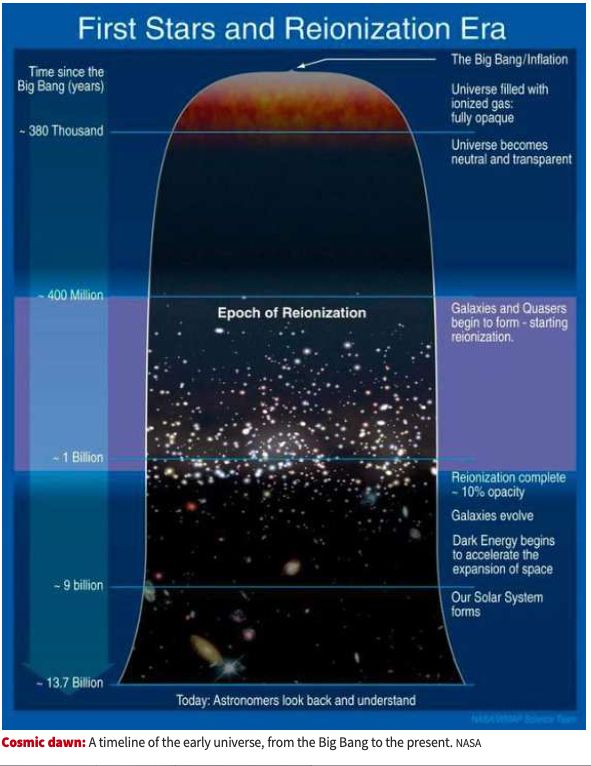
The neutral-hydrogen signal CosmoCube and PRATUSH seek to detect predates the formation of the first stars, in the still-unobserved Dark Ages. Image courtesy NASA/WMAP Science Team; reproduced with credit for educational use.
Why it matters
The signal comes from the "Dark Ages" and Era of Reionisation — the period, roughly 150 million to a billion years after the Big Bang, when the first stars and galaxies ionised the neutral hydrogen filling the early universe.
Directly observing this period would also help test explanations for the Hubble tension — the mismatch between expansion-rate measurements from nearby systems and the cosmic microwave background.
✎ Mains Practice Question
Explain the scientific significance of studying the 21-cm hydrogen signal from the early universe, and discuss India's contribution to this field through the PRATUSH mission. 10 marks · 150 words
Environment & EcologyGeneral Studies Paper III
08
Nepal Demands Climate Compensation from India, US and China After Deadly Glacial Floods
GS-III · Environment — Climate Change, Disaster Management, Loss & DamagePrelims + MainsWorld Politics Review
Following floods that killed more than 1,000 people and left thousands missing on the Nepal-China border, Nepal has demanded climate compensation from India, the United States and China — the world's three biggest greenhouse-gas emitters — after scientists linked the disaster to a warming-driven glacial collapse.
◦ Background & Context
The Trishuli river in Dhading district swelled after glacial collapse on the Nepal-China border, destroying roads, bridges and infrastructure. Nepal sits close to rapidly melting Himalayan glaciers, making such Glacial Lake Outburst Flood (GLOF)-type events more frequent.
Figure 3 — Nepal, bordered by India and China
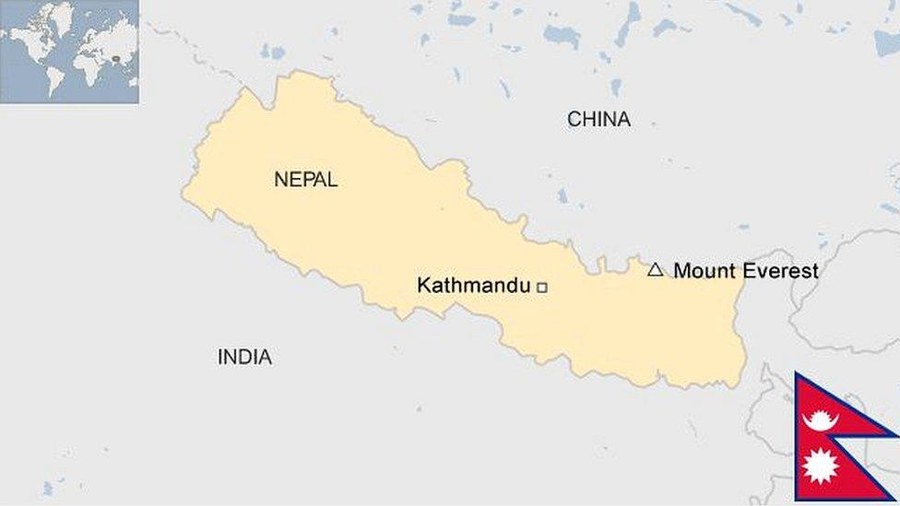
Nepal's Himalayan terrain, wedged between India and China, is central to why it faces disproportionate glacial-flood risk despite negligible emissions. Map reproduced with credit for educational use.
Figure 4 — Emissions share vs. climate vulnerability
50%25%0%India + US + China~50%Nepal<0.1%
Nepal contributes under 0.1% of global emissions but sits among the most climate-vulnerable countries owing to its Himalayan glacial terrain.
Why it matters
- Nearly all of Nepal's grid electricity comes from hydropower; more than a dozen hydropower plants were destroyed in the floods, exposing the fragility of clean-energy infrastructure built in unstable Himalayan terrain.
- The episode strengthens the case for operationalising the Loss and Damage Fund agreed at COP27/COP28, meant to compensate climate-vulnerable nations for impacts they did not cause.
- It highlights the limits of large infrastructure development in geologically fragile, rapidly warming mountain regions.
The critical view
- Attribution difficulty: establishing a direct causal and financial link between a specific emitter's historical emissions and a specific glacial-collapse event remains scientifically and legally contested.
- Compensation mechanism: no binding international mechanism currently obliges India, the US or China to pay bilateral climate compensation; existing instruments (Loss and Damage Fund) are multilateral and voluntarily funded.
- India's dual position: as a named emitter here, India must balance its own developmental emissions trajectory with its stated climate-justice advocacy for the Global South.
✎ Mains Practice Question
"Climate vulnerability is inversely related to responsibility for emissions." Discuss this in the context of Nepal's recent glacial-flood disaster and the global Loss and Damage framework. 15 marks · 250 words
09
5th Swachh Vayu Sarvekshan Awards Cities as NCAP Shows PM10 Gains in 108 of 130 Cities
GS-III · Environment — Air Pollution & Pollution ControlPrelims + MainsPIB · Ministry of Environment, Forest and Climate Change
On Swachh Vayu Diwas 2026 (International Day of Clean Air for Blue Skies), MoEFCC conferred the 5th Swachh Vayu Sarvekshan awards on top-performing NCAP cities and wards, and released a Compendium of Best Management Practices, as fresh data showed PM10 improvement in 108 of 130 NCAP cities.
▪ Scheme at a Glance — National Clean Air Programme (NCAP)
- Coverage: 130 cities across 24 States/UTs
- Funding: ₹16,425 crore performance-linked grant provided to NCAP cities as gap funding
- Monitoring tool: PRANA portal, tracking air-quality management parameters for the 130 cities
- Sarvekshan framework: released 2022-23; ranks cities on road dust, solid waste management, vehicular emissions, industrial pollution, C&D waste, DG-set/commercial emissions and IEC activities
- Ranking process: self-assessment → State-level Monitoring Committee approval → CPCB evaluation → independent field verification → selection of top 10 cities in each of 3 population categories
Figure 4 — NCAP: progress in PM10 reduction, 2025-26 vs 2017-18
108 of 130 cities improved PM10 levels vs. 2017-1872 cities>20% cut26 cities>40% cut62017-18142025-26Cities meeting NAAQS
Cities meeting National Ambient Air Quality Standards more than doubled, from 6 to 14, though the bulk of NCAP cities are still below target.
Why it matters
The Chairperson of the National Green Tribunal called for local bodies to adopt an "all-inclusive and whole of society approach", stressing that urban/rural local bodies are the frontline institutions for implementation.
The Compendium released covers best practices in road-dust control, vehicular pollution, industrial pollution, C&D waste management, open-burning control, greening, technology use and public outreach.
The critical view
- Even with improvement, only 14 of 130 cities currently meet NAAQS — the great majority remain above the prescribed limits despite eight years of NCAP.
- PM10 reduction targets do not directly track PM2.5, which is more strongly linked to health outcomes and is not highlighted in this progress data.
- Performance-linked grants create an incentive structure, but sustained funding and enforcement (not just award recognition) will determine whether gains hold during high-pollution winter months.
✎ Mains Practice Question
Evaluate the effectiveness of the National Clean Air Programme in achieving its air-quality targets. What institutional reforms are needed to accelerate compliance with NAAQS? 15 marks · 250 words
10
Five Orangutans Rescued from Odisha's Balasore District in Suspected Trafficking Case
GS-III · Environment — Wildlife Conservation & Illegal TraffickingPrelims + MainsThe Hindu
◦ Background & Context
The Odisha Forest Department rescued five young orangutans (three male, two female, aged six months to a year) abandoned in a casuarina plantation in the Udayapur-Talsari forest area of Balasore.
Orangutans are not native to India — they occur naturally only in Indonesia and Malaysia — and officials described it as an apparent botched transit/trafficking operation. The animals were shifted to Nandankanan Zoological Park for examination.
Figure 5 — The five rescued orangutans

The rescued orangutans, aged between six months and a year, before being shifted to Nandankanan Zoological Park. Image courtesy the source publication; reproduced with credit for educational use.
- Prelims hook: orangutans (genus Pongo) are found only in Indonesia and Malaysia, and are listed under CITES Appendix I, making cross-border trade in them illegal without exceptional permits.
✎ Mains Practice Question
India's ports and land routes are increasingly used as transit points for illegal wildlife trafficking. Suggest measures to strengthen enforcement against such trafficking. 10 marks · 150 words