

Contents
10 June 2026
- Zojila Tunnel — Breakthrough Achieved, Ladakh's Lifeline Closer to RealityGS3
- India-Nepal Relations: A New Phase After Balen Shah's Border RemarksGS2
- PM Modi Surpasses Nehru's Record; LPMS 'VINIMAY' LaunchedGS2
- Sagittarius A* Wind — First Definitive Evidence from ALMA TelescopeGS3
- Can a Political Party Use a Cockroach as Its Symbol? What EC Rules SayGS2
- Across the World, Fewer People Are Having Children — Falling TFR ExplainedGS1
- Bonn Climate Conference 2026 (SB64) — Adaptation, Fossil Fuels, and Delivery in FocusGS3
Article 01
Zojila Tunnel — Breakthrough Achieved, Ladakh's Lifeline Closer to Reality
GS Paper 3 — Infrastructure | Internal Security | Disaster Management | GS Paper 2 — Government Policies
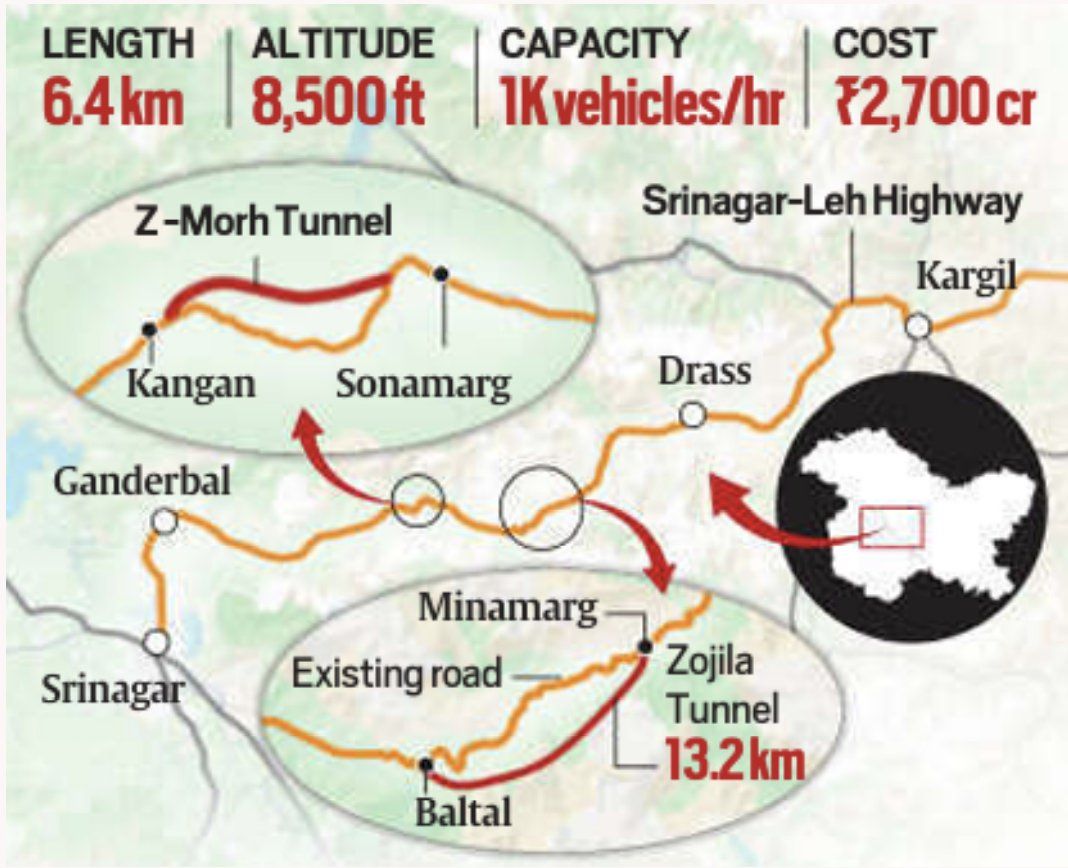
Why in News
A breakthrough blast at the East Portal of the Zojila Tunnel near Minimarg, Ladakh connected both ends of the 13-km passage beneath the Zojila Pass, completing the mountain piercing. Union Minister Nitin Gadkari, J&K Chief Minister Omar Abdullah, and Lieutenant Governor Manoj Sinha attended the event. The tunnel, once complete, will reduce the crossing time over Zojila Pass from 1–1.5 hours to 15 minutes and provide all-weather, year-round connectivity to Ladakh.
What is the Zojila Tunnel?
- Shape & Type: Horseshoe-shaped, two-lane, bi-directional road tunnel.
- Length: 13.1 km beneath the Zojila Pass at approximately 11,578 feet above sea level.
- Dimensions: 9.5 metres wide, 7.5 metres high.
- Route: Traces the Srinagar-Leh National Highway; West portal at Baltal (Sonmarg, Kashmir); East portal at Minimarg (Drass, Ladakh).
- Approach Roads: 18-km approach roads at either end; full project including bridges stretches 31 km from Sonmarg to Minimarg.
- Construction Method: New Austrian Tunnelling Method (NATM) — uses surrounding rock as part of the load-bearing structure, suited for geologically fragile Himalayas.
- Executing Agency: Megha Engineering and Infrastructure Limited (MEIL).
- Overseeing Authority: National Highways and Infrastructure Development Corporation (NHIDCL).
- Original Tender Value: ₹12,000 crore; completed at ₹7,000 crore (saving ~₹5,000 crore as per Gadkari).
- Expected Opening: February 2028 (civil work ~7–8 months; electrical installation to follow).
- Preceding Link: Z-Morh Tunnel (Sonmarg) — inaugurated by PM Modi in January 2026; Zojila extends this corridor to Minimarg.
Strategic and Civilian Significance
Civilian Need
- Zojila Pass is snowbound every winter; Manali-Leh road (only alternative) is also closed. In the absence of scheduled air services to Kargil, residents are effectively cut off each winter.
- Will facilitate year-round access to education, healthcare, tourism, and trade for Ladakh and Kargil residents.
Strategic and Military Value
- Srinagar-Leh highway is India's primary military supply artery to Ladakh.
- During the 1999 Kargil War, Pakistani forces targeted positions overlooking the highway to choke Indian military supply lines.
- The tunnel will enhance movement of military vehicles and logistics to forward areas along the LoC and LAC, especially during emergencies.
- Part of three key corridors to Ladakh: Zojila (J&K route), Rohtang (Himachal route), and Shinku La tunnel (Himachal–Zanskar route).
Delays and Timeline
- Originally scheduled for completion by September 2026; suffered a two-year delay due to COVID-19, a 2024 terrorist attack on the Sonmarg Tunnel Project, and extreme weather.
- Tuesday's breakthrough achieved six months ahead of the revised schedule.
Remaining Gap — Kargil Air Connectivity
- The tunnel addresses road connectivity but Kargil remains without direct air services.
- CM Omar Abdullah appealed to Gadkari at the event to use his influence to bring scheduled flights to Kargil: "Another dream needs to be realised — that is, regular and direct air service to Kargil."
Way Forward
- Expedite Remaining Civil Work: Prioritise ventilation, electrical systems, and safety installations to meet the February 2028 target.
- Extend Corridor: Accelerate Shinku La Tunnel (Himachal–Zanskar route) to create a fully redundant all-weather network to Ladakh.
- Air Connectivity for Kargil: Operationalise scheduled flights to Kargil to complement the road corridor.
- BRO Capacity: Strengthen the Border Roads Organisation's technical capacity for high-altitude tunnel maintenance.
Conclusion
The Zojila Tunnel breakthrough marks the transition from aspiration to near-delivery for Ladakh's all-weather connectivity. As Gadkari noted, it is "not just a tunnel but a lifeline" — both for the civilians who endure months of isolation each winter and for a military that cannot afford seasonal gaps in its supply chain along the LAC and LoC. The challenge now is sustained execution quality to meet the 2028 opening.
Prelims Pointers
- Zojila Tunnel — 13.1 km; horseshoe-shaped, bi-directional; at ~11,578 ft above sea level; Baltal (West) to Minimarg (East).
- Zojila Pass — Connects Kashmir Valley with Drass, Kargil, and Ladakh; located on the Srinagar-Leh NH.
- NATM = New Austrian Tunnelling Method — rock acts as load-bearing structure; used in geologically fragile terrain.
- MEIL = Megha Engineering and Infrastructure Limited — executing agency for Zojila Tunnel.
- NHIDCL = National Highways and Infrastructure Development Corporation Limited — oversees highway projects in border/strategic areas.
- Z-Morh Tunnel (Sonmarg) — Precedes Zojila on the same corridor; inaugurated January 2026 by PM Modi.
- Shinku La Tunnel — Planned tunnel connecting Himachal Pradesh with Ladakh's Zanskar Valley; third strategic corridor to Ladakh.
- Rohtang Tunnel (Atal Tunnel) — Connects Manali with Lahaul-Spiti; inaugurated 2020; alternative route to Ladakh.
- Kargil War (1999) — Pakistan targeted Srinagar-Leh highway to cut Indian military supply lines; underscores strategic value of Zojila Tunnel.
- BRO = Border Roads Organisation — maintains strategic roads in border areas including Ladakh.
Practice Mains Question
"All-weather road connectivity to Ladakh is simultaneously a humanitarian imperative and a strategic necessity. Critically examine how the Zojila Tunnel project addresses both dimensions and analyse the remaining gaps in Ladakh's connectivity infrastructure."
GS Paper 3 | 250 words | 15 marks
Prelims Practice MCQ
Consider the following statements about the Zojila Tunnel:
1. The Zojila Tunnel connects Sonmarg in Kashmir with Minimarg in Ladakh, providing all-weather access via the Srinagar-Leh National Highway.
2. It has been constructed using the New Austrian Tunnelling Method (NATM), which treats the surrounding rock as part of the load-bearing structure.
3. The National Highways and Infrastructure Development Corporation (NHIDCL) is the executing agency for the Zojila Tunnel project.
4. The Z-Morh Tunnel at Sonmarg, which precedes Zojila on the same corridor, was inaugurated in January 2026.
Which of the statements given above are correct?
- (a)1 and 2 only
- (b)1, 2, and 4 only
- (c)2, 3, and 4 only
- (d)1, 2, 3, and 4
Correct Answer: (b)
Statements 1, 2, and 4 are correct. Statement 3 is incorrect — NHIDCL is the overseeing authority, not the executing agency; the executing agency is Megha Engineering and Infrastructure Limited (MEIL). This is a common distinction tested in UPSC Prelims on infrastructure projects.
Article 02
India-Nepal Relations: A New Phase After Balen Shah's Border Remarks
GS Paper 2 — International Relations | India's Neighbourhood | Bilateral Agreements
Why in News
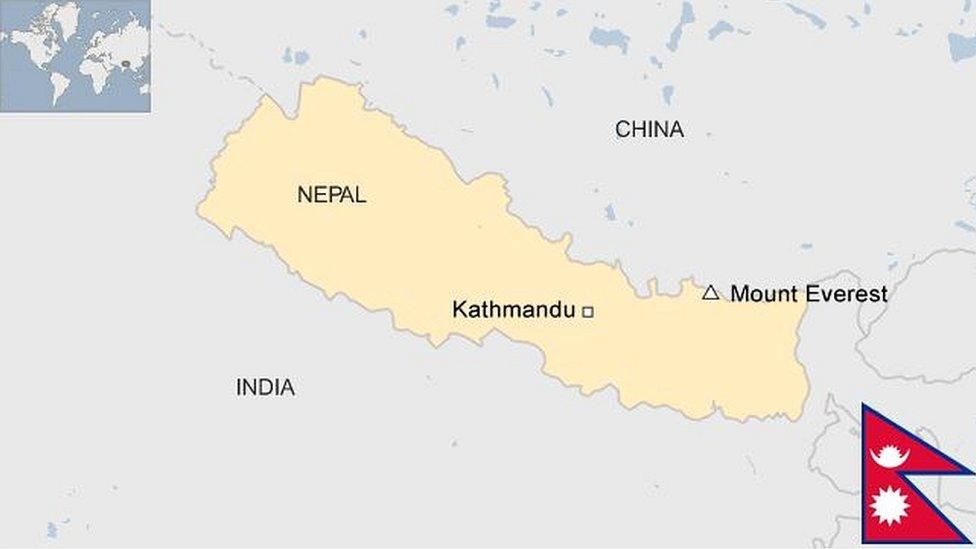
Nepal Prime Minister Balendra "Balen" Shah limited his intervention in a parliamentary discussion on the Kalapani-Lipulekh-Limpiyadhura boundary dispute to a few minutes on May 31, suggesting the issue was "not one-sided" — that "in some places, Nepal may also be occupying territory claimed by India." The remark triggered a political storm in Nepal but is being read as a signal of a more rational, dialogue-oriented approach to bilateral relations.
The Boundary Dispute — Background
| Area | Nepal's Claim | India's Position |
|---|---|---|
| Kalapani | Claims it as part of Sudurpashchim Province | Follows British-era boundary delineation inherited in 1947 |
| Lipulekh Pass | Objects to India-China trade route through the Pass | Called Nepal's territorial claim "unjustified" and "influenced by unilateral artificial enlargement" |
| Limpiyadhura | Included in Nepal's 2020 revised constitutional map (also printed on currency notes) | Maintains status quo based on inherited British survey records |
Recent Developments
- Nepal objected to the resumption of India-China trade through the Lipulekh Pass; PM Shah shared that Nepal's diplomatic note received a "positive response" from India and both sides agreed to address the issue through dialogue.
- Indian Foreign Secretary's visit to Nepal was postponed (linked to Balen Shah's disinclination to break protocol to receive him).
- Rabi Lamichhane (President, Rastriya Swatantra Party) and Foreign Affairs Minister Shishir Khanal visited India for political and diplomatic meetings — the timing seen as positive.
- Nepal's Foreign Ministry reiterated commitment to resolving the boundary through diplomatic means.
- China's President Xi Jinping's position: Nepal should sort out the border issue with India directly.
Character of Nepal's New Government
- Governance is in the hands of a young generation focused on the future, determined to free Nepal from corruption, nepotism, and ideology — prioritising social and economic issues.
- New stance: India will be treated on par with other countries rather than being given the "special relationship" access it has traditionally enjoyed.
- Protocol signals and postponements have "injected jarring notes" in ties, though India appears to have taken them in stride.
Historical Context and Shared Strengths
- Open Border Tradition: Over 1,700 km of open border; followed even in the disputed area before the India-China war of 1962.
- Centuries-old linkages: Cultural, religious, economic, and people-to-people ties.
- Indian and Nepalese Army ties: Strong institutional trust that could facilitate a mutually acceptable practical solution.
- Last Indian PM with the vision to step beyond conventional diplomacy on Nepal was Atal Bihari Vajpayee.
Concerns
- Unending Diplomacy Risk: Expert-level discussions without political will may allow the dispute to harden into a lasting bilateral irritant.
- British-Era Data Contradictions: Self-contradictory British survey data (updated maps vs. older East India Company surveys) complicates objective delineation.
- China Factor: Balen Shah's suggestion to involve China and the UK in consultations could create complications and delays — Xi has publicly advised Nepal to resolve the issue bilaterally with India.
- Irrational Nationalism: Nepal's 2020 constitutional map and currency notes with disputed territory create domestic political constraints on compromise.
Way Forward
- Shift in Mindset: Both sides must determine not to let boundary delineation differences cloud a unique relationship.
- Leverage Army Ties: The strong institutional relationship between the Indian and Nepalese armies can serve as a back-channel facilitator.
- Economic First: Prioritise trade, energy, and infrastructure cooperation to build goodwill for difficult boundary discussions.
- India's Initiative: PM Modi's political self-confidence in selling difficult decisions — demonstrated in other bilateral contexts — makes this the right moment for a bold India-Nepal reset.
- Bilateral Resolution: Resist calls to multilateralise the dispute (involving China, UK); keep it a bilateral matter.
Conclusion
Balen Shah's candid acknowledgement of mutual encroachment, however politically costly at home, opens a rare window for rational dialogue. As the authors note, it is time for India and Nepal to move towards "a more enlightened bilateral relationship to build a model sustainable partnership" — drawing strength from centuries of shared history rather than the cartographic disputes of the post-colonial era.
Prelims Pointers
- Kalapani-Lipulekh-Limpiyadhura — areas in the western Himalayan tri-junction claimed by both India and Nepal; India-administered, Nepal-claimed.
- Lipulekh Pass — high-altitude pass connecting India (Uttarakhand) to Tibet; used for the Kailash Mansarovar Yatra route; India-China trade road passes through it.
- Nepal's 2020 Constitutional Map — incorporated Kalapani, Lipulekh, and Limpiyadhura; also printed on Nepal's currency notes.
- Rastriya Swatantra Party — Nepal's ruling party; President is Rabi Lamichhane (also Home Minister).
- Shishir Khanal — Nepal's Foreign Affairs Minister.
- India-Nepal Open Border — over 1,700 km; governed by the 1950 Treaty of Peace and Friendship; allows free movement of citizens.
- Treaty of Peace and Friendship, 1950 — foundational bilateral treaty; frequently debated in Nepal as unequal.
- NHIDCL — also works in Nepal's connectivity; cross-border infrastructure is a key cooperation area.
- Kailash Mansarovar Yatra — pilgrimage route to Tibet; India uses Lipulekh as one of the route options.
Practice Mains Question
"Nepal's new government under Balen Shah offers India an opportunity to reset bilateral relations, but structural and historical constraints limit quick progress. Critically examine the key irritants in India-Nepal relations and suggest a framework for achieving durable partnership."
GS Paper 2 | 250 words | 15 marks
Prelims Practice MCQ
With reference to the Kalapani-Lipulekh-Limpiyadhura boundary dispute between India and Nepal, which of the following statements is/are correct?
1. The Lipulekh Pass is used as a route for the Kailash Mansarovar Yatra from India to Tibet.
2. Nepal incorporated Kalapani, Lipulekh, and Limpiyadhura in its official map through a constitutional amendment in 2020.
3. India's position on the boundary follows the delineation inherited from British surveys after 1947.
Select the correct answer using the code below:
- (a)1 and 2 only
- (b)2 and 3 only
- (c)1, 2, and 3
- (d)3 only
Correct Answer: (c)
All three statements are correct. Statement 1: Lipulekh Pass is indeed one of the routes used for the Kailash Mansarovar Yatra. Statement 2: Nepal passed a constitutional amendment in 2020 incorporating the three disputed territories into its official map. Statement 3: India has consistently maintained that its boundary follows the British-era surveys inherited at independence in 1947.
Article 03
PM Modi Surpasses Nehru's Record; Land Port Management System 'VINIMAY' Launched
GS Paper 2 — Governance | Polity | Constitutional Offices | Border Management
Why in News
Union Home Minister Amit Shah announced that Prime Minister Narendra Modi completed 4,398 days in office on Tuesday (June 10, 2026) and would surpass the record of former PM Jawaharlal Nehru on June 11 — making PM Modi the longest continuously-serving elected Prime Minister of India. Separately, Amit Shah launched the Land Port Management System (LPMS) — 'VINIMAY', a comprehensive digital platform for integrated border and land port management.
PM Modi's Record in Context
| PM | Total Days in Office | Nature of Tenure |
|---|---|---|
| Jawaharlal Nehru | ~4,398 days (until death, May 1964) | Continuous (1947–1964) |
| Narendra Modi | 4,399+ days (surpassed June 11, 2026) | Continuous elected tenure (2014–present) |
| Indira Gandhi | ~5,829 days (combined two tenures) | Non-continuous (1966–77 and 1980–84) |
Key distinction: Amit Shah specified that PM Modi holds the distinction of serving for the longest continuous period as an elected Prime Minister. Nehru served continuously from 1947 but was PM before the first general elections (1952) for a period. PM Modi's tenure has been entirely through successive electoral mandates (2014, 2019, 2024). NDA members will meet in Delhi to mark 12 years of the alliance in power on June 11.
LPMS 'VINIMAY' — Land Port Management System
What is VINIMAY?
- An integrated digital platform for the management of cargo, passengers, and vehicles at India's land ports.
- Designed under the concept of Smart Borders as part of a four-pronged strategy to secure India's land borders.
- Developed with input from all stakeholders, with special emphasis on security.
Key Features
- Single Electronic Window: Seamless information exchange across all agencies involved in border management.
- ANPR (Automatic Number Plate Recognition) — based gate operation system for significant time savings.
- Enhanced Inter-Agency Coordination: Integrates customs, immigration, BSF, and trade facilitation bodies.
- Aims to curb illegal activities — smuggling, trafficking, and illegal migration — at land ports.
Context — Land Ports Since 2014
- Since 2014, land ports have been developed as the first line of defence for security, a means to facilitate trade, and a bridge for people-to-people connectivity.
- Land ports have played a significant role in the holistic development of border areas, promoting legitimate trade and addressing challenges such as migration from border villages and districts.
Land Ports Authority of India (LPAI)
- LPAI = Land Ports Authority of India — statutory body under the Ministry of Home Affairs.
- Established under the Land Ports Authority of India Act, 2010.
- Manages and develops integrated check posts (ICPs) at land borders with India's neighbours (Bangladesh, Pakistan, Nepal, Bhutan, Myanmar).
Way Forward
- Expand VINIMAY to all ICPs: Ensure full rollout across all operational Integrated Check Posts on India's land borders.
- Interoperability with ICEGATE: Link LPMS with India's customs electronic gateway for seamless trade facilitation.
- Counter-Smuggling Integration: Feed ANPR data into intelligence agencies' networks for real-time threat assessment.
- Capacity Building: Train border personnel in digital systems under Smart Borders initiative.
Conclusion
The launch of VINIMAY marks a significant step in India's transition from security-centric to smart, technology-enabled border management. Combined with PM Modi's milestone of continuous democratic governance, June 2026 is a moment of both political and institutional significance for India's border administration narrative.
Prelims Pointers
- LPMS 'VINIMAY' = Land Port Management System; integrated digital platform for cargo, passengers, and vehicles at land ports; launched under MHA.
- LPAI = Land Ports Authority of India; statutory body under MHA; established under LPAI Act, 2010.
- Smart Borders = Four-pronged strategy for technology-enabled, intelligence-driven land border management in India.
- ANPR = Automatic Number Plate Recognition — vehicle surveillance technology used at border gates.
- ICP = Integrated Check Post — co-located border facilities with customs, immigration, quarantine, security; India has ICPs at Bangladesh, Pakistan, Nepal, Bhutan, Myanmar borders.
- Jawaharlal Nehru — India's first PM; served May 1947 – May 1964 (died in office); the record now surpassed by PM Modi.
- NDA = National Democratic Alliance; BJP-led coalition in power since 2014.
- ICEGATE = Indian Customs Electronic Commerce/EDI Gateway — electronic interface for customs and trade facilitation.
Practice Mains Question
"Land borders are not merely lines of division but interfaces of trade, security, and cultural exchange. Critically examine India's Smart Borders initiative and assess how the VINIMAY Land Port Management System advances the goals of security, facilitation, and development at India's land frontiers."
GS Paper 2 | 250 words | 15 marks
Prelims Practice MCQ
Which of the following statements about the Land Ports Authority of India (LPAI) is/are correct?
1. LPAI is a statutory body established under the Land Ports Authority of India Act, 2010.
2. LPAI functions under the Ministry of External Affairs.
3. LPAI manages and develops Integrated Check Posts (ICPs) at India's land borders.
Select the correct answer using the code below:
- (a)1 only
- (b)2 and 3 only
- (c)1 and 3 only
- (d)1, 2, and 3
Correct Answer: (c)
Statement 1 is correct. Statement 2 is incorrect — LPAI functions under the Ministry of Home Affairs (MHA), not the Ministry of External Affairs. Statement 3 is correct — LPAI's primary mandate is developing and managing Integrated Check Posts at India's land borders. This MHA vs MEA distinction is frequently tested in UPSC Prelims.
Article 04
Sagittarius A* Wind — First Definitive Evidence from ALMA Telescope
GS Paper 3 — Science & Technology | Space Science | Astrophysics
Why in News
A new study by researchers from Northwestern University, USA, using the ALMA telescope (Atacama Large Millimeter/submillimeter Array) in Chile, has found the first definitive evidence of a presently active wind blowing from Sagittarius A* (Sgr A*) — the supermassive black hole at the centre of the Milky Way. This confirms a hypothesis that has been suspected for over 50 years.
Key Findings
- The Evidence: By combining five years of ALMA data, researchers found a large cone-shaped clearing in the dense molecular gas surrounding Sgr A*.
- Dimensions: The clearing is at least 3.2 light-years long and opens at a 45-degree angle — as if the black hole is blowing away cold gas that would otherwise fall into it.
- Mechanism: When Sgr A* pulls on gas, the gas swirls around rather than falling straight in. Friction from acceleration heats the gas particles; gravity pressurises them further until the gas becomes a plasma burning millions of degrees hot.
- Energy: Just 1 gram of this plasma gas can release enough energy to push away 100 kg of nearby gas — the pushed gas constitutes the "wind."
About Sagittarius A* (Sgr A*)
- Location: Centre of the Milky Way Galaxy, approximately 26,000 light-years from Earth.
- Mass: Approximately 4 million solar masses — a supermassive black hole (SMBH).
- First Imaged: Event Horizon Telescope (EHT) released the first-ever image of Sgr A* in May 2022 (the second SMBH to be imaged, after M87*).
- Sgr A* is relatively quiet compared to active galactic nuclei — hence studying its outflows required years of cumulative data from ALMA.
About ALMA
- Full Name: Atacama Large Millimeter/submillimeter Array.
- Location: Atacama Desert, Chile — altitude of ~5,000 metres above sea level for minimal atmospheric interference.
- Operated By: International partnership — ESO (European Southern Observatory), NRAO (USA/Canada), and NAOJ (Japan) — in cooperation with Chile.
- Comprises: 66 high-precision antennas operating at millimetre and submillimetre wavelengths.
- Key Capability: Observes cold, dense molecular gas and dust — ideal for studying star formation, galaxy formation, and outflows from black holes.
Significance of the Sgr A* Wind
- Star Formation Regulation: By blowing away gas, the wind prevents too many stars from forming near the galactic centre, which would otherwise deplete gas and prevent future star formation.
- Galaxy Evolution: If too many stars near the centre explode (supernovae), they could blow away remaining gas and halt the galaxy's evolution. The Sgr A* wind acts as a regulator.
- Understanding SMBHs: Most black holes studied are in distant, active galaxies. Sgr A* is the nearest SMBH — evidence of its wind provides ground-truth data for black hole feedback models.
- Confirms Long-held Theory: Astronomers hypothesised this wind for 50+ years; the ALMA study provides the first direct, definitive proof of a presently active outflow.
Conclusion
The detection of Sgr A*'s wind resolves a five-decade-old astrophysical mystery and transforms how scientists understand the role of supermassive black holes in regulating galactic evolution. As India advances its own space science ambitions under ISRO, partnerships with ALMA-class observatories represent a frontier that enhances both knowledge and technological capability.
Prelims Pointers
- Sagittarius A* (Sgr A*) = Supermassive black hole at the centre of the Milky Way; ~4 million solar masses; ~26,000 light-years from Earth.
- ALMA = Atacama Large Millimeter/submillimeter Array; located in the Atacama Desert, Chile; operated by ESO + NRAO + NAOJ partnership.
- Event Horizon Telescope (EHT) = First image of Sgr A* released May 2022; first SMBH imaged was M87* (April 2019).
- Supermassive Black Hole (SMBH) = Black holes with masses millions to billions of times that of the Sun; found at centres of most large galaxies.
- Light-year = Distance light travels in one year (~9.46 × 10¹² km).
- Plasma = Fourth state of matter; ionised gas; can reach millions of degrees near black holes.
- Molecular Cloud = Dense regions of gas and dust in space; primary sites of star formation.
- ESO = European Southern Observatory — operates major telescopes in Chile including ALMA and VLT.
- Active Galactic Nucleus (AGN) = Extremely bright centre of a galaxy powered by accretion onto a supermassive black hole.
Practice Mains Question
"Recent discoveries about supermassive black holes suggest they play a far more active role in shaping galaxies than previously understood. Discuss the significance of the detection of Sagittarius A*'s galactic wind and what it reveals about the relationship between black holes and galaxy evolution."
GS Paper 3 | 150 words | 10 marks
Prelims Practice MCQ
Consider the following statements about Sagittarius A* (Sgr A*):
1. Sgr A* is a supermassive black hole located at the centre of the Milky Way galaxy.
2. The first image of Sgr A* was released by the Event Horizon Telescope in 2022, making it the first supermassive black hole to be imaged.
3. The ALMA telescope, which provided data for the recent wind discovery, is located in Chile and operates in the millimetre/submillimetre wavelength range.
Which of the statements given above is/are correct?
- (a)1 only
- (b)2 and 3 only
- (c)1 and 3 only
- (d)1, 2, and 3
Correct Answer: (c)
Statement 1 is correct. Statement 2 is incorrect — Sgr A* was the second supermassive black hole to be imaged (2022); the first was M87*, imaged in April 2019. Statement 3 is correct — ALMA is in the Atacama Desert, Chile, and operates at millimetre/submillimetre wavelengths.
Article 05
Can a Political Party Use a Cockroach as Its Symbol? What EC Rules Say
GS Paper 2 — Polity | Electoral System | Constitutional Bodies
Why in News
Ever since Chief Justice of India Surya Kant's "cockroach" remark, the image of the insect has been used by protesters and the satirical Cockroach Janta Party (CJP) — described by founder Abhijeet Dipke as a "youth pressure group," not a registered political party. The CJP held its first protest at Jantar Mantar, New Delhi on June 6. The episode raises a pointed question: under existing Election Commission rules, could any party use a cockroach as its election symbol?
How Election Symbols are Allotted — The Legal Framework
- Governed by the Election Symbols (Reservation and Allotment) Order, 1968 — issued by the Election Commission of India under Article 324 of the Constitution.
- Recognised National/State Parties: Their candidates are allotted the party's reserved symbol (e.g., Lotus for BJP, Raised Hand for Congress).
- Unrecognised Parties and Independent Candidates: EC allots symbols from a list of "free symbols"; candidates can request their preference but are not guaranteed it.
The Free Symbols List
- EC revises the free symbols list periodically; latest list published in May 2025 contains 184 symbols.
- Includes: AC, balloon, doorbell, dustbin, frying pan, jackfruit, grapes, immersion rod, latch, mixer, toothbrush, TV remote, cake, toffees, a variety of fruits and vegetables.
- State-specific exclusions: Some symbols are restricted in certain States/UTs where they are already reserved for a recognised party (e.g., Apple cannot be allotted in Arunachal Pradesh, Assam, Manipur, Meghalaya, Mizoram, Nagaland, Sikkim, Tripura, Puducherry, Tamil Nadu, Kerala, Karnataka).
- Two recognised parties in different states can have the same symbol — no rule against it when they are unlikely to contest against each other.
Can Animals Be Used as Symbols?
- No. Following representations from animal welfare activists in the 1990s, the EC stopped allotting animals as election symbols.
- Background: During the 1989 Tamil Nadu Assembly election, the AIADMK faction led by J. Jayalalithaa was allotted the rooster as its symbol. Former Union Minister Maneka Gandhi (founder of People for Animals — PFA) reported that thousands of roosters were tied to fast-moving vehicles during campaigning, leading to many birds dying.
- Exception: The Bahujan Samaj Party (BSP), formed before the animal symbol ban, retains its symbol — the Elephant — as a grandfathered exception.
- A cockroach is an insect (animal); under the prevailing EC stand, the cockroach symbol is unlikely to be granted.
Related Constitutional and Legal Points
- Article 324 — vests superintendence, direction, and control of elections in the Election Commission of India.
- Representation of the People Act, 1951 — governs registration of political parties and electoral processes.
- Party Registration: A group must apply to the EC under Section 29A of the RPA, 1951 for recognition; must have a name, constitution, and minimum membership.
- National Party Status: Requires meeting prescribed electoral performance thresholds across states.
Conclusion
The CJP episode is a civic flashpoint that accidentally illuminates a little-known corner of India's electoral law. The EC's ban on animal symbols — born from a genuine animal welfare crisis in 1989 — means the cockroach as a symbol remains firmly outside what any registered party can claim. Whether the CJP formalises itself or remains a pressure group, it has succeeded in drawing public attention to both judicial accountability and electoral symbol jurisprudence.
Prelims Pointers
- Election Symbols Order, 1968 = Issued by ECI under Article 324; governs reservation and allotment of election symbols.
- Free Symbols List (May 2025) = 184 symbols available for unrecognised parties and independent candidates.
- Reserved Symbol = Symbol exclusively allotted to a recognised national or state party (e.g., Lotus — BJP; Hand — Congress; Elephant — BSP).
- Animal Symbol Ban = EC stopped allotting animals as symbols after 1990s animal welfare representations; BSP's Elephant is a grandfathered exception.
- Maneka Gandhi = Founder of People for Animals (PFA); former Union Minister; instrumental in EC's animal symbol ban.
- Section 29A, RPA 1951 = Provision for registration of political parties with the Election Commission of India.
- Article 324 = Vests superintendence, direction, and control of elections in the Election Commission of India.
- AIADMK Rooster (1989) = Tamil Nadu Assembly election; led to animal welfare concerns and eventual ban on animal symbols.
- National Party Criteria = Must win 2% of Lok Sabha seats from at least 3 states OR win 6% of valid votes + 4 Lok Sabha seats in last LS elections, etc. (multiple criteria apply).
Practice Mains Question
"The Election Commission's power over election symbols is a microcosm of its broader constitutional role in safeguarding the integrity of electoral processes. Critically examine the legal framework governing election symbols in India and discuss the balance between political creativity and regulatory order."
GS Paper 2 | 150 words | 10 marks
Prelims Practice MCQ
With reference to election symbols in India, which of the following statements is/are correct?
1. The Election Symbols (Reservation and Allotment) Order, 1968 governs allotment of election symbols by the Election Commission of India.
2. The Election Commission stopped allotting animals as election symbols in the 1990s; however, the Bahujan Samaj Party retains its elephant symbol as a pre-existing exception.
3. Unrecognised political parties and independent candidates are allotted symbols from a list of reserved symbols.
Which of the statements given above is/are correct?
- (a)1 only
- (b)1 and 2 only
- (c)2 and 3 only
- (d)1, 2, and 3
Correct Answer: (b)
Statement 1 is correct. Statement 2 is correct — BSP's elephant is a grandfathered exception to the animal symbol ban. Statement 3 is incorrect — unrecognised parties and independent candidates are allotted from the list of free symbols, not reserved symbols. Reserved symbols are exclusively for recognised national and state parties.
Article 06
Across the World, Fewer People Are Having Children — Falling TFR Explained
GS Paper 1 — Population & Associated Issues | GS Paper 2 — Welfare Schemes | Social Issues
Why in News
Governments across the world — from India's Andhra Pradesh to Sweden and Japan — are introducing financial incentives to encourage childbearing, marking a striking reversal from a generation ago when population control was the dominant policy concern. The shift reflects a rapid decline in Total Fertility Rate (TFR) globally, which has fallen from a world average of 5.3 in the early 1960s to 2.2 in 2024 — just above the replacement rate of 2.1.
Key Data Points
| Country / Region | TFR (Approx. 2024) | Note |
|---|---|---|
| World Average | 2.2 | Just above replacement level |
| India | 2.0 | Just below replacement rate; achieved ~2020 (ahead of UN projections) |
| South Korea | 0.7 | Among lowest globally |
| Japan | 1.1 | Long-standing demographic crisis |
| Sweden | 1.4 | Despite strong state support for women |
| Sub-Saharan Africa | 4–5 | High due to limited contraception, low education, early marriage |
Replacement Rate: A TFR of 2.1 (two children per woman to replace mother and father, plus accounting for child mortality) is needed to maintain population stability. As of 2023, over two-thirds of the global population lives in countries where TFR is below 2.1.
India-Specific Data
- India's TFR declined from 5.9 in the 1960s to 2.0 in 2024 — just below replacement rate.
- The decline happened much faster than UN projections from a decade ago (which expected India to reach below-replacement TFR between 2030–2035; India achieved it ~2020).
- States at or above replacement level (NFHS-5, 2023-24): Uttar Pradesh (2.2), Bihar (2.7), Meghalaya (2.2), Jharkhand (2.2), Madhya Pradesh (2.1), Rajasthan (2.1).
- Low TFRs in South Indian states are a flashpoint in political debates about delimitation and political representation.
- Andhra Pradesh became one of the first Indian states to announce payments for having more than two children (₹30,000 incentive on birth of third child).
Drivers of TFR Decline
Economic and Structural Factors
- Urbanisation: Raises living costs; children are economically less advantageous in cities than in agrarian economies.
- Income paradox: Historically, lower-income people had more children. Now, in many countries, higher-income individuals have more children — especially in rich East Asian societies like Japan and South Korea. Middle-income countries still show the reverse pattern.
- Women's empowerment: Increased education, workforce participation, and reproductive decision-making capacity reduce fertility.
- Welfare state retreat in many Western economies has made child-rearing more costly in the absence of state support.
Social and Cultural Factors
- Social liberalism: Individuals re-examining social norms; having children is no longer seen as a mandate for a good life.
- Traditional gender roles: Women shoulder domestic responsibilities alongside careers → many choose to have fewer or no children.
- Declining marriage rates and rising number of single individuals.
- Rise of smartphones and technology reducing in-person interactions; hardening political divides on gender lines preventing coupling.
- Climate anxiety: Climate change concerns affecting decisions to raise children.
India-Specific Drivers
- Government campaigns (Hum Do Hamaare Do) spread family planning messaging even among less-educated and rural populations.
- "Development is the best contraceptive" — parents realise they do not need more children to ensure adult survival.
Consequences of Very Low TFR
- Pension and healthcare strain: In South Korea, for every newborn there are 3.5 persons aged 55; pension systems and public health care face structural collapse.
- Elderly care burden: With longer life expectancies and fewer adult children, elderly care pressure intensifies at family and state levels.
- Higher taxes on a shrinking working population.
- Immigration backlash: Immigration is a potential solution but has triggered political opposition in many countries.
- India by 2050: Elderly (65+) expected to constitute 20.8% of population (~34.7 crore), requiring major investments in healthcare, social support, and care infrastructure.
Can State Intervention Help?
- Pro-natalist policies (Sweden, Japan, Andhra Pradesh) have helped prevent steeper declines but have not reversed the trend.
- Nordic countries: fertility decreased from high to moderate levels; Southern Europe: from low to very low. Policy helps more in the former context.
- A TFR between 1.5 and 1.7 may not lead to dramatic socio-economic challenges if social policy systems are redesigned.
- "Reducing fertility is easier than increasing fertility" — as countries are finding out.
- India: Population will continue to increase due to population momentum from its younger demographic base; the challenge is channelling this human capital.
Conclusion
The global TFR decline is one of the most consequential demographic shifts of the 21st century, and India is not immune. While India still enjoys a demographic dividend, the convergence of South Indian states to very low TFR and the looming impact on delimitation debates signal that population policy must now focus not on controlling fertility but on managing the transition to an ageing, smaller-family society — while seizing the shrinking window of youth-driven economic opportunity.
Prelims Pointers
- TFR = Total Fertility Rate — average number of children a woman is expected to bear in her lifetime.
- Replacement Rate = TFR of 2.1 needed to maintain stable population; accounts for child mortality.
- India's TFR (2024) = ~2.0 — just below replacement rate; achieved below-replacement level ~2020.
- NFHS-5 (2019-21) = National Family Health Survey; India's primary source for fertility, health, and nutrition data at state level.
- Demographic Transition Theory = As societies develop, both birth and death rates fall; initial population growth slows.
- Demographic Dividend = Economic growth potential from a large working-age population relative to dependents; India's window expected to last until ~2040s.
- Delimitation = Redrawing of Lok Sabha constituency boundaries; South Indian states fear loss of seats if based on current population (due to their lower TFR success).
- Population Momentum = Continued population growth even after TFR falls below replacement level due to large existing young cohort.
- Hum Do Hamaare Do = India's family planning slogan promoting the two-child norm.
- South Korea TFR = ~0.7 (2024) — among the lowest ever recorded globally.
Practice Mains Question
"The global decline in Total Fertility Rates represents a demographic transition with profound economic and social consequences. Critically examine the drivers of TFR decline in India and across the world, and assess whether state intervention can effectively reverse this trend."
GS Paper 1 / GS Paper 2 | 250 words | 15 marks
Prelims Practice MCQ
Consider the following statements about Total Fertility Rate (TFR) and demographic trends:
1. The replacement-level TFR is 2.1 — the average number of children per woman needed to maintain a stable population.
2. India's TFR fell below the replacement level of 2.1 around 2020, ahead of UN projections from a decade ago.
3. As of 2023, more than two-thirds of the global population lives in countries where the TFR is below the replacement level of 2.1.
4. South Korea has one of the highest TFRs in the world at approximately 4.5 as of 2024.
Which of the statements given above are correct?
- (a)1 and 2 only
- (b)2 and 4 only
- (c)1, 2, and 3 only
- (d)1, 2, 3, and 4
Correct Answer: (c)
Statements 1, 2, and 3 are correct. Statement 4 is incorrect — South Korea has one of the lowest TFRs in the world at approximately 0.7 (2024), not 4.5. Sub-Saharan African countries have TFRs of 4–5.
Article 07
Bonn Climate Conference 2026 (SB64) — Adaptation, Fossil Fuels, and Delivery in Focus
GS Paper 3 — Environment & Ecology | Climate Change | International Relations | GS Paper 2 — IR
Why in News
The 64th Session of the Subsidiary Bodies (SB64) of the UNFCCC began in Bonn, Germany on June 8, 2026, and will run until June 18. This is the first major multilateral climate conference since COP30 held in Belém, Brazil in November 2025. Country delegates, civil society, and technical experts are laying the groundwork for COP31 in Antalya, Türkiye later this year, which is jointly hosted by Australia and Türkiye.
Key Themes at SB64
1. Adaptation
- Global Goal on Adaptation (GGA) and the finalisation of 59 Belém Adaptation Indicators are high priorities for 2026.
- Only ~15% of adaptation finance comes as grants; majority is delivered as loans, leaving developing countries with rising debt burdens.
- Civil society (CARE International): "How do we ensure finance is actually flowing to the local level — that is the strongest signal we want from SB64."
2. Fossil Fuel Transition
- Focus on delivering the first outcome of the Global Stocktake — specifically the decision on transitioning away from fossil fuels agreed at COP28 in UAE.
- Australian Minister Chris Bowen invoked the Strait of Hormuz crisis (linked to the Iran conflict) as compelling urgency: "Paris catalysed the biggest change of our energy systems since industrialisation. But now, Hormuz forces us to do more."
- Energy security disruptions from the West Asian conflict are accelerating calls for electrification and fossil fuel independence.
3. Climate Finance
- Finance remains the central bottleneck: "We do not have enough resources for the kind of climate action we are talking about." (TERI)
- Developing countries continue to demand greater support for mitigation, adaptation, and resilience building.
- Setbacks in official development assistance (ODA) and scaling back by major donors despite climate pledges create a "trust deficit."
- Key demand: Shift from loan-based to grant-based climate finance for the most vulnerable.
4. Just Transition
- Finalisation of a Just Transition Work Programme to support people globally affected by the shift away from fossil fuels.
- Equitable pathways for the Global South in fossil fuel transition are a recurring demand from civil society.
5. Implementation over Negotiation
- UNFCCC Executive Secretary Simon Stiell: "Climate change is the hardest, but most important, thing humanity has ever tried to do together" — urged against reopening past debates; stressed COP30's narrative shift from negotiation to implementation.
- The "Global Climate Action Agenda" — five-year initiative launched by Brazil's COP30 Presidency — focuses on six thematic areas: energy security, food systems, methane reduction, urban resilience (among others).
India's Position at SB64
- India insists that climate negotiations are inseparable from development imperatives: "Everybody keeps saying there is no success in climate change if India does not deliver. But... should we stay at a per capita income of $3,000? Is that what the world wants India to do?" (MEA Joint Secretary Acquino Vimal)
- India's solar success story cited as evidence that climate action and economic growth can align: from a 20,000 MW target by 2020 when solar cost 4× conventional power, India has built ~150,000 MW of solar capacity; added 40,000 MW in the last year alone.
- Former Environment Secretary Leena Nandan: Climate change is a global public good challenge; "Nature knows no boundaries."
- India advocates for the "climate action + development" paradigm rather than treating them as competing priorities.
Geopolitical Context
- World is moving from a globalised order to a more fragmented, multipolar system — shaped by conflicts, energy security concerns, technology competition, AI, and semiconductor races.
- The West Asian crisis (Iran war / Hormuz disruption) has pushed energy security to the top of the agenda, creating both urgency for clean energy transition and risks that climate action could lose momentum amid immediate economic priorities.
- Civil society at SB64 warns: "This is a time of disruption, but also one where the rules can be rewritten through international financial architecture reform, debt relief, and rethinking trade rules towards climate-linked developmentalism."
Road to COP31 (Antalya, Türkiye)
- COP31 co-hosted by Australia (heading negotiations) and Türkiye (carrying the Action Agenda).
- Australia's priorities: accelerating clean energy transition, mobilising finance, growing green industries, and keeping vulnerable Pacific nations at the centre of discussions.
- Türkiye (COP31 President-designate Murat Kurum): Challenging year has exposed vulnerabilities of fossil fuel reliance; need for collective action to accelerate clean energy transition.
- Key challenge for Antalya: Operationalising outcomes from Belém — translating climate finance work programme discussions into meaningful action.
Way Forward
- Accelerate Grant-Based Adaptation Finance: Shift from loans to grants for most-climate-vulnerable developing countries.
- Operationalise COP28 Fossil Fuel Decision: Convert the UAE consensus on transitioning away from fossil fuels into national energy plans.
- Strengthen UNFCCC Multilateralism: Resist geopolitical fractures pulling climate discussions into bilateral or bloc-based frameworks.
- India's De-risking Model: Replicate India's solar de-risking approach (assured prices, long-term certainty) for green hydrogen and low-carbon manufacturing globally.
- Link Climate with Development: Formally integrate NDCs with national development plans — not as competing documents.
Conclusion
SB64 meets at a moment when geopolitics is simultaneously a headwind and a tailwind for climate action — the Hormuz crisis accelerates the case for clean energy independence, but conflicts and ODA cuts reduce the financing available for vulnerable nations. For India, Bonn is yet another stage to advance the equity-first, development-integrated climate agenda that has defined its position since the Paris Agreement. The path to COP31 runs through the hard work of implementation — and Bonn's success will be measured by how much it narrows the gap between ambition and delivery.
Prelims Pointers
- SB64 = 64th Session of the Subsidiary Bodies of the UNFCCC; June 8-18, 2026; Bonn, Germany — the annual mid-year climate preparatory meeting.
- UNFCCC = United Nations Framework Convention on Climate Change; established 1992 at Earth Summit, Rio de Janeiro.
- COP30 = 30th Conference of the Parties; held November 2025 in Belém, Brazil; first COP in the Amazon.
- COP31 = To be held in Antalya, Türkiye; co-hosted by Australia (negotiations lead) and Türkiye (Action Agenda lead).
- Simon Stiell = UNFCCC Executive Secretary; from Grenada; took over from Patricia Espinosa in 2022.
- Global Stocktake = Mechanism under Paris Agreement to periodically assess collective progress towards climate goals; first completed at COP28 (Dubai, 2023).
- COP28 Fossil Fuel Decision = First-ever explicit language in a COP decision to "transition away from fossil fuels in energy systems."
- Global Goal on Adaptation (GGA) = Framework adopted at COP27 (Sharm el-Sheikh, 2022) for global adaptation targets.
- Just Transition Work Programme = UNFCCC programme to support workers and communities affected by the shift away from fossil fuel sectors.
- Paris Agreement (2015) = Landmark climate accord; limits warming to "well below 2°C" above pre-industrial levels, pursuing efforts to limit to 1.5°C.
- NDC = Nationally Determined Contribution — each country's self-set climate action plan under the Paris Agreement.
- Subsidiary Bodies = Two technical bodies under UNFCCC: SBSTA (Subsidiary Body for Scientific and Technological Advice) and SBI (Subsidiary Body for Implementation).
Practice Mains Question
"The transition from climate negotiation to climate implementation is the defining challenge of the post-Paris era. In light of the Bonn Climate Conference 2026 (SB64), examine the major barriers to implementation and assess India's role in bridging the gap between ambition and delivery in global climate action."
GS Paper 3 / GS Paper 2 | 250 words | 15 marks
Prelims Practice MCQ
With reference to the UNFCCC climate process, consider the following statements:
1. The first-ever explicit language to "transition away from fossil fuels" in a COP decision was agreed at COP28 in Dubai (UAE).
2. COP31 is to be jointly hosted by Australia and Türkiye in Antalya, Türkiye.
3. The Global Stocktake is a periodic review mechanism under the Paris Agreement to assess collective progress towards climate targets.
4. SB64 (the 64th Session of Subsidiary Bodies) is the first major multilateral climate conference since COP30 held in Belém, Brazil.
Which of the statements given above are correct?
- (a)1 and 3 only
- (b)2 and 4 only
- (c)1, 2, and 3 only
- (d)1, 2, 3, and 4
Correct Answer: (d)
All four statements are correct. Statement 1: COP28 in Dubai (December 2023) was historic for including the first explicit COP decision language on transitioning away from fossil fuels. Statement 2: COP31 is indeed co-hosted by Australia and Türkiye, with the venue being Antalya. Statement 3: The Global Stocktake is a five-year review cycle established under Article 14 of the Paris Agreement. Statement 4: SB64 (June 2026) is the first major UNFCCC meeting since COP30 in Belém, Brazil (November 2025).