

In-Depth News Analysis7 Items
Core TopicImportantConcise
International RelationsGS Paper II
01WHO Pandemic Agreement & India’s Stakes02Nobel Peace Prize 2026: Navi Pillay
Indian EconomyGS Paper III
Science & TechnologyGS Paper III
04Additive Manufacturing & NSAM05World Development Report 2026: AI
Environment & EcologyGS Paper III
06Environmental Economic Accounts Strategy 2026–3007All-India Sarus Crane Survey
International RelationsGeneral Studies Paper II
01
Pandemic Treaty Diplomacy: The WHO Pandemic Agreement, the PABS Annex and India’s Position
GS-II · IR — Important International Institutions (WHO), India and Global Groupings; GS-II · HealthPrelims + MainsThe Hindu
At the UN High-Level Meeting in New York in September 2026, India set out its position on a new Political Declaration on Pandemic Prevention, Preparedness and Response (PPPR) — a political commitment that sits on top of the legal architecture the WHO Pandemic Agreement is meant to create.
◈ Static Background: How Global Health Law Works
The World Health Organization (1948, Geneva) is the UN’s specialised agency for health. Its governing body, the World Health Assembly (WHA), can adopt three kinds of instruments, and the distinction is a frequent Prelims trap.
- Conventions/agreements (Art. 19, WHO Constitution): need a two-thirds WHA vote and bind only States that ratify. The Pandemic Agreement is only the second, after the Framework Convention on Tobacco Control (2003).
- Regulations (Art. 21): bind all members unless they opt out — e.g. the International Health Regulations (IHR), 2005, amended in 2024 to add a “pandemic emergency” alert level.
- Recommendations (Art. 23): non-binding guidance.
- PPPR: the policy cycle of preventing spillover, preparing health systems, and responding through surveillance, countermeasures and supply chains.
- One Health: treats human, animal and environmental health as interlinked; promoted by the Quadripartite — WHO, FAO, UNEP and WOAH.
▤ The Pandemic Agreement at a Glance
- Negotiated by: an Intergovernmental Negotiating Body (INB) set up in December 2021.
- Adopted: by the 78th WHA in May 2025 — 124 in favour, 0 against, 11 abstentions; India voted in favour.
- Allocation target: manufacturers joining the PABS system are to make available to WHO a target of 20% of real-time pandemic production — at least 10% as donation, the rest at affordable prices.
- Pending piece: the Pathogen Access and Benefit-Sharing (PABS) annex; the Agreement opens for signature only after the WHA adopts it, and enters into force after 60 ratifications.
- Sovereignty safeguard: the text gives WHO no power to order lockdowns, vaccination mandates or travel bans in member States.
Figure 1 — The PABS bargain at the heart of the negotiations
Source countriesmostly Global South;detect & share pathogensManufacturersmostly in high-incomecountries; hold IPACCESS: samples + genetic sequence dataBENEFIT: share of vaccines, diagnostics, drugsPABS annex (pending)North’s ask: fast, open pathogen sharing · South’s ask: binding, affordable allocationUnresolved: how much of output is guaranteed, at what price, and whether tech transfer is mandatory
Access without benefit-sharing reproduces the COVID-era pattern; benefit-sharing without access slows detection — PABS must balance both.
The questions the treaty could not fully settle
COVID-19 exposed a sequencing failure: countries that detected and shared new variants were often the last to receive vaccines. The Agreement tries to correct this, but four questions remain only partly answered.
- Who pays for prevention? Surveillance at the human–animal–environment interface is costly; funding remains largely voluntary, with the World Bank-hosted Pandemic Fund (2022) the main pooled source.
- Who controls know-how? The adopted text treats technology transfer as voluntary and mutually agreed — a compromise short of what many developing countries sought after the COVID-era patent debate.
- Who gets the output? The 20% allocation target is real progress, but how it is triggered, priced and distributed depends on the unfinished PABS annex.
- Who decides? States guarded their policy space; the United States, which has withdrawn from WHO, sits outside the process altogether.
India’s three roles in the negotiation
- Manufacturer: India is among the world’s largest vaccine producers by volume, so a PABS allocation rule would create obligations for Indian firms as well as entitlements for India.
- Source country: a megadiverse, densely populated country with high zoonotic risk; its Biological Diversity Act, 2002 (amended 2023) already treats genetic resources as subject to sovereign rights and benefit-sharing.
- Voice of developing countries: India and South Africa proposed the TRIPS waiver at the WTO (October 2020), which produced a narrower MC12 decision on vaccine patents (June 2022); vaccine supplies under Vaccine Maitri and the open-source CoWIN platform added credibility.
- Digital public goods: the Global Initiative on Digital Health, an outcome of India’s 2023 G20 presidency, is now run by WHO.
- Stance at the UN meeting: India stressed timely and equitable access to countermeasures alongside national discretion in how commitments are implemented.
Assessment
- The Agreement is a framework: until the PABS annex is adopted, no State can even sign it.
- With technology transfer voluntary, the concentration of mRNA and other platform capacity in a few countries is not changed by law.
- For India there is a domestic trade-off: in 2021, during the second wave, it paused vaccine exports — a binding allocation share could limit such choices in a future crisis.
- The absence of the US weakens financing, data-sharing networks and the treaty’s universality.
Priorities for India
- Press for a PABS annex with a clear, predictable allocation formula and a role for developing-country manufacturers in supply.
- Expand genomic surveillance through INSACOG (set up December 2020) and link it with animal and environmental surveillance under a One Health approach.
- Build on India’s first indigenous mRNA vaccine (approved in 2022) to develop rapid-response platform technologies at home.
- Prepare domestic legal readiness — health, biodiversity and IP laws — so that ratification can follow quickly once the annex is settled.
✎ Mains Practice Question
What is the Pathogen Access and Benefit-Sharing (PABS) mechanism under the WHO Pandemic Agreement? Examine its significance for developing countries and identify India’s priorities in the negotiations still under way. 15 marks · 250 words
02
Nobel Peace Prize 2026 to Navi Pillay: Recognising International Criminal Justice
GS-II · IR — International Institutions (ICJ, ICC, UN Human Rights bodies)Prelims + MainsThe Indian Express
The Norwegian Nobel Committee awarded the 2026 Peace Prize to South African jurist Navanethem “Navi” Pillay, 85, recognising her role in ensuring that genocide, war crimes and crimes against humanity are prosecuted — and signalling that peace rests on justice and the rule of law.
Figure 2 — The 2026 Peace laureate
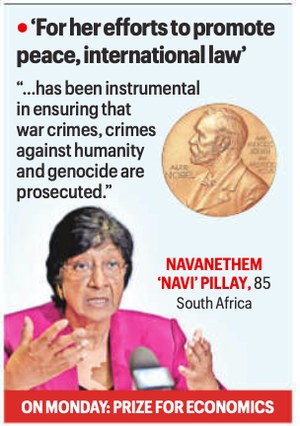
The citation credits Pillay with ensuring that war crimes, crimes against humanity and genocide are prosecuted. Image courtesy The Indian Express, 10 October 2026; reproduced with credit for educational use.
◈ Static Background
- Nobel Peace Prize: instituted under Alfred Nobel’s will, first awarded in 1901; decided by the Norwegian Nobel Committee and presented in Oslo (the other prizes are presented in Stockholm).
- Laureates linked to India: Mother Teresa (1979) and Kailash Satyarthi (2014).
- Nuremberg Trials (1945–46): the first international prosecution of State leaders for war crimes and crimes against humanity.
- Genocide Convention (1948): defines genocide as acts intended to destroy a national, ethnical, racial or religious group; India ratified it in 1959.
- International Criminal Tribunal for Rwanda (ICTR): created by UN Security Council Resolution 955 (1994); seated in Arusha, Tanzania.
A career of firsts
- Born to a family descended from Indian Tamil indentured labourers in Natal; first South African to earn a law doctorate from Harvard.
- Defended anti-apartheid activists, including the right of political prisoners to legal counsel; the first Black woman to open a law practice in Natal and to serve on its High Court.
- ICTR judge for eight years: the tribunal delivered the first international judgment for genocide (Akayesu, 1998), defined rape in international law and recognised it as an instrument of genocide, and held media figures liable for incitement.
- Later UN High Commissioner for Human Rights; chaired the UN Commission of Inquiry on the Occupied Palestinian Territory (2021–25).
- Currently an ad hoc judge at the ICJ in The Gambia v. Myanmar, the genocide case concerning the Rohingya.
▤ ICJ vs ICC — a classic Prelims distinction
- International Court of Justice: principal judicial organ of the UN (1945), at The Hague; settles disputes between States; 15 judges; India is a party to its Statute as a UN member.
- International Criminal Court: created by the Rome Statute (1998, in force 2002), also at The Hague; tries individuals for genocide, war crimes, crimes against humanity and aggression; independent of the UN; India is not a party.
- Ad hoc tribunals (ICTY 1993, ICTR 1994) were set up by the Security Council before the ICC existed.
Significance
The Committee rarely honours jurists. By choosing one amid what it called existential challenges and a high number of conflicts, it has defended international law at a moment when courts and UN bodies are criticised for lacking enforcement power. The award also carries a Global South and diaspora dimension.
✎ Mains Practice Question
“Peace requires justice.” In the light of this statement, evaluate the contribution and limitations of international criminal justice institutions in preventing mass atrocities. 10 marks · 150 words
Indian EconomyGeneral Studies Paper III
03
National PNG Drive 3.0: Moving Households from Cylinders to Pipelines
GS-III · Economy — Infrastructure: Energy; Energy SecurityPrelims + MainsThe Hindu
Marking its 20th Foundation Day on 1 October 2026, the Petroleum and Natural Gas Regulatory Board (PNGRB), together with city-gas distributors and oil-marketing companies, launched National PNG Drive 3.0 — a campaign to shift more homes from cylinder LPG to piped natural gas by the end of FY 2027.
◈ Static Background: India’s Gas Economy
- PNGRB: statutory regulator under the PNGRB Act, 2006 for the downstream sector — refining, processing, transport, storage and distribution; it does not regulate exploration and production.
- City Gas Distribution (CGD): networks supplying PNG to homes and businesses and CNG to vehicles; PNGRB authorises entities for geographical areas (GAs) through bidding rounds.
- PNG vs LPG: PNG is mainly methane, piped continuously; LPG is a propane–butane mix sold in cylinders.
- APM gas: gas from legacy domestic fields sold at government-administered prices, lower than market-linked gas.
- Policy goal: raise natural gas from about 6% of the primary energy mix to 15% by 2030, supported by the One Nation One Gas Grid.
▤ Drive 3.0 at a Glance
- Targets by end-FY 2027: 50 lakh new D-PNG connections, 40 lakh unbilled connections made active, 50 lakh new registrations.
- Incentive: an additional 200 SCM of lower-priced APM gas to CGD entities for every incremental billed D-PNG connection.
- Spare network: about 6.9 lakh inch-km of laid pipeline that could serve about 1.3 crore more connections.
- Drive 2.0 (Jan–Jun 2026): 12.10 lakh new connections, 13.37 lakh billed connections, 15.31 lakh registrations.
Figure 3 — Drive 2.0 achievements vs Drive 3.0 targets (lakh)
0255012.1050New connections13.3740Billed / activated15.3150RegistrationsDrive 2.0 achieved (Jan–Jun 2026)Drive 3.0 target (to end-FY27)
Drive 3.0 sets targets roughly three to four times Drive 2.0’s output, over a longer window; Drive 2.0 billed figures and Drive 3.0 activation targets are related but not identical measures.
Why the push now
- Sunk capacity: pipes already in the ground make each additional connection cheap; the challenge is uptake, not construction.
- Connections are not consumption: many connected homes never begin drawing gas, which is why Drive 3.0 sets a separate target to activate 40 lakh dormant connections and rewards distributors only for billed ones.
- Household fuel security: a large share of India’s LPG is imported, much of it from the Gulf; piped gas diversifies the household fuel basket.
- Cleaner combustion: gas emits less particulate matter and carbon dioxide than coal or biomass, supporting air-quality and net-zero (2070) goals.
Constraints
- Upfront costs: connection charges and security deposits deter low-income and rented households.
- Competing subsidy: targeted LPG support for Pradhan Mantri Ujjwala Yojana (2016) beneficiaries keeps cylinders cheaper for poor households, weakening the reason to switch.
- Import exposure persists: domestic gas output is supplemented by imported LNG, so price volatility shifts rather than disappears.
- Climate caveat: methane leakage along the supply chain erodes the climate advantage of gas, a transition fuel.
✎ Mains Practice Question
Natural gas is often described as India’s “bridge fuel”. Examine the role of city gas distribution in India’s energy transition and the constraints on expanding piped natural gas to households. 10 marks · 150 words
Science & TechnologyGeneral Studies Paper III
04
Additive Manufacturing in India: The National Strategy, Its Progress and NSAM 2.0
GS-III · S&T — Indigenisation of Technology; Economy — Industrial PolicyPrelims + MainsPIB · MeitY
More than four years after its launch, the National Strategy for Additive Manufacturing (NSAM) has exceeded some of its targets, and the Government is preparing a second phase aimed at commercialisation and IP generation.
◈ Static Background: What Is Additive Manufacturing?
Manufacturing can be subtractive (cutting material away, as in milling), formative (shaping it, as in casting or moulding) or additive (building an object layer by layer from a digital file). Additive manufacturing (AM), popularly called 3D printing, follows the third route.
- Process chain: CAD design (or a 3D scan) → STL file, which represents the surface as triangles → slicing into thin layers → layer-by-layer printing → post-processing.
- Process families (ISO/ASTM 52900): seven categories, including material extrusion, powder bed fusion, vat photopolymerisation and directed energy deposition; over 40 specific processes exist.
- Advantages: complex geometries, less waste, customisation, lighter parts and on-demand, distributed production.
- Limitations: slower for mass production, costly machines and materials, and certification challenges for critical parts.
- Industry 4.0 vs 5.0: 4.0 stresses automation and connectivity; 5.0 adds human-centric, sustainable and resilient production.
Figure 4 — From a digital design to a real product (PIB infographic)
Every AM object begins as a digital file; the machine only executes the layer-by-layer instructions produced by slicing. Infographic courtesy PIB (source: Atal Innovation Mission), 07 October 2026; reproduced with credit for educational use.
▤ NSAM at a Glance
- Released: February 2022 by the Ministry of Electronics and IT (MeitY); aligned with Make in India and Atmanirbhar Bharat.
- Targets: 5% of the global AM market; about US$1 billion added to GDP; 50 India-specific technologies; 100 start-ups; 500 products; 1 lakh trained workers; AM capability in 10 manufacturing sectors.
- Institutions: seven Development and Deployment Centres for R&D, skilling and technology access.
- Market outlook (projection): the global AM machines market is projected to reach US$149 billion by 2035.
Figure 5 — NSAM roadmap targets (PIB infographic)
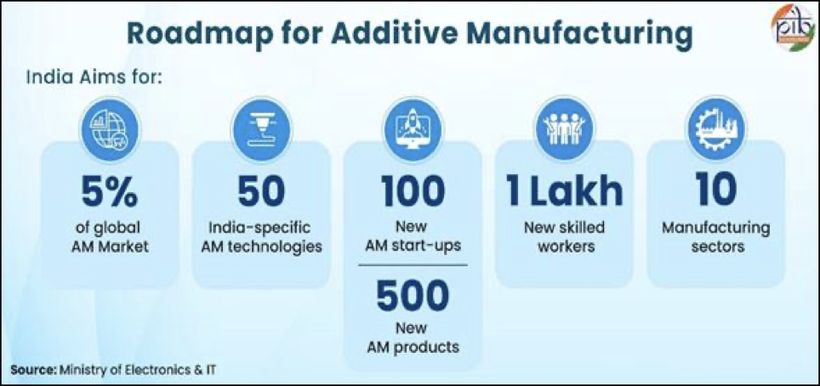
The seven headline targets of the National Strategy for Additive Manufacturing. Infographic courtesy PIB (source: Ministry of Electronics & IT), 07 October 2026; reproduced with credit for educational use.
Figure 6 — NSAM progress against targets (% of target achieved)
100% = target0%Skilled workers1.54 lakh / 1 lakh (154%)India-specific technologies65 / 50 (130%)AM start-ups supported56 / 100 (56%)Skilling and technology targets are exceeded; start-up creation and market share remain the gaps
Progress figures as reported by the Government, over four years since NSAM’s launch.
Sectoral applications in India
- Space: Agnikul Cosmos (IIT Madras-incubated) flew Agnibaan SOrTeD in May 2024 with a single-piece, 3D-printed semi-cryogenic engine.
- Defence: the Army’s first 3D-printed two-storey dwelling in Ahmedabad, built in 12 weeks; precast defences in Ladakh; workshop-level maintenance, repair and overhaul (MRO) facilities.
- Healthcare: silk-based implants and bioceramic bone grafts customised to a patient’s anatomy.
- Electronics: printed batteries, antennas and capacitors; IISc has demonstrated printed photonic integrated circuit blocks.
- Construction: on-site printing of homes with low-carbon geopolymer material; the Government cites potentially 30% lower material costs and 90% lower emissions than cement-based construction (projection).
NSAM 2.0 — proposed direction
- More IP generation and commercialisation of globally competitive technologies.
- Cheaper machines and materials through clusters; a stronger AM-electronics value chain.
- A larger start-up base, support to defence, SDG-linked pilots and international cooperation on standards.
Critical view
- The 5% market-share target is far from reach; India still imports most industrial AM machines and metal powders.
- Qualification and certification standards for aerospace and medical parts are still developing.
- Skilling numbers are high, but industry absorption of trained workers is unclear.
✎ Mains Practice Question
Additive manufacturing can help India leapfrog in advanced manufacturing. Discuss its potential across strategic sectors, and examine the gaps that the next phase of the National Strategy for Additive Manufacturing must address. 15 marks · 250 words
05
World Development Report 2026: The Promise of Artificial Intelligence for Developing Economies
GS-III · S&T — Developments and their Applications; Economy — Inclusive GrowthPrelims + MainsPIB · MeitY
The World Bank Group’s World Development Report 2026, launched in India by the IndiaAI Mission, argues that developing countries gain most from AI by adopting and adapting existing tools rather than racing to build frontier systems.
◈ Static Background
- World Development Report (WDR): the World Bank’s annual flagship report since 1978, each edition on one development theme.
- Other reports, other publishers: World Economic Outlook and Global Financial Stability Report — IMF; Human Development Report — UNDP; Global Competitiveness/Global Risks — WEF.
- AI value chain: compute (GPUs, data centres) → data → models (including large foundation models) → applications; each layer needs skills and governance.
- IndiaAI Mission (2024): outlay of about ₹10,372 crore over five years, implemented by MeitY.
The Report’s framework
- Adopt → adapt → advance: use existing AI, tailor it to local contexts, then build advanced capability.
- Be optimistic, strategic and pragmatic: make cost-conscious choices as enabler, user and regulator of AI.
- Foundations: gains depend on electricity, connectivity, compute, quality data, skills and capable institutions.
- Readiness gap: countries with most to gain may be least prepared — only one of the world’s 25 low-income countries has a national AI strategy.
- Jobs: the risk of large-scale job disruption is assessed as less imminent in developing countries.
▤ IndiaAI Mission — Seven Pillars
- IndiaAI Compute Capacity · IndiaAI Innovation Centre (indigenous foundation models) · IndiaAI Datasets Platform (AIKosh)
- IndiaAI Application Development Initiative · IndiaAI FutureSkills · IndiaAI Startup Financing · Safe & Trusted AI
- Safe & Trusted AI covers bias mitigation, algorithm auditing, explainable and privacy-preserving AI, and deepfake detection.
Indian examples cited at the launch
- AI-based monsoon forecasting delivered to farmers by text and voice, which the World Bank’s chief economist described as a model for other countries.
- Ministerial claims of higher sugarcane yields with less water in Baramati and improved TB detection (government figures).
- State showcases: early screening of developmental delay in children (Andhra Pradesh), farm advisories (Maharashtra), GeoAI for school governance (Meghalaya) and point-of-care cervical cancer screening.
Critical view
- Most pilots have not yet been evaluated rigorously; the central challenge is moving from pilots to evidence-based scale.
- A light-touch approach — relying on existing laws and voluntary compliance — may leave gaps on accountability, data protection and harm.
- Compute and model dependence on a few global firms raises questions of technological sovereignty.
✎ Mains Practice Question
“For developing countries, the priority is not creating artificial intelligence but deploying it.” Discuss in the context of India’s AI strategy, highlighting the foundations needed to scale AI for inclusive development. 15 marks · 250 words
Environment & EcologyGeneral Studies Paper III
06
MoSPI’s Strategy for Environmental-Economic Accounts in India, 2026–2030
GS-III · Environment — Conservation; Economy — Growth Measurement, Green GDPPrelims + MainsPIB · MoSPI
The National Statistics Office has released a roadmap to extend India’s environmental accounts to new areas, building on the 2022–26 strategy and the growing international recognition of natural capital in national accounts.
◈ Static Background: Why Account for Nature?
GDP records the output of an economy but not the depletion or degradation of the natural assets that support it. A country can grow GDP while running down forests, soil and water. Environmental-economic accounting tries to make this visible.
- SEEA: the UN System of Environmental-Economic Accounting. Its Central Framework (2012) is an international statistical standard; SEEA Ecosystem Accounting was adopted in 2021.
- SNA 2025: the updated System of National Accounts, which gives greater recognition to natural resources within national accounting.
- Asset accounts record stocks (forest cover, mineral reserves); flow accounts record use and emissions; accounts can be physical or monetary.
- Green National Accounts in India — A Framework (2013): report of an expert group chaired by Sir Partha Dasgupta; its recommendations shaped the new strategy.
- EnviStats India: MoSPI’s annual compendium of environmental accounts, published since 2018.
▤ The Strategy at a Glance
- Issued by: National Statistics Office, MoSPI.
- Predecessor: Strategy 2022–26, which prioritised material flow, ocean, energy and thematic (biodiversity, urban) accounts.
- New/expanded coverage: forests, minerals, soil, land, water, carbon stock, environment-related activities, biodiversity and environment statistics.
- Features: identifies data gaps, sources, milestones and policy implications; serves as a guide for States and UTs; described as “self-evolving”.
Significance
- Supports reporting under the Kunming-Montreal Global Biodiversity Framework and climate commitments.
- Helps value ecosystem services and price environmental costs into public investment decisions.
- Enables State-level green accounting, relevant to fiscal transfers that reward forest cover.
Challenges
- Valuing non-marketed ecosystem services is methodologically contested.
- Data on soil, groundwater and biodiversity are fragmented across ministries and States.
- Accounts influence policy only if they are integrated into budgeting and planning.
✎ Mains Practice Question
What is environmental-economic accounting? Discuss its significance for sustainable development in India and the challenges in integrating natural capital into national accounts. 10 marks · 150 words
07
BNHS Announces the First Synchronised All-India Sarus Crane Survey
GS-III · Environment — Biodiversity Conservation, Wetlands, Species in NewsPrelims + MainsDown To Earth
The Bombay Natural History Society (BNHS) has called for a nationwide, synchronised count of the Sarus crane on 10–11 October 2026, arguing that India still lacks a comparable national baseline for its tallest flying bird.
◈ Static Background: Cranes of India
Cranes (family Gruidae) are tall, long-legged wetland birds found on every continent except Antarctica and South America. Of the world’s 15 species, several occur in India, but only one breeds here year-round.
- Sarus crane: the only resident breeding crane in India; State bird of Uttar Pradesh.
- Black-necked crane: breeds on the Tibetan plateau and in Ladakh; winters in Arunachal Pradesh and Bhutan.
- Demoiselle and Common cranes: winter migrants; Demoiselles congregate famously at Khichan, Rajasthan.
- Siberian crane: a former winter visitor to Keoladeo National Park, not recorded there since the early 2000s.
- Central Asian Flyway: the migratory corridor between Siberia and the Indian Ocean; India hosted CMS COP13 (Gandhinagar, 2020) and leads flyway conservation efforts.
▤ Species Profile
- Scientific name: Antigone antigone; stands about 1.5 metres tall — the world’s tallest flying bird.
- Protection: Vulnerable (IUCN Red List); CITES Appendix II; Schedule I of the Wild Life (Protection) Act, 1972.
- Habitat: a mosaic of wetlands, marshes, shallow water bodies, grasslands and cultivated land — especially paddy fields with embedded wetlands.
- Cultural value: pairs for life; revered as a symbol of fidelity.
- Ecological value: an indicator species for healthy wetland-agricultural landscapes.
8,000–10,000earlier international estimate for India
~20,000Uttar Pradesh State count, 2024
30–40%suspected decline over three generations
4.33% / yrcurrent annual decline (State of India’s Birds)
A contracting range
The Sarus once ranged widely across the Gangetic plains and central and eastern India, including Bihar, West Bengal and Assam.
It is now largely confined to agricultural-wetland pockets in Uttar Pradesh, Gujarat, Rajasthan, Madhya Pradesh and Haryana, with isolated groups in Maharashtra; southern populations are declining sharply.
Threats
- Degradation and drainage of wetlands; shifts in cropping patterns away from wet crops.
- Pesticides and agrochemicals; collision with and electrocution on power lines.
- Human disturbance, poaching, and collection of eggs and chicks.
- Predation by wild and free-ranging dogs.
Why a synchronised national count matters
Earlier estimates and today’s State counts cannot be compared directly, because methods, coverage, seasons and effort differ. The apparent contrast between a national figure of 8,000–10,000 and a State count of about 20,000 illustrates the problem. The aim is a comparable baseline, not just a number.
- Identify strongholds and priority landscapes; map breeding, feeding and roosting sites.
- Locate power-line collision hotspots and guide Sarus-friendly farming.
- Underpin national and State conservation plans and integrate Sarus protection with wetland and agricultural policy.
- Use citizen science — farmers, students and birders alongside forest departments — because the birds move across district and State boundaries.
◈ Prelims Pointers
- BNHS: founded in 1883 in Mumbai; one of India’s oldest conservation research NGOs.
- State of India’s Birds: a periodic assessment by a consortium of government and non-government institutions, based largely on citizen-science data.
- World Migratory Bird Day: observed twice a year, on the second Saturday of May and of October.
- Wetlands law: Wetlands (Conservation and Management) Rules, 2017; India is a party to the Ramsar Convention (1971).
✎ Mains Practice Question
The Sarus crane survives largely in human-dominated agricultural landscapes. Examine the threats it faces, and discuss how its conservation can be integrated with wetland and agricultural policy. 10 marks · 150 words