

In-Depth News Analysis7 Items
Core TopicImportantConcise
Polity, Governance & Social JusticeGS Paper II
01OBC Creamy Layer — Supreme Court Reaffirms ‘Status, Not Salary’
International Relations & Defence DiplomacyGS Paper II · III
02Naseem Al Bahr (Oman) & RAHAT MITRA (Myanmar) — Defence Diplomacy
Science & TechnologyGS Paper III
03Physical AI — AI Moves from Bits to Atoms04‘Temple’ Wearable & Brain Blood Flow — Testing the Claims
Environment & EcologyGS Paper III
05COP31 in Antalya — Finance, Fossil Fuels & a Split Presidency
History, Art & CultureGS Paper I
06Rajatarangini, Mahabharata & Arthashastra — UNESCO Memory of the World07Remembrance Day — India’s Forgotten Sacrifice in the World Wars
Polity, Governance & Social JusticeGeneral Studies Paper II
01
OBC Creamy Layer: Supreme Court Reaffirms That Parental Salary Alone Cannot Decide Exclusion
ImportantGS-II · Polity — Reservation, Welfare of Vulnerable Sections, JudiciaryPrelims + MainsThe Indian Express · Explained
On 6 November 2026, the Supreme Court turned down the Centre’s attempt to narrow its 11 March 2026 ruling in Union of India v. Rohith Nathan, reaffirming that the creamy-layer status of an OBC candidate cannot be fixed solely on the basis of a parent’s salary income — the status and category of the parent’s post must also be weighed.
◈ Static Background — Creamy Layer from the Basics
The creamy layer is the socially and economically advanced section within the Other Backward Classes (OBCs) that is excluded from reservation benefits, so that the quota reaches those who still need it.
The idea was made binding by the nine-judge Bench in Indra Sawhney v. Union of India (1992), which upheld the 27% OBC quota on that condition.
- Constitutional basis: Article 15(4) (special provisions) and Article 16(4) (reservation in posts for backward classes not adequately represented).
- Office Memorandum of 8 September 1993 (DoPT), based on the Justice R.N. Prasad Committee: six categories — constitutional posts; Group A/Class I and Group B/Class II officers of the Centre and States; PSU employees; armed forces officers; professionals, trade and industry; property owners — plus an income/wealth test.
- The key exclusion: income from salary and agricultural land is not counted in the income/wealth test — for salaried families, the rank of the post decides.
- Ceiling today: ₹8 lakh a year (revised in 2017; it was ₹1 lakh in 1993).
How the Dispute Arose — a Timeline
- 2004: a DoPT “clarification” said that where equivalence between posts in PSUs, banks and the private sector and government posts had not been determined, parents’ salary would count — and if it crossed the limit for three consecutive years, the child fell in the creamy layer.
- From CSE-2015 (2016 batch): the clarification began to be applied rigorously, and several successful OBC candidates lost reserved-category allocation.
- 2017: the Cabinet approved equivalence norms for posts in central PSUs, but private-sector posts remained largely unmapped.
- 11 March 2026: the Court held that salary alone cannot be the basis; a clarificatory letter cannot add a substantive condition missing from the parent 1993 policy; treating children of PSU and private employees differently from those of government servants in comparable posts amounted to hostile discrimination. It directed the Centre to implement the principles within six months and to create supernumerary posts where required.
- CSE 2025: results had been declared five days before the March verdict; the Centre then sought to limit the ruling, warning that retrospective application would unsettle concluded selections.
▤ What the Court Said on 6 November 2026
- No reopening of the merits: the reading of the 1993 OM and the 2004 letter, and the rejection of mechanical, salary-based exclusion, are settled; a miscellaneous application cannot be used to seek reconsideration.
- No retrospective sweep: the Centre’s plea rested on a wrong assumption — the six-month deadline applied to deciding the claims of the respondent candidates, not to a general re-examination of all past recruitment years.
- Going forward: all selections, appointments and roster allotments must follow the 1993 OM as interpreted in March.
- Rule for PSU and private-sector families: where equivalence is not established, children are assessed under the income/wealth test, which excludes salary; salary can never be the sole criterion.
Analysis
- Why status over salary: pay commissions and allowances inflate nominal salaries without changing a post’s standing; occupational rank is a better proxy for the social advancement that Indra Sawhney sought to capture.
- Equality between similarly placed families: ignoring a government employee’s salary while counting a PSU or private employee’s salary violated Articles 14 and 16.
- Administrative lesson: eligibility rules affecting lakhs of aspirants must be framed through reasoned, notified policy, not executive letters — and equivalence mapping must be completed so that cases do not fall into a grey zone.
- Open questions: the ₹8 lakh ceiling, unrevised since 2017; the unpublished Justice G. Rohini Commission report (2023) on OBC sub-categorisation; and the use of caste data from Census 2027.
✎ Mains Practice Question
“The creamy layer is meant to identify social advancement, not merely income.” Discuss in the light of the Supreme Court’s rulings on the use of parental salary in determining OBC creamy-layer status. 10 marks · 150 words
International Relations & Defence DiplomacyGeneral Studies Papers II & III
02
From Muscat to Chennai: Naseem Al Bahr with Oman and the First RAHAT MITRA Exercise with Myanmar
ImportantGS-II · IR — India & its Neighbourhood, West AsiaGS-III · Security — Defence Cooperation, Disaster ManagementPrelims + MainsPIB · Ministry of Defence
Two exercises in one week show India’s defence diplomacy at both ends of its maritime neighbourhood: the destroyer INS Surat reached Muscat on 8 November 2026 for the 15th Naseem Al Bahr with Oman, while India and Myanmar held their first tri-services HADR exercise, RAHAT MITRA, in Chennai (5–6 November).
◈ Static Background — Oman: India’s Closest Gulf Defence Partner
- Geography: Oman guards the Strait of Hormuz (through its Musandam exclave) and faces India across the Arabian Sea; its port of Duqm has been open to Indian Navy use for logistics and maintenance since 2018.
- Ties: diplomatic relations since 1955; Strategic Partnership (2008); Oman was the first Gulf country with which all three services held bilateral exercises — Naseem Al Bahr (Navy, since 1993), Al Najah (Army) and Eastern Bridge (Air Force).
- Economy: the India–Oman CEPA, signed on 18 December 2025 and in force from 1 June 2026, gives duty-free access on 98.08% of Oman’s tariff lines — India’s second CEPA with a GCC member after the UAE (2022).
- Map pointers: land borders with the UAE, Saudi Arabia and Yemen; coastline on the Gulf of Oman and the Arabian Sea; the Musandam exclave, cut off from the mainland by UAE territory, overlooks the Strait of Hormuz; Masirah Island lies off the east coast; capital Muscat.
Figure 1 — Oman: Location and Strategic Points
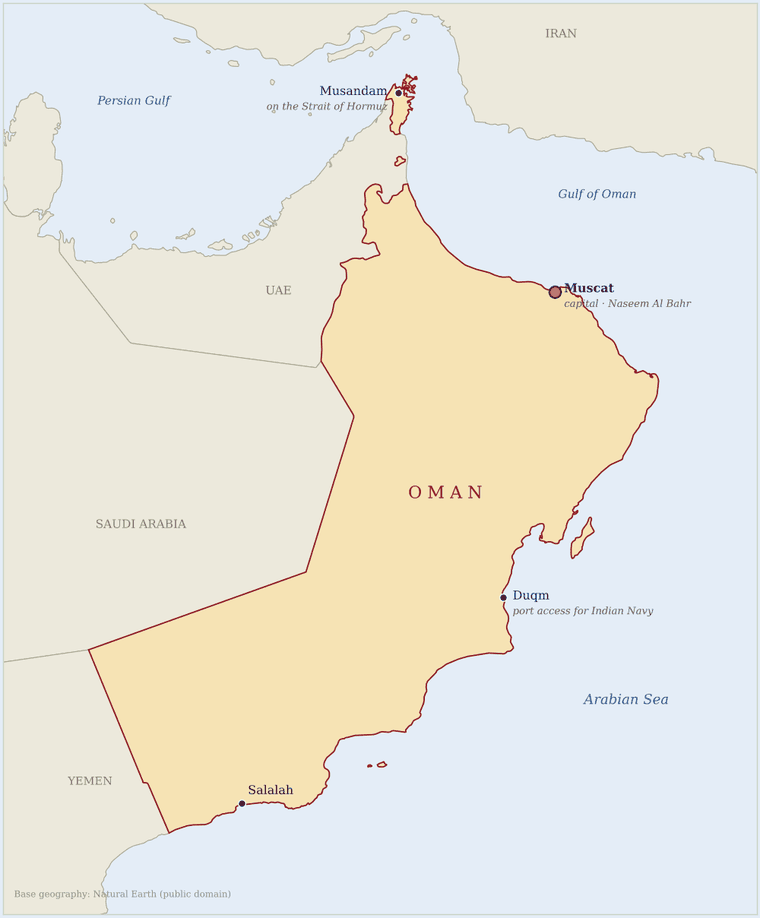
Oman sits astride the entrance to the Persian Gulf: Musandam faces Iran across the Strait of Hormuz, while Duqm on the Arabian Sea coast gives the Indian Navy a logistics foothold outside the Gulf. Base geography: Natural Earth (public domain).
◈ Static Background — Myanmar: Land Bridge to the East
- Border: about 1,643 km with Arunachal Pradesh, Nagaland, Manipur and Mizoram; Myanmar is the only ASEAN country sharing a land border with India.
- Connectivity: the Kaladan Multi-Modal Transit Transport Project via Sittwe port, and the India–Myanmar–Thailand Trilateral Highway.
- Existing military engagement: IMBEX (Army), IMNEX (Navy) and IMCOR (coordinated patrol).
- HADR record: India sent relief to Myanmar under Operation Sadbhav (2024) after Typhoon Yagi and Operation Brahma (2025) after the March earthquake.
- Map pointers: neighbours — Bangladesh, India, China, Laos and Thailand; capital Nay Pyi Taw (moved from Yangon in 2005–06); major rivers Irrawaddy (Ayeyarwady), Chindwin and Salween; Myanmar’s Coco Islands lie just north of India’s Andaman Islands, across the Coco Channel.
Figure 2 — Myanmar: Location and Key Points
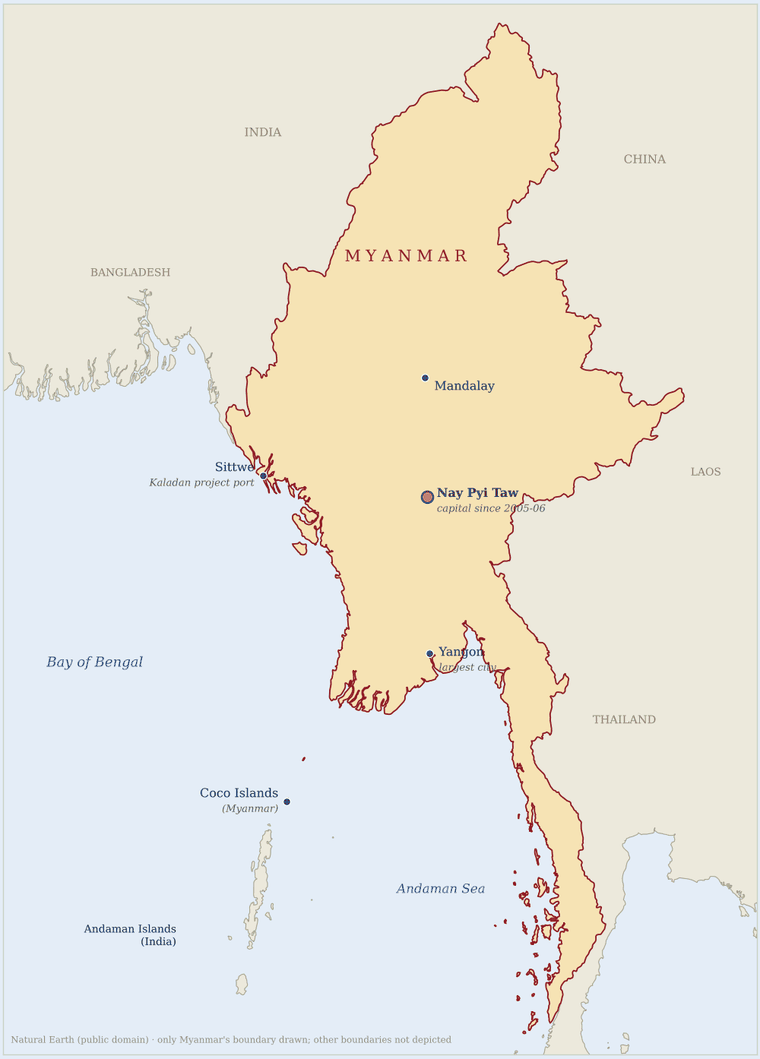
Myanmar links India’s North-East to South-East Asia by land and, through Sittwe, by sea; its Coco Islands sit close to the Andaman Islands. Base geography: Natural Earth (public domain); only Myanmar’s own boundary is drawn, other international boundaries are not depicted.
Figure 3 — Two Exercises, Two Flanks of the Indian Ocean
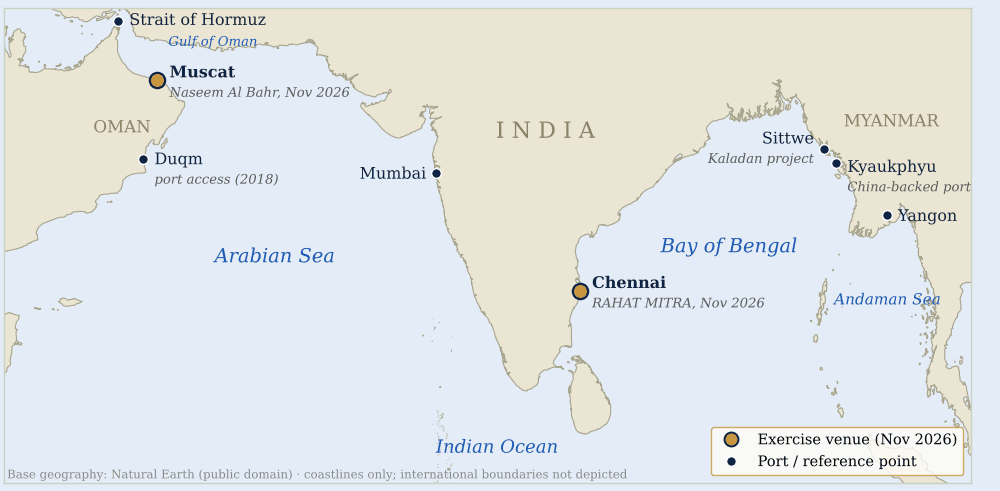
Oman anchors India’s western flank near the Hormuz chokepoint; Myanmar its eastern land bridge, where China backs the Kyaukphyu port close to India’s Sittwe project. Base geography: Natural Earth (public domain); coastlines only, international boundaries not depicted.
▤ The Two Exercises at a Glance
- Naseem Al Bahr (“Sea Breeze”), 15th edition: INS Surat with the Royal Navy of Oman; harbour and sea phases (cross-deck visits, operational interactions, sports), followed by a Coordinated Patrol (CORPAT); builds on the 13th Joint Military Cooperation Committee meeting (24 November 2025).
- INS Surat: the fourth and final Project 15B (Visakhapatnam-class) stealth guided-missile destroyer, commissioned in January 2025.
- RAHAT MITRA: the first India–Myanmar tri-services HADR exercise; 300+ personnel from the Army, Navy and Air Force of both countries; coordinated by the Indian Navy; theme “Together for Humanity, Stronger through Partnership”.
- Policy frames cited: MAHASAGAR for both; Neighbourhood First for Myanmar.
Why It Matters
- Energy and trade security: a large share of India’s crude and LNG imports passes near the Strait of Hormuz; interoperability with Oman supports anti-piracy and escort operations in the Gulf of Oman.
- First-responder role: joint HADR drills make relief faster in a region prone to cyclones, earthquakes and floods — and reinforce India’s image as a net security provider.
- Strategic competition: China’s presence in Myanmar (the China–Myanmar Economic Corridor and Kyaukphyu) makes sustained Indian engagement important for the stability of the North-East and the Bay of Bengal.
The Critical View
- Myanmar dilemma: engaging Myanmar’s military-led establishment since the 2021 coup invites criticism on democratic and humanitarian grounds; India balances principle with border security and connectivity interests.
- Border instability: conflict across the border has affected Manipur and Mizoram and delayed connectivity projects such as Kaladan’s road segment.
- Exercise vs capability: exercises signal intent, but credible presence needs ships on station, logistics access and timely delivery of promised projects.
✎ Mains Practice Question
Defence diplomacy, including joint exercises and humanitarian assistance, has become a key instrument of India’s policy in the Indian Ocean Region. Examine with reference to India’s engagement with Oman and Myanmar. 10 marks · 150 words
Science & TechnologyGeneral Studies Paper III
03
Physical AI: Why the Next Frontier of Artificial Intelligence Is in Factories, Oilfields and Robots
Core TopicGS-III · S&T — Developments in IT, Robotics & AI; Industrial PolicyPrelims + MainsThe Indian Express · Explained
A new deal between Abu Dhabi’s state oil company ADNOC, the UAE’s G42 and OpenAI, signed at ADIPEC on 2 November 2026, signals the industry’s turn to “physical AI” — AI that perceives and acts in the real world — as a way to answer the sector’s biggest question: how to make money from AI.
◈ Static Background — From AI to Physical AI
- The ladder: Artificial Intelligence (machines doing tasks that need human-like intelligence) → Machine Learning (learning patterns from data) → Deep Learning (multi-layer neural networks) → Generative AI and Large Language Models (LLMs), built on the transformer architecture (2017) and trained on vast internet text and images.
- Digital AI works in “bits” — chatbots, image generators, code assistants. Physical AI (also called embodied AI) works in “atoms” — robots, drones, self-driving vehicles and smart grids that perceive, reason and act.
- Building blocks: sensors (cameras, LiDAR, inertial units) to perceive; AI models to understand space and plan; actuators (motors, grippers) and control systems to act.
- Reinforcement learning: machines learn by trial and error against a reward signal — combined with LLM-style “common sense”, robots can improve with use.
- Digital twin: a live virtual replica of a machine, plant or process, fed by real-time data, used to simulate and optimise before acting in the real world.
- Moravec’s paradox: what is easy for humans — walking, grasping, seeing — has proved hardest for machines, which is why physical AI lagged behind language AI.
- Old vs new robotics: the first industrial robot, Unimate (1961), did one scripted job; classic robots repeat fixed motions in engineered settings, while AI-driven robots can adapt to variation.
Figure 4 — How Physical AI Works: the Perceive–Reason–Act Loop
1 · PERCEIVEcameras, LiDAR, touch,vibration, temperature2 · REASONmultimodal AI models:space, physics, planning3 · ACTmotors, grippers, valves,vehicles, grid switches4 · LEARN — real-world feedback becomes dataTraining support• Digital twins and simulation• Reinforcement learning• Real-world data — synthetic data alone falls shortWhere it is being deployed• Predictive maintenance in oil and gas• Drilling and seismic interpretation• Robotic assembly, logistics, smart grids
Generative AI stops at producing text or images; physical AI closes the loop by acting and then learning from the consequences — which is why real-world data and safety engineering become central.
▤ Deployments Cited (company-reported figures)
- ADNOC–G42–OpenAI (Nov 2026): advanced AI across the energy major’s operations to raise efficiency and solve engineering problems.
- Shell with C3.ai: enterprise-scale predictive maintenance monitoring over 13,000 pieces of equipment.
- BP: AI on real-time drilling data — exploration and drilling costs down about 7%, non-productive time down nearly 8%.
- Chevron: in-house generative-AI tool ApEX (launched August 2024) with multiple agents for seismic interpretation, first used in deepwater exploration in the Gulf of Mexico (renamed the Gulf of America by the US in 2025).
- Foxconn: AI-powered robots with digital twins for tasks like screw tightening and cable insertion — deployment time down about 50%, cycle times improved 20–30%, errors down 25%.
- Projection: a McKinsey partner expects robotics and physical AI to create at least USD 1 trillion in economic value by 2040, mostly in manufacturing and logistics.
Why the Push Now — the Monetisation Question
AI firms have spent heavily on data centres and chips, and markets have grown uneasy about returns. Consumer chatbots alone have not closed the gap; enterprise contracts that cut measurable costs in heavy industry offer a clearer revenue path.
- Industry framing: chipmaker Nvidia’s leadership has popularised “physical AI” as the next wave, predicting a future of a billion robots — a second industrial revolution in its telling.
- Data bottleneck: unlike language models trained on the internet, robots need real-world, multi-sensor data from the environments where they will work.
India Angle
- IndiaAI Mission (approved March 2024, outlay ₹10,371.92 crore) — compute, datasets, foundation models and skilling; India hosted the AI Impact Summit in New Delhi in February 2026.
- Manufacturing: physical AI aligns with Industry 4.0, PLI schemes and the push to make India an electronics and engineering hub.
- Agriculture: drones under Namo Drone Didi (2023; 15,000 drones for women SHGs) show how autonomous machines can reach farms.
- Strategic sectors: robotics for defence, disaster response, mining safety and manual-scavenging elimination.
The Critical View
- Safety and liability: when an autonomous machine causes harm, who is responsible — developer, deployer or operator? India has no AI-specific law; the EU AI Act (2024) follows a risk-based model.
- Jobs: automation can displace routine manual work in a labour-surplus economy; proponents argue it will shift humans to supervisory and problem-solving roles.
- Cybersecurity: connecting AI to operational technology — pipelines, grids, factories — widens the attack surface for physical damage.
- Evidence and hype: most performance figures are self-reported by firms and vendors; independent audits are rare.
- Dual use: the same autonomy powers lethal autonomous weapons, debated at the UN’s CCW group of experts.
✎ Mains Practice Question
“Physical AI marks the movement of artificial intelligence from the world of bits to the world of atoms.” Explain, and discuss the opportunities and regulatory challenges it presents for India’s manufacturing and labour market. 15 marks · 250 words
04
Can a Wearable Track Brain Health? The ‘Temple’ Device and the Science of Cerebral Blood Flow
ImportantGS-III · S&T — Biotechnology & Health TechnologiesGS-II · Health — Regulation of Medical DevicesPrelims + MainsThe Hindu · Science
Temple, a ₹85,000 head-worn wearable launched by the co-founder of food-delivery firm Zomato, claims to track changes in brain blood flow and an “entropy” score linked to ageing. Its own studies offer some evidence for narrower measurements, and medical professionals have publicly questioned the larger claims.
Figure 5 — The ‘Temple’ Device

The small pod is worn on the temple and reads optical signals from the skin and tissue beneath — its link to blood flow inside the brain is the disputed part. Image: X/@TEMPLE, as published in The Hindu; reproduced with credit for educational use.
◈ Static Background — How Wearables “See” Blood
- Photoplethysmography (PPG): shining light into tissue and measuring how much is absorbed or reflected; with every heartbeat, tiny vessels swell, so the signal pulses. The frequency gives heart rate; the amplitude hints at changes in blood volume.
- Wavelength matters: green light stays near the surface (used in smartwatches); red and infrared penetrate deeper. Pulse oximeters compare red and infrared absorption by oxygenated and deoxygenated haemoglobin to estimate SpO2.
- Reference methods for brain blood flow: MRI (flow per unit tissue), Transcranial Doppler (TCD) ultrasound (blood velocity in a major brain artery), and Near-Infrared Spectroscopy (NIRS), whose time-domain version can separate scalp from deeper signals.
- Anatomy: the internal carotid artery supplies the brain; the external carotid supplies the face and scalp — a sensor on the temple reads mainly the latter, linked to brain circulation only through connecting vessels.
- Why the brain matters: it is about 2% of body weight but uses roughly a fifth of the body’s energy; autoregulation keeps its blood flow stable across a wide range of blood pressures.
- Entropy: a measure of disorder in thermodynamics and of uncertainty in information theory; there is no established biological metric by that name for health or ageing.
▤ What Temple’s Own Studies Show (not peer-reviewed)
- Study 1 (44 young men): during posture changes, the device’s Brain Flow index (Temple-BF) tracked a modelled brain signal from time-domain NIRS more closely than the scalp signal — though in one test the difference was small and could be chance.
- Study 2 (20 participants): Temple-BF correlated about 0.80 with TCD ultrasound during cycling and a stand-then-lie test, and rose with brain-artery velocity rather than following heart rate.
- Company report (43 adults): on a treadmill test against a chest-strap reference, Temple had the smallest average heart-rate error among several popular wearables.
- Admitted limit: the researchers state the sensor fundamentally detects changes in blood flow in the skin and underlying tissue; none of the studies addresses “entropy”.
What the Wider Science Says
- Ageing: a 2023 study of 185 adults aged 21–80 found neck arteries kept their width with age but blood moved more slowly through them.
- Dementia links are associations: lower cerebral blood flow has been linked to about 30% higher dementia risk and faster decline, and orthostatic hypotension to about 15% higher risk (2016) — but cause and effect remain unproven.
- No intervention evidence: no trial shows that raising brain blood flow extends life or delays cognitive decline.
- Expert view: an Ashoka University physiologist considers the index a legitimate mathematical construct worth testing, but says it is too early to link it to longevity or disease; large real-world datasets could still have research value.
The Regulatory Gap
- Medical Devices Rules, 2017 (under the Drugs and Cosmetics Act, 1940) classify devices by risk into Classes A–D, regulated by CDSCO; licensing now covers all classes.
- The “wellness” route: a product described as “not a medical device” can avoid device licensing, even while its marketing implies health benefits.
- Consumer protection: the Consumer Protection Act, 2019 and the CCPA’s 2022 guidelines on misleading advertisements apply to unsubstantiated claims.
- Data: continuous physiological data are sensitive personal data under the Digital Personal Data Protection Act, 2023.
✎ Mains Practice Question
Consumer health wearables blur the line between wellness gadgets and medical devices. Discuss the risks this poses and suggest how India’s regulatory framework can ensure evidence-based claims without stifling innovation. 10 marks · 150 words
Environment & EcologyGeneral Studies Paper III
05
COP31 in Antalya: Why a Floundering Climate Process Still Matters — and What Is on the Table
Core TopicGS-III · Environment — Climate Change, International AgreementsGS-II · IR — Global Groupings & AgreementsPrelims + MainsThe Indian Express · Explained & Expert Explains
The 31st Conference of the Parties (COP31) to the UNFCCC opened in Antalya, Türkiye, on 9 November 2026 (till 20 November) under an untested split presidency, in the first COP since the US exit from the Paris Agreement — and with scientists now warning that the 1.5°C goal is effectively out of reach.
◈ Static Background — The UN Climate Regime from the Basics
- UNFCCC (1992): adopted at the Rio Earth Summit, in force 1994; its supreme body, the COP, meets annually. Core principle: Common But Differentiated Responsibilities and Respective Capabilities (CBDR-RC).
- Kyoto Protocol (1997): binding targets only for developed (Annex I) countries; its parties meet as the CMP.
- Paris Agreement (2015): keep warming “well below” 2°C and pursue 1.5°C; every country submits a Nationally Determined Contribution (NDC) every five years; a Global Stocktake every five years; its parties meet as the CMA. So Antalya hosts COP31, CMP21 and CMA8.
- Key Paris articles: Art. 6 (carbon markets), Art. 7 (adaptation and the Global Goal on Adaptation), Art. 8 (loss and damage), Art. 9.1 (developed countries “shall provide” finance to developing countries).
- Decision-making: by consensus — any single party can block; there is no mechanism to force laggards.
- Hosting: the COP venue rotates among the five UN regional groups; 2026 was the turn of the Western European and Others Group, for which both Türkiye and Australia bid.
Figure 6 — The Road to Antalya: Milestone COPs
199720092015202120222023202420252026COP3 KyotoKyoto ProtocolCOP15 Copenhagen$100 bn pledgeCOP21 ParisParis AgreementCOP26 Glasgowcoal “phase-down”COP27 Sharmel-SheikhLoss & Damage FundCOP28 Dubaifirst Global Stocktake;“transition away”COP29 BakuNCQG $300 bnCOP30 Belém“Global Mutirão”COP31Antalyasplit presidencySelected milestones only · spacing not to scale in time
Each COP adds a layer — targets at Kyoto, universal pledges at Paris, a fund at Sharm el-Sheikh, a finance goal at Baku. Antalya is billed as a “COP of implementation”, where the test is delivery rather than new treaties.
▤ COP31 at a Glance
- Dates and venue: 9–20 November 2026, Antalya Expo Centre; leaders’ summit on 11–12 November.
- Split presidency: Türkiye holds the formal COP presidency — venue, logistics and the voluntary Action Agenda; Australia is “President of Negotiations” with exclusive authority over the formal talks, in partnership with Pacific Island nations (the pre-COP was held in Fiji and Tuvalu).
- Opening friction: the opening was delayed as developing countries pressed for climate finance items, including Article 9.1, on the agenda.
- Co-chaired consultations: India and Germany (mitigation); France and the Philippines (finance); UK and Sierra Leone (adaptation); Mexico and Poland (just transition); Palau and Canada (oceans).
- Host’s pledge: Türkiye wants countries to raise electricity’s share of final energy use from about 23% to 35% by 2035.
- Absent player: the US government is not taking part in the negotiations after leaving the Paris Agreement.
Figure 7 — The Climate-Finance Ladder (USD billion per year)
1003001,300Copenhagen (2009)goal for 2020NCQG, Baku (2024)by 2035Baku-to-Belém Roadmapby 2035, public + privateDashed = aspiration, not a binding goal · bars to scale
Developing countries argue their needs run into trillions; the agreed collective goal remains $300 billion, and the $1.3 trillion figure is a roadmap that blends public and private money — hence the demand for a monitoring system.
What Belém (COP30, 2025) Left Behind
- “Global Mutirão” (a Tupi-Guarani-origin word for collective effort) — the headline package.
- Adaptation finance: a call to triple it by 2035 — five years later than developing countries wanted, and without a baseline.
- Finance roadmap: endorsement of the Baku-to-Belém Roadmap to scale finance to at least $1.3 trillion a year by 2035, building on the $300 billion NCQG.
- New tools: “Belém indicators” for the Global Goal on Adaptation, a Global Implementation Accelerator, a “Belém Mission to 1.5”, and work on a just-transition mechanism.
- The gap: over 80 countries backed a fossil-fuel roadmap, but the final text only recalled the 2023 UAE Consensus; Brazil is now steering a voluntary roadmap outside the talks, and Colombia and the Netherlands launched the Santa Marta process (April 2026).
Five Tests for Antalya
- Finance: numbers and a timeline for tripling adaptation finance, and a monitoring system for the $1.3 trillion roadmap.
- Fossil fuels: whether negotiated text includes a transition away from them.
- Electrification: how many countries sign the host’s 35%-by-2035 target.
- Governance: whether the split presidency works — a model future COPs may copy.
- Global South bargain: whether developing countries get the Article 9.1 discussion and finance reforms in return for engaging on mitigation.
The Science Backdrop
Reports from the UN Environment Programme this year say the window to limit warming to 1.5°C has effectively closed and that the realistic hope is 1.7–1.8°C. 2024 was the first calendar year above 1.5°C (WMO), though the Paris goal refers to long-term averages, not single years.
Why COPs Still Matter
- The only universal forum where developing countries can hold the developed world to account; climate has slipped down other global agendas amid wars and economic shocks.
- Concrete results do emerge: Nepal recently received $20 million from the Fund for responding to Loss and Damage after its August floods — finance no other forum would have provided so quickly.
- Direction of travel: the process has steered the world toward decarbonisation, however slowly, and accelerating renewables owe something to it.
India’s Position
- Principles: CBDR-RC, equity and climate justice; insistence on Article 9.1 finance from developed countries.
- Commitments: updated NDC (2022) — cut emissions intensity of GDP by 45% from 2005 levels and reach 50% non-fossil power capacity by 2030 (the capacity target was met in 2025); net zero by 2070; Mission LiFE.
- Energy security: higher oil and gas prices after the conflict involving Iran sharpen import-dependence concerns and the case for a faster, but fair, transition.
- Ambition: India has offered to host COP33 (2028).
The Critical View
- Consensus trap: outcomes gravitate to the lowest common denominator, and the gap between Paris goals and national action keeps widening.
- Ambition problem: temperature targets were set without the political will to meet them; pretending otherwise erodes credibility — but abandoning targets risks abandoning action itself.
- Finance quality: much climate finance comes as loans, adding to debt in vulnerable countries.
- Dual leadership risk: it is unclear who has the final word if Türkiye and Australia disagree in the closing hours.
✎ Mains Practice Question
“Conferences of the Parties have produced low-ambition outcomes, yet they remain the only universal forum for climate accountability.” Critically examine this statement in the context of COP31, and outline India’s priorities at the conference. 15 marks · 250 words
History, Art & CultureGeneral Studies Paper I
06
Rajatarangini, Mahabharata and Arthashastra Enter UNESCO’s Asia-Pacific Memory of the World Register
ImportantGS-I · Art & Culture — Literature, Ancient Texts, Heritage ConservationPrelims + MainsPIB · Ministry of Culture (IGNCA)
Manuscripts of Kalhana’s Rajatarangini, the Mahabharata and Kautilya’s Arthashastra were inscribed on 5 November 2026 on UNESCO’s Memory of the World Regional Register for Asia and the Pacific, at the 11th session of the regional committee (MOWCAP) in Jakarta, taking India’s total on that register to six.
◈ Static Background — The Memory of the World Programme
- What: launched by UNESCO in 1992 to preserve and give access to documentary heritage — manuscripts, archives, rare books, maps, audio-visual records.
- Three registers: International, Regional (for Asia-Pacific, run by MOWCAP) and National.
- Prelims trap: MoW is a programme, not a treaty — unlike the World Heritage Convention (1972) for sites and the Convention for the Safeguarding of Intangible Cultural Heritage (2003).
- India on the International Register: 14 inscriptions, including the Rigveda manuscripts (2007), the Gilgit manuscripts (2017), and the Bhagavad Gita and Natyashastra (2025).
- India on the Asia-Pacific Register: first entries in 2024 (10th session, Ulaanbaatar) — Ramcharitmanas, Panchatantra and Sahṛdayāloka-Locana; now three more in 2026.
- Nodal agency: the Indira Gandhi National Centre for the Arts (IGNCA), set up in 1987 under the Ministry of Culture, prepared all three dossiers.
▤ The Three Works and the Manuscripts Inscribed
- Rajatarangini (“River of Kings”): Kalhana’s Sanskrit chronicle of the kings of Kashmir, composed around 1148–50 CE in eight books (tarangas) of about 7,800 verses; often called the first Indian work to treat history with a critical, source-based approach; translated into English by M. Aurel Stein (1900) and continued by later chroniclers such as Jonaraja and Srivara. The inscribed manuscript is held at the Oriental Research Library, Srinagar.
- Mahabharata: the epic attributed to Vyasa, of about one lakh verses in 18 parvas, including the Bhagavad Gita (Bhishma Parva); its critical edition was prepared by the Bhandarkar Oriental Research Institute (BORI), Pune (1919–1966). The inscribed copy is a roughly 400-year-old birch-bark manuscript in the Sharada script held at BORI.
- Arthashastra: Kautilya’s treatise on statecraft, economy, law and diplomacy in 15 books; rediscovered in 1905 by R. Shamasastry and published in 1909. The inscribed item is a 16th-century palm-leaf manuscript at the Oriental Research Institute, Mysuru.
- The session: 21 items were added from 28 nominations by 26 countries for the 2025–26 cycle.
Concepts to Know from the Texts
- Saptanga theory (Arthashastra): seven limbs of the state — Swami (ruler), Amatya (ministers), Janapada (territory and people), Durga (fort), Kosha (treasury), Danda (army/justice) and Mitra (ally).
- Mandala theory: a circle of states in which a neighbour is a likely enemy and the neighbour’s neighbour a likely friend; Shadgunya — six modes of foreign policy, from peace (sandhi) to war (vigraha).
- Sharada script: the Brahmi-derived script of Kashmir, ancestor of scripts such as Takri; Rajatarangini’s historical method relied on inscriptions, coins and earlier records.
- Dharma in the Mahabharata: duty, ethics and moral dilemma — a recurring theme in GS-IV discussions.
Why It Matters — and the Limits
- Recognition and access: inscription raises international visibility and encourages conservation, digitisation and scholarly access to fragile media such as birch bark and palm leaf.
- Domestic push: the Gyan Bharatam Mission (Union Budget 2025-26) aims to survey and conserve over one crore manuscripts held by institutions and private owners.
- No binding obligations: unlike World Heritage sites, MoW inscription brings no treaty duties or dedicated funds — preservation still depends on national effort.
- Regional vs international: the regional register is a step below the international one; the challenge is to convert recognition into open, digitised access for researchers.
✎ Mains Practice Question
India possesses one of the world’s largest manuscript collections, yet much of it remains undocumented and inaccessible. Discuss the significance of UNESCO’s Memory of the World Programme and suggest measures to preserve and democratise access to India’s documentary heritage. 10 marks · 150 words
07
Remembrance Day and India’s Ambivalent Memory of the World Wars
ImportantGS-I · Modern Indian History & World History — World Wars, INA, Freedom StrugglePrelims + MainsOp-ed · Priyanjali Malik
At 11 a.m. on 11 November — the moment the 1918 Armistice took effect — much of the Commonwealth falls silent for the dead of the two World Wars. In India the day passes largely unnoticed, which the author argues obscures one of the largest contributions any country made to the Allied war effort.
◈ Static Background — India in the First World War (1914–18)
- Scale: about 1.5 million men from undivided India served, mostly overseas; around 74,000 did not return.
- Theatres: the Western Front (Ypres, Neuve Chapelle, 1915), Gallipoli, Mesopotamia (Siege of Kut, 1916), Egypt and Palestine — including the cavalry charge at Haifa (23 September 1918).
- Firsts: Khudadad Khan became the first Indian soldier to win the Victoria Cross (Belgium, 1914).
- Politics: wartime hopes led to the Montagu Declaration (20 August 1917), but post-war disappointment — the Rowlatt Act and Jallianwala Bagh (1919) — fuelled mass nationalism.
- Memorial: India Gate (All India War Memorial), designed by Edwin Lutyens (foundation 1921, unveiled 1931), bears over 13,000 names.
◈ Static Background — India in the Second World War (1939–45)
- Entry without consent: the Viceroy declared India a belligerent in September 1939 without consulting Indian leaders; the provincial ministries elected in 1937 resigned in protest — leading on to the August Offer (1940), Cripps Mission and Quit India (1942).
- Scale: about 2.5 million Indians — the largest volunteer army in history — with 87,000–89,000 dead; about 7 lakh fought in the Burma campaign, where Indians made up some 87% of the fighting force, according to the author.
- War comes home: Japanese bombing of Visakhapatnam (6 April 1942), Calcutta (December 1942) and the Kidderpore docks (December 1943); the Japanese invasion via Imphal and Kohima (March–July 1944) was turned back largely by Indian troops.
- Home-front cost: the Bengal Famine of 1943, worsened by wartime policy, killed millions.
- Bravery: Premindra Singh Bhagat, later a Lieutenant General, was the first Indian commissioned officer to win the VC in the war, for mine-clearing in the East African campaign.
The Indian National Army — a Complicated Chapter
- Origins: formed in 1942 under Captain Mohan Singh, largely from about 40,000 Indian prisoners of war captured at the fall of Singapore; revived by Subhas Chandra Bose in July 1943, who set up the Provisional Government of Azad Hind.
- The dilemma: many joined under duress, and alliance with Japan pitted Indian against Indian; yet the INA trials at the Red Fort (1945) roused national feeling and preceded the Royal Indian Navy mutiny (1946).
- A family story: the author recounts how the three Bhagat brothers — one a VC winner, one a prisoner later drawn into the INA, one fighting in Burma — were all nationalists, showing how history resists simple narratives.
Why the Ambivalence — and Why It Should End
- Colonial frame: Indians fought for freedoms denied to their own country — a legitimate grievance that shaped post-1947 memory.
- Asian solidarity myth: Japan’s claim to liberate Asia obscured its brutal expansion into India’s frontier.
- Continuity of the armed forces: the disciplined army forged in Burma became the force that defended India after 1947; its regimental traditions run unbroken.
- Honest history: acknowledging soldiers’ sacrifice need not endorse empire; India is a member government of the Commonwealth War Graves Commission, and memorials from Neuve Chapelle to Kohima are part of its story. Asked by the young VC how to serve India, Mahatma Gandhi reportedly advised him to stay in the army, because free India would need such men.
✎ Mains Practice Question
India’s contribution to the two World Wars was immense, yet it occupies an uneasy place in national memory. Examine the reasons for this ambivalence and assess how the wars shaped the course of the Indian national movement. 15 marks · 250 words