

In-Depth News Analysis8 Items
Core TopicImportantConcise
Polity & GovernanceGS Paper II
01UAPA: Bail, Vague Definitions & Trial Delays02Kulsi Hydropower Project & the Assam–Meghalaya Border
Science & TechnologyGS Paper III
03Quantum-Safe Banking & Post-Quantum Cryptography04World’s First Working Nuclear Clocks (Thorium-229)
Environment & EcologyGS Paper III
05Indonesia’s Wildfires, Haze & Orangutans06Heat-Driven Sex Reversal & Amphibian Extinction Risk
Geography & Places in NewsGS Paper I
07Twin Earthquakes in Panama — Places in News08Bay of Kotor: Fjord vs Ria — Places in News
Polity & GovernanceGeneral Studies Paper II
01
UAPA and Civil Liberties: The Debate Over Bail, Vague Definitions and Years of Pre-Trial Detention
Core TopicGS-II · Fundamental Rights (Arts 19, 21, 22), Judiciary, Criminal JusticeGS-III · Internal Security — Anti-Terror LawsPrelims + MainsThe Hindu · Letter & Spirit (Gautam Bhatia)
12 October marked the second death anniversary of a former Delhi University professor. He had spent about a decade in prison under the Unlawful Activities (Prevention) Act (UAPA) before the Bombay High Court acquitted him in 2024, and he died soon after his release. A legal commentary uses the anniversary to argue that the UAPA needs urgent reform. The central issue is how India balances national security against personal liberty.
◈ Basics First — What the UAPA Does
- Nature: the UAPA is India’s main anti-terror and anti-secession law. It was enacted in 1967 to act against unlawful associations, and terrorism chapters were added in 2004.
- “Unlawful activity” (Section 2(1)(o)) covers acts or words that support secession or question India’s sovereignty and territorial integrity. A “terrorist act” is defined in Section 15.
- Banning an association: the Centre can declare an association unlawful under Section 3. The ban must be confirmed by a UAPA Tribunal headed by a High Court judge.
- Lists of terrorist entities: terrorist organisations are listed in the First Schedule. Since 2019, individuals can also be designated as terrorists, in the Fourth Schedule.
- Main offences:
- membership of an unlawful association (Section 10);
- terrorist acts (Section 16);
- conspiracy (Section 18);
- membership of a terrorist organisation (Section 38);
- support to a terrorist organisation (Section 39).
- Investigation and sanction: cases are investigated by the National Investigation Agency (NIA) or State police. Prosecution needs government sanction under Section 45, given after review by an independent authority.
◈ Constitutional Anchor
- Article 19(2): allows reasonable restrictions on free speech. The 16th Amendment (1963) added “sovereignty and integrity of India” as a ground, and this is the constitutional basis for the UAPA.
- Article 21: after Maneka Gandhi (1978), any procedure that deprives a person of liberty must be just, fair and reasonable. Hussainara Khatoon (1979) held that a speedy trial is part of Article 21.
- Article 22: provides safeguards on arrest and detention.
- Presumption of innocence: although it is not written into the Constitution, courts treat it as a basic principle of criminal law.
Static Background — Lineage of India’s Anti-Terror Laws
- TADA (Terrorist and Disruptive Activities (Prevention) Act, 1985/1987) was allowed to lapse in 1995 after widespread complaints of misuse. In Kartar Singh v. State of Punjab (1994), the Supreme Court had upheld the law while warning against its abuse.
- POTA (Prevention of Terrorism Act, 2002) was upheld in PUCL v. Union of India (2003) and repealed in 2004. Its core terror provisions were then moved into the UAPA, a permanent statute that, unlike TADA and POTA, has no sunset clause.
- 2008: after the Mumbai attacks, an amendment added Section 43D, with tighter bail and longer custody, and the NIA Act was passed.
- 2012: threats to “economic security” were brought within the definition of terrorism.
- 2019: an amendment allowed the Centre to designate individuals as terrorists. It also let the NIA seize property connected with terrorism.
- International obligations: UN Security Council Resolution 1373 (2001) and FATF standards require States to criminalise terror financing.
Figure 1 — Six decades of special security legislation
196316th Amendment:“sovereignty andintegrity” in 19(2)1967UAPA enacted —unlawful associations1985 / 87TADA; allowedto lapse in 19952002POTA; repealedin 20042004Terror offencesmoved into UAPA2008S.43D bail bar,180-day custody;NIA Act2012“Economicsecurity” added2019Individuals can bedesignated“terrorists”
The temporary laws TADA and POTA were repealed or allowed to lapse, but their core features now sit within the permanent UAPA.
The Argument for Reform (as made in the article)
- Vague definitions: terms such as “membership” are not defined. At their widest, they can reach slogans or the mere possession of literature.
- Bail is nearly impossible: under Section 43D(5), a court must refuse bail if the accusation appears “prima facie true” on the police record. Undertrials therefore spend years in jail before trial.
- Long delays: the article cites the Bhima Koregaon case (2018), in which charges had still not been framed eight years later. It also cites the 2020 north-east Delhi riots conspiracy case, in which some accused have been in jail for more than six years without trial.
- Courts have reversed attempts to narrow the law:
- Arup Bhuyan (2011) limited “membership” to active membership involving incitement to violence. A larger Bench overruled it in 2023.
- A Delhi High Court bail ruling in 2021 read the terrorism clauses narrowly. The Supreme Court directed that it should not be treated as precedent.
- Inconsistent bail decisions: some judges closely scrutinise chargesheets, while others accept the police version. Courts also differ on how much delay justifies bail. Outcomes therefore depend heavily on which judge hears the case.
Figure 2 — How UAPA bail differs from ordinary criminal procedure
ArrestPolice custody up to30 days (ordinarylaw: 15 days)Chargesheetdue in 90 days,extendable to 180(ordinary: 60/90)Bail test — Section 43D(5)Court must refuse bail if, on the case diary orchargesheet, the accusation appears prima facietrue — the reverse of “bail is the rule”NIA v. Watali (2019)At the bail stage, courtsaccept the prosecution casebroadly; no detailedweighing of evidenceK.A. Najeeb(2021)Art. 21 relieffor long trialdelayOrdinary criminal law (contrast)“Bail is the rule, jail the exception”Default bail if chargesheet not filed in time(BNSS 2023, earlier CrPC S.167)
Section 43D reverses the ordinary rule that bail is the norm. The Najeeb principle, based on Article 21, is the main way out when a trial is long delayed.
▤ Key Judgments to Know
- NIA v. Zahoor Ahmad Shah Watali (2019): at the bail stage under the UAPA, courts should examine the prosecution case only broadly and should not weigh the evidence in detail.
- Union of India v. K.A. Najeeb (2021): constitutional courts may grant bail on Article 21 grounds where incarceration is long and the trial unlikely to end soon, despite Section 43D(5).
- Vernon Gonsalves v. State of Maharashtra (2023): merely possessing literature does not by itself make out a UAPA offence.
- Gurwinder Singh (Feb 2024) and Jalaluddin Khan (Aug 2024): both were Supreme Court Benches. The first stressed the strict bail bar, while the second held that “bail is the rule” applies even under the UAPA. Together they show the inconsistency the article criticises.
- Conviction rate: Union Home Ministry data placed in Parliament (2021) showed that only about 2% of people arrested under the UAPA between 2016 and 2019 were convicted.
The Other Side — Why a Stringent Law Is Defended
- Nature of terrorism: terror networks are covert, cross-border and increasingly online. Proving such conspiracies needs longer investigation than ordinary crime.
- Risks of release on bail: accused persons may intimidate witnesses, abscond or re-offend.
- Constitutional validity: the Supreme Court has upheld special anti-terror laws, from Kartar Singh to PUCL, as valid exercises of State power.
- Built-in safeguards: the law has independent sanction review, tribunal confirmation of bans and special courts. On this view, the problem lies in implementation, not in the design of the law.
Way Forward
- Write the Najeeb principle into the statute, so that bail becomes presumptive after a fixed period of undertrial custody.
- Define “membership”, “support” and “conspiracy” precisely, keeping a requirement of intent and nexus with violence.
- Set time limits for trials in special courts, provide enough judges, and require quarterly disclosure of pending UAPA cases.
- Provide compensation for wrongful prosecution, as the Law Commission’s 277th Report (2018) recommended.
- Strengthen the sanction review so that it acts as a real filter, not a formality.
✎ Mains Practice Question
“Under special security laws, the process itself has become the punishment.” Critically examine this statement with reference to the bail provisions of the Unlawful Activities (Prevention) Act, and suggest reforms that reconcile national security with Article 21. 15 marks · 250 words
02
Kulsi Hydropower Project: Border Communities of Assam and Meghalaya Unite in Opposition
ImportantGS-II · Federalism — Inter-State Disputes; Sixth ScheduleGS-III · Infrastructure (Hydropower), EIA, BiodiversityPrelims + MainsThe Hindu · Guwahati
In June 2025, the governments of Assam and Meghalaya jointly proposed a 55 MW hydropower-cum-irrigation project on the Kulsi river, a habitat of the endangered Gangetic river dolphin. More than 2,000 people from the Bodo, Garo, Khasi and Rabha communities have now rallied against it, on a border that the two States themselves have disputed for decades.
◈ Basics First — River, Site and Stakeholders
- The river: the Kulsi is a south-bank tributary of the Brahmaputra. According to the report, it is formed by the confluence of the Dron, Shree and Dilma rivers.
- The site: the dam is proposed at this confluence, on the Assam–Meghalaya border about 80 km south-west of Guwahati. The rally was held at Ukiam, near the dam site.
- Location on the disputed border: Ukiam lies roughly midway between Langpih and Borduar, two of the border sectors still in dispute between the States.
- Who is opposing: the Assam–Meghalaya Joint Protection Committee, formed in 2025, is coordinating the opposition. Three traditional Khasi chiefs (Syiems) have said publicly that they will not give the no-objection certificates that land-based projects in Meghalaya require.
◈ Static Background — Why the Boundary Is Disputed
- Formation of Meghalaya: Meghalaya was carved out of Assam, first as an autonomous State within Assam in 1970, and then as a full State on 21 January 1972 under the North-Eastern Areas (Reorganisation) Act, 1971.
- Areas of difference: the two States read the boundary differently, which left 12 “areas of difference”.
- 2022 MoU: a March 2022 agreement settled 6 of the 12 areas in a first phase.
- Still unresolved: the other six areas, including Langpih and Borduar, are still being negotiated.
- Sixth Schedule: under Articles 244(2) and 275(1), Meghalaya has three Autonomous District Councils: Khasi Hills, Jaintia Hills and Garo Hills. Under Paragraph 3, these councils can make laws on land, forests (other than reserved forests), water use for agriculture and the appointment of chiefs.
- Syiems and Himas: a Syiem heads a Hima, a traditional Khasi polity. Their consent carries real weight in decisions about land.
▤ Species Spotlight — Gangetic River Dolphin
- Identity: scientific name Platanista gangetica. It is India’s National Aquatic Animal (declared in 2009) and Assam’s State Aquatic Animal.
- Protection status:
- IUCN: Endangered;
- Wildlife (Protection) Act, 1972: Schedule I;
- CITES: Appendix I.
- Biology: it is functionally blind and navigates by echolocation. Because it must surface to breathe, it is also known as the “susu”.
- Conservation programmes:
- Project Dolphin was announced in 2020;
- the Vikramshila Gangetic Dolphin Sanctuary in Bihar was set up in 1991;
- National Dolphin Day is observed on 5 October.
- Why dams harm it: dams split up dolphin populations, reduce dry-season flows and change the river channel. The Kulsi population is small and already isolated.
The Case For and Against the Project
- For: the project would provide irrigation and clean power to an under-served border region. Joint planning could also become a confidence-building step between the two States.
- Against — consent: on the Meghalaya side, the project has no consent from customary institutions, and it would affect forest rights on the Assam side.
- Against — ecology: it would damage dolphin habitat and harm fisheries downstream.
- Against — the border: communities fear the project could settle the disputed boundary through construction, before any negotiated agreement.
- Regulatory threshold: under the EIA Notification, 2006, a hydro project of 50 MW or more is Category A. It therefore needs appraisal by the Union Environment Ministry’s expert committee and a public hearing.
Way Forward
- Seek free, prior and informed consent of the affected communities, following the spirit of the Niyamgiri (2013) judgment and the UN Declaration on the Rights of Indigenous Peoples (2007).
- Carry out a cumulative basin-level impact study and set ecological flow requirements suited to dolphins.
- Settle the boundary before allocating land for the project.
✎ Mains Practice Question
Development projects in the North-East often sit at the intersection of inter-State boundary disputes, customary tribal institutions and fragile ecosystems. Discuss with reference to the proposed Kulsi hydropower project. 10 marks · 150 words
Science & TechnologyGeneral Studies Paper III
03
From Quantum-Enhanced to Quantum-Safe: Why Banks Must Prepare for “Q-Day” Now
Core TopicGS-III · S&T — Quantum Technology; Basics of Cyber Security; Banking RegulationPrelims + MainsThe Indian Express · Mumbai / New Delhi
Financial regulators have recently tightened cyber-resilience rules.
- The RBI issued a cybersecurity and technology-resilience framework for commercial banks in July 2026.
- SEBI introduced an IT Resilience Index for market infrastructure institutions in August 2026.
The next threat is of a different kind. Quantum computers could break the mathematics on which today’s encryption rests.
◈ Basics First — Qubits and Cryptography
- Bit vs qubit: a classical bit is either 0 or 1. A qubit can be in a superposition of both states, and qubits can be entangled with one another.
- How quantum algorithms work: they use interference to raise the probability of correct answers and lower the probability of wrong ones. This gives an advantage only for certain kinds of problems, not for all computing.
- Decoherence: qubits are fragile and lose their quantum state easily. Large-scale, error-corrected machines are therefore still being developed.
- Symmetric cryptography (for example, AES) uses one shared key. It is fast and used to encrypt bulk data.
- Public-key (asymmetric) cryptography (RSA from 1977, Diffie–Hellman from 1976, and elliptic-curve methods) uses a public/private key pair. It is used for key exchange, digital signatures and certificates. Its security rests on problems that are hard for classical computers, such as factoring large numbers and computing discrete logarithms.
◈ Static Background — From Shor to NIST Standards
- 1994: Shor’s algorithm showed that a large enough quantum computer could factor numbers and solve discrete logarithms efficiently, which would break RSA and elliptic-curve cryptography.
- 1996: Grover’s algorithm gives a quadratic speed-up in searching. This effectively halves the strength of symmetric keys, so AES-256 is still considered adequate.
- 1984: the BB84 protocol laid the basis of Quantum Key Distribution (QKD). QKD secures key exchange using the laws of physics, not mathematical hardness.
- 2016–2024: the US NIST ran a global competition for post-quantum cryptography (PQC). In August 2024 it published FIPS 203 (ML-KEM), FIPS 204 (ML-DSA) and FIPS 205 (SLH-DSA). In 2025, it selected HQC as a backup key-establishment scheme.
- India’s National Quantum Mission: approved in April 2023, it has an outlay of ₹6,003.65 crore for 2023-24 to 2030-31, with the Department of Science & Technology as nodal department. It has four thematic hubs: computing, communication, sensing & metrology, and materials & devices.
- Financial-sector cyber regulation:
- CERT-In is the national cyber-incident agency under Section 70B of the IT Act, 2000.
- CSIRT-Fin is the incident-response team for the financial sector.
- The RBI issued a Master Direction on IT Governance in 2023.
- SEBI issued its Cybersecurity and Cyber Resilience Framework (CSCRF) in 2024.
Figure 3 — What quantum computing breaks, and what replaces it
TODAY’S CRYPTOGRAPHYQUANTUM ATTACKSAFE PATHPublic-key: RSA, ECC, DHkey exchange, digital signatures,certificates (HTTPS, UPI, SWIFT)Shor’s algorithm (1994)solves factoring and discretelogs → BROKENReplace with PQCNIST 2024: ML-KEM (FIPS 203),ML-DSA (204), SLH-DSA (205)Symmetric: AESbulk data encryption,stored recordsGrover’s algorithm (1996)quadratic speed-up on search;halves key strength → WEAKENEDUse longer keysAES-256 stays adequate;longer hash outputsHarvest Now, Decrypt Later (HNDL)Data protected only by public-key exchange can be copied today and opened once acryptographically relevant quantum computer (CRQC) exists — so long-lived data is at risk now
Public-key cryptography is the weakest point. Symmetric encryption only needs longer keys, but key exchange and signatures need new algorithms.
The Threat for Banks
- Harvest Now, Decrypt Later (HNDL): an attacker can copy encrypted data today and decrypt it once a cryptographically relevant quantum computer (CRQC) exists. The Digital Threat Report 2025-26 (by CERT-In, CSIRT-Fin and SISA) says that HNDL strategies are already active, even though the wider quantum threat has not fully arrived.
- “Quantum deadline”: some industry voices put it at 2029–30. There is, however, no agreed date for when a CRQC will exist.
- A complex technology base: banks run legacy core systems, cloud services, third-party vendors, payment platforms and hardware security modules. Each of these contains cryptography that would need to be found and replaced.
- Crypto-agility: the ability to swap algorithms and protocols without rebuilding systems. It is now treated as a core resilience capability.
Figure 4 — Mosca’s inequality: why migration cannot wait for Q-Day
Mosca’s inequality — when to start migratingData needsprotectionx = shelf-life of secrecyy = time to migrateThreatarrivesz = time until a CRQC existsEXPOSEDIf x + y > z, data encrypted today will be readable before it stops matteringBank records, KYC data and loan files often need secrecy for decades, so x alone can exceed z
Migration has to start before a quantum computer exists. How early depends on how long the data must stay secret and how long the migration itself takes.
▤ A Migration Roadmap for the Financial Sector
- Inventory: build a cryptographic bill of materials, a list of where each algorithm and key is used.
- Prioritise: start with long-lived, high-value data such as KYC records, loan files and inter-bank messages.
- Hybrid deployment: during the transition, use classical and PQC methods together.
- Vendors: write PQC readiness into vendor contracts. Test the effect on performance, because PQC keys and signatures are larger.
- Regulators: set timelines, run sector-wide testing and issue Indian standards aligned with global ones.
Challenges
- Uncertain timing: because no one knows when a CRQC will arrive, institutions may either delay or overspend.
- Smaller lenders: co-operative banks, NBFCs and fintechs lack the budgets and skills for migration.
- Interdependence: UPI, card networks and SWIFT links mean the system is only as secure as its weakest link.
- Global standards: standards are still evolving, and India has a stake in sovereign standards and indigenous capability under the NQM.
✎ Mains Practice Question
“The quantum threat to cryptography is a present danger, not a future one.” Explain this statement with reference to ‘Harvest Now, Decrypt Later’ attacks, and suggest how India’s financial sector should prepare its transition to post-quantum cryptography. 15 marks · 250 words
04
World’s First Working Nuclear Clocks: Thorium-229 and the Next Leap in Timekeeping
ImportantGS-III · S&T — Developments and Applications; Space (Navigation)Prelims + MainsThe Hindu · Science
Two papers in Nature report the world’s first working nuclear clocks. One comes from teams in China (Beijing and Shanghai) and the other from teams in Austria and Germany. Both clocks keep time using the nucleus of thorium-229 rather than an atom’s electrons.
◈ Basics First — How Any Clock Keeps Time
- Parts of a clock: every clock has an oscillator that ticks, a counter, and a reference that keeps the ticks steady. Examples are a pendulum, a quartz crystal, or a quantum transition in an atom.
- The SI second: since 1967, the second has been defined as 9,192,631,770 oscillations of the radiation from a transition in caesium-133.
- Optical atomic clocks: clocks based on ytterbium or strontium are far more precise. A ytterbium clock loses about one second in 23 billion years. The second is expected to be redefined using such clocks.
- Why the nucleus helps: in an atomic clock, the electrons are disturbed by electric and magnetic fields and by temperature. The nucleus is shielded by the electron cloud.
- Why thorium-229: exciting a nucleus usually needs X-rays or gamma rays, which are hard to control. Thorium-229 has an unusually low-energy nuclear transition (about 8.4 eV) that an ultraviolet laser can trigger.
Figure 5 — How a thorium-229 nuclear clock stays on time
UV laseroscillator — itsfrequency is the “tick”Thorium-229 nucleiin calcium fluoride crystal(~8.4 eV nuclear transition)Detectorcounts how many nucleiget excitedFeedback correctionfewer excitations = laser drifted → retuneThe nucleus sits inside the electron cloud, so it is less disturbed by stray fields than the electrons an atomic clock uses
The laser’s frequency is locked to the nuclear transition. Whenever it drifts, fewer nuclei are excited, and a computer retunes the laser.
What the Two Teams Did
- China (Beijing and Shanghai): the team embedded thorium-229 in calcium fluoride crystals. It fired an ultraviolet laser at them, with a feedback loop constantly correcting the laser.
- Austria and Germany: the team built a thorium-229 clock and ran it alongside a ytterbium atomic clock to search for ultralight dark matter. Some theories predict that such dark matter would make fundamental constants fluctuate slightly. Because the two clocks would respond differently, any change in their relative tick rates would be a signal. No signal was found.
- Why the clock is so sensitive: the transition energy is low because the strong nuclear force and the electromagnetic force nearly cancel each other in this nucleus. This makes the clock highly sensitive to tiny changes in either force.
- Current status: the prototypes are not yet as precise as the best atomic clocks, but they show the design works. Better laser power and crystal quality are expected to let them overtake atomic clocks.
◆ Prelims Pointers & India Link
- Thorium-229 vs thorium-232: thorium-229 is produced by the decay of uranium-233 and has a half-life of about 7,900 years. India’s large thorium reserves, in monazite sands, are thorium-232. Thorium-232 is the fuel for Stage III of India’s three-stage nuclear programme.
- Dark matter makes up roughly 27% of the universe’s mass-energy, against about 5% for ordinary matter.
- NavIC: India’s regional navigation satellites depend on atomic clocks. The failure of imported rubidium clocks on IRNSS-1A led to indigenous clock development. NVS-01 (2023) was the first to carry an indigenous atomic clock.
- Uses of more precise clocks:
- navigation where GNSS signals are unavailable;
- 5G and power-grid synchronisation;
- time-stamping of financial transactions;
- relativistic geodesy, which measures height differences from clock rates.
✎ Mains Practice Question
What are nuclear clocks, and how do they differ from atomic clocks? Discuss their potential applications in navigation, fundamental physics and strategic sectors, with reference to India’s needs. 10 marks · 150 words
Environment & EcologyGeneral Studies Paper III
05
Indonesia’s Worst Fires in 11 Years: Peatlands, Transboundary Haze and the Race to Save Orangutans
ImportantGS-III · Conservation, Disaster Management, PollutionGS-I · Places in News · Species in NewsPrelims + MainsThe Indian Express · Reuters / AP, Jakarta
Indonesia is facing its most intense wildfires in 11 years on Sumatra and Borneo, made worse by El Niño. Conservation teams are moving critically endangered orangutans out of burning habitat, and the haze has spread across South-East Asia.
◈ Basics First — Places, Species and Processes
- Borneo: the world’s third-largest island, shared by three countries:
- Indonesia — its part is called Kalimantan;
- Malaysia — the States of Sabah and Sarawak;
- Brunei.
- Orangutans are the only great apes of Asia. There are three species, all Critically Endangered (IUCN) and listed in CITES Appendix I:
- Bornean (Pongo pygmaeus);
- Sumatran (P. abelii);
- Tapanuli (P. tapanuliensis), described in 2017.
- Peatland fires: drained tropical peat burns below the surface and smoulders for weeks. It releases large amounts of carbon and smoke and is very hard to put out.
- El Niño: unusual warming of the central and eastern Pacific weakens the Walker circulation. This brings drought to Indonesia and Australia, and often a weaker Indian monsoon. A positive Indian Ocean Dipole also dries out Indonesia.
Figure 6 — Indonesia: Sumatra and Borneo (Kalimantan), the fire-hit islands
The fires are concentrated in Kalimantan (Indonesian Borneo) and Sumatra. The haze drifts north-west towards Singapore and Malaysia. Map courtesy BBC News; reproduced with credit for educational use.
▤ The Numbers
- Area burned: official data show over 2 lakh hectares burned between January and July. The satellite-based Nusantara Atlas estimates about 8.96 lakh hectares by the end of August.
- Orangutan rescues: since August, 46 orangutans have been rescued in West Kalimantan. Eight of them, three mother–infant pairs and two adolescent males, were moved to the Batu Nyambu protected forest.
- Other wildlife: over 270 wild animals in Kalimantan have been rescued, rehabilitated or guided to safer habitat.
- Health: the haze has been linked to about 1.75 lakh cases of respiratory illness in Indonesia.
- Regional spread: schools were closed in Malaysia, a state of emergency was declared in Sarawak, and smoke has reached Singapore and the Philippines.
- Outlook: the government has warned the fires may continue until November.
Static Background — A Recurring Regional Crisis
- Past crises: the 1997–98 haze was a turning point, and in 2015 fires burned about 2.6 million hectares. The present season is the worst since then.
- ASEAN Agreement on Transboundary Haze Pollution: signed in 2002, it came into force in 2003. Indonesia ratified it last, in 2014. Singapore passed its own Transboundary Haze Pollution Act in 2014.
- Underlying drivers: the main causes are draining peat and clearing land by fire for oil palm and pulpwood plantations. One of the orangutans in this year’s rescues died after being found on a palm-oil plantation.
India Link and Why It Matters
- Palm oil: India is among the world’s largest importers of edible oil. Palm oil is the largest share of these imports and comes mainly from Indonesia and Malaysia. This links Indian demand to how plantations are run in South-East Asia.
- Domestic substitution: the National Mission on Edible Oils – Oil Palm (2021) aims to replace imports with domestic production. Expanding oil palm in the North-East and the Andaman & Nicobar Islands must avoid repeating the same deforestation problems.
- Climate: peat fires are among the largest single sources of carbon emissions in some years. They undercut climate commitments under the Paris Agreement.
✎ Mains Practice Question
Recurrent peatland fires in South-East Asia are as much a governance failure as a climatic event. Examine with reference to the links between El Niño, plantation agriculture and transboundary haze. 10 marks · 150 words
06
Heat-Driven Sex Reversal in Frogs: How a Warming Planet Can Push Amphibians Towards Extinction
ImportantGS-III · Biodiversity, Climate Change Impacts, ConservationPrelims + MainsThe Hindu · Science
A study of agile frogs in Hungary, published in Science Advances, finds that heat-induced sex-reversed males father fewer offspring. Their offspring are also more vulnerable to heat and disease. Together, these effects could bring populations to extinction earlier as the climate warms.
◈ Basics First — How Sex Is Determined
- Genotypic sex determination (GSD): sex chromosomes decide sex.
- XX/XY in mammals and agile frogs, where XY is male;
- ZW/ZZ in birds and many reptiles, where ZW is female.
- Temperature-dependent sex determination (TSD): the incubation temperature decides sex, as in crocodilians and most turtles. In sea turtles, warmer nests produce more females, and some populations are now heavily female.
- Sex reversal: genetic sex and physical sex do not match. In bearded dragons, heat turns genetic males into functional females. In agile frogs, heat turns genetic females into fertile males.
- Sequential hermaphroditism is a different, natural life-history strategy found in fish:
- protandry, male to female, as in clownfish;
- protogyny, female to male, as in wrasses and groupers.
- Amphibians in crisis: about 40% of amphibian species are threatened, the highest share of any vertebrate group (Global Amphibian Assessment, 2023). The main threats are habitat loss, the chytrid fungus, ranavirus and climate change.
Figure 7 — The agile frog (Rana dalmatina)
The agile frog is a European brown frog that breeds in early-spring ponds. Its tadpoles are exposed to heatwaves in shallow water. Photograph: Petar Milošević (CC BY-SA), as published in The Hindu; reproduced with credit for educational use.
What the Study Found
- Mating experiments: sex-reversed (XX) males could mate and fertilise eggs. However, about one-third of females paired with them laid only part of their eggs, a “split clutch” strategy that saves eggs for a better mate.
- In the wild: across 16 populations, sex-reversed males made up about 20% of males but fathered only about 4% of egg clutches.
- Offspring: 61% of the offspring of sex-reversed males themselves sex-reversed, against 17% for offspring of normal males. Under an artificial heatwave, these tadpoles also carried higher ranavirus loads.
- Population models: some populations could disappear within 60–70 years. When ranavirus deaths were included, decline began about 10 years earlier and extinction came about 9.5 years sooner.
Figure 8 — The reproductive penalty of sex reversal
A. Share in wild populations vs share of clutches siredShare of males~20%Share of egg clutches~4%B. Offspring that themselves sex-reverse (lab-reared tadpoles)Fathered by sex-reversed males61%Fathered by sex-concordant males17%Bars drawn to scale within each panel. Data as reported from the study (Science Advances, 3 September 2026).
Sex-reversed males are common in wild populations but father few offspring. The offspring they do produce are more likely to sex-reverse, so the effect builds up across generations.
Significance for Conservation
- A hidden cost of warming: climate change can affect reproduction and sex ratios, not only temperature tolerance. This matters most for ectotherms, the cold-blooded animals whose body temperature follows their surroundings.
- Small populations at greatest risk: losing even a few breeding females can make a small population collapse.
- What managers can do:
- protect cool microhabitats such as shaded and deeper ponds;
- monitor genetic sex as well as visible sex;
- include disease in climate-risk assessments.
- India’s relevance: the Western Ghats and the North-East are amphibian hotspots with high endemism. Many species there live in narrow thermal ranges.
✎ Mains Practice Question
Climate change threatens species not only through habitat loss but also by altering their reproductive biology. Discuss with suitable examples, and suggest conservation responses. 10 marks · 150 words
Geography & Places in NewsGeneral Studies Paper I
07
Twin Earthquakes of Magnitude 7.7 and 6.6 Strike Panama: The Tectonics of a Young Isthmus
ImportantGS-I · Earthquakes, Plate Tectonics, Places in NewsPrelims + MainsThe Indian Express · AP, Panama City
Two powerful earthquakes, of magnitude 7.7 and 6.6, struck southern Panama on Friday, 9 October. They collapsed buildings near the epicentre and led to evacuations across the country, and were felt as far away as Colombia.
▤ The Event
- Epicentre: about 10 km south-west of Pitaloza Arriba in Herrera province, on the Azuero Peninsula.
- Depth: about 10 km, a shallow earthquake.
- Magnitude: the US Geological Survey (USGS) first reported magnitude 8, then revised it to 7.6 and finally to 7.7.
- Aftershocks: more than 45 were recorded, including tremors of magnitude 5.8, 5.5 and 5.2.
- Damage and casualties: a hotel collapsed in Penonomé. No deaths had been documented as of the first evening.
Figure 9 — Epicentres off southern Panama, and Panama’s regional setting
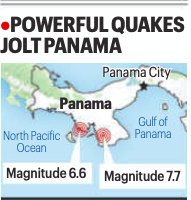
Panama is an S-shaped isthmus between Costa Rica and Colombia, with the Caribbean Sea to the north and the Pacific to the south. Both quakes struck on the Pacific side. Upper map courtesy The Indian Express (AP); lower map courtesy BBC News; both reproduced with credit for educational use.
◈ Basics First — Reading an Earthquake Report
- Focus and epicentre: the focus (hypocentre) is where the rupture begins underground. The epicentre is the point on the surface directly above it.
- Depth classes:
- shallow: 0–70 km;
- intermediate: 70–300 km;
- deep: 300–700 km.
- Magnitude: the moment magnitude scale measures the energy released and is logarithmic. Each whole step means about 10 times the ground motion and about 32 times the energy. So the 7.7 quake released roughly 45 times the energy of the 6.6.
- Intensity: the (Modified) Mercalli scale measures observed effects at a particular place, so intensity varies from place to place.
Static Background — Why Panama Shakes
- Plate setting: Panama sits on the small Panama microplate (block), surrounded by four larger plates:
- the Caribbean Plate to the north;
- the Cocos Plate to the west;
- the Nazca Plate to the south;
- the South American Plate to the east.
- The Panama Fracture Zone: this transform fault between the Cocos and Nazca plates, together with the deformed belts along the coasts, makes southern Panama seismically active. The region is part of the Pacific Ring of Fire.
- A young land bridge: the Isthmus of Panama rose about 3 million years ago, separating the Atlantic from the Pacific. This triggered the Great American Biotic Interchange, the exchange of species between the two Americas, and changed ocean circulation.
- Panama Canal:
- it is about 82 km long and opened in 1914;
- under the Torrijos–Carter Treaties (1977), it was handed over to Panama on 31 December 1999;
- its locks were expanded in 2016;
- it depends on the fresh water of Gatun Lake, which is why droughts in 2023–24 forced limits on transits.
- Darién Gap: this roadless rainforest on the Panama–Colombia border is the only break in the Pan-American Highway.
✎ Mains Practice Question
Explain why the Central American isthmus is among the most seismically active regions of the world. How does the depth of focus influence the destructiveness of an earthquake? 10 marks · 150 words
08
Bay of Kotor: Why Europe’s “Southernmost Fjord” Is Actually a Ria
ImportantGS-I · Coastal Landforms; Places in News (Montenegro, Balkans)Prelims + MainsThe Indian Express · Travel feature
The Bay of Kotor in Montenegro is often marketed as Europe’s southernmost fjord. Geologists classify it differently: it is a ria, a drowned river valley, and no glacier ever shaped it. The distinction is a standard test of coastal landforms.
◈ Basics First — Coasts of Submergence
Coasts of submergence form when the sea rises or the land sinks, flooding existing valleys. Coasts of emergence form when the land rises or the sea falls, exposing raised beaches and marine terraces. The main submergent forms are below.
- Fjord: a U-shaped glacial trough drowned by the sea. It is very deep, has steep walls and a shallow sill at its mouth. Examples: Norway (the Sognefjord, its longest), Chile, New Zealand, Greenland and Canada.
- Ria: a V-shaped river valley drowned by rising sea level. It becomes deeper and wider towards the sea, and the coast is cut across by the valleys. Examples: Galicia (Spain), south-west Ireland, Cornwall and the Bay of Kotor.
- Dalmatian (concordant) coast: mountain ridges that run parallel to the coast are partly drowned, leaving long islands parallel to the shore. The type example is Croatia’s Adriatic coast.
- Fjard: a drowned glacial lowland valley, shallower than a fjord. Examples are found in Sweden and Finland.
- Prelims trap: Milford Sound in New Zealand is actually a fjord despite being called a “sound”, while Kotor is a ria despite being called a “fjord”.
Figure 10 — Fjord vs ria: shape reveals origin
FJORD — drowned glacial troughU-shaped, very deepSteep walls · shallow sill at mouth · e.g. Norway, Chile, NZRIA — drowned river valleyV-shapedRiver-cut · deepens seaward · e.g. Galicia, SW Ireland, Kotorsea levelsea level
A glacier carves a U and leaves a sill at the mouth. A river cuts a V that deepens towards the sea.
Figure 11 — A true glacial fjord, for comparison
A Norwegian fjord, showing the steep, ice-carved walls and hanging-valley waterfalls that Kotor does not have. Representative image. Image as supplied; reproduced for educational use.
Figure 12 — Locating the Bay of Kotor on the Adriatic
The bay lies on Montenegro’s short coastline, about two hours by road south-east of Dubrovnik. Bosnia and Herzegovina reaches the sea only at Neum. Legacy IAS map; base geography Natural Earth (public domain).
Places in News — Fact File
- Bay of Kotor:
- the sea enters through the narrow Verige Strait, about 300 m wide;
- Kotor’s walls run for more than 4 km up to the Fortress of St John, about 280 m above the town;
- the region is a UNESCO World Heritage Site, inscribed in 1979. It was on the List in Danger after the 1979 earthquake and was removed in 2003.
- Montenegro:
- the name means “Black Mountain”;
- it became independent in 2006 after a referendum ended the State Union with Serbia;
- the capital is Podgorica and the main port is Bar;
- it joined NATO in 2017, has been an EU candidate since 2010, and uses the euro without being in the eurozone.
- Montenegro’s neighbours: Croatia, Bosnia and Herzegovina, Serbia and Albania. It also borders Kosovo, whose 2008 declaration of independence India does not recognise.
- Neum corridor: Bosnia’s only coastline, about 20 km long, splits Croatia’s coast in two. The Pelješac Bridge (2022) now connects the two parts of Croatia without crossing Bosnian territory.
- Karst: the limestone Dinaric Alps give the region its karst landscape, with sinkholes, poljes and underground drainage. The word “karst” comes from the Kras plateau in Slovenia.
✎ Mains Practice Question
Distinguish between fjords, rias and Dalmatian coasts as landforms of coastal submergence, with examples. Why is India’s west coast often described as a coast of submergence? 10 marks · 150 words