

In-Depth News Analysis6 Items
Core TopicImportantConcise
International RelationsGS Paper II
01Houthis Seize Yemen's Red Sea Coast & the Bab el-Mandeb Chokepoint02India–EU FTA Nears Signature03India–Canada Ties — 'Well Beyond Reset'
EconomyGS Paper III
04The Expanding Western Sanctions Regime & India's Balancing Act05China's Widening Economic Gap Within BRICS06Congo's State Control Over Geological Data
International RelationsGeneral Studies Paper II
01
Houthis Seize Yemen's Entire Red Sea Coast, Tightening Grip on Bab el-Mandeb
GS-II/III · IR & Security — Maritime Chokepoints, West AsiaPrelims + MainsThe Hindu
Yemen's Houthi movement has captured a strategic Red Sea island and the country's entire Red Sea coastline after a week-long offensive, consolidating control over territory flanking the Bab el-Mandeb Strait — one of the world's most critical shipping chokepoints.
◈ Static Background — Bab el-Mandeb Strait
Arabic for "Gate of Tears," Bab el-Mandeb is the narrow passage separating Yemen (Arabian Peninsula) from Djibouti and Eritrea (Horn of Africa), linking the Red Sea to the Gulf of Aden and, beyond it, the Indian Ocean.
- Geography: about 30 km wide at its broadest point and roughly 100 km long; Yemen's Perim Island sits inside the strait, splitting it into two navigable channels.
- Why it matters: it is the only direct maritime approach to the Suez Canal from the south — the route that, since the canal's opening in 1869, lets ships move between the Mediterranean and the Indian Ocean without rounding Africa.
- Scale: roughly one-tenth of global seaborne oil trade and about a quarter of global container trade transits the strait, making it the world's third-busiest oil chokepoint after the Straits of Hormuz and Malacca.
- Who controls what: Yemen's internationally recognised, Saudi-backed government has held the south and parts of the coast, while the Iran-aligned Houthi movement (Ansar Allah) has controlled the north, including the capital Sana'a, since 2014–15.
What Just Happened
- After a week-long offensive that left hundreds dead, the Houthis have taken Perim Island and the last stretches of coastline still held by the Saudi-backed government, giving them control of Yemen's entire Red Sea coast.
- A wreckage of a Saudi-supplied Karayel unmanned combat aerial vehicle, shot down over Hajjah governorate, points to continued external military involvement in the conflict.
- Since late 2023, the Houthis have repeatedly used their coastal position to attack commercial shipping transiting the Red Sea, in what they describe as solidarity action linked to the Gaza conflict — sharply reducing vessel traffic through the Suez route.
The Critical View
- Chokepoint risk stacks up: Bab el-Mandeb sits alongside the Strait of Hormuz as one of two chokepoints capable of disrupting global energy trade; simultaneous stress on both would affect a large share of world shipping and oil flows.
- No land bypass exists for Bab el-Mandeb-transiting cargo, unlike Hormuz (which has a partial Saudi pipeline alternative) — so disruption forces the longer, costlier route around the Cape of Good Hope.
- India's stake: a large share of India's westbound trade with Europe and the Mediterranean routes through the Red Sea–Suez corridor; sustained disruption raises freight costs and insurance premiums for Indian exporters and shipping lines.
- The development also reflects the wider proxy contest in Yemen's civil war, with the Saudi-backed government and Iran-aligned Houthis backed by rival regional and external patrons.
Figure 1 — Bab el-Mandeb: Gateway to the Red Sea
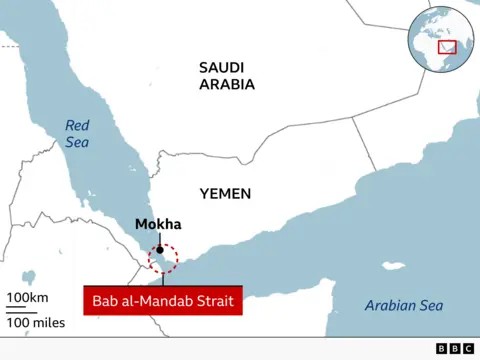
Mokha sits just north of the Bab al-Mandab Strait, the chokepoint now under Houthi control. Image courtesy BBC; reproduced with credit for educational use.
✎ Mains Practice Question
Discuss the strategic significance of the Bab el-Mandeb Strait for global trade and energy security, and examine the implications of the Houthi takeover of Yemen's Red Sea coast for India's maritime trade interests. 15 marks · 250 words
02
India and EU Close to Sealing Trade Deal, Await Nod from European Council
GS-II · IR — India's Bilateral & Economic GroupingsPrelims + MainsThe Indian Express
The European Commission has forwarded its proposal for concluding the India-EU Free Trade Agreement to the European Council, the last political hurdle before signature of what would be the largest trade agreement either side has ever concluded.
◈ Static Background — The India-EU FTA Journey
- Negotiations for an India-EU trade pact (originally under the Broad-based Trade and Investment Agreement framework) began in 2007, stalled over tariff and IP disagreements, and were suspended in 2013.
- Talks were relaunched in 2022, alongside parallel negotiations for an Investment Protection Agreement and a Geographical Indications Agreement.
- Negotiations concluded on 27 January 2026 at Hyderabad House, New Delhi, after the 14th and final formal negotiating round; the deal spans roughly 20 chapters covering goods, services, digital trade and sustainable development.
How EU Trade Deals Are Ratified
- The European Commission (EU's executive) proposes the FTA legislation.
- The European Council — heads of state/government of all 27 member-states, plus its President and the Commission President — must authorise signature.
- After signature, the European Parliament's consent is required before the agreement can enter into force.
- India, in parallel, must complete its own internal ratification procedures.
▤ Key Facts at a Glance
- Current EU-India trade: over €180 billion a year in goods and services, supporting close to 800,000 EU jobs (per the EU's own statement).
- Tariff impact: the deal is expected to eliminate or reduce tariffs on the large majority of traded goods (96%+ of tariff lines, per official EU statements).
- Coverage: about 2 billion people; roughly a quarter of global GDP between the two partners.
- Services/mobility: the deal is expected to open commitments in services and ease movement of skilled Indian professionals into the EU.
The Critical View
- Asymmetric gains debated: European companies gain deeper access to India's large consumer market and a more level playing field, while India's gains are concentrated in services trade and professional mobility — a structural asymmetry common to India's FTAs with developed economies.
- CBAM friction unresolved: the EU's Carbon Border Adjustment Mechanism, which BRICS nations have criticised as a disguised trade barrier, sits outside the FTA and could still constrain Indian exports even after tariffs fall.
- Ratification risk: the deal still needs European Parliament consent and India's internal ratification — a stage where past EU trade deals (e.g., with Canada) have faced delay or partial national-parliament vetoes.
✎ Mains Practice Question
Trace the evolution of India-EU trade negotiations since 2007 and examine the significance of the proposed India-EU FTA for India's trade diversification strategy amid global tariff uncertainty. 15 marks · 250 words
03
Canadian High Commissioner: India-Canada Ties Have Gone 'Well Beyond Reset'
GS-II · IR — India's Bilateral RelationsPrelims + MainsThe Hindu · Interview
Canada's High Commissioner to India says bilateral ties, which collapsed three years ago over the killing of Khalistani activist Hardeep Singh Nijjar, have moved beyond a mere "reset," citing a bilateral security dialogue, trade talks and a possible visit by Prime Minister Modi to Canada.
◈ Context
Ties hit their lowest point in 2023 when then-PM Justin Trudeau publicly linked Indian officials to Nijjar's killing in Canada; both countries expelled diplomats and downsized missions before restoring full embassy strength this week.
- Security cooperation: a bilateral security dialogue has met four times over the past year; Canada has declared the Lawrence Bishnoi gang a terrorist organisation and set up a financial-crimes task force, seen by India as confidence-building steps.
- Trade talks: Canada-India trade negotiations, paused for 12 years, restarted in March 2026; a fourth round is underway, with both sides hoping to conclude by the time of a prospective Modi visit to Canada.
Key Threads in the Relationship
- Education: India sends more students to Canada than any other country (about 4,27,000), though tightened visa/financial-guarantee rules and rising costs have strained the flow.
- Energy: Canada's 2024 Trans Mountain Expansion pipeline can move 9–10 lakh barrels/day to its west coast, positioning it as a potential new hydrocarbon supplier to India, alongside cooperation on CANDU nuclear reactors — 18 of India's 24 reactors are CANDU-based.
- Investment: Canadian pension funds and institutional investors have invested about $80 billion in India, among the largest sources of foreign investment.
- Unresolved: the Nijjar murder trial remains pending in Canadian courts; India has not received an apology, and neither Bishnoi's extradition nor that of his Canada-based aide has reportedly been sought.
✎ Mains Practice Question
Examine the trajectory of India-Canada relations since 2023, and discuss the areas of cooperation that could anchor a durable bilateral partnership going forward. 10 marks · 150 words
EconomyGeneral Studies Paper III
04
The Expanding Western Sanctions Regime and India's Search for Balance
GS-III · Economy — International Economic InstitutionsPrelims + MainsThe Indian Express
As India hosts the BRICS Summit, a data-driven analysis shows how sharply the West's use of economic sanctions has grown since the 1990s, and argues that India's tilt toward BRICS-linked financial architecture is a rational hedge against this "weaponisation," even as the West remains India's largest trade and investment partner.
◈ Static Background — What Are Economic Sanctions
Sanctions are coercive economic measures — trade bans, asset freezes, travel restrictions, arms embargoes — used by states or blocs to pressure a target country's policy without military force.
- SWIFT (Society for Worldwide Interbank Financial Telecommunication) is the secure messaging network banks use for cross-border payment instructions; removal from SWIFT (as with Iran and Russia) severely restricts a country's access to global finance.
- TRIPS (Trade-Related Aspects of Intellectual Property Rights) is the WTO agreement setting minimum global IP-protection standards; India and South Africa's 2020 request for a COVID-19 vaccine-related TRIPS waiver was declined by developed countries.
- CBAM (Carbon Border Adjustment Mechanism) is the EU's carbon tariff on imports, which BRICS nations have "condemned and rejected" as a disguised trade barrier rather than a genuine climate measure.
▤ Sanctions by the Numbers (Urjit Patel working paper)
- 1,325 sanctions imposed globally since 1949; 486 (about 37%) by the United States alone — nearly three times any other sanctioner.
- The US currently administers 30+ active sanctions programmes.
- The European Union is the second-largest sanctioner (263 of the 1990–2022 total, versus the US's 339).
- The financial and trade categories of sanctions have grown fastest since the 1990s, alongside the post-Soviet expansion of US-led sanctions.
Figure 2 — Fresh Sanctions on Asia, Decade-wise
Fresh sanctions on Asia (count)171950s241960s351970s251980s571990s552000s682010-22
Fresh sanctions on Asian countries have risen sharply since the 1990s. Source: "Asphyxiation by Sanctions" working paper by former RBI Governor Urjit R. Patel; recreated in-house from the reported figures.
The Critical View
- India's dual exposure: India faced US tariffs amid trade-deal friction and scrutiny over its Russian oil purchases, showing sanctions/tariff risk applies even to non-adversary states.
- Chabahar Port example: India's Chabahar project (started 2003) was frozen by US Iran-sanctions, revived in 2015–17 after sanctions eased, and faced fresh US warnings even after a 2024 ten-year India-Iran operating agreement — showing how third-country sanctions can repeatedly disrupt Indian strategic infrastructure.
- Limits of the BRICS hedge: BRICS's own financial institutions (NDB, CRA) remain dollar- and IMF-linked (see the companion editorial analysis), so the "hedge" argument is more aspirational than a proven present-day alternative.
- The West still dominates: the US and EU remain India's largest export markets and investment sources, and are central to India's services-sector growth — meaning India's approach is described as diversification, not a decisive pivot away from the West.
✎ Mains Practice Question
"Sanctions have evolved from a trade tool into an instrument of financial statecraft." Analyse this statement with reference to the growth of the Western sanctions regime, and examine India's strategy of balancing Western and BRICS-linked economic engagement. 15 marks · 250 words
05
BRICS at 20: China's Economic Heft Now Dwarfs the Rest of the Grouping
GS-III · Economy — Comparative Growth, Global GroupingsMains-orientedThe Indian Express
Two decades after BRIC was conceived to counter G7 dominance, data show China's economy has grown so large that it now exceeds the combined GDP of Brazil, Russia, India and South Africa — raising the question of whether BRICS can remain a genuinely collective platform.
◈ Static Background — From BRIC to BRICS
- The acronym BRIC was floated on the sidelines of the UN General Assembly in 2006; the first leaders' summit was held at Yekaterinburg in 2009.
- South Africa joined in 2010, making it BRICS; the bloc expanded in 2024 to add Egypt, Ethiopia, Iran, Saudi Arabia and the UAE, and inducted Indonesia in 2025 — 11 members hosting the 18th Summit in New Delhi (12–13 September 2026).
▤ GDP Trajectory, 2006 → 2026 ($ billion, current prices)
- China: 2,799 → 20,852
- India: 940 → 4,153
- Brazil: 1,108 → 2,656
- Russia: 1,061 → 2,636
- South Africa: 304 → 480 (IMF data, as cited)
Figure 3 — China's GDP vs the Rest of BRICS (2006 and 2026)
GDP, current prices ($ billion)ChinaIndiaBrazilRussiaS. Africa20062026
China's GDP alone now exceeds the combined output of Brazil, Russia, India and South Africa. Source: IMF data as cited; recreated in-house.
The Analytical Point
- By 2009 — the year of BRICS's first summit — China's GDP already exceeded the combined GDP of Brazil, Russia, India and South Africa; the gap has widened every year since.
- On GDP per capita, China has flipped from being poorer than Brazil, Russia and South Africa in 2006 to richer than Brazil and twice as rich as South Africa by 2026, while the gap with an average Indian has grown from roughly 3x to about 5x.
- This raises a structural question for BRICS: a grouping conceived to counter one dominant bloc (the G7) now contains one member whose economic weight increasingly resembles the dominance it was meant to counter.
✎ Mains Practice Question
"BRICS was conceived to counter the dominance of industrialised economies, but one of its own members now dominates the grouping." Critically examine the implications of China's economic weight for BRICS's cohesion and India's strategic calculus within the bloc. 15 marks · 250 words
06
DR Congo Tightens State Control Over Mining and Geological Data
GS-III · Economy — Critical Minerals, Resource GeopoliticsPrelims + MainsReuters, via The Hindu
The Democratic Republic of Congo — the world's largest cobalt producer and second-largest copper supplier — is building a state-controlled national geological databank, extending Kinshasa's leverage over where global exploration capital flows next.
◈ Context
- Congo hosts some of the world's richest copper, cobalt, lithium, tantalum and gold deposits, yet systematic exploration covers barely 20% of the country, per its National Geological Survey (SGNC).
- A $180-million contract with Spain's Xcalibur, begun in January 2026, is surveying over 7,00,000 sq. km using airborne geophysics; the national databank is expected to be operational by end-2026.
- Unlike open-access models such as Australia's, Congo will keep the databank in state hands with tiered access — basic data free, sensitive datasets fee-based — justified as protecting "strategic interests."
Why It Matters
- Precedent: Congo's February 2025 cobalt export ban and subsequent quota system swung the market from surplus to deficit and lifted prices from about $10/lb to roughly $26/lb — showing the state's ability to move global markets through supply control; geological-data control is described by analysts as a potentially even more powerful lever, since it shapes future discoveries, not just current supply.
- US-China competition: both countries have separate cooperation agreements with Kinshasa; Congo says the databank applies equal access rules regardless of investor origin, positioning itself to extract value from both sides of the rivalry.
- Not unique to Congo: Canada and Saudi Arabia are also moving to consolidate geological data as national strategic infrastructure — a trend relevant to India's own push to map and secure critical-mineral resources (e.g., under the National Critical Mineral Mission).
- Congo's cobalt reserves grew over 76% between 2000 and 2025 to an estimated 6 million tonnes — more than half of known global reserves (USGS).
✎ Mains Practice Question
Discuss how control over geological and exploration data is emerging as a tool of resource nationalism, with reference to the Democratic Republic of Congo's critical minerals strategy. What lessons does this hold for India's critical mineral security? 10 marks · 150 words