
Published on Apr 14, 2026
Daily Current Affairs
Current Affairs 14 April 2026

Content
- Deposit Tokens & Asset Tokenisation: Next Phase of India’s Financial Digitalisation
- Jallianwala Bagh Massacre (1919)
- 135th Birth Anniversary of Dr. B.R. Ambedkar
- Rise in Middle Class Vulnerability
- 9th Indian Ocean Conference (IOC) & Landlocked Countries: Key Takeaways
- Need Stronger Social Protection for a Changing World of Work: ILO
- South West Monsoon Rainfall to be Below Normal or Deficient in 2026
Deposit Tokens & Asset Tokenisation: Next Phase of India’s Financial Digitalisation
Why in News?
- Recent discussions (April 2026) highlight deposit tokens and real-world asset tokenisation as next-stage reforms to modernise India’s banking system beyond UPI-led Digital Public Infrastructure (DPI).
Issue in Brief
- India’s financial system faces a transition toward programmable, real-time, blockchain-based settlement systems, raising need for innovation without compromising financial stability and regulatory oversight.
Relevance
- GS Paper III: Economy (Banking, Fintech, Financial Markets), Science & Technology (Blockchain)
- GS Paper II: Governance (Regulation – RBI, SEBI), Digital Public Infrastructure
Practice Question
- “Deposit tokens and real-world asset tokenisation represent the next frontier in financial digitalisation. Analyse their potential benefits and regulatory challenges in the Indian context.” (250 words)
Static Background and Basics
- India has built robust Digital Public Infrastructure (DPI):
- UPI (real-time payments)
- Aadhaar (identity)
- DBT (welfare delivery)
- Current banking operates on:
- Batch-based settlements (T+1/T+2)
- Intermediated clearing systems
- Emerging technologies:
- Blockchain (distributed ledger)
- Tokenisation (digital representation of assets)
- RBI is already exploring Central Bank Digital Currency (CBDC – e₹) as sovereign digital money.
Conceptual Foundations
Deposit Tokens
- Deposit tokens are digital representations of bank deposits, issued by regulated banks on permissioned blockchain networks.
- Fully backed by deposits, they are direct claims on bank balance sheet, unlike cryptocurrencies.
- Enable:
- Real-time settlement
- Programmability (smart contracts)
- Atomic Delivery vs Payment (DvP)
Real-World Asset (RWA) Tokenisation
- Converts physical assets like real estate, gold, infrastructure, private equity into tradable digital tokens.
- Enables:
- Fractional ownership
- Improved liquidity
- Efficient collateralisation
Dimensions
Economic and Financial Efficiency
- Deposit tokens shift banking from delayed batch settlement to real-time settlement, improving liquidity management and reducing systemic friction.
- Tokenisation unlocks illiquid assets (real estate, gold), enhancing capital efficiency and deepening financial markets.
- Combined system enables instant settlement with regulated money, reducing counterparty and settlement risks.
Banking and Institutional Dimension
- Enhances interbank settlements, treasury operations, and corporate payments, reducing reconciliation costs and operational delays.
- Integrates compliance (KYC, AML) directly into transactions via programmable finance, reducing post-transaction verification burden.
- Strengthens role of banks by extending regulated money into digital programmable layer, unlike disintermediating crypto models.
Technology and Innovation Dimension
- Blockchain enables distributed, tamper-proof, and transparent ledgers, improving trust in financial transactions.
- Smart contracts automate:
- Settlement
- Compliance
- Reporting
- Aligns with global shift toward “always-on financial systems” (24×7 programmable finance).
Global Competitiveness Dimension
- Financial centres like Singapore, EU, UAE are integrating tokenisation into mainstream banking systems.
- Delay in adoption risks capital flight and innovation migration to more advanced jurisdictions.
- India has opportunity to shape global standards in regulated digital finance, leveraging DPI success.
Governance and Regulatory Dimension
- Requires clarity in:
- Foreign Exchange Management Act (FEMA) for cross-border token flows
- AML/KYC norms for blockchain-based systems
- Custody and ownership laws for tokenised assets
- Current initiatives largely limited to RBI regulatory sandboxes, restricting scalability.
Financial Stability Dimension
- Deposit tokens preserve bank-based monetary system, avoiding risks associated with unregulated cryptocurrencies.
- No additional credit or liquidity risk, as tokens are fully backed by deposits.
- However, risks include:
- Cybersecurity threats
- Operational vulnerabilities
- Regulatory arbitrage
Synergy: Deposit Tokens + Tokenisation
- Tokenised assets combined with deposit tokens enable:
- Instant settlement in regulated digital money
- Reduction in settlement time and counterparty risk
- Creation of efficient, transparent financial markets
- Facilitates advanced use cases:
- Trade finance
- Cross-border payments
- Collateralised lending
Challenges
- Regulatory uncertainty around cross-border tokenised transactions and capital controls.
- Lack of legal clarity on ownership rights and dispute resolution for tokenised assets.
- Interoperability issues between existing banking systems and blockchain infrastructure.
- Risk of exclusion if digital systems are not inclusive and accessible.
- Cybersecurity and operational risks in decentralised systems.
Way Forward
- Develop comprehensive regulatory framework integrating RBI, SEBI, and Ministry of Finance guidelines on tokenisation and digital money.
- Align deposit tokens with CBDC ecosystem, ensuring complementarity rather than fragmentation.
- Expand pilot projects from sandbox to production-scale systems, especially in trade finance and interbank settlements.
- Establish global interoperability standards, enabling cross-border programmable finance.
- Strengthen cybersecurity and digital infrastructure resilience.
- Promote public-private partnerships in blockchain innovation within regulated environment.
Prelims Pointers
- Deposit tokens:
- Issued by banks
- Fully backed by deposits
- Tokenisation:
- Digital representation of real-world assets
- CBDC:
- Issued by central bank (RBI)
- Blockchain:
- Distributed ledger technology
Jallianwala Bagh Massacre (1919)
Why in News?
- On 13 April 2026, India observed the 107th anniversary of the Jallianwala Bagh massacre, paying tribute to martyrs of one of the most brutal colonial atrocities.
- The massacre exposed the repressive nature of British colonial rule, transforming moderate nationalism into mass-based resistance and revolutionary consciousness.
Relevance
- GS Paper I: Modern Indian History (Freedom Struggle)
Practice Question
- “The Jallianwala Bagh massacre marked a turning point in India’s freedom struggle. Examine its impact on nationalist politics and colonial legitimacy.” (250 words)
Static Background and Basics
- The Rowlatt Act, 1919 (Anarchical and Revolutionary Crimes Act) allowed detention without trial for up to 2 years, curbing civil liberties.
- Mahatma Gandhi launched nationwide hartal on 6 April 1919 (“Black Day”), marking first mass civil disobedience against colonial rule.
- Punjab became epicentre due to arrests of leaders Dr. Saifuddin Kitchlew and Dr. Satyapal (9 April 1919).
The Jallianwala Bagh Massacre (13 April 1919)
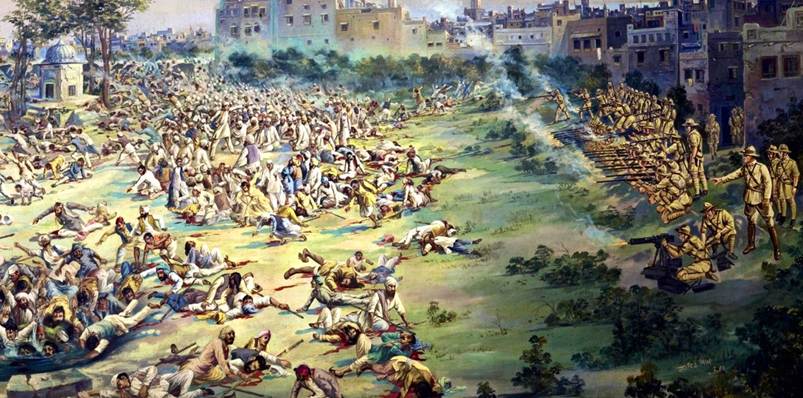
- On Baisakhi (13 April 1919), thousands gathered at Jallianwala Bagh, Amritsar, many unaware of ban on public gatherings.
- Brigadier General Reginald Dyer blocked exits and ordered troops to fire without warning on unarmed civilians.
- Official estimates: 379 deaths, but actual casualties widely believed to exceed 1,000, with hundreds injured.
- Firing continued for ~10 minutes, targeting densest parts of crowd, reflecting deliberate intent to punish and terrorise.
Immediate Consequences
- Imposition of martial law in Punjab, including humiliating punishments like “crawling order”, intensifying colonial repression.
- The Hunter Commission (1919) censured Dyer but imposed no serious punishment, exposing colonial bias.
- Indian National Congress inquiry termed massacre “premeditated and inhuman”, strengthening nationalist critique of British rule.
Political and Nationalist Impact
Transformation of Freedom Struggle
- Marked shift from moderate constitutionalism to mass nationalism, strengthening Gandhian leadership.
- Provided momentum for Non-Cooperation Movement (1920–22), integrating Khilafat and anti-colonial struggle.
Rise of Revolutionary Nationalism
- Incident deeply influenced youth like Bhagat Singh, accelerating growth of organisations like HSRA.
- Udham Singh assassinated Michael O’Dwyer in 1940, symbolising delayed retributive justice.
Moral and Intellectual Protest
- Rabindranath Tagore renounced Knighthood (1919), calling it protest against colonial inhumanity.
- Mahatma Gandhi returned Kaiser-i-Hind medal, marking rejection of British honours.
- C. Sankaran Nair resigned from Viceroy’s Council, exposing colonial injustice internationally.
Conceptual Significance
- Represents collapse of “British moral legitimacy” in India, shifting perception from reformist empire to coercive colonial power.
- Demonstrates limits of repressive governance, as violence triggered stronger resistance instead of submission.
- Reinforced importance of civil liberties and rule of law, later embedded in Indian Constitution.
Dimensions
Political Dimension
- Converted Indian National Congress into a mass-based movement, expanding participation across regions and classes.
- Strengthened demand for Swaraj (self-rule) as ultimate political objective.
Social Dimension
- United diverse sections of society—peasants, workers, middle class—under a shared anti-colonial identity.
- Created collective memory of colonial injustice, shaping nationalist consciousness.
Ethical Dimension
- Highlights ethical failure of colonial state, violating principles of justice, human dignity, and proportionality.
- Raises enduring questions on state violence and accountability in governance.
International Dimension
- Attracted global criticism of British rule, weakening its moral authority internationally.
- Became symbol of colonial oppression in global anti-imperialist discourse.
Challenges in Historical Interpretation
- Official colonial narratives underreported casualties, leading to data ambiguity and contested historiography.
- Limited accountability of perpetrators reflects structural bias in colonial justice systems.
- Need to balance emotive memory with analytical historical understanding in academic discourse.
Way Forward
- Strengthen commitment to constitutional values of liberty, equality, and dignity, preventing misuse of state power.
- Promote historical awareness and civic education, ensuring lessons of colonial repression remain relevant.
- Uphold human rights and accountability mechanisms in governance and security frameworks.
- Preserve historical sites like Jallianwala Bagh National Memorial for collective memory and reflection.
Prelims Pointers
- Date: 13 April 1919 (Baisakhi)
- Act: Rowlatt Act, 1919
- Commission: Hunter Commission (1919)
- Key figures:
- Reginald Dyer (executed massacre)
- Michael O’Dwyer (Punjab Lt. Governor)
- Udham Singh assassination: 1940 (London)
135th Birth Anniversary of Dr. B.R. Ambedkar
Why in News?
- On 14 April 2026, India celebrated the 135th Birth Anniversary of Dr. B.R. Ambedkar, with the President highlighting his role in social justice, constitutionalism, and inclusive democracy.
- Dr. B.R. Ambedkar remains central to India’s development discourse as chief architect of Constitution and pioneer of social justice, with continued relevance in debates on inequality, rights, and governance.
Relevance
- GS Paper II: Constitution, Rights, Social Justice
- GS Paper IV: Ethics (Equality, Justice, Constitutional morality)
Practice Question
- “Dr. B.R. Ambedkar’s vision of social democracy remains central to India’s constitutional and developmental discourse. Discuss.” (250 words)
Static Background and Basics
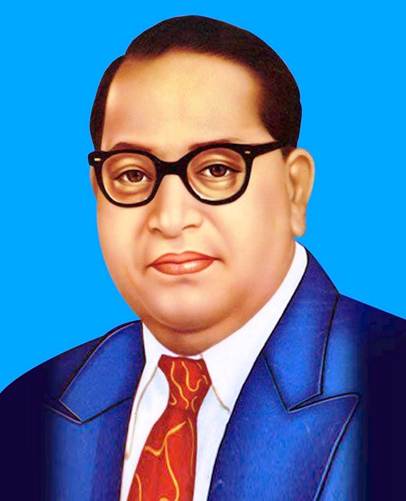
- B. R. Ambedkar was born on 14 April 1891 at Mhow (Madhya Pradesh) into a socially disadvantaged Mahar caste.
- He earned doctorates from Columbia University (USA) and London School of Economics (UK), specialising in economics, law, and public finance.
- Served as Chairman of Drafting Committee (1947–49) and India’s first Law Minister (1947–51).
- Awarded Bharat Ratna in 1990 for his contribution to nation-building.
Core Philosophy
- Advocated principles of Liberty, Equality, and Fraternity, inspired by French Revolution, as foundation of Indian democracy.
- Emphasised constitutional morality, rule of law, and institutional safeguards over majoritarian impulses.
- Viewed social democracy as essential complement to political democracy, warning against “life of contradictions”.
Key Contributions
Constitutional and Legal Contributions
- As Drafting Committee Chairman, ensured inclusion of Fundamental Rights, Directive Principles, and safeguards for marginalized communities.
- Described Article 32 (Right to Constitutional Remedies) as the “heart and soul” of the Constitution, ensuring enforceability of rights.
- Strengthened federalism, independent judiciary, and checks and balances in governance architecture.
Social Justice and Anti-Caste Movements
- Led Mahad Satyagraha (1927) asserting right of untouchables to access public water sources, challenging caste-based exclusion.
- Spearheaded Temple Entry Movements (e.g., Kalaram Temple, 1930) promoting religious equality.
- Played key role in Poona Pact (1932) ensuring political representation through reserved seats instead of separate electorates.
Economic Thought and Policy
- Authored “The Problem of the Rupee”, influencing establishment of Reserve Bank of India (1935) monetary framework.
- Advocated state-led industrialisation, labour welfare, and public finance reforms for inclusive economic development.
- Highlighted importance of water and energy resources, proposing river valley projects as economic drivers.
Labour and Welfare Reforms
- As Labour Member (1942–46), introduced:
- 8-hour workday (reduction from 14 hours)
- Maternity benefits
- Equal pay for equal work
- Strengthened foundations of modern labour rights and welfare state in India.
Women’s Empowerment
- Introduced Hindu Code Bill (1951) proposing equal rights in inheritance, marriage, and divorce, though later diluted.
- Advocated women’s education and participation as key to social transformation and equality.
Religious and Ethical Contributions
- Embraced Buddhism on 14 October 1956 at Nagpur (Deekshabhoomi), initiating mass conversion movement.
- Founded Navayana Buddhism, focusing on social equality, rationality, and rejection of caste hierarchy.
Institutions, Movements and Writings
- Founded organisations:
- Bahishkrit Hitakarini Sabha (1924)
- Independent Labour Party (1936)
- Scheduled Castes Federation (1942)
- Key writings:
- Annihilation of Caste (1936)
- The Untouchables (1948)
- The Buddha and His Dhamma (1957)
Panchteerth
- Janma Bhoomi (Mhow) – Birthplace
- Shiksha Bhoomi (London) – Education
- Deeksha Bhoomi (Nagpur) – Conversion to Buddhism
- Mahaparinirvan Bhoomi (Delhi) – Place of death (6 Dec 1956)
- Chaitya Bhoomi (Mumbai) – Cremation site
Prelims Pointers
- Birth: 14 April 1891 (Mhow)
- Chairman, Drafting Committee: 1947–49
- Article 32 → “Heart and Soul”
- Conversion to Buddhism: 14 October 1956 (Nagpur)
- Bharat Ratna: 1990
Rise in middle class vulnerability
Why in News?
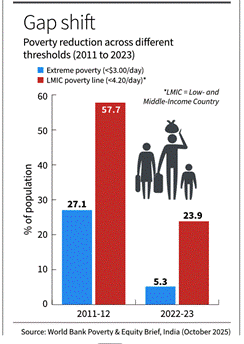
- Recent analysis highlights that despite rapid GDP growth and poverty reduction, India faces rising concerns over inequality, wage stagnation, and lack of upward economic mobility.
Issue in Brief
- India’s poverty has declined significantly, yet a large population remains just above poverty line, forming a “vulnerable middle” with unstable incomes and limited mobility prospects.
- Raises question: Is growth translating into sustainable economic security and upward mobility?
Relevance
- GS Paper III: Economy (Growth vs inequality, Employment, Informality)
- GS Paper II: Welfare policies, Inclusive growth
Practice Question
- “Despite poverty reduction, a ‘vulnerable middle’ is emerging in India. Analyse the structural factors behind this phenomenon and suggest policy measures.” (250 words)
Static Background and Basics
- Poverty measurement:
- World Bank poverty lines:
- $2.15/day (extreme poverty)
- $3.65/day (lower-middle income poverty)
- World Bank poverty lines:
- India follows multidimensional poverty approach (NITI Aayog MPI) incorporating health, education, and living standards.
- Economic development involves:
- Growth (increase in GDP)
- Structural transformation (labour shift to productive sectors)
- Mobility (sustained income progression)
Key Data and Trends
- Share of population below lower-middle income poverty line declined from >50% (2010s) to ~30% (recent estimates).
- 94% informal workers earn <₹10,000/month, indicating limited capacity for savings and upward mobility.
- <10% workforce in formal sector, highlighting structural employment constraints.
- Manufacturing lost ~24 million jobs (2016–2021) despite economic growth.
- Agriculture employs ~46% workforce but contributes only ~18% of GDP, indicating low productivity trap.
- Top 1% captures >22% national income, while 271 billionaires hold ~25% of national wealth.
- Youth unemployment ~45%, graduate unemployment ~29%, indicating skill-employment mismatch.
- Household savings declined to ~5% of GDP, while debt is rising, especially unsecured borrowing.
Conceptual Shift: Poverty vs Well-being
- Traditional poverty metrics measure threshold crossing, not distance from economic security or quality of life improvements.
- New approach (World Bank):
- Treats well-being as a spectrum, focusing on how far individuals are from a reasonable standard of living.
- Highlights that poverty reduction may mask stagnation in upward mobility.
Dimensions
Economic Dimension
- India’s growth is increasingly capital-intensive and service-driven, limiting large-scale job creation.
- Weak growth-employment linkage, resulting in “jobless growth” phenomenon.
- Stagnant real wages despite productivity growth indicate decoupling of income from output expansion.
Structural Transformation Dimension
- Shift of labour from agriculture to manufacturing/services has slowed or reversed, weakening development trajectory.
- Manufacturing sector failed to absorb ~12 million annual labour force entrants, causing labour reversion to low-productivity agriculture.
- Indicates premature deindustrialisation risk.
Labour Market Dimension
- Dominance of informal employment (~90%) leads to:
- Income volatility
- Lack of social security
- Gig economy and contractualisation further weaken job stability and income predictability.
Inequality Dimension
- Rapid wealth accumulation at top coexists with stagnant incomes for majority, widening inequality.
- High concentration of wealth reduces aggregate demand and social mobility opportunities.
- Reflects Kuznets curve reversal concerns in developing economies.
Social and Human Development Dimension
- Persistent malnutrition indicators:
- Child wasting: 18.7%
- Stunting: 35.5%
- Poor human capital outcomes limit future productivity and intergenerational mobility.
- Education no longer guarantees upward mobility due to weak job creation.
Financial Dimension
- Rising household debt and falling savings indicate financial vulnerability and consumption smoothing through credit.
- Credit increasingly used for basic consumption rather than investment, reflecting structural stress.
Governance Dimension
- Welfare programmes (DBT, PDS, financial inclusion) have reduced extreme deprivation, improving last-mile delivery efficiency.
- However, welfare alone cannot ensure long-term mobility without employment generation and productivity growth.
Core Problem: “Vulnerable Middle”
- Large population has crossed poverty threshold but remains:
- Economically insecure
- Income volatile
- Lacking upward mobility pathways
- Growth is preventing fall into poverty, but not enabling rise into stable middle class.
Challenges
- Structural constraints in manufacturing and labour-intensive sectors limit job creation.
- Weak linkage between productivity growth and wage growth undermines income gains.
- High informality reduces effectiveness of social protection and labour regulations.
- Inequality and regional disparities restrict inclusive growth outcomes.
- Measurement limitations obscure true welfare conditions above poverty line.
Way Forward
- Promote labour-intensive manufacturing (PLI redesign, MSME support) to generate large-scale employment.
- Strengthen formalisation of workforce through labour reforms and social security expansion.
- Enhance human capital investment in education, health, and nutrition to improve productivity.
- Improve wage-productivity linkage, ensuring fair income distribution.
- Expand social protection systems for vulnerable middle, not just poor (insurance, income support).
- Adopt multidimensional and spectrum-based welfare metrics for better policy targeting.
Prelims Pointers
- Poverty lines:
- $2.15/day (extreme)
- $3.65/day (lower-middle income)
- Informal workforce in India:
- ~90%
- Agriculture:
- ~46% workforce, ~18% GDP
- MPI:
- Multidimensional poverty index by NITI Aayog
9th Indian Ocean Conference (IOC) & Landlocked Countries: Key Takeaways
Why in News?
- On 11 April 2026, at the 9th Indian Ocean Conference (Mauritius), Nepal highlighted rights of landlocked countries to access seas under international law, stressing inclusive maritime governance.
Issue in Brief
- The discussion centred on Indian Ocean governance, maritime security, and inclusivity, with emphasis on ensuring equitable participation of landlocked states in global maritime economy.
Relevance
- GS Paper II: International Relations (Indian Ocean Region, Neighbourhood policy)
- GS Paper I: Geography (Landlocked states, connectivity)
- GS Paper III: Security (Maritime security)
Practice Question
- “Discuss the significance of inclusive maritime governance in the Indian Ocean Region, particularly for landlocked countries.” (250 words)
About Indian Ocean Conference (IOC)
- The Indian Ocean Conference (IOC) is a flagship consultative forum launched in 2016 by India Foundation to promote dialogue among Indian Ocean Region countries.
- The 9th IOC (2026) saw participation from 40+ countries, focusing on regional cooperation, maritime security, and economic connectivity.
- It aligns with India’s SAGAR vision (Security and Growth for All in the Region), promoting inclusive and cooperative regional architecture.
- IOC serves as a platform to address:
- Maritime security threats
- Trade and connectivity challenges
- Emerging geopolitical issues in IOR
Significance of IOC
- Provides a multilateral platform for Indo-Pacific dialogue, bridging interests of littoral, island, and landlocked states.
- Addresses strategic chokepoints and supply chain vulnerabilities, crucial for global energy and trade flows.
- Promotes cooperative security frameworks against piracy, terrorism, and trafficking in Indian Ocean Region.
- Strengthens India’s role as a regional leader and net security provider in maritime domain.
Landlocked Countries: Key Perspective
- Landlocked countries lack direct sea access but have legal rights under UNCLOS to access high seas through transit states.
- Around 44 landlocked countries globally, many facing higher trade costs and logistical disadvantages (often 2× coastal countries).
- Their participation in maritime economy depends on:
- Transit infrastructure
- Regional cooperation
- Nepal’s statement reinforces principle that access to seas is a right, not a privilege, under international law.
Relevance for India
- India plays a key role in providing connectivity access to neighbours like Nepal and Bhutan through ports and corridors.
- Strengthens India’s Neighbourhood First policy and regional integration initiatives (e.g., BBIN).
- Supports India’s strategic goal of building an inclusive Indo-Pacific order, countering exclusive geopolitical blocs.
Challenges
- Landlocked countries remain dependent on transit states’ infrastructure and political relations, creating vulnerabilities in trade access.
- Rising geopolitical competition in IOR may undermine rules-based maritime cooperation frameworks.
- Limited institutional mechanisms to fully operationalise rights of landlocked states under international law.
Way Forward
- Strengthen regional connectivity corridors and port access agreements for landlocked countries.
- Promote inclusive maritime governance under UNCLOS framework, ensuring equitable participation.
- Enhance multilateral cooperation through platforms like IOC to address shared regional challenges.
Prelims Pointers
- IOC launched: 2016
- Participation: 40+ countries
- UNCLOS:
- Provides rights of landlocked states (Part X)
- Landlocked countries globally: ~44
Need stronger social protection for a changing world of work: ILO
Why in News?
- On 14 April 2026, the International Labour Organization released report “Universal Social Protection in Changing Labour Markets”, calling for expansion of social protection to all workers.
Issue in Brief
- Rapid labour market transformation driven by gig economy, informality, automation, and climate change is exposing workers to new vulnerabilities.
- The report emphasises need for universal, inclusive, and adaptive social protection systems covering all forms of employment.
Relevance
- GS Paper II: Welfare schemes, Social justice
- GS Paper III: Economy (Labour, Informality, Employment)
Practice Question
- “Universal social protection is essential in the era of gig economy and labour market transformation. Examine.” (250 words)
Static Background and Basics
- Social Protection (Social Security) refers to policies ensuring income security, healthcare access, and protection from life-cycle risks such as unemployment, illness, and old age.
- The International Labour Organization identifies 9 core components:
- Child benefits, maternity, unemployment, employment injury, sickness, health care, old age, disability, survivors’ benefits
- Globally, only ~47% population covered by at least one social protection benefit (ILO estimates), indicating significant coverage gaps.
Key Findings of ILO Report
- Social security contributions accounted for 18.8% of total taxation and 5.7% of global GDP (2019), highlighting their fiscal importance.
- In Europe and Central Asia, contributions exceed 27% of total taxation, reflecting mature welfare states.
- Expansion of social insurance to agriculture, domestic work, MSMEs, and gig workers improves income security and labour market equity.
- Social protection systems must shift from poverty alleviation to vulnerability prevention, ensuring proactive risk management.
Changing Nature of Work
- Rise of gig economy, platform work, contractualisation, and self-employment is weakening traditional employer-employee relationships.
- Informal sector accounts for ~90% of India’s workforce, limiting access to formal social security mechanisms.
- Technological disruption and automation are increasing job insecurity and skill obsolescence risks.
Dimensions
Governance and Institutional Dimension
- Universal social protection strengthens state capacity to manage economic shocks, including pandemics, financial crises, and climate disasters.
- Acts as a tool for inclusive governance, ensuring coverage beyond formal sector workers to informal and gig economy participants.
- Requires integration of digital platforms, labour registries, and welfare databases for efficient delivery.
Economic Dimension
- Social protection stabilises aggregate demand by ensuring income security during economic downturns, acting as an automatic stabiliser.
- Enhances labour productivity and human capital formation, as workers are more willing to invest in skills when protected against risks.
- Reduces inequality, supporting inclusive and sustainable economic growth.
Social and Ethical Dimension
- Promotes equity and social justice, ensuring vulnerable groups such as women, informal workers, and migrants receive adequate protection.
- Social insurance enables risk pooling and redistribution, reducing disparities between high-income and low-income groups.
- Addresses gender inequality, as women face higher employment insecurity and unpaid care burdens.
Labour and Employment Dimension
- Extending coverage to non-standard workers (gig, part-time, self-employed) is essential in modern labour markets.
- Encourages formalisation of workforce, as access to benefits incentivises registration and compliance.
- Supports labour mobility by ensuring portable social security benefits across jobs and regions.
Technology and Future of Work Dimension
- Digital platforms can enable universal registration, benefit delivery, and portability, especially for gig and platform workers.
- However, platformisation also creates fragmented employment relationships, complicating contribution-based social insurance systems.
- Requires innovative financing models such as platform contributions and hybrid insurance systems.
Climate and Resilience Dimension
- Social protection acts as a shock absorber against climate risks, supporting workers affected by disasters, crop losses, and displacement.
- Critical for just transition policies, ensuring workers in fossil fuel sectors are supported during green transition.
- Enhances economic resilience by reducing vulnerability to systemic shocks.
India-Specific Context
- India has expanded social protection through schemes such as:
- PM Jan Dhan Yojana (financial inclusion)
- PMJJBY, PMSBY (insurance)
- Atal Pension Yojana (old-age security)
- e-Shram portal (informal worker database)
- However, challenges persist:
- Fragmented schemes
- Low coverage of gig workers
- Limited adequacy of benefits
Challenges and Gaps
- Large informal workforce limits contributory social insurance coverage, especially in developing economies like India.
- Fiscal constraints restrict expansion of universal social protection, particularly in low-income countries.
- Fragmented welfare systems create duplication, inefficiency, and exclusion errors.
- Lack of portability and interoperability affects migrant workers and gig economy participants.
- Gender gaps persist due to unequal labour force participation and unpaid care responsibilities.
Way Forward
- Move toward universal social protection floors, ensuring minimum income security and healthcare access for all citizens.
- Integrate databases like e-Shram, Aadhaar, and labour registries for targeted and efficient benefit delivery.
- Expand coverage to gig and platform workers, including mandatory contributions from aggregators.
- Strengthen contributory social insurance systems while complementing them with tax-funded schemes for vulnerable groups.
- Promote portability of benefits across states and employment types.
- Align social protection policies with SDG 1 (No Poverty) and SDG 8 (Decent Work).
Prelims Pointers
- ILO:
- Established in 1919, part of UN system
- Social protection includes 9 components (child, maternity, unemployment, etc.)
- Social security contributions:
- 18.8% of taxation globally (2019)
- Informal workforce in India:
- ~90% of total workforce
South West Monsoon rainfall to be below normal or deficient in 2026
Why in News?
- On 13 April 2026, the India Meteorological Department released its first Long Range Forecast, predicting below normal monsoon (92% of LPA) for 2026.
Issue in Brief
- Southwest Monsoon (June–September) is projected at 92% of Long Period Average (LPA = 868.6 mm), indicating below normal rainfall (~800 mm ±5%).
- High probability (35%) of deficient rainfall (<90% LPA) compared to climatological probability of 16%, signalling elevated drought risk.
Relevance
- GS Paper I: Geography (Monsoon system, Climatology)
- GS Paper III: Agriculture, Disaster management, Climate change
Practice Question
- “Monsoon variability poses significant challenges to India’s agricultural and economic stability. Analyse the factors influencing monsoon and suggest adaptation strategies.” (250 words)
Static Background and Basics:
- Southwest Monsoon contributes ~75% of India’s annual rainfall, critical for agriculture, water resources, and overall economic stability.
- Driven by land-sea thermal contrast, ITCZ shift, and cross-equatorial winds, bringing moisture-laden winds from Indian Ocean to Indian subcontinent.
- Long Period Average (LPA) is calculated over 1971–2020 baseline, currently 868.6 mm, used for classifying monsoon performance.
Classification of Monsoon (IMD Criteria)
- Normal: 96–104% of LPA
- Below Normal: 90–95% of LPA
- Deficient: <90% of LPA
- 2026 forecast (92%) → Below Normal category, with significant downside risk of deficiency.
Key Climate Drivers Affecting 2026 Monsoon
El Niño Southern Oscillation (ENSO)
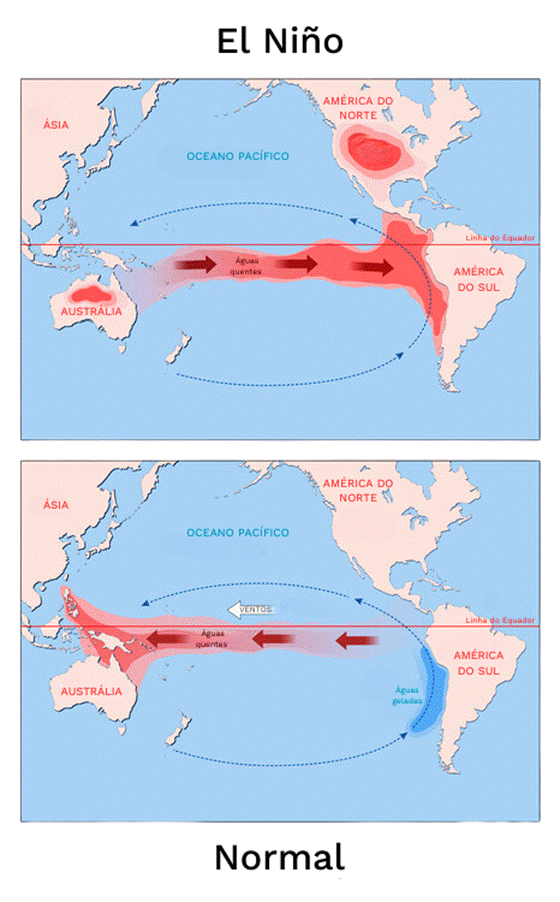
- Expected transition from weak La Niña → ENSO neutral (April–June 2026) → El Niño conditions during SWM.
- El Niño (warming of Equatorial Pacific) weakens monsoon circulation, reducing rainfall over Indian subcontinent.
- Historically associated with drought years (e.g., 2002, 2009), though exceptions exist due to interaction with other factors.
Indian Ocean Dipole (IOD)
- IOD currently neutral, expected to turn positive by late monsoon (2026).
- Positive IOD (warmer western Indian Ocean) enhances monsoon rainfall, potentially offsetting El Niño effects partially.
- Acts as a regional compensatory mechanism against Pacific-driven anomalies.
Eurasian Snow Cover
- Below-normal snow cover (Jan–March 2026) over Eurasia supports stronger monsoon circulation, as reduced albedo increases land heating.
- Acts as a favourable factor for rainfall, counterbalancing negative ENSO influence.
Climate Change Factor
- Post-2000 trends show increased atmospheric moisture due to global warming, leading to extreme rainfall events rather than uniform distribution.
- Enhances spatial variability, with some regions experiencing floods while others face drought-like conditions.
Probability Distribution (IMD Forecast)
- Deficient rainfall (<90% LPA): 35% probability (vs normal 16%)
- Below normal (90–95%): 31% probability
- Normal (96–104%): 27% probability
- Above normal: 6% | Excess: 1%
- Indicates skewed probability toward weaker monsoon outcomes.
Dimensions
Agricultural Dimension
- Around 60% of Indian agriculture is rainfed, making monsoon performance critical for Kharif crops like rice, pulses, and oilseeds.
- Below-normal rainfall risks lower sowing, reduced yields, and income shocks, especially for small and marginal farmers.
- Pre-monsoon losses due to hailstorms and flooding (2026) compound vulnerability, creating double stress scenario.
Economic Dimension
- Weak monsoon can reduce agricultural GDP growth, impacting overall economic performance due to strong rural demand linkages.
- Leads to higher food inflation, especially in cereals, pulses, and vegetables, affecting macroeconomic stability.
- Increases pressure on fiscal resources through subsidies, MSP procurement, and relief measures.
Water Resource Dimension
- Below-normal monsoon reduces reservoir levels, groundwater recharge, and river flows, affecting irrigation and drinking water availability.
- Raises risk of urban water stress and inter-state water conflicts.
Disaster and Environmental Dimension
- Increased variability due to climate change may cause localized extreme rainfall events, leading to floods alongside drought conditions.
- Enhances risk of heatwaves, droughts, and land degradation, particularly in semi-arid regions.
Governance and Policy Dimension
- Requires coordinated response involving:
- IMD forecasting
- Agricultural advisories
- Water management strategies
- Tests effectiveness of schemes like PMFBY (crop insurance) and PMKSY (irrigation).
Challenges
- Forecast uncertainty due to complex interactions between ENSO, IOD, and climate change reduces prediction reliability.
- High dependence on monsoon exposes structural weakness in irrigation coverage (~50% net sown area irrigated).
- Climate change is increasing frequency of extreme weather events, complicating traditional monsoon patterns.
- Limited adaptive capacity among small farmers increases vulnerability to rainfall variability.
Way Forward
- Expand irrigation infrastructure and micro-irrigation (PMKSY) to reduce monsoon dependence.
- Strengthen climate-resilient agriculture, including drought-resistant crop varieties and diversification.
- Improve forecast accuracy using AI and climate modelling, enhancing early warning systems.
- Promote water conservation and groundwater management through community-based approaches.
- Strengthen crop insurance (PMFBY) and direct income support mechanisms to protect farmer incomes.
- Integrate climate adaptation into agricultural policy, aligning with India’s National Action Plan on Climate Change (NAPCC).
Prelims Pointers
- LPA (1971–2020): 868.6 mm
- ENSO:
- El Niño → weak monsoon
- La Niña → strong monsoon
- IOD:
- Positive → enhances rainfall
- Negative → suppresses rainfall
- Southwest Monsoon contributes ~75% of India’s rainfall