

In-Depth News Analysis8 Items
Core TopicImportantConcise
Polity, Governance & Social JusticeGS Paper II
01Foreign Divorce Decrees & Indian Marriages — SC on Bigamy02Screens, AI and Early Childhood Education
International RelationsGS Paper II
03First BIMSTEC Health Ministers’ Meeting, Colombo04Maritime Chokepoints & the Balance of Power
Indian Economy & AgricultureGS Paper III
05Record Merchandise Exports in October 202606Corporate Investment Revival — Bank of Baroda Study07Khet Bachao Abhiyan — Soil Health Campaign
Science & TechnologyGS Paper III
08Matsya-6000 — Samudrayaan Trial Dive in 2027
Polity, Governance & Social JusticeGeneral Studies Paper II
01
Can a Foreign Divorce End an Indian Marriage? Supreme Court on Foreign Decrees and Bigamy
GS-II · Polity — Judiciary, Personal Laws; Private International LawGS-I · Society — Marriage & FamilyPrelims + MainsThe Indian Express
The Supreme Court has held that a person married under Indian law cannot rely on a foreign divorce decree to escape bigamy proceedings in India if the divorce was granted on a ground not recognised by the Indian law governing the marriage. A change of citizenship, or a second marriage abroad, does not alter this.
◈ From the Basics: Why a Foreign Judgment Needs “Recognition”
A court's decision normally has force only within its own country. When parties live across borders, Indian courts must decide whether to recognise a foreign judgment as valid here. This area is called private international law or conflict of laws.
- Personal law governs marriage: a Hindu marriage is governed by the Hindu Marriage Act (HMA), 1955, which lists the only grounds on which it can be dissolved.
- Irretrievable breakdown: it is not a ground for divorce under the HMA. The Supreme Court can dissolve a marriage on this basis only under Article 142 (Shilpa Sailesh v. Varun Sreenivasan, 2023); other courts cannot.
- Bigamy: marrying again while a spouse is alive and the first marriage subsists. Section 17, HMA makes such a marriage void and punishable under the penal law — now Section 82 of the Bharatiya Nyaya Sanhita, 2023 (earlier Section 494, IPC), with up to seven years' imprisonment.
Static Background: The Law on Foreign Judgments
- Section 13, Code of Civil Procedure, 1908: a foreign judgment is conclusive except in six situations — listed in Figure 1.
- Section 14, CPC: a court presumes that a certified foreign judgment was given by a court of competent jurisdiction, unless the contrary is shown.
- Section 44A, CPC: decrees of courts in "reciprocating territories" notified by the Centre can be executed in India as if passed by an Indian court — but they remain subject to the Section 13 tests.
- Y. Narasimha Rao v. Y. Venkata Lakshmi (1991): the leading case. A foreign divorce is valid in India only if (i) the ground is one available under the matrimonial law under which the parties married, and (ii) the respondent voluntarily and effectively submitted to the foreign court's jurisdiction — or consented to the relief.
Figure 1 — When a foreign divorce decree is not recognised in India
Section 13, CPC — six exceptions1. Court lacked competent jurisdiction2. Judgment not given on the merits3. Wrong view of international law, or refusalto recognise Indian law where applicable4. Proceedings against natural justice5. Judgment obtained by fraud6. Claim founded on breach of Indian lawNarasimha Rao tests (1991)A. Divorce ground must exist in thematrimonial law of the marriageB. Respondent voluntarily andeffectively submitted to the foreigncourt — or consented to the reliefObjecting to jurisdiction ≠ submissionIrretrievable breakdown ≠ HMA groundFails these tests → marriage subsists in Indian law → second marriage = bigamy (a continuing offence)
A foreign decree does not automatically end a marriage governed by Indian law; it must satisfy both the CPC and the matrimonial-law test.
The Case and the Ruling
- Facts: a couple married under Hindu rites in 2003 moved to the UK. The husband's divorce petition failed in India; he later obtained a UK divorce (2014) on the ground of irretrievable breakdown and remarried.
- Ground not recognised: the UK decree rested on a ground the HMA does not recognise, so it was passed "in contravention" of Indian matrimonial law.
- No submission: the wife had objected to the UK court's jurisdiction; her participation could not be treated as unconditional submission.
- Citizenship no escape: acquiring British citizenship and remarrying abroad did not matter; the only question was whether the first marriage still subsisted.
- Continuing offence: bigamy continues as long as the second marriage persists, so delay in filing the complaint was not fatal.
Significance and Concerns
- Protects spouses left behind: often women in India facing unilateral foreign decrees obtained without their real participation.
- Legal certainty: reaffirms the 1991 framework for NRI marriages, a recurring source of disputes.
- Limited codification: India has no specific statute on recognition of foreign divorces; reliance on the CPC and case law creates uncertainty.
- Reform ideas: compulsory registration of NRI marriages and clearer rules on cross-border matrimonial jurisdiction have long been proposed.
✎ Mains Practice Question
Cross-border marriages raise complex questions about the recognition of foreign divorce decrees in India. Discuss the legal framework, and examine whether India needs a dedicated law on the subject. 10 marks · 150 words
02
Screens, AI and the Early Years: Protecting Childhood in a Digital Age
GS-II · Social Justice — Education, Issues Relating to ChildrenPrelims + MainsThe Hindu · Op-ed by a former Director, NCERT
A former NCERT Director argues that early exposure to smartphones, screen-based learning and now artificial intelligence in primary classes harms children's intellectual and emotional development. He points to the CBSE plan to introduce AI from Grade III and a State plan to begin from Grade I.
◈ From the Basics: How Young Children Learn
- Early childhood (up to about age 8): the period of fastest brain development; children learn through talk, play, stories, rhymes and interaction with adults.
- Screen time concern: passive viewing can displace conversation, physical play and sleep, and is linked to weaker attention and language skills.
- EdTech: technology used in teaching. Its value depends on the age of the learner and whether it supports, rather than replaces, a teacher.
Static Background
- Article 21A: free and compulsory education for children aged 6–14, given effect by the RTE Act, 2009; Article 45 (DPSP) covers early childhood care and education up to age six.
- NEP 2020: the 5+3+3+4 structure; the Foundational Stage (ages 3–8) is to be play- and activity-based. The National Curriculum Framework for the Foundational Stage (2022) follows this approach.
- NCPCR: statutory body under the Commissions for Protection of Child Rights Act, 2005; it can act suo motu on violations of child rights.
- Global guidance: the WHO (2019) advises no sedentary screen time for children under 2 and no more than one hour a day for ages 2–4; the UNESCO GEM Report 2023 cautioned against technology replacing teacher-led learning.
- Data protection: the DPDP Act, 2023 requires verifiable parental consent for processing children's (under-18) data.
The Author's Argument
- A neglected category: real children and their education are poorly planned for, even as the word "child" is used loosely.
- Phone as babysitter: parents and policymakers treat smartphones as a learning tool despite mounting evidence of harm.
- Pandemic legacy: the belief that online teaching can substitute for real teaching took root during COVID-19 and persists, for example during pollution-related closures.
- Lessons from abroad: Britain's early push for reading apps was later reversed in favour of paper-and-pencil literacy and numeracy.
- AI too early: starting AI in primary grades reflects a "catch-up" anxiety rather than evidence; childhood needs a protective umbrella.
A Balanced Assessment
- The case for caution: evidence on early screen exposure supports age limits and teacher-led, play-based learning in early grades.
- The case for access: digital tools can help children in under-served schools, students with disabilities, and teachers in multi-grade classrooms — if used selectively.
- AI literacy vs AI use: teaching children about technology (awareness, safety, ethics) differs from making them learn through devices; policy should separate the two.
- Way forward: age-appropriate screen guidelines for schools, evidence reviews before rolling out EdTech, teacher training, and a role for NCPCR and NCERT in setting standards.
✎ Mains Practice Question
“Digital technology in early schooling must support, not replace, the teacher.” In the light of moves to introduce artificial intelligence in primary grades, discuss the opportunities and risks for children's development in India. 10 marks · 150 words
International RelationsGeneral Studies Paper II · with GS-I Geography
03
First BIMSTEC Health Ministers' Meeting: Building Regional Health Security around the Bay of Bengal
GS-II · IR — Regional Groupings, India and Neighbourhood; HealthPrelims + MainsDD India
The first BIMSTEC Health Ministers' Meeting in Colombo adopted a Joint Ministerial Statement and the Revised BIMSTEC Plan of Action on Public Health (2026–2030). India will host a BIMSTEC Centre of Excellence in Traditional Medicine at Jamnagar, and announced new health assistance for Sri Lanka.
◈ From the Basics: What Is BIMSTEC?
The Bay of Bengal Initiative for Multi-Sectoral Technical and Economic Cooperation (BIMSTEC) links South Asia and Southeast Asia around the Bay of Bengal. Its seven members are Bangladesh, Bhutan, India, Nepal, Sri Lanka (South Asia) and Myanmar, Thailand (Southeast Asia).
- Founded: 6 June 1997 through the Bangkok Declaration; Myanmar joined later in 1997, and Nepal and Bhutan in 2004.
- Secretariat: Dhaka (since 2014).
- Charter: adopted at the Fifth Summit (Colombo, 2022); it gave the grouping a formal legal identity.
- Sixth Summit (Bangkok, April 2025): adopted the Bangkok Vision 2030 and decided to create a health ministers' mechanism.
- For India: a bridge between Neighbourhood First and Act East, and an alternative to a stalled SAARC.
▤ Outcomes at a Glance
- Joint Ministerial Statement: commitment to Universal Health Coverage and SDG 3; priorities include disease surveillance, early warning, antimicrobial resistance, digital health, traditional medicine, climate-health responses and capacity building.
- Plan of Action (2026–2030): pandemic preparedness, digital health, One Health and health-workforce development.
- Proposed BIMSTEC Digital Health Framework: telemedicine, interoperable electronic health records and AI in diagnostics.
- Regional centres: Public Health (Sri Lanka), Tropical Medicine (Thailand), Traditional Medicine (India), and Bangladesh's proposed Regional Zoonotic Disease Observatory.
- Frequency: meetings every two years; Thailand to host the second in 2028.
India's Contributions
- Traditional medicine centre: at the Institute of Teaching and Research in Ayurveda (ITRA), Jamnagar — an Institute of National Importance under the ITRA Act, 2020. Jamnagar also hosts the WHO Global Centre for Traditional Medicine (2022).
- Sharing India's model: over 1.85 lakh Ayushman Arogya Mandirs; AB PM-JAY cover of ₹5 lakh per family for over 60 crore people; PM-ABHIM for public health infrastructure; eSanjeevani crossing 50 crore teleconsultations; and the Ayushman Bharat Digital Mission.
- Sri Lanka — ambulances: an MoU for 100 more ambulances for the 1990 Suwa Seriya emergency service (about US$5.28 million). India has funded the service since 2016, supporting 297 ambulances earlier.
- Sri Lanka — health kiosks: 50 Medical Kiosks/Health ATMs for primary health centres, part of a US$450 million rehabilitation package after Cyclone Ditwah (Nov–Dec 2025).
◈ Key Terms Explained from the Basics
- Universal Health Coverage (UHC): everyone can obtain needed health services without suffering financial hardship — SDG target 3.8.
- One Health: an approach recognising that the health of people, animals and the environment is linked; most emerging infections are zoonotic (spread from animals).
- Health security: the ability to prevent, detect and respond to outbreaks that cross borders — the logic of the International Health Regulations (2005).
Significance and Challenges
- Health as diplomacy: health cooperation builds trust and gives substance to India's regional leadership, as seen in Vaccine Maitri during COVID-19.
- Shared risks: the region faces common threats — dengue, malaria, AMR, zoonoses and climate-linked disease — that need cross-border surveillance.
- BIMSTEC's record: the grouping has been slow; the Free Trade Area framework (2004) is still not concluded, and activity has often lagged declarations.
- Political volatility: instability in Myanmar and shifting ties with Bangladesh can slow follow-through.
✎ Mains Practice Question
“Health cooperation can give BIMSTEC the momentum that trade has not.” Discuss with reference to the outcomes of the first BIMSTEC Health Ministers' Meeting and India's role. 10 marks · 150 words
04
From Suez to Hormuz: How Maritime Chokepoints Shape Trade and Power
GS-I · Geography — Important Straits & WaterwaysGS-II · IR — Effect of Policies of Other Countries on IndiaGS-III · Security — Energy Security, Maritime SecurityPrelims + MainsThe Indian Express · Op-ed
An op-ed argues that a few narrow sea passages — chokepoints — have shaped the global economy and the balance of power from ancient Greece to today. Blockades at Hormuz and Bab-el-Mandeb amid the West Asia conflict show that whoever can control them can disrupt the world economy.
◈ From the Basics: What Is a Chokepoint?
A maritime chokepoint is a narrow channel along a widely used sea route — a strait (natural) or a canal (artificial). Because ships have no easy alternative, any blockage, attack or closure forces long detours, raising freight costs, insurance premiums and delivery times.
- Transit passage: under Part III of UNCLOS (1982), ships and aircraft of all States enjoy transit passage through straits used for international navigation; coastal States may not suspend it.
- Canals have their own regimes: the Constantinople Convention (1888) guarantees free passage through the Suez Canal; the Montreux Convention (1936) governs the Turkish Straits (Bosporus and Dardanelles).
Figure 2 — Key maritime chokepoints between the Atlantic and the Pacific
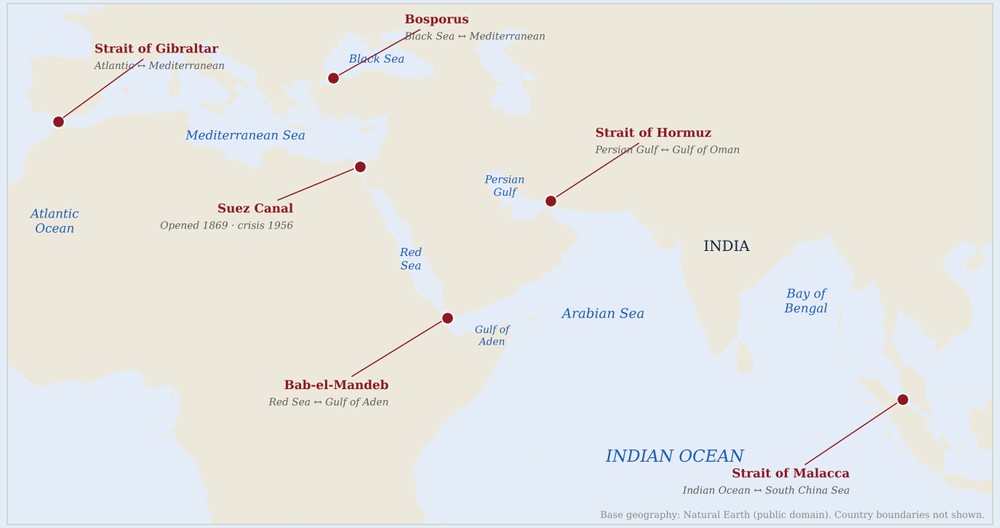
India sits at the centre of the sea lanes linking these chokepoints: Hormuz and Bab-el-Mandeb to the west, the Strait of Malacca to the east. Base geography: Natural Earth 1:50m, public domain. International boundaries are deliberately not drawn; the map is for locating places only.
▤ Chokepoints at a Glance
- Strait of Hormuz: between Iran and Oman (Musandam); links the Persian Gulf to the Gulf of Oman; carries roughly a fifth of global oil consumption.
- Bab-el-Mandeb: between Yemen and Djibouti/Eritrea; links the Red Sea to the Gulf of Aden; the southern gate of the Suez route.
- Suez Canal: opened in 1869; links the Mediterranean and Red Sea; the shortest sea route between Europe and Asia.
- Bosporus: runs through Istanbul; the Black Sea's only outlet to the Mediterranean, vital for grain and oil exports.
- Strait of Malacca: between the Malay Peninsula and Sumatra; the main route between the Indian Ocean and the South China Sea.
- Strait of Gibraltar: between Spain and Morocco; links the Atlantic and the Mediterranean.
Static Background: Chokepoints in History
- Peloponnesian War (431–404 BCE): Athens depended on grain shipped through the straits from the Black Sea; once Sparta cut this route, Athens was forced to surrender.
- Constantinople (330 CE): founded on the Bosporus as the Roman capital; the Ottomans captured it in 1453.
- Suez Crisis (1956): Egypt nationalised the Suez Canal Company; Britain, France and Israel intervened, but U.S. pressure forced them to withdraw. The crisis led to the first armed UN peacekeeping force (UNEF) and marked the decline of Britain and France as global powers.
- Lesson drawn by the author: control of chokepoints is a lever of economic coercion, and crises around them can reshape the international order.
The Op-ed's Argument
- Weaponisation: after World War II, economic institutions were meant to depoliticise trade, but powers soon used trade and chokepoints as tools of coercion.
- Globalisation's limits: 1990s predictions that markets and technology would make governments less relevant did not last; States have reasserted control over trade.
- A shifting order: current crises at Hormuz and Bab-el-Mandeb may, like Suez in 1956, bring new powers forward and weaken old ones.
- India's opportunity: India's calls for reformed multilateralism and a more representative world order can gain ground in such a moment.
Why It Matters for India
- Energy security: India imports most of its crude oil and much of its LPG, a large share from the Gulf through Hormuz.
- Trade: exports to Europe, Africa and the US East Coast use the Red Sea–Suez route; diversions around the Cape of Good Hope add about two weeks.
- Naval role: the Indian Navy's Operation Sankalp (since 2019) protects Indian-flagged ships in the Gulf region; anti-piracy patrols operate in the Gulf of Aden.
- Alternatives: strategic petroleum reserves, diversified suppliers, and corridors such as INSTC, Chabahar and IMEC reduce dependence on single routes.
✎ Mains Practice Question
“Chokepoints have become instruments of geopolitical coercion.” Examine the importance of the Strait of Hormuz and Bab-el-Mandeb for India's economic and energy security, and suggest measures to reduce vulnerability. 15 marks · 250 words
Indian Economy & AgricultureGeneral Studies Paper III
05
Exports at a Record High: What October's Trade Data Shows
GS-III · Economy — External Sector, Trade Policy, Balance of PaymentsPrelims + MainsThe Hindu · The Indian Express
India's merchandise exports hit an all-time monthly high of $49.47 billion in October 2026, up 45% year-on-year. Imports also reached a record $89.35 billion. The Commerce Secretary said the growth was broad-based: 43 of India's top 50 export destinations recorded growth.
◈ From the Basics: Reading Trade Data
- Merchandise trade: trade in physical goods. Services trade covers IT, business services, travel and transport.
- Trade deficit: imports minus exports. India runs a large goods deficit but a services surplus, which partly offsets it.
- Value vs volume: export values can rise because prices rise (e.g. oil products) or because more is shipped (volumes); only the latter shows stronger competitiveness.
- Exchange rate: a weaker rupee makes Indian goods cheaper abroad, supporting exports but raising the import bill.
- Data source: monthly trade data are released by the Ministry of Commerce and Industry, compiled by the DGCI&S, Kolkata.
Figure 3 — India's merchandise trade, October 2025 vs October 2026 ($ billion)
Oct 2025Oct 2026Exports34.1149.47 (+45%)Imports76.6989.35 (+16.5%)Trade gap42.5839.88Goods only; source data: Ministry of Commerce and Industry, as reported. Bars to scale (4 px per $1 billion).
Exports grew far faster than imports, so the goods trade gap narrowed slightly from a year earlier, even though it is the highest of the calendar year 2026.
▤ October 2026 in Numbers
- Goods + services exports: $89.99 billion, up nearly 30%; total imports $110.1 billion (+16.6%).
- Overall trade deficit (goods and services): $20.1 billion, down from $25.1 billion a year earlier.
- Drivers: petroleum products (high oil prices amid the West Asia crisis) and electronics; non-oil exports also rose.
- Supporting factors: a weaker rupee and lower US tariffs; the US has reportedly assured India of a comparative edge under the proposed trade deal.
Static Background
- Foreign Trade Policy 2023: took effect on 1 April 2023 without a fixed end date; aims at $2 trillion of goods and services exports by 2030.
- Foreign Trade (Development and Regulation) Act, 1992: the legal basis for trade policy, administered by the DGFT.
- Balance of payments: the trade balance is part of the current account, along with services, remittances and income flows.
A Balanced Assessment
- Encouraging: geographic spread and a rise in volumes, not only prices, suggest stronger underlying demand for Indian goods.
- Caution: part of the gain reflects high oil prices, which also swell the import bill; such gains can reverse when prices fall.
- Import pressure: record imports — crude oil, gold and electronics components — keep the goods deficit large.
- Sustaining momentum: trade agreements (India–EU, India–US), logistics cost reduction and moving up the value chain in electronics are key.
✎ Mains Practice Question
Record export figures can mask structural weaknesses in a country's trade. Analyse the factors behind India's recent export performance and the measures needed to make it sustainable. 10 marks · 150 words
06
Is Private Investment Finally Picking Up? Reading the Signs from Corporate Balance Sheets
GS-III · Economy — Growth, Investment Models, Mobilisation of ResourcesPrelims + MainsThe Indian Express (Bank of Baroda research)
A Bank of Baroda study of about 2,010 companies finds that growth in fixed assets picked up in 22 of 31 sectors in the first half of 2026–27. Capacity utilisation is also rising — both signs that private investment may be reviving.
◈ From the Basics: Investment and Capacity
- Investment (capital formation): spending on factories, machinery and infrastructure that raises an economy's future output. In national accounts it is measured as Gross Fixed Capital Formation (GFCF).
- Fixed assets: long-lived assets on a company's balance sheet — land, buildings, plant and machinery. Growth in fixed assets indicates actual investment, not just plans.
- Capacity utilisation: how much of existing productive capacity is in use. Firms build new capacity only when existing capacity is well used; the RBI tracks this through its OBICUS survey.
- Asset turnover ratio: sales divided by fixed assets. A rising ratio means more output from existing assets — a sign that new investment may be needed soon.
Static Background: Why Private Investment Stalled
- The slowdown: private investment rates declined after 2011–12 and did not recover as expected.
- Supply-side reforms: the IBC (2016), GST (2017), the corporate tax cut of 2019 (base rate cut to 22%, 15% for new manufacturing units) and the PLI schemes (2020) aimed to make investing attractive.
- The missing piece — demand: without strong consumption, firms see no need to add capacity; the recovery after COVID-19 was described as K-shaped, with different groups recovering at different speeds.
- Demand-side turn: later policy shifted towards income tax relief, GST rationalisation and the Employment Linked Incentive scheme, which ties support to job creation.
Figure 4 — Growth in fixed assets, selected sectors (%; first half of FY 2025–26 vs FY 2026–27)
H1 FY26H1 FY27Healthcare27.114.7Automobile & ancillaries18.514.8Logistics14.610.8IT13.65.2Iron & steel10.54.3Crude oil8.56.8Telecom0.90.1Power3.75.9Source data: Bank of Baroda Research, as reported. Bars to scale (10 px per percentage point).
Investment is picking up across healthcare, autos, logistics, IT and steel; a few sectors such as power (and non-ferrous metals, sharply) slowed.
▤ Key Findings
- Breadth: fixed-asset growth improved in 22 of 31 sectors; growth was lower than last year in only about one-fifth of sectors.
- Capacity use: the sample's asset turnover ratio rose from 1.14 (September 2025) to 1.30 (September 2026), with 23 of 31 industries improving.
- Growth outlook: the RBI projected 7.2% GDP growth for Q2 (July–September); several private estimates are higher.
Will the Trend Hold?
- The old worry — consumption: rural wages have stagnated, and weak monsoon conditions and El Niño-linked heat could hurt farm output and rural demand.
- Urban demand: real wages in the urban informal sector are barely growing.
- Policy implication: sustained private investment needs broad-based income growth; supply-side incentives alone cannot create demand.
✎ Mains Practice Question
Despite several supply-side reforms, private corporate investment in India remained subdued for over a decade. Examine the reasons and assess whether recent indicators point to a durable revival. 15 marks · 250 words
07
Khet Bachao Abhiyan: A National Campaign to Protect Soil Health
GS-III · Agriculture — Soil, Farm Inputs, Subsidies; Environment — Land DegradationPrelims + MainsMinistry of Agriculture & Farmers' Welfare
The Union Agriculture Minister launched the nationwide Khet Bachao Abhiyan from Taraori in Haryana's Karnal district — a campaign from 22 October to 30 November to promote soil conservation, balanced fertiliser use and sustainable farming.
◈ From the Basics: Why Soil Health Matters
- Soil health: the capacity of soil to sustain plants, animals and people; it depends on nutrients, organic matter and living micro-organisms.
- Primary nutrients: nitrogen (N), phosphorus (P) and potassium (K). A ratio of about 4:2:1 is generally considered balanced for Indian conditions; actual use is heavily skewed towards nitrogen (urea).
- Why imbalance hurts: excess urea degrades soil, pollutes groundwater with nitrates, and gives diminishing yields.
- Land degradation: ISRO's Desertification and Land Degradation Atlas (2021) estimated about 97.85 million hectares — nearly 30% of India's area — as degraded in 2018–19.
The Three Measures Promoted
- Balanced fertiliser use: apply nutrients as advised by the Soil Health Card — a scheme launched in 2015 that tests soil and recommends crop-wise doses.
- Crop rotation: break the paddy–wheat cycle with pulses such as chickpea, lentil and pigeon pea, which fix atmospheric nitrogen through Rhizobium bacteria in their root nodules.
- Natural farming: start on at least half an acre, using preparations such as Beejamrit and Ghanjeevamrit made from cow dung, cow urine and soil, and expand gradually.
▤ Fertiliser Subsidy — The Static Frame
- Subsidy bill: over ₹1.5 lakh crore, cushioning farmers from global price rises.
- Farmer prices: a bag of urea at about ₹266 and of DAP at ₹1,350.
- Two regimes: urea has a statutorily fixed retail price, while P and K fertilisers come under the Nutrient Based Subsidy scheme (2010). Cheap urea is a key reason for the skewed NPK ratio.
- Self-reliance: green ammonia (made with green hydrogen) could reduce dependence on imported gas for fertiliser production.
Stubble Burning and Soil Life
Burning crop residue pollutes the air and kills beneficial micro-organisms, insects and earthworms that drive decomposition and nutrient cycling. Alternatives include in-situ management with machines such as the Happy Seeder, and bio-decomposers that break down straw in the field.
Significance and Gaps
- Strength: direct outreach by ICAR scientists and agricultural universities can make soil-test advice practical for farmers.
- Price signals: as long as urea is far cheaper than other nutrients, awareness alone may not change practice; subsidy reform is the harder question.
- Natural farming evidence: long-term yield data across agro-climatic zones are still limited; a gradual, evidence-based expansion is prudent.
- Procurement bias: assured procurement of rice and wheat discourages diversification into pulses.
✎ Mains Practice Question
Imbalanced fertiliser use has emerged as a major threat to India's soil health. Discuss its causes and evaluate the role of awareness campaigns, subsidy reform and crop diversification in addressing it. 15 marks · 250 words
Science & TechnologyGeneral Studies Paper III
08
Matsya-6000: India's Crewed Deep-Ocean Submersible Readies for Its First Trial Dive
GS-III · S&T — Indigenisation of Technology; Economy — Blue EconomyGS-I · Geography — Ocean ResourcesPrelims + MainsThe Hindu
The first 500-metre trial dive of Matsya-6000, India's crewed deep-ocean submersible, is planned for January–February 2027 in the Bay of Bengal, the Secretary, Ministry of Earth Sciences, has said. It is a step towards sending humans to 6,000 metres under the Samudrayaan project.
◈ From the Basics: Why Go to the Deep Ocean?
- The deep sea: the ocean below about 1,000 m is dark, cold and under immense pressure — about 600 times surface atmospheric pressure at 6,000 m.
- Resources: the seabed holds polymetallic nodules rich in manganese, nickel, cobalt and copper, as well as hydrothermal sulphides.
- Science: deep-sea biodiversity, ocean circulation and climate records can be studied directly only by going there.
- Why titanium: the crew sphere must resist crushing pressure; titanium alloy is strong and light, but very hard to forge into a large sphere.
Figure 5 — Matsya-6000's depth milestones
0 m2,0004,0006,000500 m — first trial dive (Jan–Feb 2027)Phase 1 · Bay of Bengal · two trained aquanauts from NIOT~3,700 m — average depth of the world ocean~5,000–6,000 m — polymetallic nodule fieldsCentral Indian Ocean Basin (India's ISA contract area)6,000 m — design depth, three crewDepth
The submersible will be qualified in phases, starting shallow and working down to the 6,000 m range where India's seabed mineral interests lie. Depths drawn to scale.
▤ Mission at a Glance
- Programme: Samudrayaan (launched 2021), under the Deep Ocean Mission approved in 2021 with an outlay of about ₹4,077 crore.
- Developer: the National Institute of Ocean Technology (NIOT), Chennai, an autonomous institute of the Ministry of Earth Sciences; ISRO is helping build the titanium hull.
- Design: carries three people in a 2.1-metre diameter titanium sphere to 6,000 m.
- Exclusive club: only a few countries — including the US, Russia, France, Japan and China — have built crewed vehicles for such depths.
Static Background: India and the Seabed
- Pioneer investor (1987): India was the first country to receive pioneer investor status for nodule exploration in the Central Indian Ocean Basin.
- International Seabed Authority (ISA): set up under UNCLOS, headquartered in Kingston, Jamaica; it regulates mineral activity in the international seabed ("the Area"), the "common heritage of mankind".
- Contract area: India holds an ISA exploration contract over about 75,000 sq km in the Central Indian Ocean Basin.
- Blue Economy: the Deep Ocean Mission also covers ocean climate services, deep-sea biodiversity and offshore energy.
Significance and Concerns
- Strategic minerals: nickel, cobalt and manganese are vital for batteries and the clean-energy transition.
- Technology spin-offs: life-support, pressure-hull and underwater navigation capabilities overlap with Gaganyaan and naval technology.
- Environmental caution: scientists warn that deep-sea mining could cause long-lasting harm to poorly understood ecosystems; the ISA's mining code is still under negotiation.
- Public profile: the programme has drawn less attention than space missions, though it needs similar long-term support.
✎ Mains Practice Question
Discuss the strategic and economic significance of India's Deep Ocean Mission. How should India balance seabed resource exploration with the protection of deep-sea ecosystems? 10 marks · 150 words