
Published on Apr 15, 2026
Daily Current Affairs
Current Affairs 15 April 2026

Content
- Startup India Fund of Funds (FoF) 2.0: Strengthening India’s Innovation Ecosystem
- Delimitation & Inter-State Redistribution of Lok Sabha Seats
- What are the legal consequences of piracy?
- Measuring the universe
- Hubble Tension: Crisis in Modern Cosmology
- Labour Protests in India: Wage Stagnation, Inflation & Structural Labour Crisis
- Mapping the legislative vacuum in India’s heat crisis
- Sudan war: Sexual violence against women ‘quadruples’ in three years, says UN Women
Startup India Fund of Funds (FoF) 2.0: Strengthening India’s Innovation Ecosystem
Why in News?
- On 13 April 2026, Government notified Startup India Fund of Funds 2.0 (FoF 2.0) with ₹10,000 crore corpus to mobilize capital for startups.
Issue in Brief
- FoF 2.0 aims to address persistent funding gaps, especially in deep-tech, early-stage, and manufacturing startups, by catalysing domestic venture capital ecosystem.
Relevance
- GS Paper III: Economy (Startups, Venture Capital, Industrial Policy), Science & Technology (Innovation ecosystem)
- GS Paper II: Governance (Institutional mechanisms, Ease of Doing Business)
Practice Question
- “Startup India Fund of Funds 2.0 seeks to address critical funding gaps in India’s startup ecosystem. Examine its significance, challenges, and role in promoting innovation-driven growth.” (250 words)
Static Background
- Startup India Initiative (2016) launched to promote entrepreneurship, innovation, and ease of doing business.
- Fund of Funds model:
- Government does not invest directly in startups
- Invests via SEBI-registered Alternative Investment Funds (AIFs)
- Small Industries Development Bank of India acts as implementation agency.
- Alternative Investment Funds (AIFs):
- Privately pooled investment vehicles regulated by Securities and Exchange Board of India
Key Features of FoF 2.0
- Total corpus:
- ₹10,000 crore allocated across 16th and 17th Finance Commission cycles
- Investment focus areas:
- Deep-tech (AI, semiconductors, quantum, etc.)
- Early growth-stage startups
- Innovative manufacturing and technology-driven sectors
- Structured governance:
- Venture Capital Investment Committee (VCIC) for AIF selection
- Empowered Committee (EC) for monitoring and oversight
- Includes co-investment mechanisms with institutional investors under regulated framework.
Performance Linkage (FoF 1.0 Context)
- Builds on Fund of Funds for Startups (FFS 1.0, 2016) which:
- Catalysed domestic VC ecosystem
- Addressed early-stage funding gaps
- FoF 2.0 reflects shift towards scale, innovation depth, and strategic sectors.
Dimension
Economic Dimension
- Enhances availability of risk capital, especially where private VC participation is limited.
- Promotes job creation, entrepreneurship, and capital formation, contributing to GDP growth.
Innovation & Technology Dimension
- Focus on deep-tech sectors supports strategic capabilities in:
- AI, quantum computing, advanced manufacturing
- Reduces dependence on foreign technology and capital ecosystems.
Industrial Policy Dimension
- Supports Make in India and Atmanirbhar Bharat by funding innovation-led manufacturing startups.
- Encourages transition from service-led to product-based innovation economy.
Financial Ecosystem Dimension
- Strengthens domestic venture capital and private equity ecosystem through AIFs.
- Reduces over-reliance on foreign venture capital flows, improving financial resilience.
Governance Dimension
- Multi-layered structure (VCIC + EC) ensures:
- Professional selection of funds
- Monitoring and accountability mechanisms
- Implementation through SIDBI ensures institutional continuity.
Social Dimension
- Promotes inclusive entrepreneurship, potentially benefiting startups in Tier-2/3 cities.
- Supports high-quality employment generation, especially in technology-driven sectors.
Key Challenges
- Risk of capital concentration in established startups, limiting support for truly early-stage ventures.
- Dependence on AIF performance may lead to uneven distribution of funds across sectors and regions.
- Limited exit opportunities (IPO/M&A) in India affecting investor returns.
- Regulatory complexity in AIF operations and compliance.
Way Forward
- Ensure balanced allocation across early-stage, growth-stage, and deep-tech startups.
- Strengthen startup exit ecosystem through reforms in IPO markets and M&A regulations.
- Promote regional diversification of AIF investments, including Tier-2/3 ecosystems.
- Enhance synergy with initiatives like Digital India, Make in India, and National Deep Tech Mission.
- Improve regulatory clarity and ease for AIF participation and cross-border investments.
Delimitation & Inter-State Redistribution of Lok Sabha Seats
Why in News?
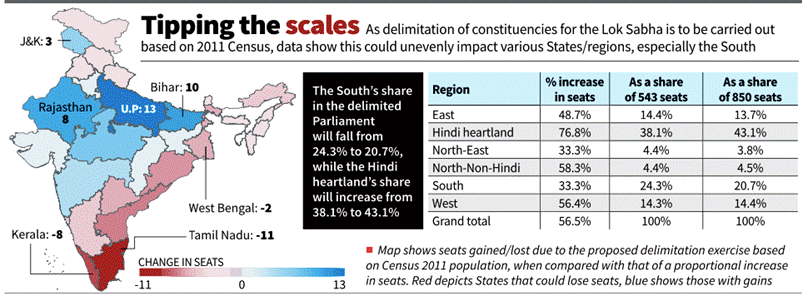
- The Centre circulated draft Constitution (131st Amendment) Bill and Delimitation Bill proposing seat redistribution based on 2011 Census and expansion of Lok Sabha.
Issue in Brief
- Proposed reforms aim to increase Lok Sabha strength to 850 seats and enable inter-State redistribution, raising concerns on federal balance, representation, and demographic equity.
Relevance
- GS Paper II: Constitution, Federalism, Representation, Parliament
- GS Paper I: Population dynamics, Regional disparities
Practice Question
- “Proposed delimitation and inter-state redistribution of Lok Sabha seats raises questions of equity and federal balance. Critically analyse.” (250 words)
Static Background
- Article 81: Allocation of Lok Sabha seats among States based on population.
- Article 82: Delimitation after every Census through Delimitation Commission.
- 42nd Amendment Act, 1976: Froze seat allocation based on 1971 Census to promote population control.
- 84th Amendment Act, 2001: Extended freeze till first Census after 2026.
- Current system:
- Inter-State allocation → 1971 Census
- Intra-State delimitation → 2001 Census
Key Provisions of Proposed Bills
- Increase Lok Sabha strength:
- From 550 → up to 850 seats (815 States + 35 UTs)
- Enable redistribution based on latest Census (2011) instead of 1971 baseline.
- Integrate 33% reservation for women (linked to delimitation process).
- Mandate Delimitation Commission to readjust seat allocation across States.
Data-Based Impact
- Hindi heartland States:
- Share increases from 38.1% → 43.1%
- Southern States:
- Share declines from 24.3% → 20.7%
- Reflects population-proportional representation shift, benefiting high population growth States.
Dimensions
Constitutional / Legal Dimension
- Aligns with principle of “one person, one vote” (population-based representation) under Article 81.
- However, removal/modification of seat freeze weakens policy incentive for population stabilisation.
Federalism Dimension
- Redistribution may alter political weight of States in Union legislature, impacting cooperative federalism.
- Southern States argue demographic performance (lower fertility) may lead to reduced representation.
Governance / Administrative Dimension
- Larger Lok Sabha (850 members) raises concerns regarding:
- Efficiency of parliamentary functioning
- Debate quality and legislative productivity
- Delimitation exercise is complex, requiring time, data accuracy, and political consensus.
Political Economy Dimension
- Seat redistribution could influence:
- Electoral strategies and coalition politics
- Resource allocation and policy priorities at Union level
- Potential shift in regional political influence.
Social Dimension
- Raises debate on fairness between:
- Population-based representation vs development-based equity
- States with successful population control policies may perceive relative disadvantage.
Ethical Dimension
- Balancing:
- Democratic equality (equal representation)
- Inter-generational fairness (rewarding responsible population policies)
Key Challenges
- Lack of national consensus on delimitation timing and methodology.
- Linking women’s reservation with delimitation may delay implementation of gender representation.
- Potential for regional political tensions and perception of inequity.
- Administrative complexity in redrawing constituencies across diverse geographies.
Way Forward
- Build broad political consensus through Inter-State consultations and parliamentary debate.
- Consider balanced formula combining population with indicators like development or demographic performance.
- Decouple women’s reservation implementation from delimitation delays for immediate effect.
- Ensure transparency and independence of Delimitation Commission to maintain trust.
- Strengthen parliamentary processes to handle expanded House size efficiently.
What are the legal consequences of piracy?
Why in News?
- Tamil film Jana Nayagan was leaked online before theatrical release, triggering enforcement under amended Cinematograph Act, 1952 and piracy laws.
Issue in Brief
- Pre-release piracy represents a severe breach of intellectual property rights (IPR), causing significant financial loss and exposing gaps in enforcement and digital content protection systems.
Relevance
- GS Paper II: Governance, Intellectual Property Rights
- GS Paper III: Technology, Cybersecurity, Digital economy
Practice Question
- “Despite strong legal provisions, piracy remains widespread in India. Analyse the legal, technological, and governance challenges in curbing digital piracy.” (250 words)
Static Background
- Copyright Act, 1957 governs protection of creative works including films, music, and literature.
- Section 63 and 63A:
- Punishment up to 3 years imprisonment and ₹2 lakh fine for copyright infringement.
- Cinematograph Amendment Act, 2023 introduced stricter anti-piracy provisions:
- Fine up to 5% of audited gross production cost — key factual trap.
- Digital Rights Management (DRM) refers to technologies used to prevent unauthorised copying of digital content.
Key Features of the Current Case
- Leak occurred before theatrical release, unlike typical piracy which happens post-OTT release, increasing severity of financial and legal implications.
- Indicates breach within trusted distribution chain, suggesting insider leak rather than external hacking.
- Authorities have arrested six individuals, including those sharing cloud storage links, showing expanded liability beyond original uploader.
Dimensions
Legal Dimension
- India has strong statutory framework, combining Copyright Act penalties and Cinematograph Act financial sanctions for piracy deterrence.
- Courts also issue:
- John Doe orders (pre-emptive injunctions)
- Dynamic injunctions (blocking evolving piracy links)
- However, enforcement remains inconsistent, limiting deterrence effect.
Governance and Enforcement Dimension
- India is often labelled a “notorious market” for piracy due to weak enforcement and low conviction rates.
- Investigation challenges include:
- Anonymous digital networks
- Cross-border hosting of pirated content
- Focus often remains on distributors rather than individual infringers, reducing accountability.
Technological Dimension
- Piracy thrives due to:
- Ability to bypass DRM protections
- Distribution via torrent networks, Telegram groups, cloud storage links
- Studios use:
- Encryption of theatrical prints
- Forensic watermarking (visible/invisible) to trace leaks
- However, complete prevention remains technologically difficult.
Economic Dimension
- Pre-release leaks damage:
- Box office revenues
- OTT and satellite rights valuation
- Film industry faces substantial losses, affecting investment, employment, and creative ecosystem sustainability.
Institutional Dimension
- Rise of anti-piracy firms sending takedown notices to platforms shows increasing reliance on private enforcement mechanisms.
- Platforms often comply quickly, but constant domain switching by piracy sites limits long-term effectiveness.
Ethical Dimension
- Piracy raises concerns of fair compensation for creative labour, impacting artists, technicians, and producers across the value chain.
- Reflects tension between digital accessibility and protection of intellectual property rights.
Key Challenges
- Difficulty in completely removing pirated content due to decentralised distribution networks (torrent, encrypted messaging platforms).
- Weak enforcement and delayed legal action reduce deterrence against piracy networks.
- Insider leaks within supply chain undermine content security frameworks.
- Rapid technological evolution outpacing legal and regulatory responses.
Way Forward
- Strengthen cybercrime investigation capacity, including digital forensics and international cooperation for cross-border piracy networks.
- Enhance enforcement of Cinematograph Amendment Act, 2023, ensuring strict penalties in high-impact cases.
- Promote adoption of advanced DRM technologies and blockchain-based content tracking systems.
- Increase awareness among users regarding legal consequences of sharing pirated content.
- Encourage collaboration between government, industry, and digital platforms for coordinated anti-piracy strategy.
Hubble Tension: Crisis in Modern Cosmology
Why in News?
- On 10 April 2026, astronomers refined the local expansion rate to 73.5 km/s/Mpc, reinforcing the persistent discrepancy known as the Hubble tension.
Issue in Brief
- Two highly precise methods measuring the rate of expansion of the universe (Hubble constant) produce conflicting results, challenging the standard cosmological model.
Relevance
- GS Paper III: Science & Technology (Space science, Cosmology)
Practice Question
- “The ‘Hubble tension’ represents a major challenge to the standard cosmological model. Explain its causes and implications for modern physics.” (250 words)
Static Background
- Hubble constant (H₀) measures the rate at which the universe expands, expressed as km/s per megaparsec (Mpc) — key unit frequently asked in prelims.
- 1 megaparsec (Mpc) ≈ 3.26 million light years, used as standard astronomical distance unit in cosmology.
- Expansion of universe was first discovered by Edwin Hubble in 1929 through redshift observations.
- Cosmic Microwave Background (CMB) refers to relic radiation from Big Bang (~380,000 years after origin of universe) — crucial conceptual trap.
Two Competing Measurement Methods
Local (Late Universe) Method
- Uses cosmic distance ladder, involving:
- Cepheid variable stars (standard candles)
- Type Ia supernovae (standardisable candles)
- Measures present-day expansion directly from nearby galaxies.
- Gives higher value:
- ~73–73.5 km/s/Mpc (confirmed on 10 April 2026)
Early Universe Method
- Uses Cosmic Microwave Background (CMB) data from missions like Planck Mission.
- Applies cosmological models (ΛCDM) to project early universe conditions to present expansion rate.
- Gives lower value:
- ~67 km/s/Mpc
Nature of the Tension
- The gap between ~73 and ~67 km/s/Mpc is statistically significant and persists despite improvements in measurement precision.
- Both methods are independently robust, suggesting issue is not random error but systematic or theoretical limitation.
Dimensions
Scientific Dimension
- Challenges the validity of ΛCDM model (Lambda Cold Dark Matter), which is the current standard model of cosmology.
- Indicates potential gaps in understanding of dark energy, dark matter, or early universe physics.
Technological Dimension
- Precision measurements rely on advanced telescopes like:
- Hubble Space Telescope
- James Webb Space Telescope
- Improved observational accuracy has strengthened both conflicting results rather than resolving discrepancy.
Theoretical Physics Dimension
- Possibility of “new physics” beyond Standard Model, such as:
- Dynamic dark energy
- New relativistic particles
- Modified gravity theories
- Could fundamentally alter understanding of universe evolution and fate.
Epistemological Dimension
- Demonstrates how scientific progress occurs through anomalies and paradigm shifts, similar to Kuhn’s theory of scientific revolutions.
- Highlights limits of current models despite high-precision data.
Key Challenges
- Difficulty in identifying whether discrepancy arises from measurement errors or fundamental theoretical flaws.
- Dependence on cosmological models introduces model-based uncertainties in early universe method.
- Increasing precision has widened confidence in both sides rather than resolving disagreement.
Way Forward
- Strengthen cybercrime investigation capacity, including digital forensics and international cooperation for cross-border piracy networks.
- Enhance enforcement of Cinematograph Amendment Act, 2023, ensuring strict penalties in high-impact cases.
- Promote adoption of advanced DRM technologies and blockchain-based content tracking systems.
- Increase awareness among users regarding legal consequences of sharing pirated content.
- Encourage collaboration between government, industry, and digital platforms for coordinated anti-piracy strategy.
Labour Protests in India: Wage Stagnation, Inflation & Structural Labour Crisis
Why in News?
- On 8 April 2026, factory workers in Noida began protests demanding wage hikes, which escalated into violence on 14 April 2026, highlighting structural labour distress.
Issue in Brief
- Labour unrest reflects widening gap between rising cost of living (inflation-driven) and stagnant real wages, compounded by delays in wage revision and ambiguity in labour law implementation.
Relevance
- GS Paper III: Economy (Labour markets, Employment, Informality)
- GS Paper II: Governance (Labour laws, Social protection)
Practice Question
- “Rising labour unrest in India reflects deeper structural issues in wage growth, informality, and labour governance. Analyse.” (250 words)
Static Background
- Minimum wage comprises:
- Base wage (revised every 5 years)
- Variable Dearness Allowance (VDA) linked to Consumer Price Index–Industrial Workers (CPI-IW, base year 2016), revised twice annually.
- Four Labour Codes notified on 21 November 2025 aim to streamline labour laws:
- Code on Wages
- Industrial Relations Code
- Social Security Code
- OSHWC Code
- Labour Codes define 8-hour workday and 48-hour weekly limit, aligning with International Labour Organization norms, but operational rules remain largely unnotified.
Key Data and Evidence
- CPI-IW inflation rose 24.8% (Feb 2021–Feb 2026) nationally, with ~27.4% in Delhi-NCR, significantly increasing cost of living for industrial workers.
- Haryana minimum wage rose from ₹9,803 (July 2021) to ₹13,274 (July 2025) before revision, lagging inflation-adjusted income requirements.
- Uttar Pradesh wages increased ~24.8% (2021–2026), matching inflation, implying no real wage growth and stagnant purchasing power.
- Migrant workers face extreme costs, including LPG cylinders up to ₹4,000 (informal markets), alongside rising rents and food prices.
Dimensions
Economic Dimension
- Wage growth lagging inflation leads to erosion of real wages, reducing consumption capacity and weakening aggregate demand in labour-intensive manufacturing sectors.
- External shocks such as West Asia conflict and Strait of Hormuz disruptions increase input costs, affecting industrial profitability and wage payments.
Labour Market Dimension
- Informal and migrant workers dominate workforce, lacking formal contracts, social security, and bargaining power, making them highly vulnerable to inflationary shocks and wage delays.
- Absence of strong enforcement mechanisms results in overtime violations, delayed payments, and contract exploitation.
Governance and Legal Dimension
- Base wage revisions delayed beyond mandatory 5-year cycle, indicating administrative inertia and weak compliance with statutory labour provisions.
- Labour Codes shift regulatory power to executive rule-making, reducing legislative oversight and increasing ambiguity in implementation.
Institutional Dimension
- Lack of formal recognition of trade unions and collective bargaining frameworks weakens workers’ negotiating capacity in industrial disputes.
- Flexibility in working hours (e.g., 12-hour shifts for 4 days) risks overwork under guise of labour flexibility.
Social Dimension
- Migrant workers face multiple vulnerabilities including high living costs, lack of affordable housing, and limited access to welfare schemes, intensifying urban distress.
- Wage stagnation increases income inequality and precarity, particularly in industrial clusters like NCR.
Ethical Dimension
- Failure to ensure fair wages amid rising costs violates principles of economic justice, dignity of labour, and Directive Principles (Articles 39, 43).
- Raises ethical concerns of exploitation in growth-centric industrialisation models.
Key Challenges
- Persistent mismatch between inflation and wage growth, leading to declining real incomes.
- Delay in final notification and implementation of Labour Code rules, creating regulatory uncertainty.
- Weak grievance redressal and absence of effective collective bargaining mechanisms.
- Rising cost-of-living pressures without adequate social protection for workers.
- Increasing vulnerability of migrant labour in urban-industrial ecosystems.
Way Forward
- Ensure time-bound revision of base wages, strictly adhering to 5-year cycle with inflation-adjusted benchmarks.
- Strengthen automatic linkage of wages to CPI-IW, ensuring real wage protection.
- Expedite notification and uniform implementation of Labour Code rules across states.
- Reinforce trade union rights and institutionalise collective bargaining frameworks.
- Expand social protection coverage through portable benefits for migrant workers.
- Improve labour governance via digital wage monitoring and compliance enforcement systems.
Mapping the legislative vacuum in India’s heat crisis
Why in News?
- Recent evidence (2025–2026) shows heatwaves expanding geographically and intensifying, with 57% of Indian districts classified as heat-prone, disproportionately impacting informal workers and vulnerable populations.
Issue in Brief
- Heatwaves have evolved from seasonal climatic events into a systemic socio-economic and public health crisis, exposing deep inequalities in access to cooling, safety, and livelihood protection.
Relevance
- GS Paper III: Environment, Disaster Management, Climate change
- GS Paper II: Governance (Public health, labour protection)
Practice Question
- “Heatwaves in India are evolving into a socio-economic crisis, yet the legal framework remains inadequate. Examine the governance gaps and suggest measures.” (250 words)
Static Background
- Heatwave in India is defined by India Meteorological Department based on temperature thresholds (≥40°C plains, ≥37°C coastal) and deviation from normal conditions.
- Heat Index (temperature + humidity) better reflects human discomfort and mortality risk, especially in coastal regions, but is not yet primary legal trigger.
- Heatwaves are not currently included in India’s Notified Disaster list, limiting access to National Disaster Response Fund (NDRF) — key policy gap.
Key Data and Evidence
- Over 57% districts heat-prone, indicating nationwide spread beyond traditional northwest and central India heat belts.
- Around 400–490 million informal workers lack access to cooling infrastructure, facing direct exposure to extreme heat conditions.
- Micro-climate effects (e.g., waste sites) increase local temperatures by ~5% higher than surrounding areas, intensifying occupational hazards.
Dimensions
Environmental Dimension
- Climate change has increased frequency, duration, and spatial spread of heatwaves, including penetration into humid and coastal regions.
- Urban heat island effect exacerbates temperature rise in cities due to concrete infrastructure, reduced vegetation, and waste accumulation.
Economic Dimension
- Heat stress reduces labour productivity significantly, especially in construction, agriculture, and informal sectors, causing income loss and economic inefficiency.
- Informal workers face “work vs survival trade-off”, where resting reduces income while working risks severe health consequences.
Social Dimension (Thermal Inequality)
- Heat impact is stratified by class, caste, and gender, creating “thermal injustice” where vulnerable groups lack access to cooling and protection.
- Marginalised occupations (sanitation workers, waste pickers) face compound exposure from heat and toxic environments, reinforcing caste-based vulnerabilities.
Labour and Governance Dimension
- Existing legal framework:
- Factories Act, 1948 → limited to indoor workspaces
- OSHWC Code, 2020 → does not mandate outdoor heat safety standards
- Section 23 allows government action but lacks binding obligations, creating regulatory vacuum for worker protection.
Public Health Dimension
- Heat exposure leads to heatstroke, dehydration, cardiovascular stress, and occupational injuries, disproportionately affecting outdoor workers.
- Lack of cooling infrastructure and rest protocols increases mortality and morbidity risks during extreme heat events.
Technology and Platform Economy Dimension
- Gig workers face algorithmic pressure (delivery deadlines, penalties), discouraging rest even during extreme heat alerts.
- Absence of legal classification as “workers” excludes them from labour protections and occupational safety frameworks.
Ethical Dimension
- Heat exposure for vulnerable workers represents violation of Article 21 (Right to Life), as survival becomes contingent on unsafe labour conditions.
- Raises ethical concern of climate injustice, where those least responsible for emissions suffer maximum impact.
Key Challenges
- Absence of heatwaves in Notified Disaster list, restricting funding and coordinated response mechanisms.
- Weak labour protections for informal and gig workers, who constitute majority of workforce.
- Lack of legally enforceable heat safety standards and work-rest cycles.
- Inadequate urban planning leading to heat islands and poor cooling infrastructure.
- Data and policy gap in adopting Heat Index-based thresholds for accurate risk assessment.
Way Forward
- Include heatwaves in Notified Disaster list (2026–31 Finance Commission recommendation) to unlock NDRF funding and strengthen response capacity.
- Adopt Heat Index as legal trigger for declaring heat alerts, ensuring better protection in humid and coastal regions.
- Notify binding rules under OSHWC Code Section 23, mandating work-rest cycles, hydration access, and protective equipment.
- Recognise “Right to Cool” under Article 21, ensuring access to cooling shelters, water kiosks, and public infrastructure.
- Regulate gig platforms to suspend penalties during extreme heat alerts, ensuring worker safety.
- Promote parametric heat insurance models (e.g., SEWA) to compensate income losses during extreme weather conditions.
- Strengthen urban planning through green cover expansion, reflective materials, and heat-resilient infrastructure.
Sudan war: Sexual violence against women ‘quadruples’ in three years, says UN Women
Why in News?
- On 14 April 2026, UN Women reported that conflict-related sexual violence in Sudan has quadrupled since April 2023, signalling systematic weaponisation of gender-based violence.
Issue in Brief
- The ongoing conflict in Sudan has normalised sexual violence as a deliberate war strategy, alongside mass displacement and humanitarian collapse, raising serious international legal and ethical concerns.
Relevance
- GS Paper II: International Relations, Global governance
- GS Paper IV: Ethics (Human rights, gender justice)
Practice Question
- “Sexual violence in conflict zones represents a grave violation of international humanitarian law. Analyse the Sudan crisis in this context.” (250 words)
Static Background
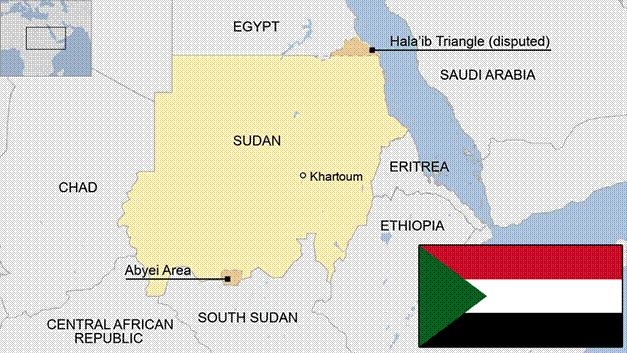
- Sudan conflict began in April 2023 between Sudanese Armed Forces (SAF) and Rapid Support Forces (RSF), making it a non-international armed conflict under international humanitarian law.
- Sexual violence in conflict is legally classified as both a “war crime” and “crime against humanity” under the Rome Statute of the International Criminal Court (ICC) — important Prelims distinction.
- UN Security Council Resolution 1325 (2000) focuses on Women, Peace and Security (WPS), mandating women’s participation in peacebuilding and protection during conflicts.
- Under Geneva Conventions (1949), protection of civilians, including women, is mandatory; violations such as rape constitute grave breaches of humanitarian law.
Key Data and Evidence
- Number of survivors needing support has quadrupled since 2023, indicating systematic escalation rather than isolated incidents of violence.
- Over 4.3 million women and girls internally displaced, increasing vulnerability to trafficking, exploitation, and sexual abuse.
- Around 17.1 million people require humanitarian assistance in 2026, reflecting near-collapse of state capacity and service delivery systems.
- Two-thirds frontline responders reported increased sexual violence in 2025, with further escalation reported in 2026, confirming sustained conflict intensity.
Dimensions
International Relations Dimension
- Sudan crisis exposes limitations of UN-led multilateral conflict resolution, especially in internal conflicts where sovereignty constraints limit external intervention.
- Demonstrates weakening of rules-based international order, where enforcement of humanitarian norms remains inconsistent and selective.
Security Dimension
- Sexual violence is used as a tactical weapon to terrorise populations, displace communities, and assert territorial control, making it part of military strategy rather than collateral damage.
- Such violence contributes to long-term instability by destroying social fabric and creating intergenerational trauma, complicating post-conflict recovery.
Social and Gender Dimension
- Women and girls face disproportionate impact, including sexual violence, forced displacement, loss of livelihoods, and exclusion from decision-making processes.
- Exclusion of women from peace negotiations violates UNSCR 1325 principles, weakening prospects of inclusive and sustainable peace agreements.
Humanitarian Dimension
- Collapse of basic services like food supply, healthcare, and shelter has created extreme vulnerability, especially for displaced women and children.
- Blockades and insecurity severely restrict humanitarian access, undermining effectiveness of global aid mechanisms.
Governance and Legal Dimension
- Widespread impunity reflects failure of international accountability mechanisms like ICC enforcement, due to political constraints and lack of cooperation from state actors.
- Weak domestic institutions further aggravate inability to investigate, prosecute, and prevent gender-based crimes.
Ethical Dimension
- Use of sexual violence as a weapon represents complete breakdown of moral norms in warfare, violating principles of dignity, autonomy, and human rights.
- Raises ethical responsibility of international community to act against systematic and targeted violence against civilians.
Role of Women-led Organisations
- Women-led organisations have reached ~20 million people, providing essential services including food aid, healthcare, and psychosocial support in conflict zones.
- 99% report operational challenges, including insecurity, funding shortages, and administrative restrictions, limiting their ability to scale interventions.
- Around 1 in 5 frontline women workers face threats, highlighting risks faced by local peacebuilders and humanitarian actors.
Challenges
- Weak enforcement of international humanitarian law, allowing perpetrators to operate with near-complete impunity.
- Continued exclusion of women from formal peace processes, undermining inclusive governance and durable conflict resolution.
- Severe funding constraints affecting gender-focused humanitarian interventions and local organisations.
- Persistent insecurity limiting aid delivery, monitoring, and civilian protection mechanisms.
- Normalisation of sexual violence as a conflict tactic, setting dangerous global precedents.
Way Forward
- Strengthen enforcement of Rome Statute provisions through ICC and international cooperation, ensuring accountability for sexual violence as war crime.
- Institutionalise women’s participation in peace processes, in line with UNSC Resolution 1325 and subsequent WPS resolutions.
- Increase funding and protection for women-led grassroots organisations, which play critical role in last-mile humanitarian delivery.
- Enhance international diplomatic engagement and ceasefire negotiations, prioritising civilian protection mechanisms.
- Develop early warning and monitoring systems for conflict-related sexual violence, integrating them into UN peacekeeping mandates.