

In-Depth News Analysis11 Items
Core TopicImportantConcise
Polity & GovernanceGS Paper II
01Written Grounds of Arrest: SC Tightens Safeguards
International RelationsGS Paper II
02India–US Trade Deal: Overcapacity, Section 301 & Sticking Points03India–China Trade: Exports Up 40%, Deficit Crosses $100 bn
EconomyGS Paper III
04RBI's Rupee Defence: Foreign Exchange Risk Reserve & Other Measures05LNG Imports: Oman Replaces US as Top Supplier06Nobel Economics 2026: Hall, Woodford & the Keynes–Kalecki Debate07Ayush Services Sector Report: Women 43% of Workforce
Science & TechnologyGS Paper III
08UN Global Initiative on AI for Agri-Food Systems
Environment & EcologyGS Paper III
09Kigali Amendment at 10: HFCs & India's Cooling Challenge10NBA Disburses ₹2.02 Crore ABS Funds from Seed Sector11Jeypore Ground Gecko & the Balda Hills Mining Proposal
Polity & GovernanceGeneral Studies Paper II
01
Grounds of Arrest Must Be in Writing: Supreme Court Adds Consequences for Non-Compliance in Jaskaran Jeet Singh Deol
GS-II · Fundamental Rights (Art. 21, 22), Criminal Justice, JudiciaryPrelims + MainsThe Hindu · Text & Context
In Jaskaran Jeet Singh Deol v. State of Punjab (September 2026), the Supreme Court held that where an arrest is declared illegal for failure to give written grounds of arrest, the police need the magistrate's permission to re-arrest — and directed a change of investigating officer and a departmental inquiry for the lapse.
◈ From the Basics — Constitutional Protections on Arrest
- Article 21: no person shall be deprived of life or personal liberty except according to procedure established by law — read since Maneka Gandhi (1978) as a procedure that is fair, just and reasonable.
- Article 22(1): an arrested person must be informed, as soon as may be, of the grounds of arrest and has the right to consult and be defended by a lawyer of choice.
- Article 22(2): the arrested person must be produced before the nearest magistrate within 24 hours (excluding journey time), and cannot be detained beyond that without the magistrate's authority.
- Article 22(3): these protections do not apply to an enemy alien or to persons held under preventive detention laws.
- Statute: Section 50 of the CrPC, now Section 47 of the Bharatiya Nagarik Suraksha Sanhita (BNSS), 2023 (in force from 1 July 2024), requires police to communicate the grounds of arrest to a person arrested without warrant — but neither the Constitution nor the BNSS specifies the mode of communication.
How the Law Evolved — From Oral to Written
- Pankaj Bansal v. Union of India (2023) — a PMLA case: a written copy of the grounds must be given without exception, because oral grounds can be disputed and the accused needs them to seek legal advice and bail.
- Prabir Purkayastha v. State (NCT of Delhi) (May 2024) — a UAPA case: communicating grounds is a vital safeguard, not a formality; a breach vitiates the arrest and remand and entitles the person to release.
- Vihaan Kumar v. State of Haryana (2025) — observed that written communication is the ideal mode, though not a statutory requirement.
- Rajesh Mihir Shah v. State of Maharashtra (2025) — settled the rule for all offences under all statutes, including the BNS: grounds must be given in writing, in a language the arrestee understands; if this is not possible at the time of arrest, they may be given orally first, but in writing at least two hours before remand proceedings. Non-compliance makes arrest and remand illegal.
- Jaskaran Jeet Singh Deol (September 2026) — adds consequences for violation (below).
Figure 1 — The arrest-safeguard sequence after Rajesh Mihir Shah and Jaskaran Jeet Singh Deol
Arrestgrounds told (oral ifwriting not feasible)Written groundsin a language thearrestee understands≥ 2 hours beforeremand proceedings(time to consult lawyer)Magistratewithin 24 hoursArt. 22(2)if not complied withArrest and remand rendered illegal → accused entitled to be releasedRe-arrestonly with magistrate's leave;grounds first, reasons stated,superior's endorsementAccountabilityinvestigation moved toanother officer; departmentalinquiry into the lapseCompensationHigh Court may award as apublic-law remedy; civilsuit remains open
The 2026 ruling moves the rule from declaration to deterrence: violations now carry procedural, disciplinary and monetary consequences.
What the 2026 Judgment Adds
- Re-arrest needs judicial leave: the investigating officer (IO) must apply to the magistrate for custody, stating reasons, explaining why grounds were not supplied, and only after furnishing the grounds; the application needs the immediate superior's endorsement.
- Change of IO and a departmental inquiry for the lapse.
- Compensation: the High Court may award compensation as a public-law remedy for violation of Article 22, without barring a civil suit — a remedy rooted in Rudul Sah v. State of Bihar (1983) and Nilabati Behera v. State of Orissa (1993).
▤ Related Landmarks to Remember
- Joginder Kumar v. State of UP (1994) — arrest must be justified, not routine; the right to have someone informed.
- D.K. Basu v. State of West Bengal (1997) — 11 requirements on arrest (identification of police, arrest memo, informing a relative, medical examination), later reflected in the CrPC.
- Arnesh Kumar v. State of Bihar (2014) — no automatic arrest for offences punishable up to seven years; police must record reasons.
- BNSS, 2023 — replaced the CrPC, 1973; the Bharatiya Nyaya Sanhita (BNS) replaced the IPC, 1860.
Significance and Concerns
- Significance: makes Article 22(1) enforceable in practice, curbs arbitrary arrests, and protects the accused's ability to oppose remand and seek bail — particularly under stringent laws such as the PMLA and UAPA.
- Uniformity: the rule now applies to ordinary penal offences as well, removing confusion between statutes.
- Concerns: police capacity (translation, documentation at the point of arrest) is uneven; investigators fear that technical lapses could lead to release in serious cases. The magistrate-leave route for re-arrest tries to balance this.
- Way forward: standard bilingual formats for written grounds, training, digital arrest memos and audit through the CCTNS network.
✎ Mains Practice Question
“Procedural safeguards at the moment of arrest are the first line of defence of personal liberty.” Discuss the evolution of the judicial requirement to communicate grounds of arrest in writing, and examine its implications for policing in India. 15 marks · 250 words
International RelationsGeneral Studies Paper II
02
The Long Road to an India–US Trade Deal: Convergence on Overcapacity, Divergence on Concessions
GS-II · Bilateral Relations, Effect of Policies of Developed Countries · GS-III · External SectorPrelims + MainsThe Indian Express · Explained
Nearly a year into talks, India and the US are still finalising the interim framework agreed in February 2026. A joint stand on industrial overcapacity may keep India out of a US Section 301 tariff net, but New Delhi doubts whether concessions would buy lasting tariff certainty.
◈ From the Basics — The US Trade Toolkit
- Section 301, Trade Act of 1974: lets the US Trade Representative (USTR) investigate and retaliate against foreign practices deemed unfair or burdensome to US commerce — used against China from 2018.
- Section 232, Trade Expansion Act of 1962: tariffs on national-security grounds (e.g. steel and aluminium).
- IEEPA (1977): emergency economic powers; used for the 2025 “reciprocal” tariffs, which, as reported, the US Supreme Court later struck down.
- WTO principle at stake: Most-Favoured-Nation (MFN) treatment, GATT Article I — country-specific tariffs sit uneasily with it; bilateral deals must meet GATT Article XXIV to qualify as free trade areas.
- Overcapacity: production capacity in excess of market demand, which depresses world prices; China is most often accused of it in EVs, batteries, steel, chemicals, semiconductors and solar panels.
Timeline of the Tariff Episode
- 2025: India faced US reciprocal tariffs, and from August 2025 a combined rate of 50% after an additional 25% penalty linked to purchases of Russian crude.
- February 2026: an interim framework offered to cut India's reciprocal tariff from 25% to 18% in return for concessions; it lost relevance once the reciprocal regime was invalidated.
- 2026: the US opened a Section 301 overcapacity probe into 16 economies, including China, the EU, Japan, South Korea, Vietnam, Mexico, Bangladesh and India.
- October 2026: after the G20 trade ministers' meeting in Milwaukee, India joined 13 other countries and blocs (including the EU, Australia, Japan) in committing to act against structural excess capacity.
Areas of Progress
- Possible exclusion from Section 301 tariffs: joining the overcapacity statement may place India outside the net, weeks before the probe's results.
- Lower proposed rate: tariffs on India were cut from a proposed 12.5% to 10% after India notified a ban on imports of goods made with forced labour.
- Unilateral moves aligning with US interests: lower tariffs on bourbon whiskey and motorcycles, tax holidays for data centres, and opening of the civil nuclear sector.
$8.3 bnExports to US, Aug 2026 (+21%)
+89%Electronics exports to US ($5.5 bn)
$5.97 bnImports from US, Aug 2026 (+65%)
16Economies in Section 301 probe
Sticking Points
- Value of concessions: whether a deal requiring significant concessions (agriculture, dairy, digital trade, procurement) will deliver a competitive tariff edge over rivals.
- Durability: the US has imposed fresh curbs even after signing agreements — as with Canada despite the USMCA (2020), which replaced NAFTA.
- Russian oil: the proposed Sanctioning Russia and Iran Act of 2026 would allow tariffs of up to 100% on buyers of Russian oil and gas. Analysts at GTRI point to unequal treatment, noting that China secured a tariff pause; they argue India should not trade energy security for temporary tariff relief.
- Exporter caution: US buyers are diversifying orders across countries, hurting low-margin footwear and textiles; exemptions for electronics and pharmaceuticals have kept India's overall exports to the US stable.
- Official view: a period of “suspended animation” with somewhat lower tariffs may be preferable to a deal with heavy concessions.
Analysis
- Strategic logic: the US is India's largest export market, and both sides set a “Mission 500” goal ($500 billion bilateral trade by 2030) in 2025; supply-chain diversification away from China favours India in electronics.
- Policy autonomy: India's stance mirrors its broader strategic autonomy — sensitive sectors (farm, dairy, data) and energy sourcing are treated as red lines.
- Multilateral erosion: unilateral tariffs and sector-specific probes weaken the WTO framework, already hampered by a non-functional Appellate Body since December 2019.
- Way forward: a phased deal with built-in tariff-stability clauses, continued diversification through FTAs (UAE, Australia, EFTA, UK), and domestic competitiveness reforms.
✎ Mains Practice Question
“In an era of unilateral tariffs, a trade agreement may offer access without certainty.” Examine the challenges in concluding the India–US trade agreement and suggest how India can balance market access with strategic autonomy. 15 marks · 250 words
03
India's Exports to China Rise 40.7%, but the Bilateral Trade Deficit Crosses $100 Billion in Nine Months
GS-II · India and its Neighbourhood · GS-III · External Sector, Trade DeficitPrelims + MainsThe Hindu
Data from China's General Administration of Customs show that India's exports to China grew fast in January–September 2026 — but from a small base. Imports grew more in absolute terms, pushing the deficit past $100 billion with a quarter of the year still to go.
▤ The Numbers (January–September 2026)
- Two-way trade: $144.45 billion, up 25.4%.
- India's imports from China: $125.19 billion, up 23.3%.
- India's exports to China: $19.26 billion, up 40.7% — already equal to last year's full-year total.
- Trade deficit: $105.93 billion, on track to exceed 2025's record of $116.12 billion.
- Ratio: India imports about $6.5 worth of goods for every $1 it exports to China.
Figure 2 — The widening gap
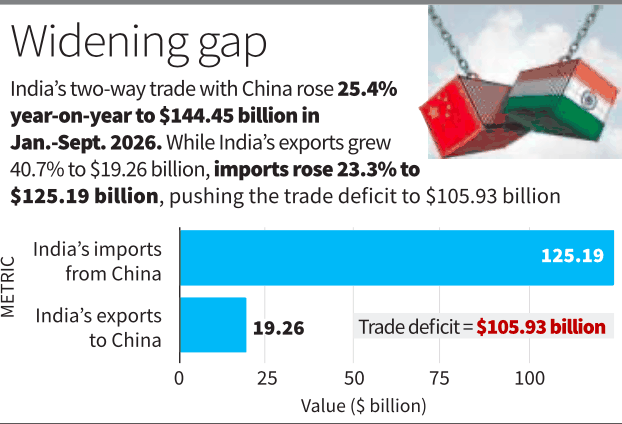
Even with 40% export growth, the absolute gap keeps widening because the import base is more than six times larger. Image courtesy The Hindu; reproduced with credit for educational use.
Why the Deficit Persists
- Composition: India imports electronics and components, machinery, organic chemicals, active pharmaceutical ingredients (APIs), solar cells and modules and batteries; it exports mainly raw materials and intermediates (ores, cotton, marine products).
- Manufacturing dependence: India's assembly-led growth (mobiles, solar, EVs) draws on Chinese components — so export growth in finished goods can raise imports from China.
- Market access: Indian officials cite non-tariff barriers in China for pharmaceuticals, agricultural products and IT services.
India's Policy Response
- PLI schemes (from 2020) and the Electronics Component Manufacturing Scheme (2025) to deepen domestic supply chains; PLI for bulk drugs/APIs.
- Press Note 3 (2020) — government approval for FDI from land-border countries (reportedly eased in 2026).
- Trade remedies: anti-dumping duties (via DGTR), Quality Control Orders and safeguard measures.
- Diplomatic context: relations have been normalising since the October 2024 border patrolling arrangement, alongside the resumption of direct flights and the Kailash Mansarovar Yatra in 2025.
Analysis
A bilateral deficit is not by itself a problem — the concern is strategic dependence in critical inputs. A shock to Chinese supply (export curbs on rare earths, APIs or electronics) can stall Indian production. The policy aim is therefore de-risking, not trade balance for its own sake.
✎ Mains Practice Question
India's trade deficit with China reflects structural dependence rather than mere market imbalance. Examine the causes of this dependence and evaluate the measures taken to reduce it. 10 marks · 150 words
EconomyGeneral Studies Paper III
04
Defending the Rupee: RBI Borrows China's Foreign Exchange Risk Reserve and Revives Old Tools
GS-III · Monetary Policy, External Sector, Exchange Rate ManagementPrelims + MainsThe Indian Express · Explained
Days after a 25-basis-point repo rate hike failed to stop the rupee's slide, the Reserve Bank of India announced measures to curb speculative and structural demand for dollars — most notably a Foreign Exchange Risk Reserve (FERR) modelled on China.
◈ From the Basics — How the Rupee's Value Is Set
- Managed float: since the Liberalised Exchange Rate Management System (1992) and full market determination from March 1993, the rupee's value is set by demand and supply, with the RBI intervening to curb excessive volatility — not to target a level.
- Why the rupee weakens: a trade/current account deficit means more foreign currency leaves than enters; FPI outflows, high crude prices and domestic hedging demand add pressure.
- Hedging: an importer buys a forward or derivative contract to lock in a future exchange rate. Normally encouraged, but in a stressed market the extra demand for dollars itself weakens the rupee.
- Legal basis: the RBI regulates the forex market under the Foreign Exchange Management Act (FEMA), 1999.
- Impossible trinity: a country cannot simultaneously have a fixed exchange rate, free capital flows and an independent monetary policy — the RBI is juggling all three.
▤ The Context in Numbers
- Repo rate raised by 25 bps to 5.5% on 7 October 2026 — the first hike in over three years; the rupee still fell.
- The rupee is down about 7% in 2026 and hit a record low of ₹96.96 per dollar in May.
- A concessional FCNR(B) swap window opened in June brought in dollars, leaving the banking system in surplus liquidity that blunts rate hikes.
- China's trade surplus hit a record $1.2 trillion in 2025.
The Measures
- Foreign Exchange Risk Reserve: banks must keep 20% (variable by the RBI) of the value of rupee-linked forex derivative contracts above $2 million as cash with the RBI — making it costlier to hedge or bet against the rupee.
- Oil marketing companies: the RBI will directly facilitate dollar purchases of Indian Oil, HPCL and BPCL, and may supply dollars from its reserves, keeping this large demand off the market.
- No rebooking of cancelled rupee derivative contracts.
- No double hedging of the same underlying exposure.
- Proof of underlying exposure required for assets above $5 million used for hedging (earlier $100 million).
Figure 3 — Pressures on the rupee and the RBI's response
Demand for dollars ↑Trade deficit (oil, electronics)Importers' hedging demandSpeculative positionsForeign investor outflowsRupeeunder pressureRBI responseRepo +25 bps → 5.5%FX Risk Reserve: 20% cash with RBIDirect dollar window for OMCsTighter hedging rules ($5 mn proof)Outcome depends on crude prices and foreign investor behaviour
Most measures work on the demand side — making dollar purchases costlier or routing them through the RBI — rather than adding supply.
The China Parallel and the 2013 Precedent
- China's use: China's FX risk reserve ratio works in both directions; in March 2026 it was cut from 20% to zero because the yuan was strengthening. India faces the opposite problem.
- 2013 taper tantrum: when the US Federal Reserve signalled an end to bond-buying, the rupee plunged; the RBI then used an FCNR(B) swap window (which raised about $34 billion), a special dollar window for oil companies and curbs on speculation — the template for today's response.
Assessment
- Benefits: buys time, curbs one-way bets and reduces volatility; local banks and traders, not foreign ones, are the main targets.
- Costs: raises hedging costs for genuine importers, may shift activity to offshore non-deliverable forward (NDF) markets, and can be read as capital-control creep by investors.
- Policy tension: surplus liquidity from the FCNR swaps undercuts the rate hike, forcing the RBI to absorb liquidity through other tools.
- Limits: analysts expect only “breathing room”; durable stability depends on crude prices, the current account and foreign investor flows.
✎ Mains Practice Question
Discuss the tools available to the Reserve Bank of India to manage exchange-rate volatility. Critically examine whether administrative curbs on currency hedging are an appropriate response to sustained pressure on the rupee. 15 marks · 250 words
05
Oman Overtakes the US as India's Top LNG Supplier as the Hormuz Disruption Reshapes Energy Sourcing
GS-III · Energy Security, Infrastructure · GS-II · West AsiaPrelims + MainsThe Indian Express
In September 2026, Oman and Nigeria led India's liquefied natural gas (LNG) imports, ahead of the US, as European buyers bid away American cargoes. Overall imports stayed above last year's levels despite the disruption of shipping through the Strait of Hormuz.
◈ From the Basics — Why the Strait of Hormuz Matters for India's Gas
- Geography: the Strait of Hormuz links the Persian Gulf to the Gulf of Oman and the Arabian Sea, between Iran and Oman's Musandam peninsula — the world's most important oil and LNG chokepoint.
- India's exposure: LNG meets about half of India's natural gas needs, and about 60% of that LNG normally transits Hormuz, mainly from Qatar and the UAE.
- Oman's advantage: its LNG terminals (at Qalhat, near Sur) lie on the Gulf of Oman, outside the strait.
- Gas in the energy mix: India aims to raise natural gas to 15% of its primary energy mix by 2030; demand comes from city gas distribution, fertilisers, power and industry (e.g. ceramics).
- Long-term contracts: Petronet LNG's 20-year deal with QatarEnergy (signed February 2024) for 7.5 million tonnes a year from 2028 shows how concentrated sourcing has been.
Figure 4 — Oman and the Strait of Hormuz
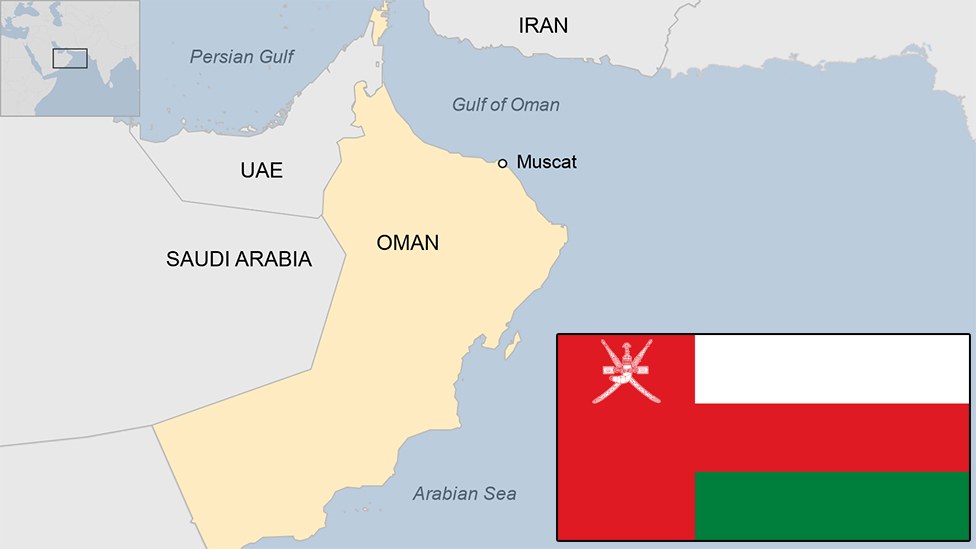
The Strait of Hormuz is the narrow passage at the northern tip (Musandam) between the Persian Gulf and the Gulf of Oman. Oman's LNG terminal at Qalhat lies on the Gulf of Oman coast south-east of Muscat — outside the strait — which is why Omani cargoes kept flowing when Qatari and Emirati supplies were disrupted. Map courtesy BBC News; reproduced with credit for educational use.
Figure 5 — India's LNG imports by source, May–September 2026 (million tonnes)
United States3.40 (28.7%)Oman2.33Nigeria2.20 (18%)UAE1.11 (9.3%)Qatar0.04 (0.3%; −90% y-o-y)Total May–Sept 2026: 11.87 million tonnes (+17.8% y-o-y) · vessel-tracking data (Kpler)
Qatar, India's top LNG source before the West Asia conflict, has almost vanished from the basket; non-Hormuz suppliers have filled the gap.
Key Developments
- September 2026: total LNG imports of 2.24 million tonnes — down 22.1% month-on-month (seasonal) but up 7% year-on-year. Oman 0.59 mt, Nigeria 0.35 mt, US 0.34 mt (down 60.7%), UAE 0.31 mt.
- Price over volume trade-off: India is buying spot cargoes at high prices while China, Japan and South Korea cut purchases and switch fuels; China also buys Russian LNG, which India avoids because of Western sanctions.
- Gulf risk appetite: the UAE has shipped cargoes despite the blockade, reportedly by switching off tanker transponders; Qatar has done so less.
- Demand drivers: weaker hydropower and stretched coal generation raised gas-fired power demand; city gas growth and LPG-to-PNG switching keep a floor under imports.
Implications for Energy Security
- Diversification works: sourcing from Oman, Nigeria and the US cushioned the shock — a case for a spread of long-term contracts across regions.
- Cost of security: spot purchases at elevated prices raise costs for fertiliser and power producers, with fiscal implications through subsidies.
- Structural options: strategic gas storage (India has strategic crude reserves but little gas storage), more regasification capacity on the east coast, domestic exploration, and compressed biogas under SATAT.
✎ Mains Practice Question
The disruption of shipping through the Strait of Hormuz has exposed the vulnerability of India's gas-based economy ambitions. Discuss the measures India should take to strengthen its natural gas security. 10 marks · 150 words
06
Nobel Prize in Economics 2026 to Robert E. Hall and Michael Woodford: Micro Foundations, Sticky Prices and the Demand Debate
GS-III · Monetary Policy, Inflation, Growth · Economic TheoryPrelims + MainsThe Hindu · Explainer (DevMac network)
The 2026 economics prize honours Robert E. Hall and Michael Woodford “for microeconomic foundations of macroeconomic stabilisation” — the framework behind New Keynesian models and modern inflation targeting. A commentary situates their work in the long debate with the Keynes–Kalecki tradition.
◈ From the Basics — Business Cycles and Two Schools
- The prize: the Sveriges Riksbank Prize in Economic Sciences in Memory of Alfred Nobel, instituted in 1968; first awarded in 1969 to Ragnar Frisch and Jan Tinbergen.
- Business cycle: short-run fluctuations (booms and recessions) around a long-run trend growth path.
- Keynes and Kalecki (writing after the Great Depression; Keynes's General Theory, 1936): effective demand, especially private investment, drives both the cycle and the long-run trend; recessions arise from insufficient investment, so fiscal policy and public investment should fill the gap.
- Real Business Cycle theory (Kydland and Prescott, Nobel 2004): markets clear; cycles come from supply shocks; little role for stabilisation policy.
- New Keynesian synthesis (Hall, Woodford and others): keeps micro foundations but adds sticky prices — because firms do not all reset prices at once, demand shocks can push output away from potential in the short run.
The Core Contrast
- Role of demand: New Keynesian — demand matters in the short run, supply sets the long run; Keynes–Kalecki — demand shapes both. As Kalecki put it, the long-run trend has no existence independent of a chain of short-run situations.
- Cause of unemployment: New Keynesian — price rigidity; Keynes–Kalecki — rigidity of investment (“animal spirits”); falling prices may even worsen demand through debt defaults.
- Money: New Keynesian — money is non-neutral only in the short run, so monetary policy's main job is stabilising inflation (inflation targeting); Keynes–Kalecki — fiscal policy leads, monetary policy plays “second fiddle”.
- Distribution: the writers link the shift to inflation targeting with a falling wage share since the 1980s, arguing that frameworks are never class-neutral — a contested, heterodox view.
▤ India Connection
- Flexible inflation targeting was adopted through the RBI Act amendment of 2016: a six-member Monetary Policy Committee targets CPI inflation of 4% ± 2% — a direct application of New Keynesian thinking.
- India's own debates mirror the paper's divide: the role of public capital expenditure in crowding in private investment versus the primacy of price stability.
- Woodford's “Interest and Prices” (2003) provided the theoretical basis for interest-rate rules and forward guidance used by central banks.
✎ Mains Practice Question
Distinguish between demand-led and supply-led explanations of business cycles. In this light, evaluate the relative roles of monetary and fiscal policy in India's macroeconomic stabilisation. 15 marks · 250 words
07
Ayush Services Sector Valued at $36.92 Billion; Women Form 43% of Its Workforce
GS-III · Services Sector, Employment · GS-II · Health · GS-I · Women's ParticipationPrelims + MainsPIB · Ministry of Ayush · 8 Oct 2026
The Ayush Service Sector Report, prepared by RIS and released on Ayurveda Day 2026, offers the first detailed estimate of the traditional-medicine services economy: its size, structure, and an unusually high share of women workers.
◈ From the Basics — What Is Ayush?
- AYUSH = Ayurveda, Yoga & Naturopathy, Unani, Siddha, Sowa-Rigpa and Homoeopathy. Sowa-Rigpa (the Himalayan/Tibetan system) was formally recognised in 2010.
- Ministry of Ayush: formed on 9 November 2014, upgraded from the Department of AYUSH (originally the Department of Indian Systems of Medicine and Homoeopathy, 1995).
- Regulators: the National Commission for Indian System of Medicine and the National Commission for Homoeopathy, both set up under Acts of 2020.
- Global anchor: the WHO Global Centre for Traditional Medicine at Jamnagar, Gujarat (foundation stone 2022).
- RIS: the Research and Information System for Developing Countries, a New Delhi policy think tank under the Ministry of External Affairs.
▤ Key Findings
- Size: US$36.92 billion in FY 2024–25, a 16.91% CAGR since FY 2022–23; supports 1.76 million livelihoods, over 1 million of them in local and standalone clinics.
- Segments: standalone clinics $16.21 billion (43.9%); day-care centres $10.13 billion — together over 70% of revenue.
- Systems: Ayurveda is the largest at $17.73 billion (~48%).
- Growth hotspots: wellness at 21.29% CAGR; Yoga centres' revenue up about 75% over two years.
- Medical Value Travel: $1.77 billion; foreign patients are about 5% of patient volumes but 15–25% of hospital revenue, with stays of 5–11 days.
- Projection: $216–318 billion by 2047 (estimate in the report).
Figure 6 — Share of women in the Ayush services workforce (%)
50% mark60+58575343Spas & wellnessresortsEducationalinstitutesDay-carecentresHospitalsOverallsectorSource: Ayush Service Sector Report (RIS), as released by the Ministry of Ayush
Women are a majority in every organised segment; the lower overall share reflects the large, less-organised clinic segment.
Significance and Concerns
- Women's employment: India's female labour force participation remains low; care, wellness and education-linked services offer formal, skilled jobs close to home.
- Services exports: wellness tourism and Medical Value Travel (supported by the Ayush visa introduced in 2023) add to services exports.
- Concerns: the evidence base for some therapies remains thin; quality standards, accreditation (e.g. NABH for Ayush hospitals) and regulation of misleading claims are essential. Most livelihoods are in unorganised clinics with limited social security.
✎ Mains Practice Question
The Ayush services sector combines growth potential with high women's participation. Discuss its role in India's services economy and the reforms needed to ensure quality and evidence-based practice. 10 marks · 150 words
Science & TechnologyGeneral Studies Paper III
08
India Hosts Second Meeting of the UN Global Initiative on AI for Agri-Food Systems (GI-AI4FS)
GS-III · AI & Emerging Tech, E-technology for FarmersPrelims-orientedPIB · Ministry of Communications (DoT) · 10 Oct 2026
The Telecommunication Engineering Centre (TEC) of the Department of Telecommunications, with ICAR, hosted the second meeting of GI-AI4FS alongside India Mobile Congress 2026 in New Delhi, preceded by an international hackathon (8–9 October 2026) at the ICAR campus.
◈ Basics & Key Facts
- GI-AI4FS: a UN initiative coordinated by the International Telecommunication Union (ITU) with FAO, IFAD and WFP — the three Rome-based food agencies.
- ITU: founded 1865, headquartered in Geneva; the oldest UN specialised agency, which sets ICT standards and runs the AI for Good platform.
- TEC: DoT's technical body for telecom standards and testing; ICAR (est. 1929) works under the Department of Agricultural Research and Education.
- Meeting agenda: about 70 in-person and 25 online participants; governance structure, Working Group chairs and terms of reference, and priority work streams.
- Uses of AI and IoT in farming: sensors, weather stations, drones and satellite data for precision agriculture, early crop-disease detection, traceability and lower post-harvest losses.
- Domestic link: the Digital Agriculture Mission (approved 2024) builds AgriStack (farmer registry, crop sown survey) and the Krishi Decision Support System.
✎ Mains Practice Question
How can artificial intelligence and the Internet of Things make Indian agriculture more resilient? Discuss the need for interoperable, farmer-centric standards in deploying these technologies. 10 marks · 150 words
Environment & EcologyGeneral Studies Paper III
09
Kigali Amendment Turns 10: Phasing Down HFCs as India's Cooling Demand Booms
GS-III · Environmental Conventions, Climate Change, Energy EfficiencyPrelims + MainsThe Indian Express · Experts Explain (IGSD)
Adopted on 15 October 2016, the Kigali Amendment to the Montreal Protocol committed the world to phasing down hydrofluorocarbons (HFCs). A decade on, rising heat and air-conditioner demand — nowhere more than in India — make its next phase as important as its first.
◈ From the Basics — From Ozone to Climate
- Vienna Convention (1985) — framework for protecting the ozone layer; Montreal Protocol (1987) — binding phase-out of CFCs, halons and other ozone-depleting substances (ODS). It is the first UN treaty to achieve universal ratification; about 99% of controlled ODS have been eliminated.
- International Day for the Preservation of the Ozone Layer: 16 September (the Protocol's signing date).
- The HFC problem: HFCs replaced CFCs because they do not harm the ozone layer — but many are potent greenhouse gases, with hundreds to thousands of times the warming effect of CO₂ per kilogram over a century.
- Kigali Amendment: proposed by Micronesia and Mauritius (2009); adopted at Kigali, Rwanda on 15 October 2016; in force 1 January 2019; 175 parties by early October 2026.
- Climate payoff: full implementation could avoid 0.3–0.5°C of warming by 2100.
- Multilateral Fund: established 1990, operational since 1991 — developed countries finance developing countries' agreed incremental costs (factory conversion, technician training).
India's Obligations
- Ratified in 2021; India belongs to the later group of developing countries with a 2024–26 baseline.
- Freeze: HFC production and consumption capped at the baseline in 2028.
- Cuts: 10% below baseline in 2032, 20% in 2037, 30% in 2042 and 85% in 2047 — calculated in CO₂-equivalent terms.
- India Cooling Action Plan (2019) — among the first national cooling plans; aims to cut cooling demand by 20–25%, refrigerant demand by 25–30% and cooling energy requirements by 25–40% by 2037–38.
Figure 7 — India's HFC phase-down schedule (% of baseline allowed)
050100Baseline2024–26Freeze 2028−10% (2032)−20% (2037)−30%(2042)−85%20282032203720422047Limits in CO₂-equivalent tonnes; horizontal axis not to scale
The steepest step comes in 2047; equipment bought before the first cuts may stay in use well into the 2030s.
Why Cooling Is the Next Frontier
- Two routes to warming: refrigerant leakage (direct) and electricity use by cooling equipment (indirect, where power is fossil-based).
- Double dividend: UNEP and the IEA estimate that pairing the HFC transition with better energy efficiency could roughly double the climate benefit — manufacturers redesigning for new refrigerants can improve efficiency at the same time.
- India's scale: cooling already accounts for slightly over a tenth of annual electricity demand, and up to a third of power use on hot summer nights; under current policies, cooling demand is projected to more than double by 2035.
▤ Short-Lived Climate Pollutants (SLCPs)
- The four main SLCPs: methane, black carbon, HFCs and tropospheric ozone — “super pollutants” with strong warming effects but short atmospheric lifetimes, so cutting them slows warming quickly.
- Sector-specific design: Kigali handles HFCs; methane from livestock must account for small farmers' incomes, and black carbon requires action on diesel engines and household cooking fuels (where schemes such as PM Ujjwala Yojana are relevant).
- India has not joined the Global Methane Pledge (2021), citing agriculture and livelihood concerns.
Way Forward for India
- Tighten BEE star-labelling standards for air conditioners and refrigerators in step with the refrigerant transition.
- Promote low-GWP natural refrigerants and passive cooling through building codes (ECBC) and heat action plans.
- Train and certify servicing technicians to curb leakage, and use Multilateral Fund support for MSME conversion.
✎ Mains Practice Question
The Montreal Protocol has evolved from an ozone treaty into an effective climate instrument. Discuss with reference to the Kigali Amendment, and examine the challenges India faces in meeting its HFC phase-down commitments amid rising cooling demand. 15 marks · 250 words
10
Access and Benefit-Sharing: NBA Distributes ₹2.02 Crore from Seed Companies to 27 States and 3 UTs
GS-III · Biodiversity Conservation, Environmental ConventionsPrelims + MainsPIB · Ministry of Environment, Forest & Climate Change · 10 Oct 2026
The National Biodiversity Authority (NBA) has shared ₹2.02 crore received from seed companies for using agricultural biological resources — rice, eggplant, tomato, okra, gourds and others — among 27 State Biodiversity Boards and 3 UT Biodiversity Councils, taking cumulative ABS disbursement to ₹202 crore.
◈ From the Basics — What Is Access and Benefit-Sharing?
ABS means that those who use biological resources or associated traditional knowledge — for research, products or commercial breeding — must obtain prior approval and share a part of the benefits with the communities and countries that conserved them.
- Convention on Biological Diversity (CBD) — adopted at the Rio Earth Summit (1992), in force 1993; its three objectives are conservation, sustainable use and fair and equitable benefit-sharing.
- Nagoya Protocol on ABS — adopted 2010, in force 12 October 2014; India is a party.
- Biological Diversity Act, 2002 (amended in 2023) — three-tier structure: NBA (Chennai, est. 2003), State Biodiversity Boards, and Biodiversity Management Committees (BMCs) at local-body level, which maintain People's Biodiversity Registers (PBRs).
- Kunming–Montreal Global Biodiversity Framework (2022) — Target 13 (benefit-sharing from genetic resources and traditional knowledge) and Target 19 (resource mobilisation). India's updated NBSAP 2024–2030 aligns with it.
Figure 8 — How ABS money flows
Usersseed companies usingcrop genetic resourcespay ABS contributionNBAapportions share bycultivation area whenclaimants unidentifiedSBBs / UTBCs27 States + 3 UTstop 10 States:₹1.43 croreCommunitiesBMCs, PBRs,traditional varieties,habitat restorationCumulative ABS disbursed by the NBA: ₹202 crore
Where individual benefit-claimers cannot be traced (resources bought through markets), the State's share is set by crop area under cultivation.
Significance and Gaps
- Operationalises equity: farmers and communities who conserved crop diversity share in commercial seed breeding — a principle also in the Protection of Plant Varieties and Farmers' Rights Act, 2001.
- Convergence: ABS funds can complement PM-JANMAN, PM Van Dhan Yojana and tribal livelihood programmes.
- Gaps: the amounts are small relative to the value of genetic resources; many BMCs are inactive and PBRs outdated; the 2023 amendment's exemptions for AYUSH practitioners and cultivated medicinal plants were criticised for narrowing the ABS net.
- Global debate: benefit-sharing from Digital Sequence Information (DSI) — the Cali Fund set up at CBD COP16 (2024) — will be reviewed at COP17 in Yerevan, Armenia, from 19 October 2026.
✎ Mains Practice Question
“Access and benefit-sharing is the bridge between biodiversity conservation and community welfare.” Examine India's ABS framework under the Biological Diversity Act, 2002, and the challenges in its implementation. 10 marks · 150 words
11
Bauxite Mining Proposal in Odisha's Balda Hills Threatens the Rare Jeypore Ground Gecko
GS-III · Biodiversity, Conservation vs Mining · GS-II · Tribal Rights (FRA)Prelims + MainsThe Hindu
The Jeypore ground gecko, presumed extinct for 130 years until its rediscovery in 2010, has been recorded in the Balda hills of Odisha — inside the site of a proposed 147-hectare opencast bauxite mine in the Nagnaswari reserve forest, which local Adivasis have opposed for two years.
▤ Species Profile — Prelims Pointers
- Name: Jeypore ground gecko (Cyrtodactylus/Geckoella jeyporensis); IUCN: Endangered.
- Range: endemic to high-elevation forests (900–1,400 m) of the Eastern Ghats in Odisha and Andhra Pradesh.
- Appearance: nocturnal, about 3.6 inches long, relatively large head, yellow-orange patterned body.
- History: described in 1878 by Richard Henry Beddome from Potangi; rediscovered in 2010 in Koraput district. Sightings: one in 2025, three in 2026.
- Evolutionary value: split from its closest relatives over 20 million years ago.
- Threats: its type locality at Potangi has been lost to NALCO's bauxite mining, where it is believed locally extinct; coffee plantations and mining threaten remaining habitat.
Figure 9 — The Jeypore ground gecko
A nocturnal, ground-dwelling gecko of the Eastern Ghats' boulder-strewn hill forests, distinguished by its yellow-orange body with dark blotches and a comparatively large head. Representative image.
◈ From the Basics — Mining, Forests and Tribal Rights
- Bauxite: the ore of aluminium; Odisha holds India's largest reserves, concentrated in the Eastern Ghats' laterite-capped hills (Koraput, Rayagada, Kalahandi).
- Communities: the Bondo (a Particularly Vulnerable Tribal Group) and Paraja (Porja) Adivasis regard the hill as ancestral land; their forest-rights claims have not been recognised.
- Forest Rights Act, 2006: recognises individual and community forest rights; the Gram Sabha is the authority to initiate the process.
- Niyamgiri precedent — Orissa Mining Corporation v. MoEF (2013): the Supreme Court left it to the Dongria Kondh gram sabhas to decide whether bauxite mining affected their rights; all 12 rejected the project.
- Forest clearance: diversion of forest land needs approval under the Van (Sanrakshan Evam Samvardhan) Adhiniyam, 1980 (the Forest Conservation Act as renamed and amended in 2023), with FRA compliance.
Analysis
- Small range, high risk: range-restricted endemics have no fallback habitat; loss of one hill can mean local extinction, as Potangi shows.
- Knowledge gap: the gecko's behaviour and life cycle are poorly known — a reason for caution under the precautionary principle.
- Process concerns: Environmental Impact Assessments often miss small, cryptic species; independent biodiversity surveys should precede approvals in endemic hotspots.
- Balancing development: aluminium is a critical industrial metal, but siting decisions must weigh endemic biodiversity, PVTG rights and free, prior and informed consent.
✎ Mains Practice Question
Mineral-rich regions of the Eastern Ghats are also home to endemic species and vulnerable tribal communities. Discuss how India's legal framework seeks to reconcile mining with conservation and tribal rights, and suggest improvements. 15 marks · 250 words