
Published on Apr 16, 2026
Daily Current Affairs
Current Affairs 16 April 2026

Content
- WPI Inflation Hits 3-Year High
- Ease of Doing R&D in India – NITI Aayog Reports Explained
- Amaravati Quantum Computing Facility
- Borrowers’ Platform by Developing Countries
- Boat Capsize in Andaman Sea
- China Blocking Scarborough Shoal
WPI Inflation Hits 3-Year High
Why in News?
- 15 April 2026: India’s Wholesale Price Index (WPI) inflation rose to 3.88% in March 2026, the highest in 38 months, driven by sharp crude oil price surge amid West Asia conflict.
Issue in Brief
- WPI inflation surged sharply due to fuel, energy, and petrochemical price increases, reflecting strong global commodity price transmission into domestic wholesale markets.
- Indicates cost-push inflation building within production systems, even as retail inflation remains relatively moderate due to policy interventions.
Relevance
- GS Paper III (Economy)
- Inflation, monetary policy, external sector vulnerability, energy economics
- GS Paper III (International Relations – Economic)
- Impact of geopolitical conflicts on global commodity markets
- GS Paper II (Governance)
- Fiscal policy, subsidy management, inflation control measures
Practice Question
- “Rising WPI inflation reflects structural vulnerabilities in India’s energy-dependent economy. Analyse its causes, implications, and policy responses.” (250 words)
Static Background
- WPI measures price changes at the wholesale/producer level, with base year 2011–12, and acts as a leading indicator of inflation trends in the economy.
- CPI measures retail inflation faced by consumers and is used by RBI for inflation targeting (4% ±2%), unlike WPI which captures supply-side pressures.
- Cost-push inflation occurs when rising input costs (fuel, raw materials) increase production costs, which are eventually passed on to consumers in the form of higher prices.
Key Data & Evidence
- WPI inflation increased to 3.88% in March 2026 from 2.13% in February, marking the highest level since mid-2022 amid global energy disruptions.
- Crude petroleum prices surged by 49.1% month-on-month, reflecting the sharpest increase and the primary driver of overall wholesale inflation rise.
- Ammonia gas prices rose by 22.3% and PVC by 8.4%, indicating strong inflationary pressures in fertiliser and petrochemical sectors.
- Fuel products such as LPG, petrol, diesel, and ATF recorded 4–8% price increases, contributing significantly to energy-led inflationary pressures.
- Plastic products saw a 4.1% increase in wholesale prices, highlighting transmission of petrochemical cost increases into everyday consumer goods.
Overview
- Global geopolitical tensions in West Asia disrupted crude oil supply chains, leading to a sharp spike in international oil prices, directly impacting India’s import-dependent energy economy.
- India’s heavy dependence on crude imports (around 85%) amplifies vulnerability, making domestic inflation highly sensitive to global commodity price fluctuations.
- Price increases in petrochemicals have cascading effects across sectors, including plastics, packaging, fertilisers, and manufacturing inputs, thereby broadening inflationary impact.
- WPI inflation rising faster than CPI indicates suppressed retail inflation, partly due to government interventions like fuel tax adjustments and administered pricing mechanisms.
- Sustained increase in wholesale prices is likely to transmit into retail inflation, especially if firms pass higher input costs to consumers over time.
- Industrial sector faces margin pressures due to rising input costs, particularly affecting MSMEs with limited capacity to absorb cost shocks.
- Higher crude prices may widen India’s Current Account Deficit, increase import bills, and exert downward pressure on the rupee, worsening imported inflation.
Challenges / Concerns
- India’s structural dependence on imported crude oil exposes it to recurring external shocks, making inflation management difficult during geopolitical crises.
- Persistent wholesale inflation may eventually pass through to consumers, increasing retail inflation and reducing purchasing power, especially for lower-income households.
- Rising input costs can slow industrial growth by reducing profitability, discouraging investments and affecting employment generation in manufacturing sectors.
- Policy dilemma for RBI arises between controlling inflation and supporting growth, as aggressive rate hikes may dampen economic recovery.
- Fiscal pressures may increase if government reduces fuel taxes or increases subsidies, impacting fiscal consolidation targets and budgetary stability.
- Agriculture sector may face rising input costs due to higher fertiliser and fuel prices, potentially leading to future food inflation and rural distress.
Way Forward
- Reduce dependence on imported crude oil by accelerating renewable energy adoption, including solar, wind, and green hydrogen under India’s energy transition strategy.
- Expand and effectively utilise Strategic Petroleum Reserves to cushion short-term supply shocks, ensuring energy security during global disruptions.
- Adopt calibrated monetary policy approach balancing inflation control and growth, avoiding excessive tightening that could harm investment and consumption.
- Implement targeted fiscal measures such as temporary fuel tax rationalisation, rather than broad subsidies, to manage inflation without excessive fiscal burden.
- Strengthen domestic petrochemical and fertiliser production capacity, reducing reliance on imports and enhancing supply chain resilience.
- Provide targeted support to MSMEs through credit and input subsidies, helping them absorb cost shocks and sustain industrial output.
Prelims Pointers
- WPI base year is 2011–12, and it measures inflation at the wholesale or producer level, not retail level.
- CPI, not WPI, is used by RBI for inflation targeting under monetary policy framework in India.
- Fuel and power have around 13% weight in WPI, but exert disproportionate influence due to linkages with other sectors.
- Cost-push inflation is caused by rising input costs such as crude oil, unlike demand-pull inflation driven by excess demand.
- India imports approximately 85% of its crude oil requirement, making it vulnerable to global price shocks.
Ease of Doing R&D in India – NITI Aayog Reports Explained
Why in News?
- Recently NITI Aayog released reports on “Ease of Doing Research & Development in India” and survey report based on 850+ researchers and 400+ institutions.
Issue in Brief
- Reports propose ROPE framework (Remove Obstacles, Promote Enablers) to reform India’s R&D ecosystem and improve efficiency, funding, and innovation output.
- Emphasis on lab-to-market translation, private sector participation, and trust-based governance to transform India into a global innovation hub.
Relevance
- GS Paper III (Science & Technology)
- Innovation ecosystem, R&D, technology development
- GS Paper III (Economy)
- Knowledge economy, industrial competitiveness, productivity
- GS Paper II (Governance)
- Institutional reforms, regulatory framework, ease of doing research
Practice Question
- “India’s R&D ecosystem faces structural bottlenecks despite improving innovation indicators. Examine the challenges and suggest reforms in light of recent policy initiatives.” (250 words)
Static Background
- R&D (Research & Development): Systematic activity aimed at knowledge creation, innovation, and technological advancement, critical for economic growth and competitiveness.
- GERD (Gross Expenditure on R&D): Key indicator of innovation capacity, expressed as percentage of GDP spent on research activities.
- Global Innovation Index (GII): Published by WIPO, ranks countries based on innovation inputs and outputs.
Key Data & Evidence
- India’s GERD remains low at ~0.64–0.7% of GDP, significantly below USA (~3.5%), China (~2.4%), South Korea (~4.8%).
- Global Innovation Index 2025: India ranked 38th, improving from 48th in 2020; top among lower-middle-income economies.
- Patent landscape: India ranks 6th globally in patent applications, with patent-to-GDP ratio rising from 144 (2013) to 381 (2023).
- Human capital gap: Only ~260 researchers per million population, compared to 4000+ in developed economies.
Overview
- ROPE Framework Significance:
- Focuses on removing bureaucratic bottlenecks and regulatory rigidities while promoting enablers like funding access, collaboration, and institutional autonomy.
- Lab-to-Market Gap:
- India produces high volume of research publications, but struggles to convert them into commercial technologies, patents, and scalable products.
- Funding Structure Imbalance:
- Unlike global ecosystems where private sector contributes ~70% of R&D funding, India relies heavily on public sector (>60%), limiting innovation dynamism.
- Institutional Rigidities:
- Procurement delays, fragmented funding, and compliance-heavy systems reduce research efficiency and discourage experimentation.
- Innovation Ecosystem Progress:
- Rise in patents, startups, and innovation ranking indicates improvement, supported by initiatives like ANRF, Atal Innovation Mission, Startup India.
- Human Capital Challenge:
- Despite strong STEM output, brain drain and lack of merit-based incentives limit retention of high-quality researchers.
Challenges / Concerns
- Low R&D Investment Trap
- Persistent sub-1% GERD restricts scale and quality of innovation, limiting India’s ability to compete with global technology leaders.
- Weak Private Sector Participation
- Industry prefers importing mature technologies rather than investing in domestic R&D, weakening indigenous innovation ecosystems.
- Fragmented Funding Architecture
- Absence of performance-linked funding and unified mechanisms leads to inefficiency, duplication, and suboptimal resource allocation.
- Bureaucratic Overregulation
- Rigid procurement rules (e.g., L1 tender system) delay acquisition of critical equipment, slowing research timelines significantly.
- Lab-to-Market Disconnect
- Lack of Technology Transfer Offices (TTOs) and weak industry linkages result in poor commercialization of research outputs.
- Siloed Institutional Structures
- Weak University–Industry–Government collaboration and rigid departmental divisions hinder interdisciplinary innovation.
- Human Resource Constraints
- Low researcher density, lack of merit-based career progression, and inadequate early-stage support drive talent migration abroad.
- Quality vs Quantity Gap
- High publication volume but low citation impact (CNCI) and limited presence in high-impact global journals reflect quality concerns.
Way Forward
- Increase R&D Investment
- Target GERD of 1.5–2% of GDP through enhanced public funding and incentives for private sector participation.
- Mobilise Private & CSR Funding
- Provide tax incentives, matching grants, and CSR channels to support startups, deep-tech research, and university innovation ecosystems.
- Reform Governance & Procurement
- Replace rigid L1 procurement rules with quality-based systems, and grant researchers financial and operational autonomy.
- Strengthen Lab-to-Market Linkages
- Establish Technology Transfer Offices (TTOs) and institutionalise industry-academia collaboration frameworks.
- Mission-Mode R&D Focus
- Prioritise strategic sectors like AI, Quantum Computing, Semiconductors, Green Hydrogen through time-bound national missions.
- Human Capital Development
- Introduce merit-based career progression, competitive funding, and global collaboration opportunities to retain talent.
- Break Institutional Silos
- Promote interdisciplinary research funding and flexible institutional structures to enable cross-domain innovation.
- Strengthen ANRF Implementation
- Ensure effective rollout of Anusandhan National Research Foundation to democratise research funding beyond elite institutions.
Prelims Pointers
- GERD: Measures total R&D expenditure as % of GDP.
- GII: Published by World Intellectual Property Organization (WIPO).
- India ranks 6th globally in patent applications.
- ROPE Framework: Removing Obstacles, Promoting Enablers.
- ANRF: Apex body to fund and promote research across institutions.
Amaravati Quantum Computing Facility
Why in News?
- 14April 2026: India’s first indigenous quantum computing testing facility (AQRF) launched at Amaravati under National Quantum Mission, positioning it as a global quantum hub.
Issue in Brief
- Establishment of Amaravati Quantum Reference Facility (AQRF) provides sovereign, open-access quantum infrastructure for research, testing, and innovation.
- Part of Amaravati Quantum Valley initiative, aiming to build a global-scale quantum ecosystem with industry-academia partnerships.
Relevance
- GS Paper III (Science & Technology)
- Emerging technologies, quantum computing, cybersecurity
- GS Paper III (Internal Security)
- Quantum threat to encryption, strategic technologies
Practice Question
- “Quantum computing represents a transformative frontier technology. Analyse India’s preparedness and challenges in building a competitive quantum ecosystem.” (250 words)
Static Background
- Quantum Computing: Uses qubits (superposition + entanglement) to perform computations exponentially faster than classical systems for specific problems.
- National Quantum Mission (2023–31): Aims to develop quantum computing, communication, sensing, and cryptography capabilities in India.
- Qubit: Basic unit of quantum information, unlike classical bit (0/1), can exist in multiple states simultaneously.
Key Data & Evidence
- Amaravati facility includes indigenous “Amaravati 1Q system” and open-access 1S system for research visibility.
- Planned deployment of IBM 133-qubit quantum computer, indicating global collaboration.
- 80+ industry and academic partnerships established under Quantum Valley initiative.
- India aims to position Amaravati among top 5 global quantum hubs.
Overview
- Strategic Technological Leap:
- Establishes sovereign quantum infrastructure, reducing dependence on foreign quantum cloud services and enhancing technological autonomy.
- Ecosystem Approach:
- Combines hardware (AQRF), cloud access, skilling, and innovation, creating a full-stack quantum ecosystem rather than isolated research initiatives.
- Global Competitiveness:
- Entry into quantum race alongside US, China, EU, critical for future dominance in AI, cybersecurity, and advanced computing.
- Industry-Academia Synergy:
- 80+ partnerships indicate strong collaboration, addressing India’s traditional weakness in lab-to-market translation of research.
- Open Access Model:
- Availability of 1S system for researchers promotes democratisation of quantum research and talent development.
Challenges / Concerns
- Technological Complexity & Early Stage Nature
- Quantum computing remains nascent with high error rates and decoherence issues, limiting immediate large-scale commercial applications.
- High Capital & Infrastructure Costs
- Quantum systems require extreme cooling (near absolute zero) and specialised infrastructure, making scaling expensive and resource-intensive.
- Talent Deficit
- Shortage of quantum scientists, engineers, and interdisciplinary experts may constrain utilisation and innovation potential.
- Global Competition & Technology Gap
- Advanced economies have significant lead in quantum hardware and algorithms, posing challenges for India to catch up rapidly.
- Limited Industrial Adoption
- Private sector participation remains limited due to uncertain commercial viability and long gestation period.
- Cybersecurity Risks
- Quantum computing could break existing encryption systems, necessitating urgent development of quantum-safe cryptography frameworks.
- Fragmented Ecosystem Risk
- Without coordination, multiple initiatives may lead to duplication of efforts and inefficient resource utilisation.
Way Forward
- Strengthen Indigenous Capability
- Invest in domestic quantum hardware manufacturing, cryogenic systems, and control electronics to reduce import dependence.
- Human Capital Development
- Establish specialised quantum education programs, fellowships, and global collaborations to build skilled workforce.
- Mission-Mode Research Focus
- Prioritise applications in drug discovery, materials science, climate modelling, and logistics optimisation.
- Public-Private Partnerships
- Encourage industry participation through incentives, co-funding, and startup ecosystem support in quantum technologies.
- Cybersecurity Preparedness
- Develop post-quantum cryptography standards and integrate into national cybersecurity architecture.
- Global Collaboration Strategy
- Engage with trusted international partners while safeguarding strategic autonomy in critical technologies.
- Integrated Ecosystem Governance
- Align National Quantum Mission, academia, industry, and startups under a coordinated national framework.
Prelims Pointers
- Qubit: Can exist in superposition, unlike classical bit.
- National Quantum Mission: Covers quantum computing, communication, sensing, cryptography.
- Quantum advantage: Ability to solve problems faster than classical computers in specific domains.
- Decoherence: Loss of quantum state due to environmental interaction.
- Post-quantum cryptography: Encryption resistant to quantum attacks.
Borrowers’ Platform by Developing Countries
Why in News?
- IMF–World Bank Spring Meetings 2026: Developing countries launched the first-ever Borrowers’ Platform, with UNCTAD as secretariat, to strengthen collective voice on sovereign debt.
Issue in Brief
- Platform aims to coordinate borrowing countries, enhance debt management capacity, and address structural imbalances in global financial architecture dominated by creditors.
- Responds to rising debt distress, high servicing burdens, and unequal borrowing conditions faced by developing economies.
Relevance
- GS Paper II (International Relations)
- Global economic governance, IMF–World Bank reforms, South-South cooperation
- GS Paper III (Economy)
- Sovereign debt, fiscal sustainability, global financial architecture
Practice Question
- “The proposed Borrowers’ Platform reflects structural inequities in the global financial architecture. Critically examine its significance and limitations.” (250 words)
Static Background
- Sovereign Debt: Borrowing by governments from domestic or external sources to finance deficits and development.
- Paris Club: Informal group of creditor nations coordinating debt relief for distressed countries.
- Debt Sustainability: Ability of a country to service debt without compromising growth or fiscal stability.
Key Data & Evidence
- External debt (developing countries): $11.7 trillion (2024); global public debt: $102 trillion.
- Developing countries’ debt: ~$31 trillion, growing twice as fast as developed economies since 2010.
- Debt servicing burden: ~10% of revenues, while LDCs spend ~25%.
- 54 countries (3.4 billion people) spend more on debt servicing than health or education.
- Borrowing costs: Developing nations pay 2–4 times higher interest than US.
- Negative net resource transfer (2023): Paid $25 billion more than received.
Overview
- Structural Imbalance in Global Finance:
- Existing mechanisms like Paris Club are creditor-driven, limiting negotiating power and coordination among borrowing countries.
- Need for Collective Voice:
- Platform enables peer learning, coordination, and unified representation, addressing fragmentation among developing economies.
- Debt Distress & Development Trade-off:
- High servicing burdens crowd out spending on health, education, and climate action, undermining long-term development goals.
- Shift Toward Inclusive Architecture:
- Marks transition from creditor-centric governance to more balanced participation of borrowers in global financial decision-making.
- Technical Cooperation Focus:
- Platform is non-confrontational, focusing on capacity building, transparency, and best practices, rather than direct debt restructuring negotiations.
- Market Signalling Effect:
- Improved coordination and transparency may reduce risk perception, potentially lowering borrowing costs over time.
Challenges / Concerns
- Limited Mandate & Authority
- Platform is not a negotiation or restructuring forum, limiting its ability to directly influence debt relief outcomes.
- Coordination Complexity
- Diverse interests of developing countries (income levels, debt profiles) may hinder consensus-building and unified positions.
- Creditor Resistance
- Existing institutions dominated by advanced economies may resist reforms that dilute creditor influence.
- Implementation & Continuity Risks
- Sustaining momentum requires institutionalisation, governance mechanisms, and long-term commitment.
- Data Transparency Gaps
- Many countries lack robust debt data systems, limiting effectiveness of coordination and policy formulation.
- Geopolitical Fragmentation
- Competing global blocs may influence participation and alignment within the platform.
- Moral Hazard Concerns
- Collective platforms may create perception of leniency or coordinated pressure on creditors, affecting credit discipline.
Way Forward
- Strengthen Institutional Framework
- Develop clear governance structures, regular engagement mechanisms, and accountability systems for sustained functioning.
- Enhance Technical Capacity
- Expand UNCTAD’s DMFAS programme to improve debt transparency, analytics, and management capabilities.
- Integrate with Global Institutions
- Ensure formal linkages with IMF, World Bank, and G20 frameworks for greater policy influence.
- Promote Fair Borrowing Conditions
- Advocate for equitable interest rates, restructuring norms, and responsible lending practices globally.
- Data & Transparency Reforms
- Standardise debt reporting and disclosure mechanisms across developing countries.
- South-South Cooperation
- Strengthen knowledge sharing and best practices among developing economies.
- Link with SDGs & Climate Finance
- Align debt strategies with SDG financing and climate resilience goals, ensuring sustainable development.
Prelims Pointers
- UNCTAD: UN body focusing on trade, development, and finance issues.
- Paris Club: Group of creditor nations, not borrowers.
- Debt sustainability: Ability to service debt without fiscal stress.
- DMFAS: UNCTAD programme for debt management capacity building.
- Negative net resource transfer: Country pays more to creditors than it receives.
Boat Capsize in Andaman Sea
Why in News?
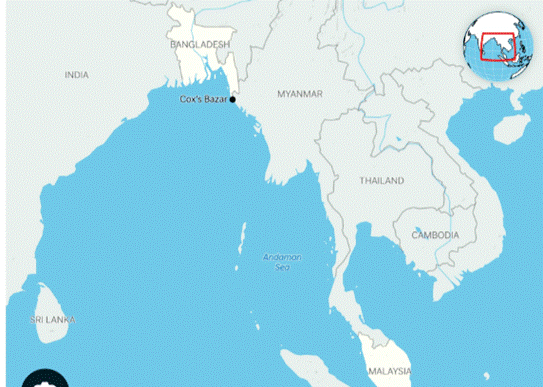
- 15 April 2026: Around 250 people reported missing, including Rohingya refugees and Bangladeshi nationals, after a boat capsized in the Andaman Sea en route to Malaysia.
Issue in Brief
- Incident highlights irregular maritime migration and human trafficking risks in Southeast Asia involving vulnerable Rohingya refugees.
- Reflects ongoing humanitarian crisis and unsafe migration routes, despite international monitoring and interventions.
Relevance
- GS Paper II (International Relations)
- Refugee crisis, regional cooperation, humanitarian diplomacy
- GS Paper III (Internal Security)
- Maritime security, human trafficking, illegal migration
Practice Question
- “Irregular maritime migration in the Bay of Bengal reflects deeper humanitarian and governance failures. Analyse the causes and suggest solutions.” (250 words)
Static Background
- Rohingya Crisis: Ethnic minority from Myanmar’s Rakhine State; victims of statelessness and persecution, leading to mass displacement since 2017.
- Andaman Sea: Part of eastern Indian Ocean, key route for irregular migration toward Malaysia, Thailand, Indonesia.
- Refugee Protection: Governed globally by United Nations High Commissioner for Refugees, though many countries are not signatories to refugee conventions.
Key Data & Evidence
- ~250 people missing, only 9 rescued (3 Rohingya, 6 Bangladeshis) after capsizing.
- Rohingya population: ~1 million refugees in Bangladesh (Cox’s Bazar).
- UN estimates: Thousands attempt dangerous sea crossings annually in Bay of Bengal–Andaman region.
Overview
- Humanitarian Dimension:
- Rohingyas undertake perilous sea journeys due to lack of citizenship, livelihood, and security, reflecting persistent humanitarian failure.
- Migration Drivers:
- Push factors include persecution in Myanmar, poverty, overcrowded refugee camps, and lack of durable solutions in Bangladesh.
- Human Trafficking Nexus:
- Smuggling networks exploit refugees, leading to unsafe vessels, overcrowding, and frequent maritime disasters.
- Regional Security Concern:
- Irregular migration creates maritime security challenges, illegal entry concerns, and strain on coastal surveillance systems.
- International Governance Gap:
- Absence of coordinated regional refugee framework in South and Southeast Asia limits effective response and burden-sharing.
Challenges / Concerns
- Statelessness & Legal Vacuum
- Rohingyas lack citizenship recognition, limiting access to legal migration channels and forcing reliance on dangerous routes.
- Weak Regional Cooperation
- Countries in the region lack binding agreements on refugee protection and rescue coordination, leading to fragmented responses.
- Human Trafficking Networks
- Organised syndicates exploit vulnerable populations, with limited cross-border enforcement mechanisms.
- Overburdened Host Countries
- Bangladesh faces economic, environmental, and social pressures hosting large refugee populations.
- Maritime Safety Deficits
- Poorly equipped vessels, lack of monitoring, and limited search-and-rescue capacity increase fatality risks.
- Limited International Support
- Declining global attention and funding for Rohingya crisis affect humanitarian assistance and long-term solutions.
Way Forward
- Regional Cooperation Framework
- Develop Bay of Bengal–ASEAN coordination mechanisms for search and rescue, anti-trafficking, and refugee management.
- Address Root Causes
- Push for safe repatriation of Rohingyas to Myanmar with citizenship guarantees and rights protection.
- Strengthen Maritime Surveillance
- Enhance coast guard coordination, satellite monitoring, and early warning systems to prevent such incidents.
- Combat Trafficking Networks
- Strengthen international policing cooperation (Interpol, regional agencies) to dismantle smuggling syndicates.
- Humanitarian Support Expansion
- Increase global funding and burden-sharing mechanisms for refugee-hosting countries like Bangladesh.
- Legal Migration Pathways
- Explore safe, regulated migration channels and resettlement programs to reduce irregular migration risks.
Prelims Pointers
- Rohingya: Stateless ethnic minority from Myanmar’s Rakhine State.
- Andaman Sea: Part of Indian Ocean, between Myanmar, Thailand, and Andaman & Nicobar Islands.
- UNHCR: UN agency for refugee protection.
- Irregular migration: Movement outside legal frameworks.
- Human trafficking vs smuggling: Trafficking involves exploitation, smuggling is facilitation of illegal entry.
China Blocking Scarborough Shoal
Why in News?
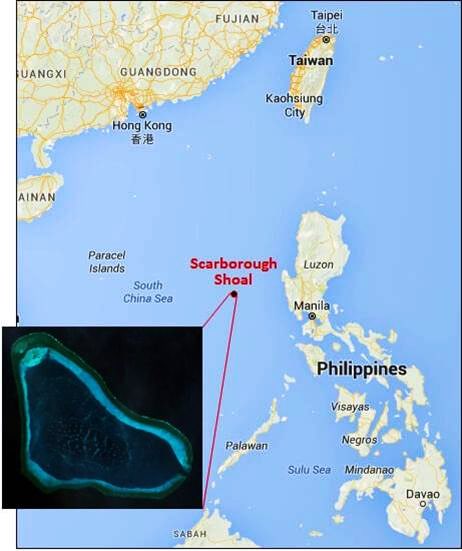
- China deployed ships and floating barriers to restrict access to Scarborough Shoal, escalating tensions with the Philippines in the South China Sea.
Issue in Brief
- China is tightening control over Scarborough Shoal by restricting entry, reinforcing its territorial claims in disputed waters.
- Move intensifies China–Philippines maritime confrontation, raising concerns over regional stability.
Relevance
- GS Paper II (International Relations)
- Indo-Pacific geopolitics, maritime disputes, international law
- GS Paper III (Security)
- Maritime security, naval strategy, grey-zone warfare
Practice Question
- “China’s actions in the South China Sea challenge the rules-based international order. Discuss with reference to Scarborough Shoal dispute.” (250 words)
Static Background
Scarborough Shoal
- Disputed atoll in South China Sea, claimed by China, Philippines, and Taiwan.
- Located within Philippines’ Exclusive Economic Zone (EEZ) (~200 nautical miles).
Legal Framework
- Governed by United Nations Convention on the Law of the Sea.
- 2016 PCA ruling (Philippines v. China) invalidated China’s Nine-Dash Line claims, but China rejected the verdict.
South China Sea Importance
- Handles ~1/3rd of global trade (~$3–5 trillion annually).
- Rich in fisheries, hydrocarbons, and strategic sea lanes.
Key Data & Evidence
- China using maritime militia, coast guard ships, and barriers to control access.
- Scarborough Shoal standoff (2012) led to China gaining de facto control.
- Region sees frequent naval patrols and stand-offs between China and Southeast Asian states.
Overview
- Assertion of Maritime Sovereignty:
- China’s actions reflect incremental expansion strategy (“salami slicing”) to consolidate control without full-scale conflict.
- Challenge to International Law:
- Blocking access within another country’s EEZ undermines UNCLOS principles and 2016 arbitral ruling.
- Regional Security Implications:
- Heightens risk of naval confrontation, miscalculation, and escalation in Indo-Pacific waters.
- Impact on Philippines:
- Restricts fishing rights and economic activities, affecting livelihoods and sovereignty claims.
- Great Power Competition:
- Issue intersects with US–China rivalry, as the US supports freedom of navigation operations (FONOPs).
Challenges / Concerns
- Erosion of Rules-Based Order
- Continued disregard for international rulings weakens global maritime governance frameworks.
- Grey-Zone Warfare Tactics
- Use of coast guard and militia instead of navy complicates response and avoids conventional escalation thresholds.
- ASEAN Disunity
- Lack of unified stance among ASEAN countries limits collective bargaining power against China.
- Escalation Risks
- Close encounters between vessels increase chances of accidental conflict or militarisation.
- Economic & Livelihood Impact
- Fishing restrictions affect coastal communities, creating socio-economic instability.
- Delayed Code of Conduct (CoC)
- Slow progress on China–ASEAN CoC negotiations prolongs uncertainty and disputes.
Way Forward
- Strengthen International Law Enforcement
- Promote adherence to UNCLOS and arbitral rulings, with support from global institutions.
- ASEAN Unity & Negotiation
- Accelerate binding South China Sea Code of Conduct with enforceable provisions.
- Confidence-Building Measures
- Establish hotlines, joint patrol norms, and incident prevention mechanisms.
- Diversify Strategic Partnerships
- Countries like Philippines to enhance ties with Quad nations and regional allies for maritime security.
- Capacity Building
- Strengthen coast guard capabilities, surveillance, and maritime domain awareness.
- Diplomatic Engagement
- Encourage multilateral dialogue platforms to prevent escalation and ensure peaceful resolution.
Prelims Pointers
- Scarborough Shoal: Disputed feature in South China Sea within Philippines’ EEZ.
- UNCLOS: Defines territorial waters (12 nm) and EEZ (200 nm).
- Nine-Dash Line: China’s expansive claim rejected by 2016 PCA ruling.
- FONOPs: Conducted to ensure freedom of navigation in international waters.