

Contents
Thursday, 17 July 2026
- SC Sets Aside Assam Foreigner Declarations for 27 — Citizenship Must Follow Due ProcessGS 2
- NIPUN Bharat at Five Years — Progress, Gaps and the Road AheadGS 2
- Centre Issues Draft Notification Banning Paraquat DichlorideGS 3
- NaMo Green Rail — India Flags Off Its First Hydrogen-Powered TrainGS 3
- Kudankulam Data Leak — Ransomware, BOP Data and Nuclear SecurityGS 3
- Supreme Court Jurisprudence on Hunger Strikes and State Duty of CareGS 2
Article 01
SC Sets Aside Assam Foreigner Declarations for 27 — Citizenship Must Follow Due Process
GS Paper 2 — Indian Constitution | Judiciary | Citizenship
Why in News
- The Supreme Court, in Sabitri Dey @ Swasthi Dey & Ors. v. Union of India & Ors. (2026 INSC 694), set aside a batch of 27 Gauhati High Court judgments that had upheld Foreigners Tribunal orders declaring the appellants to be illegal migrants.
- A bench of Justice Vikram Nath and Justice Sandeep Mehta remanded all 27 cases to the concerned Foreigners Tribunals for fresh adjudication.
- The Court held that citizenship determinations carry significant constitutional weight and cannot be conducted through mechanical, one-sided, or ex parte proceedings.
Static Background
Foreigners Tribunals (FTs) — Structure and Powers
- Statutory basis: Constituted under the Foreigners (Tribunals) Order, 1964, issued under Section 3 of the Foreigners Act, 1946, to adjudicate whether a person is a foreigner.
- Geographical scope: While the Foreigners (Tribunals) Order applies across India, FTs currently operate primarily in Assam, where they handle citizenship disputes arising from the National Register of Citizens (NRC) and police references.
- Composition: Each Tribunal is headed by a member drawn from judicial officers, advocates, or civil servants with judicial experience.
- Powers: FTs exercise civil court powers — summoning witnesses, examining persons on oath, and requiring production of documents. Under the Immigration and Foreigners Order, 2025, they have additionally been vested with powers of a Judicial Magistrate First Class, including authority to issue arrest warrants and order detention.
- Procedure: The Tribunal issues notice to the proceedee, provides an opportunity to present evidence, and delivers a reasoned opinion. A declaration of foreigner status may lead to detention and deportation.
Burden of Proof — Evolution of the Legal Framework
| Law / Judgment | Key Provision on Burden |
|---|---|
| Foreigners Act, 1946 — Section 9 | Reverse burden: the proceedee must prove they are not a foreigner |
| IMDT Act, 1983 (Assam-specific) | Burden shifted to the State/complainant, making detection and deportation significantly harder |
| State of Arunachal Pradesh v. Khudiram Chakma (1994) | SC held burden lies on the individual asserting Indian citizenship |
| Sarbananda Sonowal v. Union of India (2005) | SC struck down IMDT Act as unconstitutional; characterised illegal immigration as "external aggression" under Article 355; restored reverse burden under Section 9 |
| Immigration and Foreigners Act, 2025 | Consolidates and replaces the Foreigners Act, 1946; Section 9 reverse-burden principle carried forward |
India's Citizenship Framework — Jus Soli to Jus Sanguinis
- Constitution (1950): Articles 5–11 provided an inclusive, largely jus soli (right by birth) framework at commencement.
- Citizenship Act, 1955: Statutory framework for acquiring citizenship through birth, descent, registration, naturalisation, and territorial incorporation.
- Amendment 1986 (post-Assam Accord, 1985): First shift toward jus sanguinis — citizenship by birth restricted to those with at least one Indian citizen parent.
- Amendment 2003: Further tightened — one parent must be Indian and the other must not be an illegal migrant. Introduced Section 14A (NRIC), concept of "illegal migrant," and OCI status.
- CAA, 2019: Exempted Hindus, Sikhs, Buddhists, Jains, Parsis, and Christians from Pakistan, Bangladesh, and Afghanistan from the definition of "illegal migrant"; reduced naturalisation period from 11 to 5 years for these groups.
Citizenship by Birth — Current Position
| Birth Period | Citizenship Condition |
|---|---|
| 26 Jan 1950 – 1 Jul 1987 | Citizen by birth regardless of parents' nationality (jus soli) |
| 1 Jul 1987 – 3 Dec 2004 | At least one parent must be an Indian citizen |
| On or after 3 Dec 2004 | One parent must be Indian citizen AND the other must not be an illegal migrant |
Analysis
Facts of the Lead Case
The case originated from a May 1997 order of the Illegal Migrants (Determination) Tribunal declaring Sabitri Dey and her husband Sambhu Dey as illegal migrants after they failed to appear before the Tribunal following notice. The petitioners contended they were unaware of the proceedings, and that the 1997 order rested entirely on hearsay evidence from an Enquiry Officer rather than substantive proof. They came to know of the order only in 2019 and approached the Gauhati High Court, which dismissed their petition in 2020 citing a 23-year delay and "utter negligence." The Supreme Court thereafter admitted the matter.
Core Legal Questions Before the Court
- Whether an individual can be declared a foreigner through ex parte proceedings — based solely on non-appearance — when they possess government documents supporting Indian citizenship.
- Whether denial of legal aid or appointment of amicus curiae in such proceedings constitutes a breach of Article 21 (right to a fair and just procedure).
- Whether the Gauhati High Court erred in refusing to examine documentary evidence of citizenship on account of procedural delays alone.
The Supreme Court's Ruling
- Proceedings under the Foreigners Act, 1946 (now Immigration and Foreigners Act, 2025) must be fair, lawful, and reasoned; they cannot be mechanical or devoid of application of mind.
- Articles 14 (equality before law) and 21 (protection of life and personal liberty) extend to foreigners as well — these guarantees are not confined to citizens.
- Section 9's reverse burden does not permit a Foreigners Tribunal to make a mechanical declaration of foreigner status merely on account of the proceedee's absence. The Tribunal must independently assess the State's evidence, ensure proper service of notice, disclose the main grounds of reference, provide a fair hearing opportunity, and record reasoned findings.
- The Court set aside all 27 Gauhati High Court judgments along with the corresponding Foreigners Tribunal opinions, remanding the matters for fresh adjudication on merits.
New Deportation Policy, 2026
- The Ministry of Home Affairs has simultaneously introduced a New Deportation Policy establishing a uniform, time-bound framework for detection, identification, detention, and deportation of illegal migrants — particularly Bangladeshi and Myanmarese nationals.
- States and UTs are required to set up district-level Special Task Forces (STFs), operationalise Holding Centres, and use the Foreigners Identification Portal (FIP) for biometric and demographic profiling.
- Nationality verification must be completed within 90 days for suspected Bangladeshi and Myanmarese nationals.
The ruling reaffirms that the constitutional weight of citizenship determinations demands procedural rigour — not procedural shortcuts. By holding that a Tribunal is the primary adjudicatory forum rather than a forwarding authority, the Court strengthens the accountability of Foreigners Tribunals across Assam. The judgment is likely to affect a significant number of pending cases, requiring Tribunals to independently assess evidence, ensure notice compliance, and record reasoned findings before any foreigner declaration is made.
Prelims Pointers
- Foreigners Tribunals are quasi-judicial bodies constituted under the Foreigners (Tribunals) Order, 1964, under Section 3 of the Foreigners Act, 1946 — not under any Act of Parliament directly.
- Section 9, Foreigners Act, 1946 — places the burden of proof on the proceedee (accused person) to establish that they are not a foreigner; this is a reverse burden, departing from the ordinary presumption of innocence.
- IMDT Act, 1983 applied only to Assam and reversed the burden to the State; struck down in Sarbananda Sonowal v. Union of India (2005) as unconstitutional — SC described illegal immigration as "external aggression" under Article 355.
- Article 355 of the Constitution — duty of Union to protect States against external aggression and internal disturbance; invoked in Sonowal (2005) to justify stricter immigration control.
- Immigration and Foreigners Act, 2025 — new legislation that consolidates and replaces the Foreigners Act, 1946; the reverse burden principle under Section 9 is carried forward.
- Jus Soli vs Jus Sanguinis: Jus soli = citizenship by place of birth; jus sanguinis = citizenship by descent/parentage. India has progressively shifted from jus soli (pre-1987) toward jus sanguinis (post-2003 amendments).
- CAA, 2019 — exempts six religious minorities (Hindus, Sikhs, Buddhists, Jains, Parsis, Christians) from Pakistan, Bangladesh, and Afghanistan from the "illegal migrant" category; reduces naturalisation period from 11 to 5 years for them. Does not affect Muslim citizens.
- OCI (Overseas Citizen of India) — introduced by the Citizenship (Amendment) Act, 2003. India does not permit dual citizenship; OCI is not full citizenship but a lifelong residency and work visa.
- New Deportation Policy, 2026 (MHA) — mandates district-level STFs, Holding Centres, Foreigners Identification Portal (FIP) for biometric profiling, and 90-day nationality verification for Bangladeshi and Myanmarese nationals.
- Articles 14 and 21 — the SC in this ruling confirmed that these fundamental rights extend to foreigners, not just citizens. Article 14 (equality before law) and Article 21 (protection of life and personal liberty) impose procedural obligations even in foreigner-determination proceedings.
Mains Practice Question
The Supreme Court's ruling in Sabitri Dey v. Union of India (2026) reaffirms that citizenship determination must comply with constitutional due process rather than procedural technicalities. In this context, critically examine the functioning of Foreigners Tribunals in Assam and evaluate the adequacy of the legal framework governing citizenship disputes.
GS Paper 2 | Indian Constitution, Governance | 250 words
MCQ — Match the Following
Match the following laws/judgments with their key provisions regarding citizenship and foreigner determination:
List I (Law / Case)
A. Foreigners Act, 1946 — Section 9
B. IMDT Act, 1983
C. Sarbananda Sonowal v. Union of India (2005)
D. Citizenship (Amendment) Act, 2003
List II (Key Provision / Outcome)
1. Introduced the concept of "illegal migrant" and OCI into Indian law
2. Placed burden of proof on the State/complainant in Assam foreigner cases
3. Struck down as unconstitutional; illegal immigration termed "external aggression"
4. Reverse burden — proceedee must prove they are not a foreigner
- AA-1, B-4, C-3, D-2
- BA-4, B-2, C-1, D-3
- CA-4, B-2, C-3, D-1
- DA-2, B-4, C-1, D-3
Answer: C
Section 9 of the Foreigners Act, 1946 places the reverse burden of proof on the proceedee (A-4). The IMDT Act, 1983, applicable only to Assam, shifted the burden to the State/complainant (B-2). The Supreme Court in Sarbananda Sonowal (2005) struck down the IMDT Act and described illegal immigration as "external aggression" under Article 355 (C-3). The Citizenship (Amendment) Act, 2003 introduced the concept of "illegal migrant" and Overseas Citizen of India (OCI) into the Citizenship Act, 1955 (D-1).
Article 02
NIPUN Bharat at Five Years — Progress, Gaps and the Road Ahead
GS Paper 2 — Education | Social Justice | Government Schemes
This article is based on an opinion piece authored by Anita Karwal, Chairperson, Gujarat Real Estate Regulatory Authority, and Ishmeet Singh, CEO, CSF. Views reflect the authors' perspective on education policy; verify specific data points with official NIPUN Bharat and ASER reports before use in exam answers.
Why in News
- Five years after its launch in July 2021, the NIPUN Bharat Mission's outcomes are being assessed and its next phase is under active policy debate.
- While measurable gains in foundational literacy and numeracy (FLN) have been recorded in several states, persistent gaps at the Grade 3–5 level remain significant.
- Calls are growing to extend the Mission's scope and deepen institutional machinery ahead of the 2026–27 deadline for universal FLN achievement.
Prelims Pointers
- NIPUN Bharat stands for National Initiative for Proficiency in Reading with Understanding and Numeracy. Launched in July 2021 by the Ministry of Education under the Samagra Shiksha scheme, within the framework of NEP 2020.
- Target: Every child to acquire competencies in reading, writing, and numeracy by the end of Grade 3, and not later than Grade 5, by 2026–27. Target group: children aged 3–9 years (Balvatika to Grade 3).
- Samagra Shiksha — an integrated, centrally sponsored scheme covering pre-school to Class XII, formed by subsuming Sarva Shiksha Abhiyan (SSA), Rashtriya Madhyamik Shiksha Abhiyan (RMSA), and Teacher Education schemes.
- FLN (Foundational Literacy and Numeracy) — refers to a child's ability to read simple sentences with comprehension and solve basic arithmetic by the end of Class 3. These are gateway skills for all subsequent learning.
- Learning poverty (World Bank definition) — inability to read and understand a simple text by age 10. India's learning poverty rate is approximately 55–56%, worsened by the COVID-19 pandemic.
- ASER (Annual Status of Education Report) — published by NGO Pratham Foundation. Tracks learning outcomes in government schools. Grade 3 students able to read a Grade 2 text improved from 16.3% (2022) to 23.4% (2024) — reflecting slow progress.
- PARAKH — Performance Assessment, Review and Analysis of Knowledge for Holistic Development; the national assessment body under NEP 2020. PARAKH Rashtriya Sarvekshan (PRS) and the Foundational Learning Study (FLS) are its key assessment tools. EGRA/EGMA (Early Grade Reading/Mathematics Assessment) are international benchmarking standards for FLN measurement.
- DIKSHA — Digital Infrastructure for Knowledge Sharing; national platform providing e-content, assessment banks, teacher handbooks, and children's literature for both students and teachers.
- Balvatika — the pre-primary class (age 5–6) introduced under NEP 2020, designed to bridge early childhood education with formal schooling; a critical feeder for NIPUN Bharat's FLN goals.
- NISHTHA — National Initiative for School Heads and Teachers Holistic Advancement; the teacher capacity-building programme with FLN-specific modules deployed under NIPUN Bharat.
- NPST — National Professional Standards for Teachers; framework under NEP 2020 setting competency benchmarks for teachers at different career stages.
- Multi-Grade Multi-Level (MGML) classrooms — characterise approximately 70% of India's primary schools, where a single teacher handles students of different grades and learning levels simultaneously.
- PM SHRI — PM Schools for Rising India; centrally sponsored scheme to upgrade over 14,500 schools to serve as model institutions demonstrating NEP 2020 implementation.
- NIPUN Bharat implementation structure: Five-tier — National to State to District to Block/Cluster to School — with participation from School Management Committees (SMCs), parents, local bodies, and communities.
Article 03
Centre Issues Draft Notification Banning Paraquat Dichloride
GS Paper 3 — Agriculture | Environment | Science & Technology
Why in News
- The Union Ministry of Agriculture issued a gazette notification on 13 July 2026 proposing a nationwide prohibition on the manufacture, import, transport, distribution, sale, and use of paraquat dichloride.
- The draft notification was issued under Section 27 of the Insecticides Act, 1968, with a 30-day window for objections before the final ban order is issued — it is a proposed, not yet enacted, ban.
- The decision follows the recommendation of a government-appointed Expert Committee and the Registration Committee, citing documented health risks and the absence of a specific antidote.
- Telangana had earlier imposed a temporary three-month ban from 3 April 2026, highlighting that states lack authority to permanently ban centrally registered agrochemicals — a power vested solely with the Centre.
Static Background
What is Paraquat Dichloride?
- Chemical nature: A non-selective, fast-acting contact herbicide (weedicide) that destroys green plant tissue on contact by interfering with the electron transport chain during photosynthesis, generating toxic free radicals.
- Crops used in: Tea, cotton, coffee, rubber, paddy, wheat, maize, potato, grapes, and apple — primarily for pre-harvest desiccation and weed control.
- Toxicity profile: Among the world's most toxic agricultural chemicals. Can enter the body through ingestion, inhalation, or skin absorption. Causes severe lung fibrosis (scarring), kidney and liver failure, and cardiovascular damage. Linked to Parkinson's disease with chronic occupational exposure.
- No antidote: There is no specific antidote for paraquat poisoning — a critical public health concern that distinguishes it from many other agrochemicals where treatment protocols exist.
- Global status: Already banned or severely restricted in over 70 countries, including the European Union and China.
Regulatory Framework for Pesticides in India
- Insecticides Act, 1968: The primary legislation governing the import, manufacture, sale, transport, distribution, and use of pesticides (termed "insecticides" in the Act). Administered by the Ministry of Agriculture and Farmers Welfare.
- Central Insecticides Board and Registration Committee (CIBRC): The statutory body under the Act responsible for registering pesticides and recommending regulatory action. The Registration Committee's recommendation was the direct trigger for the ban notification.
- Section 27, Insecticides Act, 1968: Empowers the Central Government to prohibit the import, manufacture, or use of any insecticide if satisfied that its use involves risk to human beings or animals, after consulting the Board.
- Division of powers: Regulation of agrochemicals is a Central subject — states may impose temporary restrictions but cannot permanently ban a registered chemical. Telangana's three-month ban illustrated this constraint.
Context — Paraquat Deaths in India
- More than 200 deaths — predominantly by suicide — were attributed to paraquat poisoning in Telangana over recent years. Similar concerns were raised by Andhra Pradesh, Odisha, and Kerala.
- The Telangana Legislative Assembly passed a unanimous resolution urging the Centre to impose a nationwide ban.
- Concerns also extend to occupational poisoning among agricultural workers and accidental ingestion, particularly in rural households where storage practices may be inadequate.
Analysis
What the Expert Committee Found
- Documented adverse health effects, including Parkinson's disease linkage and irreversible lung damage.
- Continued history of poisoning incidents — both intentional and accidental — with consistently high fatality rates.
- Absence of a specific antidote, making treatment outcomes significantly worse than for most other chemical exposures.
- International precedent: the ban or severe restriction of paraquat in over 70 countries, including major agricultural economies, was cited as corroborating evidence.
Scope of the Proposed Ban
- Complete prohibition on manufacture, import, transport, distribution, sale, and use of paraquat dichloride throughout India.
- Applies to all formulations and concentrations of the active ingredient.
- A 30-day objection period allows industry stakeholders to file responses with the Ministry before the final notification is gazetted.
Agricultural Implications
- Weed management cost: Paraquat was one of the cheapest and fastest-acting weedicides available; its removal will require farmers — especially in tea and cotton — to shift to costlier or more labour-intensive alternatives.
- Alternatives: Glufosinate-ammonium, glyphosate (itself under global scrutiny), and manual/mechanical weeding are the primary substitutes; their accessibility and cost-effectiveness vary by region and crop.
- Food chain safety: The ban is expected to reduce hazardous chemical residues entering the food chain — a concern particularly relevant for export-oriented crops where MRL (Maximum Residue Limit) compliance is checked by importing countries.
India's proposed ban on paraquat dichloride signals a significant recalibration of pesticide regulation — prioritising public health and occupational safety over agrochemical convenience. With over 200 documented deaths in a single state, no available antidote, and bans already in force across more than 70 countries, the regulatory case is strong. The more complex challenge lies in transition — ensuring farmers have access to affordable, safer alternatives and that the shift does not disproportionately burden small and marginal cultivators who relied on paraquat for low-cost weed control.
Prelims Pointers
- Paraquat dichloride is a non-selective contact herbicide — it kills all green plant material it contacts and does not discriminate between weeds and crops; used primarily before crop emergence or post-harvest.
- Section 27 of the Insecticides Act, 1968 — empowers the Central Government to prohibit any pesticide that poses risk to human or animal life. This is the legal basis for the draft ban notification (July 2026). Note: The Act uses the term "insecticide" for all pesticides including herbicides and fungicides.
- Registration Committee (under CIBRC) — the statutory body that evaluates and registers pesticides in India; its recommendation is required before the government can ban a registered agrochemical.
- No antidote — the absence of a specific antidote for paraquat poisoning is a key distinguishing characteristic and a primary reason cited for the ban. This fact is frequently examined in prelims in the context of hazardous chemicals.
- Banned in 70+ countries including the EU and China — India would join this growing list upon finalisation of the ban.
- State vs Centre on agrochemicals: Agrochemical regulation is a Central subject under the Insecticides Act, 1968. States may restrict use temporarily but cannot permanently ban a centrally registered chemical — Telangana's 3-month ban (April 2026) illustrated this boundary.
- Parkinson's disease linkage: Chronic occupational exposure to paraquat has been epidemiologically linked to increased risk of Parkinson's disease — a neurological fact relevant to GS 3 (Science) and environmental health questions.
- Draft vs enacted ban: As of July 2026, the ban is a draft notification under Section 27 with a 30-day objection period. The final notification has not yet been issued — distinguish this in answers.
Mains Practice Question
The proposed ban on paraquat dichloride reflects the tension between agrochemical utility and public health imperatives. Examine the regulatory framework governing pesticide bans in India, the health and agricultural implications of the paraquat ban, and the challenges of ensuring a just transition for farmers.
GS Paper 3 | Agriculture, Environment, Science & Technology | 250 words
MCQ — Single Statement
With reference to paraquat dichloride and its proposed ban in India, which of the following statements is correct?
- AParaquat dichloride is a selective herbicide used only in paddy cultivation and is banned in fewer than 20 countries.
- BThe proposed ban is enacted under the Environment Protection Act, 1986, and states have independent authority to permanently ban registered agrochemicals.
- CThe draft ban notification was issued under Section 27 of the Insecticides Act, 1968, and paraquat poisoning has no specific antidote, contributing to its high fatality rate.
- DThe Registration Committee recommended continued use of paraquat with stricter label warnings as an alternative to an outright ban.
Answer: C
Option C is correct. The draft ban notification was issued on 13 July 2026 under Section 27 of the Insecticides Act, 1968, after the Registration Committee recommended prohibition. The absence of a specific antidote is a key cited reason for the ban. Option A is wrong — paraquat is non-selective (not crop-specific) and has been banned in over 70 countries. Option B is wrong — the legal basis is the Insecticides Act, 1968, not the Environment Protection Act; and states cannot permanently ban centrally registered chemicals. Option D is wrong — the Registration Committee recommended an outright ban, not a label-based approach.
Article 04
NaMo Green Rail — India Flags Off Its First Hydrogen-Powered Train
GS Paper 3 — Science & Technology | Infrastructure | Energy
Why in News
- Prime Minister Narendra Modi flagged off the NaMo Green Rail from Jind, Haryana — India's first hydrogen-powered fuel cell passenger train, indigenously designed and integrated.
- The event was part of a multi-state visit to Haryana, Chandigarh, and Punjab under which initiatives worth over ₹25,000 crore were unveiled across rail, road, and healthcare sectors.
- India becomes one of the few countries globally to operationalise a hydrogen-powered passenger train at commercial scale.
India's first hydrogen fuel cell passenger train, the NaMo Green Rail, ready for operations on the Jind–Sonipat route in Haryana.
Static Background
Hydrogen as a Transport Fuel — The Science
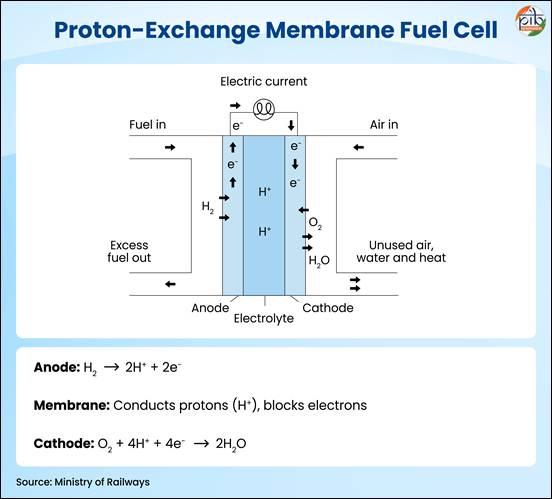
- Fuel cell principle: A hydrogen fuel cell generates electricity through an electrochemical reaction between hydrogen (H₂) and atmospheric oxygen (O₂). The only by-product is water vapour — making it a zero-emission propulsion technology at the point of use.
- Contrast with combustion: Unlike diesel or compressed natural gas engines that combust fuel to drive pistons, a fuel cell converts chemical energy directly into electrical energy, achieving higher efficiency and eliminating particulate and NOx emissions.
- Contrast with battery-electric trains: Battery-electric trains store electricity onboard and require charging infrastructure; hydrogen trains generate their own electricity onboard continuously, providing greater range and faster "refuelling" analogous to conventional trains.
- Green vs grey hydrogen: Hydrogen produced using renewable energy (electrolysis powered by solar/wind) is called green hydrogen; produced from natural gas reforming with CO₂ release is grey hydrogen. The climate benefit of hydrogen trains depends on the source of hydrogen used.
India's Hydrogen Policy Framework
- National Green Hydrogen Mission (2023): Approved with an outlay of ₹19,744 crore by 2029–30. Targets production capacity of at least 5 million metric tonnes (MMT) of green hydrogen per annum by 2030, along with development of export capacity and domestic usage in industry, mobility, and power sectors.
- SIGHT programme: Strategic Interventions for Green Hydrogen Transition — the financial incentive scheme under the Mission providing production-linked incentives for green hydrogen and electrolyser manufacturing.
- Indian Railways and hydrogen: Indian Railways has been actively piloting hydrogen traction as part of its goal of achieving net-zero carbon emissions by 2030. The NaMo Green Rail represents the culmination of earlier hydrogen train pilot projects.
Global Hydrogen Train Landscape
| Country | Train / Initiative | Status |
|---|---|---|
| Germany | Coradia iLint (Alstom) | World's first commercially operated hydrogen train; operational since 2018 in Lower Saxony |
| United Kingdom | HydroFLEX (Porterbrook/Univ. of Birmingham) | Pilot completed; further development ongoing |
| China | CRRC hydrogen tram | Operational in limited corridors |
| India | NaMo Green Rail (indigenously designed & integrated) | Flagged off July 2026; Jind–Sonipat route |
Key Features of the NaMo Green Rail
- Design and integration: Designed and integrated indigenously — a significant achievement in terms of domestic manufacturing capability under the Make in India framework.
- Configuration: 10-coach trainset, making it one of the world's longest and most powerful hydrogen-fuelled passenger trains.
- Propulsion: 3,200 horsepower (HP) hydrogen fuel cell propulsion system.
- Emission profile: Generates its own electricity onboard through the reaction of hydrogen with atmospheric oxygen; the only emission is water vapour.
- Route: Jind–Sonipat corridor in Haryana, for initial operations.
Other Infrastructure Announced — Multi-State Visit
- Delhi–Amritsar–Katra Expressway: A 157.92 km, four-lane access-controlled stretch built at ₹9,680 crore; will reduce Delhi–Katra travel time from 14 hours to approximately 6 hours.
- Jind–Gohana Greenfield Highway (NH-352A): Will cut travel time on this corridor from 2 hours to 40 minutes.
- National highway projects (Jind): Foundation stones and dedications totalling ₹12,470 crore.
- PGIMER Advanced Mother and Child Centre (Chandigarh): 300-bed tertiary care facility for high-risk pregnancies and intensive newborn care; part of ₹4,700 crore in healthcare infrastructure.
- Advanced Neurosciences Centre (Chandigarh): Integrated hub for neurology, neurosurgery, and neuro-critical care under one roof.
- PM-ABHIM Critical Care Block: 150-bed emergency response and disaster backup facility.
- Sikh Museum, Kurukshetra: Foundation stone laid to document the legacy of the Sikh Gurus.
- Jalandhar rail and road projects: ₹5,470 crore in infrastructure dedications.
- IT City–Kurali (Mohali) six-lane greenfield highway: To streamline inter-state transit between Punjab, Haryana, Himachal Pradesh, and Jammu & Kashmir.
The NaMo Green Rail is more than a transportation milestone — it is a demonstration of India's ability to indigenously design and deploy green mobility technology at scale. As Indian Railways pursues its 2030 net-zero target, hydrogen traction offers a viable solution for non-electrified routes where overhead catenary infrastructure is impractical. The critical challenge going forward is ensuring that the hydrogen powering these trains is sourced from renewable processes rather than fossil fuels, so that the zero-emission promise at the point of use translates into a genuinely lower lifecycle carbon footprint.
Prelims Pointers
- NaMo Green Rail — India's first hydrogen-powered fuel cell passenger train; 10-coach, 3,200 HP propulsion system; indigenously designed and integrated; flagged off from Jind, Haryana; operational on the Jind–Sonipat route.
- Hydrogen fuel cell operation: Electricity generated onboard through a chemical reaction between hydrogen and atmospheric oxygen; by-product is water vapour only — zero pollutant emissions at point of use.
- World's first commercial hydrogen train: Germany's Coradia iLint by Alstom, operational since 2018 in Lower Saxony — frequently examined as a reference point.
- Green hydrogen vs grey hydrogen: Green = electrolysis using renewable energy (no CO₂); Grey = steam methane reforming from natural gas (CO₂ emitted). Green hydrogen is the climate-beneficial variant. Blue hydrogen = grey hydrogen with carbon capture.
- National Green Hydrogen Mission (2023): Outlay of ₹19,744 crore by 2029–30; target of 5 MMT/year green hydrogen production capacity by 2030. Includes SIGHT (Strategic Interventions for Green Hydrogen Transition) as the financial incentive instrument.
- Indian Railways net-zero target: Indian Railways aims to achieve net-zero carbon emissions by 2030 — one of the most ambitious commitments by any railway network globally. Hydrogen trains are one pathway alongside solar-powered stations and electric traction.
- Delhi–Amritsar–Katra Expressway: 157.92 km, four-lane access-controlled; cost ₹9,680 crore; reduces Delhi–Katra travel time from 14 hours to ~6 hours.
- PM-ABHIM — Pradhan Mantri Ayushman Bharat Health Infrastructure Mission; the Critical Care Block inaugurated in Chandigarh is a 150-bed emergency and disaster backup facility under this scheme.
Mains Practice Question
India's first hydrogen-powered passenger train represents a convergence of green energy policy and transport decarbonisation. Critically examine the potential and challenges of hydrogen traction technology in the context of Indian Railways' net-zero carbon goal, and evaluate India's National Green Hydrogen Mission as a policy enabler.
GS Paper 3 | Science & Technology, Infrastructure, Energy | 250 words
MCQ — Direct Factual
Which of the following correctly describes the NaMo Green Rail flagged off in July 2026?
- AA battery-electric trainset developed in partnership with the German firm Alstom; it runs on the Delhi–Amritsar corridor and has an 8-coach configuration.
- BA hydrogen fuel cell train that emits water vapour as its only by-product; it draws power from overhead catenaries charged by solar energy.
- CAn indigenously designed 10-coach hydrogen fuel cell trainset with a 3,200 HP propulsion system; it generates electricity onboard through the reaction of hydrogen with atmospheric oxygen.
- DA compressed natural gas-powered train developed under the National Green Hydrogen Mission with a 5,000 HP engine, initially operated on the Jind–Delhi route.
Answer: C
Option C is correct. The NaMo Green Rail is an indigenously designed and integrated 10-coach trainset powered by a 3,200 HP hydrogen fuel cell propulsion system. It generates electricity onboard through the electrochemical reaction between hydrogen and atmospheric oxygen, producing only water vapour. Option A is wrong — it is not battery-electric, not developed with Alstom, and the coach count is incorrect. Option B is wrong — hydrogen fuel cell trains do not draw power from overhead catenaries; they generate power onboard. Option D is wrong — it runs on hydrogen, not CNG; the HP figure and route are incorrect.
Article 05
Kudankulam Data Leak — Ransomware, BOP Data and Nuclear Security
GS Paper 3 — Internal Security | Cybersecurity | Nuclear Energy
Why in News
- Approximately 14.3 GB of data pertaining to operations at the Kudankulam Nuclear Power Plant (KKNPP), Tirunelveli, Tamil Nadu, was leaked online as part of a ransomware attack.
- The breach originated from an infiltration of infrastructure belonging to Reliance Infrastructure Limited (Reliance ADAG Group), hosted on servers managed by third-party data centre provider Yotta Data Services Private Limited.
- The leaked data was published on World Leaks, a dark web platform operated by ransomware groups that publicly release data when victims decline to pay the ransom.
- NPCIL clarified that the data relates only to Balance of Plant (BOP) common service facilities — not to reactor operations, nuclear safety systems, or nuclear security-related information.
The Kudankulam Nuclear Power Plant in Tirunelveli district, Tamil Nadu — India's largest nuclear power station with two 1,000 MWe VVER reactors currently commissioned.
Static Background
Kudankulam Nuclear Power Plant — Key Facts
- Location: Tirunelveli district, Tamil Nadu — on India's southern tip, close to Kanyakumari.
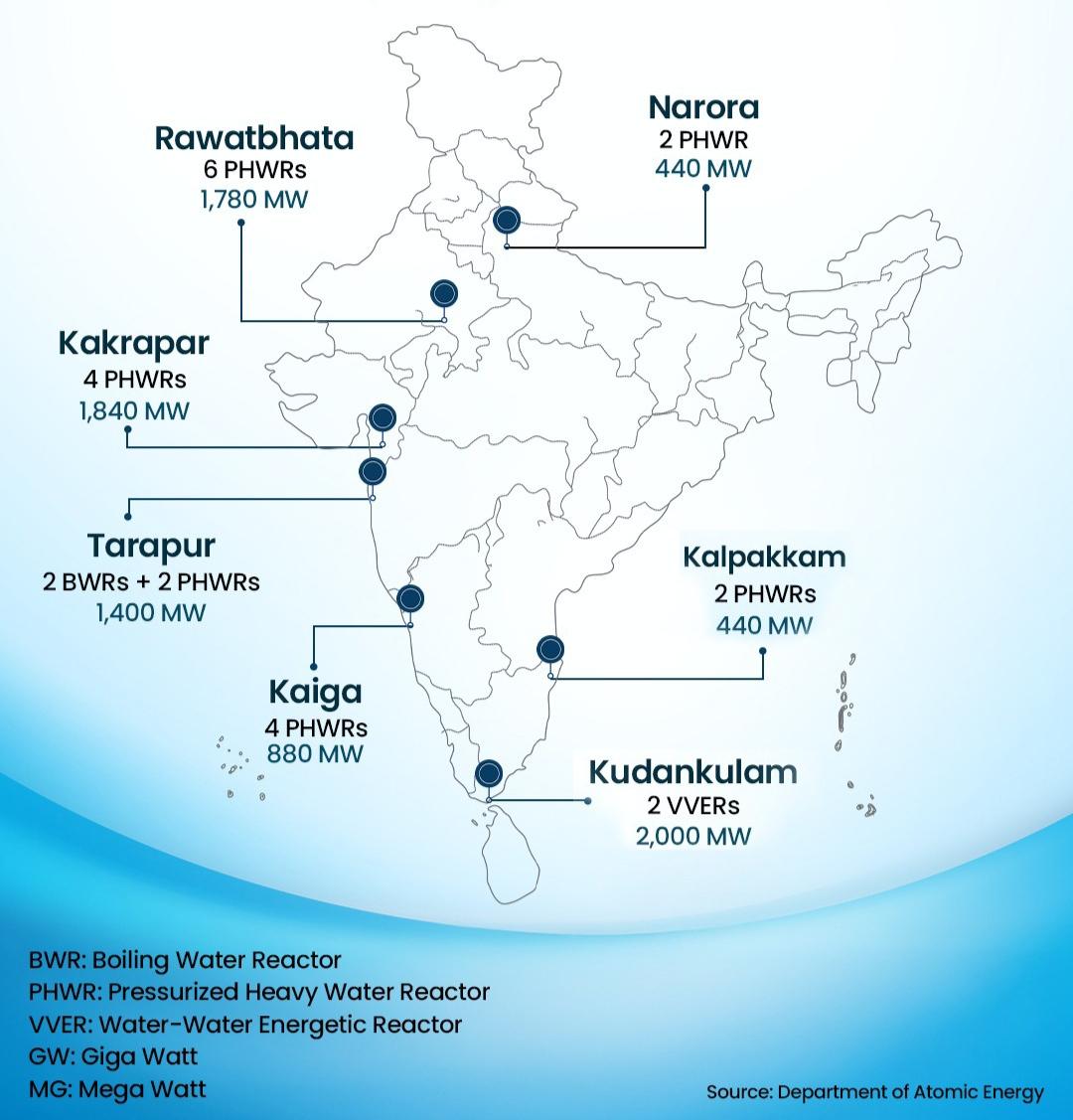
- Capacity: Two 1,000 MWe VVER reactors currently commissioned, providing up to 2 GW (2 gigawatts) of installed power generation capacity.
- Technology and partner: Built in collaboration with Russian state nuclear corporation Rosatom. The VVER (Water-Water Energetic Reactor) is a pressurised water reactor design developed in the Soviet Union.
- Expansion: The Government of India is planning four more VVER units at the site, which would triple the installed capacity to approximately 6 GW — making it one of the largest nuclear power complexes in Asia.
- Operator: Nuclear Power Corporation of India Limited (NPCIL), a public sector undertaking under the Department of Atomic Energy.
- Balance of Plant (BOP): Refers to all supporting systems of a power plant outside the core nuclear reactor — including cooling water systems, turbines, generators, electrical systems, and common service infrastructure. BOP systems are important for plant operations but do not directly involve nuclear materials or fission processes.
Ransomware and Dark Web — Operational Context
- Ransomware: A category of malicious software that encrypts victims' data and demands payment for decryption. A separate but growing variant — data extortion ransomware — exfiltrates data and threatens public release if the ransom is not paid, even without encrypting the victim's systems.
- World Leaks: A dark web platform operated by ransomware groups that publicly hosts data from organisations that declined to pay the demanded ransom, serving as a pressure mechanism and a criminal marketplace.
- Dark web: Portions of the internet not indexed by conventional search engines, accessible only through specialised software (typically Tor). Used for both legitimate privacy purposes and criminal operations including ransomware infrastructure.
- Data centre liability: Third-party data centre providers hold infrastructure but may not bear direct regulatory liability for the data stored by their customers — a legal and operational ambiguity that this incident has highlighted.
India's Cybersecurity Framework — Relevant Institutions
- CERT-In (Indian Computer Emergency Response Team): Nodal agency for cybersecurity incident response under the Ministry of Electronics and Information Technology (MeitY). Mandates reporting of cyber incidents by organisations within 6 hours of detection under 2022 rules.
- NCIIPC (National Critical Information Infrastructure Protection Centre): Under the National Technical Research Organisation (NTRO), designated as the nodal agency for protecting Critical Information Infrastructure (CII) — which includes power, nuclear, banking, and defence sectors.
- Information Technology Act, 2000 (amended 2008): Governing legislation for cybercrimes and data protection; Section 70 designates "Protected Systems" that attract enhanced penalties for unauthorised access.
- Personal Data Protection framework: India's Digital Personal Data Protection Act, 2023 is the current data protection legislation; enforcement and rules are being progressively implemented.
Analysis
What Was and Was Not Compromised
- NPCIL confirmed that the leaked data pertains only to Balance of Plant (BOP) common service facilities — not to the core reactor operations, nuclear safety systems, or nuclear security-related information.
- The 14.3 GB tranche is part of a larger 1.2 TB dataset on World Leaks linked to Reliance Infrastructure's operations. It reportedly includes plant blueprints, supplier details, meeting and inspection records, equipment reviews, and a $112 million insurance policy against terrorist attacks.
- Yotta Data Services confirmed that it detected suspicious activity on 29 May 2026, terminated the suspicious process, and isolated the affected server before ransomware encryption could execute. No lateral movement to other servers or Yotta customers was detected.
- Reliance stated in a stock exchange filing that "no ransomware execution, data loss or lateral movement occurred" — though the contradiction with the confirmed data publication on World Leaks has raised questions about the scope of that characterisation.
Why the Leak Matters Despite BOP-Only Scope
- Sensitive metadata: Supplier lists, contractor details, and insurance documents can enable adversaries to map the plant's supply chain and identify potential points of physical or cyber vulnerability.
- Blueprint risk: Engineering drawings of support infrastructure, even non-nuclear systems, can inform attack planning targeting turbines, cooling infrastructure, or electrical systems — components that, if disrupted, could force a reactor shutdown.
- Supply chain intelligence: Knowledge of which vendors supply what equipment — including security-relevant systems — enables targeted compromise of supplier networks as a vector for future attacks.
- Third-party cloud risk: The fact that sensitive infrastructure data was hosted on a commercial third-party data centre cloud environment (Yotta's servers) rather than air-gapped, government-managed infrastructure raises governance questions about data classification and storage policies for critical sector entities.
- Insider and OSINT risk: Even without direct nuclear data, the combination of plant layouts, personnel structures, and insurance coverage creates an intelligence picture that adversarial state actors or non-state actors could exploit.
Gaps Exposed — Policy and Regulatory Dimensions
- Absence of clear, mandatory standards for data classification and storage by Critical Information Infrastructure (CII) entities and their service providers.
- Ambiguity in responsibility: Yotta (infrastructure provider), Reliance Infrastructure (data owner), and NPCIL (plant operator) each describe limited liability — creating accountability gaps in the event of a breach with serious consequences.
- The Cyber Security Framework for the Power Sector (2021) mandates cybersecurity audits and incident reporting, but enforcement and compliance levels in third-party supply chains remain uneven.
The Kudankulam incident underscores a structural vulnerability that extends well beyond this single event: as critical infrastructure entities increasingly rely on commercial cloud and data centre providers, the attack surface for adversarial actors widens. The BOP-only nature of the leaked data prevents this from being a nuclear safety crisis — but it is a serious cybersecurity governance failure. India's framework for protecting Critical Information Infrastructure must extend to the entire data custody chain, including third-party providers, with mandatory air-gapping or enhanced security controls for nuclear sector data.
Prelims Pointers
- Kudankulam Nuclear Power Plant (KKNPP): Located in Tirunelveli district, Tamil Nadu. Two commissioned units of 1,000 MWe each (total 2 GW). Built with Russian Rosatom under the VVER (pressurised water reactor) technology. Operator: NPCIL (Nuclear Power Corporation of India Limited), under Department of Atomic Energy. Four additional VVER units planned, which would triple capacity.
- Balance of Plant (BOP) — all supporting systems of a power station outside the nuclear reactor core: turbines, generators, cooling systems, electrical switchgear, and common service infrastructure. NPCIL confirmed that only BOP data was leaked — no nuclear safety or security-related systems were affected.
- VVER reactor (Vodo-Vodyanoi Energetichesky Reaktor) — a Soviet/Russian-designed pressurised water reactor (PWR). Water is used both as coolant and moderator. Among the most widely deployed reactor types globally.
- Ransomware — malware that encrypts data and demands payment. Data extortion ransomware (as in this case) exfiltrates data and publishes it on dark web platforms if ransom is not paid, even without encrypting the victim's systems. World Leaks is one such dark web publication site.
- CERT-In (Indian Computer Emergency Response Team) — nodal cybersecurity incident response agency under MeitY. Under 2022 rules, organisations must report cyber incidents within 6 hours of detection.
- NCIIPC (National Critical Information Infrastructure Protection Centre) — under NTRO (National Technical Research Organisation), PMO. Designated nodal agency for protecting Critical Information Infrastructure (CII) under Section 70A of the IT Act, 2000. Power, nuclear, banking, defence, and telecom sectors are designated CII.
- Section 70, IT Act, 2000 — designates "Protected Systems" (critical government computer resources); unauthorised access attracts imprisonment up to 10 years. This is distinct from NCIIPC's broader CII mandate under Section 70A.
- Rosatom — Russia's state nuclear energy corporation; one of the world's largest nuclear energy companies, involved in reactor construction, fuel supply, and nuclear services globally. India-Russia civil nuclear partnership covers Kudankulam construction and operations.
Mains Practice Question
The Kudankulam data breach highlights the cybersecurity vulnerabilities arising from India's critical infrastructure sector's increasing dependence on third-party commercial cloud services. Examine the existing legal and institutional framework for protecting Critical Information Infrastructure (CII) in India and suggest measures to address the gaps exposed by this incident.
GS Paper 3 | Internal Security, Cybersecurity | 250 words
MCQ — Assertion-Reason
Assertion (A): NPCIL confirmed that the Kudankulam data breach did not compromise any nuclear safety or reactor security-related systems.
Reason (R): The leaked data pertained only to Balance of Plant (BOP) common service facilities, which are support systems outside the core reactor operations, and are managed separately from nuclear-classified infrastructure.
Choose the correct option:
- ABoth A and R are true, and R is the correct explanation of A.
- BBoth A and R are true, but R is NOT the correct explanation of A.
- CA is true, but R is false.
- DA is true and R is true, and R correctly explains why nuclear safety systems were unaffected — but the breach remains significant due to supply chain intelligence, engineering blueprints, and third-party data governance risks.
Answer: D
Both the Assertion and Reason are factually accurate, and R does correctly explain A — NPCIL's confirmation that nuclear safety systems were unaffected rests precisely on the BOP-only nature of the leak. However, the standard A-R options (A or B) do not capture the full picture: even with BOP-only scope, the breach is significant because supplier details, engineering blueprints, and insurance documents create exploitable intelligence for adversaries. Option D best reflects this nuance. In standard UPSC format, the answer would be A (both true, R explains A) — candidates should use contextual judgment. This question tests the ability to distinguish between nuclear safety risk and broader cybersecurity/intelligence risk.
Article 06
Supreme Court Jurisprudence on Hunger Strikes and the State's Duty of Care
GS Paper 2 — Indian Constitution | Fundamental Rights | Judiciary
Why in News
- Activist Sonam Wangchuk's indefinite fast at Jantar Mantar, New Delhi crossed 19 days without any government response, drawing judicial attention.
- The Delhi High Court asserted on 16 July 2026 that the "life of any citizen is precious," flagging concern over the executive's silence toward a protester whose health was at risk.
- The case has revived attention to a series of Supreme Court orders from 2024 — passed in the Jagjit Singh Dallewal hunger strike case — in which a bench headed by (then Justice, now CJI) Justice Surya Kant articulated the State's constitutional duty of care toward a person on an indefinite fast.
Static Background
Constitutional Status of Hunger Strikes
- Hunger strikes are neither unconstitutional nor prohibited under any Indian law. The Supreme Court has held that they constitute a form of protest "accepted both historically and legally in our constitutional jurisprudence."
- The right to protest — including through fasting — flows from Article 19(1)(a) (freedom of speech and expression) and Article 19(1)(b) (right to assemble peaceably without arms), subject to reasonable restrictions under Articles 19(2) and 19(3).
- The State may not disrupt this right of expression unless there is a "genuine threat or reasonable basis of communal disharmony, social disorder, or public tranquillity" — a high threshold that mere political inconvenience does not meet.
The State's Duty of Care — SC's Position
- Multiple Supreme Court orders — passed during periodic hearings in the Dallewal case (2024) — held that both the Union of India and the State of Punjab have a "bounden duty" to take all necessary measures to provide immediate and adequate medical aid to a person on an indefinite fast, without forcing them to break the fast unless it is imperative to save their life.
- The Court emphasised that the age, health condition, and standing of the individual must be taken into account by the State in discharging this duty.
- This position reflects a paternal duty of care — the State, as custodian of life under Article 21, is obligated to protect the physical wellbeing of a protester even while respecting their political choice to fast.
Precedents and Key Cases
| Case / Event | Key Principle / Observation |
|---|---|
| In Re: Ramlila Maidan Incident (SC) | SC documented the UPA government's proactive outreach to Baba Ramdev in 2011 — four senior Ministers met him at the airport; PM Manmohan Singh wrote to him on May 19, 2011 assuring action on black money and requesting him to call off the fast. Court noted this as the expected standard of State engagement with a fasting protester. |
| Jagjit Singh Dallewal Hunger Protest (2024) | SC bench (headed by then-Justice Surya Kant, now CJI) held it was the duty of the State of Punjab and Union of India to provide medical aid to Mr. Dallewal without forcing him to break his fast; court took cognisance of his age, health, and prominence. |
| Sonam Wangchuk Fast (2026 — ongoing) | Delhi HC (July 16, 2026) affirmed the preciousness of every citizen's life; government silence on the 19-day fast drew judicial attention but no SC intervention had been reported as of date of article. |
Analysis
The Tension Between State Power and Dissent
- The judicial position creates an important asymmetry: the State must protect life while simultaneously having no authority to forcibly end a hunger strike that does not threaten public order. This limits the executive's ability to use either force or indifference as a response tool.
- The Court has explicitly discouraged the executive from taking a "hostile view" of hunger strikers. A hostile or indifferent response — such as allowing a fasting individual to deteriorate without medical outreach — may itself constitute a constitutional failure.
- The Ramlila Maidan precedent places an implicit obligation on governments to engage politically — to at minimum make credible outreach attempts — when a respected public figure undertakes an indefinite fast on a matter of public concern.
Article 21 and the Right to Protest
- Article 21 (right to life and personal liberty) has been expansively interpreted by the Supreme Court to include the right to a dignified life, the right against arbitrary detention, and procedural due process guarantees. In the context of hunger strikes, it imposes a positive obligation on the State to ensure no preventable harm comes to a protester's life.
- The courts have drawn a distinction between the State's legitimate interest in maintaining public order (which may justify regulating the venue or manner of protest) and the State's impermissible interest in suppressing the content of dissent.
Sonam Wangchuk — Context
- Sonam Wangchuk is a Ladakh-based activist and innovator known for his educational and environmental work. His fast is understood to be centred on demands related to constitutional protections and statehood for Ladakh following its reorganisation in 2019 under the Jammu and Kashmir Reorganisation Act.
- The government's 19-day silence stands in contrast to the standard of proactive engagement documented in the Ramlila Maidan case and the Dallewal orders.
The Supreme Court's jurisprudence on hunger strikes occupies a careful constitutional space: it upholds the right to fast as a legitimate form of dissent while simultaneously imposing a duty of care on the State that cannot be discharged through silence or hostility. For UPSC purposes, the key doctrinal contribution of these cases is the affirmation that Article 21's positive dimensions extend to the State's obligation to protect the life of a dissenting citizen — even one who has voluntarily chosen to fast — and that political engagement, not just medical response, is part of what the Constitution demands.
Prelims Pointers
- Constitutional status of hunger strikes: Neither unconstitutional nor illegal. The SC has explicitly held them to be a form of protest accepted in India's constitutional jurisprudence. They derive legitimacy from Articles 19(1)(a) and 19(1)(b) — freedom of speech and expression, and peaceful assembly.
- In Re: Ramlila Maidan Incident — suo motu SC case arising from the 2011 midnight police action against Baba Ramdev's fast at Ramlila Maidan, New Delhi. SC documented the expected standard of State engagement with hunger strikers and upheld the right to protest through fasting.
- Jagjit Singh Dallewal — septuagenarian Punjab farmer leader who undertook a prolonged hunger strike against farm laws in 2024. SC orders in his case established the clearest articulation of the State's medical duty of care toward hunger strikers.
- Sonam Wangchuk — Ladakh-based engineer, innovator, and activist; known for establishing the Himalayan Institute of Alternatives, Ladakh (HIAL). His 2026 fast at Jantar Mantar concerns constitutional protections for Ladakh, including demands under the Sixth Schedule. The Sixth Schedule provides autonomous district council governance arrangements for tribal areas — sought by Ladakhi groups as a safeguard.
- Sixth Schedule of the Constitution — provides for autonomous district councils with legislative, judicial, and executive powers in tribal areas of Assam, Meghalaya, Tripura, and Mizoram. Ladakh's demands relate to extending similar protections to the UT, which currently does not have a legislature.
- Article 21 — protection of life and personal liberty. Interpreted broadly by the SC to include: right to livelihood, right to health, right to dignified life, right against arbitrary detention. In the hunger strike context, it generates a positive state obligation to protect life even of a voluntary faster.
- CJI Justice Surya Kant — 53rd Chief Justice of India (since 24 November 2025). The bench he headed as a Supreme Court judge in 2024 passed the Dallewal orders; the article references these orders in the context of the Wangchuk fast.
- Jantar Mantar, New Delhi — a historic astronomical observatory (18th century, Maharaja Jai Singh II) that has become a designated protest site in central Delhi. Protests at Jantar Mantar are subject to specific permissions under Delhi Police regulations and court-supervised guidelines.
Mains Practice Question
The Supreme Court has held that the State bears a constitutional duty to protect the life of a person on an indefinite hunger strike without forcing them to abandon their right to dissent. Analyse the constitutional basis of this duty, the limits it places on executive power, and the implications of government silence in such situations.
GS Paper 2 | Indian Constitution, Fundamental Rights, Governance | 250 words
MCQ — Which is NOT Correct
With reference to the Supreme Court's jurisprudence on hunger strikes and the State's duty of care, which of the following statements is NOT correct?
- AHunger strikes are a constitutionally recognised form of protest in India, deriving legitimacy from Articles 19(1)(a) and 19(1)(b).
- BThe State may not disrupt the right to expression through fasting unless there is a genuine threat of communal disharmony, social disorder, or breach of public tranquillity.
- CThe Supreme Court has held that the State must compel a hunger striker to break their fast after 15 days to discharge its duty of care under Article 21.
- DIn the Dallewal case (2024), the SC held that providing medical aid to the hunger striker was a "bounden duty" of both the State of Punjab and the Union of India.
Answer: C
Option C is the incorrect statement. The Supreme Court has explicitly held the opposite — the State must provide medical aid and support without forcing the hunger striker to break their fast, "unless it is imperative to do so to save their life." There is no 15-day compulsory break rule; the intervention threshold is imperilling of life, not an arbitrary time limit. Options A, B, and D are all accurate reflections of the SC's jurisprudence as established in In Re: Ramlila Maidan Incident and the Dallewal case orders.