

In-Depth News Analysis8 Items
Core TopicImportantConcise
International RelationsGS Paper II
01India–Pakistan 1991 Agreement & Naval Collision02Oman’s Sohar Port & India’s Gulf Energy Access03UK Devolved Nations & the Cardiff Agreement
Economy, Labour & InfrastructureGS Paper III
04EPFO Wage Ceiling Raised to ₹25,00005Railways: High-Density Network & Multitracking
Environment & EcologyGS Paper III
06Sumatran vs Asian Elephants & Indonesian Wildfires
Society, Gender & CultureGS Paper I
07Dadasaheb Phalke Award 2024 — Anant Nag08Global Gender Gap Index 2026 — India 131st
International RelationsGeneral Studies Paper II
01
Naval Collision at Sea: India Invokes the 1991 India–Pakistan Agreement on Military Exercises
GS-II · IR — India and its Neighbourhood · GS-III · SecurityPrelims + MainsThe Indian Express
India summoned Pakistan’s Chargé d’Affaires after a Pakistani ship collided with an Indian Navy vessel on 15 September 2026, calling the conduct a direct contravention of Article 10 of the 1991 Agreement on Advance Notice on Military Exercises, Manoeuvres and Troop Movements.
◈ Static Background — Confidence-Building Measures (CBMs)
Confidence-Building Measures are agreed rules that reduce the risk of war by misperception — through transparency, notification and communication. Between India and Pakistan, most formal CBMs emerged in the 1980s–2000s, after the 1971 war and the Simla Agreement (1972).
- Drivers in the 1980s: advancing nuclear weapons programmes in both countries raised the cost of war; the Soviet invasion of Afghanistan (December 1979) made Pakistan and the U.S. keen on a calm eastern border.
- 10 March 1983: Agreement establishing an India–Pakistan Joint Commission.
- January 1987 — Exercise Brass Tacks: a large Indian exercise in Punjab and Rajasthan (reportedly about 1.5 lakh troops) alarmed Pakistan and triggered a near-crisis — the direct trigger for the 1991 notification regime.
- 31 December 1988: Agreement on Prohibition of Attack against Nuclear Installations and Facilities and a Cultural Cooperation Agreement.
- 6 April 1991: the Advance Notice agreement and a companion Agreement on Prevention of Air Space Violations and permitting overflights and landings by military aircraft.
▤ The 1991 Agreement at a Glance
- Purpose: a mechanism to inform each other of exercises and troop movements to prevent a crisis arising from misreading intentions.
- Scope: rules for land, naval and air forces; major exercises close to the border to be avoided, or notified in advance if held.
- Naval “major exercise”: six or more ships of destroyer/frigate size and above, exercising together and crossing into the other’s Exclusive Economic Zone (EEZ).
- Article 10: naval ships and submarines of either country must not close within 3 nautical miles (about 5.5 km; 1 NM ≈ 1.85 km) of each other in international waters.
- Clarification clause: either side may seek clarification on assembly of forces, direction, extent and duration of an exercise.
- Last comparable incident: 16 June 2011 — Pakistani warship PNS Babur brushed past INS Godavari in the Gulf of Aden, damaging its helicopter safety net.
Figure 1 — Evolution of India–Pakistan military CBMs
1972SimlaAgreement1983JointCommission1987Brass Tackscrisis1988Nuclearinstallations pact1991Advance notice +airspace pacts2011Babur–Godavariincident2026ShipcollisionMost CBMs followed moments of crisis or heightened nuclear risk.
The 1991 agreement grew directly out of the 1987 Brass Tacks scare.
Maritime Law Context
- UNCLOS (1982): the EEZ extends up to 200 nautical miles from baselines; beyond territorial waters (12 NM), warships enjoy freedom of navigation but must show due regard for others.
- COLREGs (1972): the International Regulations for Preventing Collisions at Sea set universal rules on safe speed, right of way and look-out.
- Bilateral rules add a stricter layer: the 3 NM stand-off under Article 10 goes beyond general law, reflecting the risks of close encounters between rival navies.
Why It Matters
- Escalation risk: close encounters between warships of nuclear-armed neighbours can escalate quickly without agreed rules and communication.
- Durability of CBMs: India’s invocation shows the 1991 framework remains legally live even when political dialogue is frozen.
- Diplomatic channel: the summons of a Chargé d’Affaires reflects downgraded diplomatic ties, with no High Commissioners in place since 2019.
Critical View and Way Forward
- Limitation: CBMs lack enforcement or dispute mechanisms; compliance depends on political will.
- Gaps: no dedicated naval incidents-at-sea agreement (like the U.S.–USSR INCSEA, 1972) or real-time naval hotline exists between the two navies.
- Way forward: joint investigation of the incident, activation of DGMO/naval communication channels, and exploring an INCSEA-type protocol for the Arabian Sea.
✎ Mains Practice Question
Confidence-building measures between India and Pakistan have survived periods of hostility but have rarely prevented crises. Examine their relevance with reference to the 1991 Agreement on Advance Notice of Military Exercises. 15 marks · 250 words
02
Beyond Hormuz: Oman Pitches Sohar Port for Indian Investment
GS-II · IR — India and West Asia · GS-III · Energy Security, InfrastructurePrelims + MainsThe Hindu
With shipping through the Strait of Hormuz disrupted by Iran–U.S. hostilities, Oman has invited Indian investment in Sohar Port and Freezone, located on the Gulf of Oman outside the strait.
◈ Static Background — Geography and India–Oman Ties
- Strait of Hormuz: the narrow link between the Persian Gulf and the Gulf of Oman / Arabian Sea, bordered by Iran to the north and Oman’s Musandam peninsula to the south — the world’s most important oil transit chokepoint.
- Oman: Sultanate on the south-eastern Arabian Peninsula; capital Muscat; member of the Gulf Cooperation Council (GCC); long a neutral mediator in regional disputes.
- Strategic partnership: India and Oman are strategic partners since 2008; Oman was India’s first Gulf partner for joint military exercises across all three services.
- Duqm: India secured access to Duqm Port for military logistics and maintenance in 2018.
- Trade: the India–Oman Comprehensive Economic Partnership Agreement (CEPA) was signed in December 2025.
Figure 2 — Sohar Port lies on the Gulf of Oman, outside the Strait of Hormuz
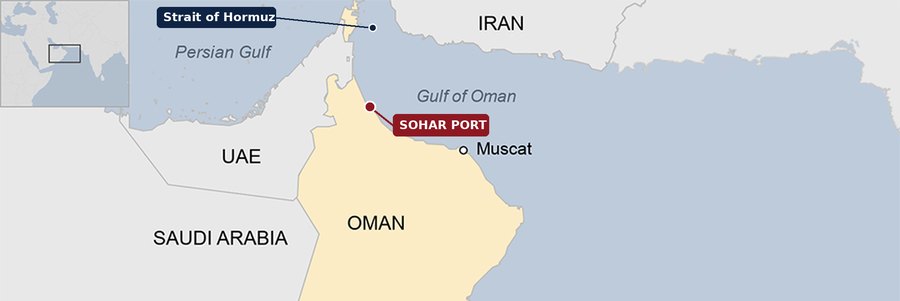
Ships using Sohar need not transit Hormuz, and the port sits near UAE and Saudi energy pipeline routes. Base map courtesy original publisher; Sohar Port and Strait of Hormuz marked by Legacy IAS for educational use.
▤ Sohar Port — Key Facts
- Location: north-eastern Oman, on the Batinah coast of the Gulf of Oman, between Muscat and the UAE border.
- Scale: investments of over US$30 billion; capacity to handle about 72 million tonnes of cargo a year, as stated by Sohar officials.
- Advantage over Duqm and Salalah: proximity to energy pipelines of the UAE and eastern Saudi Arabia, allowing Gulf energy to reach the sea bypassing Hormuz.
- Model: a port-cum-Freezone integrated industrial and logistics platform; Indian firms already operate there.
Why It Matters for India
- Energy security: India imports most of its crude oil and a large share of LPG and LNG from the Gulf; a Hormuz disruption threatens supply and prices.
- Route diversification: pipelines such as the UAE’s Habshan–Fujairah line already bypass the strait; access to ports like Sohar adds redundancy.
- Maritime strategy: complements India’s presence at Duqm and Chabahar (Iran), and the SAGAR / MAHASAGAR vision of Indian Ocean engagement.
- Economic diplomacy: investment in Gulf free zones can support Indian manufacturing and re-export to West Asia and Africa.
Challenges
- Pipeline dependence: bypass capacity is limited compared with the volume normally moving through Hormuz.
- Regional volatility: the Gulf of Oman itself is not immune to attacks on shipping.
- Competition: Chinese investment in Gulf and Omani ports shapes the commercial landscape.
✎ Mains Practice Question
Chokepoint vulnerability is a central challenge to India’s energy security. Discuss the importance of Oman in India’s strategy to secure uninterrupted energy supplies from West Asia. 10 marks · 150 words
03
United No More? Scotland, Wales and Northern Ireland Signal Push for Independence Referendums
GS-II · IR — Developed Countries’ Politics · Comparative ConstitutionsPrelims + MainsThe Indian Express
The First Ministers of Scotland, Wales and Northern Ireland, together with the leader of the opposition in the Republic of Ireland, signed the “Cardiff Agreement”, a memorandum asserting their nations’ right to self-determination and calling on London to facilitate constitutional change.
◈ Static Background — How the United Kingdom Was Formed
- British Isles: over 6,000 islands in north-western Europe; the two largest are Great Britain and Ireland.
- Wales: conquered by England in the late 1200s; legally annexed to the Kingdom of England by an Act of Union in 1536.
- 1707 — Acts of Union: England and Scotland united as the Kingdom of Great Britain.
- 1801 — Acts of Union (1800): after the failed 1798 Irish rebellion, Ireland joined, forming the United Kingdom of Great Britain and Ireland.
- 1922: after the Anglo-Irish War (1919–21), most of Ireland became independent; six counties formed Northern Ireland within the UK, now the United Kingdom of Great Britain and Northern Ireland.
- Devolution (1998): the Scotland Act, Government of Wales Act and Northern Ireland Act created devolved legislatures; the Good Friday Agreement (1998) provides for a possible border poll on Irish unification.
Figure 3 — The four nations of the United Kingdom
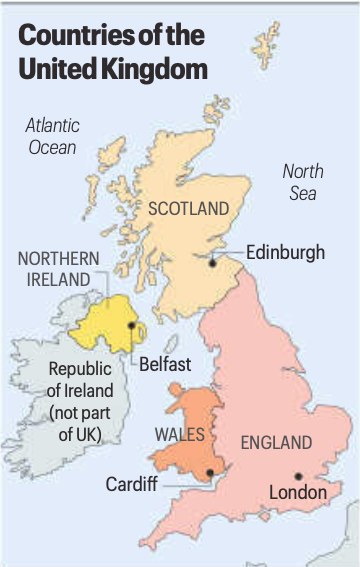
UK = England + Scotland + Wales + Northern Ireland; Great Britain = England + Scotland + Wales. Image courtesy The Indian Express, 17 September 2026; reproduced with credit for educational use.
▤ Referendums and Legal Position
- 2014 Scottish referendum (18 September): 55.3% No, 44.7% Yes, held under a Section 30 order of the Scotland Act, 1998 that temporarily transferred the power to legislate.
- 2022 UK Supreme Court ruling: the Scottish Parliament cannot unilaterally call a second referendum — the power lies with the UK Parliament.
- Northern Ireland border poll (1973): 98.9% voted to remain in the UK, amid a boycott by Irish nationalists.
- Wales: has never held an independence referendum.
- Recent polling (reported): support for independence at 47% in Scotland, 36% in Northern Ireland and 32% in Wales.
- Trigger: the UK Prime Minister said referendums for Scotland and Northern Ireland were not on the cards, while the U.S. President expressed support for Irish reunification.
Comparative Lens — The UK and India
- Union model: the UK is a unitary state with devolution and no codified constitution; parliamentary sovereignty means Westminster can grant or withhold referendums.
- India: described as an “indestructible Union of destructible States” — Article 1 calls India a Union of States, and Article 3 lets Parliament reorganise States, but there is no right to secede.
- Anti-secession safeguards: the 16th Constitutional Amendment (1963) allowed reasonable restrictions on free speech in the interests of sovereignty and integrity and added this to the oaths of legislators.
- Lesson: asymmetric devolution can accommodate regional identity, but where it is perceived as insufficient, demands can shift from autonomy to independence.
Why It Matters
- Post-Brexit strains: Scotland and Northern Ireland voted to remain in the EU in 2016, sharpening constitutional tensions.
- India–UK ties: constitutional uncertainty could affect the implementation climate for the India–UK Comprehensive Economic and Trade Agreement (CETA).
✎ Mains Practice Question
Compare the constitutional position on secession and regional autonomy in the United Kingdom and India. What explains the stability of the Indian Union despite its diversity? 15 marks · 250 words
Economy, Labour & InfrastructureGeneral Studies Paper III
04
Cabinet Raises EPFO Wage Ceiling from ₹15,000 to ₹25,000 a Month
GS-III · Employment, Inclusive Growth · GS-II · Social Security, WelfarePrelims + MainsThe Hindu · PIB
The Union Cabinet raised the wage ceiling for mandatory coverage under the Employees’ Provident Fund Organisation (EPFO) from ₹15,000 to ₹25,000 a month — the first revision since 2014 — effective 17 September 2026.
◈ Static Background — India’s Provident Fund System
- Constitutional basis: Article 41 (DPSP) directs the State to secure public assistance in old age and disablement; Article 43 seeks a living wage; social security is in the Concurrent List (Entry 23).
- Statute: the Employees’ Provident Funds and Miscellaneous Provisions Act, 1952, now consolidated in the Code on Social Security, 2020.
- EPFO: a statutory body under the Ministry of Labour and Employment, governed by a tripartite Central Board of Trustees (CBT) of government, employers and workers.
- Three schemes: Employees’ Provident Fund (EPF, 1952) for savings; Employees’ Deposit Linked Insurance (EDLI, 1976) for death cover; Employees’ Pension Scheme (EPS, 1995) for pension.
- Coverage rule: applies to establishments with 20 or more employees; workers earning up to the wage ceiling must be enrolled, those above may join voluntarily.
- Ceiling history: raised from ₹6,500 to ₹15,000 in September 2014; unchanged for 12 years until now.
▤ How Contributions Work
- Employee: 12% of basic wage + dearness allowance, all to EPF.
- Employer: 12%, of which 8.33% goes to EPS (calculated on the wage ceiling) and 3.67% to EPF.
- Government: contributes 1.16% of wages (up to the ceiling) to EPS.
- Effect of new ceiling: the maximum monthly EPS share rises from ₹1,250 to about ₹2,082.5 (8.33% of ₹25,000).
- Fiscal cost: annual Government outgo estimated at about ₹11,339 crore, against existing budgetary support of about ₹10,250 crore.
- Coverage (government estimate): over 51 lakh additional employees brought under mandatory coverage; the Labour Ministry puts potential beneficiaries at up to 1 crore.
- Wage context: average salary in private establishments is about ₹23,000, per a government survey cited by the Ministry.
Figure 4 — What changes with the new wage ceiling
Wage ceiling (₹/month)15,000 (2014)25,000 (2026)Maximum EPS share (₹/month)1,250≈2,082.5Government budgetary support (₹ crore/year)10,250≈11,339
Recreated from Government figures: a 67% rise in the ceiling raises annual budgetary support by about 11%.
Stakeholder Positions
- Government: expects wider access to PF savings, EPS pension and EDLI insurance, and better returns on savings.
- Trade unions: a central trade union called it “too little and too late”, arguing inflation since 2014 justified at least ₹30,000 and warning that take-home pay may fall if employers shift costs onto workers.
- MSME employers: an entrepreneurs’ body warned of cash-flow strain and a possible shift towards gig arrangements, seeking Government absorption of the increase for two years and EPFO software upgrades.
- Staffing industry: described it as a structural gain for formalisation.
Critical Analysis
Strengths: the move expands the formal social-security net for middle-wage workers, improves old-age income under EPS and aligns the ceiling more closely with prevailing private-sector wages.
- Take-home pay: higher mandatory deductions reduce immediate disposable income for newly covered workers.
- Informality incentive: higher labour costs could push small firms to under-report wages or use contract/gig engagements.
- No indexation: a 12-year gap between revisions erodes coverage in real terms; an automatic, inflation-linked review would be more predictable.
- Pension adequacy: the minimum EPS pension and the actuarial health of the pension fund remain long-standing concerns.
Way Forward
- Periodic indexation of the ceiling to wages or inflation, decided through the tripartite CBT.
- Transitional support for MSMEs and simplified compliance through digital systems.
- Portability and extension of social security to gig and platform workers under the Code on Social Security, 2020.
✎ Mains Practice Question
Raising the EPFO wage ceiling expands social security coverage but also raises the cost of formal employment. Critically examine this trade-off in the context of India’s efforts to formalise its workforce. 15 marks · 250 words
05
Decongesting the Rail Backbone: Multitracking the High-Density Network and New Freight Corridors
GS-III · Infrastructure — Railways, LogisticsPrelims + MainsThe Indian Express
Indian Railways has taken up multitracking — four lines instead of two — on all seven High-Density Network (HDN) routes, and is expediting the East–West Dedicated Freight Corridor, to relieve congestion that limits freight growth.
◈ Static Background — Railways and the Freight Economy
- Scale: a network of over 69,000 route-km; among the world’s largest freight carriers.
- Cross-subsidy: freight earns over 65% of revenue and subsidises passenger fares.
- Modal share: rail carries about 27% of India’s freight, having lost ground to roads as National Highways expanded.
- National Rail Plan (NRP): a long-term capacity plan targeting a rail freight modal share of 45% by 2030.
- Dedicated Freight Corridor Corporation of India Ltd (DFCCIL): set up in 2006 to build freight-only lines.
- Policy links: PM Gati Shakti National Master Plan (2021) and the National Logistics Policy (2022), which aim to cut logistics costs.
Figure 5 — Indian Railways’ seven high-density routes
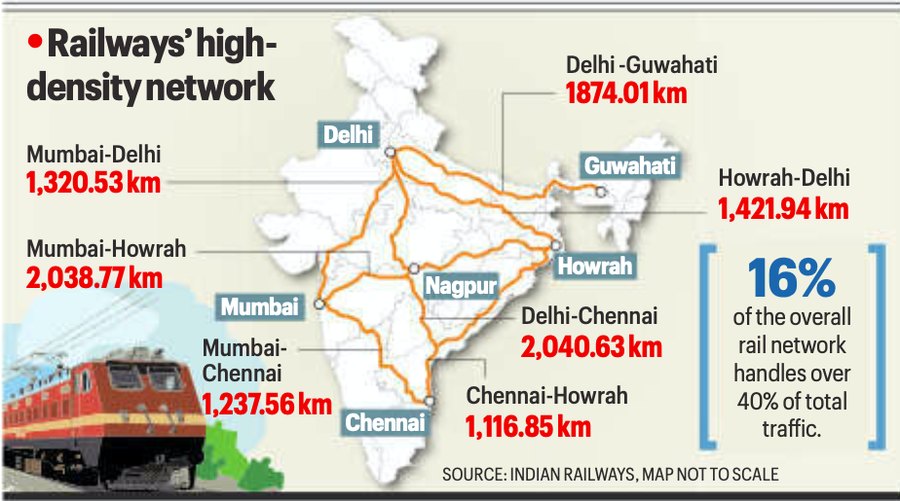
About 16% of the network carries over 40% of total traffic. Map not to scale. Image courtesy The Indian Express, 17 September 2026 (source: Indian Railways); reproduced with credit for educational use.
▤ The Numbers
- Seven HDN routes: 11,051 km — about 16% of the network, carrying over 40% of traffic. Longest: Delhi–Chennai (2,040.63 km); shortest: Chennai–Howrah (1,116.85 km).
- Ideal vs actual use: HDNs should run at 70–80% of capacity, but only 4.6% of the network operates below 80%.
- Example of saturation: the 28-km Karjat–Lonavala ghat section near Mumbai sees about 67 trains each way daily against a capacity of 40.
- Freight speed: average freight train speed is only about 25 km/h.
- Loading: 1,670 million tonnes in 2025-26; target of 3,000 million tonnes by 2030.
- Recent approval: eight multitracking projects covering 1,196 km worth ₹20,804 crore; about 2,000 km of HDN routes are already four-line.
Figure 6 — Projected line-capacity utilisation by 2031 without multitracking (share of network)
Over 150%50%100–150%39%70–100%9%Source: National Rail Plan, as reported. Recreated by Legacy IAS.
Without capacity addition, nearly nine-tenths of the network would be saturated or worse by 2031.
Dedicated Freight Corridors (DFCs)
- Eastern DFC: Ludhiana (Punjab) – Sonnagar (Bihar); carries mainly coal and minerals from eastern India.
- Western DFC: connects JNPT and Mumbai and Gujarat ports (Pipavav, Mundra, Kandla) to Inland Container Depots in north India, mainly carrying ISO containers.
- Operational status: both corridors are fully operational, running about 420 freight trains a day on average.
- East–West DFC (under way): 1,738 km from Dankuni (West Bengal) to Surat (Gujarat), serving coal, iron ore, bauxite, steel, fertilisers and FCI godowns.
- In the pipeline, not yet sanctioned: East Coast corridor (Kharagpur–Vijayawada) and North–South corridor (Itarsi–Nagpur–Vijayawada).
Critical Analysis and Way Forward
- Strengths: separating freight and passenger traffic raises speed, punctuality and safety, and shifting freight from road to rail lowers emissions and logistics costs.
- Challenges: land acquisition delays, high capital cost, last-mile connectivity gaps and the freight–passenger cross-subsidy that keeps rail freight tariffs high.
- Way forward: rationalise freight tariffs, expand Gati Shakti multimodal cargo terminals, ensure time-bound project completion and deploy Kavach automatic train protection on upgraded routes.
✎ Mains Practice Question
Indian Railways’ declining share in freight transport is as much a capacity problem as a pricing problem. Discuss with reference to the high-density network and dedicated freight corridors. 15 marks · 250 words
Environment & EcologyGeneral Studies Paper III
06
Wildfires Threaten the Critically Endangered Sumatran Elephant: How It Differs from India’s Asian Elephant
GS-III · Environment — Biodiversity, Disaster (Forest Fires)Prelims + MainsThe Hindu (AFP)
An Indonesian conservation group reported over 4,500 fire hotspots across 21 Sumatran elephant habitats between June and early September 2026, with more than 5.6 lakh hectares burned, pushing one of the world’s rarest elephants closer to the brink.
◈ Static Background — The Asian Elephant and Its Subspecies
- Two genera of living elephants: Loxodonta (African savanna and forest elephants) and Elephas (the Asian elephant, Elephas maximus).
- Asian elephant subspecies: Indian (E. m. indicus) on the mainland; Sri Lankan (E. m. maximus); Sumatran (E. m. sumatranus); and the Bornean elephant of Borneo.
- Sumatran elephant: endemic to the island of Sumatra, Indonesia; uplisted to Critically Endangered in 2011 owing to rapid habitat loss.
- India’s share: India holds the largest population of wild Asian elephants; the elephant is India’s National Heritage Animal (2010).
Figure 7 — Sumatran elephant vs Indian (mainland Asian) elephant
FeatureSumatran elephantIndian elephantScientific nameE. maximus sumatranusE. maximus indicusIUCN statusCritically EndangeredEndangered (species level)RangeSumatra island, IndonesiaIndia, Nepal, Bhutan, SE AsiaWild population~2,400–2,800 (WWF)India holds the largest shareMain threatsFires, palm oil, deforestationFragmentation, conflict, trains
Same species, very different risk levels: an island subspecies with shrinking forests is far more vulnerable.
▤ Fire Impact (as reported)
- Hotspots: over 4,500 in 21 habitats (June–early September); over 2,800 in the first week of September alone, more than double August’s ~1,300.
- Area burned: over 5,60,000 hectares.
- Ecological effects: habitat loss and fragmentation, reduced food and water, altered movement patterns, and physiological stress from toxic smoke.
- Wider impact: fires across Sumatra and Borneo have caused regional haze.
Why Indonesian Forests Burn
- Peatlands: drained peat soils store vast carbon and can smoulder underground for weeks, releasing heavy smoke.
- Land clearing: slash-and-burn clearing for oil palm and pulpwood plantations is a major ignition source.
- Climate: dry seasons intensified by El Niño conditions increase fire spread.
- Regional law: the ASEAN Agreement on Transboundary Haze Pollution (2002) seeks cooperation on fire prevention and haze control.
India’s Framework for Elephant Conservation
- Project Elephant (1992): a Centrally Sponsored Scheme for habitat, corridor and conflict management; now merged with Project Tiger as Project Tiger and Elephant.
- Legal protection: Schedule I of the Wildlife (Protection) Act, 1972; CITES Appendix I.
- Monitoring: the MIKE (Monitoring the Illegal Killing of Elephants) programme under CITES.
- Key issues: human–elephant conflict, train collisions, and fragmentation of elephant corridors — lessons India shares with Sumatra.
✎ Mains Practice Question
Forest fires are increasingly a threat to biodiversity rather than only a seasonal event. Discuss their causes and ecological impacts, drawing lessons for elephant conservation in India. 10 marks · 150 words
Society, Gender & CultureGeneral Studies Paper I
07
Dadasaheb Phalke Award 2024: India’s Highest Film Honour Goes to Kannada Actor Anant Nag
GS-I · Art & Culture — Indian Cinema, AwardsPrelims-orientedThe Hindu · PIB
On the recommendation of the Dadasaheb Phalke Award Selection Committee, the Government announced that veteran actor Anant Nag will receive the Dadasaheb Phalke Award 2024 — making him only the second Kannada film artist honoured for work in Kannada cinema, after Dr. Rajkumar (1995).
◈ Static Background — Dadasaheb Phalke and the Award
- Dadasaheb Phalke (Dhundiraj Govind Phalke, 1870–1944): known as the “Father of Indian Cinema”; made Raja Harishchandra (1913), India’s first full-length feature film.
- Institution: instituted in 1969 by the Government of India to mark Phalke’s birth centenary; the first recipient was actress Devika Rani.
- Status: India’s highest award in cinema, for outstanding lifetime contribution to the growth and development of Indian cinema.
- Administering Ministry: Ministry of Information and Broadcasting; presented at the National Film Awards ceremony, by the President of India.
- Components: a Swarna Kamal (Golden Lotus) medallion, a shawl and a cash prize.
- Selection: a committee of eminent film personalities recommends the awardee; the award year refers to the year for which it is given, not the year of announcement.
Figure 8 — Anant Nag, Dadasaheb Phalke Award 2024 recipient
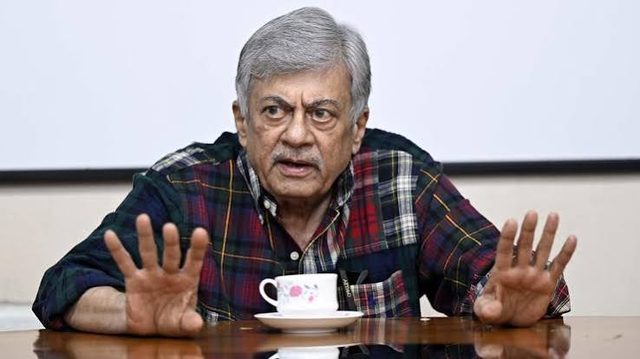
A career of more than five decades across mainstream and parallel cinema. Photo courtesy original publisher; reproduced with credit for educational use.
1973
Film debut — Kannada film Sankalpa
300+
Films, over 250 in Kannada
2025
Padma Bhushan conferred
22 Sep
72nd National Film Awards, Kevadia, Gujarat
▤ The Awardee — Key Facts
- Background: born Anant Nagarkatte in 1948 in Uttara Kannada district; began in Kannada, Marathi, Hindi and Konkani theatre, largely shaped in Mumbai.
- Range: worked in both mainstream and parallel (New Wave) cinema, including Hindi art-house films of the 1970s.
- State honours: five Karnataka State Film Awards, including a Lifetime Achievement award.
- Ceremony: to be presented at the 72nd National Film Awards on 22 September 2026 at Kevadia (Ekta Nagar), Gujarat.
- Karnataka connection: cinematographer V.K. Murthy (from Karnataka) received the award for 2008, but for work in Hindi cinema.
Recipients from Southern Film Industries (Prelims hook)
- B.N. Reddi (1974) — Telugu; the first recipient from South India.
- Akkineni Nageswara Rao (1990) — Telugu; Dr. Rajkumar (1995) — Kannada; Sivaji Ganesan (1996) — Tamil.
- Adoor Gopalakrishnan (2004) — Malayalam; K. Balachander (2010) — Tamil; Rajinikanth (2019) — Tamil.
- Mohanlal (2023) — Malayalam; Anant Nag (2024) — Kannada.
Significance
- Recognising regional cinema: the award highlights the contribution of language cinemas to India’s film culture beyond Hindi cinema.
- Soft power and heritage: Indian cinema is a major vehicle of cultural diplomacy and a record of social change.
- Theatre–cinema link: the awardee’s career reflects how regional theatre traditions fed into Indian film acting.
✎ Mains Practice Question
Regional language cinemas have enriched India’s cultural identity and contributed to social reform. Discuss with suitable examples. 10 marks · 150 words
08
Global Gender Gap Index 2026: India Holds at 131st
GS-I · Society — Role of Women · GS-II · Vulnerable SectionsPrelims + MainsThe Hindu (PTI)
India retained its 131st rank in the World Economic Forum’s Global Gender Gap Index 2026, with its parity score edging up to 64.5% — still below the global average.
◈ Static Background — The Index
- Publisher: the World Economic Forum (WEF), Geneva; first released in 2006.
- Scoring: from 0 to 1 (0–100%), where 100% means full parity between women and men.
- Four sub-indices: Economic Participation & Opportunity, Educational Attainment, Health & Survival and Political Empowerment.
- Measures gaps, not levels: it assesses relative gaps between men and women, not absolute development.
▤ 2026 Rankings
- Top three: Iceland, Finland and Norway, unchanged.
- Bottom three: Chad (last), Iran and Pakistan.
- India: 131st, score 64.5%, slight improvement but unchanged rank; 14 countries rank below India, including several West Asian and African states.
Where India Lags and Why
- Economic participation: low female labour force participation, wage gaps and few women in senior roles pull the score down.
- Political empowerment: women’s share in Parliament and ministerial positions remains low; the Constitution (106th Amendment) Act, 2023 (Nari Shakti Vandan Adhiniyam) reserves one-third of seats in the Lok Sabha and State Assemblies, operative after the next Census and delimitation.
- Health & survival: the sex ratio at birth weighs on this sub-index.
- Relative strength: near-parity in educational enrolment.
Critical View
- Methodological critiques: the index relies on national averages and gives heavy weight to political representation, missing unpaid care work and local-government representation (where 73rd/74th Amendments reserve at least one-third of seats for women).
- Way forward: childcare and safe transport to raise women’s workforce participation, skilling, and timely operationalisation of legislative reservation.
✎ Mains Practice Question
Despite progress in education and health, India continues to rank low on global gender parity indices. Examine the reasons and suggest measures to improve women’s economic and political participation. 15 marks · 250 words