

Content
- Study flags overlooked danger posed by hanging glaciers on mountain slopes in Central Himalaya
- Govt imparts AI training to 2,500 artisans under PM Vishwakarma Scheme
- How AI companies are quietly becoming the world’s cybersecurity gatekeepers
- When bonds break: Chimpanzee ‘civil war’ challenges assumptions about how wars begin, researchers say
- A weakening wind
- How altered mosquitoes could reshape malaria control
Study flags overlooked danger posed by hanging glaciers on mountain slopes in Central Himalaya
Why in News?
- A recent study in npj Natural Hazards flags 219 unstable hanging glaciers in Alaknanda basin, warning of increasing avalanche risks amid rising human exposure in Central Himalaya.
Relevance
- GS I (Geography)
- Glacial geomorphology, cryosphere dynamics
- Himalayan vulnerability (tectonics + climate)
- GS III (Environment & Disaster Management)
- Climate change–induced hazards (beyond GLOFs)
- Multi-hazard risk (avalanche + flood + landslide)
- Disaster Risk Reduction (DRR) & early warning systems
Practice Questions
Q1.“Emerging cryospheric hazards like hanging glacier avalanches are under-recognised in India’s disaster management framework.”Examine. (250 words)
Static Background
- Hanging glaciers are small glaciers clinging to steep mountain slopes, often detached from main glacier systems, making them inherently unstable and prone to sudden ice avalanches.
- The Himalayan cryosphere is highly sensitive to climate change, with warming rates exceeding global averages, leading to glacier retreat, fragmentation, and hazard formation.
- Glacial hazards include avalanches, Glacial Lake Outburst Floods (GLOFs), and debris flows, often intensified by topography, seismicity, and anthropogenic activities.
- The Alaknanda basin (Uttarakhand) is a key headstream of the Ganga river system, characterised by high altitude variation (400–7800 m), fragile geology, and increasing developmental pressure.
Core Issue / Key Findings
- 219 hanging glaciers identified, covering ~72 sq km area with ~2.39 cubic km ice volume, indicating substantial cryospheric mass at risk.
- Nearly one-third glaciers classified as highly unstable, prone to sudden detachment and avalanche generation.
- Avalanche debris could exceed 50 metres height, with potential to reach settlements like Badrinath, Mana, and Hanuman Chatti.
- Built-up area in vulnerable zones increased from ~8,000 sq m (2000) to projected 1.5 lakh sq m (2030), reflecting rapid human encroachment.
- Upper Alaknanda basin contains ~30% of total hanging glacier mass, making it a critical hotspot of risk.
Overview
- Climate-induced glacier destabilisation: accelerated warming leads to retreat, thinning, and detachment of tributary glaciers, increasing instability of hanging glaciers.
- Mass shedding mechanism: hanging glaciers compensate instability through frequent ice/snow avalanches, which become hazardous when intersecting human settlements.
- Compound disaster risk: avalanches can block rivers, create temporary lakes, and trigger secondary floods (GLOFs), amplifying disaster intensity.
- Anthropogenic exposure: rapid expansion of pilgrimage infrastructure, roads, hydropower projects increases vulnerability in hazard-prone zones.
- Seismic vulnerability: Himalayan region’s high tectonic activity can trigger glacier collapses, compounding climate risks.
- Data-driven hazard modelling (satellite + simulations) enhances predictive capacity but remains underutilised in policy frameworks.
- Overlooked hazard dimension: unlike GLOFs, hanging glacier avalanches are less studied, leading to policy blind spots in disaster risk reduction.
Challenges / Concerns
- Lack of real-time monitoring systems for high-altitude glaciers due to difficult terrain and logistical constraints.
- Unregulated infrastructure development in fragile zones increases disaster exposure.
- Limited integration of scientific data into planning, leading to continued construction in high-risk areas.
- Institutional fragmentation between agencies handling environment, disaster management, and infrastructure.
- Early warning systems for avalanches remain weak compared to flood or cyclone forecasting systems.
- Climate change uncertainty complicates long-term risk assessment and mitigation planning.
Key Takeaways
- Highlights emerging climate-induced cryospheric hazards beyond GLOFs, expanding scope of disaster management in Himalayas.
- Demonstrates interaction of climate change, geomorphology, and human development in creating multi-hazard risks.
- Emphasises need for science-based policy, risk zoning, and sustainable mountain development.
Prelims Pointers
- Hanging glaciers are located on steep slopes and prone to avalanches due to instability.
- Alaknanda river is a major tributary of the Ganga originating in Uttarakhand Himalayas.
- GLOF occurs when glacial lakes burst due to structural failure or external triggers.
- Himalayan region is tectonically active and climate-sensitive, increasing disaster vulnerability.
- Satellite imagery and DEM (Digital Elevation Models) are used for glacier and hazard assessment.
- Avalanche-induced river blockage can create temporary lakes leading to downstream floods.
Govt imparts AI training to 2,500 artisans under PM Vishwakarma Scheme
Why in News?
- Under PM Vishwakarma Scheme, over 2,500 artisans trained in AI tools, marking a first-of-its-kind initiative integrating grassroots craftspeople into the AI ecosystem.
Relevance
- GS III (Economy & S&T)
- MSMEs, informal sector formalisation
- AI for inclusive growth, productivity enhancement
Practice Questions
Q1.“Integration of AI into traditional sectors can redefine inclusive growth in India.”Discuss with reference to PM Vishwakarma Scheme. (250 words)
Static Background
- The PM Vishwakarma Scheme (2023) is a ₹13,000 crore Central Sector scheme (FY 2023–28) providing end-to-end support—recognition, skills, credit, and market linkages—to traditional artisans in the unorganised sector.
- Targets 18 family-based traditional trades (carpenter, mason, blacksmith, tailor, cobbler, etc.), rooted in guru–shishya tradition, aiming to modernise without eroding cultural identity.
- Addresses structural constraints of informal economy: lack of identity, access to institutional credit, modern tools, and integration into formal markets.
- Aligns with “AI for Social Good” and Digital India vision, integrating emerging technologies into grassroots livelihoods for inclusive growth.
- ~30 lakh artisans registered, with ~26 lakh skill-verified beneficiaries, and ~86% completing basic training, indicating large-scale capacity building.
- 4.7 lakh collateral-free loans sanctioned worth ₹41,188 crore, at concessional 5% interest rate, reducing dependence on informal credit markets.
- 497 District Project Management Units (DPMUs) covering 618 districts, ensuring last-mile implementation, awareness, and monitoring. Government initiatives like IndiaAI Mission and Digital India aim to promote “AI for Social Good”, ensuring inclusive technological transformation.
Core Issue / Key Findings
- 2,500+ artisans trained in using AI tools such as ChatGPT, Google Gemini, and Indus for business enhancement and productivity gains.
- Training includes branding, product design, packaging, digital marketing, and customer engagement using AI-enabled tools.
- Initiative aims to bridge digital divide, enhance market access, and improve global competitiveness of traditional crafts sector.
- Aligns with “AI for Social Good” vision, emphasising inclusive, technology-driven livelihood transformation.
Overview
- Integration of AI into traditional sectors represents a structural shift from subsistence-based craftsmanship to market-oriented digital enterprises.
- AI enables artisans to enhance product design, customise offerings, and access global e-commerce platforms, overcoming traditional market barriers.
- Reduction in information asymmetry through AI tools improves pricing, branding, and consumer targeting, increasing profitability.
- Skill augmentation rather than displacement: AI complements artisans’ creativity by enhancing efficiency, outreach, and value addition.
- Democratisation of technology: access to advanced AI tools reduces entry barriers for small producers, promoting inclusive innovation.
- Export potential expansion: improved packaging, branding, and digital presence can integrate artisans into global value chains.
- Women and rural participation likely to increase, as AI tools reduce dependence on intermediaries and physical mobility.
- Policy convergence with MSME, Digital India, and Startup India initiatives reflects holistic approach to grassroots economic transformation.
- Localisation of AI tools (language, context) critical for effective adoption among non-English speaking artisans.
Challenges / Concerns / Gaps
- Limited digital literacy among artisans may restrict effective utilisation of AI tools despite training initiatives.
- Infrastructure gaps such as poor internet connectivity in rural areas hinder sustained adoption.
- Dependence on external platforms may expose artisans to platform monopolies and pricing control risks.
- Data privacy and security concerns as artisans increasingly rely on digital platforms for business operations.
- Scalability challenges in extending training to millions of artisans across diverse regions and crafts.
- Risk of homogenisation of traditional crafts if AI-driven designs overshadow indigenous uniqueness.
Key Takeaways
- Illustrates application of AI for inclusive growth and livelihood enhancement, aligning with “Sabka Saath, Sabka Vikas”.
- Demonstrates technology-driven transformation of informal sector and traditional economy.
- Highlights importance of bridging digital divide for equitable technological development.
Prelims Pointers
- PM Vishwakarma Scheme targets artisans and craftspeople with skill, financial, and technological support.
- AI tools can be used for branding, design, marketing, and customer engagement in MSMEs.
- MSME sector contributes ~30% to GDP and ~45% to exports in India.
- Digital divide refers to unequal access to technology and digital skills.
- IndiaAI Mission promotes AI adoption across sectors with focus on inclusivity.
- AI for Social Good emphasises use of technology for inclusive and sustainable development outcomes.
How AI companies are quietly becoming the world’s cybersecurity gatekeepers
Why in News?
- Launch of Project Glasswing by Anthropic brings major tech firms into an AI-driven cybersecurity coalition, raising concerns over concentration of cyber power and access control.
Relevance
- GS III (Internal Security & S&T)
- Cybersecurity, zero-day vulnerabilities
- AI in defence systems
- GS II (Governance & IR)
- Digital sovereignty, regulation of Big Tech
- Global tech governance gaps
Practice Questions
Q1.“AI is transforming cybersecurity from a public good into a privately controlled strategic asset.”
Critically examine. (250 words)
Static Background
- Zero-day vulnerability refers to a previously unknown software flaw, leaving developers with “zero days” to fix once discovered, making it highly valuable for both defence and offensive cyber operations.
- Exploit development involves converting vulnerabilities into usable attack tools, enabling unauthorised access, data theft, or system disruption, forming the backbone of cyber warfare and cybercrime.
- Artificial Intelligence in cybersecurity enhances automated vulnerability detection, threat intelligence, and incident response, significantly reducing human effort and time required for cyber defence.
- Platform capitalism and digital monopolies describe situations where few large firms control critical digital infrastructure, creating entry barriers, network effects, and market concentration risks.
Core Issue / Key Findings
- Project Glasswing coalition includes major firms such as Amazon Web Services, Google, Microsoft, and Nvidia.
- Anthropic’s Claude Mythos Preview model can autonomously detect and exploit zero-day vulnerabilities, identifying flaws in widely used systems like OpenBSD and FFmpeg.
- AI models now achieve rapid vulnerability detection, reducing effort from weeks of expert work to overnight automated analysis.
- OpenAI’s absence from the coalition highlights emerging competition among AI firms in cybersecurity dominance.
Overview
- Shift from reactive to proactive cybersecurity paradigm, where AI identifies vulnerabilities before exploitation, fundamentally altering threat-detection timelines and defence strategies.
- Concentration of cyber capabilities within a few firms creates asymmetry in access, where only select actors possess advanced defensive and offensive tools.
- Vertical integration (AI + cloud + security) enables hyperscalers to control entire cybersecurity value chain, from detection to mitigation and monetisation.
- Potential cartel-like structure without explicit collusion, as firms collectively control access to critical tools and shape global cybersecurity standards.
- Dual-use nature of AI models raises ethical concerns, as tools designed for defence can also be repurposed for offensive cyber operations or cyber warfare.
- Open-source ecosystem dependency: while firms fund open-source security, they also leverage it to improve proprietary AI systems, creating asymmetric benefits.
- Regulatory vacuum in AI cybersecurity governance allows private firms to self-regulate access, bypassing public oversight mechanisms.
- Geopolitical implications: control over advanced cyber tools becomes a strategic asset, influencing national security and digital sovereignty.
- Innovation vs monopolisation trade-off: while consolidation accelerates innovation, it risks stifling competition and limiting equitable access.
- Emergence of AI arms race in cybersecurity, with firms like OpenAI launching competing models (e.g., GPT-5.4-Cyber), accelerating capability escalation.
Challenges / Concerns
- Access inequality where smaller firms, developing countries, and independent researchers lack access to advanced AI cyber tools.
- Risk of misuse or leakage of AI models capable of generating exploits, posing threats to critical infrastructure globally.
- Lack of transparent governance frameworks for deciding who gets access to high-end cybersecurity AI systems.
- Dependence on private corporations for national cybersecurity infrastructure raises concerns over sovereignty and strategic autonomy.
- Ethical concerns regarding centralised control over tools that determine global cyber defence capabilities.
- Rapid technological evolution outpacing regulation, leading to policy lag and enforcement challenges.
Key Takeaways
- Illustrates intersection of AI, cybersecurity, and geopolitics, highlighting emerging digital power structures.
- Raises critical questions on regulation of dual-use technologies and digital monopolies.
- Demonstrates need for international cooperation and domestic regulatory frameworks for AI governance.
Prelims Pointers
- Zero-day vulnerability → unknown software flaw with no prior patch available.
- Exploit → code that leverages vulnerability to breach systems.
- AI in cybersecurity enables automated vulnerability detection and threat response.
- Cloud computing + AI integration creates powerful cybersecurity platforms.
- Open-source software underpins much of global internet infrastructure.
- Cybersecurity increasingly linked with national security and strategic autonomy.
When bonds break: Chimpanzee ‘civil war’ challenges assumptions about how wars begin, researchers say
Why in News?
- A long-term study of chimpanzees in Kibale National Park reveals a rare “civil war”-like split, challenging conventional assumptions that war requires ideology, identity, or cultural divisions.
Relevance
- GS I (Society)
- Social cohesion, group dynamics, causes of conflict
- Role of identity vs structural/relational factors
- GS II (Governance)
- Institutional breakdown → conflict escalation
- Conflict prevention, peacebuilding strategies
Practice Questions
Q1.“Conflict may arise not only from ideological differences but also from breakdown of social cohesion.”
Examine in light of recent behavioural studies. (250 words)
Static Background
- Chimpanzees (Pan troglodytes) are among humans’ closest relatives, often used in Evolutionary Biology and behavioural ecology to understand origins of cooperation, aggression, and conflict.
- Fission–fusion social structure: chimpanzee groups exhibit fluid sub-grouping patterns, where individuals frequently split and merge while maintaining overall cohesion.
- Traditional theories of conflict emphasise ideology, ethnicity, religion, or identity politics as primary drivers of human warfare and large-scale violence.
- Social network theory highlights importance of interpersonal bonds, alliances, and trust networks in maintaining group stability.
Core Issue / Key Findings
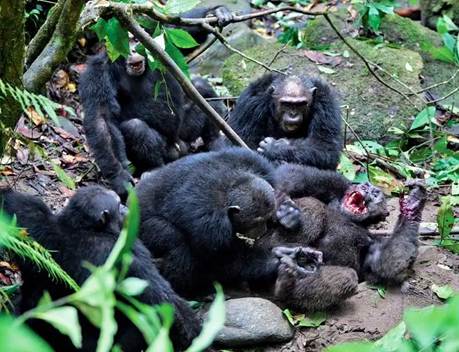
- The Ngogo chimpanzee community (~200 individuals) split permanently after 2015, forming two rival groups (Western: ~10 males; Central: ~30 males).
- Over 7 years, researchers documented 24 violent encounters, resulting in at least 7 adult male deaths and 17 infant killings.
- Reproductive isolation began before physical split, indicating early breakdown of social integration.
- Such events are extremely rare (~once in 500 years), making this case significant for understanding conflict dynamics.
Overview
- Breakdown of social bonds, not ideology, triggered conflict, suggesting that micro-level relational fractures can escalate into large-scale violence.
- Large group size (~200 individuals) may have exceeded social cohesion limits, increasing stress on alliance maintenance and cooperation mechanisms.
- Network fragmentation: previously interconnected male alliances split into distinct, non-overlapping social networks, facilitating polarisation.
- Resource competition (food variability) intensified intra-group tensions, demonstrating ecological drivers of conflict even in resource-rich environments.
- Reproductive competition played a key role, as male dominance and mating opportunities became contested, reinforcing group division.
- Catalytic events (death of key individuals, leadership change, epidemic) weakened bridging ties, accelerating social fragmentation.
- Leadership transition (alpha male change) altered power dynamics, increasing aggression, mistrust, and factionalism.
- Violence emerged gradually, not suddenly, indicating that conflict is a process of escalation rather than a single triggering event.
- Implications for human conflict: suggests wars may originate from erosion of trust, local rivalries, and institutional breakdown, not only ideology.
- Relational approach to peacebuilding: emphasises importance of daily interactions, trust-building, and conflict resolution mechanisms.
Challenges / Concerns
- Difficulty in extrapolating animal behaviour to humans, as human conflicts involve complex cultural, political, and institutional factors.
- Limited number of such long-term datasets, restricting generalisation of findings across species and contexts.
- Underestimation of structural factors (institutions, governance) when focusing primarily on interpersonal dynamics.
- Policy translation gap, as insights from behavioural ecology are rarely integrated into conflict prevention strategies.
Key Takeaways
- Highlights non-traditional explanations of conflict, focusing on social cohesion, network breakdown, and ecological pressures.
- Demonstrates interdisciplinary linkage between biology, sociology, and political science in understanding conflict origins.
- Reinforces importance of trust, cooperation, and institutional resilience in preventing conflict escalation.
Prelims Pointers
- Chimpanzees exhibit fission–fusion social systems, allowing flexible grouping patterns.
- Kibale National Park (Uganda) is a major site for primate behavioural research.
- Social network fragmentation can lead to group polarisation and conflict.
- Ecological factors like food variability can influence animal behaviour and aggression.
- Alpha male dominance hierarchy plays key role in chimpanzee social organisation.
- Behavioural studies of primates help understand evolutionary roots of human conflict and cooperation.
A weakening wind
Why in News?
- A recent study in Nature Climate Change reports weakening sea–land breezes due to ocean warming, with ~3% decline in breeze days in Mumbai and faster future deterioration projected.
Relevance
- GS I (Geography)
- Local wind systems (mesoscale circulation)
- Urban climatology
- GS III (Environment)
- Climate change impacts on microclimate
- Urban heat island & air pollution
Practice Questions
Q1.“Climate change is altering not only global systems but also local climatic processes.”Examine with reference to sea–land breezes. (250 words)
Static Background
- Sea–land breeze is a local wind system driven by differential heating between land and sea, forming a classic example of mesoscale atmospheric circulation.
- During daytime, land heats faster → low pressure over land → onshore sea breeze, while at night reverse gradient creates land breeze.
- The mechanism depends on thermal contrast (temperature gradient) between land and ocean, a key driver in Atmospheric Circulation processes.
- Sea breezes play critical role in urban microclimate regulation, improving ventilation, heat dissipation, and pollutant dispersion.
Core Issue / Key Findings
- Ocean warming reduces land–sea temperature contrast, weakening the driving force behind sea–land breezes.
- ~3% decline in breeze days observed in coastal cities like Mumbai due to historical ocean warming.
- Study across 18 global coastal megacities shows consistent decline, especially in mid-latitude cities (e.g., New York, Shanghai).
- By 2050, breezes may weaken 4.5 times faster under high-emission scenarios.
Overview
- Reduction in thermal gradient weakens pressure differences, directly reducing frequency and intensity of coastal breezes.
- Urban Heat Island (UHI) effect intensifies, as weakened breezes reduce natural cooling and ventilation capacity of coastal cities.
- Air pollution worsens, since sea breezes help disperse particulate matter and urban pollutants, especially in densely populated coastal regions.
- Climate change feedback loop: weaker breezes → higher urban temperatures → increased energy demand → higher emissions.
- Coastal megacities vulnerability increases due to combined stress of heatwaves, humidity, and reduced ventilation.
- Urban planning implications: loss of natural ventilation challenges traditional coastal city design assumptions.
- Public health risks escalate with heat stress, respiratory diseases, and reduced livability indices.
- Regional climate variability may increase as local wind systems interact with monsoon circulation and synoptic weather systems.
- Under-recognised climate risk: unlike sea-level rise, microclimatic changes like breeze weakening remain policy blind spots.
Challenges / Concerns
- Limited integration in urban climate models, leading to underestimation of heat and pollution risks.
- Lack of city-level adaptation strategies addressing weakening natural ventilation systems.
- High dependence on artificial cooling (ACs) increases energy demand and emissions, worsening climate change.
- Insufficient observational data for long-term monitoring of local wind system changes.
- Urban densification and coastal construction further obstruct airflow, compounding the problem.
Key Takeaways
- Highlights link between global warming and local climate systems (microclimate disruption).
- Demonstrates importance of thermal gradients in atmospheric processes and urban climate regulation.
- Emphasises need for climate-resilient urban planning integrating natural ventilation systems.
Prelims Pointers
- Sea breeze → daytime wind from sea to land; land breeze → reverse at night.
- Driven by temperature and pressure differences between land and sea.
- Global warming reduces thermal contrast, weakening local wind systems.
- Urban Heat Island effect worsens when natural ventilation declines.
- Coastal cities particularly vulnerable due to dependence on sea breeze cooling.
- Local winds (mesoscale phenomena) can be significantly altered by global climate change.
How altered mosquitoes could reshape malaria control
Why in News?
- Recent Nature study demonstrates genetically modified mosquitoes blocking malaria parasites in real-world African infections, marking a breakthrough beyond laboratory validation.
Relevance
- GS III (Science & Tech / Health)
- Biotechnology applications (CRISPR, gene drives)
- Public health innovation
- GS II (Governance)
- Regulatory frameworks for emerging tech
- Global health governance
Practice Questions
Q1.“Gene-drive technology represents a paradigm shift in disease control but raises significant ethical and ecological concerns.”Discuss. (250 words)
Static Background
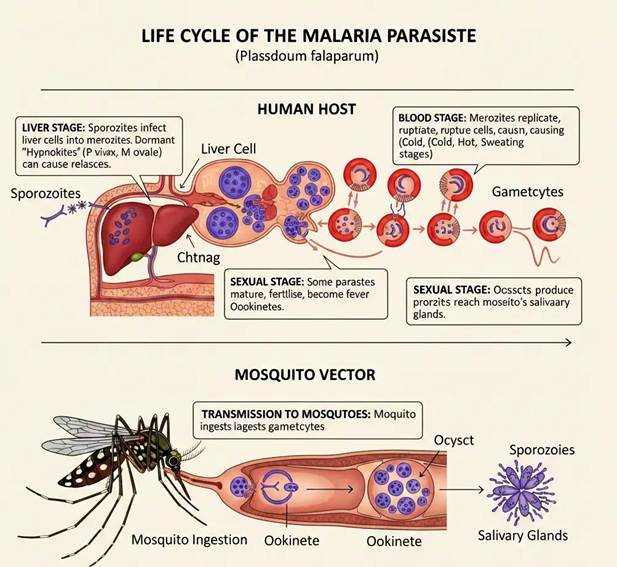
- Malaria is caused by Plasmodium parasites transmitted by female Anopheles gambiae mosquitoes, remaining a major global public health challenge.
- Traditional control relies on vector control (bed nets, insecticides) and treatment (antimalarial drugs, vaccines like RTS,S).
- Gene drives are genetic systems that bias inheritance beyond Mendelian 50% probability, enabling rapid spread of engineered traits.
- CRISPR-Cas9 enables precise genome editing, forming the basis for modern gene-drive technologies.
Core Issue / Key Findings
- Study shows genetically modified mosquitoes suppress malaria parasites from real-world infections, not just lab strains.
- Gene drive inheritance reached ~90–94% transmission, enabling rapid spread of anti-malaria traits in mosquito populations.
- Malaria still causes ~5 lakh deaths annually, mainly among children in sub-Saharan Africa.
- Rising insecticide resistance in mosquitoes and drug resistance in parasites weakening traditional control strategies.
- Population modification strategy prevents parasite development without eliminating mosquito populations.
Overview
- Paradigm shift from “killing mosquitoes” to “blocking transmission”, representing a more targeted and potentially sustainable intervention.
- Gene drive mechanism (biased inheritance) enables self-propagating control, reducing need for repeated interventions unlike insecticides.
- Population suppression vs modification: suppression reduces mosquito numbers, while modification preserves ecological role but blocks disease transmission.
- Field-relevant validation in Tanzania enhances credibility, showing feasibility in endemic, real-world ecological conditions.
- Local scientific capacity building (African research institutions) strengthens biosecurity governance and technological self-reliance.
- Resistance evolution risk: parasites may evolve countermeasures, requiring multi-gene or combinational strategies.
- Ecological considerations: modification approach reduces risk compared to species elimination, maintaining ecosystem balance.
- Integration with existing tools (nets, drugs, vaccines) essential, as gene drives alone cannot ensure eradication.
- Ethical and governance dimensions: irreversible ecological interventions demand global regulatory consensus and community consent.
- Technological safeguards (split drives, reversal drives) indicate evolving focus on containment and controllability.
Challenges / Concerns
- Ecological risks and unintended consequences due to irreversible genetic spread in wild populations.
- Ethical concerns regarding consent of affected communities and transboundary impacts.
- Regulatory vacuum in many countries for approving gene-drive organisms.
- Potential resistance evolution in parasites or mosquitoes, reducing long-term effectiveness.
- High technological complexity and cost, limiting scalability in low-income endemic regions.
- Public perception and trust deficit may hinder deployment despite scientific success.
Key Takeaways
- Illustrates application of biotechnology in public health and vector control.
- Demonstrates shift from conventional vector eradication to genetic disease control strategies.
- Highlights importance of bioethics, global governance, and risk assessment in emerging technologies.
Prelims Pointers
- Gene drive → biases inheritance (>50%), enabling rapid spread of genetic traits.
- CRISPR-Cas9 → gene-editing tool used to create gene drives.
- Anopheles gambiae → primary malaria vector in Africa.
- Population suppression vs modification → elimination vs transmission blocking strategies.
- RTS,S vaccine is first approved malaria vaccine (partial efficacy).
- Gene-drive mosquitoes not yet released in wild, still under experimental and regulatory evaluation stages.