

In-Depth News Analysis9 Items
Core TopicImportantConcise
Polity, Governance & Internal SecurityGS Paper II & III
01ISI-backed Shahzad Bhatti Network Busted — UAPA & Counter-Terror Law02Supreme Court on Solid Waste Management — SWM Rules 202603SC on Polygamy — Muslim Personal Law (Shariat) Application Act, 193704Supreme Court on Elephant Corridors — Project Elephant
International RelationsGS Paper II
05India-Thailand Exercise MAITREE-XV — India-ASEAN Defence Cooperation06India's Arctic Narrative — Parliamentary Report, Himadri Station, Svalbard Treaty
Environment & EcologyGS Paper III
07Amazon Forest Regeneration — Pioneer Species, Secondary Forests
EconomyGS Paper III
08Solar Irrigation — PM-KUSUM, Groundwater, Gujarat SKY Scheme
Social Justice & EthicsGS Paper I, II & IV
09'Perfect Victim' Myth — Nils Christie, Tarun Tejpal Case, Bombay HC
Polity, Governance & Internal SecurityGeneral Studies Papers II & III
01
Multi-State Crackdown Dismantles ISI-Backed Shahzad Bhatti Network Ahead of Independence Day
GS-III · Internal Security — Cross-Border Terrorism, UAPAPrelims + MainsPIB · 17 Aug 2026
Security agencies dismantled the Shahzad Bhatti Network (SBN), a Pakistan-based, ISI-funded terror syndicate, in a coordinated 14-state operation on 12 August 2026, neutralising planned disruptions ahead of Independence Day.
◈ Background & Context
India has faced a sustained pattern of cross-border terrorism since the 1980s, with Pakistan's Inter-Services Intelligence (ISI) financing and directing proxy networks operating within Indian territory.
The legal architecture responding to this threat was built in stages: the Terrorist and Disruptive Activities (Prevention) Act, 1987 (TADA) lapsed in 1995; it was replaced by the Prevention of Terrorism Act, 2002 (POTA), which was repealed in 2004, and finally by the current Unlawful Activities (Prevention) Act (UAPA), originally enacted in 1967 and significantly amended in 2008, 2012 and 2019.
The 2019 UAPA amendment empowered the Centre to designate individuals (not just organisations) as terrorists — a first in Indian law. UAPA is the primary statute under which SBN operatives have been charged.
The Operation — Key Facts
- Date: 12 August 2026 — timed to prevent planned attacks before Independence Day (15 August).
- Scale: 253 persons detained across 14 States; over 80 FIRs registered; 200+ arrests recorded cumulatively.
- Top states (detentions): Uttar Pradesh (62), Haryana (52), Delhi (51), Punjab (44), Rajasthan (15), Maharashtra (8).
- Intelligence mechanism: Real-time intelligence-sharing system between central agencies and State Police forces — demonstrating cooperative federalism in internal security.
- Recoveries: IEDs, grenades with Pakistan Ordnance Factory (POF) markings, pistols, live cartridges, and CCTV cameras used for espionage.
About Shahzad Bhatti Network (SBN)
- Pakistan-based, ISI-backed syndicate linked to grenade attacks, IED blasts and petrol bomb incidents and targeted killings across India.
- Operated through local conduits paid to conduct reconnaissance of police stations, defence installations and religious sites.
- Also deployed CCTV cameras for espionage — a hybrid intelligence-gathering and terror support function.
Legal Framework Applied
- UAPA (primary charge — unlawful activities, terror financing, membership of banned outfit)
- Bharatiya Nyaya Sanhita (BNS), 2023 — replaced IPC from July 2024
- Arms Act, 1959; NDPS Act, 1985; Explosive Substances Act, 1908
✎ Mains Practice Question
Cross-border terrorism remains one of the gravest threats to India's internal security. Examine the legal architecture under the UAPA and the structural challenges in coordinating multi-state counter-terrorism operations. 15 marks · 250 words
02
SC: Solid Waste Management Is Every Citizen's Responsibility, Not Just Sanitary Workers'
GS-II · Governance — Judicial Interventions; GS-III · Environment — SWMPrelims + MainsThe Hindu · 20 Aug 2026
The Supreme Court has declared that the expectation that sanitary workers alone manage India's solid waste is "constitutionally unethical," directing schools to integrate waste management education and District Collectors to engage households.
◈ Background & Context
Solid waste management in India is governed by the Solid Waste Management (SWM) Rules, first notified in 2000 under the Environment (Protection) Act, 1986, overhauled in 2016 and now updated as SWM Rules, 2026.
The rules place primary responsibility on local bodies (urban local bodies and gram panchayats) and waste generators — not only on workers.
India generates approximately 150,000 metric tonnes of municipal solid waste daily. Urban India's waste generation is projected to triple by 2047. Only about 22–25% is scientifically processed; the remainder is landfilled or dumped.
Key Court Directions (Justice S.V.N. Bhatti Bench — Aug 18, 2026)
- Department of School and Higher Education directed to integrate waste management — theoretical and practical — into school curricula with immediate effect; teachers to be trained as trainers.
- District Collectors to engage with households and educational institutions directly.
- A five-Secretary committee (Housing & Urban Affairs, Environment, Jal Shakti, Panchayati Raj, Drinking Water Sanitation + CPCB Member-Secretary) set up on May 25, 2026, to monitor the situation.
- Court noted the volume and complexity of waste — biodegradable, non-biodegradable, hazardous, e-waste, construction debris — has "outgrown what any single class of workers can handle."
Constitutional & Policy Significance
- Court framed passive waste generation as "constitutionally unethical" — anchoring environmental responsibility in Article 21 (right to a clean environment) and Article 51A(g) (fundamental duty to protect environment).
- Acknowledged that law alone cannot induce civic behaviour — necessity of bottom-up behavioural change.
- SWM Rules, 2026 cited as the extant standards requiring compliance and full infrastructure audit.
✎ Mains Practice Question
The Supreme Court's framing of passive waste generation as "constitutionally unethical" expands the scope of citizens' environmental duties. Critically examine the role of judicial intervention and community participation in addressing India's solid waste management crisis. 15 marks · 250 words
03
Supreme Court Seeks Centre's Response on Polygamy Petition; Asks for Legislative Steps
GS-II · Polity — Personal Laws, Fundamental Rights, Uniform Civil CodePrelims + MainsThe Hindu · 20 Aug 2026
Following a petition challenging the constitutional validity of polygamy permitted under the Muslim Personal Law (Shariat) Application Act, 1937, the Supreme Court has sought the Centre's response and urged consideration of legislative steps to abolish polygamy for all citizens irrespective of religion.
◈ Background & Context
Muslim personal law in India is governed primarily by the Muslim Personal Law (Shariat) Application Act, 1937. Section 2 of the Act applies Shariat — covering marriage, succession, inheritance and charities — to Muslims.
Unlike Hindus, Christians and Parsis, Muslim men are not prohibited from marrying multiple times under this law.
The debate is part of the broader Uniform Civil Code (UCC) discourse.
The 22nd Law Commission of India (2018) had noted that a UCC was "neither necessary nor desirable at this stage." The 23rd Law Commission re-examined the question and submitted a fresh report in 2024. Article 44 of the Constitution lists the UCC as a Directive Principle of State Policy (DPSP) — non-justiciable but constitutionally aspirational.
What the Petitioners Sought
- Declaration that Section 2 of the Muslim Personal Law (Shariat) Application Act, 1937 is unconstitutional as violative of Articles 14, 15 and 16 (equality provisions).
- Treat polygamy as a criminal offence under Section 82 of the Bharatiya Nyaya Sanhita (BNS) — currently applicable only to non-Muslims.
- Compulsory registration of Muslim marriages and divorces with State authorities.
- Direction to the Law Commission or Union government to draft codification aligning Muslim personal law with constitutional principles of gender equality.
Landmark Precedents
- Sarla Mudgal v Union of India (1995): SC prohibited Hindu husbands from converting to Islam to contract a second marriage; such marriage declared void.
- Lily Thomas v Union of India (2000): Reiterated Sarla Mudgal; second marriage after feigned conversion held illegal and punishable under Section 494 IPC.
- Shayara Bano v Union of India (2017): SC invalidated instant triple talaq (talaq-e-biddat) by 3:2 majority; court declined to rule on polygamy and nikah halala at the time.
- Muslim Women (Protection of Rights on Marriage) Act, 2019: Enacted by Parliament following Shayara Bano; criminalised instant triple talaq.
✎ Mains Practice Question
Personal laws in India occupy a contested space between constitutional guarantees of equality and the protection of religious identity. Examine the Supreme Court's evolving position on Muslim personal law practices in light of fundamental rights jurisprudence. 15 marks · 250 words
04
Supreme Court: No State Can Block Traditional Elephant Migration Corridors; Mandates National Survey
GS-III · Environment — Wildlife Conservation, Human-Animal ConflictPrelims + MainsThe Hindu · 18 Aug 2026
The Supreme Court declared that no State can obstruct ancient inter-State elephant migration routes, directing the Centre to conduct a fresh national survey of elephant corridors and mandating removal of walls, trenches and other impediments built by States across these pathways.
◈ Background & Context
India is home to approximately 29,000–32,000 Asian elephants — the largest wild elephant population in Asia — distributed across 14 States. The elephant is classified as Endangered on the IUCN Red List. In India it is a Schedule I species under the Wildlife (Protection) Act, 1972, affording the highest legal protection.
Project Elephant, launched in 1992 under the Ministry of Environment, Forest and Climate Change (MoEFCC), aims to protect elephant habitats, mitigate human-elephant conflict and maintain genetic viability of wild elephant populations.
As of 2025, India has 33 Elephant Reserves covering approximately 80,777 sq km across 14 States.
Elephant corridors are defined linear land strips that connect fragmented habitats and allow seasonal migration. The Wildlife Trust of India (WTI) had identified 101 elephant corridors across India in its landmark 2005 study, updated in 2017.
What Triggered This Case
- A petition was filed seeking protection of an elephant corridor in West Bengal, specifically the route through which elephant herds migrate from Nepal and North Bengal into Odisha and Chhattisgarh.
- Odisha and Chhattisgarh had built walls on this migratory path, directly impeding trans-State movement.
- A previous national corridor survey was conducted in 2023; the Supreme Court held it insufficient and ordered a fresh one.
Key SC Directions (CJI Surya Kant Bench — Aug 17, 2026)
- Centre to conduct a fresh nationwide survey identifying States that have built walls or dug trenches on inter-State elephant corridors.
- Survey report to be submitted within 8 weeks, also covering the status of implementation of the ban on firearms, explosives and fire torches (fireballs) used to divert elephant herds.
- MoEFCC's guidelines on maintaining corridors must be complied with mandatorily.
- Court directed the Centre to create synergy across States — "Elephant corridors are not State-specific."
- Clear ruling: crop damage and farmer hardship are not grounds to block elephant migration — "solutions lie elsewhere."
33 Elephant Reserves — State-wise Distribution
Figure 1 — Elephant Reserves in India: State-wise Reference (Project Elephant, MoEFCC)
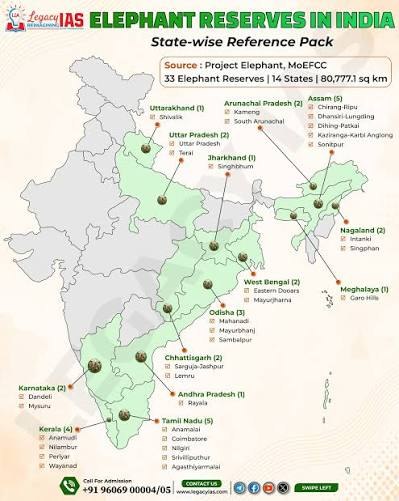
India's 33 Elephant Reserves span 14 States covering 80,777 sq km. The SC's corridor order will directly impact connected reserves across North Bengal–Odisha–Chhattisgarh and Nepal–India border landscapes. Image: Legacy IAS Elephant Reserves Reference Pack (Project Elephant, MoEFCC); reproduced for educational use.
Human-Elephant Conflict (HEC) — Context
- Over 500 humans are killed annually in India in elephant encounters; 100+ elephants die each year from electrocution, train accidents, and poisoning.
- Conventional mitigation: early warning systems, bee-hive fences, chilli fences, community watch groups, compensation mechanisms.
- The court's ruling rejects physical blockades as a conflict solution, pushing States toward these non-barrier coexistence strategies.
▤ Key Numbers
- 29,000–32,000 — Wild Asian elephants in India (largest population in Asia)
- 33 — Elephant Reserves; 14 States; 80,777 sq km
- 101 — Elephant corridors identified (WTI, updated 2017)
- 1992 — Year Project Elephant launched
- 8 weeks — Deadline for Centre to submit fresh survey report to SC
✎ Mains Practice Question
Human-elephant conflict is intensifying as forest fragmentation accelerates in India. Examine the role of elephant corridors in wildlife conservation and critically assess the legal and institutional mechanisms to protect them. 15 marks · 250 words
International RelationsGeneral Studies Paper II
05
India-Thailand Joint Military Exercise MAITREE-XV Commences — Counter-Insurgency Focus Under UN Charter Chapter VII
GS-II · IR — India-ASEAN Relations, Defence DiplomacyPrelims + MainsAIR · 20 Aug 2026
The 15th edition of the India-Thailand Joint Military Exercise MAITREE has commenced in Thailand, with a 85-member Indian contingent from 9 Gorkha Rifles and a corresponding Royal Thai Army contingent focusing on counter-insurgency and counter-terrorism operations in jungle and semi-urban environments.
◈ Background & Context
India's Act East Policy (upgraded from "Look East" in 2014) prioritises deepening strategic and defence ties with ASEAN nations.
Thailand — a founding ASEAN member and a major non-NATO US ally — is a key partner in India's eastern neighbourhood engagement. Exercise MAITREE ('friendship' in Thai) was established to institutionalise this bilateral defence relationship.
India has numerous bilateral military exercises across the globe: Shakti (France), Tasman Saber (Australia), Yudh Abhyas (USA), Mitra Shakti (Sri Lanka), Hand in Hand (China — currently suspended), BOLD KURUKSHETRA (Singapore). MAITREE is India's primary bilateral exercise with Thailand.
Key Facts — MAITREE-XV
- 15th edition; venue: Thailand (previous edition at Foreign Training Node, Umroi, Meghalaya, September 2025)
- Indian contingent: 85 personnel, primarily from 9 Gorkha Rifles
- Thai contingent: 85 personnel from 3rd Battalion, 25th Infantry Brigade, 5th Division, Royal Thai Army
- Focus: Joint Counter Insurgency and Counter Terrorist Operations in jungle and semi-urban terrain — Chapter VII of UN Charter (Action with Respect to Threats to Peace)
- Training elements: Field exercises, combat discussions, lectures, demonstrations and a culminating validation exercise; exchange of operational experience and contemporary equipment showcase
- Duration: concludes 31 August 2026
Figure 2 — Thailand: Location & Strategic Context
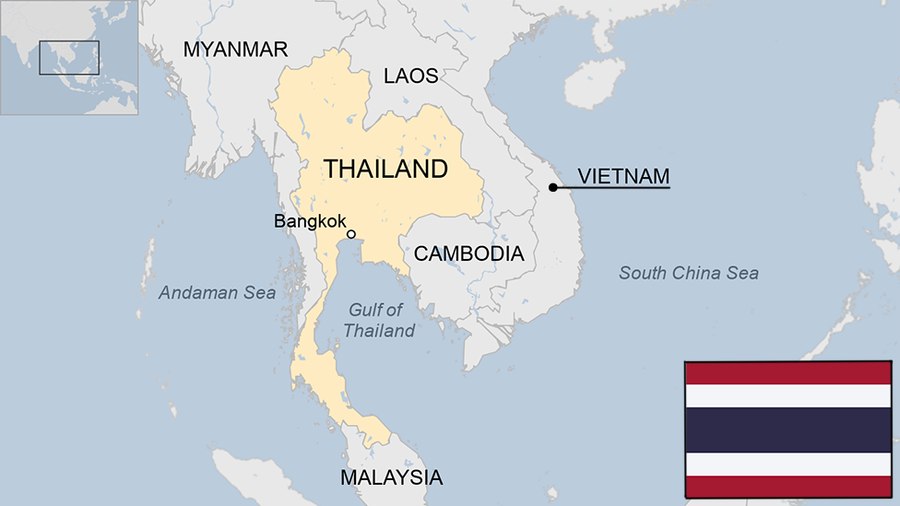
Thailand borders Myanmar, Laos, Cambodia and Malaysia and has coastlines on the Andaman Sea and the Gulf of Thailand — making it a pivotal Indo-Pacific partner for India's Act East Policy. Image courtesy BBC; reproduced with credit for educational use.
India-ASEAN Defence Architecture
- India and ASEAN share an ASEAN-India Strategic Partnership (upgraded to Comprehensive Strategic Partnership in 2022).
- ASEAN Defence Ministers' Meeting Plus (ADMM+): India participates as a Plus-country alongside US, China, Japan, South Korea, Australia, Russia and New Zealand.
- Chapter VII, UN Charter: Authorises the UN Security Council to take action — including use of force — against threats to international peace and security. Training under its framework signals willingness to contribute to UN-mandated operations.
✎ Mains Practice Question
India's Act East Policy has deepened defence and security cooperation with ASEAN nations. Examine the significance of bilateral military exercises in advancing India's strategic interests in the Indo-Pacific. 10 marks · 150 words
06
From Science to Geopolitics: Parliamentary Committee Calls for a Coherent Indian Arctic Narrative
GS-II · IR — Polar Regions, India's Foreign Policy; GS-III · S&T — Climate, Polar ResearchPrelims + MainsThe Indian Express · 20 Aug 2026
A Parliamentary Standing Committee report on India's role in Arctic and Antarctic regions has flagged critical gaps in funding, institutional coherence and naval capability, urging India to translate its 2022 Arctic Policy into a decisive, multi-domain strategic engagement.
◈ Background & Context
India's Arctic engagement began in 2007 with the establishment of the Himadri research station at Ny-Ålesund, Svalbard (Norway). India is one of only two developing countries with a permanent scientific presence in the Arctic.
India's formal policy framework arrived with the India Arctic Policy, 2022, articulating objectives around climate research, sustainable development, and international cooperation.
Crucially, India — as part of the British Dominion — was among the original 14 signatories of the Svalbard Treaty, 1920. This entitles Indian nationals to visit Svalbard without a visa and engage in commercial activities there — a legal right rarely utilised.
Why the Arctic Matters to India
- Monsoon teleconnection: Rapid Arctic warming and declining sea ice alter atmospheric circulation patterns that directly influence the South Asian monsoon. India's agriculture — contributing ~18% of GDP, supporting 50%+ of the population — depends on the southwest monsoon for ~70% of annual rainfall.
- Sea-level rise: Arctic ice melt contributes significantly to global sea-level rise, threatening India's 11,098 km coastline and over 250 million people in vulnerable coastal zones of South Asia by mid-century.
- Geopolitics: The Arctic is emerging as a contest zone for the US, Russia and China — all strategic actors for India. China, despite being a non-Arctic state, now operates multiple polar-capable vessels and is building a nuclear icebreaker.
- Strategic minerals and shipping: The Northern Sea Route (NSR) — shorter by ~40% vs Suez Canal for Asia-Europe shipping — is becoming navigable as Arctic ice retreats, with implications for India's trade routes.
Key Gaps Identified by the Parliamentary Committee
- Funding: India spent only ₹17.53 crore on Arctic activities in 2024–25 — less than one-tenth of Antarctica expenditure and less than the cost of one km of a flyover.
- Institutional fragmentation: Arctic affairs are divided across four different territorial and functional divisions of the Ministry of External Affairs — no dedicated senior official, no whole-of-government approach.
- Polar Research Vessel (PRV): Sanctioned in 2014, India's indigenous PRV is expected only by end of this decade. Without it, India's scientific reach beyond Svalbard depends entirely on foreign-chartered vessels.
- Arctic Council: India holds Observer status at the Arctic Council since 2013 but lacks the capacity to translate observation into influence.
Figure 3 — India vs China: Comparative Arctic Engagement (2025)
IndiaChinaResearch stations1 (Himadri, Ny-Ålesund)2+ (Yellow River + others)Polar vesselsNone (PRV sanctioned 2014)Multiple (incl. nuclear icebreaker WIP)Arctic Council statusObserver (since 2013)Observer (since 2013); far greater presenceArctic spending (2024–25)₹17.53 croreEstimated 20× India's spendPolicy frameworkIndia Arctic Policy, 2022China's Arctic Policy, 2018 ("Near-Arctic state")Svalbard Treaty signatory (1920)Non-signatory; "Polar Silk Road" strategy
India's legal advantage (Svalbard Treaty signatory since 1920) is offset by chronic underinvestment; China's Arctic footprint is decisively larger despite being a non-Arctic state.
▤ Arctic — Key Numbers
- 1920 — Svalbard Treaty; India among 14 original signatories
- 2007 — Himadri station established at Ny-Ålesund
- 2013 — India gains Observer status at the Arctic Council
- 2022 — India Arctic Policy released
- ₹17.53 crore — India's Arctic spending, 2024–25 (< 1/10th of Antarctica spend)
- 11,098 km — India's coastline at risk from Arctic-driven sea-level rise
✎ Mains Practice Question
The Arctic is rapidly transitioning from a zone of scientific inquiry to one of geopolitical contestation. Critically examine India's Arctic interests and the gaps between its policy ambitions and operational capabilities. 15 marks · 250 words
Environment & EcologyGeneral Studies Paper III
07
A Few Pioneer Species Drive Amazon Regeneration: Brazilian Study Unlocks Restoration Blueprint
GS-III · Environment — Forests, Biodiversity, Climate ChangePrelims + MainsThe Hindu · AFP · 20 Aug 2026
A peer-reviewed study published in Global Change Biology has found that just 15–25 pioneer tree species out of thousands in the Amazon do most of the work in regenerating secondary forests, providing a targeted blueprint for faster, more cost-effective tropical forest restoration.
◈ Background & Context
The Amazon Rainforest — spanning 9 countries (Brazil, Peru, Colombia, Venezuela, Ecuador, Bolivia, Guyana, Suriname, French Guiana) — is the world's largest tropical rainforest, covering approximately 5.5 million sq km.
It stores an estimated 150–200 billion tonnes of carbon, making it the single most important terrestrial carbon sink on Earth.
Brazil's National Institute for Space Research (INPE) data shows an area roughly the size of Spain has been deforested in Brazil over the past four decades. However, the Amazon also contains secondary forests — areas where trees have begun regrowing after deforestation — covering an area the size of Uruguay.
Key Findings — Global Change Biology Study
- Research led by Fernando Elias (Emilio Goeldi Museum of Pará), under the Sustainable Amazon Network, analysed 25,000+ trees and palms in four regions of eastern Amazonia — regeneration periods from 1 to 60 years.
- Just 15–25 pioneer species dominate early forest regeneration — tolerating poor soil, intense sunlight and growing rapidly.
- Pioneer canopy can reduce sub-canopy temperatures by up to 6°C — essential for shade-requiring mature-forest species to establish.
- Pioneer species produce dense leaf litter, increasing organic matter and triggering soil recovery — the "beginning of forest recovery."
- Key species identified: Cecropia palmata (pale trunk, large hand-shaped leaves), Inga alba (long edible pods), Inaja palm, Babassu palm (oil-rich nuts, valued by rural communities).
Significance for Restoration Science & Policy
- Knowing which species dominate carbon stocks allows targeted restoration — directing limited funding toward maximum-impact species rather than generic reforestation.
- Connects to UNFCCC commitments: Brazil under President Lula has committed to zero deforestation by 2030; deforestation dropped to its lowest in a decade in 2025.
- India's own National Mission for a Green India (Green India Mission) under the National Action Plan on Climate Change (NAPCC) could adopt similar pioneer-species targeting for degraded forest restoration.
- Secondary forests also play a role under REDD+ (Reducing Emissions from Deforestation and forest Degradation) — preserved secondary forest earns carbon credits.
Figure 4 — The Amazon Biome: 9-Country Spread
The Amazon biome spans 9 countries, with ~60% lying within Brazil. Secondary forests the size of Uruguay are actively regenerating within this footprint — and pioneer species drive that recovery. Image courtesy BBC; reproduced with credit for educational use.
▤ Amazon — Key Numbers
- 5.5 million sq km — Amazon Rainforest extent
- 9 countries span the Amazon biome
- ~Spain-sized area deforested in Brazil over 40 years (INPE)
- ~Uruguay-sized secondary forest area actively regenerating
- 15–25 pioneer species drive most of early forest regeneration
- Up to 6°C — temperature reduction under pioneer canopy vs open ground
✎ Mains Practice Question
Tropical secondary forests are increasingly recognised as critical assets for carbon sequestration and biodiversity recovery. Examine the role of pioneer species in forest regeneration and the implications for India's forest restoration commitments under the Paris Agreement. 15 marks · 250 words
EconomyGeneral Studies Paper III
08
Solar Irrigation and Groundwater: Not a Crisis If Done Right — PM-KUSUM, SKY Scheme and Model-Specific Evidence
GS-III · Economy — Agriculture, Energy, Water ResourcesPrelims + MainsThe Hindu · 20 Aug 2026
A research analysis argues that concerns about solar irrigation worsening India's groundwater crisis are model-specific and context-dependent — grid-connected solar with feed-in tariffs, as demonstrated by Gujarat's Suryashakti Kisan Yojana (SKY), can actually incentivise water conservation while generating additional income for farmers.
◈ Background & Context
India has approximately 25 million agricultural water pumps, most powered by heavily subsidised grid electricity (agricultural electricity subsidies across States exceed ₹1 lakh crore per year) or diesel.
Groundwater irrigation accounts for an estimated 45–62 million tonnes of CO₂ annually. Over-exploitation of aquifers — particularly in Punjab, Haryana and Rajasthan — has reached critical levels.
The Pradhan Mantri Kisan Urja Suraksha evam Utthan Mahabhiyan (PM-KUSUM) scheme, launched in 2019 under the Ministry of New and Renewable Energy (MNRE), aims to solarise agricultural pumps and feeder lines to reduce both electricity subsidies and diesel dependence.
By 2026, over 2.5 million solar pumps have been installed under PM-KUSUM.
Why the Standard Concern Is Too Simplistic
- Model diversity: "Solar irrigation" is not a single model. Models differ in design, ownership structure, and pricing incentives — each carrying different groundwater implications.
- Regional hydrogeology matters: In hard-rock aquifer regions with limited recharge and rainfed cropping (e.g., Deccan Plateau), solar irrigation changed water use very little. Over-exploitation risk is highest in alluvial aquifer regions already under pressure (Indo-Gangetic Plain).
- Eastern India contrast: Large rainfed areas with high diesel costs; solar irrigation here would meaningfully expand agricultural productivity and climate resilience — the concern should be access, not over-abstraction.
Evidence: Grid-Connected Solar as Conservation Incentive
- Gujarat Suryashakti Kisan Yojana (SKY): ~100 agricultural feeders transitioned to solar; farmers given feed-in tariff of ~₹7/unit for surplus power exported to grid. Solar farmers showed significantly slower growth in energy consumption and irrigation application than non-solar farmers.
- Farmers earned an average of ~₹21,900/year by exporting surplus electricity — converting them from energy consumers to energy producers.
- Each grid-connected solar farmer in Gujarat offsets approximately 12.3 tonnes of CO₂ annually through on-farm use and exports; subsidies recovered within the first two years.
- Bangladesh fee-for-service centralised model: Pump owners serving multiple farmers showed no increase in water use vs diesel-irrigated farms — financial incentive to serve more customers required efficient water distribution.
Policy Recommendations
- PM-KUSUM 2.0 (under preparation) should differentiate deployment by region: standalone pumps in irrigation-deficit, low-groundwater-risk areas; grid-connected feeders in water-stressed zones.
- Grid-connected models need simpler connection procedures and attractive buyback prices reflecting local water and crop value.
- Feeder-level solar transitions should pair with micro-irrigation incentives and direct cash payments for reduced pumping — similar to Punjab's 'Pani Bachao, Paisa Kamao' and Haryana's 'Mera Pani Meri Virasat'.
- Scale standalone pumps through water-user associations, water-selling entrepreneurs and farmer cooperatives in irrigation-deprived regions.
✎ Mains Practice Question
Solar irrigation in India presents both an opportunity and a risk for sustainable groundwater management. Critically analyse the model-specific and regional factors that should guide the design of PM-KUSUM 2.0 to balance energy transition with aquifer conservation. 15 marks · 250 words
Social Justice & EthicsGeneral Studies Papers I, II & IV
09
The 'Perfect Victim' Myth: Bombay HC Tejpal Verdict and the Criminology of Victimhood
GS-II · Social Justice — Women's Rights, Judicial Reform; GS-IV · Ethics — Integrity & ImpartialityMains-orientedThe Hindu · 20 Aug 2026
The Goa Division Bench of the Bombay High Court's conviction of a former editor for sexual assault, overturning an acquittal, has renewed focus on Norwegian criminologist Nils Christie's 'ideal victim' theory and its distorting influence on judicial assessments of sexual assault survivors in India.
◈ Background & Context
The concept of the 'ideal victim' was theorised by Norwegian criminologist Nils Christie in 1986 (essay in From Crime Policy to Victim Policy).
Christie argued that society grants or withholds 'victim status' based on perceived vulnerability, respectability and blamelessness — and that this socially constructed standard is deeply shaped by gender, caste and class.
In Indian sexual assault jurisprudence, this theory has played out repeatedly.
The Goa Sessions Court (2021) acquitted the accused, partly based on the complainant's composed demeanour on CCTV footage — a textbook example of demanding a "performance of trauma." The Bombay High Court (August 2026) termed this approach "perverse," and delivered a 10-year rigorous imprisonment sentence.
Christie's 'Ideal Victim' — Five Attributes
- Weak — female, disabled, very young or very old relative to the offender.
- Respectable activities — engaged in socially approved conduct at time of crime.
- No fault — cannot be blamed for being where they were.
- Stranger — did not know the offender personally.
- Big and bad offender — perpetrator has no sympathetic backstory.
Christie noted: when none of these attributes are met — when the offender is an acquaintance, a liberal intellectual, a person of social capital — the victim's status itself becomes contested, regardless of the evidence.
Indian Case Law — The Pattern
- Mathura case (1979): Sessions court relied on survivor's prior sexual experience to infer consent; SC acquitted accused citing absence of resistance. Led to the Criminal Law Amendment Act, 1983 reversing the burden of proof in custodial rape.
- Bhanwari Devi case (1992): Jaipur court acquitted accused on caste grounds — reasoning upper-caste men would not "pollute themselves." Catalysed the Vishakha Guidelines (1997) and eventually the Sexual Harassment of Women at Workplace (POSH) Act, 2013.
- Jindal case (2017): Punjab & Haryana HC suspended sentences of convicted students; described survivor's conduct as having a "perverse streak."
- Tejpal case (2026): Bombay HC criticised Sessions Court for focusing on complainant's "conduct, reactions and personal background" instead of the evidence on record.
Institutional Reform Signal
- Former CJI B.R. Gavai (2025) apologised on behalf of the judiciary for the SC judgment in the Mathura case — calling it a "moment of institutional embarrassment."
- SC issued a report on August 3, 2026, recommending greater gender sensitivity in judicial writing — cautioning against drawing adverse conclusions from delayed reporting, absence of physical injuries, inconsistencies or demeanour.
✎ Mains Practice Question
The 'ideal victim' construct has repeatedly shaped judicial assessments in sexual assault cases in India, often at the expense of survivors' credibility. Critically examine this phenomenon with reference to landmark judgments and the steps taken to address systemic gender bias in the Indian judiciary. 15 marks · 250 words