

Contents
21 July 2026
- Kukrail Night Safari — Supreme Court Clears India's First Night Safari ProjectGS 3
- R. Vairamuthu Conferred the 60th Jnanpith AwardGS 1
- Indian Grey Hornbill Breeds for Fourth Consecutive Year at GirGS 3
- Spotted Deer Translocation from Sasan Gir to Mandvi ForestGS 3
- Polluted River Stretches Decline from 351 to 296GS 3
- Why Inflation Is Rising in India — A Structural PerspectiveGS 3
- Magnetic Levitation: How Maglev Trains WorkGS 3
- India Approves First Dengue Vaccine — QDENGAGS 2
- Security vs Ecology: BSF Considers Fencing in the SundarbansGS 3
- Right to Protest — Constitutional Framework and Legal RestrictionsGS 2
Article 01
Kukrail Night Safari — Supreme Court Clears India's First Night Safari Project
GS Paper 3 — Environment & Ecology | Biodiversity | Conservation
Why in News
The Supreme Court has granted approval to the Uttar Pradesh government's Rs 1,510-crore Kukrail Night Safari and Day Zoo project in Lucknow. The project, proposed inside the ecologically sensitive Kukrail Reserve Forest, will be India's first night safari and the world's fifth, after Singapore, Thailand, China, and Indonesia. The approval follows four years of regulatory and judicial scrutiny.
Static Background
Kukrail Reserve Forest
- Location and Extent: Notified in 1950, Kukrail Reserve Forest spans approximately 4,500 acres on the outskirts of Lucknow, Uttar Pradesh — the city's largest contiguous green cover.
- Etymology: Named after the Kukrail stream, a tributary of the Gomti River that flows through the forest.
- Ecological Functions: Serves as Lucknow's key urban green lung — aiding carbon sequestration, temperature regulation, groundwater recharge, air purification, and climate resilience.
- Biodiversity Value: Supports birds, reptiles (including gharials), butterflies, and small mammals; contributes to the ecological health of the Kukrail stream.
- Kukrail Gharial Rehabilitation Centre (KGRC): Established in 1975, the KGRC is India's first gharial conservation centre. Over five decades, it has emerged as one of the world's most successful reptile breeding facilities, releasing gharials into rivers across India. It houses research laboratories, veterinary facilities, and rescue enclosures for gharials and turtles.
Gharial — Key Facts
- Scientific Name: Gavialis gangeticus — a critically endangered crocodilian native to the Indian subcontinent.
- IUCN Status: Critically Endangered; one of the rarest reptiles on earth.
- Habitat: Restricted primarily to deep, fast-flowing rivers, especially the Chambal, Gandak, and Girwa rivers.
- Conservation Significance: The gharial is an indicator species for river health and a flagship of India's reptile conservation programme.
Regulatory Framework for Zoo and Night Safari Projects
- Central Zoo Authority (CZA): A statutory body under the Ministry of Environment, Forest and Climate Change (MoEFCC) responsible for oversight, recognition, and regulation of zoos in India under the Wild Life (Protection) Act, 1972.
- Central Empowered Committee (CEC): A Supreme Court-appointed body that reviews projects involving forest land, wildlife habitat, and ecological concerns; it conducted inspections and recommended design modifications for the Kukrail project.
- Multiple Clearances Required: Projects inside reserve forests require State Wildlife Board approval, CZA recognition, and forest, wildlife, and environmental clearances under the Forest Conservation Act and Environment (Protection) Act.
Project Details and Design
The Rs 1,510-crore project will be developed across 855 acres within the reserve forest in two phases. Phase I covers the Night Safari and Eco-tourism Zone; Phase II encompasses the Day Zoo. The night safari will feature theme-based zones inspired by domestic and international wildlife landscapes, with naturalistic habitats incorporating grasslands, wetlands, rock formations, and native vegetation.
A key design feature is a specialised lighting system engineered to replicate the intensity and quality of natural moonlight. This allows visitors to observe nocturnal animals during their naturally active hours without causing stress or discomfort to the animals. Transport within the facility will be by battery-operated vehicles to minimise noise and emissions. The project master plan also includes conservation breeding facilities, wildlife interpretation centres, cafeterias, a 7D theatre, and an auditorium.
Proposed species habitats include Asiatic lions, Bengal tigers, leopards, hyenas, flying squirrels, and gharials. The facility is designed to accommodate approximately 4,000 visitors on weekdays and around 8,000 on weekends and public holidays.
Why Four Years of Scrutiny?
The project was first announced by Chief Minister Yogi Adityanath in July 2022 and received cabinet approval the following month. However, its location within the Kukrail Reserve Forest — a protected urban green space — triggered multiple layers of regulatory review. State Wildlife Board and CZA approvals came in 2023. The Supreme Court-appointed CEC conducted site inspections, sought project design modifications, and the SC heard multiple rounds of arguments before clearing the project. The prolonged process reflects the legal and ecological weight given to forest and wildlife habitat diversion in India.
Conclusion / Way Forward: The Kukrail Night Safari represents an attempt to integrate wildlife conservation, research, and eco-tourism — a model that, if well-executed, could demonstrate how urban biodiversity assets can generate conservation value alongside public engagement. The project's success, however, will depend on rigorous implementation of habitat design, moonlight-mimicking lighting standards, and the continuation of the KGRC's breeding and release programme. The SC's scrutiny sets a precedent that forest-based tourism projects must justify ecological trade-offs, not merely offer economic or tourism rationale.
Prelims Pointers
- World's Night Safaris (in sequence): Singapore (first), Thailand, China, Indonesia — Kukrail (Lucknow) will be the fifth if completed.
- Project Cost and Area: Rs 1,510 crore; 855 acres within Kukrail Reserve Forest (total forest area: ~4,500 acres); two phases — Night Safari & Eco-tourism Zone (Phase I), Day Zoo (Phase II).
- Kukrail Reserve Forest: Notified 1950; named after Kukrail stream, a tributary of the Gomti River; located in Lucknow, UP.
- KGRC: Kukrail Gharial Rehabilitation Centre — established 1975; India's first gharial conservation facility; breeds and releases gharials into rivers across India. Note: this is an existing facility, not part of the new project.
- Gharial (Gavialis gangeticus): IUCN — Critically Endangered; habitat: deep fast-flowing rivers (Chambal, Gandak, Girwa); indicator species of river health.
- Central Zoo Authority (CZA): Statutory body under MoEFCC; regulates zoos under the Wild Life (Protection) Act, 1972; granted approval to this project in 2023.
- Central Empowered Committee (CEC): Supreme Court-appointed; reviews forest and wildlife diversion cases; conducted inspections of the Kukrail project.
- Key Feature: Moonlight-mimicking lighting system allows nocturnal animal observation without disturbing the animals — distinguishes a night safari from a conventional zoo.
- Note on Status: The Kukrail Night Safari has received SC approval and regulatory clearances but is not yet operational — it is a proposed project cleared for construction.
Mains Practice Question
India's urban forests are simultaneously ecological assets and development pressure points. Critically analyse the Kukrail Night Safari case as a model for balancing eco-tourism, urban biodiversity conservation, and wildlife law compliance.
GS Paper 3 | Environment & Ecology | 15 Marks | 250 Words
MCQ Practice
Which of the following statements about the Kukrail Night Safari project is correct?
- AIt will be the world's first night safari, surpassing Singapore's.
- BIt is located within the Kukrail Reserve Forest and has received Supreme Court approval for construction.
- CThe project includes a moonlight-mimicking lighting system to allow observation of nocturnal animals without disturbing them.
- DThe Central Empowered Committee is a statutory body under the Ministry of Environment, Forest and Climate Change.
Answer: C
Option A is incorrect — Kukrail will be the world's fifth night safari (after Singapore, Thailand, China, Indonesia). Option B is partially correct but incomplete — while the project is within Kukrail Reserve Forest and has SC approval, the phrasing "will be the world's first" in option A and the CEC description in D make C the best single correct statement. Option D is incorrect — the CEC is a Supreme Court-appointed committee, not a statutory body under MoEFCC. Option C is accurate: the moonlight-mimicking lighting is the defining design feature of the night safari concept.
Article 02
R. Vairamuthu Conferred the 60th Jnanpith Award
GS Paper 1 — Art & Culture | Indian Literature | Literary Awards
Why in News
Tamil poet and lyricist R. Vairamuthu has been conferred the 60th Jnanpith Award for the year 2025. He is the third Tamil literary figure to receive this honour — the highest literary award in India — ending a 24-year gap since a Tamil writer last received the Jnanpith. His earlier recipients from Tamil literature were the late writers Akilan and Jayakanthan. Vairamuthu had previously won the Sahitya Akademi Award in 2003 for his work Kallikattu Ithikasam.
Static Background
The Jnanpith Award — Overview
- Established: 1961, by the Bharatiya Jnanpith — a cultural organisation founded in 1944 by industrialist Sahu Shanti Prasad Jain and his wife Rama Jain.
- Nature: India's highest literary honour, often referred to as the "Nobel Prize of Indian literature." Recognises exceptional and outstanding contribution to Indian literature over a lifetime.
- First Award: Conferred in 1965 to G. Sankara Kurup for Malayalam literature.
- Scope of Works: From 1965 to 1981, the award was given for a specific book or work. Since 1982, it has recognised an author's overall lifetime contribution to Indian literature.
- Language Coverage: All 22 languages listed in the Eighth Schedule of the Constitution; English was included in 2013. No posthumous awards are given.
- Prize Components: A cash prize of Rs 11 lakh, a citation, and a bronze statuette of Vagdevi (Saraswati — the goddess of knowledge and speech). The award is customarily presented by the President of India.
- Selection: A high-level committee called the Pravara Parishad, comprising eminent scholars and litterateurs, evaluates nominations on the basis of creativity, vision, and impact on Indian literature.
Key Milestones in Jnanpith History
| Milestone | Recipient / Detail |
|---|---|
| First recipient (1965) | G. Sankara Kurup — Malayalam |
| First woman recipient (1976) | Ashapurna Devi — Bengali |
| First English-language winner (2018) | Amitav Ghosh |
| Tamil recipients | Akilan, Jayakanthan, R. Vairamuthu (60th, 2025) |
| 60th Jnanpith (2025) | R. Vairamuthu — Tamil |
R. Vairamuthu — Profile
- Renowned Tamil poet, lyricist, and literary figure; known primarily for his contributions to Tamil film poetry and classical literary forms.
- Recipient of the Sahitya Akademi Award (2003) for Kallikattu Ithikasam.
- Third Tamil literary figure to receive the Jnanpith Award, after a gap of 24 years.
Related: Sahitya Akademi Award
- Awarded annually by the Sahitya Akademi (India's national academy of letters) for outstanding literary works in 24 recognised languages.
- The Sahitya Akademi is an autonomous body under the Ministry of Culture, established in 1954.
- Unlike the Jnanpith (lifetime achievement), the Sahitya Akademi Award is typically for a specific published work.
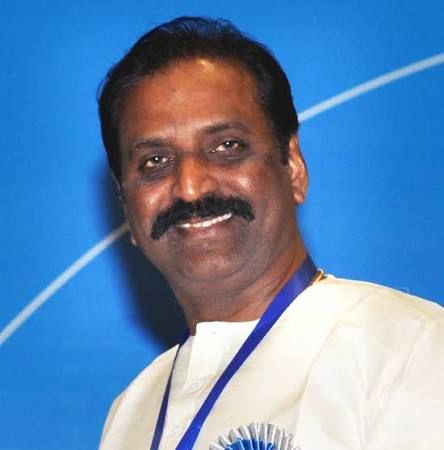
Tamil poet and lyricist R. Vairamuthu conferred the 60th Jnanpith Award for 2025 — third Tamil literary figure to receive India's highest literary honour.
Conclusion / Way Forward: The Jnanpith Award's recognition of Tamil literature through Vairamuthu underscores the cultural and linguistic plurality that the award has historically sought to celebrate. As India's only literary honour spanning all Eighth Schedule languages plus English, the Jnanpith continues to be a significant barometer of the vitality of regional literary traditions. For UPSC aspirants, the award's institutional history, selection process, and key recipients are all important recurring themes in GS Paper 1.
Prelims Pointers
- 60th Jnanpith Award (2025): Conferred on R. Vairamuthu (Tamil) — third Tamil recipient, after Akilan and Jayakanthan; ends a 24-year gap for Tamil literature.
- Jnanpith Award — Instituted: 1961 by Bharatiya Jnanpith (est. 1944); first award given in 1965 to G. Sankara Kurup (Malayalam).
- Prize: Rs 11 lakh cash + citation + bronze statuette of Vagdevi (Saraswati); presented by the President of India.
- Language Scope: All 22 Eighth Schedule languages + English (included 2013); no posthumous awards.
- Selection Body: Pravara Parishad — a high-level committee of scholars and litterateurs.
- Shift in Award Basis: 1965–1981: for a specific work; 1982 onwards: for lifetime contribution.
- Key Firsts: First woman — Ashapurna Devi, 1976 (Bengali); First English winner — Amitav Ghosh, 2018.
- Vairamuthu's earlier award: Sahitya Akademi Award, 2003, for Kallikattu Ithikasam.
- Bharatiya Jnanpith: Cultural organisation; founded by Sahu Shanti Prasad Jain and Rama Jain; established 1944.
Mains Practice Question
Literary awards such as the Jnanpith play a significant role in preserving and promoting India's linguistic diversity. Examine the institutional significance of the Jnanpith Award and its contribution to Indian cultural integration.
GS Paper 1 | Indian Culture & Heritage | 10 Marks | 150 Words
MCQ Practice
Consider the following statement about the Jnanpith Award:
"The Jnanpith Award has been conferred for an author's lifetime contribution to Indian literature since its very inception in 1965."
Is this statement correct?
- AYes, the award has always recognised lifetime contribution.
- BNo, from 1965 to 1981 it was given for a specific work; the shift to lifetime contribution came in 1982.
- CNo, the award was for lifetime contribution only after English was included in 2013.
- DYes, but only for authors writing in Eighth Schedule languages.
Answer: B
The Jnanpith Award was initially given for a specific published work (1965–1981). Since 1982, it has been awarded for an author's overall lifetime contribution to Indian literature. The inclusion of English in 2013 expanded the award's language scope but did not change this basis. Options A, C, and D are therefore incorrect.
Article 03
Indian Grey Hornbill Breeds for Fourth Consecutive Year at Gir
GS Paper 3 — Environment & Ecology | Wildlife Conservation | Species Reintroduction
Why in News
More than six decades after the Indian Grey Hornbill disappeared from Gujarat's Gir forests, a peer-reviewed study published in the international journal Birds has documented four consecutive years of successful breeding following a structured reintroduction programme that began in 2021. The findings represent a significant milestone in India's wildlife restoration efforts and mark the species' confirmed re-establishment in the Gir ecosystem.
Static Background
Indian Grey Hornbill — Species Profile
- Scientific Name: Ocyceros birostris
- IUCN Status: Least Concern
- Distribution: The most widely distributed hornbill species in India; range extends from Jammu to Kerala and from Rajasthan to West Bengal. Also found in parts of Pakistan, Nepal, and Bangladesh.
- Habitat Preference: Dry plains, foothills, open habitats; found in deciduous forests, orchards, thorny scrublands, gardens, and urban areas with old trees.
- Appearance: Ashy-grey body with long tail feathers bearing a white band; curved, ivory-coloured beak that is blackish at the base. A narrow protruding casque sits on the upper mandible — larger in males than females.
- Eye Features: Adults have red eyes with grey periorbital skin; juveniles have brown-orange eyes with reddish-orange skin.
- Ecological Role: An important seed disperser — contributes to natural forest regeneration across forest, agricultural, and urban landscapes.
Gir National Park and Wildlife Sanctuary
- Location: Junagadh and Gir Somnath districts, Gujarat; the only wild habitat of the Asiatic Lion.
- Protected Area Status: Declared a Wildlife Sanctuary in 1965 and upgraded to include a National Park core in 1975. The improved protection following these declarations created favourable ecological conditions for the hornbill reintroduction.
- Ecological Context: The forest's gradual recovery under protection from the 1960s onwards made it a suitable candidate for restoring locally extinct species.
Concept: Wildlife Translocation and Reintroduction
- Translocation refers to the deliberate capture and transfer of wildlife from one location to another for conservation purposes — either within a species' historic range (reintroduction) or to an unoccupied suitable habitat (introduction).
- Translocation is authorised under the Wildlife (Protection) Act, 1972, which empowers the Chief Wildlife Warden to permit such activities for scientific management.
- Success is measured through post-release monitoring of survival, settlement, habitat use, and — most critically — breeding behaviour, as reproduction indicates genuine population establishment.
Reintroduction Programme — Key Details
Forty Indian Grey Hornbills were translocated from Gujarat's Aravalli forests to Gir in two phases: 28 birds during 2021–22, and a further 12 birds in 2023. To monitor their adaptation, 11 male hornbills were fitted with satellite transmitters, enabling scientists to track movement patterns, habitat use, settlement behaviour, and breeding activity. The study, published in Birds, documents successful breeding in each year from 2021 to 2024 — four consecutive breeding seasons — confirming that the reintroduced population has established itself in the Gir ecosystem.
The same news cycle also noted a separate conservation success: Gujarat recently recorded the survival of a second Great Indian Bustard chick beyond the critical 40-day threshold, hatched using the "jump-start" technique — a captive breeding and assisted hatching method being deployed to reverse the species' critical population decline.
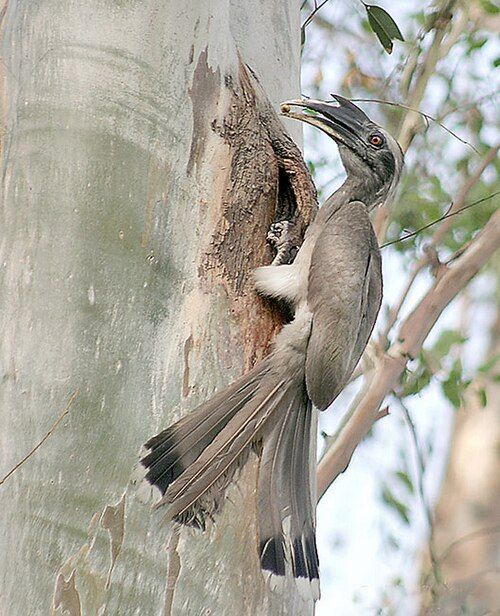
Indian Grey Hornbill (Ocyceros birostris) — reintroduced to Gir in 2021; has bred successfully for four consecutive years (2021–2024).
Conclusion / Way Forward: The Indian Grey Hornbill's successful re-establishment at Gir demonstrates that science-based translocation, combined with rigorous post-release monitoring using satellite telemetry, can restore locally extinct species to recovered habitats. The four consecutive breeding seasons move the population beyond mere survival to genuine ecological integration. This model — source population assessment, phased release, satellite tracking, and peer-reviewed documentation — is a replicable framework for India's broader wildlife restoration agenda. Long-term success will require continued monitoring and protection of the Gir ecosystem.
Prelims Pointers
- Indian Grey Hornbill: Scientific name — Ocyceros birostris; IUCN — Least Concern; most widely distributed hornbill in India.
- Reintroduction: 40 birds translocated from Aravalli forests (Gujarat) to Gir in two phases — 28 birds (2021–22) + 12 birds (2023).
- Monitoring Method: 11 male birds fitted with satellite transmitters to track movement, habitat use, and breeding.
- Conservation Result: Four consecutive years of successful breeding (2021–2024) confirmed in peer-reviewed journal Birds.
- Gir Protected Area Timeline: Gir Wildlife Sanctuary declared 1965; Gir National Park established 1975; both provided ecological recovery that enabled reintroduction.
- Ecological Role: Seed disperser — vital for natural forest regeneration; indicator of forest habitat quality.
- Casque: A bony projection on the upper beak of hornbills; larger in males; used for identification and, in some species, amplification of calls.
- Translocation Authority: Under the Wildlife (Protection) Act, 1972, the Chief Wildlife Warden may permit translocation for scientific management.
- Related News: Gujarat also reported a Great Indian Bustard chick surviving past 40 days via the "jump-start" technique — a separate conservation milestone.
Mains Practice Question
Wildlife translocation has emerged as a key tool in India's species recovery efforts. Using the reintroduction of the Indian Grey Hornbill in Gir as a case study, examine the scientific, ecological, and legal dimensions of such programmes.
GS Paper 3 | Environment & Ecology | 15 Marks | 250 Words
MCQ Practice
Assertion (A): The Indian Grey Hornbill's successful reintroduction in Gir is evidenced by four consecutive years of breeding since 2021.
Reason (R): Breeding behaviour in a reintroduced population is considered a reliable indicator of genuine ecological establishment, not merely short-term survival.
- ABoth A and R are true, and R is the correct explanation of A.
- BBoth A and R are true, but R is not the correct explanation of A.
- CA is true but R is false.
- DA is false but R is true.
Answer: A
Assertion A is factually correct — the study published in Birds documents breeding in each year from 2021 through 2024. Reason R is also correct and directly explains why the breeding record is scientifically significant: in conservation biology, successful reproduction demonstrates population establishment, not just post-release survival. Both are true and R correctly explains A.
Article 04
Spotted Deer Translocation from Sasan Gir to Mandvi Forest
GS Paper 3 — Environment & Ecology | Human-Wildlife Conflict | Conservation Management
Why in News
The Gujarat Forest Department has completed the translocation of 50 spotted deer (Chital) from the Sasan Gir Wildlife Division to the Mandvi Forest Range in Surat district. Conducted in three phases between May and June 2026, the initiative aims to strengthen the natural prey base for carnivores in South Gujarat, enhance local biodiversity, and reduce incidents of human-wildlife conflict by keeping predators within forest boundaries.
Static Background
Spotted Deer (Chital) — Species Profile
- Scientific Name: Axis axis; commonly known as Chital, Cheetal, or Axis Deer.
- Distribution: Native to the Indian subcontinent — India, Nepal, Bhutan, Bangladesh, and Sri Lanka. Introduced to the Andaman Islands, where it has become an invasive alien species.
- Habitat: Deciduous forests, open grasslands, and riverine habitats; commonly found along forest fringes where forest meets agricultural land.
- Physical Features: Golden-brown coat with white spots (spots are retained throughout life, unlike in most deer). Only males bear antlers — three-pronged, shed and regrown annually.
- Diet: Herbivorous; feeds on grasses, young shoots, leaves, and fallen fruit — a grazer and browser.
- Ecological Role: Forms a documented symbiotic association with Hanuman Langur monkeys (langurs drop fruit; deer eat them; langurs alert deer to predators). Serves as a key prey species for tigers, leopards, Asiatic lions, and Indian wolves — essential for maintaining top predator populations.
- Conservation Status: IUCN Red List — Least Concern (LC); protected under Schedule II of the Wildlife (Protection) Act, 1972.
- Threats: Habitat loss and fragmentation, poaching, and competition with livestock for grazing resources.
Human-Wildlife Conflict (HWC) — Context
- HWC occurs when wildlife and human populations compete for the same resources — food, land, water — leading to crop damage, livestock predation, and occasionally attacks on humans.
- A depleted prey base is one of the primary drivers of large carnivore movement into human-dominated landscapes; predators venture outside forests when prey density within forests is insufficient to meet nutritional needs.
- Strengthening the herbivore base within forests is therefore a science-based, preventive approach to HWC mitigation — a demand-side management strategy for predators.
Legal Framework for Translocation
- Under the Wildlife (Protection) Act, 1972, the Chief Wildlife Warden of a state is empowered to permit the capture or translocation of wild animals for purposes of scientific management and conservation.
- Translocation operations require detailed habitat assessments of the receiving site to verify carrying capacity — food availability, water sources, cover, and absence of disease vectors.
Translocation — Operational Details
The 50 deer were translocated in three batches: 21 on 23 May, 16 on 18 June, and 13 on 24 June 2026. Prior to the operation, the Gujarat Forest Department conducted detailed habitat assessments of the Mandvi Forest Range to confirm it could sustain the released population. Ten permanent water points were developed across the release area to ensure year-round drinking water availability — a critical factor for deer survival and settlement.
Post-release monitoring is being conducted through dedicated forest guards and trained trackers carrying out continuous field observation, supplemented by strategically placed camera traps to assess movement, habitat use, health status, and survival rates of the translocated animals.
Conclusion / Way Forward: Prey base augmentation through translocation is an ecologically grounded strategy for both conservation and HWC mitigation. A robust herbivore population keeps predators within forest habitats, reducing the economic and social costs of conflict for forest-fringe communities. The Mandvi translocation, if supported by sustained monitoring and habitat management, can serve as a scalable model for prey augmentation in South Gujarat's forest landscapes. Ensuring long-term ecological balance will require periodic assessments of the deer population's growth, its integration with resident wildlife, and the response of carnivore movement patterns.
Prelims Pointers
- Operation: 50 spotted deer translocated from Sasan Gir Wildlife Division to Mandvi Forest Range, Surat district, Gujarat; three phases — May and June 2026.
- Objective: Strengthen carnivore prey base, enhance biodiversity, reduce human-wildlife conflict by keeping predators inside forests.
- Spotted Deer: Axis axis; also called Chital or Cheetal; IUCN — Least Concern; Schedule II of WPA, 1972.
- Distribution Note: Native to Indian subcontinent; introduced to Andaman Islands → now classified as invasive alien species there.
- Unique Feature: White spots retained throughout life (unlike most deer); only males carry three-pronged antlers shed and regrown annually.
- Symbiosis: Chital-Langur association — langurs drop fruit that deer eat; langurs also alert deer to approaching predators.
- Key Prey Species for: Tigers, leopards, Asiatic lions, Indian wolves.
- Legal Authority: Wildlife (Protection) Act, 1972 — Chief Wildlife Warden may permit translocation for scientific management.
- Monitoring: Camera traps + trained trackers + forest guards — assessing movement, habitat use, health, survival.
- HWC Link: A depleted prey base drives large carnivores into human-dominated areas — prey augmentation is a preventive HWC strategy.
Mains Practice Question
Human-wildlife conflict is a growing challenge in India's forest-fringe communities. Examine prey base augmentation through wildlife translocation as a science-based strategy for conflict mitigation, with reference to the Wildlife (Protection) Act, 1972.
GS Paper 3 | Environment & Ecology | 15 Marks | 250 Words
MCQ Practice
Which of the following statements about the Spotted Deer (Axis axis) is NOT correct?
- AIt is listed as Least Concern on the IUCN Red List.
- BBoth male and female spotted deer bear three-pronged antlers that are shed annually.
- CIt is protected under Schedule II of the Wildlife (Protection) Act, 1972.
- DIt is native to the Andaman Islands and plays a key ecological role there as an indigenous herbivore.
Answer: D
Option D is incorrect — the Spotted Deer is not native to the Andaman Islands; it was introduced there and has become an invasive alien species. Option B is also incorrect (only males carry antlers), but D represents the single most factually inaccurate and potentially misleading option as it misclassifies the species' ecological role in a specific region. Note: In a "NOT correct" question, the answer is the false statement — D falsely claims nativity and positive ecological role in the Andamans.
Article 05
Polluted River Stretches Decline from 351 to 296
GS Paper 3 — Environment & Ecology | River Pollution | Water Governance
Why in News
The Union government informed the Rajya Sabha that the number of polluted river stretches across India has declined from 351 in 2018 to 296 in 2025, based on Biochemical Oxygen Demand (BOD) — a standard indicator of organic pollution in water bodies. The data comes from the latest report of the Central Pollution Control Board (CPCB). The interim figure in 2022 stood at 311, indicating a sustained but gradual improvement.
Static Background
Key Water Quality Parameters
- Biochemical Oxygen Demand (BOD): Measures the amount of dissolved oxygen consumed by biological processes (mainly microbial decomposition of organic matter) in a given water sample over a set period — typically 5 days at 20°C. A high BOD indicates high organic pollution and low dissolved oxygen, harming aquatic life. It is the primary metric used by CPCB to classify polluted river stretches.
- Dissolved Oxygen (DO): The amount of oxygen dissolved in water. High DO is essential for fish and other aquatic organisms; low DO (often caused by high BOD) leads to hypoxic or dead zones.
- pH: Measures the acidity or alkalinity of water; extreme pH values (too acidic or alkaline) indicate industrial pollution and are harmful to aquatic life.
- Faecal Coliform (FC): Indicates contamination by human or animal sewage; a public health parameter for drinking water and bathing water quality.
- Heavy Metals: No specific standards for rivers have been prescribed as yet, though CPCB monitors parameters including pH, BOD, DO, and FC to assess overall river pollution levels.
Key Institutions
- Central Pollution Control Board (CPCB): A statutory authority under the Ministry of Environment, Forest and Climate Change; responsible for monitoring water quality through the National Water Quality Monitoring Programme (NWQMP), which operates a network of 2,265 monitoring stations across the country in association with State Pollution Control Boards (SPCBs) and Pollution Control Committees (PCCs).
- CPCB Laboratories: One Central Water Laboratory in Delhi; eight regional laboratories for water quality analysis.
- State Pollution Control Boards (SPCBs): Maintain their own laboratories accredited either by the National Accreditation Board for Testing and Calibration Laboratories (NABL) or under the Environment (Protection) Act.
Major Causes of River Pollution
- Discharge of untreated or partially treated sewage from urban settlements and towns.
- Industrial effluents — especially from chemical, textile, tannery, and pharmaceutical industries.
- Inadequate dilution due to reduced river flows (abstraction for irrigation, reduced monsoon flows).
- Dumping of solid waste on riverbanks.
- Agricultural runoff carrying pesticides, fertilisers, and sediment.
- Geogenic effects — natural leaching of minerals from rock formations.
- Non-point sources of pollution (diffuse sources not traceable to a single discharge point).
Government Programmes for River Conservation
| Programme | Focus | Expenditure (reported) |
|---|---|---|
| Namami Gange | Rejuvenation of the Ganga river — sewage treatment, ghats, biodiversity, afforestation, public awareness | Rs 11,332 crore (to date) |
| National River Conservation Plan (NRCP) | Pollution abatement in rivers other than Ganga; sewage interception and treatment | Rs 1,888 crore (to date) |
| Urban Sanitation Schemes | Ministry of Housing and Urban Affairs — sewerage infrastructure in urban local bodies | Additional; implemented in parallel |
Analysis
The reduction of polluted stretches from 351 to 296 over seven years reflects incremental progress, but the pace signals that river restoration remains a long-term challenge. The persistence of 296 polluted stretches underscores structural deficits in sewage treatment infrastructure — India's urban sewage treatment capacity continues to lag significantly behind the volume of wastewater generated. The reliance on BOD as the primary classification metric, combined with the absence of prescribed heavy metal standards for rivers, also points to gaps in the comprehensiveness of river monitoring frameworks.
The National Water Quality Monitoring Programme's 2,265 stations, while extensive, must contend with the seasonal variability of river flows — pollution levels in rivers fluctuate significantly between lean-flow (non-monsoon) and high-flow (monsoon) seasons, complicating consistent assessment.
Conclusion / Way Forward: Sustaining the declining trend in polluted river stretches requires scaling up sewage treatment plant (STP) capacity in Tier-2 and Tier-3 cities, closing the gap between sewage generation and treatment, and enforcing effluent discharge norms for industries. Prescribing river-specific heavy metal standards, expanding the NWQMP monitoring network, and integrating real-time sensor-based monitoring would improve early detection. River conservation must also address non-point sources through better agricultural runoff management and solid waste governance in river-adjacent areas.
Prelims Pointers
- Polluted River Stretches Data (BOD-based): 351 (2018) → 311 (2022) → 296 (2025); source — CPCB's latest report.
- BOD (Biochemical Oxygen Demand): Measures oxygen consumed by microbial decomposition of organic matter in water over 5 days at 20°C; high BOD = high organic pollution = low aquatic oxygen = fish kills.
- CPCB: Central Pollution Control Board — statutory body under MoEFCC; monitors river water quality through the NWQMP (2,265 stations); 1 Central Water Lab (Delhi) + 8 regional labs.
- NWQMP: National Water Quality Monitoring Programme — CPCB + State Pollution Control Boards (SPCBs) + Pollution Control Committees (PCCs).
- Namami Gange: Rs 11,332 crore spent to date; focuses on Ganga river rejuvenation.
- NRCP: National River Conservation Plan — Rs 1,888 crore; covers rivers other than Ganga; focuses on sewage interception and treatment.
- Key Water Quality Parameters Monitored: pH, BOD, DO (Dissolved Oxygen), FC (Faecal Coliform); no prescribed heavy metal standards for rivers yet.
- Major Pollution Sources: Untreated/partially treated sewage, industrial effluents, agricultural runoff, solid waste, inadequate dilution, geogenic effects.
- NABL: National Accreditation Board for Testing and Calibration Laboratories — accredits SPCB labs.
Mains Practice Question
Despite significant government expenditure under programmes like Namami Gange and the National River Conservation Plan, India's rivers remain heavily polluted. Critically examine the structural and institutional factors responsible and suggest a comprehensive roadmap for river restoration.
GS Paper 3 | Environment & Ecology / Water Governance | 15 Marks | 250 Words
MCQ Practice
Match the following water quality parameters with their correct descriptions:
Parameter: 1. BOD 2. DO 3. Faecal Coliform 4. pH
Description: A. Indicates sewage contamination — a public health marker B. Measures oxygen consumed by microbial decomposition of organic matter C. Amount of oxygen dissolved in water — essential for aquatic life D. Measures acidity or alkalinity; extremes indicate industrial pollution
- A1-C, 2-B, 3-A, 4-D
- B1-B, 2-A, 3-D, 4-C
- C1-B, 2-C, 3-A, 4-D
- D1-A, 2-C, 3-B, 4-D
Answer: C
BOD (1) → B (oxygen consumed by microbial decomposition); DO (2) → C (dissolved oxygen essential for aquatic life); Faecal Coliform (3) → A (sewage contamination marker — public health); pH (4) → D (acidity/alkalinity; industrial pollution indicator). Option C gives the correct 1-B, 2-C, 3-A, 4-D mapping.
Article 06
Why Inflation Is Rising in India — A Structural Perspective
GS Paper 3 — Indian Economy | Inflation | Monetary & Fiscal Policy
Editorial Origin: This article is based on an opinion/analytical piece by researchers from the DevMac (Development Macroeconomics) network. The Kaleckian structuralist framework presented represents a particular analytical school of thought and should be read as informed commentary, not settled economic consensus. Treat factual data points (WPI figures, policy measures) as reference material; the theoretical interpretations are the authors' own.
Why in News
India's Wholesale Price Index (WPI) inflation rose sharply to approximately 10% in June (reference period in article), driven primarily by fuel and power prices and manufactured goods — not by demand overheating. The spike follows a prolonged period of low or near-zero WPI inflation. The analytical piece argues that this inflation is structural in origin, not demand-pull, and calls for targeted fiscal policy responses including countercyclical indirect tax adjustments on fuel.
Prelims Pointers
- WPI (Wholesale Price Index): Measures the average change in prices of goods at the wholesale level — before they reach consumers; captures price movements at the producer/trade level. Compiled by the Office of the Economic Adviser, Ministry of Commerce and Industry. Comprises three sub-categories: Primary Articles (food, minerals), Fuel & Power, and Manufactured Products.
- CPI (Consumer Price Index): Measures price changes at the retail/consumer level; used as the primary inflation target under India's monetary policy framework (RBI targets CPI at 4% ± 2%).
- Demand-Pull Inflation: Occurs when aggregate demand exceeds aggregate supply — "too much money chasing too few goods." More relevant for primary commodity prices where supply is relatively fixed.
- Cost-Push Inflation: Occurs when rising production costs — especially raw material costs like crude oil — are passed on as higher prices. The dominant mechanism for manufactured goods inflation.
- Kalecki's Structuralist Framework: Polish economist Michal Kalecki's theory distinguishes between primary commodity prices (demand-determined, because supply is fixed in the short run) and manufactured goods prices (cost-determined, because factories run below capacity and adjust output to demand without price changes).
- El Niño Effect on Food Prices: El Niño suppresses monsoon rainfall in South/Southeast Asia; a poor monsoon reduces agricultural output → reduces supply → raises food prices. Historically, drought years in India consistently correlate with food price spikes.
- Countercyclical Indirect Tax Policy: The idea of reducing customs and excise duties on fuel when global crude oil prices rise — to prevent domestic pump prices from increasing and to suppress cost-push inflation. India briefly employed this approach before reversing it (a reversal cited as contributing to the WPI spike).
- Inflation Targeting Framework: India adopted a flexible inflation targeting framework in 2016 under an amendment to the RBI Act; the MPC (Monetary Policy Committee) targets CPI inflation at 4% with a tolerance band of ±2%. The article's authors argue this framework is inadequate for structurally determined inflation.
- CDSCO / DCGI note: Not applicable to this article.
Article 07
Magnetic Levitation: How Maglev Trains Work
GS Paper 3 — Science & Technology | Infrastructure | Transport Technology
Why in News
Maglev (magnetic levitation) technology is receiving renewed global attention as a next-generation transport solution. With speeds exceeding 400 km/hr and a smooth, near-frictionless ride, maglev trains eliminate the mechanical limitations of conventional rail. Understanding the underlying physics and engineering trade-offs of maglev is increasingly relevant for UPSC aspirants, particularly in the context of India's infrastructure development ambitions and high-speed rail planning.
Static Background
The Basic Principle — Why Magnetic Levitation Works
Nature has four fundamental forces: the two nuclear forces (strong and weak), the electromagnetic force, and gravity. Although gravity governs large-scale motion, it is far weaker than the electromagnetic force — approximately 1039 times weaker. This enormous difference is what allows a small refrigerator magnet to hold against Earth's gravitational pull, and it is what makes levitating a 150–500 tonne train physically feasible.
By generating sufficiently powerful electromagnetic forces — using either conventional electromagnets or superconducting magnets — engineers can counteract gravity and lift a train off its guideway entirely, eliminating contact and, with it, rolling friction.
Levitation Technology: EMS vs EDS
| Feature | Electromagnetic Suspension (EMS) | Electrodynamic Suspension (EDS) |
|---|---|---|
| Mechanism | Conventional electromagnets on train arms attract upward toward guideway underside | Superconducting magnets induce repulsive current in track coils via electromagnetic induction |
| Hover Height | ~10 mm above guideway | ~100 mm above guideway |
| Minimum Speed for Levitation | Works from standstill | Requires ~100 km/hr before magnetic repulsion is sufficient; uses wheels at lower speeds |
| Max Operating Speed | Around or below 500 km/hr | Higher; SCMAGLEV (Japan) achieved 603 km/hr in testing (2015) |
| Key Example | Shanghai Maglev (China, 2004) | SCMaglev (Japan) — Superconducting Maglev |
How a Maglev Train Moves Forward
The walls of the maglev guideway are lined with electrical coils carrying alternating current (AC). This AC creates a continuously shifting magnetic field along the track — the poles (north and south) shift direction along the guideway at a controlled frequency. The magnets on the train are attracted to the opposite pole ahead and simultaneously repelled by the like pole behind, creating a net forward force. The train is thus pulled from the front and pushed from the back simultaneously. To increase speed, engineers simply raise the frequency of the alternating current.
The same linear motor principle governs braking: reversing the current direction switches the attracting and repelling poles, decelerating the train. Regenerative braking can capture the energy released during deceleration and feed it back into the electrical grid. Side-mounted magnets keep the train laterally centred within the guideway. Emergency friction brakes (auxiliary wheels or braking pads between guideway and train body) provide backup stopping capability.
Challenges and Limitations
- Dedicated Infrastructure: Maglev systems cannot share guideways or stations with conventional rail; the guideway must be purpose-built with embedded magnets, coils, and precision engineering — making retrofitting impossible.
- Construction Cost: The Shanghai Maglev, completed in 2004, cost Rs 580–720 crore per kilometre (inflation-adjusted) — excluding terrain preparation and ongoing operational/maintenance costs.
- Aerodynamic Drag: At speeds above 300 km/hr, aerodynamic resistance (air drag) replaces rolling friction as the primary resistance. Maglev trains require streamlined, aerodynamic designs — including a distinctive beak-shaped front section — to manage this. Such design adds to cost.
- Demand Threshold: The economics of maglev require very high and consistent passenger demand to justify capital and operating expenditure. Low ridership makes maglev economically unviable.
Other Applications of Magnetic Levitation Technology
- Industrial Turbines and Compressors: High-speed rotating shafts are suspended in magnetic fields instead of conventional mechanical bearings, reducing friction and wear, and enabling higher rotational speeds.
- Aircraft Carrier Catapults: Modern aircraft carriers use linear motor technology (the same principle that propels maglev trains) to electromagnetically accelerate aircraft along launch runways — replacing older steam-powered catapults.
- Semiconductor Manufacturing and Factory Automation: Maglev-derived systems enable rapid, precise, vibration-free motion for semiconductor fabrication, food and pharmaceutical packaging, CNC machining, inspection imaging, and DNA sequencing.
- Scientific Levitation: Diamagnetism — a very weak magnetic property exhibited by all materials — can be exploited to levitate objects. British physicists Andre Geim and Michael Berry used a 10-tesla magnet to levitate a living frog in 1997 by calculating the field strength needed to cancel Earth's gravitational pull on the animal. This work earned them the Ig Nobel Prize in 2000. Notably, Andre Geim later also won the Nobel Prize in Physics (2010) for his work on graphene — making him the only scientist to have won both an Ig Nobel and a Nobel Prize.

A maglev train floats above its guideway using electromagnetic suspension — no wheel contact, no rolling friction, speeds exceeding 400 km/hr.
Conclusion / Way Forward: Maglev technology represents the frontier of ground transportation, offering speeds impossible with conventional wheel-on-rail systems and near-total elimination of mechanical wear. However, its economic model demands scale and consistent ridership that only a few dense urban corridors globally can currently justify. For India, maglev remains a long-term aspiration; in the near term, the principles of linear motor propulsion, electromagnetic suspension, and superconducting materials have wider technological applications — from defence to semiconductor manufacturing — that are relevant to India's industrial and technology policy.
Prelims Pointers
- Maglev: Portmanteau of 'Magnetic Levitation'; trains float above the guideway using magnetic fields, eliminating rolling friction; top speed exceeds 400 km/hr.
- EMS (Electromagnetic Suspension): Uses conventional electromagnets; train arms attract upward toward guideway; hover height ~10 mm; works from standstill.
- EDS (Electrodynamic Suspension): Uses superconducting magnets; electromagnetic induction creates repulsive force; hover height ~100 mm; needs ~100 km/hr to levitate (uses wheels below this speed); higher speed ceiling than EMS.
- Speed Record: SCMaglev (Japan) — 603 km/hr in testing, 2015; uses EDS with superconducting magnets.
- Shanghai Maglev (2004): China; cost ~Rs 580–720 crore/km (adjusted); uses EMS.
- Forward Motion Mechanism: Alternating current in guideway coils creates shifting magnetic poles; train is simultaneously pulled from front and pushed from behind — a linear motor.
- Aerodynamic Resistance: Above 300 km/hr, air drag replaces rolling friction as the primary resistance force — hence the beak-like aerodynamic front design.
- Andre Geim: Only scientist to win both an Ig Nobel Prize (2000, for levitating a frog using diamagnetism) and a Nobel Prize (2010, for graphene); co-discovery of graphene with Konstantin Novoselov.
- Diamagnetism: A very weak form of magnetism present in all materials; can be exploited to levitate objects using a strong enough external magnetic field.
- Linear Motor: Technology that converts electrical energy directly into linear (straight-line) motion using alternating magnetic fields; used in maglev propulsion and aircraft carrier catapult systems.
Mains Practice Question
Examine the scientific principles underlying maglev train technology. What are the key engineering and economic constraints that limit its widespread adoption, and how does it compare with conventional high-speed rail for a country like India?
GS Paper 3 | Science & Technology / Infrastructure | 15 Marks | 250 Words
MCQ Practice
Consider the following two statements about maglev technology:
Statement 1: Electrodynamic Suspension (EDS) maglev systems can achieve higher maximum speeds than Electromagnetic Suspension (EMS) systems, but require the train to be travelling at approximately 100 km/hr before levitation is possible.
Statement 2: In maglev propulsion, the train is pulled forward from the front by an attractive magnetic force and simultaneously pushed forward from the rear by a repulsive magnetic force generated by the alternating current in the guideway coils.
- AStatement 1 is correct but Statement 2 is incorrect.
- BStatement 2 is correct but Statement 1 is incorrect.
- CBoth statements are correct.
- DNeither statement is correct.
Answer: C
Statement 1 is correct — EDS systems (using superconducting magnets and electromagnetic induction) achieve higher top speeds (Japan's SCMaglev hit 603 km/hr) but require wheel-based movement until ~100 km/hr, after which the repulsive magnetic force is sufficient for levitation. Statement 2 is also correct — the alternating current in guideway coils creates shifting north-south poles; the train magnets are attracted to the opposite pole ahead (pulling force) and repelled by the like pole behind (pushing force), resulting in simultaneous front-pull and rear-push.
Article 08
India Approves First Dengue Vaccine — QDENGA
GS Paper 2 — Health | Governance | Vaccines & Public Health Policy
Why in News
Dr. Rajeev Singh Raghuvanshi, Drug Controller General of India (DCGI), has granted market authorisation to Takeda Biopharma's QDENGA (TAK-003), making it the first dengue vaccine to receive regulatory approval in India. The vaccine is approved for individuals aged 4 to 60 years for the prevention of dengue, irrespective of prior dengue infection history, and does not require pre-vaccination screening. India accounts for approximately one-third of the global dengue burden.
Static Background
Dengue — Disease Profile
- Causative Agent: Dengue virus — a member of the Flaviviridae family; transmitted by the bite of infected Aedes aegypti and Aedes albopictus mosquitoes.
- Serotypes: Four distinct serotypes — DENV-1, DENV-2, DENV-3, DENV-4. Infection with one serotype confers lifelong immunity to that type but only temporary cross-protection against others. A subsequent infection with a different serotype carries higher risk of severe dengue (dengue haemorrhagic fever / dengue shock syndrome).
- Epidemiology in India: Reported dengue cases have increased nearly 11-fold over the past two decades. India bears approximately one-third of the global dengue burden; modelling studies suggest actual infections are substantially higher than officially reported cases.
- Seasonality: Dengue peaks during and after the monsoon season (July–October) when stagnant water provides breeding grounds for Aedes mosquitoes.
DCGI and CDSCO — Regulatory Framework
- DCGI (Drug Controller General of India): Head of the Central Drugs Standard Control Organisation (CDSCO); responsible for approval of new drugs, vaccines, and medical devices in India. Current incumbent: Dr. Rajeev Singh Raghuvanshi. Operates under the Ministry of Health and Family Welfare.
- CDSCO: India's national drug regulatory authority; functions under the Drugs and Cosmetics Act, 1940. Responsible for approval of clinical trials, new drug applications, and post-marketing surveillance (pharmacovigilance).
- New Drug Approval Pathway: Requires Phase I, II, and III clinical trials demonstrating safety, immunogenicity, and efficacy; a local Phase III trial (India-specific) is often required for domestic approval.
Vaccine Technology — Key Concepts
- Live-Attenuated Vaccine: Contains a weakened (attenuated) form of the live pathogen. The weakened virus can replicate in the body but does not cause disease in immunocompetent individuals; it stimulates a robust immune response including both antibody and cell-mediated immunity. Examples: MMR (measles-mumps-rubella), oral polio vaccine (OPV), varicella (chickenpox) vaccine.
- Tetravalent: A vaccine designed to provide protection against all four dengue serotypes (DENV-1 through DENV-4) simultaneously — critical because natural infection with multiple serotypes is common and each serotype can cause disease.
- Two-Dose Regimen: QDENGA is administered as two doses, given three months apart; does not require prior dengue serostatus testing before administration (unlike the earlier CYD-TDV/Dengvaxia vaccine, which required pre-vaccination screening for prior dengue exposure).
QDENGA — Efficacy and Global Status
QDENGA's approval in India is underpinned by Takeda's global clinical development programme comprising 19 Phase I, II, and III trials involving over 28,000 participants across dengue-endemic and non-endemic regions. The pivotal Phase III trial enrolled more than 20,000 participants across eight dengue-endemic countries.
| Efficacy Metric | Result | Time Point |
|---|---|---|
| Efficacy against virologically confirmed dengue | 80.2% | 12 months after second dose |
| Efficacy against dengue-related hospitalisation | 90.4% | 18 months |
| Global approvals | 43 countries (Asia, Latin America, Europe) | Prior to India approval |
| Doses distributed globally | Over 32 million | Through public and private programmes |
Conclusion / Way Forward: The approval of QDENGA addresses a significant public health gap in India's immunisation landscape. Unlike Dengvaxia (CYD-TDV), QDENGA does not require pre-vaccination serostatus screening, making it operationally more suitable for mass immunisation. Its inclusion in India's National Immunisation Programme would require a cost-effectiveness assessment and health technology appraisal. Complementary vector control measures — elimination of stagnant water breeding sites, Aedes surveillance, and community health education — remain essential alongside vaccination to achieve meaningful dengue burden reduction.
Prelims Pointers
- QDENGA (TAK-003): First dengue vaccine approved in India; developed by Takeda Biopharma; approved by DCGI (Dr. Rajeev Singh Raghuvanshi); age group 4–60 years; two doses, three months apart.
- Vaccine Type: Live-attenuated tetravalent — weakened live virus, provides protection against all four dengue serotypes (DENV-1, 2, 3, 4).
- No Prior Screening Required: Unlike Dengvaxia (CYD-TDV), QDENGA can be given regardless of prior dengue infection status — eliminates need for pre-vaccination serology.
- Efficacy: 80.2% against confirmed dengue (at 12 months post-dose 2); 90.4% against dengue hospitalisation (at 18 months).
- Global Status: Approved in 43 countries; 32 million+ doses distributed globally before India approval.
- India's Dengue Burden: ~1/3 of global burden; reported cases up ~11-fold over 20 years; actual infections estimated higher due to under-reporting.
- Dengue Transmission: Aedes aegypti (primary) and Aedes albopictus (secondary) mosquitoes; four serotypes — subsequent heterotypic infection carries higher severe disease risk.
- DCGI: Drug Controller General of India — head of CDSCO under MoH&FW; current incumbent — Dr. Rajeev Singh Raghuvanshi; authority to approve drugs, vaccines, and medical devices under Drugs and Cosmetics Act, 1940.
- CDSCO: Central Drugs Standard Control Organisation — India's national drug regulatory authority.
- Live-Attenuated Vaccine: Uses weakened live pathogen; stimulates strong immune memory including cell-mediated immunity; cannot cause disease in healthy individuals; examples — MMR, OPV, varicella.
Mains Practice Question
India's approval of its first dengue vaccine is a significant milestone in public health governance. Discuss the role of the DCGI and CDSCO in vaccine regulation, the challenges in dengue prevention, and the considerations for incorporating QDENGA into India's national immunisation programme.
GS Paper 2 | Health Governance | 15 Marks | 250 Words
MCQ Practice
Which of the following correctly describes QDENGA, India's first approved dengue vaccine?
- AIt is an inactivated monovalent vaccine targeting only DENV-1 and requires pre-vaccination serological screening.
- BIt is a live-attenuated bivalent vaccine approved for individuals above 18 years only.
- CIt is a live-attenuated tetravalent vaccine approved for ages 4–60, administered in two doses three months apart, and does not require prior dengue infection screening.
- DIt is an mRNA vaccine providing protection against two dengue serotypes, approved in India for the first time ahead of any other country.
Answer: C
QDENGA (TAK-003) is a live-attenuated tetravalent vaccine — designed to protect against all four dengue serotypes. It is approved for individuals aged 4 to 60 years, administered in two doses three months apart, and does not require pre-vaccination dengue serostatus screening. Option A is wrong on multiple counts (inactivated, monovalent, requires screening). Option B is wrong — it is tetravalent, not bivalent, and the age range is 4–60, not 18+. Option D is incorrect — it is not an mRNA vaccine, and it had already been approved in 43 other countries before India.
Article 09
Security vs Ecology: BSF Considers Fencing in the Sundarbans
GS Paper 3 — Environment & Ecology | Internal Security | Biodiversity
Why in News
The Border Security Force (BSF) is conducting a feasibility study for installing physical fences along a 90-km stretch of the Sundarbans mangroves on the Indo-Bangladesh border. The government has separately sanctioned the construction of flood-light illuminated non-physical barriers in the area. The proposal has sparked debate among ecologists and security experts about the potential impact on the region's biodiversity, tidal hydrology, and local communities — set against the legitimate need to secure a porous and difficult-to-monitor border zone.
Static Background
The Sundarbans — Ecological Profile
- Location: Spread across the delta of the Ganga, Brahmaputra, and Meghna rivers; shared between India (West Bengal) and Bangladesh. The Indian Sundarbans cover approximately 9,630 sq km.
- UNESCO World Heritage Site: The Sundarbans National Park is a UNESCO World Heritage Site (1987) and a Ramsar Wetland of International Importance.
- Biosphere Reserve: Declared a Biosphere Reserve under UNESCO's Man and Biosphere Programme.
- Ecosystem Type: The world's largest mangrove forest. Characterised by tidal creeks, brackish water, and a highly dynamic, fluid landscape shaped by tidal action — making fixed infrastructure inherently challenging to install and maintain.
- Biodiversity: Home to the Bengal Tiger (a strong swimmer, crosses rivers and tidal channels regularly), saltwater crocodiles, Irrawaddy dolphins, spotted deer, wild boar, and an exceptionally rich avifauna. The species here are adapted to a semi-aquatic, tidal lifestyle — river and sandbank crossings are routine, not exceptional, animal behaviour.
- Ichamati River: The proposed fencing site is on the banks of the Ichamati river in the northern Sundarbans — identified as lying partly within or adjacent to the Sundarbans Wildlife Sanctuary.
- Local Communities: Dense populations of fisherfolk, honey collectors (Mawalis), and agricultural communities live along the forest fringes, with significant land use conflicts and historical displacement concerns.
Border Security — Context
- BSF (Border Security Force): India's primary border guarding force; responsible for securing the Indo-Bangladesh international border — one of the longest land borders in the world at approximately 4,096 km.
- Challenge in Sundarbans: The tidal, mangrove terrain makes conventional border infrastructure (fencing, roads, patrol tracks) technically difficult and ecologically disruptive. Thick mangroves, creeks, and swamps restrict physical access for both border patrol and construction operations.
- Earlier Proposal: The BSF had previously explored the release of snakes and crocodiles into border rivers as deterrents — a proposal that itself generated ecological controversy.
The Debate — Ecological vs Security Arguments
Arguments for fencing (or regulated physical infrastructure): The Sundarbans is a porous border zone, and advocates for regulated infrastructure argue that illegal cross-border movement — including illegal fishing and construction within non-protected areas — has already caused significant ecological damage to unprotected mangrove zones. Dr. Krishna Ray (Associate Professor, Botany, West Bengal State University) notes that fencing in non-protected areas along the Bangladesh border need not harm the ecosystem significantly, provided the BSF exercises care to protect shoreline mangroves and wildlife during construction. Better border regulation, in this view, could reduce the illegal activities currently degrading the ecosystem.
Arguments against fencing: Dr. Megnaa Mehtta (Assistant Professor, Social Anthropology, University College London) argues that the Ichamati river is a natural corridor used routinely by tigers, deer, wild boar, and crocodiles — restricting it would disrupt normal wildlife movement. She characterises the project as a resource misallocation in an area that needs other fundamental infrastructure improvements more urgently. Decades of research, she notes, do not identify the Sundarbans as a primary route for serious cross-border infiltration. She also raises concerns about historical failures to compensate communities displaced by earlier infrastructure projects such as embankments.
Conclusion / Way Forward: The Sundarbans fencing question illustrates the inherent tension between border security imperatives and ecological integrity in biodiverse frontier landscapes. The solution likely lies in context-specific, graduated approaches: technology-based surveillance (cameras, sensors, drones, patrol boats) in ecologically sensitive zones, and physical infrastructure only in areas where ecological impact assessments confirm minimal biodiversity disruption. Any physical construction must be preceded by independent environmental impact assessment, meaningful community consultation, and legally binding rehabilitation commitments for displaced residents. The porous, tidal nature of the Sundarbans also calls for stronger India-Bangladesh bilateral cooperation on border management — a diplomatic rather than purely infrastructural solution.
Prelims Pointers
- Sundarbans: World's largest mangrove forest; shared between India (West Bengal) and Bangladesh; UNESCO World Heritage Site (1987); Ramsar Wetland; UNESCO Biosphere Reserve.
- Sundarbans National Park: Core zone within Indian Sundarbans; home to Bengal Tiger — a strong swimmer that routinely crosses tidal channels and rivers.
- BSF Proposal: Feasibility study for 90-km physical fence along Sundarbans Indo-Bangladesh border; flood-light illuminated non-physical barriers also sanctioned.
- Ichamati River: Proposed fencing location — in northern Sundarbans; a natural wildlife movement corridor for tigers, deer, wild boar, and crocodiles.
- Ecological Concern: Fixed infrastructure in a tidal, fluid ecosystem disrupts animal movement corridors; creeks and sandbanks are routine crossing points for Sundarbans wildlife, not exceptional routes.
- Indo-Bangladesh Border: Approximately 4,096 km — one of the world's longest land borders; guarded by BSF.
- Key Flora: Mangroves — including species like Sundari (Heritiera fomes, from which "Sundarbans" derives its name), adapted to tidal saline conditions.
- Diamagnetism Note: Not applicable to this article — see Article 07 for maglev context.
- Conservation Status (Bengal Tiger): Endangered (IUCN); protected under Schedule I of WPA, 1972; the Sundarbans holds a significant share of India's wild tiger population.
Mains Practice Question
The proposal to install border fencing in the Sundarbans mangroves highlights the tension between national security imperatives and ecological conservation. Examine the ecological, social, and strategic dimensions of this issue and suggest a balanced approach.
GS Paper 3 | Environment & Ecology / Internal Security | 15 Marks | 250 Words
MCQ Practice
Consider the following statement about the Sundarbans:
"The Bengal Tiger in the Sundarbans is an exclusively land-dwelling predator that avoids water crossings, making river-based barriers an effective deterrent to its movement."
Is this statement correct?
- AYes — Bengal Tigers in the Sundarbans are adapted to avoid tidal waters.
- BNo — Bengal Tigers in the Sundarbans are strong swimmers that routinely cross rivers and tidal channels; water crossings are a normal part of their movement behaviour.
- CYes — though tigers can swim, they avoid saltwater channels in the Sundarbans.
- DNo — but only because the Sundarbans has no tigers; they were reintroduced only after 2010.
Answer: B
Bengal Tigers in the Sundarbans are well-documented strong swimmers; they routinely cross tidal channels, rivers, and sandbanks as part of their normal territorial and foraging movement. This is a defining ecological characteristic of the Sundarbans tiger population and is precisely why ecologists oppose physical barriers along the Ichamati river — such barriers would interrupt normal wildlife movement, not merely deter border crossing. Options A and C are factually incorrect. Option D is entirely false — the Sundarbans has a wild tiger population and reintroduction framing is incorrect.
Article 10
Right to Protest — Constitutional Framework and Legal Restrictions
GS Paper 2 — Polity & Governance | Fundamental Rights | Judicial Pronouncements
Why in News
A large planned protest march to Parliament in New Delhi led to police action — including the use of prohibitory orders under Section 163 of the Bharatiya Nagarik Suraksha Sanhita (BNSS) — reigniting debate about the legal boundaries of the right to protest in India. Section 163 of the BNSS is the successor provision to Section 144 of the Code of Criminal Procedure (CrPC), which has been repeatedly examined by the Supreme Court for its constitutional validity and limits.
Static Background
Constitutional Provisions — Right to Protest
- Article 19(1)(a): Guarantees the freedom of speech and expression to all citizens.
- Article 19(1)(b): Guarantees the right to assemble peaceably and without arms.
- Not Absolute — Reasonable Restrictions: Articles 19(2) and 19(3) permit the State to impose reasonable restrictions on these rights in the interests of: sovereignty and integrity of India; security of the State; friendly relations with foreign States; public order; decency or morality; and other specified grounds.
- Key Distinction: The Constitution permits regulation of protests (where, when, how), but not their complete prohibition. Regulation is constitutionally valid; blanket prohibition is not.
Section 163 BNSS — Successor to Section 144 CrPC
- Nature: An emergency executive power — empowers an Executive Magistrate to issue written directions where "immediate prevention or speedy remedy" is considered necessary to prevent obstruction, danger to human life or public tranquillity, or the possibility of a riot or affray.
- Duration: Orders under Section 163 ordinarily remain in force for not more than two months, unless extended by law.
- Scope of Use in Practice: Empirical research (Bhandari, Sekhri, Maheshwari, and Aggarwal, 2023) examining approximately 5,400 Section 144 orders in Delhi (Jan 2021–2022) found that only about 1.5% related to prohibited unlawful assemblies; five of Delhi's 18 police districts issued no assembly-related orders at all. The study characterised the provision as having become a tool of routine administration — with orders mechanically re-issued at the end of every two-month statutory period, a "city-wide mechanical process."
- India's International Position: At the UN Human Rights Council (Geneva, 2021), India's representative affirmed that peaceful assembly is a constitutional right, while noting the government's obligation to balance it against public order and the right to life.
Supreme Court Jurisprudence on Right to Protest
| Case | Year | Key Holding |
|---|---|---|
| Himat Lal K. Shah v. Commissioner of Police | 1973 | State may regulate public meetings on streets; cannot impose arbitrary exclusion that deprives citizens of the right to assemble. Distinguished between reasonable regulation and arbitrary exclusion. |
| Mazdoor Kisan Shakti Sangathan v. Union of India | 2018 | Upheld Section 144 CrPC as an emergency power but held it cannot become a permanent prohibition mechanism. Directed authorities to frame guidelines for regulated protests. Reinstated Jantar Mantar as Delhi's designated protest site. Prohibited blanket bans even under NGT orders. |
| Amit Sahni v. Commissioner of Police (Shaheen Bagh case) | 2020 | Protests must be held in "identified areas"; protesters cannot block public roads or cause indefinite inconvenience. Right to protest exists but not at the cost of others' rights to use public spaces. |
Designated Protest Sites and Regulatory Guidelines
- Jantar Mantar, New Delhi: The Supreme Court's 2018 judgment reaffirmed Jantar Mantar Road as Delhi's designated protest site.
- Azad Maidan, Mumbai: Designated protest venue in Mumbai.
- SC-Directed Regulatory Guidelines (2018): Include — limiting number of participants, maintaining minimum distances from Parliament, the Supreme Court, and other sensitive locations; prescribing time limits; prohibiting weapons (firearms, lathis, swords).
Analysis
The legal framework governing protests in India reflects a constitutional balance: robust protection for the right to assemble and speak, subject to reasonable and proportionate restrictions. The Supreme Court's consistent jurisprudence reinforces that executive powers like Section 163 BNSS are emergency tools — not instruments of routine governance or permanent prohibition. The empirical evidence from Delhi (2021–22) documenting the mechanical, cyclostyled re-issuance of Section 144 orders points to a structural gap between the provision's emergency design and its administrative reality.
For aspirants, the key constitutional distinction to internalise is: regulation = permissible; prohibition = unconstitutional. The State retains broad regulatory authority over where, when, and how citizens protest, but it cannot use that authority to eliminate the right to protest altogether.
Conclusion / Way Forward: A democracy's health can partly be assessed by how it treats the right to protest — the most direct form of political expression available to ordinary citizens. India's constitutional framework, as interpreted by the Supreme Court, provides a nuanced architecture: the right to protest is fundamental, but not unlimited. Operationalising this balance requires framing transparent, publicly available guidelines for protest permissions, ensuring that Section 163 BNSS is used sparingly and with recorded reasons, and building designated protest infrastructure in major cities that allows effective civic expression without disrupting urban life.
Prelims Pointers
- Constitutional Basis of Right to Protest: Article 19(1)(a) — freedom of speech and expression; Article 19(1)(b) — right to assemble peaceably and without arms.
- Reasonable Restrictions: Articles 19(2) and 19(3) — State may restrict in interests of sovereignty, security, public order, decency/morality, etc. Restrictions must be "reasonable" — not arbitrary or absolute.
- Section 163 BNSS: Successor to Section 144 CrPC (Code of Criminal Procedure); empowers an Executive Magistrate to issue written directions for "immediate prevention or speedy remedy"; orders valid for up to two months.
- Key Distinction: Regulation of protest = constitutionally permissible; blanket prohibition of protest = unconstitutional (SC consistent position).
- Himat Lal K. Shah (1973): "Freedom of assembly is an essential element of any democratic system." Distinguished reasonable regulation from arbitrary exclusion.
- Mazdoor Kisan Shakti Sangathan (2018): Section 144 = emergency power, not permanent ban tool; directed protest guidelines; reaffirmed Jantar Mantar as Delhi's designated protest site.
- Amit Sahni / Shaheen Bagh (2020): Protests must be in identified areas; cannot block public roads indefinitely.
- Designated Protest Sites: Jantar Mantar (Delhi); Azad Maidan (Mumbai).
- Empirical Finding (2023 study): Only ~1.5% of Section 144 orders in Delhi (2021–22) related to unlawful assemblies; orders were mechanically re-issued — characterised as routine administration, not emergency use.
- BNSS: Bharatiya Nagarik Suraksha Sanhita — the new code replacing the CrPC; enacted 2023, came into force 2024.
Mains Practice Question
The right to protest is constitutionally protected but not absolute. Critically examine the legal framework governing protests in India, with reference to Article 19, Section 163 BNSS, and relevant Supreme Court judgments. What reforms are needed to ensure the right to protest is not reduced to a mere formality?
GS Paper 2 | Polity & Governance / Fundamental Rights | 15 Marks | 250 Words
MCQ Practice
Assertion (A): Section 163 of the Bharatiya Nagarik Suraksha Sanhita (BNSS) is designed as an emergency measure and ordinarily remains in force for not more than two months.
Reason (R): The Supreme Court has held that executive powers to regulate assembly, such as Section 144 CrPC / Section 163 BNSS, cannot be used as a permanent mechanism to prohibit the constitutional right to peaceful protest.
- ABoth A and R are true, and R is the correct explanation of A.
- BBoth A and R are true, but R is not the correct explanation of A.
- CA is true but R is false.
- DA is false but R is true.
Answer: A
Assertion A is correct — Section 163 BNSS (and its predecessor, Section 144 CrPC) is explicitly an emergency power; orders under it ordinarily cannot exceed two months. Reason R is also correct — the Supreme Court in Mazdoor Kisan Shakti Sangathan (2018) directly held that Section 144 cannot become a permanent prohibition tool. R correctly explains why A is true: the two-month statutory limit on Section 163 orders reflects the constitutional requirement that such emergency powers remain temporary and cannot substitute for permanent prohibition of the right to assemble.