

In-Depth News Analysis7 Items
Core TopicImportantConcise
Polity, Governance & Social JusticeGS Paper II
01Cauvery: SC Dismisses Tamil Nadu's Plea02Ladakh's First Panchayat and Civic Polls as a UT03Rising C-Sections in Private Hospitals
Indian EconomyGS Paper III
04Why Gold Prices Rallied — and Are Now Falling05SEBI Plans Faster FPI Onboarding
Environment & EcologyGS Paper III
06Stubble Burning: Counting Fires Is Not Enough07Botswana Cheetah's Wild Litter; Population 62
Polity, Governance & Social JusticeGeneral Studies Paper II
01
Supreme Court Dismisses Tamil Nadu's Plea for Cauvery Shortfall, Backs the Expert Authority
GS-II · Federalism — Inter-State Water Disputes; GS-I · RiversPrelims + MainsThe Hindu
A Bench of the Supreme Court headed by Justice Vikram Nath dismissed Tamil Nadu's plea that Karnataka must make good a shortfall of 16.01 tmc ft (later revised to 11.719 tmc ft) of Cauvery water on a pro-rata basis in the 2026-27 irrigation year — a distress year. Karnataka argued that Tamil Nadu had in fact received more than its allocation.
◈ From the Basics
- Inter-State river: a river flowing through more than one State; sharing its water is a shared constitutional responsibility.
- tmc ft: thousand million cubic feet (about 28.3 million cubic metres) — the standard unit in Cauvery allocation.
- Water year: for the Cauvery it runs from June to May, with monthly release schedules.
- Distress year: a year of deficient rainfall in which the river cannot meet all normal allocations. Pro-rata sharing means each State's share is cut in the same proportion.
- Expert body: the Cauvery Water Management Authority (CWMA), which directs releases, assisted by the Cauvery Water Regulation Committee (CWRC), which monitors daily flows.
The Arguments
- Tamil Nadu: Karnataka failed to implement the Supreme Court's binding judgment ensuring water at Biligundlu pro-rata in distress years. Releases came only when Karnataka's reservoirs were nearly full, spilled over, or after it had met its own irrigation needs — creating uncertainty downstream.
- Karnataka: Tamil Nadu had received excess water; the decision checks States that "rush to court" to challenge the expert authority.
- Outcome: the Court dismissed the plea, reinforcing the role of the CWMA as the forum for day-to-day water management.
Figure 1 — The Cauvery basin: source, dams and the inter-State measuring point
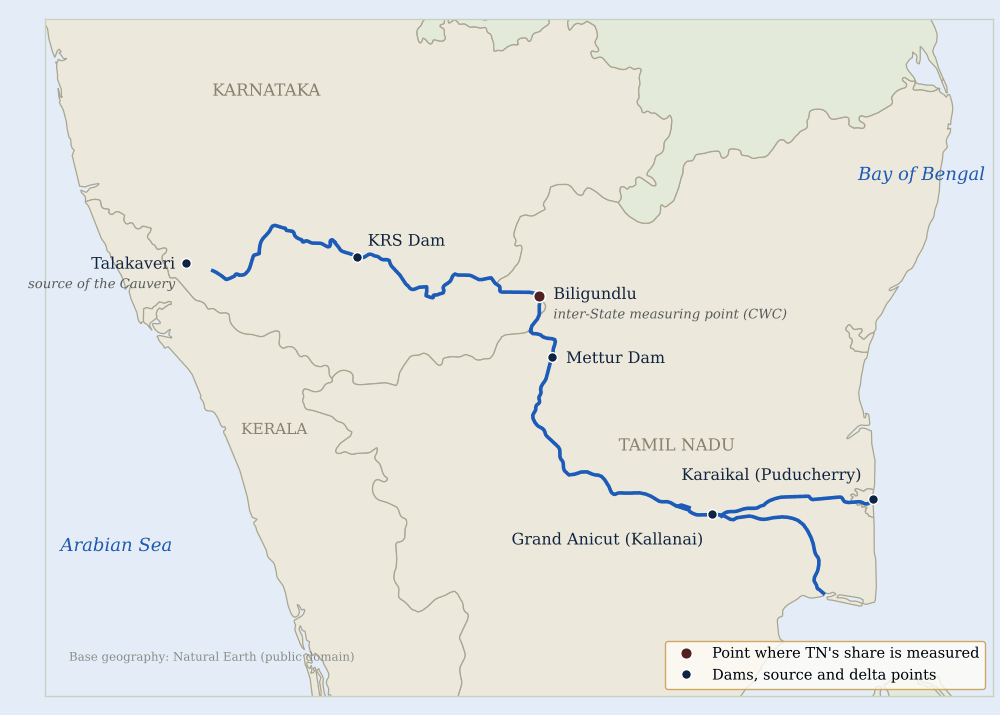
The Cauvery rises at Talakaveri in Karnataka's Kodagu district and reaches the Bay of Bengal through the Tamil Nadu delta. Tamil Nadu's share is measured at Biligundlu on the inter-State border. River and boundaries plotted from Natural Earth data (public domain).
◈ Static Background — Constitutional and Legal Framework
- Article 262: Parliament may by law provide for adjudicating inter-State river disputes, and may exclude the jurisdiction of the Supreme Court and other courts over them.
- Entry 17, State List (water) is subject to Entry 56, Union List (regulation of inter-State rivers in the public interest).
- Inter-State River Water Disputes Act, 1956: provides for tribunals; Section 6A (added in 1980) lets the Centre frame a scheme to implement an award — the basis of the CWMA (constituted June 2018). Also: the River Boards Act, 1956.
- Reform: the ISRWD (Amendment) Bill, 2019 proposed a single permanent tribunal with benches and a Dispute Resolution Committee; it was passed by the Lok Sabha in 2019.
How the Dispute Evolved
- 1892 and 1924: agreements between the Madras Presidency and the princely State of Mysore.
- 1990: the Cauvery Water Disputes Tribunal (CWDT) set up; interim order in 1991; final award in February 2007.
- 16 February 2018 — Supreme Court verdict: modified the award to Karnataka 284.75, Tamil Nadu 404.25, Kerala 30 and Puducherry 7 tmc ft (with 10 tmc ft for the environment and 4 for outflow to the sea). Karnataka must deliver 177.25 tmc ft at Biligundlu in a normal year. The Court also held that it can hear appeals against tribunal awards under Article 136.
- Mekedatu: in November 2025 the Supreme Court called Tamil Nadu's challenge to Karnataka's proposed Mekedatu reservoir "premature", leaving the matter to expert bodies.
◈ Issues & Way Forward
- No agreed distress formula: pro-rata sharing in deficit years is applied case by case, leading to repeated litigation each dry year.
- Timing matters: the total delivered may meet the annual target but arrive too late for the delta's kuruvai and samba crops.
- Strengthen the CWMA: real-time telemetry of reservoir levels and flows, and binding monthly schedules for distress years.
- Demand management: micro-irrigation, crop diversification away from water-intensive paddy and sugarcane, and groundwater recharge in both States.
- Cooperative federalism: treat river basins as shared ecosystems, with basin-level planning rather than State-wise claims.
✎ Mains Practice Question
Despite a final judicial verdict and an expert management authority, the Cauvery dispute returns to the courts in every deficit year. Examine the reasons and suggest institutional reforms for resolving inter-State river water disputes. 15 marks · 250 words
02
Ladakh Holds Its First Panchayat and Municipal Elections Since Becoming a Union Territory
GS-II · Local Governance, Union Territories, Scheduled AreasPrelims + MainsThe Hindu
The Union Territory of Ladakh voted on 21 November 2026 in its first panchayat and municipal elections since it was carved out of Jammu and Kashmir in 2019. The last such polls were held in 2018, when Ladakh was part of the former State.
▤ The Polls at a Glance
- Electors: about 1.87 lakh, spread over some 59,146 sq km; polling stations range from Drass (10,800 ft) to Korzok (15,075 ft), in temperatures of −7°C to −9°C.
- Panchayats: polls for 192 panchayat halqas and 1,428 panchs; 55 sarpanches and 1,186 panch candidates were elected unopposed.
- Municipal councils: voting in all 21 wards of Leh; 4 of 17 wards in Kargil returned members unopposed.
- Administrative change: Ladakh now has eight districts — six created in 2026 alongside Leh and Kargil — and elections to Hill Development Councils across all eight are due on 4 December.
◈ From the Basics
- Panchayat halqa: the term used in J&K and Ladakh for a village-panchayat area, headed by a sarpanch, with ward members called panchs.
- Union Territory without a legislature: administered by the President through a Lieutenant Governor (Article 239); local bodies and hill councils are the main elected forums.
- Hill Development Council: an elected district-level body with powers over local development and land use, created by statute.
Static Background
- J&K Reorganisation Act, 2019: created the UT of Ladakh (without a legislature) with effect from 31 October 2019.
- Ladakh Autonomous Hill Development Council (LAHDC) Act, 1995: set up the Leh council (1995) and later the Kargil council (2003); amended in 2026 to cover the new districts.
- Constitutional basis for local bodies: the 73rd and 74th Amendments (1992) (Parts IX and IX-A); for UTs, the President may apply them with modifications (Article 243L).
- Sixth Schedule: provides Autonomous District Councils in tribal areas of Assam, Meghalaya, Tripura and Mizoram (Articles 244(2) and 275(1)). Ladakh's population is over 97% Scheduled Tribe, and in 2019 the NCST recommended its inclusion.
- 2025 regulations for Ladakh: 85% reservation in government jobs for locals, a domicile requirement, recognition of Bhoti and Purgi among official languages, and one-third reservation for women in hill councils.
◈ Significance & Concerns
- Restoring grassroots democracy after a gap of several years, especially as Ladakh has no legislature of its own.
- Unopposed seats: the large number of uncontested panch seats points to low competition — or to boycott calls linked to political demands.
- Unresolved demands: security was tightened in Leh and Kargil, centres of protests for Statehood and Sixth Schedule status; the redrawing of districts and council constituencies has also drawn objections.
- Way forward: genuine devolution of funds, functions and functionaries to panchayats and councils, and continued dialogue on constitutional safeguards for land, jobs and culture.
✎ Mains Practice Question
In a Union Territory without a legislature, local bodies and hill councils carry the burden of democratic representation. Discuss in the context of Ladakh, with reference to the demand for Sixth Schedule status. 10 marks · 150 words
03
Study of Insurance Claims Finds Most Private-Hospital Births Are by Caesarean Section
GS-II · Health — Maternal Health, Health FinancingPrelims + MainsThe Hindu
An analysis by Plum Data Labs of over 1.6 lakh delivery-related health-insurance claims — mainly from corporate and white-collar employees — finds the Caesarean-section (C-section) rate at an all-time high of 69%, far above the 10–15% the WHO community has long considered appropriate.
◈ From the Basics
- C-section: surgical delivery of a baby through incisions in the abdomen and uterus. It saves lives when medically needed but carries surgical risks, longer recovery and higher cost.
- Valid medical reasons: breech presentation (baby not head-down), placenta or umbilical-cord complications, multiple babies, and high blood pressure in the mother.
- The 10–15% benchmark: since 1985, rates in this range have been considered ideal; a 2015 WHO statement found that rates above about 10% at population level are not linked to lower maternal or newborn deaths. The WHO recommends the Robson classification to audit C-sections.
- Out-of-pocket expenditure (OOPE): health costs paid directly by households, not covered by insurance or the State.
▤ Key Findings
- By facility: nursing homes, single- and multi-speciality hospitals and mother-and-child hospitals all recorded 67–72%; single-speciality private hospitals in non-metro cities were highest at 72–73%, against 51% in mission and trust hospitals.
- By region: Telangana (62%) and Andhra Pradesh (52%) led; Kolkata exceeded 44%. The four cities with the lowest rates were all in Tamil Nadu — Chennai, Coimbatore, Salem and Vellore (lowest, 34%) — where mothers tend to give birth younger.
- Context: in Delhi-NCR and Bengaluru, nearly 60% of mothers are aged 30 or older.
- National survey: the NFHS 2023-24 recorded 54% C-sections in private-sector deliveries (NFHS-5, 2019-21: 47.4% private, 14.3% public).
- Costs: 82% of insured families still paid out of pocket.
Figure 2 — Why insured families still pay: policy limits vs median claims (₹)
Typical policy limitMedian claimNormal delivery50,00060,000C-section75,00094,000Source: Plum Data Labs analysis of 1.6 lakh+ claims, as reported in The Hindu, 21 Nov 2026.
Typical claims exceed standard limits for both kinds of delivery, before newborn intensive-care costs are counted.
Why the Rate Is Rising
- Clinical factors: gestational diabetes, thyroid conditions, other pre-existing conditions, the mother's weight, and a previous C-section.
- Older mothers in metropolitan areas, where first births come later.
- Supply-side incentives: planned surgery fits hospital schedules, earns more, and lowers the fear of litigation — an example of supplier-induced demand.
- Demand-side factors: fear of labour pain and the wish to choose an "auspicious" date.
Static Background — Maternal Health Schemes
- Janani Suraksha Yojana (2005) — cash incentive for institutional delivery; Janani Shishu Suraksha Karyakram (2011) — free delivery, including C-section, in public facilities.
- PM Surakshit Matritva Abhiyan (2016) — free antenatal check-ups on the 9th of every month; LaQshya (2017) — quality of labour rooms; SUMAN (2019) — assured, dignified maternity care.
- IRDAI regulates health insurance; maternity cover is optional and often comes with waiting periods and sub-limits.
◈ Way Forward
- Mandatory audits of C-sections using the Robson classification, with hospital-wise rates made public.
- Second opinion for planned C-sections and standard clinical protocols.
- Midwifery-led care for low-risk births, building on the Nurse Practitioner in Midwifery programme.
- Insurance reform: revise outdated sub-limits and include newborn day-one cover.
✎ Mains Practice Question
The rate of Caesarean deliveries in India's private hospitals far exceeds medically recommended levels. Examine the causes of this trend and its implications for maternal health and household finances. Suggest regulatory measures. 10 marks · 150 words
Indian EconomyGeneral Studies Paper III
04
Behind the Sharp Fall in Gold Prices: A Rally, a Correction and a Changing Inflation Outlook
GS-III · Economy — Inflation, Monetary Policy, External SectorPrelims + MainsThe Indian Express
Gold prices in Delhi have fallen about 25% — from ₹1,70,305 per 10 grams of 24-carat gold on 28 February 2026 to ₹1,26,875 on 20 November 2026. But the fall comes after an extraordinary rally, and gold is still far more expensive than it was a few years ago.
Figure 3 — Gold price at selected dates (₹ per 10 g, 24-carat, Delhi)
30,51020 Oct 201651,71526 Feb 202264,18524 Feb 20241,70,30528 Feb 2026 (peak)1,26,87520 Nov 2026Values as reported in The Indian Express, 21 Nov 2026. Bars show prices on the dates named, not a continuous series.
Prices rose about 165% in the two years to February 2026 and 230% in four years; even after the fall, they are 145% above February 2022.
◈ From the Basics — Why People Buy Gold
- Store of value: gold holds its real (inflation-adjusted) value over long periods, so it is bought as a hedge against inflation and uncertainty.
- No yield: unlike a bond or deposit, gold pays no interest. When interest rates rise, the opportunity cost of holding gold rises and demand tends to fall.
- Safe haven: demand surges during wars, crises and currency weakness.
- Global demand (about 3,200 tonnes a year, World Gold Council): investment 43%, jewellery 27%, central banks 21%, technology 8%.
What Drove the Rally
- Government borrowing: heavy public debt in major economies raised fears of future inflation.
- Inflation: headline and core inflation stayed above central-bank targets in most countries.
- Geopolitics: wars and conflicts — including the strikes on Iran from 28 February 2026 — raised safe-haven demand.
- Central-bank buying: central banks have been net buyers of gold since the 2008 financial crisis, diversifying reserves away from the dollar.
Why Prices Are Falling Now
The main trigger is a shift in expectations from interest-rate cuts to rate increases. A new chair at the US Federal Reserve, seen as an inflation hawk, raised rates in September 2026; the target Fed funds rate stands at about 4%, up from 0.25% in early 2022. Other major central banks had already tightened.
Static Background — Gold in India's Economy
- India is one of the world's largest gold consumers and depends almost entirely on imports, which widen the current account deficit.
- Customs duty on gold was cut to 6% in the July 2024 Budget, partly to curb smuggling.
- Schemes (2015): the Sovereign Gold Bond scheme (government bonds linked to gold prices, paying interest) and the Gold Monetisation Scheme (to mobilise idle household gold).
- The RBI has steadily added gold to its foreign-exchange reserves in recent years.
◈ Outlook & Implications
- Higher rates would weigh on gold, but debt, inflation, conflict and central-bank buying still support it — the balance among them will decide the path.
- For India: lower prices reduce the import bill and ease the current account; they also lower the value of collateral in gold loans, a growing segment for banks and NBFCs.
- For households: gold remains a key savings asset, especially for women and rural families; volatility shows the need for diversified financial savings.
✎ Mains Practice Question
Explain the relationship between interest rates, inflation expectations and gold prices. How do sharp movements in gold prices affect India's external sector and household finances? 10 marks · 150 words
05
SEBI Plans to Cut Foreign Portfolio Investor Onboarding Time to Five Days
GS-III · Economy — Capital Markets, Investment, External SectorPrelims + MainsThe Hindu
The Securities and Exchange Board of India (SEBI) plans to cut the time taken to register foreign portfolio investors (FPIs) to as little as five days. Speaking at the CII Financing Summit, SEBI's chairman said a consultation paper to further ease FPI investment would follow soon.
◈ From the Basics
- FPI vs FDI: a foreign investor holding less than 10% of a listed company's equity is an FPI; 10% or more is treated as FDI. FPI money is liquid and can leave quickly ("hot money"); FDI is longer-term.
- Onboarding: registering an FPI with SEBI through a Designated Depository Participant (DDP), including KYC and beneficial-ownership checks.
- ICDR and LODR: SEBI's Issue of Capital and Disclosure Requirements (2018) rules govern IPOs and fund-raising; the Listing Obligations and Disclosure Requirements (2015) rules govern continuing disclosures by listed companies.
- Market-making: an intermediary continuously quotes buy and sell prices, making it easier to trade — important for the thinly traded corporate bond market.
What SEBI Is Planning
- Faster entry: FPI onboarding cut to about five days; removal of some India-specific constraints.
- Review of ICDR and LODR: to remove duplicate reporting and simplify compliance for listed companies.
- Corporate bonds: working with the RBI and the Finance Ministry on a market-making framework or fixed-income channel to deepen secondary trading.
- Philosophy: "optimum regulation" — simpler access to capital while maintaining investor safeguards.
Static Background
- SEBI: set up in 1988; statutory powers under the SEBI Act, 1992.
- SEBI (Foreign Portfolio Investors) Regulations, 2019: two categories of FPIs — Category I (e.g., sovereign funds, central banks, regulated entities) and Category II (others).
- Other channels: the Voluntary Retention Route (2019) for FPI investment in debt; the IFSC at GIFT City for offshore funds.
◈ Significance & Caution
- Why now: foreign inflows support the rupee and the current account and deepen markets; faster entry helps India compete with other emerging markets for global capital.
- Deeper bond market: companies rely heavily on bank loans; a liquid bond market spreads financing risk and supports long-term infrastructure investment.
- Caution: easier entry must not weaken checks on beneficial ownership, round-tripping and market manipulation; FPI flows can also reverse quickly in a crisis.
✎ Mains Practice Question
Distinguish between Foreign Portfolio Investment and Foreign Direct Investment. Discuss how regulatory simplification can attract foreign capital without compromising market integrity and financial stability. 10 marks · 150 words
Environment & EcologyGeneral Studies Paper III
06
Stubble Burning: Why Satellite Farm-Fire Counts Understate the Problem
GS-III · Environment — Air Pollution; S&T — Remote Sensing; AgriculturePrelims + MainsThe Indian Express
Satellites have recorded 16,070 farm-fire incidents across northern India this kharif harvesting season. But scientists warn that fire counts miss much of the burning, and argue that mapping the burnt area would give a truer picture — with direct consequences for pollution forecasts and policy.
◈ From the Basics
- Stubble burning: setting fire to the straw left after the paddy harvest, to clear fields quickly for wheat sowing. The window between the two crops is only 10–20 days (October to mid-November).
- Active-fire detection: satellites spot thermal anomalies — places much hotter than their surroundings — at the moment they pass overhead.
- Polar-orbiting vs geostationary satellites: polar-orbiters (e.g., Suomi-NPP, Aqua, Terra) see a place only at fixed times each day; geostationary satellites watch the same region continuously but at coarser resolution.
- Burnt-area (BA) mapping: compares images before and after burning to detect scars left on the land. Burning changes how the ground reflects sunlight, and the signal lasts longer than the fire itself.
What Satellites Miss
- Timing: most monitoring satellites pass between about 10.30 am and 1.30 pm. An ISRO Space Applications Centre study (November 2025) found burning in Punjab and Haryana had shifted to late afternoon and evening, after the overpasses.
- Instrument drift: Aqua's MODIS sensor now passes around 4 pm instead of 1.30 pm as its orbit has drifted, catching some later fires.
- Small, short fires: a 2019 study found the MODIS active-fire product missed more than 90% of fires in north-west India. Partial burning gives weaker signals.
- Evidence of evasion: a 2026 study using a South Korean geostationary satellite found a sharp spike in fires around and after 4 pm since 2022, while aerosol pollution over the Indo-Gangetic Plain did not fall between 2022 and 2025, even as official counts dropped.
- Cloud cover and haze can also hide fires from satellites.
Figure 4 — Fewer fires, but not less burning: fire counts vs burnt area, 2024 and 2025
20242025Farm-fire counts1,406662Haryana10,9095,114PunjabBurnt area (sq km)7,1178,812Haryana23,26219,757PunjabSource: iFOREST estimates, as reported in The Indian Express, 21 Nov 2026. Panels use separate scales.
Haryana's fire count halved while its burnt area grew by about a quarter; Punjab's count fell 53% but its burnt area only 15%.
Why Accurate Data Matters
Fire counts feed the emission estimates the Indian Institute of Tropical Meteorology (IITM) uses in air-quality forecasts for Delhi-NCR, where stubble burning can contribute more than 30% of PM2.5 at peak. Undercounting can delay decisions such as triggering stages of the Graded Response Action Plan (GRAP).
Static Background
- Punjab Preservation of Subsoil Water Act, 2009 (and Haryana's 2009 law): delayed paddy transplanting to save groundwater — an unintended effect was a shorter window before wheat sowing, encouraging burning.
- Crop Residue Management (CRM) scheme (2018): subsidies for machines such as the Happy Seeder and Super SMS; IARI's Pusa decomposer breaks down straw in the field.
- Commission for Air Quality Management (CAQM) Act, 2021: covers NCR and adjoining areas and allows environmental compensation for stubble burning; the penalties were doubled in 2024.
- Instruments: VIIRS (on Suomi-NPP) and MODIS (on Aqua and Terra) detect fires; the European Sentinel-2 satellites, which revisit every five days, are being used for burnt-area mapping.
◈ Way Forward
- Use both tools: combine active-fire counts with burnt-area maps and geostationary data covering the evening hours.
- Ground checks: the Centre has asked District Collectors to intensify patrols after 3 pm.
- Standard method: agree a national methodology for measuring area burnt, checked against high-resolution imagery.
- Address the cause: widen the sowing window through crop diversification away from paddy, and make straw economically valuable (biomass power, compressed biogas, ethanol).
✎ Mains Practice Question
"A fall in farm-fire counts does not necessarily mean a fall in stubble burning." Discuss the limitations of satellite-based monitoring and suggest a combination of technological and agronomic measures to tackle crop-residue burning. 15 marks · 250 words
07
Botswana-Born Cheetah Gives Birth to Four Cubs in the Wild at Kuno; India's Cheetah Population Reaches 62
GS-III · Environment — Species Reintroduction, Biodiversity ConservationPrelims + MainsThe Indian Express
A two-and-a-half-year-old female cheetah from Botswana, KOMG3, gave birth to four cubs in the wild at Kuno National Park, Madhya Pradesh, taking India's cheetah population to 62, including 43 born in India. It is the second recorded cheetah birth in the wild since the programme began in 2022, and the first by a female brought from Botswana.
▤ Project Cheetah at a Glance
- Translocations: 8 cheetahs from Namibia (17 September 2022), 12 from South Africa (February 2023) and 9 from Botswana (six females, three males; February 2026) — the world's first intercontinental translocation of a large wild carnivore.
- Sites: Kuno National Park and Gandhi Sagar Wildlife Sanctuary (Madhya Pradesh); plans envisage a connected population of 60–70 cheetahs across the Kuno–Gandhi Sagar landscape.
- Recent litters: India-born females KJP21 (five cubs, sired by a Botswana male) and KGP12 (four cubs), and the Namibian Aasha and Jwala, have all bred this year.
- Setbacks: cub deaths, injuries and, recently, the shooting of a young male in Morena district after it strayed outside the park.
◈ From the Basics
- Reintroduction: bringing a species back to an area from which it has disappeared. Success requires survival, breeding in the wild and eventually a self-sustaining population.
- Founder population and genetic diversity: animals from different source populations (Namibia, South Africa, Botswana) widen the gene pool and reduce inbreeding.
- Why wild births matter: births inside enclosures show breeding ability; births in the open show the animals are adapting to India's habitat, prey and predators.
Static Background
- Extinction in India: the cheetah was declared extinct in 1952 — the only large mammal to go extinct in India since Independence — owing to hunting and habitat loss.
- Conservation status: the cheetah (Acinonyx jubatus) is Vulnerable on the IUCN Red List; the Asiatic subspecies, now surviving only in Iran, is Critically Endangered. Listed in CITES Appendix I.
- Implementation: the Action Plan for Introduction of Cheetah in India (2022), led by the National Tiger Conservation Authority (NTCA) with the Madhya Pradesh Forest Department and the Wildlife Institute of India.
- Kuno: a wildlife sanctuary upgraded to a National Park in 2018, in the Sheopur district of MP; earlier also considered for relocating Asiatic lions from Gir.
◈ Assessment
- Progress: rising numbers and wild births suggest the animals are adapting, and the Botswana cohort broadens genetic diversity.
- Concerns: high cub mortality, predation by leopards, limited space and prey at Kuno, conflict when cheetahs stray into villages, and dependence on repeated imports.
- Critics' view: some ecologists argue India lacks large, connected grasslands with enough prey, and that resources could go to native endangered species such as the Great Indian Bustard.
- Way forward: secure corridors between Kuno and Gandhi Sagar, augment prey, involve local communities, and set clear long-term success criteria.
✎ Mains Practice Question
Four years into Project Cheetah, critically assess its achievements and challenges. What ecological and social conditions are necessary for the long-term success of large-carnivore reintroduction in India? 10 marks · 150 words