

In-Depth News Analysis8 Items
Core TopicImportantConcise
Polity & GovernanceGS Paper II
01Article 371K for Ladakh & the Article 371 Family02SC Strikes Down Maharashtra Methanol Rules
International RelationsGS Paper II
03India–New Zealand FTA Enters into Force04SLINEX-26: India–Sri Lanka Naval Exercise
EconomyGS Paper III
05UPI Tap & Pay: Towards Code-less Payments
Science & TechnologyGS Paper III
06Gaganyaan Crew Module Parachute System
Environment & EcologyGS Paper III
07India’s Transition to Alternative-Fuel Vehicles08Rhesus Macaque Delisting & Human–Wildlife Conflict
Polity & GovernanceGeneral Studies Paper II
01
Proposed Article 371K for Ladakh: Understanding India’s “Special Provisions” for States
GS-II · Polity — Federalism, Special Provisions, Union TerritoriesPrelims + MainsThe Indian Express
The Centre has proposed inserting a new Article 371K into the Constitution to give Ladakh special safeguards, following an “in-principle understanding” between the Ministry of Home Affairs (MHA) and Ladakh’s two representative platforms. The proposal extends a long tradition of region-specific constitutional arrangements.
◈ Static Background — Where Article 371 Comes From
- Part XXI of the Constitution is titled “Temporary, Transitional and Special Provisions”; Articles 371 to 371J sit in it, alongside provisions such as Article 370.
- Original Article 371 (1950): placed the governments of the former princely Part B States (such as Hyderabad and Mysore) under the President’s general control for ten years — a transitional supervision clause.
- 1956 reset: the States Reorganisation Act and the 7th Constitutional Amendment abolished the Part A/B/C classification; Article 371 was rewritten to provide for regional development boards in Maharashtra and Gujarat.
- Nature: each special provision is a negotiated, region-specific settlement — some protect customary law and land, some address regional backwardness, some manage integration.
- Mode of insertion: new sub-articles are added by constitutional amendment under Article 368, requiring a special majority in both Houses of Parliament.
Figure 1 — States with special provisions under Article 371
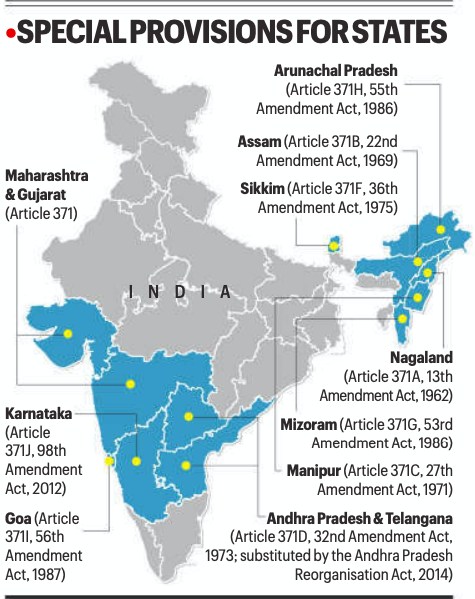
Eleven States carry special provisions, clustered in the North-East and the Deccan. Image courtesy The Indian Express, 22 September 2026; reproduced with credit for educational use.
The Article 371 family — three broad purposes
- Protecting identity, customary law and land: 371A Nagaland (13th Amendment, 1962, following the 16-Point Agreement of 1960) and 371G Mizoram (53rd Amendment, 1986, after the Mizo Peace Accord) — Parliament’s laws on religious and social practices, customary law and land ownership apply only if the State Assembly so resolves.
- Voice for hill and tribal areas: 371B Assam (22nd Amendment, 1969) and 371C Manipur (27th Amendment, 1971) allow special committees of the Assembly for tribal or hill-area members; in Manipur the Governor reports annually to the President on the hill areas.
- Regional equity: Article 371 (Maharashtra and Gujarat — Vidarbha, Marathwada, Saurashtra, Kutch), 371D (Andhra Pradesh and Telangana, 32nd Amendment, 1973, from the Six-Point Formula) and 371J (Kalyana Karnataka, 98th Amendment, 2012) provide development boards and local reservation in education and jobs.
- Integration and administration: 371F Sikkim (36th Amendment, 1975) managed Sikkim’s entry as the 22nd State; 371H Arunachal Pradesh (55th Amendment, 1986) gives the Governor special responsibility for law and order; 371I Goa (56th Amendment, 1987) only fixes a minimum Assembly size of 30.
- Often missed: 371E (32nd Amendment, 1973) enabled Parliament to establish a central university in Andhra Pradesh.
◈ Static Background — Ladakh’s Constitutional Position
- UT without legislature: the Jammu and Kashmir Reorganisation Act, 2019 created Ladakh as a separate Union Territory from 31 October 2019, administered by a Lieutenant Governor under Article 239.
- Article 240: lets the President make regulations for certain UTs, including Ladakh, with the force of an Act of Parliament.
- Existing local bodies: the Ladakh Autonomous Hill Development Councils of Leh (1995) and Kargil (2003) handle local development but have no legislative power.
- Demands since 2019: the Apex Body, Leh (ABL) and the Kargil Democratic Alliance (KDA) have sought statehood or a legislature, inclusion under the Sixth Schedule, job protections and safeguards for land and culture.
- Sixth Schedule contrast: it provides Autonomous District Councils only in Assam, Meghalaya, Tripura and Mizoram (Articles 244(2) and 275(1)); Ladakh’s predominantly tribal population made it a recurrent demand.
What the proposed Article 371K envisages
- Institution: a directly elected UT-level body with legislative, executive, financial, budgetary and planning powers.
- Subjects (as stated by the MHA): land, culture and language, forests, environment and natural resources, and other matters reserved for the UT under Article 240.
- Novelty: it would be the first Article 371 provision for a Union Territory without a legislature, rather than a State.
- Open questions: Ladakh’s leaders also seek control over law and order — the reverse of 371H, where the Governor holds that responsibility — and land protections resembling 371A and 371G.
Analysis — how strong will the safeguard be?
- Design decides value: a body that merely lists legislative subjects would offer limited protection; control over land, resources, recruitment and administration would be considerably stronger.
- Lessons from Manipur: hill tribes have argued that Article 371C has not delivered meaningful autonomy — a caution that a committee-based or advisory model can remain symbolic.
- Federal balance: Ladakh is a strategically sensitive border region; placing policing and the bureaucracy under an elected executive would make its head of government more powerful than the Chief Minister of Jammu & Kashmir.
- Asymmetric federalism: the proposal reflects the Constitution’s capacity to accommodate diversity through bespoke arrangements rather than uniform rules.
Way Forward
- Clarity in text: define the elected body’s powers, fiscal autonomy and its relationship with the LG and the Hill Councils precisely in the amendment.
- Continued dialogue: keep the ABL, KDA and the MHA engaged so that the settlement is seen as legitimate in both Leh and Kargil.
- Ecological safeguards: give the body clear authority over land use in a fragile, high-altitude ecosystem.
▤ Prelims Pointers
- 371A (Nagaland) and 371G (Mizoram): the strongest protections — central laws on customary law and land need the State Assembly’s consent.
- 371H (Arunachal): Governor’s special responsibility for law and order.
- 371I (Goa): only a minimum Assembly size of 30 members.
- 371J (Karnataka): the latest provision, 98th Amendment, 2012, for Kalyana Karnataka.
- Article 240: the President’s regulation-making power for specified UTs, including Ladakh.
✎ Mains Practice Question
Article 371 has evolved from a transitional provision into an instrument of asymmetric federalism. Discuss with examples, and examine the challenges in extending such a provision to a Union Territory like Ladakh. 15 marks · 250 words
02
Supreme Court Strikes Down Maharashtra’s Methanol Rules as Disproportionate
GS-II · Polity — Fundamental Rights, JudiciaryPrelims + MainsThe Hindu
On 18 September 2026, a Bench of Justices J.B. Pardiwala and K. Vinod Chandran struck down Rules 18A and 18B of the Maharashtra Poisons Rules, 1972, holding that they failed the proportionality test under Articles 14 and 19(1)(g).
◈ Static Background — Methanol and Hooch Tragedies
- Methanol (methyl alcohol, CH₃OH): a toxic industrial solvent used for formaldehyde, resins, paints and chemicals; the body converts it into formic acid, which can cause blindness, metabolic acidosis and death.
- Ethanol vs methanol: potable liquor contains ethanol; spurious liquor becomes lethal when cheap methanol is mixed in.
- Maharashtra’s trigger: a 1991 Mumbai hooch tragedy killed around 93 people; the P.R. Parthasarthy committee recommended stricter controls, and Rules 18A and 18B were inserted in 2011.
- Legal base: the Poisons Act, 1919 allows State governments to regulate possession and sale of poisons; “intoxicating liquors” fall under the State List (Entry 8).
◈ Static Background — The Proportionality Test
Indian courts test restrictions on fundamental rights through a four-part proportionality standard, articulated in Modern Dental College v. State of M.P. (2016) and K.S. Puttaswamy (2017).
- Legitimate aim: the measure must pursue a proper purpose.
- Rational connection: the measure must actually advance that purpose.
- Necessity: no less restrictive but equally effective alternative should exist.
- Balancing: the benefit must outweigh the harm to the right.
What the Court held
- Rule 18A(1) — verifying a purchaser’s Form A licence before sale — was a disproportionate burden, since the licence check revealed nothing about how methanol would actually be used.
- Rule 18A(2) — mandatory colourant and bitterant for sale to non-drug manufacturers — lacked a “reasonable and proximate nexus” with preventing illicit liquor, which is made in the unregulated sector.
- Rule 18B — confiscation of methanol held without a Form A licence — conflicted with lawful possession under a Form B permit, rendering that permit redundant.
- Industry impact: the Court accepted that additives could contaminate paints and pharmaceuticals and affect catalysts and laboratory uses — a continuing burden for no demonstrated benefit.
Guidelines issued to States
- Coordinated enforcement: prohibition, excise, police, transport, industries and health departments, with NGOs, to act against illicit liquor at borders, transit points and production sites.
- Tighter licensing: licences only after verification, with periodic review; industrial users must maintain stock records and return excess methanol, on pain of suspension or cancellation.
- Secure transport: dedicated, tamper-proof sealed tankers under excise supervision.
- Social measures: more de-addiction centres, local counselling and support for affected families.
Significance
- Regulation vs outcome: the ruling reinforces that the State’s power to regulate is not in doubt — but a rule must be shown to work, not merely look protective.
- Ease of doing business: it affirms Article 19(1)(g) protection against blanket burdens on legitimate industry.
- Enforcement gap: the Court itself noted that directions matter only if police and excise machinery implement them.
✎ Mains Practice Question
Explain the doctrine of proportionality as applied by the Supreme Court to regulatory restrictions on trade. How can States prevent hooch tragedies without imposing disproportionate burdens on legitimate industry? 10 marks · 150 words
International RelationsGeneral Studies Paper II
03
India–New Zealand Free Trade Agreement to Enter into Force on 20 October 2026
GS-II · IR — Bilateral AgreementsGS-III · Economy — External TradePrelims + MainsThe Hindu
Both countries have completed ratification of the India–New Zealand Free Trade Agreement (FTA), which will take effect on 20 October 2026. Union Commerce and Industry Minister Piyush Goyal said the pact aims to double bilateral trade in four to five years, while India’s dairy and sensitive farm products stay protected.
◈ Static Background — FTAs and India’s Trade Policy
- Free Trade Agreement: a treaty under which partners eliminate or cut tariffs on “substantially all trade” between them, permitted under Article XXIV of the GATT as an exception to the WTO’s most-favoured-nation rule.
- Modern FTAs go beyond tariffs — covering services, investment, mobility of professionals, intellectual property, sanitary and phytosanitary (SPS) standards and technical barriers to trade (TBT).
- The RCEP decision: India withdrew from the Regional Comprehensive Economic Partnership (RCEP) talks in November 2019, partly over fears of dairy and farm imports from Australia and New Zealand and of Chinese goods.
- Recent pivot: since 2022, India has signed trade pacts with the UAE, Australia, the EFTA bloc and the United Kingdom, among others. With New Zealand, India now has trade agreements with every RCEP member except China.
Figure 2 — New Zealand at a glance
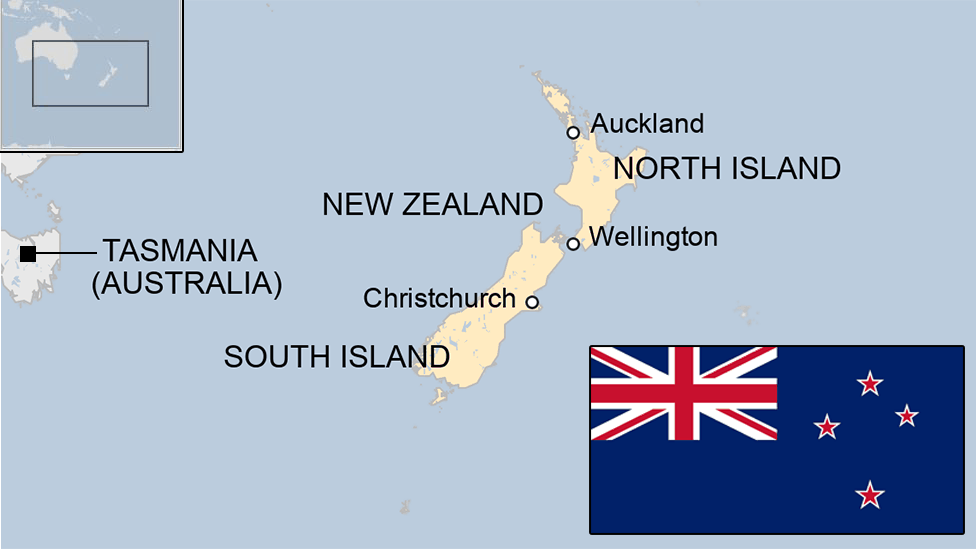
A two-island nation in the South-West Pacific; Wellington is the capital and Auckland the largest city. Image courtesy BBC News; reproduced with credit for educational use.
▤ The Agreement at a Glance
- Timeline: negotiations first launched in 2010 but stalled; relaunched on 16 March 2025, concluded in December 2025, signed on 27 April 2026, and in force from 20 October 2026.
- New Zealand’s offer: duty-free access for 100% of Indian exports from entry into force.
- India’s offer: about 70% of tariff lines liberalised, covering around 95% of New Zealand’s exports by value — either duty-free or at sharply reduced rates, some phased in.
- Excluded for India: dairy and sensitive farm items such as onions, almonds, chickpeas, peas, artificial honey and sugar.
- Investment: New Zealand has committed to facilitate around $20 billion of investment in India over 15 years.
- Mobility: a Temporary Employment Entry visa pathway for skilled Indians, capped at 5,000 at any time, for up to three years.
- Trade base: bilateral merchandise trade of about $1.3 billion in 2024-25; India is New Zealand’s ninth-largest export market.
Why it matters
- Export gains: labour-intensive sectors such as textiles, engineering goods and pharmaceuticals, as well as MSMEs, handloom artisans and weavers, get zero-duty access.
- Farm-sector red lines held: keeping dairy out addresses the concern that shaped India’s RCEP exit, given dairy’s role in rural livelihoods.
- Indo-Pacific and Pacific gateway: the agreement deepens India’s presence in Oceania and can support engagement with Pacific Island countries.
- Services and people: mobility provisions support India’s strength in skilled services, including Ayush practitioners, yoga instructors and IT professionals.
Concerns and limits
- Small trade base: at around $1.3 billion, trade is modest; gains depend on actual utilisation of preferences, which has historically been low in Indian FTAs.
- Asymmetric tariffs: New Zealand’s tariffs were already low, so India’s tariff cuts are proportionately larger than what it receives.
- Non-tariff barriers: New Zealand’s strict biosecurity and SPS standards may limit Indian agricultural and processed-food exports.
- Investment is a commitment, not a guarantee: the $20 billion figure depends on business decisions over 15 years.
✎ Mains Practice Question
India’s recent FTAs mark a shift from its reluctance after exiting RCEP. With reference to the India–New Zealand FTA, discuss how India is balancing export ambitions with the protection of sensitive sectors. 15 marks · 250 words
04
SLINEX-26: 13th India–Sri Lanka Bilateral Maritime Exercise at Visakhapatnam
GS-II · IR — India and its NeighbourhoodPrelims-orientedPIB · Ministry of Defence
The 13th edition of the Sri Lanka–India Exercise (SLINEX) is being held at Visakhapatnam from 17 to 21 September 2026, with a Harbour Phase followed by a Sea Phase focused on interoperability.
◈ Static Background
- SLINEX: conceptualised in 2005 as the bilateral naval exercise between the two navies; the Harbour Phase is under the Eastern Naval Command, headquartered at Visakhapatnam.
- Participants: INS Kavaratti, an indigenous anti-submarine warfare corvette, and INS Jyoti, a fleet tanker, from India; SLNS Sindurala from Sri Lanka.
- MAHASAGAR: “Mutual and Holistic Advancement for Security and Growth Across Regions”, announced in March 2025 as an expansion of the 2015 SAGAR vision (Security and Growth for All in the Region).
- Wider framework: the Colombo Security Conclave brings together India, Sri Lanka, the Maldives, Mauritius and Bangladesh on maritime security.
- Significance: Sri Lanka sits astride major Indian Ocean sea lanes; regular exercises build trust and interoperability as extra-regional navies expand their presence in the region.
✎ Mains Practice Question
How does the MAHASAGAR vision build upon SAGAR? Discuss the role of bilateral naval exercises such as SLINEX in advancing India’s maritime diplomacy in the Indian Ocean Region. 10 marks · 150 words
EconomyGeneral Studies Paper III
05
A Decade of UPI: ‘Tap & Pay’ Signals a Move Towards Code-less, OTP-free Payments
GS-III · Economy — Banking, Digital PaymentsPrelims + MainsNews reports · NPCI
At the Global Fintech Fest 2026 in Mumbai, RBI Governor Sanjay Malhotra launched UPI ‘Tap & Pay’ on point-of-sale (PoS) terminals, built by the National Payments Corporation of India (NPCI), allowing payments without scanning QR codes or entering OTPs.
◈ Static Background — UPI and NPCI
- Unified Payments Interface (UPI): launched by NPCI in 2016; it links multiple bank accounts to one mobile app and enables instant, 24×7 account-to-account transfers using a virtual payment address.
- NPCI: set up in 2008 by banks under RBI guidance as a not-for-profit company, under the Payment and Settlement Systems Act, 2007; it also runs RuPay, IMPS and FASTag.
- Growth driver: adoption accelerated after the November 2016 demonetisation; UPI now accounts for about 85% of digital payment transactions in India.
- Earlier add-ons: RuPay credit cards linked to UPI (2022), UPI Lite for small-value payments, and UPI 123PAY for feature phones.
What is new
- How it works: the user unlocks an NFC-enabled phone and taps it on an NFC-enabled PoS terminal; Near Field Communication (NFC) is short-range wireless data exchange.
- Offline-friendly: the transaction uses the PoS terminal’s internet connection, so it works even without mobile data on the user’s phone.
- Limits: PIN-less payments up to ₹5,000; above that, the UPI PIN must be entered on the terminal. It supports multiple account types, including RuPay credit cards on UPI.
- Security context: RBI directions requiring two-factor authentication for digital payments took effect from 1 April 2026, prompting alternatives to OTPs such as passkeys and device biometrics.
Analysis
- Convenience vs security: removing OTPs reduces fraud through stolen or shared codes, but PIN-less limits shift risk to lost or stolen unlocked devices.
- Infrastructure gap: benefits depend on NFC-enabled phones and PoS terminals, which are less common among small merchants who rely on printed QR codes.
- Market concentration: a few apps dominate UPI volumes; new features may deepen the dominance of large players.
- Digital public infrastructure: UPI remains the model for India’s approach of building open, interoperable public platforms.
✎ Mains Practice Question
UPI has transformed retail payments in India within a decade. Discuss the challenges of balancing convenience, security and inclusion as digital payments move beyond OTPs and QR codes. 10 marks · 150 words
Science & TechnologyGeneral Studies Paper III
06
Gaganyaan: Why the Crew Module Needs a Multi-stage Parachute System
GS-III · S&T — Space TechnologyPrelims + MainsThe Hindu
Safe recovery of astronauts is the final — and least forgiving — phase of a human spaceflight. The Gaganyaan crew module relies on a redundant, staged parachute system to slow from high speed to a gentle splashdown.
◈ Static Background — Gaganyaan and Re-entry
- Gaganyaan: India’s human spaceflight programme, led by ISRO’s Human Space Flight Centre (HSFC), aims to send a crew to low-earth orbit and return them safely.
- Re-entry physics: a returning spacecraft sheds most of its speed through atmospheric drag; parachutes then decelerate it further for landing on land or sea.
- Developer: the parachute system is developed by the Aerial Delivery Research and Development Establishment (ADRDE), Agra, a DRDO laboratory.
- Earlier tests: the Test Vehicle mission TV-D1 (October 2023) tested crew escape, and the Integrated Air Drop Test (August 2025) dropped a crew-module mock-up from a helicopter to test parachutes.
Figure 3 — Staged parachute deployment of the Gaganyaan crew module
Re-entryDrag slowsmodule tosubsonic2 DroguesMortar-fired;stabilise andfirst slow3 Pilot chutesMortar-ejected;pull out themain chutes3 Main chutesOpen partly(reefed), thenfully bloomSplashdownPyro cuttersrelease chutesso wind cannot drag itRedundancy: if one main chute fails, the other two can still land the module safelyModule speed in the lower atmosphere: about 170 m/s
Canopy size grows in stages so that each opening shock stays within what the fabric and the crew can tolerate.
Key concepts
- Three chute types: a small pilot chute pulls out larger chutes; the drogue stabilises the module and cuts speed early; the wide main chute brings it to a soft landing.
- Why stages: opening a full main chute at about 170 m/s would create a huge opening shock, tearing the fabric or subjecting the crew to dangerous deceleration.
- Reefing: a cord around the canopy limits how wide it opens; a timed cutter severs it once the module has slowed, letting the chute bloom fully.
- Wake problem: the module’s blunt shape creates turbulence behind it, so mortars must eject chutes fast enough to clear the wake.
Materials and testing
- Kevlar: high tensile strength for suspension lines, risers and reinforcement tapes.
- Nomex: heat resistance for areas exposed to hot mortar gases and aerothermal heating.
- Nylon: elastic canopy fabric that absorbs shock loads and packs compactly.
- Test methods: the Rail Track Rocket Sled at the Terminal Ballistics Research Laboratory, Chandigarh, drops from helicopters or aircraft, and small rocket-powered test vehicles.
✎ Mains Practice Question
Crew safety during recovery is a critical challenge for India’s human spaceflight programme. Explain the engineering principles behind the Gaganyaan crew module’s parachute system and the importance of redundancy and testing. 10 marks · 150 words
Environment & EcologyGeneral Studies Paper III
07
Alternative-Fuel Vehicles Overtake Petrol in Car Sales: Decoding India’s Mobility Transition
GS-III · Environment — Pollution, Clean Energy; Economy — InfrastructurePrelims + MainsThe Hindu
In August 2026, data from the Federation of Automobile Dealers Associations (FADA) showed that alternative-fuel vehicles — CNG, hybrid and electric combined — made up 41.95% of new passenger-vehicle sales, overtaking petrol (40.85%) for the first time. A closer look at registration data shows the transition is uneven across segments.
◈ Static Background — Why the Fuel Mix Matters
- Transport emissions: road transport is a major source of carbon dioxide, particulate matter and nitrogen oxides in Indian cities, and drives oil imports.
- Fuel categories: battery electric vehicles (EVs) have no tailpipe emissions; hybrids combine an engine with a battery; CNG and LPG are fossil fuels with lower emissions than petrol or diesel.
- Policy support: the FAME scheme (Faster Adoption and Manufacturing of Electric Vehicles, 2015 and 2019), the PM E-DRIVE scheme (2024, outlay ₹10,900 crore), Production-Linked Incentives for autos and battery cells, and 5% GST on EVs.
- Climate goals: India targets net-zero emissions by 2070; decarbonising transport is central to its Nationally Determined Contributions.
- Data source: the Vahan portal of the Ministry of Road Transport and Highways is the national database of vehicle registrations.
Figure 4 — Fuel-wise share of registrations: two-wheelers, three-wheelers and cars (2021–2026)
Three-wheelers have largely electrified; two-wheelers are moving steadily; in cars, CNG/LPG — not EVs — is replacing petrol and diesel. 2026 data up to August. Image courtesy The Hindu, 22 September 2026; reproduced with credit for educational use.
Segment-wise picture
- Overall: petrol and diesel accounted for 83.5% of about 82 lakh vehicles registered in January–March 2026, down 11.5 percentage points from 2021, when they formed over 95% of 57 lakh registrations. EVs made up 10.6%.
- Two-wheelers (over 70% of new vehicles): EV share rose from 6.4% in 2025 to 9.1% in 2026 (till August); petrol’s share fell to about the 90% mark for the first time.
- Three-wheelers (about 4% of vehicles): EVs formed 60.5% of the roughly 9.8 lakh registered till August; petrol and diesel share halved from nearly 30% in 2021 to under 15%.
- Cars: petrol and diesel share fell from 86% in 2021 to 61.6% in 2026, but mainly because of vehicles running on petrol with CNG or LPG; EVs formed about 6.2%, and hybrids have stayed near 8% since 2023.
Analysis — why cars lag
- Upfront cost: electric cars remain costlier than comparable petrol or CNG models, despite lower running costs.
- Charging anxiety: public charging networks are thin outside metros and highways, which matters more for cars used on longer trips.
- CNG as a bridge: an expanding city gas distribution network makes CNG a cheaper, familiar alternative — lowering emissions but prolonging fossil-fuel dependence.
- Where electrification works: three-wheelers electrified fastest because of short, predictable routes, low running costs for commercial operators and cheaper batteries.
- Headline vs detail: grouping CNG, hybrids and EVs as “alternative fuels” can overstate progress towards zero-emission mobility.
Way Forward
- Charging infrastructure: faster rollout of public and residential charging, including standardised connectors and interoperable payments.
- Battery ecosystem: domestic cell manufacturing and recycling to reduce costs and import dependence on critical minerals.
- Clean power: EV benefits depend on the grid’s energy mix, so renewable expansion must keep pace.
- Targeted incentives: focus support on segments with the largest pollution impact, such as urban fleets, taxis and buses.
▤ Prelims Pointers
- FADA: Federation of Automobile Dealers Associations — publishes monthly retail sales data.
- Vahan: MoRTH’s national vehicle registration database.
- PM E-DRIVE: successor to FAME-II for EV demand incentives and charging infrastructure.
- CNG/LPG: cleaner-burning, but still fossil fuels — not zero-emission.
✎ Mains Practice Question
India’s shift away from petrol and diesel vehicles is uneven across segments. Analyse the factors behind rapid electrification of three-wheelers and slower adoption in cars, and suggest measures to accelerate the transition to zero-emission mobility. 15 marks · 250 words
08
Himachal’s Monkey Menace: Human–Wildlife Conflict after the Rhesus Macaque Lost Legal Protection
GS-III · Environment — Conservation, Human–Wildlife ConflictPrelims + MainsThe Indian Express
The death of a 63-year-old woman in Shimla after an attack by rhesus macaques has revived debate on who is responsible for managing the animal since it was removed from the protected list in 2022 — and whether victims can be compensated.
◈ Static Background — The Law
- Rhesus macaque (Macaca mulatta): a widespread, adaptable primate of South and South-East Asia, classified as Least Concern by the IUCN.
- Wild Life (Protection) Act, 1972: earlier listed the rhesus macaque under Part I of Schedule II, making it a protected species.
- 2022 Amendment: rationalised the schedules from six to four and removed the rhesus macaque from protection, and the separate vermin schedule was dropped.
- Vermin power: under Section 62, the Centre can declare a wild animal vermin for an area and period; the rhesus macaque had earlier been declared vermin in parts of Himachal Pradesh for limited periods.
- Constitutional duties: Article 48A (State to protect wildlife) and Article 51A(g) (citizens’ duty of compassion for living creatures).
Figure 5 — Estimated rhesus macaque population in Himachal Pradesh
3,17,5122,26,0861,36,443200420132019-20
The State forest department attributes much of the fall to sterilisation — 1,86,448 monkeys sterilised between 2006 and March 2024.
What changed after 2022
- Shift of responsibility: Himachal’s Chief Wildlife Warden, Alok Prem Nagar, said monkeys are now treated like stray animals under civic bodies rather than the forest department.
- Capacity gap: urban local bodies such as the Shimla Municipal Corporation lack funds, trained staff and expertise to capture and sterilise monkeys.
- Funding loss: central funds that forest departments received for monkey control are no longer available for an unprotected species.
- Cost shift: the forest department now charges civic bodies about ₹700 per sterilisation.
- Scale: Shimla records 50–55 monkey attacks a month, according to civic officials.
The compensation gap
- State policy: Himachal’s wildlife compensation provides ₹75,000 for severe injury, ₹1 lakh for permanent disability and ₹4 lakh for death.
- The catch: since the rhesus macaque is no longer covered by the Act, officials indicate victims’ families may not qualify — an unintended consequence of delisting.
Analysis and Way Forward
- Root cause: public feeding and easy access to food waste draw monkeys out of forests; enforcing anti-feeding rules and waste management addresses the source.
- Institutional clarity: a clear division of roles between forest departments and civic bodies, with dedicated funding, is needed.
- Humane population control: sterilisation has shown results and should be sustained rather than relying on culling.
- Victim relief: compensation policies should cover conflict with species regardless of their schedule status.
✎ Mains Practice Question
The removal of the rhesus macaque from legal protection has created gaps in responsibility and compensation. Examine the challenges in managing urban human–wildlife conflict in India and suggest an institutional framework to address them. 10 marks · 150 words