

In-Depth News Analysis9 Items
Core TopicImportantConcise
Polity & GovernanceGS Paper II
01Election Commissioners, the Cabinet Secretariat and Institutional Independence02Right to Protest — Mere Presence Not Enough for Prosecution03Prasar Bharati and Public Service Broadcasting
International RelationsGS Paper II
04India–Poland: Target to Double Trade by 203005Places in News — Alberta Referendum, Canada
EconomyGS Paper III
06Keynes vs Microfoundations — Why Investment Drives the Economy
Science & TechnologyGS Paper III
07PHP2Shell — Critical Web Vulnerabilities
EnvironmentGS Paper III
08Loss and Damage Fund — First Country Allocation to Nepal
Internal SecurityGS Paper III
09India–China Face-off in Arunachal Pradesh
Polity & GovernanceGeneral Studies Paper II
01
RTI Records Show Cabinet Secretariat Declined to Act on Election Commissioners’ Letters, Citing Non-Interference in a Constitutional Body
GS-II · Constitutional Bodies — Election Commission of IndiaPrelims + MainsThe Indian Express · p1 · The Hindu · p7
File notings released under the RTI Act show that when two Election Commissioners wrote to the Cabinet Secretary on 29 July 2026 seeking action against an officer in the Election Commission of India (ECI), the Cabinet Secretariat acknowledged the letters and kept the Chief Election Commissioner’s (CEC) office informed, but noted that action would be “inappropriate” and could be seen as “interference” in a constitutional body.
◈ From Basics — How the Election Commission Is Constituted
- Article 324: vests the superintendence, direction and control of elections to Parliament, State Legislatures, and the offices of President and Vice-President in the ECI.
- Composition: a CEC and such number of ECs as the President fixes; multi-member briefly in 1989 and permanently since October 1993.
- Appointment: under the CEC and Other ECs (Appointment, Conditions of Service and Term of Office) Act, 2023, by the President on the recommendation of a committee of the Prime Minister, the Leader of the Opposition in the Lok Sabha and a Union Cabinet Minister.
- Security of tenure — Article 324(5): the CEC can be removed only like a Supreme Court judge; an EC can be removed only on the CEC’s recommendation.
- Equal voice: in T.N. Seshan v. Union of India (1995), the Supreme Court held that the CEC and ECs have equal status and decide by majority.
▤ Institutions at a Glance
- Cabinet Secretariat: functions directly under the Prime Minister; assists the Cabinet under the Government of India (Transaction of Business) Rules, 1961. The Cabinet Secretary is the senior-most civil servant.
- ECI staff — Article 324(6): the President and Governors must provide the staff the ECI needs. The ECI has no separate cadre; officers come on deputation.
- RTI Act, 2005: Section 8(1)(i) exempts Cabinet papers only until a decision is taken; file notings are generally disclosable.
Why it matters
- Independence in practice: the Cabinet Secretariat’s own recorded view affirms that the executive should not intervene in the ECI’s internal functioning.
- Internal governance: the episode raises the question of how disagreements within a multi-member Commission are resolved — through the Commission itself or outside it.
- Reform debate: the Goswami Committee (1990) and the ECI have sought an independent secretariat and charging of ECI expenses to the Consolidated Fund of India.
✎ Mains Practice Question
The independence of the Election Commission depends not only on constitutional safeguards but also on its internal functioning and administrative autonomy. Examine with reference to recent developments. 10 marks · 150 words
02
Mere Presence at a Protest Is Not Enough for Prosecution: Delhi High Court Quashes FIR Against SSC Aspirant
GS-II · Fundamental Rights — Article 19; Criminal JusticePrelims + MainsThe Hindu · p8
The Delhi High Court quashed an FIR against an SSC aspirant booked after a protest at Ramlila Maidan (August 2025), holding that mere participation in a demonstration does not establish a common intention to disobey police orders or obstruct personnel.
◈ From Basics — The Right to Protest
- Article 19(1)(a) (speech and expression) and Article 19(1)(b) (to assemble peaceably and without arms) together protect peaceful protest.
- Article 19(3): the State may impose reasonable restrictions on assembly in the interests of sovereignty and integrity of India and public order.
- Key judgments: Ramlila Maidan Incident (2012) — the right to protest is a fundamental right; Mazdoor Kisan Shakti Sangathan (2018) — protest sites cannot be closed outright; Amit Sahni (2020) — public spaces cannot be occupied indefinitely.
▤ The Legal Provisions Involved (new and old)
- Prohibitory orders: Section 163, BNSS (formerly Section 144, CrPC).
- Disobeying a public servant’s order: Section 223, BNS (formerly Section 188, IPC).
- Common intention: Section 3(5), BNS (formerly Section 34, IPC).
- Quashing power: High Court’s inherent powers under Section 528, BNSS (formerly Section 482, CrPC).
- The three new criminal laws came into force on 1 July 2024.
Why it matters
- Individual culpability: criminal liability needs material showing a person’s own act or shared intention — not presence in a crowd.
- Chilling effect: blanket FIRs against protesters can deter lawful dissent, especially by students and job aspirants.
- Balance: the ruling does not bar action against those who actually break the law; it requires that the evidence be specific.
✎ Mains Practice Question
“The right to protest is integral to democracy, but it is not absolute.” Discuss the balance between Article 19(1)(b) and public order, with reference to judicial pronouncements. 10 marks · 150 words
03
Prasar Bharati and the Unfinished Idea of Public Service Broadcasting
GS-II · Statutory Bodies; Media and GovernancePrelims + MainsThe Hindu · Opinion · p14
An opinion article argues that Prasar Bharati, India’s public broadcaster, has not become the autonomous public service broadcaster envisaged in its 1990 Act, because key provisions on parliamentary oversight and complaint redress remain unimplemented.
◈ From Basics — Public vs State Broadcasting
A public service broadcaster, as described by UNESCO, is neither commercial nor state-controlled: it is funded publicly, independent in editorial judgement and accountable to the public. A state broadcaster is run as an arm of government.
- All India Radio took its name in 1936; Doordarshan began in 1959 and was separated from AIR in 1976.
- Lineage of reform: Chanda Committee (1966) → B.G. Verghese Working Group (1977–78) → Prasar Bharati Bill (1979, lapsed) → Prasar Bharati (Broadcasting Corporation of India) Act, 1990, in force only from 1997.
- Supreme Court: in Secretary, Ministry of I&B v. Cricket Association of Bengal (1995), the Court held that airwaves are public property and called for an independent authority to regulate their use.
▤ Key Sections of the Prasar Bharati Act
- Section 12: objectives — inform, educate and entertain; safeguard the citizen’s right to be informed “freely, truthfully and objectively”.
- Section 13: a 22-member Parliamentary Committee to oversee the corporation — never constituted, according to the author.
- Sections 14–15: a Broadcasting Council to hear complaints — never set up, according to the author.
- Section 23: the Centre may issue directions to the corporation.
- Public Service Broadcasting Day: 12 November, marking Mahatma Gandhi’s only AIR broadcast (1947, to refugees at Kurukshetra).
The author’s argument
- Institutional gaps: the unimplemented oversight and complaint bodies leave no independent channel for editorial redress.
- Structure: assets and staff were never fully transferred, and funding depends on the Ministry.
- Workforce mix: a 2021 manpower audit found nearly half of staff in engineering and under 20% in content — the reverse of the BBC model (as cited by the author).
- Remedies proposed: constitute the parliamentary committee and Broadcasting Council, professionalise the Board, provide independent funding and amend the Act.
Other perspectives
- Governments have argued that a public broadcaster has a legitimate role in communicating public programmes and that ministerial accountability to Parliament provides oversight.
- The Sam Pitroda Expert Committee (2014) recommended greater autonomy alongside modernisation; Prasar Bharati has since expanded into digital platforms, including its OTT service launched in 2024.
✎ Mains Practice Question
Distinguish between public service broadcasting and state broadcasting. Evaluate the extent to which the Prasar Bharati Act, 1990 has achieved its objective of creating an autonomous public broadcaster. 15 marks · 250 words
International RelationsGeneral Studies Paper II
04
India and Poland Aim to Double Bilateral Trade by 2030 as Polish Prime Minister Visits New Delhi
GS-II · IR — India and Europe; Bilateral RelationsPrelims + MainsThe Hindu · p7 · The Indian Express · p6
During the first visit to India by a Polish Prime Minister since 2010, the two sides set a goal of doubling bilateral trade by 2030 from about US$6 billion, and discussed cooperation in space, transport, renewable energy, clean coal, mining and technology. No agreements were signed; trade is expected to get a boost from the India–EU Free Trade Agreement, which is due to be signed in December.
◈ From Basics — Poland in Europe
- Location: Central Europe on the Baltic Sea; capital Warsaw, on the Vistula. It borders seven countries — Germany, Czech Republic, Slovakia, Ukraine, Belarus, Lithuania and Russia (the Kaliningrad exclave).
- Memberships: NATO (1999), European Union (2004), Schengen Area; part of the Visegrád Group (with Czechia, Slovakia, Hungary) and the Weimar Triangle (with France and Germany).
- Strategic geography: the Suwałki Gap, a narrow land strip on the Poland–Lithuania border between Belarus and Kaliningrad, is seen as NATO’s most sensitive corridor.
- Economy: one of the EU’s fastest-growing economies; now in the group of countries with a trillion-dollar GDP.
Figure 1 — Poland and its neighbours
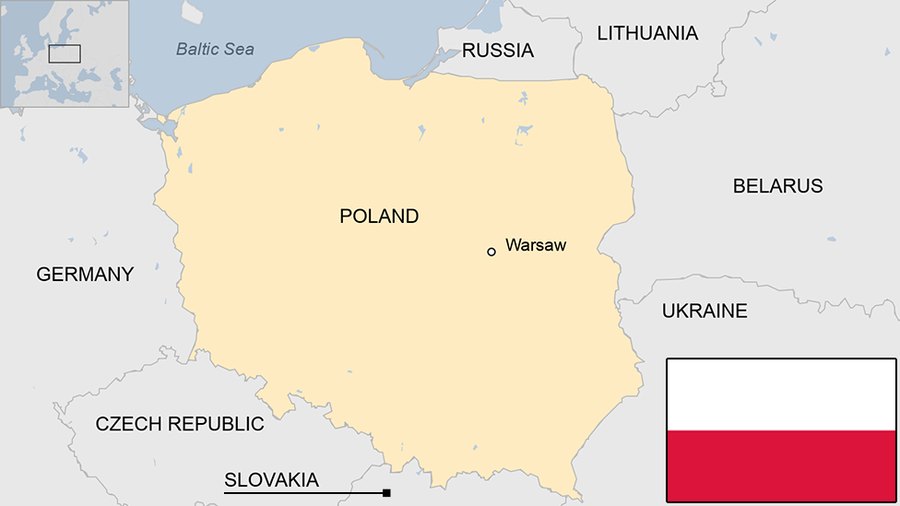
Map hook: Russia borders Poland only through the Kaliningrad exclave; Poland is a frontline State on NATO’s eastern flank and the main transit route for aid to Ukraine. Map reproduced with credit to its original publisher for educational use.
▤ Relationship at a Glance
- Diplomatic ties: established in 1954.
- Strategic Partnership: since August 2024, when an Indian Prime Minister visited Warsaw for the first time in about 45 years.
- Trade: about US$6 billion; target — double by 2030.
- Focus areas: rail transport, clean coal technology, mining, space, renewables, defence and technology; a large Polish business delegation visited Delhi and Bengaluru.
- Ukraine: India’s “four-point proposal” to mitigate the effects of the Russia–Ukraine conflict was discussed.
Historical anchors — a relationship rooted in goodwill
- The “Good Maharaja”: during World War II, the Jam Sahib of Nawanagar sheltered about 1,000 Polish children at Balachadi near Jamnagar; a square in Warsaw is named after him.
- Kolhapur: the Valivade camp hosted over 5,000 Polish refugees between 1943 and 1948.
- Operation Ganga (2022): Poland facilitated the evacuation of Indian students from Ukraine across its border.
Why it matters
- Gateway to Central Europe: Poland is the largest economy in Central and Eastern Europe and a hub for Indian IT and pharmaceutical firms.
- India–EU FTA: stronger ties with individual member States help build support for the trade agreement and for trusted supply chains.
- Energy transition: Poland’s experience in moving away from coal and in clean coal technology is relevant to India.
- Strategic balance: engagement with a frontline NATO State broadens India’s European partnerships while India maintains ties with Russia.
The critical view
- Low base: trade of about US$6 billion is small for two large economies; doubling still leaves it modest.
- No signed agreements during the visit; outcomes depend on the India–EU FTA and on business follow-through.
- Divergent views on Russia: Poland sees Russia as a direct threat; India’s strategic autonomy will require careful handling.
✎ Mains Practice Question
Central and Eastern Europe has emerged as a new frontier in India’s engagement with Europe. Discuss the significance of the India–Poland Strategic Partnership in this context, and the challenges posed by divergent views on the Russia–Ukraine conflict. 15 marks · 250 words
05
Places in News: Alberta Votes Against Moving Towards a Separation Referendum
GS-II · IR — Developments in Other Countries; Comparative FederalismGS-I · World GeographyPrelims + MainsThe Hindu · Text & Context · p16
In a non-binding referendum on 19 October 2026, nearly 75% of voters in the Canadian province of Alberta chose that it should remain a province of Canada, rather than asking the provincial government to begin the process for a binding referendum on separation. Official results are due on 29 October.
Figure 2 — Alberta in Canada
Alberta lies between British Columbia and Saskatchewan and borders the US State of Montana; capital Edmonton, largest city Calgary. Map courtesy BBC; reproduced with credit for educational use.
◈ From Basics — Canada and Alberta
- Canada: a federation formed in 1867 (Constitution Act, 1867); 10 provinces and 3 territories; a parliamentary democracy and constitutional monarchy.
- Alberta: became a province in 1905. Its oil sands (notably the Athabasca deposits) give Canada the world’s fourth-largest proven oil reserves, after Venezuela, Saudi Arabia and Iran; Alberta produces over 80% of Canada’s crude.
- Roots of discontent: a perception that the province contributes more to the federation than it receives, opposition to federal limits on oil extraction, and recent trade tensions with the US.
Secession and federalism — a comparative lens
- Canada’s precedent: Quebec held sovereignty referendums in 1980 and 1995 (the latter lost narrowly, about 50.6% to 49.4%). The Supreme Court’s Reference re Secession of Quebec (1998) held that a province cannot secede unilaterally, but a clear majority on a clear question would oblige negotiation; the Clarity Act (2000) followed.
- India’s position: Article 1 describes India as a “Union of States” — no State has a right to secede. The 16th Amendment (1963) allowed reasonable restrictions on free speech in the interests of sovereignty and integrity, and added it to the oaths of legislators.
- Prelims hook: India is often described as an “indestructible Union of destructible States” — Parliament can alter State boundaries under Article 3.
Why it matters
- The result strengthens Canada’s federal government amid trade tensions with the US and plans for new oil pipelines.
- About 30% support for the separation option, against under 2% historically for separatist parties, shows a significant rise in regional discontent.
✎ Mains Practice Question
Compare the approaches of the Canadian and Indian constitutions to regional demands for secession. What lessons do they offer for managing fiscal and resource-related grievances in a federation? 10 marks · 150 words
EconomyGeneral Studies Paper III
06
Economics Beyond the Individual: Why Keynes Placed Business Investment, Not Saving, at the Centre of Growth and Instability
GS-III · Economy — Growth, Investment, Monetary PolicyPrelims + MainsThe Hindu · Economic Notes · p16
An “Economic Notes” article contrasts the microfoundations approach to macroeconomics — which builds aggregate outcomes from individual choices and underpins modern interest-rate targeting — with the Keynesian view that business investment, driven by uncertain profit expectations, is the main source of growth and instability.
◈ From Basics — Key Concepts
- Microeconomics studies individual choices; macroeconomics studies the economy as a whole — output, employment, prices. The field grew from J.M. Keynes’s General Theory (1936), written after the Great Depression.
- Consumption smoothing: people spread consumption over their lifetimes (Friedman’s permanent income and Modigliani’s life-cycle hypotheses). Higher interest rates reward saving and reduce current spending.
- Neutral interest rate: the rate that neither stimulates nor restrains demand — a reference point for central banks, including the RBI.
- Paradox of thrift (Keynes): if everyone saves more at once, demand and income fall, and total saving may not rise.
Figure 3 — Two views of how saving and investment are matched
Classical / microfoundations viewKeynesian viewHousehold savingInvestmentInterest rate equates themSaving today = demand tomorrow;policy works mainly via interest ratesBusinessinvestmentIncome rises(multiplier)Income generates matching savingInvestment depends on uncertainprofit expectations (“animal spirits”)Policy implication: watch the investment behaviour of firms, not just household saving
In the Keynesian view, saving does not automatically become investment; income adjusts to bring them into balance.
The author’s argument
- The microfoundations approach (associated with economists Robert Hall and Michael Woodford) gave central banks rigorous models for interest-rate targeting, but treated saving as automatically becoming future demand.
- Keynes’s insight: saving may be held for uncertain needs (a health emergency, say), so it sends no clear signal to businesses about future demand; investment, not saving, drives output and jobs.
- Instability: under uncertainty, investors follow the herd — investing in booms, retreating in slumps — which amplifies cycles. Hyman Minsky’s Financial Instability Hypothesis explains how this fed the 2008 crisis; the author sees similar risks in today’s AI-driven stock gains.
- Structure matters: heterodox economics stresses who owns capital and makes investment decisions, rather than treating all individuals as similarly placed.
Why it matters for India
- Private investment: India’s growth debate centres on reviving private capital expenditure, which has lagged public capex — a Keynesian concern with business expectations.
- Monetary policy limits: rate changes alone may not revive investment if firms expect weak demand; fiscal and regulatory certainty also matter.
- Prelims terms: multiplier, animal spirits, paradox of thrift, liquidity trap, Minsky moment.
✎ Mains Practice Question
“Saving does not automatically translate into investment.” Explain this Keynesian proposition and discuss its relevance for reviving private investment in India. 10 marks · 150 words
Science & TechnologyGeneral Studies Paper III · Cyber Security
07
PHP2Shell: Two Critical Flaws in a Widely Used Web Language Force Precautionary Shutdowns Worldwide
GS-III · Cyber Security; Role of AIPrelims + MainsThe Indian Express · Explained · p17
Websites of Japan’s Finance Ministry, the Port of Rotterdam and the Wikimedia Foundation, among others, went offline as operators rushed to fix two critical vulnerabilities in PHP, collectively called PHP2Shell. Researchers found the flaws with the help of AI tools, and patches have been released.
◈ From Basics — Web Servers and Vulnerabilities
- PHP (Hypertext Preprocessor): an open-source, server-side programming language created in 1994; it processes logins, forms and payments behind the scenes on roughly 70% of websites whose server language is identifiable.
- Vulnerability: a flaw that can be exploited to breach security. A zero-day is one exploited before a fix exists.
- Remote code execution (RCE): the most serious class — an attacker runs commands on a server over the internet, without logging in.
- CVE and CVSS: flaws are catalogued under Common Vulnerabilities and Exposures IDs and rated by severity on the Common Vulnerability Scoring System.
▤ The Two Flaws, Simply Explained
- Memory problem: if processing (say, of an uploaded CV) is interrupted and PHP treats incomplete data as valid, an attacker can exploit the error.
- Leftover information: if data from one user’s request leaks into the next, an attacker can manipulate the confusion.
- Risk: taking control of servers, or reading passwords, documents and personal data from server memory.
- Why shutdowns: patching is hard on shared hosting and on old devices whose software users cannot update — so agencies advised going offline until fixed.
AI: friend or foe?
- Defence: AI tools helped researchers find and disclose the flaws faster, through coordinated disclosure with PHP’s developers.
- Offence: the same tools can shorten the time attackers need to build exploits, leaving defenders less time to patch.
The Indian angle
- CERT-In (Section 70B, IT Act) issues advisories and requires incidents to be reported within 6 hours.
- Many government and small-business websites run on PHP; the episode underlines the need for software inventories, regular patching and security audits — and for supporting the open-source projects that underpin the internet.
✎ Mains Practice Question
Artificial intelligence is changing both cyber defence and cyber offence. Discuss with examples, and suggest measures to protect India’s digital infrastructure from widely shared software vulnerabilities. 10 marks · 150 words
EnvironmentGeneral Studies Paper III — Climate Change
08
UN Loss and Damage Fund Earmarks $21.6 Million for Nepal — Its First Allocation to a Specific Country
GS-III · Environment — Climate Finance; Disaster ManagementGS-II · International InstitutionsPrelims + MainsThe Hindu · p4 · The Indian Express · p18
The Board of the Fund for responding to Loss and Damage (FRLD) has provisionally set aside $21.6 million for Nepal after an ice-and-rock avalanche on 26 August 2026 triggered debris flows and floods along the Bhotekoshi–Trishuli–Narayani river system. It is the Fund’s first allocation to a specific country, made weeks before COP31 in Türkiye.
◈ From Basics — Mitigation, Adaptation and Loss & Damage
- Mitigation: cutting greenhouse gas emissions. Adaptation: preparing for climate impacts (embankments, drought-resistant crops).
- Loss and damage: impacts that cannot be avoided by mitigation or adaptation — destroyed homes, lost lives, vanished livelihoods, and non-economic losses such as culture and territory.
- Equity basis: developing countries contribute little to cumulative emissions but bear heavy losses — the principle of Common But Differentiated Responsibilities (CBDR) under the UNFCCC (1992).
Figure 4 — The evolution of loss and damage in climate negotiations
2013Warsaw Int’lMechanism2015Paris AgreementArticle 82019SantiagoNetwork2022Fund agreedCOP27, Egypt2023OperationalisedCOP28, Dubai2026First countryaward: NepalBlue: recognition and technical support · Green: the Fund · Gold: first payout
It took over a decade to move from recognising loss and damage to paying for it.
▤ The Fund at a Glance
- Established: COP27, Sharm el-Sheikh (2022); operational arrangements agreed at COP28, Dubai (2023).
- Hosting: the World Bank acts as interim trustee; the Board’s seat is in the Philippines.
- Pledges: over $820 million (mostly from developed countries), of which $342 million is for the start-up phase.
- Demand: 176 requests from 119 countries, worth about $2.8 billion.
- Nepal’s award: $21.6 million (including $1.6 million oversight fees), against $4.71 billion in recovery needs and about $5 billion in self-assessed losses.
Figure 5 — Nepal’s allocation against its needs
Recovery needs$4.71 billionFRLD allocation$21.6 million (about 0.5%)Bars drawn to scale
A landmark step in principle, but small in scale; disbursement also depends on donors honouring pledges.
Geography of the disaster
- The Bhotekoshi rises in Tibet and becomes the Trishuli in Nepal, which joins the Narayani (Gandaki); the Narayani enters India as the Gandak and joins the Ganga near Patna.
- Glacial hazards: warming destabilises ice and rock on steep slopes, causing avalanches, debris flows and glacial lake outburst floods (GLOFs) — a shared risk for the Indian Himalaya, as seen in Chamoli (2021) and Sikkim’s South Lhonak GLOF (2023).
The critical view
- Scale gap: pledges of under $1 billion fall far short of losses estimated in the hundreds of billions a year.
- Speed: money is released only after project proposals are cleared — slow for emergency relief.
- Fairness: contributions are voluntary; the New Collective Quantified Goal agreed at COP29, Baku (2024) — $300 billion a year by 2035 — does not specifically cover loss and damage.
✎ Mains Practice Question
“Loss and damage finance has moved from recognition to reality, but not yet to adequacy.” Examine this statement with reference to the Fund for responding to Loss and Damage and its relevance for Himalayan countries, including India. 15 marks · 250 words
Internal SecurityGeneral Studies Paper III — Border Management
09
ITBP Chief Confirms Continuing Face-offs with Chinese Troops at Several Locations in Arunachal Pradesh
GS-III · Security Challenges in Border Areas; Border ManagementGS-II · India–China RelationsPrelims + MainsThe Hindu · p7
The Director-General of the Indo-Tibetan Border Police (ITBP) said face-offs with Chinese troops have taken place at several locations in Arunachal Pradesh and are continuing — the first official confirmation of the scale of tensions in the area since July. Government sources cite a stand-off at Asaphila, near Taksing, where PLA tents are reported within 6–7 km of India’s perception of the Line of Actual Control (LAC).
◈ From Basics — The India–China Boundary
- Length: about 3,488 km (MHA), in three sectors — Western (Ladakh), Middle (Himachal Pradesh, Uttarakhand) and Eastern (Sikkim, Arunachal Pradesh).
- McMahon Line: drawn at the Simla Convention (1914) between British India and Tibet; India treats it as the boundary in the east, while China rejects it and claims much of Arunachal Pradesh, which it calls “Zangnan”.
- LAC: the line of actual control is not jointly demarcated, so “perceptions” differ — the root of recurring face-offs.
- India’s position: Arunachal Pradesh is an integral part of India; India has rejected China’s repeated “renaming” of places in the State.
Figure 6 — Sectors of the India–China boundary
Shaded areas indicate territory claimed by China. India’s official position is that Aksai Chin, as part of Ladakh, and the whole of Arunachal Pradesh are integral parts of India. Sector lengths shown are approximate. Map reproduced with credit to its original publisher for educational use; not an authoritative depiction of India’s boundaries.
Figure 7 — Locating Arunachal Pradesh and Ladakh
Arunachal Pradesh (Eastern Sector) and Ladakh (Western Sector). Note: this map predates the 2020 merger of Dadra and Nagar Haveli with Daman and Diu into a single Union Territory. Map reproduced with credit to its original publisher for educational use.
▤ ITBP and the Border Framework at a Glance
- ITBP: raised on 24 October 1962, during the India–China war; a Central Armed Police Force under the Ministry of Home Affairs, guarding the India–China border. Its personnel are known as “Himveers”.
- Past flashpoints in the east: Sumdorong Chu (1986–87) and Yangtse, Tawang (December 2022); in the west, Galwan (2020) and the October 2024 patrolling arrangement for Depsang and Demchok.
- Agreements: 1993 (peace and tranquillity), 1996 (military CBMs), 2005 protocol, 2013 Border Defence Cooperation Agreement.
- Dialogue mechanisms: Special Representatives talks (since 2003) and the WMCC (since 2012).
- Development: the Vibrant Villages Programme (2023) for border villages and the Arunachal Frontier Highway.
Why it matters
- Face-offs in the Eastern Sector show that the 2024 understanding in Ladakh has not settled tensions along the whole LAC.
- Continuing confrontations raise the risk of escalation and test the existing CBMs, which were designed for a more stable border.
- The role of ITBP commandos highlights the importance of border-guarding forces, infrastructure and surveillance in deterrence.
The way forward
- Use the Special Representatives and WMCC mechanisms to clarify the LAC and prevent incidents.
- Speed up border roads, telecom and habitation under the Vibrant Villages Programme.
- Improve Army–ITBP coordination and surveillance through satellites and drones.
✎ Mains Practice Question
The undemarcated Line of Actual Control remains a source of recurring face-offs between India and China. Examine the challenges of managing the Eastern Sector and suggest measures to strengthen border management. 15 marks · 250 words