

In-Depth News Analysis10 Items
Core TopicImportantConcise
Polity, Governance & Social JusticeGS Paper II
01Street Vendors Act vs. Bengaluru's Footpath Drive02Right to Protest — CJP March & Police Action03Fast-Track Courts — Scope, Performance & Limits
International RelationsGS Paper II
04EAS Manila — Jaishankar on Maritime Safety & Myanmar05US–Saudi Civilian Nuclear Deal
EconomyGS Paper III
06RBI Polymer Currency Notes Trial
Science & TechnologyGS Paper III
07Beta Pictoris d — Exoplanet Discovery via JWST08DRDO 'Kusha' Long-Range SAM — First Flight Test
Environment & EcologyGS Paper III
09Kutki (Picrorhiza kurroa) — Sustainable Cultivation, Himachal Pradesh10Climate Change Vulnerability of Elderly — HelpAge India Report
Polity, Governance & Social JusticeGeneral Studies Paper II
01
Street Vendors Act, 2014 vs. Bengaluru's 'Safe Footpath' Drive: A Conflict of Rights
GS-II · Governance — Statutory Frameworks, Livelihood Rights, Urban Local BodiesPrelims + MainsThe Hindu · Explainer
Bengaluru's 10-day 'Safe Footpath' drive — removing thousands of street vendors from pavements following a Supreme Court ruling — has raised questions of procedural compliance under the Street Vendors (Protection of Livelihood and Regulation of Street Vending) Act, 2014.
◈ Background & Context
The Supreme Court's recognition of the right to walk on safe, obstruction-free footpaths as a fundamental right prompted Bengaluru Development Minister Krishna Byre Gowda to direct the five corporations under the Greater Bengaluru Authority to undertake a 10-day clearance drive.
- The Street Vendors Act, 2014, was enacted to end arbitrary evictions by laying down a step-by-step regulatory process — it neither prohibits vending on public streets nor grants vendors unrestricted rights over public spaces.
- Street vending has been held by the Supreme Court to be a legitimate occupation protected under Article 19(1)(g) of the Constitution, subject to reasonable regulation in the public interest.
- Bengaluru's drive proceeded without constituting a Town Vending Committee (TVC) — the statutory precondition for all regulatory action under the Act.
Mandatory Procedure Under the Act
- Step 1 — TVC Constitution: Every city must form a Town Vending Committee comprising officials, police, planning authorities, resident representatives, and street vendors (minimum 40% of members), with representation for women and marginalised communities.
- Step 2 — Survey of existing vendors: The TVC must survey all vendors currently operating before any decision on who can vend and where.
- Step 3 — Certificates of Vending: Eligible vendors are issued certificates specifying location and conditions. The Act expressly bars eviction or relocation until the survey is complete and certificates issued.
- Step 4 — Zoning: The TVC identifies vending zones and no-vending zones. Bengaluru currently has neither a TVC nor declared zones.
✎ Mains Practice Question
The Street Vendors (Protection of Livelihood and Regulation of Street Vending) Act, 2014, attempts to balance two competing constitutional rights. In light of the tensions exposed by Bengaluru's 'Safe Footpath' drive, critically examine the Act's procedural framework and the challenges in its implementation. 15 marks · 250 words
02
Right to Protest and the Limits of Police Power: Constitutional and Legal Framework
GS-II · Polity — Fundamental Rights, Judicial Review, Internal SecurityPrelims + MainsThe Hindu · Explainer
The Cockroach Janta Party's 'Chalo Sansad' march at Jantar Mantar on July 20, demanding NTA reform, descended into police action involving tear gas and lathi charges — reigniting constitutional debate on the scope of the right to protest and the standards governing police force.
◈ Background & Context
Article 19(1)(b) guarantees the right to assemble peacefully, subject to reasonable restrictions under Article 19(3) in the interests of public order and national integrity. Delhi Police cited prohibitory orders under Section 163 BNSS barring marches in the New Delhi district outside designated sites.
- Whether an assembly is "unlawful" under the Bharatiya Nyaya Sanhita (BNS) depends on whether its common object involves criminal force, resistance to law, or compulsion by threat — not merely the absence of permission.
- A lawful assembly may become unlawful if its conduct changes during the event — a fact-specific determination.
- The Delhi High Court has sought responses from the Centre and Delhi Police on petitions alleging police brutality and excessive use of force.
Standards Governing Police Action
- The NHRC Manual on Human Rights for Police Officers states that force, when inevitable, must be the "irreducible minimum" required, consistent with UN Basic Principles on the Use of Force and Firearms (lawful, necessary, proportionate).
- Anita Thakur v. State of J&K (2016): Supreme Court held excessive force violates fundamental rights; awarded compensation to injured protesters.
- Mazdoor Kisan Shakti Sangathan v. UoI (2018): Authorities may regulate demonstrations for public order but cannot extinguish the right to protest entirely.
- Amit Sahni v. Commissioner of Police (2020) [Shaheen Bagh]: Dissent is a constitutional right, but indefinite occupation of public spaces is not protected.
- The BNSS requires police officers making arrests to carry visible identification, but has no corresponding rule for crowd-control personnel — a gap raised by the Jantar Mantar incident.
✎ Mains Practice Question
Discuss the constitutional and statutory framework governing the right to protest in India. How have Supreme Court judgments attempted to balance the right to assemble peacefully with the state's obligation to maintain public order? Illustrate with relevant case law. 15 marks · 250 words
03
Fast-Track Courts in India: Legal Basis, Performance, and Structural Constraints
GS-II · Governance — Judiciary, Justice Delivery, Judicial ReformsPrelims + MainsThe Indian Express
Prime Minister Modi's announcement of fast-track courts to handle examination paper-leak cases has renewed scrutiny of what these courts can — and structurally cannot — achieve in India's justice delivery system.
◈ Background & Context
There is no single central legislation governing fast-track courts (FTCs). The 14th Finance Commission (2015–20) recommended FTCs for heinous offences and cases involving vulnerable groups.
In 2019, following amendments to criminal law and a Supreme Court directive, the Union government launched the Fast-Track Special Courts (FTSC) scheme, funded partly by the Nirbhaya Fund, specifically for rape cases and POCSO offences.
- As of January 2026: 862 regular FTCs functioning across 21 states/UTs; 774 FTSCs (including 398 exclusive POCSO courts) across 29 states/UTs.
- FTSCs dispose of approximately 9.5 cases per month, versus 3.3 by a regular trial court of comparable jurisdiction.
- Over 2.4 lakh cases remained pending in FTSCs by end-2023, illustrating that disposal rate and pendency are not the same metric.
Constitutional and Legal Constraints
- Article 14 (equality before law) requires that cases assigned to special courts have a rational, objective basis — offence type or victim vulnerability — not merely the "object of speedier trial" (State of WB v. Anwar Ali Sarkar, 1952).
- The BNSS recommends (not mandates) trial completion within two years for general offences and two months for sexual offences — there is no statutory right to a fixed deadline.
- In P. Ramachandra Rao v. State of Karnataka (2002), a seven-judge Constitution Bench ruled it is "neither advisable nor judicially permissible" to prescribe a universal outer limit for criminal proceedings.
▤ Key Numbers
- FTSC target: 41–42 cases per quarter (≈165 annually)
- Disposal rate: ~96% (heard or dismissed, not necessarily adjudicated)
- Pendency in FTSCs (end-2023): >2.4 lakh cases
- RBI currency printing spend (last decade): ₹52,095 crore — cited for scale comparison
✎ Mains Practice Question
Fast-track courts are often proposed as a solution to India's judicial pendency crisis. Critically examine the legal basis, performance record, and structural limitations of fast-track courts in India, and suggest measures to improve justice delivery. 15 marks · 250 words
International RelationsGeneral Studies Paper II
04
India at the 21st East Asia Summit: Maritime Safety, Myanmar, and the Indus Waters Treaty
GS-II · IR — India's Foreign Policy, Indo-Pacific, Multilateral ForumsPrelims + MainsThe Hindu
External Affairs Minister S. Jaishankar, participating in the 21st East Asia Summit (EAS) in Manila, articulated India's position on global maritime safety, the South China Sea Code of Conduct, the Myanmar conflict, and India-Pakistan tensions — while the MEA sharply rebutted Pakistan's remarks at the ASEAN Regional Forum.
◈ Background & Context
The East Asia Summit is a premier Indo-Pacific leaders' forum. India has been a member since 2005. The 21st EAS met against the backdrop of the ongoing West Asia/Gulf conflict and continued instability in Myanmar following the military coup of February 2021.
- On maritime safety: Jaishankar stated that global waterways "must remain safe and unimpeded" and that attacks on seafarers, civilian shipping, or infrastructure are unacceptable — consistent with India's concern about Houthi disruptions in the Red Sea.
- On South China Sea: India supports a "substantive, effective and legally binding Code of Conduct" fully compliant with UNCLOS 1982, without prejudicing the rights of all users.
- On Myanmar: India backed ASEAN efforts for a political solution; Myanmar's Ethnic Armed Organisations (EAOs) have been challenging the junta since the 2021 coup.
- India announced hosting the 7th EAS Maritime Security Cooperation Conference in Kochi and an EAS Maritime Heritage Festival in Lothal (ancient Harappan port city, Gujarat).
India-Pakistan: IWT and ARF
- Pakistan Deputy PM Ishaq Dar used the ARF to call for resolution of the Kashmir dispute per UNSC resolutions and described the Indus Waters Treaty as a cornerstone of regional stability.
- The MEA spokesperson Randhir Jaiswal termed Pakistan's remarks a "cynical exploitation" of multilateral forums to "amplify falsehoods" and "peddle state-sponsored disinformation".
- India has previously placed the Indus Waters Treaty in abeyance following the Pahalgam attack — a development that has created diplomatic friction.
✎ Mains Practice Question
Examine India's strategic interests in the East Asia Summit framework. How does India's position on maritime safety, South China Sea, and Myanmar reflect its broader Indo-Pacific foreign policy priorities? 10 marks · 150 words
05
US–Saudi Civilian Nuclear Agreement: Strategic Calculus, Non-Proliferation Concerns, and Regional Implications
GS-II · IR — Nuclear Diplomacy, Gulf Security, Non-Proliferation RegimePrelims + MainsThe Hindu
The United States and Saudi Arabia announced a landmark civilian nuclear cooperation agreement on July 23, 2026 — a development with far-reaching implications for Gulf security, the global non-proliferation regime, and the ongoing US-Iran conflict.
◈ Background & Context
The deal was announced while the US is engaged in an armed confrontation with Iran — which began partly over concerns about Iran's nuclear programme — and remains a key point of contention in now-stalled peace negotiations.
Saudi Arabia has long asserted its right to a civilian nuclear programme; last year it signed a mutual defence pact with nuclear-armed Pakistan.
- President Trump stated the deal is "totally subject" to Saudi Arabia joining the Abraham Accords (normalisation with Israel), linking strategic-economic interests to regional political realignment.
- Reports indicate the agreement may include a provision allowing US companies to build a uranium enrichment facility in Saudi Arabia — though Trump publicly denied this, and the Energy Department made no mention of it.
- US Secretary of State Marco Rubio stated any civilian nuclear agreement will include "safeguards to ensure it can't be turned into a weapons programme".
Figure 1 — Saudi Arabia: Location and Regional Context
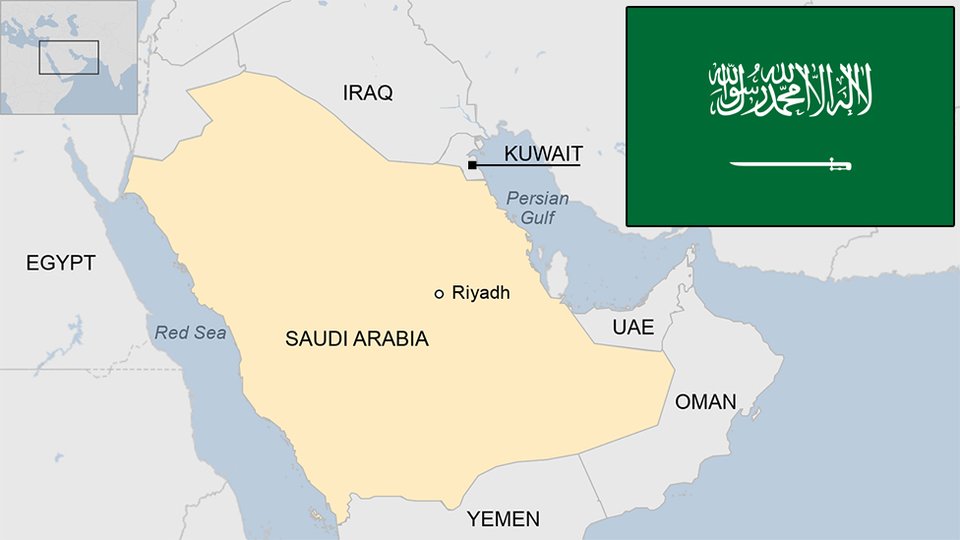
Saudi Arabia borders Iraq, Kuwait, UAE, Oman, and Yemen, making it a pivotal player in Gulf security architecture. Image: BBC/public domain map; reproduced with credit for educational use.
Non-Proliferation Concerns and Strategic Implications
- Proliferation risk: Policymakers have long argued that if Iran acquires a nuclear weapon, a regional arms race across the Gulf becomes probable. A Saudi enrichment capability would materially accelerate that risk.
- Bilateral comparison: The US maintains civilian nuclear cooperation agreements ('123 Agreements' under the Atomic Energy Act) with over 50 countries. Saudi Arabia's deal is contentious because enrichment rights are not standard in such agreements.
- Congressional review: The deal must be submitted to Congress. The Republican-controlled legislature is unlikely to block it, though lawmakers from both parties and Israeli officials have historically opposed Saudi enrichment capabilities.
- India's context: The India-US civilian nuclear deal (2008) — also a 123 Agreement — did not grant India enrichment or reprocessing rights in US-supplied facilities, setting a different precedent.
▤ Key Terms & Prelims Facts
- 123 Agreement: Named after Section 123 of the US Atomic Energy Act, 1954; required for any significant nuclear cooperation between the US and another country.
- Abraham Accords (2020): US-brokered normalisation agreements between Israel and UAE, Bahrain, Sudan, and Morocco — Saudi Arabia has not yet joined.
- NPT: Nuclear Non-Proliferation Treaty; Saudi Arabia is a signatory. Enrichment is permitted under NPT but must be under IAEA safeguards.
- IAEA Safeguards: Verification system to ensure nuclear material is not diverted from civilian to military use.
✎ Mains Practice Question
The US–Saudi civilian nuclear agreement raises fundamental questions about the global non-proliferation regime. Critically examine the strategic rationale, safeguard mechanisms, and proliferation risks associated with civilian nuclear cooperation agreements in a volatile regional context. 15 marks · 250 words
EconomyGeneral Studies Paper III
06
RBI's Polymer Currency Trial: Environmental, Security, and Import-Dependency Considerations
GS-III · Economy — Monetary Policy, Currency Management, Environmental ImpactPrelims + MainsThe Indian Express
A tender floated by Bharatiya Reserve Bank Note Mudran Pvt Ltd (BRBNMPL) for 3.4 crore polymer sheets signals the RBI's resumption of plastic banknote trials — approximately 15 years after a similar exercise was abandoned — reigniting debate on the merits and risks of replacing cotton-based currency with polymer notes.
◈ Background & Context
Polymer banknotes were first issued by Australia in 1988 and are now used in over 50 countries, including the UK, Canada, New Zealand, Thailand, Vietnam, Malaysia, and Singapore.
India's 2009–12 trial of ₹10 polymer notes across five climatically diverse cities (Kochi, Mysuru, Shimla, Jaipur, Bhubaneswar) was abandoned due to "technical infirmities".
- The RBI spent ₹52,095 crore over the last decade printing nearly 26,000 crore note pieces — accounting for 15–44% of its total expenditure (excluding provisions) in any given year.
- In the last three years, for every four new notes supplied, approximately three soiled notes were destroyed — a cycle polymer's greater durability would slow considerably.
Figure 2 — RBI Currency Printing Costs & Volume (FY17–FY26)
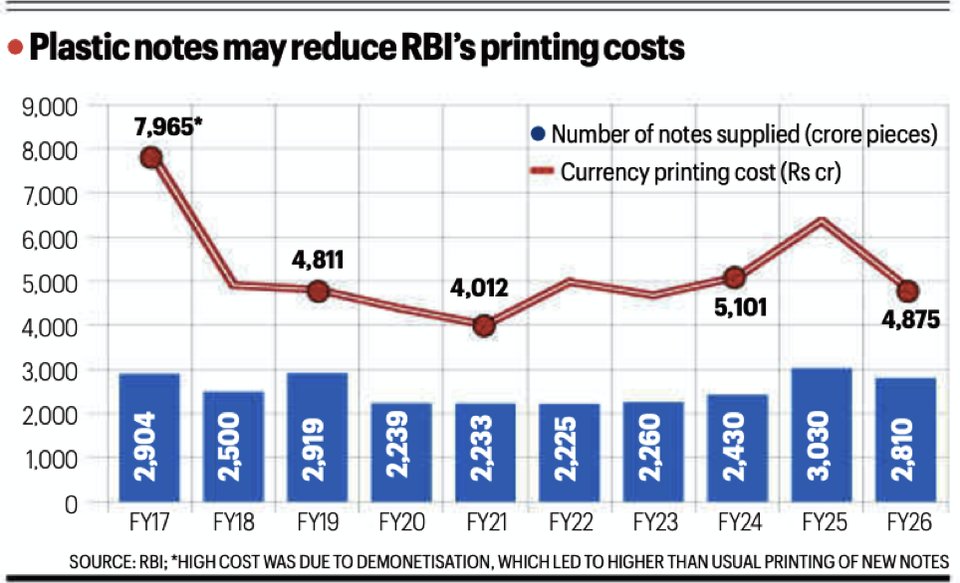
Printing costs peaked at ₹7,965 crore in FY17 due to demonetisation-driven volume; costs have since stabilised around ₹4,875–₹5,101 crore annually. Source: RBI; reproduced from The Indian Express for educational use.
Key Advantages of Polymer Notes
- Durability: Polymer notes last two to six times longer than cotton-based notes, depending on denomination — lower-denomination notes circulate more intensively and degrade faster.
- Environmental benefit: A 2013 TERI study (commissioned by RBI) found significant environmental gains; polymer waste can be granulated and recycled into compost bins, plumbing fittings, and other products.
- Security: Most counterfeit notes globally are produced on paper. India detected 2.3 lakh counterfeit notes in 2025–26 (up from 2.17 lakh in 2024–25); polymer's resistance to counterfeiting could reduce this.
- Cost over lifecycle: Though one polymer note costs more to manufacture than a paper one, fewer notes need be produced and replaced, reducing overall lifecycle cost.
Key Risks and Challenges
- Import dependency: The polymer substrate may need to be imported; the BRBNMPL tender required bidders to "firewall" operations in Pakistan or China from Indian operations — acknowledging supply-chain vulnerability in a security-sensitive domain.
- Sunk investment: Significant capital has been invested in existing cotton-paper note infrastructure. Bank Note Paper Mill India and BRBNMPL's Mysuru ink factory represent domestic capacity that any transition would have to account for.
- Gradual transition required: Any shift must be incremental, with parallel investment in polymer-compatible printing infrastructure.
✎ Mains Practice Question
Discuss the environmental, security, and economic considerations involved in transitioning India's currency from cotton-based to polymer banknotes. What are the key challenges that must be addressed for a successful implementation? 10 marks · 150 words
Science & TechnologyGeneral Studies Paper III
07
Beta Pictoris d: JWST Discovers a Third Directly-Imaged Exoplanet Using Atmospheric Spectroscopy
GS-III · Science & Technology — Space Science, Exoplanet Detection, SpectroscopyPrelims + MainsDeccan Chronicle · AP
Two independent teams — one Scottish-German using ESO's Very Large Telescope, another from UC San Diego using NASA's James Webb Space Telescope — have announced the discovery of Beta Pictoris d, the third directly imaged planet in the Beta Pictoris system and the faintest planet ever directly imaged from Earth.
◈ Background & Context
Beta Pictoris is a young star system approximately 23 million years old, located 63 light-years from Earth in the southern constellation Pictor (the Painter/Easel). It hosts a prominent debris disk and has been a key target for studying planetary formation.
- The system previously hosted two known planets: Beta Pictoris b (one of the first directly imaged exoplanets) and Beta Pictoris c.
- With Beta Pictoris d, it becomes the second known planetary system with at least three directly imaged planets.
- Fewer than 100 of over 6,000 confirmed exoplanets have been detected through direct imaging; most are found via the transit method (dimming of starlight as the planet passes in front).
Figure 3 — Direct Image of the Beta Pictoris System (ESO/VLT)

The star symbol (★) marks Beta Pictoris; the bright object to the left is a known companion planet; the faint dot indicated by the arrow (↑) is the newly discovered Beta Pictoris d — approximately 100 times dimmer than the known companion. Image: ESO/VLT; reproduced for educational use.
About Beta Pictoris d
- Mass: At least twice the mass of Jupiter, making it the smallest of the three known giant planets in the system.
- Orbit: Approximately 30 astronomical units (AU) — comparable to Neptune's distance from the Sun — and the widest orbit among the three planets. Takes 91 years to complete one revolution (similar to Uranus's orbital period).
- Had remained hidden within one of the brightest known debris disks, making conventional imaging difficult.
Discovery Method: NIRSpec Spectroscopy (JWST)
- Discovered accidentally using JWST's Near-Infrared Spectrograph (NIRSpec) Integral Field Unit while studying Beta Pictoris b — the planet's chemical signature and motion were detected spectroscopically, not visually.
- Carbon monoxide (CO) absorption lines and radial velocity analysis confirmed its planetary nature.
- Follow-up using JWST's Mid-Infrared Instrument (MIRI) detected water vapour and methane in its atmosphere.
- This is the first directly-imaged exoplanet discovered primarily through moderate-resolution spectroscopy — demonstrating a new method: detecting hidden planets via atmospheric chemical fingerprints rather than visual brightness alone.
- The VLT-based Scottish-German team independently confirmed the discovery within days, having found it hidden in archival data going back 11 years.
▤ Key Instruments & Terms (Prelims)
- JWST: James Webb Space Telescope (NASA); largest space telescope ever launched; operates primarily in infrared.
- NIRSpec: Near-Infrared Spectrograph — one of JWST's four science instruments; can observe 100 objects simultaneously.
- MIRI: Mid-Infrared Instrument — JWST instrument detecting mid-infrared wavelengths; used to study atmospheres, cold objects.
- ESO VLT: European Southern Observatory's Very Large Telescope, Chile — one of the world's most powerful ground-based telescopes.
- Astronomical Unit (AU): Mean Earth–Sun distance ≈ 150 million km.
- Light-year: Distance light travels in one year ≈ 9.46 trillion km.
- Debris disk: Ring of dust, gas, and rocky material around a star, formed from collisions between planetesimals — an indicator of planetary system formation.
✎ Mains Practice Question
The discovery of Beta Pictoris d demonstrates a novel method of exoplanet detection using atmospheric spectroscopy. Discuss the significance of this discovery for planetary science and explain the different methods used to detect exoplanets, with their relative advantages and limitations. 15 marks · 250 words
08
Project Kusha: DRDO's Long-Range Surface-to-Air Missile Completes Maiden Flight Test
GS-III · S&T — Defence Technology, Indigenisation, Missile SystemsPrelims + MainsThe Indian Express
The Defence Research and Development Organisation (DRDO) successfully conducted the maiden flight test of the 'Kusha' Long-Range Surface-to-Air Missile (SAM) on July 23, 2026, at APJ Abdul Kalam Island off the Odisha coast — a significant milestone in India's indigenisation of air defence capabilities.
◈ Background & Context
A long-range SAM is typically defined as one with a range exceeding 200 km. India currently operates the Russian-origin S-400 Triumf (capable of engaging targets up to 400 km away) — a platform that has attracted both strategic attention and import-dependency concerns.
- The test was conducted against an electronic target simulating a high-speed, high-altitude aerial threat, which Kusha successfully intercepted.
- All weapon system elements — missiles, radars, command and control centre — were developed by DRDO laboratories and domestic industry partners.
- Defence Minister Rajnath Singh described the test as a milestone that will eliminate India's import dependency for long-range SAM systems.
Figure 4 — DRDO Kusha Long-Range SAM: Maiden Flight Test, APJ Abdul Kalam Island
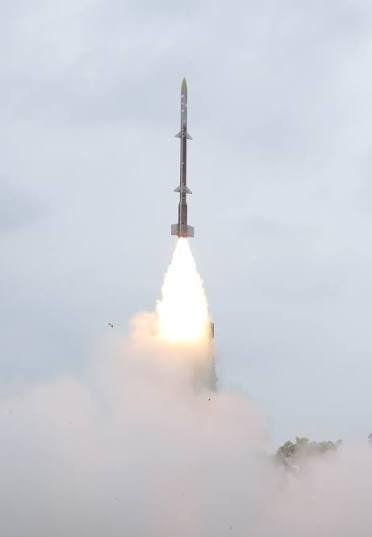
The maiden flight of 'Kusha' from APJ Abdul Kalam Island, Odisha, on July 23, 2026. Image: PTI; reproduced for educational use.
Project Kusha in India's Air Defence Architecture
- Threat envelope: Kusha is designed to intercept fighter jets, cruise missiles, UAVs, and large enemy aircraft across a wide range and altitude envelope.
- IADWS linkage: In 2025, DRDO also tested the Integrated Air Defence Weapon System (IADWS) — a multi-layered system comprising indigenous QRSAM, Advanced VSHORADS missiles, and a high-power laser-based Directed Energy Weapon (DEW).
- Mission Sudarshan Chakra: Kusha and IADWS together represent building blocks toward a home-grown nationwide multi-domain security shield — the stated goal of Mission Sudarshan Chakra over the next decade.
▤ Key Terms & Prelims Facts
- SAM (Surface-to-Air Missile): Ground-launched missile designed to destroy aircraft and missiles.
- APJ Abdul Kalam Island: Formerly Wheeler Island, Odisha; India's premier missile test range.
- QRSAM: Quick Reaction Surface-to-Air Missile — indigenously developed short-range SAM.
- VSHORADS: Very Short Range Air Defence System — designed to counter low-flying aerial threats.
- DEW (Directed Energy Weapon): Weapons using concentrated energy (laser, microwave) to destroy targets — DRDO's high-power laser DEW is a notable indigenous achievement.
- S-400 Triumf: Russian-origin long-range SAM system; India signed the purchase agreement in 2018; attracted US CAATSA sanctions concerns.
✎ Mains Practice Question
India's air defence architecture has historically relied on imported systems. In the context of the successful test of the indigenous 'Kusha' SAM system, discuss the strategic significance of indigenising long-range air defence capabilities and the role of Mission Sudarshan Chakra in achieving this goal. 15 marks · 250 words
Environment & EcologyGeneral Studies Paper III
09
Sustainable Cultivation of Kutki (Picrorhiza kurroa): Conservation and Rural Livelihood in the Himalayas
GS-III · Environment — Biodiversity Conservation, Medicinal Plants, Sustainable LivelihoodsPrelims + MainsThe Hindu
Farmers in Himachal Pradesh's Mandi district, supported by the Himalayan Research Group (HRG), have pioneered a sustainable 'stolon harvest' cultivation model for Kutki (Picrorhiza kurroa) — an endangered alpine medicinal herb — offering both a conservation solution and an additional livelihood source for mountain communities.
◈ Background & Context
Picrorhiza kurroa, known locally as Kutki, is a high-value medicinal herb native to the alpine and sub-alpine zones of the Himalayas at altitudes of 2,700–4,500 metres.
Used in Ayurvedic formulations, it has been driven to endangerment by decades of destructive wild harvesting — the entire plant (including root) was typically uprooted.
- Kutki is listed on the IUCN Red List as an endangered species and included in Appendix II of CITES (Convention on International Trade in Endangered Species of Wild Fauna and Flora) — permitting international trade only under regulated conditions with export permits.
- HRG, a DST-supported body based in Shimla, spent over a decade developing and field-demonstrating the sustainable harvest methodology; it now spans approximately 180 farmers in Mandi district — the largest private land cultivation cluster of this species.
- The initiative originated as a research project under the Department of Biotechnology's Himalayan Bioresource Mission in 2022.
The Stolon Harvest Method
- The innovative method harvests only the plant's stolons — lateral creeping stems with nodes, technically distinct from roots (which are fibrous and medicinally inert).
- The mother plant is left intact, allowing it to continue producing stolons for years — converting a destructive annual extraction into a perennial, sustainable yield.
- After drying, harvested stolons are collected for marketing; farmers earn approximately ₹15,000–₹16,000 annually by producing 5–6 kg of dried herb.
- A common misconception held that Kutki's root was the drug — in practice, it is the stolon, which the old wild-harvest method destroyed along with the plant.
✎ Mains Practice Question
India's biodiversity-rich Himalayan region faces significant pressure from the commercial trade in medicinal plants. Using the case of Kutki (Picrorhiza kurroa), discuss how sustainable cultivation models can simultaneously serve conservation and rural livelihood objectives. What role should regulatory frameworks like CITES play in this context? 15 marks · 250 words
10
Climate Change and Ageing: Structural Vulnerabilities of the Elderly and the Case for People-Centred Adaptation
GS-III · Environment — Climate Change Impacts, Disaster Risk ReductionGS-II · Social Issues — Vulnerable Groups, Healthcare, Elderly PolicyPrelims + MainsThe Hindu
A HelpAge India study examining climate change's impact on senior citizens finds that the elderly face disproportionate harm from both sudden climate shocks and slow-onset stresses — and that India's hazard-centred disaster response frameworks must shift to people-centred, intersectional systems to address this growing vulnerability.
◈ Background & Context
India's elderly population is projected to rise from 149 million in 2022 to approximately 347 million by 2050 — over 20% of the projected population. As the demographic composition shifts, an increasing share of the country becomes structurally exposed to climate-related health challenges.
- Climate stressors affecting the elderly include: rising temperatures, erratic rainfall, drought, flooding, coastal erosion, indoor heat stress, dampness, and environmental degradation — which together worsen chronic illness, raise mortality risk, reduce mobility, and increase care needs.
- The report employs an "Intersectional Place Perspective" — recognising that risk is shaped by the interaction of age, gender, widowhood, disability, poverty, social isolation, and local environmental conditions, not by any single factor in isolation.
- Access barriers for the elderly during climate events: poor health (30%), severe climate-shock experience (30%), no formal education (22%), lower socio-economic group (22%), long wait times (25%), digital access difficulties (15%).
Policy Recommendations
- Shift from hazard-centred to people-centred systems — integrating climate adaptation, healthy ageing, social protection, and disaster risk reduction.
- Establish climate-resilient healthcare for older persons; expand social protection and livelihood support.
- Age-inclusive early warning systems and community monitoring networks; stronger local care systems for those living alone or with impairments.
- Harness the One Health framework; generate better age-disaggregated climate-health data; strengthen institutional coordination.
- Targeted support for highest-risk groups: those living alone, widows, persons with impairments, the oldest-old, and financially insecure households.
✎ Mains Practice Question
Climate change impacts are not socially neutral, and senior citizens represent a disproportionately vulnerable group. Critically examine the intersecting vulnerabilities of the elderly in the context of climate change and suggest an integrated policy framework that connects climate adaptation with healthy ageing and social protection. 15 marks · 250 words