

In-Depth News Analysis6 Items
Core TopicImportantConcise
Polity, Governance & JudiciaryGS Paper II
01SC Reduces Practice Period — Judicial Service Entry02SC 9-Judge Bench — Industry Definition & IRC
Economy & International TradeGS Paper III
03Press Note 3 Relaxation — FDI from Land-Border Countries
Environment & EcologyGS Paper III
04Record El Niño 2026 — Global Food & Climate Impact05Urban Flooding & Heat — Disaster Management Act Amendment
History, Art & CultureGS Paper I
06Ashoka in Ujjain — Vaishya Tekri Excavation
Polity, Governance & JudiciaryGeneral Studies Paper II
01
Supreme Court Reduces Mandatory Practice Period from 3 Years to 1 Year for Entry-Level Judicial Service
GS-II · Polity — Judiciary, Appointments, Constitutional BodiesPrelims + MainsThe Hindu · The Indian Express · 25 Aug 2026
A three-judge bench of the Supreme Court, in a 2:1 majority, modified its own May 2025 verdict and reduced the minimum legal practice requirement for entry-level judicial service examinations from three years to one year, while simultaneously making post-selection institutional training mandatory.
◈ Background & Context
Entry-level judicial service posts — Munsiffs, Civil Judges (Junior Division), and Judicial Magistrates First Class — are filled through competitive examinations conducted by State Public Service Commissions in consultation with High Courts.
Eligibility requirements, including any minimum practice period, are set by the Supreme Court through its supervisory role over subordinate courts under Article 235 of the Constitution.
- On 20 May 2025, a bench headed by then-CJI B.R. Gavai barred fresh law graduates from appearing in these examinations, imposing a three-year minimum practice requirement.
- Review petitions were filed against that verdict. A bench of CJI Surya Kant and Justices A.G. Masih and K. Vinod Chandran heard the review.
- The bench ruled 2:1: CJI Surya Kant and Justice Masih modified the May 2025 order; Justice Vinod Chandran — who had been part of the original bench — dissented and dismissed the review petitions.
Key Terms of the Modified Order
- Selection: Law graduates may now appear for the entry-level judicial service examination after just one year of legal practice (reduced from three years).
- Post-selection training: Trainee judicial officers must complete one year of intensive institutional training at the concerned State Judicial Academy before assuming judicial duties.
- Emoluments during training: Trainees are to be paid a fixed emolument equivalent to 50% of the salary of a Judicial Magistrate First Class in the relevant state.
- Law clerkship (Year 2): After the academy year, trainees undergo a further year of structured law clerkship — the first six months under District/Sessions Judges or senior judicial officers, and the remaining six months under a sitting High Court judge.
- Equivalence: The clerkship year is to be treated as equivalent to one year of practice at the Bar for the purpose of satisfying eligibility requirements.
- Supervisory benefit: Senior judicial officers can assess trainee performance over a sustained period before the trainee is given independent judicial charge.
Critical View
- Proponents argue the revised framework addresses concerns about a shrinking pool of judicial service aspirants and the deterrent effect of a three-year practice bar on bright law graduates.
- Critics, including Justice Chandran in his dissent, likely hold that a minimum period of independent practice is necessary before a candidate is equipped to adjudicate disputes — a concern that institutional training may not fully substitute.
- The two-year structured training pathway (academy + clerkship) is in effect a form of apprenticeship — addressing quality concerns while lowering the entry barrier.
Constitutional & Institutional Anchors
- Article 235: Control over subordinate courts, including conditions of service, vests in the High Court.
- Article 233: Appointment of district judges — the gateway into the Higher Judicial Service — is made by the Governor in consultation with the High Court.
- State Judicial Academy: Set up under each High Court; responsible for pre-service and in-service training of judicial officers. The National Judicial Academy (Bhopal) handles national-level programmes.
- All India Judges Association cases: A series of SC judgments (1991, 1992, 2002) progressively set service conditions, pay scales and training requirements for judicial officers — the precedent backdrop to this ruling.
✎ Mains Practice Question
The Supreme Court's decision to reduce the mandatory practice period for judicial service entry, paired with compulsory institutional training, raises questions about the balance between accessibility and judicial competence. Critically examine the implications of this ruling for the quality and independence of the subordinate judiciary in India. 15 marks · 250 words
02
SC Nine-Judge Bench Severs BWSSB Precedent from Industrial Relations Code: A New Chapter for Labour Law
GS-II · Polity — Judiciary, Labour Law, Constitutional ProvisionsPrelims + MainsThe Hindu · The Indian Express · 25 Aug 2026
A nine-judge Constitution Bench of the Supreme Court held on 20 August 2026 that the nearly five-decade-old definition of "industry" under the landmark BWSSB (1978) judgment will not automatically govern Section 2(p) of the Industrial Relations Code (IRC), 2020, effectively resetting the interpretive framework for India's new labour law regime.
◈ Background & Context
The 1978 seven-judge bench in Bangalore Water Supply and Sewerage Board vs A. Rajappa — authored by Justice V.R.
Krishna Iyer — introduced the "Triple Test" for determining whether an entity constitutes an "industry" under Section 2(j) of the Industrial Disputes Act, 1947. The test asked: Is the activity (a) systematic and organised, (b) involving employer-employee cooperation, and (c) aimed at providing goods or services to satisfy human wants?
This expansive definition brought hospitals, educational institutions, and municipalities within the protective ambit of the Act, with only core sovereign functions (defence, judiciary, law enforcement) excluded.
- For nearly 50 years, BWSSB enabled workers across diverse sectors to access dispute resolution, enforce labour rights and engage in collective bargaining.
- In 2005, a five-judge bench in State of U.P. vs Jai Bir Singh questioned BWSSB's "worker-oriented" approach, referring it for reconsideration — first to a seven-judge bench (2017), then to a nine-judge bench.
- The IRC, 2020 — consolidating the ID Act 1947, Trade Unions Act 1926, and Industrial Employment (Standing Orders) Act 1946 — came into force on 21 November 2025, simultaneously repealing the ID Act. The reference was therefore effectively moot before judgment was delivered.
The Judgment: Majority and Minority Positions
- CJI Surya Kant (with Justices Sharma, Aradhe and Pancholi — 4 judges): The Triple Test of 1978 will continue to apply to pending cases under the ID Act. However, "industry" under the IRC must be interpreted based on the IRC's own text and statutory context, and BWSSB will not serve as the "sheet anchor" for interpreting Section 2(p). The CJI also set down a "reformulated" Triple Test — but expressly described it as hypothetical, with no operative effect given the ID Act's repeal.
- Justice Joymalya Bagchi: Supported the reference but declined to endorse the "reformulated" Triple Test. Held that concerns about BWSSB converting any organised activity into an industry were "misplaced." Noted that even states can enter non-sovereign activities, and absence of profit motive does not take an activity outside "industry."
- Justice B.V. Nagarathna: Affirmed BWSSB; found the exercise "unnecessary and only academic." Cautioned that altering the definition creates uncertainty and could disrupt industrial peace. Highlighted that BWSSB reflected the era of privatisation, liberalisation and globalisation.
- Justices D. Datta and U. Bhuyan: Held the reference "requires no answer" and stressed that institutional credibility rests on respecting finality of established law.
- Justice P.S. Narasimha: Agreed the reference had become unnecessary but stated the IRC's definition must be "freed of the bondage" of the BWSSB ratio.
What Changes, and What Doesn't
- Pending disputes (filed under the ID Act before November 2025) continue to be governed by the BWSSB framework — no change.
- Future disputes under the IRC will require fresh interpretation of Section 2(p) — courts cannot treat BWSSB as automatically applying.
- The IRC raises the threshold for prior government approval before retrenchment or closure from establishments with 100 workers to 300 workers — already narrowing coverage independent of the "industry" definition debate.
- The IRC's definition of "worker" excludes supervisory employees earning above ₹18,000/month, further limiting who can raise a dispute before labour tribunals.
Significance of the Triple Test (Prelims)
▤ The BWSSB Triple Test at a Glance
- Limb 1 — Systematic activity: Organised, regular, not casual or sporadic.
- Limb 2 — Employer-employee cooperation: A relationship of employment, not merely contract work.
- Limb 3 — Service to human wants: Production, supply or distribution of goods or services — profit motive irrelevant.
- Excluded: Sovereign functions — defence, judiciary, legislature, police — regardless of how organised or staffed.
- IRC Section 2(p): Its precise text differs from ID Act Section 2(j) — the Court held future courts must interpret 2(p) on its own terms.
Figure 1 — The Nine-Judge Bench: Positions at a Glance
9 Judges · 3 Broad PositionsCJI + 3 Judges(Sharma, Aradhe,Pancholi)IRC to be interpretedafresh; BWSSB not"sheet anchor."Reformulated TripleTest (hypothetical only)Justices Nagarathna& BagchiBWSSB affirmed.Reference "unnecessary"or "only academic."Reformulated TripleTest: not endorsed.Justices Datta,Bhuyan & NarasimhaReference "requiresno answer" (ID Actalready repealed).IRC free of BWSSB"bondage" (Narasimha).All 9 judges unanimous: IRC Section 2(p) must be interpreted independently in future cases. Source: SC judgment, 20 Aug 2026
Despite differing reasoning, all nine judges agreed that "industry" under the IRC must be interpreted on the IRC's own terms — not automatically on the basis of the 1978 BWSSB precedent.
✎ Mains Practice Question
The Supreme Court's nine-judge bench ruling on the definition of "industry" has been described as "severing" the new labour law regime from a worker-protective precedent. Analyse the significance of the BWSSB (1978) judgment for labour rights in India and assess the implications of its prospective marginalisation for workers under the Industrial Relations Code, 2020. 15 marks · 250 words
Economy & International TradeGeneral Studies Paper III
03
Press Note 3 Relaxation: 29 FDI Projects Worth ₹4,896 Cr Reported; But Impact Remains Early-Stage
GS-III · Economy — FDI Policy, External Sector, InvestmentGS-II · IR — India-China Relations, Trade PolicyPrelims + MainsThe Hindu · 25 Aug 2026
The Union government disclosed that 29 FDI projects worth ₹4,895.65 crore have been reported under the revised framework following the March 2026 partial relaxation of Press Note 3 — a figure that amounts to less than 1% of India's total FDI in FY 2025–26, but represents early movement in previously locked investments.
◈ Background & Context
Press Note 3 (April 2020) amended India's FDI policy to require government approval for any investment originating from a country sharing a land border with India — covering China, Pakistan, Bangladesh, Nepal and Bhutan.
The earlier rule required such approval only for Bangladesh and Pakistan. The stated rationale was to prevent opportunistic takeovers of Indian companies whose stock prices had fallen during the COVID-19 pandemic.
- The April 2020 timing preceded the May 2020 Galwan clashes between Indian and Chinese troops; however, the policy's continued application over subsequent years has been widely linked to the strained India-China relationship.
- A key grievance from global investors was that even companies with a very small (minority, non-controlling) Chinese stake were subjected to the full approval process, deterring investment into India.
The March 2026 Relaxation
- The Centre allowed FDI through the automatic route (no prior government approval) for entities where land-border-country investors hold less than 10% stake on a non-controlling basis.
- Entities with 10% or more stake from land-border countries, or those with controlling interests, continue to require prior approval.
- The 29 projects received span IT, AI, information and communications, manufacturing, pharmaceuticals, data centres and transport — sourced primarily from Mauritius, the US, South Korea, Japan, Singapore, Luxembourg and the Cayman Islands.
- The government expects the revised rules to provide greater regulatory clarity, ease of doing business, and integration of Indian firms into global supply chains.
Critical Assessment
- ₹4,896 crore is a modest initial figure — India's total FDI in FY 2025–26 was significantly higher; this represents the unlocking of previously stalled pipeline, not yet a surge.
- The relaxation is targeted and narrow — it does not allow direct Chinese investment above 10% without approval. India-China economic normalisation remains partial and geopolitically contingent.
- The emphasis on supply-chain integration reflects India's strategic interest in becoming a node in global value chains, particularly in electronics and pharmaceuticals, without excessive dependence on Chinese capital.
Key Terms (Prelims)
- Press Note 3 (2020): DPIIT notification amending the Consolidated FDI Policy — applicable to all sectors, including those under automatic route.
- Automatic route vs Government route: Under automatic route, no prior approval is needed; under government route, FIPB (now replaced by relevant ministry + DPIIT) approval is required.
- DPIIT: Department for Promotion of Industry and Internal Trade — nodal body for FDI policy.
- Land-border countries: China, Pakistan, Bangladesh, Nepal, Bhutan, Myanmar and Afghanistan (all countries sharing a land border with India).
✎ Mains Practice Question
India's Press Note 3 framework reflects the challenge of balancing national security with economic openness. Critically examine the evolution of India's FDI policy towards land-border countries, and assess whether the 2026 relaxation adequately addresses the concerns of global investors while safeguarding strategic interests. 10 marks · 150 words
Environment & EcologyGeneral Studies Paper III
04
UK Met Office Forecasts Strongest El Niño in Over a Century: 3°C+ Pacific Warming, 2027 Likely Hottest Year on Record
GS-III · Environment — Climate Change, El Niño-ENSO, Food SecurityPrelims + MainsThe Hindu · The Indian Express · AFP · 25 Aug 2026
Britain's Met Office has forecast that the 2026 El Niño event is likely to be the strongest in over a century, with Pacific Ocean surface temperatures rising more than 3°C above the baseline — an "unprecedented" reading that has already contributed to well-below-normal monsoon rainfall in India and threatens to push 2027 past 2024 as the warmest year on global record.
◈ Background & Context
El Niño is the warm phase of the El Niño–Southern Oscillation (ENSO) cycle — a periodic climatic pattern arising from warming of sea surface temperatures (SSTs) in the tropical eastern-central Pacific Ocean.
It typically occurs every two to seven years, lasts nine to twelve months, and drives significant changes in global wind patterns, atmospheric pressure, precipitation and temperatures.
- El Niño is defined by SST anomalies of at least +0.5°C above a 30-year rolling baseline in the Niño 3.4 region of the Pacific. The 2026 event is running approximately 2.6°C above the 30-year average — well into "strong" and approaching "extreme" territory.
- As of August 2026, the Met Office's head of long-range forecasting forecasts a peak above 3°C — "unheard of in modern climate records" and treated as "unprecedented."
- The European Union's Copernicus Climate Change Service had projected 2026 could itself be a "record-breaking year" even before the El Niño signal intensified.
How El Niño Disrupts Global Weather — Key Mechanisms
- In normal years, strong equatorial trade winds push warm water westward across the Pacific, keeping the western Pacific (near Australia and SE Asia) warm and the eastern Pacific cool. The warm pool drives convection and rainfall over Asia-Pacific.
- During El Niño, trade winds weaken or reverse. Warm water shifts eastward toward South America. This suppresses convection over the western Pacific and shifts rainfall patterns globally.
- Result: drier conditions in southeast Asia, Australia, southern Africa, and northern Brazil; wetter conditions in the Horn of Africa, southern USA, Peru and Ecuador.
- El Niño adds to the background warming from anthropogenic climate change, pushing global average temperatures higher.
Figure 2 — Normal Year vs El Niño Year: Pacific Wind and Temperature Patterns
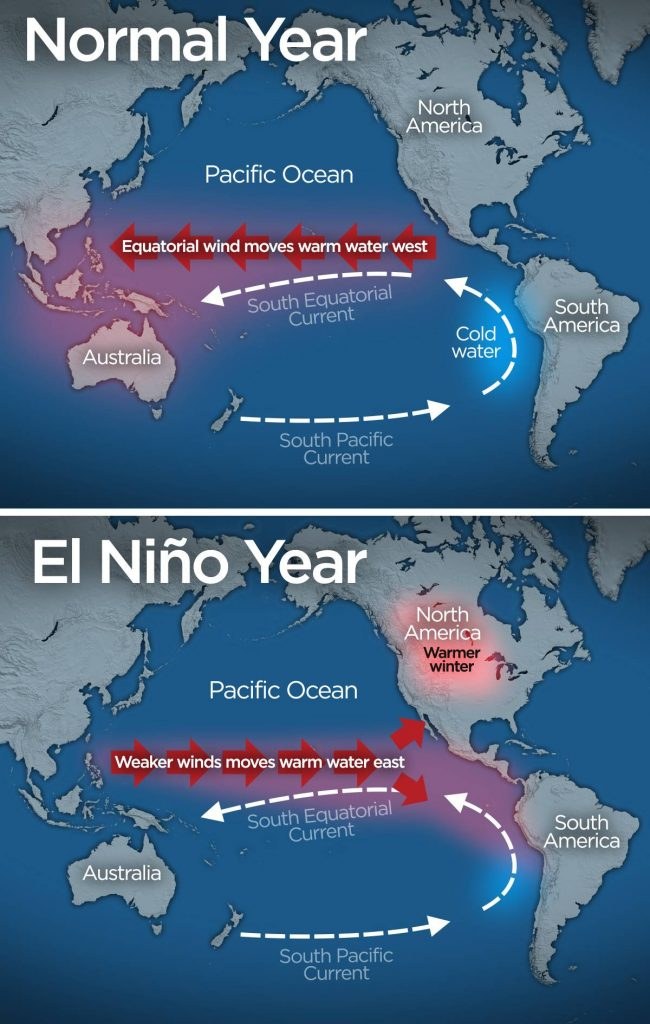
In a normal year, trade winds push warm water west. During El Niño, weakened winds allow warm water to migrate east — suppressing rainfall over the western Pacific and triggering drought across SE Asia, Australia and India. Image: External source; reproduced with credit for educational use.
Impact on India
- The Met Office confirmed that El Niño is already causing well-below-normal rainfall in India — threatening the kharif harvest and reservoir replenishment across peninsular and central India.
- Strong El Niño years historically correlate with deficient Indian monsoons: the 2002, 2009, and 2015–16 drought years all coincided with moderate-to-strong El Niño events.
- The India Meteorological Department (IMD) and IITM (Indian Institute of Tropical Meteorology, Pune) use ENSO forecasts as a primary input for seasonal monsoon prediction.
El Niño and the Global Wheat Crisis
- A supercharged El Niño compounds existing stresses on the global food system — drought in US Great Plains (worst wheat harvest since 1970), disrupted Black Sea grain shipments (Russia-Ukraine war), and Houthi attacks rerouting Red Sea shipping around South Africa.
- El Niño threatens water levels in the Panama Canal (transit route for grain) and the Rhine-Danube rivers in Europe, raising shipping costs.
- Russia and Ukraine together account for nearly a third of global wheat trade — with grain shipments nearly halted due to active conflict in the Black Sea.
- The FAO has warned of higher wheat prices in H2 2026; global food system risks are compounded when "seamless trade, cheap energy and stable climate" — the three pillars of the current model — are simultaneously disrupted.
Key Terms & Prelims Hooks
- ENSO: El Niño–Southern Oscillation — the overarching coupled ocean-atmosphere cycle; La Niña (opposite phase) brings above-normal rainfall to India.
- Niño 3.4 region: The primary benchmark zone in the equatorial Pacific (5°N–5°S, 170°W–120°W) for defining El Niño/La Niña events.
- IOD (Indian Ocean Dipole): A separate ocean-atmosphere oscillation that also significantly influences Indian monsoon rainfall — positive IOD generally favours good monsoon.
- NOAA: US National Oceanic and Atmospheric Administration — maintains the Climate Brink ENSO dashboard and primary Pacific SST monitoring.
- Copernicus Climate Change Service (C3S): EU's climate monitoring body — part of the Copernicus Earth Observation programme (ESA).
- El Niño threshold: +0.5°C SST anomaly sustained for five consecutive overlapping three-month periods in the Niño 3.4 region.
- Origin of term: Coined by Peruvian and Ecuadoran fishermen in the 19th century — "El Niño" (the Christ Child) for the warm current arriving near Christmas that reduced fish catches.
✎ Mains Practice Question
An exceptionally strong El Niño in 2026 has compounded pre-existing stresses in the global food and climate system. Analyse the cascading impact of this El Niño event on India's monsoon, agricultural output and food prices, and discuss the policy measures India should adopt to build resilience against ENSO-linked climate shocks. 15 marks · 250 words
05
Why Indian Cities Flood and Overheat: Urban Vulnerability and the 2025–26 Amendments to the Disaster Management Act
GS-III · Environment — Disaster Management, Urbanisation, Climate AdaptationGS-II · Governance — Urban Local Bodies, LegislationPrelims + MainsThe Hindu · 25 Aug 2026
Extreme heat and flash flooding across Indian cities in 2026 have once again exposed an underlying structural problem: weather translates into disaster not because of the hazard alone, but because of how Indian cities have been built and governed — with inadequate drainage, disappearing green cover, built-over floodplains, and fragmented disaster-response authority.
◈ Background & Context
India's urban population is projected to reach 951 million by 2050. More than half of the infrastructure that Indian cities will need by then is yet to be built.
The choices made now — on land use, materials, drainage, and green cover — will determine whether this urbanisation adds to or reduces disaster vulnerability.
The World Bank estimates urban temperatures in Indian city centres are already 3–4°C higher than surrounding areas due to the urban heat island effect.
- A 2021 NITI Aayog report found that 65% of India's 7,933 urban settlements have no master plan — leaving development largely ungoverned by risk-informed frameworks.
- Responsibility in most cities is fragmented across municipal corporations, district administrations and state departments, operating under different plans and lines of authority.
Key Legislative Changes: 2025–26
- Section 41A, Disaster Management Act, 2005 (2025 amendment): State governments may now constitute an Urban Disaster Management Authority (UDMA) in every state capital and city with a municipal corporation, except Delhi and Chandigarh. UDMAs are responsible for preparing and implementing urban disaster management plans.
- August 2026 change — Heatwaves and lightning notified as natural calamities: States can now use the State Disaster Response Fund (SDRF) for eligible heatwave and lightning relief. Heatwave mitigation projects can receive support from the State Disaster Mitigation Fund (SDMF).
Why the Framework Falls Short
- Constitution of UDMAs is left to state governments with no mandatory deadline — leaving most cities without a dedicated urban disaster authority.
- Flood maps and heat maps are rarely integrated into building regulations, master plans or development permissions.
- Disaster financing has historically focused on post-event relief, not pre-event mitigation or early warning activation.
- The World Bank estimates timely urban flood adaptation could prevent annual losses of $5 billion by 2030 and $30 billion by 2070; heat reduction measures could save over 130,000 lives by 2050.
Key Institutions & Terms (Prelims)
- Disaster Management Act, 2005: Establishes NDMA (National), SDMAs (State), DDMAs (District); Chapter IV deals with local authority responsibilities.
- NDMA: National Disaster Management Authority — headed by the Prime Minister; issues national disaster management guidelines.
- SDRF / SDMF: State Disaster Response Fund / State Disaster Mitigation Fund — central transfers to states for relief and mitigation respectively.
- Urban Heat Island (UHI) Effect: Higher temperatures in urban areas compared to surrounding rural areas due to dense construction, asphalt, reduced vegetation and waste heat from buildings and transport.
- Section 41A (new): Allows state governments to set up Urban Disaster Management Authorities; excludes Delhi and Chandigarh (which have Union Territory-level arrangements).
✎ Mains Practice Question
"The recurrence of urban flooding and heat disasters in Indian cities reflects governance failures as much as climatic ones." Critically examine this statement with reference to India's urban planning framework and the recent amendments to the Disaster Management Act, 2005. 15 marks · 250 words
History, Art & CultureGeneral Studies Paper I
06
Tracing Ashoka in Ujjain: New Excavation at Vaishya Tekri and What It May — and May Not — Reveal
GS-I · History — Mauryan Empire, Buddhist Architecture, Ancient PolityPrelims + MainsThe Indian Express · 25 Aug 2026
The Madhya Pradesh government has begun fresh excavations at Vaishya Tekri in Ujjain — a large mound believed to be a Mauryan-era stupa possibly linked to Emperor Ashoka's viceroyalty over Avanti — reopening a site last officially excavated in 1938–39 and raising questions about what archaeology can reliably establish about Ashoka's presence in the region.
◈ Background & Context
Ujjayini (modern Ujjain), on the banks of the Sipra river (a tributary of the Chambal), was the capital of Avanti — one of the sixteen Mahajanapadas. It was among ancient India's most important commercial centres, linking trade routes to the western coastal ports of Bharuch and Sopara as well as to Pataliputra.
- Mud fortifications were first constructed around Ujjain in the 7th century BCE. By the 6th century BCE, Avanti had emerged as a powerful independent kingdom with Ujjain as its capital.
- Ashoka was sent to Ujjain as viceroy by his father Bindusara — unlike his brief deputation to Taxila for a specific purpose, Ashoka is believed to have spent approximately a decade in Avanti.
- En route to Ujjain, Ashoka is said to have stayed at Vidisha, where he met Vedisadevi (also known as Devi), the daughter of a merchant. Their children, Mahinda and Sanghamitta, later became pivotal in spreading Buddhism to Sri Lanka.
- Ashoka's own edicts issued after he became emperor refer to a "kumara" (prince/viceroy) stationed at Ujjain — providing an epigraphic basis for his connection to the city.
Vaishya Tekri: What We Know and What Scholars Urge
- The 1938–39 excavations by the Department of Archaeology of the erstwhile Gwalior State revealed large bricks and punch-marked coins, leading archaeologists to tentatively date the structure to the Mauryan period.
- Academic Peter Skilling (2011) described Vaishya Tekri as approximately 350 feet at the base and 100 feet high — comparable in scale to the Great Stupa at Sanchi.
- However, historian Himanshu Prabha Ray has urged caution: the 1938–39 excavation report is decades old, its interpretation was shaped by Alexander Cunningham's earlier writings on Ashoka, and it is premature to assert a direct Ashokan connection without further investigation.
- Historian Romila Thapar notes that Ujjain was a major crossroads linking trade routes to western ports and to Pataliputra, making it strategically important for Mauryan administration.
Figure 3 — Vaishya Tekri Mound, Ujjain: The Site Under Fresh Excavation
Vaishya Tekri — the large earthen mound in Ujjain believed to overlay a Mauryan-era stupa. At roughly 350 feet at its base and 100 feet in height, it is comparable in scale to the Great Stupa at Sanchi. Image: The Indian Express; reproduced with credit for educational use.
What Good Excavation Should Ask
- Historian Himanshu Prabha Ray recommends that excavations look beyond the stupa mound itself — at what other structures surrounded it, who the monks were who taught or stayed there, and how the site grew over time.
- Drawing on the Sanchi model: stupas never occur as isolated structures — they are surrounded by smaller stupas, monasteries and votive offerings, the study of which reveals the social and institutional history of Buddhism at that site.
- The excavation should use stratigraphic, archaeobotanical and numismatic evidence to establish a reliable chronology, rather than fitting finds into pre-existing Ashokan narratives.
Key Facts for Prelims
- Avanti: One of the 16 Mahajanapadas; capital Ujjayini (Ujjain); conquered by the Nanda dynasty before the Mauryans consolidated control.
- Sipra river: A tributary of the Chambal; Ujjain is situated on its banks; the Kumbh Mela (Simhastha) held at Ujjain is associated with the Sipra.
- Vedisadevi / Devi: Ashoka's companion at Vidisha; mother of Mahinda and Sanghamitta — who carried Buddhism to Sri Lanka.
- Punch-marked coins: The dominant coinage of the Mauryan period — silver coins with symbols punched on them (not inscribed); found at Vaishya Tekri in 1938–39.
- Alexander Cunningham: First Director-General of the Archaeological Survey of India (ASI), founded 1861; his surveys shaped early interpretations of Buddhist sites including Sanchi, Sarnath and Bodh Gaya.
- Mahinda and Sanghamitta: Ashoka's son and daughter; credited with taking Buddhism to Sri Lanka; Mahinda's arrival is celebrated as Poson Poya in Sri Lanka.
- Great Stupa at Sanchi: Built by Ashoka; located in Madhya Pradesh; a UNESCO World Heritage Site; the torana (gateways) are renowned examples of early Buddhist art.
✎ Mains Practice Question
Discuss the significance of Ujjain in the Mauryan political and cultural landscape, with particular reference to Ashoka's viceroyalty. What methodological cautions should guide the interpretation of new archaeological evidence from sites like Vaishya Tekri? 1