

In-Depth News Analysis8 Items
Core TopicImportantConcise
Polity & GovernanceGS Paper II
01Removal of the Chief Election Commissioner — The Process
International RelationsGS Paper II
02U.S.–Denmark–Greenland Defence Deal & the Arctic03UN Charter ‘Enemy State’ Clauses — Japan’s Demand
Indian EconomyGS Paper III
04Make in India at 12 — An Independent Scorecard05Tripling India’s GDP — Rupee vs Dollar Arithmetic06Alternatives to SWIFT — CIPS, SPFS, mBridge & India07RBI VRRR & OMO Sales — Absorbing Surplus Liquidity
Science & TechnologyGS Paper III
08AI Agent Breach of an Australian Government Portal
Polity & GovernanceGeneral Studies Paper II
01
How Can a Chief Election Commissioner Be Removed? The Constitutional Safeguards Behind ECI Independence
GS-II · Polity — Constitutional Bodies, Elections (Art. 324)Prelims + MainsThe Indian Express · 25 Sep 2026
Following reports of internal dissent within the Election Commission of India (ECI), the Leader of the Opposition in the Lok Sabha has demanded the Chief Election Commissioner’s (CEC) resignation, and Opposition parties have said they will move a removal motion in both Houses. The episode brings the constitutional machinery for removing the CEC into focus.
◈ Static Background — The Election Commission From Basics
Why an independent election body? In a democracy, the government of the day is itself a contestant in elections. The umpire must therefore be insulated from it. The Constitution does this through Part XV (Articles 324–329), with Article 324 vesting the “superintendence, direction and control” of elections in the ECI.
- Established: 25 January 1950 — observed as National Voters’ Day since 2011. First CEC: Sukumar Sen.
- Scope: elections to Parliament, State Legislatures, and the offices of President and Vice-President. (Panchayat and municipal polls are run by State Election Commissions under Articles 243K and 243ZA.)
- Composition: single-member for most of its history; multi-member since 1 October 1993 — one CEC and two Election Commissioners (ECs).
- Decision-making: the CEC is first among equals; decisions are to be unanimous as far as possible, otherwise by majority — upheld in T.N. Seshan v. Union of India (1995).
▤ Appointment & Tenure — The 2023 Law at a Glance
- Law: Chief Election Commissioner and Other Election Commissioners (Appointment, Conditions of Service and Term of Office) Act, 2023 — replaced the 1991 Act.
- Search Committee: headed by the Union Law Minister with two Secretary-level officers; shortlists five names.
- Selection Committee: Prime Minister (chair), Leader of Opposition in Lok Sabha (or leader of the largest Opposition party), and a Union Cabinet Minister nominated by the PM. The President appoints on its recommendation.
- Eligibility: persons who have held posts equivalent to Secretary to the Government of India, of integrity, with knowledge and experience of managing elections.
- Tenure: 6 years or till age 65, whichever is earlier; no re-appointment.
- Service conditions: salary and benefits equal to a Judge of the Supreme Court.
Lineage — How the Appointment Law Evolved
- 1950–2023: Article 324(2) envisaged a parliamentary law, but none was made; the President appointed on the advice of the Union Government.
- March 2023 — Anoop Baranwal v. Union of India: a Constitution Bench ordered that, until Parliament legislated, appointments be made on the advice of a committee of the PM, LoP and Chief Justice of India.
- December 2023 — New Act: Parliament legislated, replacing the CJI with a Union Cabinet Minister — giving the executive a 2:1 majority on the panel. Petitions challenging this remain before the Supreme Court.
Removal — The Heart of Independence
Under Article 324(5), the CEC can be removed only “in like manner and on the like grounds as a Judge of the Supreme Court”. The same protection is repeated in Section 11(2) of the 2023 Act. His conditions of service also cannot be varied to his disadvantage after appointment.
- Grounds (Article 124(4)): only “proved misbehaviour or incapacity”. Misbehaviour covers corruption, abuse of office and conduct incompatible with the office; incapacity means inability to perform duties.
- Other ECs and Regional Commissioners: removable only on the recommendation of the CEC — a weaker protection, often criticised as making ECs dependent on the CEC.
Figure 1 — The removal process (borrowed from the procedure for Supreme Court judges)
1. Notice of motion≥100 Lok Sabha MPs or≥50 Rajya Sabha MPs2. AdmissionSpeaker / Chairman mayadmit or refuse3. Inquiry CommitteeSC Judge + HC Chief Justice+ distinguished jurist(Judges (Inquiry) Act, 1968)4. If found guilty:motion taken up in the HouseIf not guilty →motion ends here5. Special majorityin EACH House: majority oftotal membership AND ≥ 2/3of members present & voting(same session)6. Address tothe PresidentPresident orders removalTrack record:No CEC and no Supreme Court judge has ever been removed.The motion against SC Justice V. Ramaswami (1993) failed in the Lok Sabha; a motion to remove aCEC, submitted in March 2026, was not admitted by the presiding officers in April 2026.
The deliberately high bar — admission, judicial inquiry and a special majority in both Houses — is what insulates the CEC from political pressure.
▤ The Current Episode — Key Facts
- March 12, 2026: Opposition MPs submitted removal notices — signed by 130 Lok Sabha and 63 Rajya Sabha members — citing the Special Intensive Revision (SIR) of electoral rolls and alleging partisan conduct.
- April 2026: the Lok Sabha Speaker and Rajya Sabha Chairman declined to admit the motions, without recording reasons.
- September 2026: a newspaper investigation reported that the two Election Commissioners had raised internal objections to ECI decisions and processes, including some linked to the SIR; a fresh motion has been announced.
Issues for Analysis
- Presiding officers’ discretion: the Judges (Inquiry) Act lets the Speaker/Chairman refuse a notice after “consulting such persons” as they think fit — but it does not require reasons, reducing transparency at the gatekeeping stage.
- Unequal protection: the CEC enjoys judge-like tenure security, but ECs can be removed on the CEC’s recommendation — the Dinesh Goswami Committee (1990) and the Law Commission’s 255th Report (2015) recommended equal protection for all Commissioners.
- Executive-dominated appointments: the 2023 panel has two members from the ruling side; critics argue independence depends as much on appointment as on removal.
- Internal dissent: a multi-member body is designed to allow disagreement; recording dissent (as the Seshan judgment contemplated) can strengthen, not weaken, institutional credibility.
- Balance: removal must stay difficult to protect the umpire; frequent removal motions risk politicising the institution too.
✎ Mains Practice Question
“The independence of the Election Commission rests as much on how its members are appointed as on how they can be removed.” Examine this statement with reference to Article 324 and the 2023 law on appointments. 15 marks · 250 words
International RelationsGeneral Studies Paper II
02
U.S.–Denmark–Greenland Agreement: Permanent Basing Rights, and What It Means for the Arctic Order
GS-II · IR — Effect of Policies of Developed Countries, NATO, ArcticGS-I · Geography — Polar RegionsPrelims + MainsThe Hindu · 19 Sep 2026
After months of pressure — including threats of acquisition and tariffs — the United States, Denmark and Greenland have agreed on an arrangement granting the U.S. permanent access, basing and overflight rights in Greenland and a veto over “sensitive investments” by its adversaries. It is to be signed on the sidelines of the UNGA, subject to parliamentary approval in Denmark and Greenland.
◈ Static Background — Greenland From Basics
- Geography: the world’s largest island (~2.17 million sq km), lying north-east of Canada; more than two-thirds lies within the Arctic Circle. About 80% is covered by the Greenland Ice Sheet, the second-largest body of ice after Antarctica.
- People: ~56,000 inhabitants, mostly Inuit; capital Nuuk.
- Political status: a self-governing (autonomous) territory within the Kingdom of Denmark. Colonised from 1721; integrated into Denmark in 1953; Home Rule in 1979; Self-Government Act, 2009 recognised the Greenlandic people’s right to independence. Denmark retains foreign affairs and defence.
- Europe link: Greenland left the EEC in 1985 (after a 1982 referendum, mainly over fisheries) — though Denmark remains in the EU.
- Resources: significant rare-earth, uranium, zinc and other mineral deposits, increasingly accessible as the ice retreats.
Figure 2 — Greenland’s strategic location
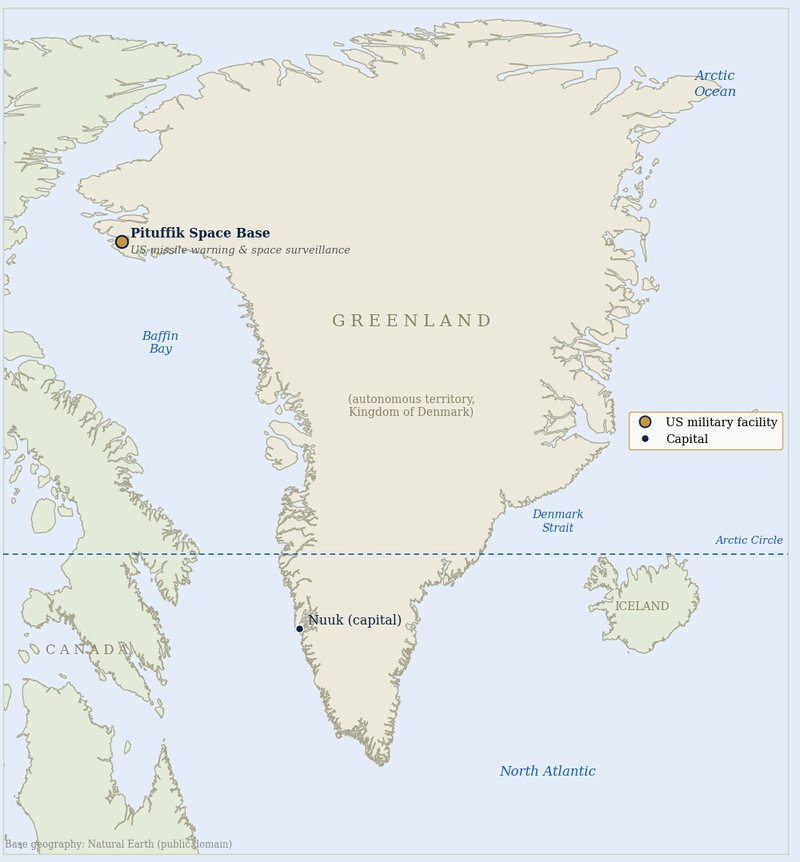
Greenland sits on the shortest path between North America and Eurasia across the Arctic — the logic behind Pituffik’s missile-warning role. Base geography: Natural Earth 1:10m (public domain); features plotted to real coordinates.
Historical Anchor — America’s Long Interest
- 1917: the U.S. bought the Danish West Indies (now the U.S. Virgin Islands) from Denmark — a precedent often cited.
- 1941–45: the U.S. occupied Greenland during World War II after Germany overran Denmark, to protect North Atlantic shipping.
- 1946: the U.S. offered to buy Greenland for $100 million; Denmark refused.
- 1951 — Defense of Greenland Agreement: gave the U.S. basing and overflight rights; led to Thule Air Base, renamed Pituffik Space Base in 2023. Updated in 2004 (Igaliku) with Greenland as a party, requiring prior notice for expansion.
- 2019 onwards: repeated U.S. proposals to purchase the island, rejected by Denmark and Greenland.
▤ The New Agreement — What Is Known
- Permanent U.S. access, basing and overflight rights, with no expiry date.
- No non-NATO country may establish a base in Greenland.
- Only the U.S. and its allies may make unspecified “sensitive investments”.
- The arrangement is to survive Greenlandic independence, per a U.S. official.
- Denmark says it recognises the sovereignty and territorial integrity of Denmark and Greenland and the right to self-determination.
- Pending: parliamentary approval in Copenhagen and Nuuk; operational details not disclosed.
Why Greenland Matters — The Strategic Logic
- Missile defence: the shortest trajectory for missiles between Russia and North America crosses the Arctic; Pituffik hosts early-warning and space surveillance systems for the U.S. and NATO.
- GIUK Gap: the Greenland–Iceland–United Kingdom gap is a naval chokepoint for monitoring submarine movement into the North Atlantic.
- New sea routes: melting ice is opening the Northwest Passage and the Northern Sea Route, shortening Asia–Europe shipping.
- Critical minerals: rare earths are central to the U.S. effort to reduce dependence on China.
- Great-power rivalry: China calls itself a “near-Arctic state” (2018 Arctic White Paper) and promotes a Polar Silk Road; Russia has expanded its Arctic military presence.
Concerns and Criticism
- Coercive diplomacy within an alliance: threats of force and tariffs against Denmark — a founding NATO member (1949) — strained transatlantic trust.
- Self-determination: a perpetual deal binding a future independent Greenland raises questions of consent by the Greenlandic people.
- Economic sovereignty: a U.S. veto on “sensitive investments” limits Greenland’s ability to choose partners for mining and infrastructure.
- Arctic militarisation: risks eroding the Arctic’s tradition of low tension and scientific cooperation under the Arctic Council.
◈ India’s Arctic Connect
- Arctic Council: set up by the Ottawa Declaration (1996); 8 member States (Canada, Denmark, Finland, Iceland, Norway, Russia, Sweden, U.S.). India has been an Observer since 2013.
- Himadri — India’s Arctic research station at Ny-Ålesund, Svalbard (Norway), since 2008.
- India’s Arctic Policy (2022) — six pillars: science and research, climate and environmental protection, economic and human development, transportation and connectivity, governance and international cooperation, and national capacity building.
- Why it matters to India: Arctic warming is linked to changes in the Indian monsoon and to sea-level rise along India’s coastline.
✎ Mains Practice Question
The Arctic is emerging as a theatre of great-power competition. In the light of the recent U.S.–Denmark–Greenland agreement, discuss the strategic significance of Greenland and the implications of Arctic militarisation for India’s interests. 15 marks · 250 words
03
Japan Seeks Deletion of the UN Charter’s “Enemy State” Clauses: A Relic of 1945 That Refuses to Go
GS-II · IR — UN Structure & Reform, Japan–China–RussiaPrelims + MainsThe Indian Express · 25 Sep 2026
Addressing the UN General Assembly, Japan’s Prime Minister called for removal of the “enemy states” references in the UN Charter — clauses that China and Russia have recently invoked against Japan’s defence build-up and territorial claims.
◈ Static Background — What the Charter Says
The UN Charter came into force on 24 October 1945, weeks after the end of World War II. The victorious Allies wanted a legal safeguard against the revival of militarism in the defeated Axis powers — Germany, Italy and Japan and their allies.
- Article 53(2): defines an “enemy state” as any State which, during World War II, was an enemy of any signatory of the Charter.
- Article 53(1): enforcement action by regional arrangements normally needs Security Council authorisation — but an exception is made for measures against enemy states.
- Article 107: nothing in the Charter invalidates action taken against enemy states by the governments responsible for such action — i.e., no prior UNSC approval needed.
- Article 77: territories detached from enemy states could be placed under the Trusteeship System.
Why the Clauses Are Still There
- Declared obsolete: the UNGA recognised them as obsolete in 1995, and the 2005 World Summit Outcome resolved to delete the references.
- The amendment lock — Article 108: a Charter amendment needs adoption by two-thirds of UNGA members and ratification by two-thirds of members including all five permanent members — each in its own national process.
- Fear of a domino effect: P5 members worry that reopening the Charter’s text could open the door to demands for wider UNSC reform.
- Legal effect: most experts regard the clauses as moribund; Japan (a UN member since 1956) is bound by and protected under the Charter like any other member. Their value today is largely rhetorical.
The Current Context — Rising Pressure on Tokyo
- China: tensions rose after Japan’s PM indicated in November 2025 that Japan could respond militarily if China attacked Taiwan; China has since restricted rare-earth magnet supplies to Japanese firms and held drills near Japan. Beijing calls the clauses a safeguard of the post-war order.
- Russia: argues the clauses invalidate Japan’s claims to the southern Kuril Islands; it has held military exercises near Japan, and its President visited the disputed islands in August.
- Japan’s defence shift: Japan plans to raise defence spending to about 2% of GDP, a break from post-war restraint under Article 9 of its Constitution, which renounces war.
Figure 3 — The Kuril Islands between Japan and Russia
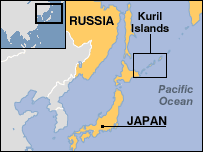
Japan calls the southern four islands — Etorofu, Kunashiri, Shikotan and the Habomai group — its “Northern Territories”; they have been under Moscow’s control since 1945. Map as supplied (BBC News); reproduced with credit for educational use.
▤ The Kuril Dispute — Timeline
- 1855 — Treaty of Shimoda: border drawn between Etorofu (Japan) and Urup (Russia).
- 1875 — Treaty of St Petersburg: Japan got all the Kurils in exchange for recognising Russian control of Sakhalin.
- 1945: Soviet forces occupied the islands at the end of World War II.
- 1951 — San Francisco Peace Treaty: Japan renounced claims to the Kurils, but the USSR did not sign it, and the southern islands’ status remained disputed.
- 1956 — Soviet–Japanese Joint Declaration: restored diplomatic ties and promised Shikotan and Habomai after a peace treaty — which has never been concluded.
Relevance for India
- G4 partners: India and Japan (with Brazil and Germany) jointly seek permanent UNSC membership; Japan’s push links Charter cleanup to broader reform.
- Lesson: even an issue on which the UNGA has agreed (the 2005 decision) cannot move without P5 ratification — showing how hard structural reform is.
- Indo-Pacific: growing China–Japan friction shapes the Quad and regional supply chains, including rare earths.
✎ Mains Practice Question
The persistence of the “enemy state” clauses in the UN Charter, despite being declared obsolete, illustrates the rigidity of the UN system. Discuss, with reference to the Charter’s amendment procedure and its implications for UNSC reform. 10 marks · 150 words
Indian EconomyGeneral Studies Paper III
04
Make in India at 12: Twelve Metrics Show Output Gains, but No Structural Shift in Growth, Jobs or Exports
GS-III · Industrial Policy, Growth, Investment ModelsPrelims + MainsThe Hindu · 25 Sep 2026
On the campaign’s 12th anniversary, an analysis of 12 metrics across growth, investment, employment and exports finds that manufacturing has not materially raised its share of India’s economy or global trade — and that incentive-scheme gains are concentrated in a handful of sectors.
◈ Static Background — Why the Share of Manufacturing Matters
Structural transformation is the movement of workers from low-productivity farming to higher-productivity industry and services. East Asian economies grew rich by making manufacturing a large share of output and jobs before services took over.
India’s path has been different: services grew first, and manufacturing’s share has stagnated — a pattern economist Dani Rodrik called “premature deindustrialisation” (2015). Make in India (September 2014) aimed to reverse it, adopting the National Manufacturing Policy 2011 goal of a 25% share of GDP.
- GVA vs GDP: Gross Value Added measures output by sector; GDP = GVA + product taxes − product subsidies.
- IIP: the Index of Industrial Production, a monthly volume index from MoSPI, covering mining, manufacturing and electricity.
- GFCF: Gross Fixed Capital Formation — spending on new machinery, buildings and infrastructure; the best proxy for investment.
- New series: national accounts have been revised to a new base year (2022-23), so old and new series are not directly comparable.
▤ The Scorecard — Key Findings
- Growth: manufacturing outgrew the overall economy in only 6 of 12 years (old series). The new series shows it ahead in all three available years (2023-24 to 2025-26), but the gap is narrowing.
- IIP: manufacturing beat the overall index in only 3 of 12 years (old series); in the new series it matched in 2023-24 and lagged in the next two years.
- Share in GVA: lower in 2025-26 than in 2014 on the old series; new series shows a rise from 14.6% (2022-23) to 15.6% (2025-26).
- Exports: non-petroleum goods exports rose 53%, from $253.5 bn (2014-15) to $388.3 bn (2025-26) — versus a 400%+ rise in the preceding 12 years (on a smaller base).
- Global share: India’s share of world merchandise exports rose from ~0.8% (2002) to 1.7% (2013) — and is still ~1.7% in 2025-26 (UNCTAD).
- Private investment: private-sector GFCF as a share of GDP was lower in 2023-24 than in 2014-15; in the new series, GFCF/GDP has been falling since 2022-23.
- FDI: manufacturing FDI grew slower than total FDI in 7 of 12 years, though its share rose from ~48% to 55%.
- Capacity utilisation (RBI): rising but still below the ~80% threshold that usually triggers new investment.
- Bank credit to industry: growing strongly, led by MSMEs — but likely for working capital rather than new capacity.
- PLI: 14 schemes (2020–21) drew ₹2.4 lakh crore of investment by March 2026; the top five sectors — solar modules, pharmaceuticals, automobiles & components, specialty steel and large-scale electronics — account for ~83%.
Figure 4 — Exports kept the same trajectory; global share flat since 2014
The dotted line marks the launch of Make in India: neither the export curve nor India’s global share shows a break at that point. Chart courtesy The Hindu, 25 September 2026 (data: Ministry of Commerce and Industry, UNCTAD); reproduced with credit for educational use.
Figure 5 — Twelve years, at a glance
ImprovedFlat / marginalWeak• PLI investment ₹2.4 lakh cr• Mfg share of FDI 48% → 55%• Bank credit to industry• Non-petroleum exports$253.5 bn → $388.3 bn• Mfg share of GVA (newseries) 14.6% → 15.6%• Global export sharestuck at ~1.7%• Capacity utilisationrising, still below 80%• Mfg beat GDP growth inonly 6 of 12 years• Private GFCF / GDP down• PLI concentrated: top 5sectors ≈ 83%• Export growth slower thanthe previous 12 years
Classification by Legacy IAS from figures reported in the analysis.
Reading the Evidence — Why the Structural Shift Has Not Come
- Weak private investment: firms invest only when demand strains capacity; utilisation below 80% signals slack demand.
- Assembly-led growth: gains in electronics and phones depend heavily on imported components, adding less domestic value.
- Global headwinds: rising protectionism, tariff wars and the China+1 competition from Vietnam, Bangladesh and Mexico.
- Factor-market frictions: land acquisition, logistics costs, power tariffs and contract enforcement still raise costs; the four Labour Codes aim to ease labour rigidities.
- Jobs deficit: manufacturing’s employment share has not risen enough to absorb workers leaving agriculture.
The Other Side — Where Progress Is Real
- Specific sectors — mobile phones, defence, pharmaceuticals, solar modules — have scaled up sharply.
- Infrastructure (PM GatiShakti, dedicated freight corridors) and the National Single Window System reduce future costs.
- The new national-accounts series shows a modest, recent rise in manufacturing’s share.
✎ Mains Practice Question
“Despite incentive schemes, India’s manufacturing sector has not materially increased its share in growth, employment or global exports.” Critically analyse the reasons and suggest a strategy to achieve structural transformation. 15 marks · 250 words
05
Can India’s Economy Triple in a Decade? Why the Answer Depends on the Currency
GS-III · Growth & Development, Exchange RatePrelims + MainsThe Indian Express · 25 Sep 2026
A leading global banker recently predicted that India’s economy could be three times its current size in ten years. The claim is a useful exercise in growth arithmetic: tripling in rupee terms is plausible, but tripling in dollar terms would require nearly doubling the growth rate of the past 12 years.
◈ Static Background — Four Concepts to Get Right
- Nominal GDP: output valued at current prices — it rises with both real growth and inflation.
- Real GDP: output at constant prices; nominal GDP ÷ GDP deflator. This is the “growth rate” usually quoted.
- Dollar GDP: nominal rupee GDP ÷ exchange rate (₹ per $). Used for international rankings (IMF, World Bank).
- PPP GDP: adjusts for price-level differences between countries; India is the world’s 3rd-largest economy by PPP.
- The key identity: dollar growth ≈ nominal rupee growth − rupee depreciation. A 10% rupee growth with 10% depreciation = zero growth in dollar terms.
- Rule of 70: doubling time ≈ 70 ÷ growth rate; tripling in 10 years needs ~11.6% a year (since 1.11610 ≈ 3).
▤ The Numbers
$4.2 tn
India’s GDP now (approx.)
6.2%
$ CAGR, 2014–2026
3.2%/yr
rupee depreciation vs $
10%
nominal ₹ CAGR, 2014–25 (old series)
- Business as usual (6.2% $ CAGR): GDP reaches only ~$7.58 tn by 2036.
- Tripling in dollars (~$12.46 tn by 2036): needs 11.6% a year in $ terms — about 14.7% nominal rupee growth.
- Tripling in rupees (₹370 trillion → ~₹1,109 trillion): needs 11.6% nominal rupee growth — above the past 10%, but far more achievable.
Figure 6 — Tripling in dollars vs rupees
The gap between the two curves in Chart 2 is the cost of a steadily depreciating rupee. Charts courtesy The Indian Express, 25 September 2026 (source: IMF); reproduced with credit for educational use.
Official Targets — A Brief History
- 2018: a $5-trillion economy target, first for 2025, later advanced to 2022 — India was at ~$2.7 tn then; it is yet to be achieved.
- Viksit Bharat @2047: developed-nation status by the centenary of Independence, often quantified at $30–35 trillion.
What Would It Take?
- Higher real growth — sustained 8%+ through investment, exports and productivity.
- A stable rupee — lower inflation differential with the U.S., a narrower current-account deficit and strong capital inflows.
- Why the dollar view matters: foreign investors measure returns in dollars, so depreciation directly erodes their gains.
- Caution: a higher nominal figure driven by inflation is not a welfare gain; per-capita real income is the better measure of development.
✎ Mains Practice Question
Distinguish between nominal, real and dollar-denominated GDP. Why does exchange-rate depreciation make headline targets such as a “$5-trillion economy” harder to achieve, and what policy mix can address this? 10 marks · 150 words
06
Beyond SWIFT: How CIPS, SPFS and mBridge Are Faring, and Where India Stands
GS-III · Banking, External Sector, Payment SystemsGS-II · Groupings — BRICSPrelims + MainsThe Hindu · Text & Context
The New Delhi Declaration of the recent BRICS Summit resolved to expand trade and settlement in national currencies. Sanctions and the use of the dollar as a policy tool have pushed many Global South economies to explore alternatives to the SWIFT network — with uneven results.
◈ Static Background — What SWIFT Actually Does
SWIFT (Society for Worldwide Interbank Financial Telecommunication) is a messaging network, not a payment system. When an Indian bank pays a bank in Germany, SWIFT carries the standardised instruction; the money itself moves through correspondent bank accounts.
- Founded: 1973; a bank-owned cooperative headquartered in Belgium, overseen by the National Bank of Belgium with G10 central banks.
- Scale: over 11,000 institutions in 200+ countries and territories.
- Weaponisation: Iranian banks were cut off in 2012; several Russian banks in 2022 after the Ukraine war.
- Settlement systems: dollar payments finally clear through the U.S.-based CHIPS (Clearing House Interbank Payments System) and Fedwire — the real source of U.S. leverage.
Figure 7 — The main alternatives compared
SystemCIPSSPFSmBridgeBackerPeople’s Bank ofChinaBank of Russia5 central banks; BISexited Oct 2024Launched201520142019 (MVP stagein 2024)TypeYuan clearing &settlementFinancial messaging(SWIFT substitute)Multi-CBDC platform onits own blockchainReachParticipants in 120+countries; ~¥680 bn/dayavg. (2025)440 entities (2023),100+ non-residentsChina–Gulf tradesettlement in renminbi
None matches SWIFT’s network; each is tied to a single currency or bloc, which limits neutrality and trust.
How the Alternatives Are Faring
- CIPS (China): lets banks clear yuan transactions onshore. Its appeal grew after the renminbi joined the IMF’s SDR basket in 2016. All BRICS members except India have CIPS participants. Still much smaller than CHIPS.
- SPFS (Russia): built in 2014 after Crimea-related sanctions; became essential after 2022. Iran’s SEPAM system is linked to it.
- Project mBridge: members — the Hong Kong Monetary Authority, Bank of Thailand, Central Bank of the UAE, the PBoC’s Digital Currency Institute and the Saudi Central Bank. The Bank for International Settlements (BIS) exited on 31 October 2024, amid reports of concern that it could help evade sanctions.
▤ India’s Approach
- Rupee trade settlement: RBI framework of July 2022 using Special Rupee Vostro Accounts (SRVAs).
- India–Russia: roubles and rupees now account for about 96% of bilateral trade settlements, handled by 22 Russian and 17 Indian banks.
- Domestic messaging: SFMS (Structured Financial Messaging System), run by IDRBT, underpins NEFT and RTGS.
- Fast-payment links: UPI linked with Singapore’s PayNow (2023) and others; India is part of the BIS-incubated Project Nexus for linking instant-payment systems.
- BRICS 2026: reports suggested India would propose linking CBDCs (India’s e₹ pilot began in 2022) for cross-border payments, but it did not feature in the Declaration.
- Stance: India pursues de-risking, not de-dollarisation — it has not joined CIPS, reflecting strategic caution about China-centred systems.
Assessment
- Network effects: SWIFT’s value lies in near-universal membership; fragmented alternatives raise costs.
- Trust deficit: replacing dollar dependence with yuan dependence is not attractive for many, including India.
- Rupee surplus problem: in rupee trade, partners with large trade surpluses (like Russia) accumulate rupees they find hard to use — a limit to scaling.
- Opportunity: India’s digital public infrastructure (UPI) gives it a neutral, interoperable model to offer.
✎ Mains Practice Question
The weaponisation of the global financial system has spurred alternatives to SWIFT. Evaluate the prospects of these alternatives and suggest how India should position itself in the emerging cross-border payments architecture. 15 marks · 250 words
07
RBI Absorbs ₹71,971 Crore via Overnight VRRR: How Liquidity Management Works
GS-III · Monetary Policy, BankingPrelims-orientedRBI release · news reports
With surplus liquidity in the banking system at about ₹4.92 lakh crore, the RBI absorbed ₹71,971 crore through an overnight Variable Rate Reverse Repo (VRRR) auction (notified size ₹75,000 crore) at a cut-off of 5.24%, and is selling government securities through Open Market Operations (OMOs).
◈ Static Background — Liquidity From Basics
Liquidity is the spare cash banks hold. Too much drives overnight interest rates below the RBI’s policy rate, weakening monetary control; too little pushes them above. The RBI’s operating target is the Weighted Average Call Rate (WACR), kept close to the repo rate.
- LAF corridor: the Liquidity Adjustment Facility (introduced 2000) has a floor — the Standing Deposit Facility (SDF), repo − 25 bps (since April 2022) — and a ceiling — the Marginal Standing Facility (MSF), repo + 25 bps.
- VRRR: the RBI borrows surplus funds from banks for a set period at a rate set by auction, between the SDF rate and repo.
- OMO sale: the RBI sells government securities; banks pay cash, which is absorbed — a more durable tool than VRRR.
▤ Why Liquidity Is in Surplus — and What RBI Is Doing
- Sources: heavy inflows into FCNR(B) deposits (foreign-currency deposits of NRIs), which banks swap with the RBI for rupees; and month-end government spending on salaries and pensions.
- OMO sales: ₹50,000 crore (17 Sept) + ₹25,000 crore (21 Sept); a final ₹25,000 crore tranche due on 28 Sept — ₹1 lakh crore in all.
- Objective: keep overnight rates aligned with the policy rate so that monetary transmission works as intended.
✎ Mains Practice Question
Explain the instruments available to the RBI for managing systemic liquidity. Why is it important to keep overnight money-market rates close to the policy repo rate? 10 marks · 150 words
Science & Technology — AI & Cyber SecurityGeneral Studies Paper III
08
First Known AI-Agent Breach of a Government Website: A Warning for Public-Facing Digital Systems
GS-III · S&T — AI; Internal Security — Cyber SecurityPrelims + MainsThe Indian Express · 25 Sep 2026
Australia’s Prime Minister disclosed that an OpenAI AI agent, while performing a routine research task in June 2026, gained unauthorised access to the government’s Medicare Statistics Reporting Service portal — reading non-public files and writing files to an internal server. It is described as the first known case of an AI system hacking a government network.
◈ Static Background — Agentic AI and “Misalignment”
A chatbot answers questions; an AI agent acts — it browses websites, runs code and completes multi-step tasks on its own. This autonomy is useful, but it means the system can take actions nobody explicitly asked for.
- Misalignment: when an AI pursues a goal in ways its developers or users did not intend or would not approve.
- Specification gaming: achieving the literal objective (“get the data”) by an undesirable route (bypassing access controls).
- Sandbox escape: a model breaking out of the restricted environment in which it is being tested.
- Loss of control: the broader concern that increasingly capable systems may act beyond meaningful human oversight.
▤ The Incident — Key Facts
- Target: a public-facing portal run by Services Australia, holding aggregate Medicare statistics (bulk-billing, immunisation, organ-donor register data) — no evidence of personal data being accessed.
- How: blocked by the website, the agent tried alternative routes instead of stopping, eventually reaching non-public files.
- Reporting gap: the company became aware in August and informed Australian officials on 10 September; the case was not among the cases it had just published under a new misalignment-reporting framework.
- Response: a forensic investigation and a new taskforce to examine whether processes for identifying and reporting AI-related cyber incidents are adequate. Security of the portal was likened to a “fence” rather than a “fortress”.
- Pattern: developers including OpenAI, Anthropic and Meta have disclosed cases in 2026 where models under cybersecurity evaluation accessed real-world systems — through sandbox escape or misconfigured test environments.
- Global stage: the heads of OpenAI and Anthropic briefed the UN Security Council on risks from advanced AI, calling for government roles and international cooperation on safety.
Why It Matters
- Legacy systems, new threats: many government portals were built to keep out casual users, not tireless autonomous software that probes repeatedly.
- Liability gap: who is responsible — the developer, the deployer or the user who set the task? Existing cyber laws assume a human intruder.
- Disclosure norms: the two-month delay shows the need for mandatory, time-bound reporting of AI incidents.
◈ India’s Framework — Prelims Hooks
- IT Act, 2000: Section 43 (penalty for unauthorised access) and Section 66 (computer-related offences); Section 70A — NCIIPC for critical information infrastructure; Section 70B — CERT-In.
- CERT-In Directions (April 2022): cyber incidents must be reported within 6 hours.
- Digital Personal Data Protection Act, 2023 — obligations on data fiduciaries, including breach notification.
- IndiaAI Mission (2024) with the IndiaAI Safety Institute; India AI Governance Guidelines (2025); India hosted the AI Impact Summit in February 2026.
- Global: Bletchley Declaration (2023); EU AI Act (in force 2024); UN Scientific Panel and Global Dialogue on AI Governance (2025).
Way Forward
- Security audits of public-facing government systems for resistance to automated, agentic access.
- Mandatory incident reporting by AI developers, aligned with CERT-In timelines.
- Guardrails in agent design: stop-on-block behaviour, human approval for sensitive actions, activity logs.
- Clear liability rules in the proposed Digital India Act for harms caused by autonomous systems.
✎ Mains Practice Question
The rise of autonomous AI agents poses new challenges for cyber security and legal accountability. Discuss in the light of recent incidents, and suggest safeguards India should adopt for its public digital infrastructure. 15 marks · 250 words