

In-Depth News Analysis7 Items
Core TopicImportantConcise
Polity, Governance & Social JusticeGS Paper II
01Gorkhaland — Permanent Political Solution Committee02Youth Vote — Patterns, Diversity & Electoral Impact (Lokniti-CSDS)
Economy, Agriculture & GovernanceGS Paper III
03India's Merchant Fleet — 100-Ship Plan, $75 Billion Freight Bill04RBI Bulletin — West Asia Conflict, Inflation & Macro Outlook05Non-GMO Popcorn Maize Hybrid — Agri Seed Indigenisation
Science, Technology & EnvironmentGS Papers III & III
06H1N1 Influenza A — 98% of Cases in India, ICMR Response07Monsoon 2026 — Model Failures, El Niño & AI in Weather Prediction
Polity, Governance & Social JusticeGeneral Studies Paper II
01
Centre Constitutes High-Level Committee for 'Permanent Political Solution' to Gorkha Issue
GS-II · Polity — Centre-State Relations, Federalism, Tribal & Minority IdentityPrelims + MainsThe Hindu · Indian Express · 25 Aug 2026
Following a meeting in Siliguri on 22 August 2026, the Union Home Ministry constituted a high-level committee chaired by former Deputy NSA Pankaj Kumar Singh to finalise modalities for a "permanent political solution" to the Gorkha issue — a demand tracing its formal origins to 1907.
◈ Background & Context
The Gorkha demand for a distinct administrative identity is rooted in cultural, linguistic and ethnic distinctiveness.
Darjeeling, Kalimpong, Kurseong, the Terai and the Dooars are Nepali-speaking, ethnically distinct from the Bengali plains — a difference that has historically produced a sense of political marginalisation within West Bengal's legislative structure.
- The movement began formally in 1907, when the Darjeeling Hillmen's Association, led by Sonam Wangel Laden La, petitioned the Minto-Morley Reforms Committee to separate Darjeeling and Jalpaiguri from Bengal.
- Cases were subsequently presented to the Simon Commission (1929) and to British officials for alternative governance, including a Chief Commissioner's Province model.
- By 1947, the undivided CPI submitted a memorandum for "Gorkhasthan" to Nehru and Liaquat Ali Khan.
Timeline of Key Developments
- 1980s — GNLF & Subhas Ghising: The Gorkha National Liberation Front coined the term "Gorkhaland" and led a violent agitation, resulting in the creation of the Darjeeling Gorkha Hill Council (DGHC) in 1988 — a semi-autonomous body under the West Bengal government.
- 2007 — GJM formation: Bimal Gurung's Gorkha Janmukti Morcha reignited the statehood demand.
- 2011 — GTA established: The Gorkha Territorial Administration replaced the DGHC under a tripartite agreement between the Centre, West Bengal and GJM.
- 2017 — 104-day agitation: The West Bengal government's announcement of mandatory Bengali in hill schools triggered the longest and most violent unrest — 11 protestor deaths, bomb blasts, complete shutdown of the region's tourism economy. Gurung went underground; the GJM split.
- 2022 — GTA elections: Anit Thapa's Bharatiya Gorkha Prajatantrik Morcha (BGPM) won 27 of 45 seats; BJP and GJM boycotted.
- 2026 — New committee: MHA constitutes a committee chaired by Pankaj Kumar Singh (former Deputy NSA, current interlocutor) to examine all dimensions within the constitutional framework, including governance structure, financial assistance, and ST status for 11 Gorkha communities.
Figure 1 — Proposed Gorkhaland Territory: Darjeeling Hills, Terai & Dooars Region
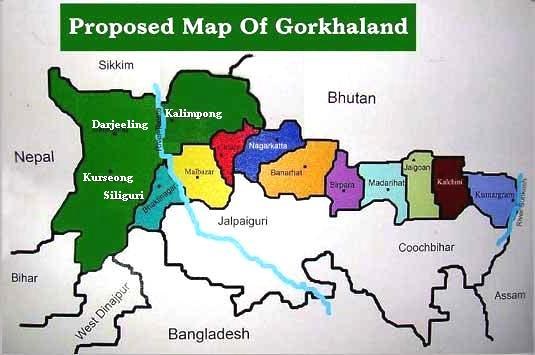
The proposed Gorkhaland territory spans Darjeeling, Kalimpong and Kurseong in the hills, and extends into the Terai and Dooars plains — a multi-ethnic corridor bordering Nepal, Bhutan, Sikkim, and Bangladesh. Map reproduced for educational reference; boundaries are as claimed by demand groups, not Government of India official delimitation.
Current Political Landscape
- Hill politics is now split: TMC-backed BGPM controls local governance (GTA); BJP holds all three assembly seats (Darjeeling, Kalimpong, Kurseong) after the 2026 West Bengal elections and the Darjeeling Lok Sabha seat (2019 & 2024).
- This split incentivises both national and state-level actors to engage with the Gorkha community without fully resolving the statehood demand.
- The new committee's mandate — "permanent political solution within the constitutional framework" — deliberately leaves the statehood question open, focusing instead on identity recognition, ST status, governance reform and fiscal devolution.
Constitutional & Legal Dimensions
- Article 3: Parliament can form a new state or alter boundaries, but requires the concerned state legislature's view — West Bengal's consent would be necessary for a separate Gorkhaland state.
- Sixth Schedule: Provides for Autonomous District Councils (ADCs) for tribal areas — the GTA has been compared to a Sixth Schedule body, though it was created by a tripartite MoU rather than a constitutional amendment.
- ST status demand: 11 Gorkha communities seek Scheduled Tribe recognition — a matter of Union List (Entry 82, List I), requiring Presidential notification, but shaped by state government recommendations.
- Article 371: Special provisions for northeastern states; Gorkha groups have periodically sought similar protections for their region.
Why It Matters for UPSC
- The Gorkha issue is a test case for India's management of sub-national identity claims within a federal structure — balancing state integrity (West Bengal) against minority aspirations.
- The use of an interlocutor-led committee mirrors approaches used in Naga peace talks and J&K reorganisation discussions — a pattern of process-oriented conflict management.
- The racial profiling dimension — Gorkha residents mistaken for Nepali or Chinese nationals — touches Article 19 and the question of equal citizenship for communities with distinct physical features.
✎ Mains Practice Question
The Gorkha demand for a separate political identity has persisted for over a century, repeatedly producing administrative compromises without a lasting resolution. Critically examine the constitutional options available for addressing sub-national identity claims of this nature, and assess the prospects and limitations of the "permanent political solution" approach announced by the Centre in 2026. 15 marks · 250 words
02
India's Youth Vote: Diverse, Dynamic and Not a Uniform Bloc — Lokniti-CSDS Analysis
GS-II · Polity — Elections, Representation, Democratic ParticipationMains-orientedThe Hindu · 25 Aug 2026
Lokniti-CSDS survey data demolishes the notion of a homogeneous "youth vote" in India — turnout and party preference among 18–28-year-olds varies sharply by state, age sub-group, and electoral cycle, making youth a fluid rather than fixed electoral force.
◈ Background & Context
The backdrop to this analysis is the Jantar Mantar protest by the Cockroach Janta Party (CJP), rising youth unrest signalled by BJP losses in Bankipur (Bihar) and Daita by-elections, and upcoming assembly elections in seven states including Uttar Pradesh, Punjab and Gujarat.
The question being asked: can Gen Z swing state elections?
- Lokniti-CSDS (Centre for the Study of Developing Societies) conducts India's most systematic post-poll surveys, covering turnout, party choice and demographic breakdowns including age cohorts.
- Youth is typically segmented into three sub-groups: 18–21 (first-time voters), 22–25, and 26–28 — each can show meaningfully different political behaviour.
Turnout Patterns — No Single National Trend
- 2024 Lok Sabha: 18–21-year-old turnout was ~6 percentage points below the national average; 22–25 turnout was 68%.
- Low youth turnout states: Bihar (18–21: 41% vs. state average 67.3%); Uttar Pradesh (18–21: 51% vs. 61.1% average).
- High youth turnout states: Madhya Pradesh (18–21: 89% vs. 75.6%); West Bengal (18–21: 93%); Tamil Nadu (18–21: 90%); Assam (22–25: 95%).
- Key finding: Young voters are among the least active in some states and the most active in others — turnout is determined by the political context of each election, not age alone.
Party Preference — State-by-State Variation
- West Bengal (2021 → 2026): Marked shift from AITC+ to BJP among youth. By 2026, BJP support among 18–21-year-olds: 51% vs. AITC+ 33%.
- Punjab 2022: AAP dominated — 47% among 18–21-year-olds (Congress: 24%, BJP: 6%); AAP's support among 22–25-year-olds rose to 52%, instrumental in the Congress rout.
- Tamil Nadu 2026: TVK received 69% support among 18–21-year-olds — support declined sharply with age (26% among 29+), illustrating a new political formation's concentration among first-time voters.
- Delhi (2015 & 2020): AAP led across all age groups, but especially among younger voters; BJP support increased with voter age in both elections.
- Uttarakhand 2022: Congress led among 18–21-year-olds (48% vs. BJP 33%) but BJP still won — showing youth preference does not always translate to electoral outcome.
- Uttar Pradesh 2022: Despite BJP's convincing win, the SP was competitive among youth — BJP+ got 44% among both 18–21 and 22–25 cohorts; SP+ got 38–39%.
Figure 2 — Youth Voter Turnout: Select State Comparisons (18–21 age group)
Turnout %100%80%60%40%20%BiharUPMPW. BengalTamil NaduPunjabYouth (18–21) turnoutState average turnoutSource: Lokniti-CSDS surveys · The Hindu, 25 Aug 2026
Youth turnout exceeds the state average in MP, West Bengal, Tamil Nadu and Punjab; it lags significantly in Bihar and UP — no national pattern holds.
Key Analytical Findings
- No monolithic "youth vote": Preferences of 18–21-year-olds often differ from 22–25-year-olds; both differ from 26–28-year-olds. The sub-group matters as much as the generational label.
- Youth can back the losing party: In Uttarakhand 2022, the Congress led among youth but BJP won — youth preference is a signal, not a determinant, of election outcomes.
- New formations attract first-time voters disproportionately: AAP in Punjab 2022, TVK in Tamil Nadu 2026 — novelty and anti-incumbency concentrate most strongly among 18–21-year-olds.
- Volatility between cycles: Bihar 2020 and 2025 show youth preferences can shift by 10–15 percentage points between elections — the youth cohort is the most volatile segment of the electorate.
✎ Mains Practice Question
Lokniti-CSDS data suggests that India does not have a uniform "youth vote" but a diverse, volatile youth electorate whose choices are shaped by state-specific political contexts. Discuss the implications of this finding for theories of representation and the design of youth-centric political engagement policies in a federal democracy. 10 marks · 150 words
Economy, Agriculture & GovernanceGeneral Studies Paper III
03
National Shipping Board Proposes 100-Vessel Addition to Cut India's $75 Billion Annual Foreign Freight Bill
GS-III · Economy — Shipping, Trade Infrastructure, Blue EconomyPrelims + MainsThe Hindu · 25 Aug 2026
The National Shipping Board's five-point roadmap — fiscal reform, assured cargo, competitive financing, regulatory streamlining, and ease of doing business — targets 100 additional vessels in five years to reduce dependence on foreign shipping lines for critical cargo including crude oil, gas, coal and urea.
◈ Background & Context
India currently pays an estimated $75 billion annually in freight charges to foreign shipping companies. Despite being a maritime nation with a 11,098 km coastline and 12 major ports, India's share of global merchant shipping tonnage is less than 2%.
The bulk of critical commodity imports — crude oil, LNG, coal, fertiliser inputs — move on foreign-flagged vessels.
- India's merchant fleet currently has around 1,600 vessels (including coastal), but only ~250 ocean-going vessels — a fraction of what China, Greece, Japan and South Korea operate.
- The National Shipping Board (NSB), under the Ministry of Ports, Shipping and Waterways, advises the government on maritime policy; the 'Sagar Samvad' event was its first major industry consultation.
- This builds on earlier initiatives: Sagarmala Programme (port-led development), Maritime India Vision 2030, and the government's stated target of making India a top-10 shipbuilding nation.
The Five-Point Roadmap
- Fiscal reforms: Tax incentives for ship acquisition (tonnage tax regime reform) and flag-of-convenience reversal to attract Indian-flagged vessels.
- Assured cargo support: Right of first refusal for Indian ships on government-cargo (fertilisers, food, coal for PSUs) — a proven lever used by Japan and South Korea historically.
- Competitive financing: Access to low-cost capital for fleet acquisition; Indian shipping companies currently face higher financing costs than foreign competitors.
- Regulatory streamlining: Reducing turnaround time and port dues; aligning Indian maritime regulations with international conventions.
- Ease of doing business: Single-window clearances; crew certification reforms to expand the pool of Indian maritime professionals.
Why the $75 Billion Number Matters
- Freight payments to foreign shipping lines constitute an invisible import — they widen the current account deficit without adding domestic productive capacity.
- Dependence on foreign vessels for strategic imports (crude oil, defence logistics, LNG) creates a supply-chain vulnerability in conflict or sanction scenarios — the Russia-Ukraine war illustrated this for many economies.
- A larger domestic fleet also generates high-skill maritime employment and supports the blue economy — shipbuilding, ship repair, port services and ancillary industries.
✎ Mains Practice Question
India's dependence on foreign shipping lines for critical commodity imports represents both an economic and a strategic vulnerability. Critically examine the National Shipping Board's five-point roadmap to expand India's merchant fleet, and assess the structural reforms required to make India a competitive maritime nation. 15 marks · 250 words
04
RBI August Bulletin: West Asia Conflict Weighs on Business Confidence; CPI Inflation at 4.45% in July
GS-III · Economy — Inflation, Monetary Policy, Trade, External ShocksPrelims + MainsThe Hindu · 25 Aug 2026
The RBI's August 2026 Bulletin identifies the ongoing West Asia conflict as the primary external risk — straining oil and commodity supply chains and dampening business confidence — while noting that India's domestic demand remains buoyant and robust macroeconomic fundamentals continue to cushion the economy.
◈ Background & Context
The RBI Bulletin's 'State of the Economy' article is authored by RBI staff and does not represent the official MPC view, but provides a comprehensive macro assessment.
The August 2026 edition flags two external headwinds: the West Asia conflict (impacting oil, LNG and commodity supply chains) and new US tariffs (compounding trade uncertainty).
- India imports ~85% of its crude oil requirements — West Asia is the primary source, making freight routes and commodity pricing geopolitically sensitive.
- CPI inflation rose marginally to 4.45% YoY in July 2026 (from 4.38% in June), driven by food and beverages; core inflation remained stable, signalling the absence of broad demand-side price pressure.
- 8 of 12 CPI divisions recorded sequential increases in July; meat, eggs and spices registered double-digit inflation.
Key Data Points — July 2026
- CPI Inflation: 4.45% YoY (food-driven; above the RBI's 4% target but within the 2–6% tolerance band)
- Core inflation: Unchanged — confirming supply-side rather than demand-side drivers
- Merchandise exports: Grew at a four-month high in July 2026 (within FY 2026-27)
- Merchandise imports: Also grew strongly; trade deficit widened — driven by electronic goods
- Fuel inflation: Edged up marginally
- Kharif sowing: Supported by July monsoon pickup; approaching previous year's levels
- High-frequency indicators: Vehicle and tractor sales remain buoyant; petroleum product consumption growth returned to positive after three consecutive months of contraction
Structural Concern — Food Price Dynamics
- Within pulses, all major constituents registered month-on-month price increases in July.
- Edible oil prices rose broadly — mustard and palm oil led — reflecting both domestic supply gaps and international price signals (palm oil linked to Southeast Asian production).
- Rice and wheat continued an upward price trajectory, though the pace of month-on-month increase stabilised.
- The August high-frequency data (up to 21st) showed a broad-based sequential increase in food prices — suggesting inflationary momentum carries into Q2 of FY 2026-27.
✎ Mains Practice Question
The RBI has repeatedly cited supply-side food price pressures as the primary driver of CPI inflation in India, even as core inflation remains anchored. Examine the monetary policy dilemma this creates, and discuss what structural interventions — beyond interest rate management — are needed to stabilise India's food inflation. 15 marks · 250 words
05
India's First Non-GMO High-Expansion Popcorn Maize Hybrid Seed Launched in Andhra Pradesh
GS-III · Economy/Agriculture — Seed Technology, Aatmanirbhar Bharat in AgriculturePrelims + MainsPIB · 24 Aug 2026
Vice-President C.P. Radhakrishnan launched India's first non-GMO, high-expansion popcorn maize hybrid seed in Eluru district, Andhra Pradesh — an indigenously developed variety designed to reduce dependence on imported hybrid technology for high-quality specialty maize.
◈ Background & Context
India's maize production (~35 million tonnes annually) is dominated by conventional varieties; specialty maize segments — popcorn, baby corn, sweet corn — have historically depended on imported hybrid seeds, particularly from the US and Israel.
The Gourmet Popcornica enterprise developed this indigenous hybrid through a farmer-enterprise partnership model, covering 17,500+ farmers across 40,000+ acres in 8 states.
- Non-GMO: The hybrid is bred through conventional cross-breeding, not genetic engineering — relevant to India's regulatory framework under the Environment Protection Act and GEAC (Genetic Engineering Appraisal Committee) oversight, which has been cautious about GM food crops.
- High-expansion ratio: A quality parameter for popcorn (volume of popped corn per unit of kernel); imported hybrids have dominated this segment due to superior expansion ratios.
- Broader significance: Seed sovereignty is a recurring UPSC theme — the Protection of Plant Varieties and Farmers' Rights Act (PPV&FRA), 2001 and the Seeds Bill debate directly connect to this event.
✎ Mains Practice Question
Seed sovereignty is considered a foundational element of agricultural self-reliance. Examine the regulatory framework governing seed development and commercialisation in India, and discuss the role of farmer-enterprise partnerships in advancing indigenous seed technology. 10 marks · 150 words
Science, Technology & EnvironmentGeneral Studies Paper III
06
H1N1 Accounts for 98% of Influenza A Cases in India: ICMR Chief Urges Caution, Not Panic
GS-III · S&T — Virology, Public Health; GS-II · Health GovernancePrelims + MainsThe Hindu · 25 Aug 2026
ICMR Director-General Rajiv Bahl confirmed that the H1N1 pdm09 strain — the familiar 2009 pandemic-origin virus now endemic as a seasonal influenza — accounts for ~98% of Influenza A detections in India, with H3N2 comprising only 2–3%, and stressed the virus remains mild and self-limiting for most people.
◈ Background & Context
H1N1 pdm09 emerged in Mexico in early 2009, caused the first influenza pandemic of the 21st century (WHO declared in June 2009, declared over in August 2010), and has since become part of the seasonal influenza repertoire globally.
India experiences seasonal influenza surges typically during the monsoon (Jul–Sep) and post-winter (Feb–Mar) periods.
- India's influenza surveillance runs through a network of 73 sentinel hospitals tracking Influenza A (H1N1, H3N2), Influenza B, SARS-CoV-2, human metapneumovirus, adenovirus and parainfluenza viruses simultaneously.
- H1N1 is included in the standard seasonal influenza vaccine (trivalent and quadrivalent formulations); the ICMR chief noted no urgent mass vaccination need for the general population, but advised high-risk groups (65+, immunocompromised) to consult doctors.
- Minor genetic drift in influenza viruses each season is normal and does not necessarily signal a new or more dangerous strain — antigenic shift (major genetic reassortment) is the pandemic risk threshold.
Key Scientific Distinctions (Prelims)
- H1N1 pdm09: The 2009 pandemic strain; now seasonal; predominantly affects younger adults and pregnant women (unlike seasonal H3N2 which disproportionately affects elderly).
- Antigenic drift vs. shift: Drift = minor, gradual mutations (annual vaccine updates address this); Shift = sudden, major genetic reassortment producing a novel subtype with pandemic potential.
- Influenza A vs. B: Type A (H1N1, H3N2) causes most seasonal epidemics and all pandemics; Type B (Yamagata, Victoria lineages) is less variable and causes milder outbreaks.
- Sentinel surveillance: A targeted, hospital-based monitoring system tracking specific disease indicators — distinct from passive surveillance that relies on voluntary reporting.
- ICMR: Indian Council of Medical Research; apex body for biomedical and health research in India; under MoHFW.
✎ Mains Practice Question
India's disease surveillance infrastructure, anchored by sentinel hospitals and ICMR's national networks, plays a critical role in early detection and public health response to respiratory illness outbreaks. Assess the strengths and gaps in India's current influenza surveillance system, and examine the policy frameworks needed to build pandemic preparedness. 10 marks · 150 words
07
Monsoon 2026: Why Climate Models Failed to Predict Erratic Spatial & Temporal Evolution — and What AI Can Do
GS-III · Environment — Monsoon, Climate Change, Disaster Management; S&T — AI in Climate SciencePrelims + MainsThe Hindu · 25 Aug 2026
While models correctly predicted a 2026 El Niño and a >10% seasonal rainfall deficit, they failed to anticipate the unprecedented sub-seasonal volatility — June 40% below normal, July recovering to 1% above — raising fundamental questions about whether El Niño-global warming interactions are generating a structurally less predictable monsoon system.
◈ Background & Context
The 2026 monsoon follows the 2023 season (El Niño, seasonal total 94% of LPA — models roughly correct) and the 2024 failed La Niña prediction.
The pattern reveals an accelerating gap between seasonal aggregate forecasting (improving) and sub-seasonal/spatial prediction (still limited). This matters because farmers, disaster managers and water utilities need space-time precision, not just seasonal totals.
- Climate models predict El Niño with ~80% accuracy — but will still be wrong one-fifth of the time; monsoon prediction accuracy is lower, around 60%.
- India's multi-tiered prediction system covers: short range (days 1–3), medium range (days 3–10), extended range (weeks 2+), and seasonal-to-interannual predictions — each with different methodologies and uncertainty levels.
- The 2026 season onset over Kerala was predicted to be delayed — it was, by a few days — but everything after was a "whiplash": June collapse followed by rapid July recovery that still failed to capture farm-scale rainfall deficits.
Why Models Struggled in 2026
- El Niño + global warming interaction: The combination may be generating new monsoon behaviour — more extreme dry-wet switches, erratic spatial distribution — that historical datasets do not adequately represent.
- Local amplifiers not yet in models: Land use change, urbanisation, deforestation and irrigation alter rainfall patterns at farm and neighbourhood scales — these factors are insufficiently represented in current global climate models.
- Intrinsic irreducible uncertainty: Long-lead spatial and temporal monsoon prediction faces chaotic atmospheric dynamics that even perfect models cannot fully resolve beyond a certain time horizon.
- Active-break cycle erraticity: The 2026 season showed unusually long active and break spells that current models could not capture even a few days in advance.
Figure 3 — 2026 Monsoon: Sub-Seasonal Rainfall Departure from Normal (% of LPA)
0%+20%+40%-20%-40%–40%June 2026(40% below normal)+1%July 2026(1% above normal)>–10%Seasonal 2026(predicted >10% deficit)Source: The Hindu / IMD data · LPA = Long Period Average (1961–2010)
The June-to-July swing of ~41 percentage points illustrates the sub-seasonal volatility that current climate models failed to anticipate — even as the seasonal aggregate deficit prediction held broadly correct.
Role of AI in Improving Monsoon Prediction
- AI/ML tools extract patterns from data without requiring mechanistic understanding of governing physics — a significant advantage where the precise drivers of monsoon variability are incompletely understood.
- Hybrid dynamic-AI models are the frontier: they combine physical process models (atmosphere, ocean, land) with AI-driven pattern recognition to improve spatial downscaling — bringing global predictions from the scale of hundreds of kilometres down to farm and neighbourhood scales.
- AI is proving indispensable for optimal observation network design — identifying where to place sensors to maximise predictive improvement per rupee of investment.
- Data constraints remain: AI models need sufficient observational data covering local amplifiers (urbanisation, land use) at the relevant spatial and temporal scales — India's rain gauge and weather station network has significant density gaps, especially in the Western Ghats and Northeast.
Institutions & Terms to Know (Prelims)
- IMD — India Meteorological Department; issues official monsoon forecasts; uses Ensemble Prediction Systems and IITM's coupled models.
- IITM Pune — Indian Institute of Tropical Meteorology; India's lead climate modelling centre; develops the CFS-based coupled climate model.
- El Niño: Warming of Central/Eastern Pacific SSTs; typically suppresses Indian monsoon (deficit rainfall risk); opposite of La Niña.
- LPA: Long Period Average — the baseline for monsoon normal (1961–2010: 87 cm); a season is "deficient" if rainfall is <90% of LPA.
- Active-break cycle: The oscillating pattern of intense rainfall (active phase) and suppressed rainfall (break phase) within the monsoon season — occurs roughly every 2–4 weeks.
- AIMR: All-India Monsoon Rainfall — the aggregate seasonal total; easier to predict than spatial or sub-seasonal distribution.
✎ Mains Practice Question
The 2026 monsoon season highlighted the gap between India's improving seasonal rainfall forecasting capability and its limited ability to predict sub-seasonal and spatial monsoon evolution. Discuss the scientific and technological challenges involved, and examine how artificial intelligence tools could be integrated with existing climate models to bridge this gap. 15 marks · 250 words