

In-Depth News Analysis7 Items
Core TopicImportantConcise
Polity, Governance & Social JusticeGS Paper II
01Census 2027: How Should Caste Be Counted?02Constitution Day: Amendments, Basic Structure & the Judiciary
Economy, Agriculture & IPRGS Paper III
03Hapus GI Dispute: Konkan vs Valsad
Science & TechnologyGS Paper III
04IN-SPACe Report: Satellite Supply Chain
Environment & EcologyGS Paper III
05India’s Wildlife Conservation: Gains & Gaps06Sea Turtle Nesting Assessment (WII)
Society & Social JusticeGS Papers I & II
07Public Toilets & Women’s Workforce Participation
Polity, Governance & Social JusticeGeneral Studies Paper II
01
Census 2027 and Caste: An Open-Entry Question Revives an Old Problem of Classification
GS-II · Polity — Welfare of Vulnerable Sections, Reservation; Statutory BodiesGS-I · Society — CastePrelims + MainsThe Hindu · Explainer
For the first time since 1931, the Census will ask every household about caste. But Question 10 of the 2027 schedule (“SC/ST/Caste”) leaves caste as open entry, with no pre-coded list for communities outside the Scheduled Castes and Scheduled Tribes. This risks repeating the data problems of the 2011 Socio-Economic and Caste Census.
◈ The Basics — What is the Census?
- Legal basis: “Census” is Entry 69 of the Union List; it is conducted under the Census Act, 1948 and Census Rules, 1990 by the Registrar General & Census Commissioner of India (Ministry of Home Affairs).
- History: the first non-synchronous Census was held in 1872, the first synchronous one in 1881; the 2011 Census was the 15th overall and the 7th after Independence. The 2021 round was postponed.
- Census 2027 — two phases: House-listing (2026) and Population Enumeration (from February 2027). The reference date is 1 March 2027, or 1 October 2026 for snow-bound areas (Ladakh, J&K, Himachal Pradesh, Uttarakhand).
- Firsts: India’s first digital Census, with tablet-based enumeration and an option for self-enumeration. It will also be the first enumeration of caste for all communities since 1931, following the Union Cabinet Committee on Political Affairs decision of April 2025.
What exactly has been decided
- SCs and STs will be recorded against notified lists, as in every Census since 1951.
- Everyone else names a caste, which the enumerator types in as spoken — there is no drop-down menu and no State-wise schedule.
- Officials say a code directory and validation checks will reconcile spellings, sub-castes and regional names after enumeration.
- On 28 October 2026, the Supreme Court declined a plea for an OBC drop-down list, treating it as a matter of policy.
Figure 1 — A century of counting caste
19311951198020112023–252027Last fullcaste count4,147 castesOnly SCs andSTs countedthereafterMandal report3,743 backwardcommunitiesSECC: open entry~46.7 lakhcaste namesState surveysBihar, Karnataka,TelanganaCensus Q10:open-entrycaste fieldOpen entry produced unusable data in 2011; pre-coded lists worked in the State surveys
The method chosen — open entry or a pre-coded list — decides whether the data can be tabulated.
Two methods, two track records
- Open entry (SECC 2011): run by the Ministries of Rural Development and Housing & Urban Poverty Alleviation. It returned about 46.7 lakh distinct caste names, against 4,147 castes in 1931. Spelling variants (Yadav/Yadava/Yaduvanshi), surnames and jati names became separate entries, and the caste tables were never released.
- Pre-coded lists (State surveys): Bihar (2023), Karnataka and Telangana used pre-coded lists and could publish results.
~63%
Backward classes — Bihar survey (EBC + BC)
~70%
Backward classes — Karnataka survey
56.33%
Backward classes — Telangana survey
Why the Centre prefers open entry — and the rebuttal
- Government’s reasoning: the Central and State OBC lists cover nearly 3,000 communities and are, in official wording, lists of classes rather than castes. Some entries (e.g. “local borns” in the Andaman and Nicobar Islands, tea-garden workers in Assam) would not work as a caste menu.
- Constituent Assembly roots: the term “backward classes” in Article 16(4) was deliberately chosen over “community”; Ambedkar preferred to leave identification to a commission — later realised through Article 340.
- The rebuttal: both lists are already organised State by State. Enumerators could record the administrative category beside the caste name as spoken, keeping the detail needed for sub-categorisation while fixing each respondent’s category at the time of the count.
◈ The Ambedkar Precedent (1932)
In 1932, the Indian Franchise Committee (Lothian Committee) began estimating the population of the “Depressed Classes” to allocate separate representation. Ambedkar’s essay From Millions to Fractions recorded how the count shrank as committees applied differing tests.
- The 1911 Census used ten tests of untouchability; the 1921 and 1931 Censuses put the population at around five crore.
- Provincial committees then cut the figure sharply — the United Provinces counted only a few groups, Bengal a single caste. Ambedkar argued the test of untouchability varies by region, so a uniform national test would exclude many.
- Lesson for 2027: definitions decide the count. A region-wise, list-based method is consistent with how SC, ST and OBC lists already work.
Why reliable caste data matters
- OBC sub-categorisation: the Rohini Commission (set up under Article 340 in 2017; report submitted 2023) examined unequal distribution of OBC benefits.
- SC sub-classification: in State of Punjab v. Davinder Singh (2024), a 7-judge bench (6:1) allowed States to sub-classify SCs, overruling E.V. Chinnaiah (2005) — this needs quantifiable data.
- Creamy layer and the 50% ceiling from Indra Sawhney (1992) are debated with little current evidence.
- The concern on the other side: some argue that counting caste may harden identities and fragment social cohesion. Supporters reply that caste already shapes land, education and jobs, and policy needs to see where the gaps lie.
✎ Mains Practice Question
The method of caste enumeration will decide whether the 2027 Census yields usable data. Examine the problems with open-entry recording of caste, and discuss how caste data can inform reservation and welfare policy. 15 marks · 250 words
02
Constitution Day 2026: A Living Document — Amendments, the Basic Structure and the Judiciary’s New Challenges
GS-II · Polity — Amendments, Basic Structure, JudiciaryPrelims + MainsThe Indian Express · PTI
Marking 77 years since the adoption of the Constitution, the Prime Minister wrote on its role as a social document and on its amendment history, while the Chief Justice of India said courts must interpret the Constitution as a living document — within the limits of its basic structure — and deliver timely, affordable justice.
◈ Background & Context
- Constitution Day (Samvidhan Divas) has been observed on 26 November since 2015; the Constitution was adopted on 26 November 1949 and commenced on 26 January 1950.
- “A social document”: historian Granville Austin (The Indian Constitution: Cornerstone of a Nation, 1966) described it as first and foremost a social document, aimed at social revolution through law.
- Translations: an updated text of the Constitution is now available in all 22 languages of the Eighth Schedule.
Figure 2 — Amendments referred to on Constitution Day
195119751976197820162018–1920231st38th, 39th42nd44th101st102nd, 103rd106thArt 15(4);Art 19(2);9th ScheduleEmergency-eralimits onjudicial review“Mini-Constitution”;Fund. DutiesRestoredsafeguards;Art 300AGST;Arts 246A,269A, 279ANCBC (338B);EWS 10% —15(6), 16(6)One-thirdseats forwomenOuter limit on Article 368: the Basic Structure doctrine (Kesavananda Bharati, 1973)
Amendments have both expanded social justice and, at times, curtailed rights; the basic structure doctrine is the judicial check.
Amendments to know — Prelims hooks
- 1st Amendment (1951): passed by the Provisional Parliament; added Art 15(4), new grounds in Art 19(2) (public order, friendly relations with foreign States, incitement), Arts 31A–31B and the Ninth Schedule.
- 38th & 39th (1975): during the Emergency; the 39th shielded certain elections from courts. Part of it was struck down in Indira Nehru Gandhi v. Raj Narain (1975), the first application of the basic structure to an amendment.
- 42nd (1976): “socialist”, “secular”, “integrity” in the Preamble; Fundamental Duties (Art 51A); curbs on judicial review. Largely reversed by the 44th (1978), which moved property out of Part III into Art 300A.
- 101st (2016): GST and the GST Council (Art 279A). 102nd (2018): constitutional status to the NCBC (Art 338B). 103rd (2019): up to 10% EWS reservation, upheld 3:2 in Janhit Abhiyan (2022).
- 106th (2023): one-third reservation for women in the Lok Sabha and State Assemblies, operative after delimitation following the next Census.
- Article 356: its frequent past use led to the safeguards laid down in S.R. Bommai (1994) — floor test, judicial review of proclamations.
The CJI on the judiciary’s new challenges
- Basic structure elements he listed: rule of law, democracy, fundamental rights and an independent judiciary — these cannot be altered by any number of amendments.
- New kinds of disputes: AI, technology and cross-border issues make geographical boundaries less relevant; courts must assess whether they are equipped.
- “Digital arrests”: courts should use their powers and new technology to protect citizens defrauded by impersonators posing as officials.
- Timely and affordable justice: introspection, he clarified, meant examining institutional capacity, not diminishing the judiciary.
▤ Justice delivery — static anchors
- Article 39A (inserted by the 42nd Amendment): equal justice and free legal aid; given effect through NALSA under the Legal Services Authorities Act, 1987.
- Pendency: over 5 crore cases are pending across courts, as per the National Judicial Data Grid.
- e-Courts Phase III (approved 2023, outlay ₹7,210 crore): digitisation, paperless courts and AI-assisted tools.
✎ Mains Practice Question
“The Constitution is a living document, but its amendability is bounded by the basic structure.” Discuss with reference to key constitutional amendments, and examine the challenges the judiciary faces in delivering timely and affordable justice. 15 marks · 250 words
Economy, Agriculture & IPRGeneral Studies Paper III
03
Whose Hapus? The Konkan–Valsad GI Dispute and the Law on Homonymous Geographical Indications
GS-III · Economy — IPR, Agricultural MarketingPrelims + MainsThe Indian Express
Mango growers of Maharashtra’s Konkan region, whose Alphonso (Hapus) received a Geographical Indication (GI) tag in October 2018, are opposing an application for “Valsad Hapus” from Gujarat. The GI Registry has concluded the final hearing and reserved its decision; Konkan’s GI holders rejected a suggested settlement.
◈ The Basics — What is a GI?
A Geographical Indication identifies a product as originating in a specific place, where its quality, reputation or characteristics are essentially linked to that origin. It stops others from using the name, and lets registered producers of that region market under it.
- Law: the Geographical Indications of Goods (Registration and Protection) Act, 1999, in force from 15 September 2003, enacted to meet India’s obligations under the WTO’s TRIPS Agreement (Arts 22–24).
- Administration: the GI Registry, Chennai, under the Controller General of Patents, Designs and Trade Marks (DPIIT, Ministry of Commerce & Industry).
- First Indian GI: Darjeeling Tea (2004–05). Registration is valid for 10 years and is renewable indefinitely.
- Homonymous GIs (Section 10): the Act allows registration of identically or similarly named GIs from different places, provided practical conditions distinguish them and consumers are not misled.
The two sides
- Existing GI (2018): Alphonso from Ratnagiri, Sindhudurg, Raigad, Thane and Palghar, after a decade-long effort by growers and the Dr Balasaheb Sawant Konkan Krishi Vidyapeeth.
- Valsad application: filed on 13 February 2023 by the Bharatiya Kisan Sangh (Gandhinagar) and Navsari Agricultural University. Applicants say Valsad has its own tradition of Alphonso cultivation with distinct qualities. They also note that its peak season begins as Ratnagiri’s ends (around the third week of May), and they have sought backing under One District One Product.
- Konkan’s objection: Valsad may seek recognition under a different name; sharing “Hapus” would confuse consumers and dilute the premium. Konkan Hapus earns about ₹200 crore domestically and ₹80 crore from exports.
Figure 3 — How a GI is registered (and where disputes arise)
Applicationby producers’associationExaminationconsultativegroup reviewAdvertisedin theGI JournalOpposition3 months(+1 extension)Registration10 years,renewableSection 10 — homonymous GIsSame name allowed only if products are distinguishableValsad Hapus: decisionreserved after final hearing
Disputes usually crystallise at the opposition stage; the Registry must then weigh distinctiveness against consumer confusion.
Precedents and the larger issues
- Similar-name precedent: “Banglar Rasogolla” (West Bengal, 2017) and “Odisha Rasagola” (2019) both hold GIs with distinct names — a template for co-existence.
- International dimension: India has contested Pakistan’s claim over Basmati before the EU; TRIPS gives Art 23 “additional protection” only to wines and spirits, which India has sought to extend to other products.
- Economic value: India has over 600 registered GIs, but weak post-registration enforcement, low awareness and few authorised users limit price premiums.
- Federal and producer equity: disputes across State lines test whether GI law protects reputation built by one region or rewards shared agronomic heritage.
✎ Mains Practice Question
Geographical Indications can raise rural incomes, but disputes over shared names are increasing. Discuss the GI framework in India, with reference to the Konkan–Valsad Hapus dispute, and suggest ways to make GIs economically effective. 10 marks · 150 words
Science & TechnologyGeneral Studies Paper III
04
India’s Satellite Supply Chain Is “Highly Dependent” on Imports: IN-SPACe Report
GS-III · S&T — Space; Indigenisation of TechnologyPrelims + MainsThe Hindu
IN-SPACe’s report Supply Chain Landscape of Satellite Manufacturing in India finds that nearly 60% of satellite costs come from electronic, electrical and electromechanical components and specialised materials, most of which are imported. The private sector’s role is largely limited to structural assemblies and propulsion parts.
◈ The Basics — India’s Space Reform Architecture
- IN-SPACe (Indian National Space Promotion and Authorisation Centre): approved in June 2020 as a single-window, autonomous body under the Department of Space, headquartered in Ahmedabad. It authorises and promotes non-governmental space activity.
- NSIL (NewSpace India Limited, 2019): ISRO’s commercial arm; ISRO focuses on R&D.
- Indian Space Policy, 2023: defines roles of ISRO, IN-SPACe, NSIL and private players across the value chain.
- FDI liberalisation (2024): up to 74% automatic for satellite manufacturing and operations, 49% for launch vehicles, and 100% for components and sub-systems.
Figure 4 — Where the dependence lies
Share of satellite cost~60% components & specialised materials~40% all other costsSuppliers mapped in the reportIndian53Foreign162
Foreign suppliers (from the US, Germany, Japan, France and the Netherlands, among others) outnumber Indian ones three to one.
Key findings
- Limited testing and certification facilities weaken the global acceptance of Indian components.
- Project-based manufacturing: firms build to individual ISRO orders, which discourages long-term investment in automation and capacity.
- Long lead times: critical components often take 12–16 months to procure, delaying projects.
- Skills gap: shortages in systems engineering, quality assurance and qualification testing; limited private R&D and technology transfer.
▤ Scale and ambition
- Space economy: about $9 billion now, projected by the Government to reach $40–45 billion within a decade.
- Private sector: from a few start-ups to an expected 400–500 companies in a few years (official projection).
- Opportunity: the report sees India moving from satellite assembler to exporter of systems and sub-systems — small satellites, communication payloads, high-resolution imaging.
Way forward
- Shared test and qualification facilities open to private firms; mutual recognition of certification.
- Demand aggregation and multi-year procurement to replace one-off project orders — the next phase of reform, the IN-SPACe chairman said, must generate demand.
- Component PLI-style support for space-grade electronics, linked to the semiconductor mission, and patient capital (the ₹1,000 crore space VC fund).
✎ Mains Practice Question
Space-sector reforms have opened the door to private players, but India’s satellite manufacturing remains import-dependent. Examine the constraints identified and suggest measures to build a self-reliant space supply chain. 10 marks · 150 words
Environment & EcologyGeneral Studies Paper III
05
How India Conserved Its Big Mammals — and the Gaps That Remain: Corridors, Coexistence and “Misguided Kindness”
GS-III · Environment — Conservation, BiodiversityPrelims + MainsThe Indian Express · Explained
With a cheetah from Botswana giving birth to four cubs at Kuno National Park, India’s cheetah count has reached 62, of which 43 were born in India. A leading conservation scientist uses the milestone to assess India’s record: large populations of big mammals in a crowded country, but weak connectivity, unaddressed conflict and welfare-driven choices that can work against species survival.
◈ Static Background — An Old Conservation Ethic
- Biogeography: the Indian plate drifted across the ocean, evolving endemic life, before colliding with Asia about 50 million years ago and receiving Eurasian, Persian and Southeast Asian species.
- Ancient protection: Kautilya’s Arthashastra describes abhayaranyas (forests where animals were protected) in the Mauryan period (~300 BCE); Ashoka’s Pillar Edict V lists animals not to be killed. The US Yellowstone (1872) is usually called the first national park.
- Colonial decline: clearing for farms and timber, sport hunting and bounties devastated wildlife; surviving royal hunting reserves and rugged forests later became many of today’s parks. India’s first national park, Hailey NP (1936), is now Jim Corbett.
- Modern framework: the Wildlife (Protection) Act, 1972 and Project Tiger (1 April 1973), launched with nine reserves.
Figure 5 — Milestones in Indian wildlife conservation
~300 BCE187219361972197320052006–072022Abhayaranyas(Arthashastra)Yellowstone,USAHailey NP(Corbett)Wildlife(Protection) ActProjectTigerSariska crisis;Tiger Task ForceNTCA;WCCBProjectCheetahThe Sariska failure of 2005 triggered the science-based reforms behind today’s tiger recovery
Each crisis has produced institutions: the 2005 tiger collapse led to the NTCA and the Wildlife Crime Control Bureau.
The Sariska turning point
In the 1980s–90s, the illegal trade in tiger parts, ivory and rhino horn grew, and poachers turned to India once tigers in China and Southeast Asia were depleted. In 2005, Sariska lost all its tigers even as official estimates showed 19.
- Tiger Task Force (2005), report titled “Joining the Dots”: exposed bureaucratic failure, ignored warnings and inflated counts. A scientific estimate found only about 1,400 tigers, against 3,500 reported.
- Reforms: the National Tiger Conservation Authority (2006, via a WPA amendment), the Wildlife Crime Control Bureau (2007), and scientific monitoring of tigers, prey and habitat.
- Core–buffer zoning and voluntary relocation from core areas, now with a package of ₹15 lakh per family. The author notes this component has had no Ministry allocation since 2021.
- Result: 58 tiger reserves securing about 70,000 km² of human-free habitat; tigers have grown about 6% a year, recolonising some 3,000 km² annually.
~4,000
Wild tigers — world’s largest population
~23,000
Asian elephants
15,000+
Leopards
~1,000
Asiatic lions — the only wild population
The Asiatic lion — success with a single point of failure
- Once found from Persia to Palamu (Bihar), lions were reduced in the British era to fewer than 50 in Junagadh under the Nawab’s protection.
- Today about 1,000 share some 30,000 km² of Kathiawar (Saurashtra), coexisting with people and livestock.
- But a single, genetically vulnerable population is exposed to epidemics. In 2013, the Supreme Court (Centre for Environmental Law, WWF-India v. Union of India) ordered a second home at Kuno in the “species’ best interest” — it has not happened.
◈ Where “kindness” can hurt conservation
- Individual welfare vs population health: treating every sick animal (e.g. lion hospitals) lets carriers of harmful genes breed, raising the genetic load; spreading risk through multiple populations matters more.
- Feral dogs and cats: unchecked populations spread disease, compete for prey and hybridise with the endangered Indian wolf and wild cats; humane population control is needed.
- Zoos and captive breeding cannot replace wilderness. For the Great Indian Bustard, underground cabling and bird diverters on power lines matter more than captive release.
- Island ecosystems: Lakshadweep and the Andaman & Nicobar Islands are rich in endemics and need special scrutiny of development projects.
Gaps that remain
- Small protected areas: parks and sanctuaries cover only about 5% of India’s land. They are too small to be viable alone, so corridors and connectivity matter more than fencing.
- Linear infrastructure: highway wildlife passages have improved, but agricultural and pastoral landscapes still see road deaths of wolves, caracals, foxes, desert cats, jackals and hyenas.
- Conflict management: policy relies on compensation; proactive mitigation and real benefits for forest communities — a Task Force recommendation — remain weak.
- Project Cheetah: launched on 17 September 2022 (8 from Namibia, then 12 from South Africa in 2023). About 15 cheetahs roam free while some 40 remain in enclosures; the author argues this ratio should be reversed if cheetahs are to restore open ecosystems.
Way forward — making coexistence pay
- Community homestays (as in Ladakh’s snow leopard landscapes) over high-end tourism, with a share of tourism profits going to local people.
- Agroforestry on private land, branded non-timber forest produce, and science-based, monitored sustainable use of wildlife outside PAs, building on community rights under the Forest Rights Act, 2006.
- Align with the Kunming–Montreal Global Biodiversity Framework (2022) “30×30” goal through OECMs (Other Effective Area-based Conservation Measures) beyond formal protected areas.
✎ Mains Practice Question
India supports the world’s largest populations of several large mammals despite high human density. Critically examine the factors behind this success and the challenges of connectivity, human–wildlife conflict and welfare-driven interventions in conservation. 15 marks · 250 words
06
Olive Ridley Most Widespread, Leatherbacks Concentrated at Galathea Bay: First Pan-India Sea Turtle Nesting Assessment
GS-III · Environment — Species Conservation, EIAGS-I · Geography — Coastal FeaturesPrelims + MainsThe Indian Express
A multi-season assessment by the Wildlife Institute of India (WII) for the Union Environment Ministry found the Olive Ridley to be the most widespread marine turtle on India’s mainland coast, with 18,713 solitary nests in 2024–25. It also flagged Galathea Bay on Great Nicobar — the site of a proposed port — as a key Leatherback nesting beach.
◈ The Basics — Sea Turtles of India
- Five species occur in Indian waters: Olive Ridley, Green, Hawksbill, Leatherback and Loggerhead (the last rarely nests in India). All are in Schedule I of the Wildlife (Protection) Act, 1972 and CITES Appendix I.
- IUCN status: Olive Ridley — Vulnerable; Leatherback — Vulnerable (several subpopulations Critically Endangered); Green — Endangered; Hawksbill — Critically Endangered; Loggerhead — Vulnerable.
- Arribada (Spanish for “arrival”): synchronised mass nesting by Olive Ridleys, seen in Odisha at Gahirmatha (in Bhitarkanika), Rushikulya and the Devi river mouth. Turtles also nest solitarily along much of the coast.
- Leatherback: the largest living turtle, with a leathery carapace instead of a hard shell; it dives deepest and feeds on jellyfish. In India it nests only on the Andaman and Nicobar Islands.
Figure 6 — Sea turtles: air-breathing reptiles that return to land only to nest
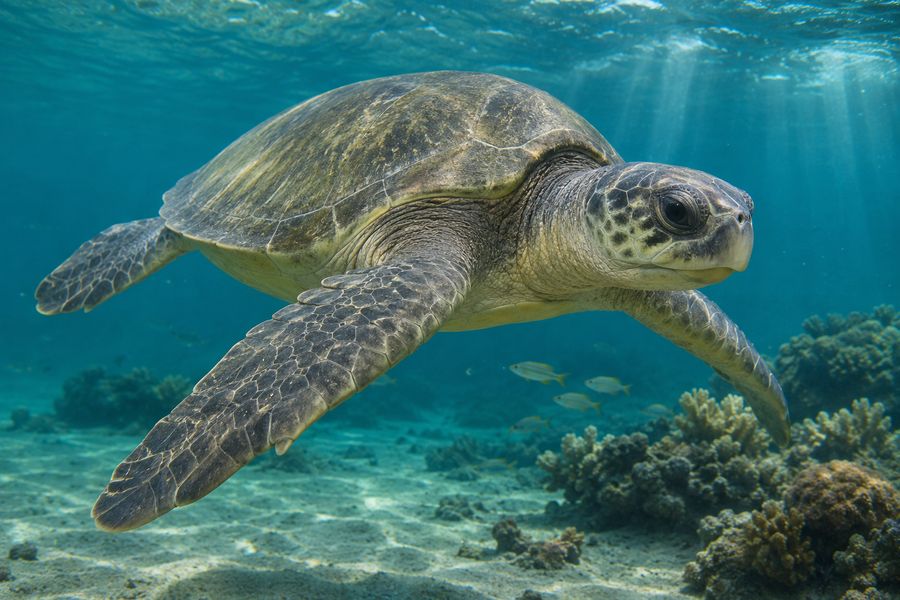
Representative image of a marine turtle. Females come ashore only to lay eggs, often on the beach where they hatched (natal homing).
Figure 7 — Key sea turtle nesting areas cited in the assessment
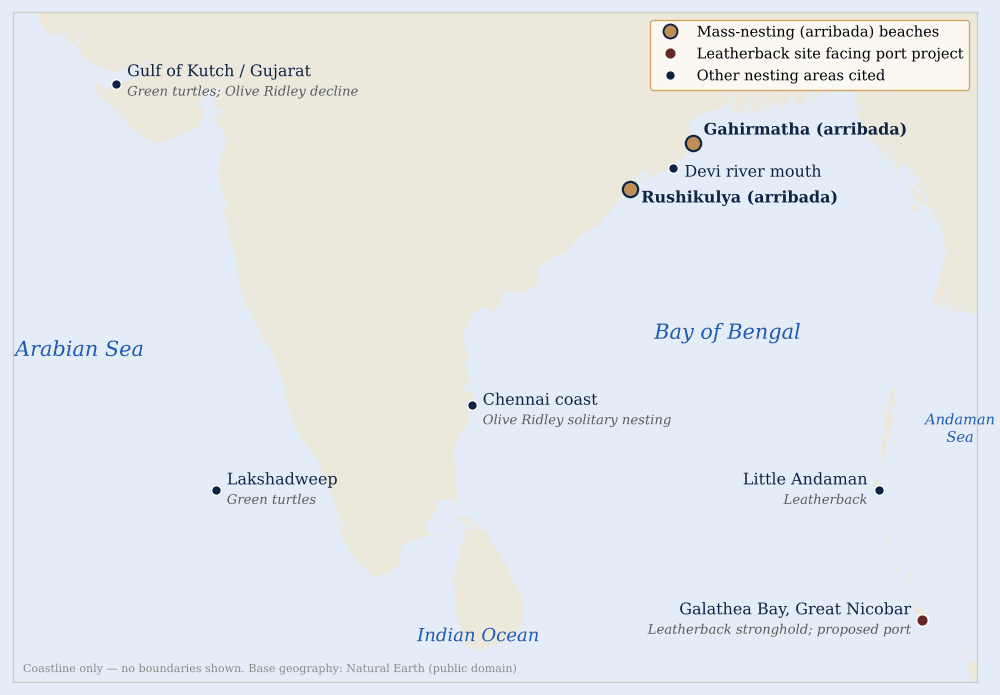
Olive Ridley mass-nesting is concentrated in Odisha; Leatherback nesting is confined to the Andaman and Nicobar Islands, with Galathea Bay the stronghold. Coastline-only map prepared by Legacy IAS from Natural Earth (public domain); no boundaries depicted.
What the assessment found
- Coverage: 360 beach stretches over 1,300 km across Gujarat, Maharashtra, Karnataka, Kerala, Lakshadweep, Tamil Nadu, Andhra Pradesh, Odisha, West Bengal and the A&N Islands, using data from December 2022 to May 2025.
- Olive Ridley: on at least 300 stretches; about 8,000 solitary-nesting females in 2024–25, estimated at 2.5 clutches per female (each clutch about 100–110 eggs). Nesting runs from late October to March.
- Decline in Gujarat: attributed to closure of river mouths and disruption of sandy beaches.
- Green turtles: largely in Gujarat, the rest in Lakshadweep and the A&N Islands.
- Method: population is estimated from nest counts, combining literature, field assessments and State forest records — direct counts at sea are practically impossible.
Figure 8 — Leatherback nests recorded at Galathea Bay, Great Nicobar
03006009006434788892023–242024–25Nov 2025–Mar 2026WII assessmentWII assessmentA&N Forest Dept data
Different sources: the first two seasons are from the WII report, the third from the A&N Forest Department. One Galathea hatchery relocated 626 nests in 2023–24 — a national record.
▤ The Great Nicobar link
- Great Nicobar Island (GNI) project: a mega-project — including an international transshipment port at Galathea Bay, an airport, a township and a power plant — cited at about ₹92,000 crore.
- CRZ question: before the National Green Tribunal, the Centre said the port site did not fall in ICRZ-IA — the Island Coastal Regulation Zone category with the highest protection, where ports are prohibited. Turtle nesting is one reason a beach qualifies for ICRZ-IA.
- Galathea National Park and the Great Nicobar Biosphere Reserve (a UNESCO MAB site since 2013) adjoin the area; the island is also home to the Shompen, a PVTG.
Gaps flagged and the way forward
- Monitoring gaps: poor data from remote parts of Lakshadweep and the A&N Islands; underestimation of predation on nests (dogs, jackals, wild boar).
- In-situ over hatcheries: the report favours protecting eggs on site rather than relocating them, since hatcheries can alter incubation temperature and thus the sex ratio.
- Flipper tagging to track individuals and estimate populations more reliably.
- Existing measures: Operation Olivia (Coast Guard patrols off Odisha), mandatory Turtle Excluder Devices on trawl nets, seasonal fishing bans and the Marine Mega Fauna Stranding Guidelines (2021) and National Marine Turtle Action Plan.
✎ Mains Practice Question
The first pan-India assessment of sea turtle nesting highlights both conservation gains and monitoring gaps. Discuss the threats to marine turtles along India’s coasts and examine how development projects on ecologically sensitive islands should be evaluated. 15 marks · 250 words
Society & Social JusticeGeneral Studies Papers I & II
07
The Economic Cost of Inequitable Toilet Access: Public Infrastructure and Women’s Work
GS-I · Society — Role of Women, UrbanisationGS-II · Welfare SchemesMains-orientedThe Hindu · Analysis
A survey of public toilets in Kolkata by the Sabar Institute and Azad Foundation found that people who earn their living on the street — vendors, drivers — spend up to about 10% of their earnings on using public toilets. It argues that poor sanitation is a hidden barrier to women’s work.
◈ Background & Context
- Right to sanitation: courts have read access to sanitation into the right to life with dignity (Article 21).
- Swachh Bharat Mission (launched 2 October 2014) targeted open defecation; SBM-Urban 2.0 (2021–26) shifted focus to sustained sanitation and waste management. Quality and gender-sensitivity of public toilets remain weak.
- Women in the workforce: the article cites female labour force participation of about 23–25% in urban India, against over 60% in sub-Saharan Africa; the rise in PLFS 2023–24 came mainly from rural women, possibly out of distress.
Key points
- Survey findings: complaints of dirty facilities, poor lighting, broken bolts, and privacy violations and harassment; women and queer persons face the highest risk.
- Spatial inequality: toilets in poorer neighbourhoods of the Kolkata Municipal Corporation area are worse in both quality and number.
- “Toilet poverty”: by analogy with UK “energy poverty” (spending 10%+ of income on energy), many women vendors and drivers are toilet-poor.
- Wider barriers: unpaid care work, unsafe commutes, unfriendly workplaces and lower wages together deter women from working.
- Social spending as investment: high-income OECD countries spent about 22% of GDP on social policies in 2021. Subsidised childcare, elder care and public infrastructure raise women’s participation, growth and tax revenue — a virtuous cycle.
✎ Mains Practice Question
Gender-sensitive public infrastructure is an economic, not merely a welfare, issue. Discuss with reference to women’s labour force participation in urban India. 10 marks · 150 words