

In-Depth News Analysis7 Items
Core TopicImportantConcise
Polity, Governance & Social JusticeGS Paper II
01Exam Integrity Reforms — Nilekani Task Force & Anti-Paper Leak Bill 2026
Economy, Infrastructure & IndustryGS Paper III
02FDI Allowed in Inventory-Based E-Commerce for Exports03National Investment Policy for Urea (NIPU) 2026 — Fertiliser Self-Reliance04India's Data Centre Capacity to Hit 12 GW by 2030 — AI Fuels Surge05CBDT Crypto-Asset Reporting Framework — OECD CARF Alignment
Science & TechnologyGS Paper III
06Saving Soil — Schemes, Digital Ecosystem & Carbon Farming
Environment, Ecology & BiodiversityGS Paper III
07Thane Creek Flamingo Sanctuary — India's First AI Bird Monitoring Centre
✓Polity, Governance & Social JusticeGeneral Studies Paper II
01
Public Examinations Reform: Nilekani Task Force & Amendment Bill 2026
GS-II · Polity — Statutory Bodies, Governance, Welfare SchemesPrelims + MainsThe Hindu · Indian Express
The Centre launched a three-pronged response to the NEET-UG 2026 paper leak controversy — sacking 47 NTA officials, constituting a Nandan Nilekani-led high-powered task force, and introducing the Public Examinations (Prevention of Unfair Means) Amendment Bill 2026 in Lok Sabha — in what marks India's most sweeping examination reform since NTA's inception.
◈ Background & Context — National Testing Agency & Examination Leaks
The National Testing Agency (NTA) was established in 2017 as an autonomous body under the Ministry of Education to conduct entrance examinations for higher educational institutions. It replaced earlier ad-hoc arrangements and conducts over 240 examinations annually involving 5.4 crore+ candidates.
- Statutory basis: NTA was set up under the Societies Registration Act, 1860 — it is NOT a statutory body created by Parliament, making it accountable primarily through the Ministry of Education rather than direct parliamentary oversight.
- Key exams conducted: NEET-UG (medical admissions), JEE Main (engineering), CUET-UG/PG (central universities), UGC-NET, CMAT, GPAT — affecting lakhs of aspirants annually.
- 2024 NEET controversy: NEET-UG 2024 paper leak triggered nationwide protests; the Ministry constituted the 7-member K. Radhakrishnan Committee (June 2024), which submitted 101 recommendations in October 2024 covering institutional restructuring, technology safeguards, and candidate welfare.
- 2026 crisis: Fresh NEET-UG 2026 paper leak allegations led to the CJP (Cockroach Janta Party) Gen-Z-led protest march on July 20 to Parliament, triggering the present reform wave.
- Original law: Public Examinations (Prevention of Unfair Means) Act, 2024 — enacted to deter exam fraud; the 2026 Amendment Bill further stiffens penalties.
The Nilekani Task Force — Composition & Mandate
The high-powered task force is chaired by Nandan Nilekani — co-founder of Infosys and founding Chairman of UIDAI (2009–14), architect of India's Aadhaar biometric identity stack. His tech-governance credentials are seen as central to the task force's mandate.
- Members: Former ISRO Chairman S. Somanath; former Intelligence Bureau Director Tapan Deka; IIT-Madras Director V. Kamakoti; former Education Secretary Anita Karwal; logistics expert Amrit Lal Meena.
- Mandate: Recommend next-generation reforms to make examinations leak-proof, technology-driven, secure, transparent, and tamper-resistant — with special emphasis on digital infrastructure, biometric authentication, and institutional safeguards.
- Distinction from Radhakrishnan Committee: The 2024 committee focused on institutional and process reform. The Nilekani body is explicitly technology-forward — focused on deploying advanced digital tools (AI, encryption, biometrics).
- Context: Congress noted the Centre has yet to fully implement the 101 Radhakrishnan recommendations before constituting a new panel — raising questions about implementation versus legislation cycles.
Public Examinations (Prevention of Unfair Means) Amendment Bill 2026 — Key Provisions
- Imprisonment for individuals: Minimum raised from 3 → 5 years; maximum at 10 years.
- Organised/syndicate fraud: Minimum raised from 5 → 7 years; minimum fine raised from ₹1 crore → ₹10 crore.
- General fine: Maximum fine raised 5× from ₹10 lakh → ₹50 lakh.
- Private IT vendors/service providers complicit: Penalty cap raised from ₹1 crore → ₹5 crore; debarment period doubled from 4 → 8 years.
- Time-bound investigations: Mandatory completion within 60 days (local police, central agencies, or Special Task Forces).
- Fast-track courts: State/UT governments must designate Courts of Session as Special Fast-Track Courts for day-to-day hearing; all ongoing 2024 Act cases transfer automatically.
- Trial deadline: Must conclude within 3 months of chargesheet; appeals heard by two-judge HC bench within 3 months.
- Parliamentary status: Six hours allotted for debate; 91 amendments moved across party lines; discussion agreed for Tuesday after Speaker Om Birla's mediation.
K. Radhakrishnan Committee (2024) — Recap of Key Recommendations
- CPPT (Computer-assisted Secure Pen-and-Paper Testing): Encrypted papers transmitted digitally to exam centre servers; printed locally 15–30 minutes before exam — eliminating transit-based leaks.
- DIGI-EXAM: Multi-stage Aadhaar-biometric authentication at application, examination, and admission stages — modelled on DigiYatra.
- 1,000 Secure Testing Centres: Built in government institutions (IITs, NITs, KVs) in a phased manner; mobile testing buses for remote regions.
- Multi-Session Testing: Shift away from single-day, single-paper model for large examinations like NEET (24 lakh+ candidates) — multiple sessions across days, with transparent score normalisation.
- AI/ML Grievance Redressal: Chatbots in regional languages for candidate queries; AI-based anomaly detection for malpractice patterns.
- Implementation status (May 2026 SC affidavit): 60 short-term recommendations implemented; Aadhaar biometrics, mobile jammers, CCTV, multi-layer frisking, state-district coordination committees all operational.
▤ Examination System — Key Numbers
- NTA examinations: 240+ since inception; 5.4 crore+ candidates
- NEET-UG 2024: ~24 lakh candidates; paper leak triggered nationwide protests
- Student suicides: Increased ~80% over the last decade (NCRB); exam failure among leading causes
- Coaching industry: ~₹50,000 crore shadow economy; ILO India Employment Report 2024: youth account for 83% of India's unemployed
- K. Radhakrishnan Committee: 37,000+ MyGov responses; 23 formal sittings; 101 recommendations (60 short-term, 35 long-term)
- New Bill penalties: Up to 10 years jail + ₹50 lakh fine (individuals); ₹10 crore fine (syndicates)
Figure 1 — India's Exam Reform Architecture (2026)
India's 2026 Exam Integrity Reform — Three PillarsNilekani Task ForceTech-driven reform mandateAI, encryption, biometricsZero-trust digital architectureJIT paper deliveryAadhaar multi-stage authNandan Nilekani (Chair)UIDAI · ISRO · IIT-M · IBAmendment Bill 2026Harsher deterrence frameworkJail: 5–10 yrs (individuals)Jail: 7+ yrs (syndicates)Fine: ₹50 lakh / ₹10 crore60-day investigation limitFast-track courtsAmends 2024 ActNTA RestructuringInstitutional capacity rebuild47 officials terminated10 dedicated verticals1,000 secure test centresMulti-session testingRadhakrishnan Cmte (2024)101 recommendationsConstitutional Anchors: Art. 14 (Equality) · Art. 16 (Equal Opportunity) · Art. 21A (Right to Education)Goal: Secure, transparent, tech-driven examination system that upholds meritocracy and demographic dividend
India's 2026 exam reform rests on three interlocking pillars — deterrence (law), technology (task force), and institutional capacity (NTA restructuring) — addressing the structural vulnerabilities of a hyper-centralised testing system.
Structural Vulnerabilities — Why Leaks Keep Happening
- Single-point-of-failure model: Centralised printing, physical transit over long distances, and outsourcing to private IT vendors and private colleges create multiple weak links — one breach compromises the entire national ecosystem simultaneously.
- Erosion of meritocracy: Organised crime syndicates with resources gain asymmetric advantage, violating Art. 14 (equality) and Art. 16 (equal opportunity in public employment).
- Macro-economic cost: Exam cancellations, re-examinations, and litigation paralyse recruitment cycles, trapping youth in indefinite preparation loops — wasting prime productive years and feeding the ₹50,000 crore coaching shadow economy.
- Technological obsolescence: Absence of "Zero-Trust Digital Architecture," advanced encryption, and algorithmic question generation leaves the system vulnerable to dark-web-enabled paper-leak networks.
✎ Mains Practice Question
The recurring paper leak controversies in India's public examination system reveal structural flaws in its institutional design and technological architecture. Critically examine these vulnerabilities and suggest a multi-layered reform framework that balances security, equity, and access. 15 marks · 250 words
Economy, Infrastructure & IndustryGeneral Studies Paper III
02
India Opens FDI in Inventory-Based E-Commerce — But Only for Exports
GS-III · Economy — FDI Policy, E-Commerce, Trade & ExportsPrelims + MainsBusiness Standard · PIB
The DPIIT has amended India's FDI policy to allow 100% FDI in the inventory-based e-commerce model — but exclusively for exporting goods manufactured or produced in India, creating a targeted export facilitation channel without disrupting domestic retail.
◈ Background & Context — India's FDI in E-Commerce Framework
India's FDI policy for e-commerce has historically distinguished between three models, each with different permissibility:
- Marketplace model (B2B): 100% FDI permitted — platform acts as intermediary connecting buyers and sellers; inventory not owned by the e-commerce entity (e.g., Amazon India, Flipkart marketplace).
- Inventory-based model (B2C): Previously 0% FDI — e-commerce entity owns the inventory and sells directly to consumers; seen as competing unfairly with domestic small retailers and kiranas.
- B2B e-commerce: 100% FDI permitted — transactions between businesses, not consumers.
- Policy rationale for the restriction: Protecting India's estimated 6–7 crore small/micro retailers (kirana stores) who cannot compete with capital-backed inventory-model players offering deep discounts.
- Regulator: DPIIT (Department for Promotion of Industry and Internal Trade) under the Ministry of Commerce issues FDI policy through Press Notes; FEMA (Foreign Exchange Management Act) governs the legal framework for foreign investment flows.
The 2026 Policy Change — What Changed and Why
- What changed: The restriction on inventory-based B2C e-commerce is now lifted for exports — an e-commerce entity may now own inventory of goods manufactured/produced in India and sell internationally through digital platforms.
- Condition: The goods must be manufactured and/or produced in India; the model is permitted solely for export, not domestic sale to Indian consumers.
- Legal linkage: The new clause aligns with the Foreign Trade Policy 2023 and the Foreign Exchange Management (Export of Goods & Services) Regulations, 2015.
- Effective from: Date of FEMA notification (to be published).
- Origin of proposal: Mooted by the Directorate General of Foreign Trade (DGFT) as part of the e-commerce export promotion strategy.
▤ India's E-Commerce Export Gap — The Numbers
- India's e-commerce exports: ~$2 billion currently
- China's e-commerce exports: ~$350 billion — a 175× gap
- Global e-commerce trade: ~$800 billion; projected to reach $2 trillion by 2030
- India's opportunity: Capturing even 1% of the 2030 global market = $20 billion in export earnings
- Key export categories suitable for inventory-model e-commerce: Handicrafts, gems & jewellery, textiles, ayurvedic products, organic foods
Implications & Concerns
- Positive: Enables global e-commerce giants (Amazon, Alibaba, Temu) to set up India-based inventory warehouses specifically for exporting Indian-made goods — providing MSMEs and artisans direct global market access without export logistics burden.
- Safeguard built in: The restriction on domestic inventory-based sales remains — small retailers and kiranas are protected from FDI-backed undercutting within India.
- Implementation risk: Boundary policing between export-only and domestic inventory will require robust FEMA compliance monitoring; misuse could see export inventory channelled domestically under creative structuring.
✎ Mains Practice Question
India's decision to allow FDI in the inventory-based e-commerce model exclusively for exports reflects a calibrated approach to balancing foreign investment, domestic retail protection, and export promotion. Analyse the potential impact of this policy change on India's export ecosystem and its limitations. 10 marks · 150 words
03
NIPU 2026: Overhauling India's Urea Investment Policy for Self-Reliance
GS-III · Economy — Agriculture, Fertiliser Policy, Food SecurityPrelims + MainsThe Hindu · PIB
The Cabinet Committee on Economic Affairs approved the National Investment Policy for Urea (NIPU) 2026, aiming to bridge India's persistent urea production-demand gap through new gas-based plant investments, transparent return structures, and forex risk mitigation — marking the first major urea policy overhaul since 2014.
◈ Background & Context — Urea: India's Most Subsidised Fertiliser
Urea is a nitrogenous fertiliser (46% N content) and the most widely used fertiliser in India, critical for cereal crop production.
India is the world's second-largest urea consumer after China, yet remains import-dependent for a significant portion of its requirement — making it vulnerable to global price spikes and supply disruptions.
- Policy history: National Investment Policy for Urea first announced in 2012; amended in 2013 and October 2014 to facilitate fresh investment. May 2015 amendment for 25 existing gas-based units drove additional production of 20–25 LMT annually.
- Production trajectory: 225 LMT/annum (2014–15) → 314.07 LMT (2023–24); 293.30 LMT produced in 2025–26.
- Current capacity: 33 operational urea manufacturing units; total installed capacity 269.42 LMT (reassessed).
- Six new units under 2012 policy: 4 through Joint Venture Companies of nominated PSUs; 2 by private companies.
- Production gap: Kharif 2026 requirement: 370.84 LMT; availability: 432.44 LMT (of which 381.59 LMT under DBT system through PoS devices authenticated via Aadhaar/KCC).
- Neem-coated urea: 100% mandatory neem coating on domestically produced urea — slows nitrogen release, improves nutrient-use efficiency, reduces diversion for non-agricultural use.
Key Changes Under NIPU 2026
- Separation of fixed and variable costs: Greater transparency in cost structures — fixed costs (capital, maintenance) separated from variable costs (feedstock gas prices), enabling cleaner subsidy calculations.
- Return on Equity (RoE) band: Floor at 12%, ceiling at 16% — provides a viable investment return for new entrants while capping windfall gains; addresses investor uncertainty that stalled new plant creation.
- Forex risk mitigation: Fixed costs converted from foreign currency to Indian rupees after 4 years at prevailing exchange rates — reduces investor exposure to rupee depreciation on long-gestation urea projects.
- Target: Encourage new gas-based urea manufacturing units; close the production-demand gap; reduce import dependence.
▤ India's Fertiliser Subsidy Bill — FY2025–26
- Total fertiliser subsidy FY2025–26: ₹2,17,281.10 crore
- Urea subsidy alone: ₹1,42,175.74 crore (FY2025–26); ₹1,24,319.50 crore (FY2024–25)
- Phosphorus (P) subsidy: ₹74,999.99 crore; Potassium (K) subsidy: ₹52,810 crore
- Organic fertiliser promotion: ₹105.37 crore (FY2024–25); ₹32.56 crore (FY2023–24)
- FY2024–25 total: ₹1,77,162.06 crore — total FDI in fertiliser subsidies FY2022–23 to July 2025: ₹6.77 lakh crore
✎ Mains Practice Question
India's urea subsidy regime, while ensuring food security, has created fiscal stress and market distortions. Critically examine the evolution of India's urea policy and assess the effectiveness of the National Investment Policy for Urea 2026 in achieving self-reliance. 15 marks · 250 words
04
India's Data Centre Capacity Set to Quintuple to 12 GW by 2030
GS-III · S&T & Economy — Digital Infrastructure, AI, Data EconomyPrelims + MainsThe Hindu · Business Line
India's operational data centre capacity is projected to grow more than fivefold — from 2.2 GW (2025) to 12 GW by 2030 — driven by AI workload growth, hyperscale cloud investments, and a decade of policy support, according to Wood Mackenzie, signalling India's emergence as an Asia-Pacific data infrastructure rival.
◈ Background & Context — Data Centres & India's Digital Economy
- Data centre: A facility housing computing infrastructure (servers, storage, networking) for processing, storing, and distributing digital data. Measured in IT load capacity (Megawatts/Gigawatts).
- India's digital economy: Valued at ₹32 lakh crore in 2025; ~12% of GDP; 1.03 billion+ active internet users; ~22 billion monthly UPI transactions.
- IndiaAI Mission (2024): ₹10,371.92 crore outlay; aims to build AI compute capacity — data centres are the physical backbone of this mission.
- Digital Personal Data Protection Act 2023: Data localisation provisions incentivise building domestic data centre capacity — organisations storing Indian personal data may need to keep it within India.
- Current geography: Maharashtra and Tamil Nadu account for ~65% of installed IT load; growth expected in AP, Telangana, UP, Karnataka.
Key Projections (Wood Mackenzie Report)
- Total capacity: 2.2 GW (2025) → 12 GW (2030) — 5.5× growth in 5 years.
- AI-dedicated capacity: 275 MW (2025) → 6,546 MW (2030) — nearly 24× growth; AI will account for ~55% of total data centre capacity by 2030.
- Electricity demand: 10 TWh (2025) → 191 TWh (2040) — a near 20× increase; will strain India's power grid and renewable energy transition.
- India's domestic AI market: Projected to reach ₹11.7 lakh crore by 2032.
- Key investors: Amazon Web Services, Google (hyperscalers); AdaniConnex (2.6 GW pipeline announced).
- Policy tailwind: India's consistent data centre policy support, low power tariffs in certain states, and large domestic AI demand have created a structural investment thesis.
✎ Mains Practice Question
The projected fivefold expansion of India's data centre capacity by 2030 presents both opportunities and challenges. Analyse the drivers of this growth and examine the policy, energy, and security implications for India's digital economy strategy. 10 marks · 150 words
05
CBDT's Crypto Reporting Guidance: Aligning India with OECD's Global Tax Framework
GS-III · Economy — Taxation, Fintech, Digital Assets, International FrameworksPrelims + MainsIndian Express
The Central Board of Direct Taxes (CBDT) has released a 198-page guidance note aligning India's crypto-asset tax reporting with the OECD's Crypto-Asset Reporting Framework (CARF), placing the primary compliance burden on crypto exchanges rather than individual investors — and paving the way for automatic cross-border information exchange from 2027.
◈ Background & Context — Crypto Regulation in India
- India's crypto tax regime: Finance Act 2022 introduced 30% flat tax on Virtual Digital Assets (VDAs) and 1% TDS on transfers above threshold — one of the world's strictest crypto tax regimes.
- Income Tax Act 2025 definition: Crypto-asset = digital representation of value relying on a cryptographically secured distributed ledger or similar technology to validate and secure transactions.
- Existing exchange frameworks: India participates in the Common Reporting Standard (CRS) and the Foreign Account Tax Compliance Act (FATCA) for traditional financial accounts — but these did not cover crypto, which can be transferred outside the traditional financial sector.
- CBDT: Statutory body under the Department of Revenue, Ministry of Finance; administers direct taxes under the Income Tax Act. Its guidance notes are authoritative (though not legally binding in case of conflict with the Act).
OECD CARF — What It Is and Why It Matters
- CARF (Crypto-Asset Reporting Framework): Developed by the OECD in 2022; requires crypto service providers to identify users and report specified transaction data to tax authorities, who then share it automatically with other countries.
- Purpose: Plug the loophole in CRS — crypto assets can be held and transferred pseudonymously outside the traditional banking system, evading existing CRS reporting. CARF captures these flows.
- Reporting entities: Reporting Crypto-Asset Service Providers (RCASPs) — exchanges, wallet providers, DeFi platforms.
- India's implementation: Under Section 509 of Income-tax Act 2025 and Rules 241–244, Form 167 of the Income-tax Rules 2026.
- Automatic exchange: Information collected by Indian RCASPs will be automatically shared with foreign tax authorities from 2027 — and vice versa, allowing Indian authorities to see Indian residents' offshore crypto holdings.
Implications for Taxpayers & Exchanges
- For individual taxpayers: No new direct filing requirement — but accuracy of disclosures in ITR becomes critical as RCASP data will be cross-verified by the Income Tax Department.
- For exchanges (RCASPs): Must conduct customer due diligence; determine tax residency of users; collect KYC; maintain records of all reportable transactions; file annual Form 167.
- Pre-existing users (as of Dec 31, 2025): Must complete self-certification within 12 months from January 1, 2026.
- Key taxpayer obligations: Report crypto income in ITR per existing IT Act provisions; maintain records of purchases, sales, transfers, wallet movements; preserve exchange statements; ensure ITR is consistent with RCASP records.
✎ Mains Practice Question
The alignment of India's crypto-asset tax reporting with the OECD's Crypto-Asset Reporting Framework (CARF) represents a significant step towards global tax transparency. Examine the challenges and opportunities this framework presents for India's regulatory and revenue objectives. 10 marks · 150 words
Science & TechnologyGeneral Studies Paper III
06
Saving Soil, Securing Farms: India's Comprehensive Soil Health & Digital Agriculture Drive
GS-III · Environment & Agriculture — Soil Conservation, Carbon Farming, Digital AgriculturePrelims + MainsPIB · Ministry of Agriculture
A PIB feature article titled "Saving Soil, Securing Farms" consolidates India's multi-pronged soil health strategy — spanning the Soil Health Card Scheme, National Mission on Natural Farming, digital soil mapping, AI-powered precision agriculture, and the Carbon Credit Trading Scheme — reflecting how soil security has evolved from a farm management issue to a national climate and food security imperative.
◈ Background & Context — India's Soil Wealth: Static Overview
India's 306.65 million hectares of total reported area (Land Use Statistics 2022–23) supports one of the world's most diverse agricultural systems, with ~59% under agriculture.
More than 46% of the workforce is employed in agriculture and allied activities — making soil health a direct determinant of rural incomes, food systems, and economic stability.
- Alluvial soils: Indo-Gangetic and Brahmaputra plains; river deltas of Mahanadi, Krishna, Godavari — Punjab, Haryana, UP, Bihar, Assam, WB, Odisha, AP. Fertile, widely distributed, highest agricultural productivity.
- Black (Regur) soils: Maharashtra, MP, Gujarat — clayey, moisture-retentive, rich in lime and calcium; ideal for cotton (hence "cotton soils"); swell when wet, shrink when dry, self-ploughing character.
- Red soils: Parts of Tamil Nadu, Karnataka, NE Andhra Pradesh, eastern MP, Bihar, WB, Rajasthan — red colour due to iron oxide (Fe₂O₃); porous, low in key nutrients (N, P, humus).
- Laterite soils: Eastern AP, Karnataka, Kerala, MP, Odisha, Assam, parts of Maharashtra — form under high rainfall and intense leaching; low in N, P, Ca; acidic; suitable for tea, coffee, cashew.
- Desert soils: Rajasthan, Gujarat, Leh-Ladakh — sandy, low moisture retention, high soluble salts; wind erosion major concern; irrigation transforms them (canal colonies).
- Saline/Alkaline soils (Usar/Kallar): UP, Punjab, Haryana, Bihar, Rajasthan, coastal Odisha, Sundarbans (WB), Kutch (Gujarat) — surface salt accumulation reduces crop productivity; reclamation through gypsum application and drainage.
Figure 2 — India's Major Soil Types
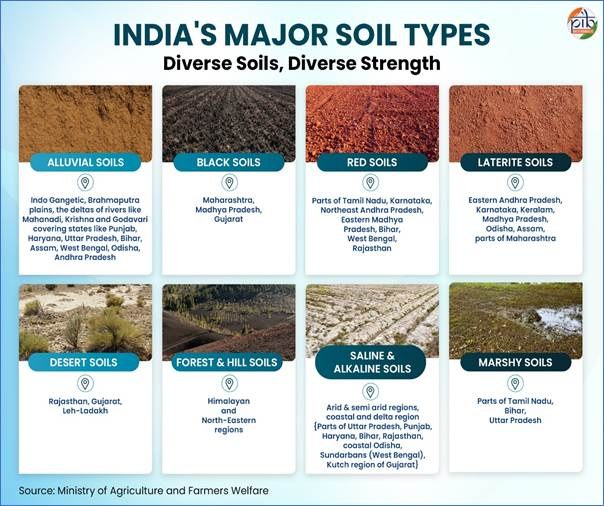
India's eight major soil types — from fertile alluvial plains to mineral-poor laterite and saline coastal soils — underpin the country's diverse cropping systems; managing each type's specific constraints is central to sustainable agriculture. (Source: Ministry of Agriculture & Farmers Welfare)
India's Soil Health Schemes — Key Programmes
- Soil Health Card (SHC) Scheme (2015): Provides farm-specific soil nutrient status and crop-wise fertiliser recommendations; 25.89 crore SHCs generated as of March 2026; 70,002 Krishi Sakhis trained for grassroots dissemination; School Soil Health Programme: 4,430 schools and 1,29,167 students enrolled (2025–26).
- National Mission for Sustainable Agriculture (NMSA, 2014–15): Under NAPCC; promotes integrated farming, rainwater conservation, and climate-resilient practices; ₹2,119.84 crore released for Rainfed Area Development covering 8.50 lakh hectares and 14.35 lakh farmers.
- National Mission on Natural Farming (NMNF, 2024): Promotes input-cost reduction, chemical-free production; 18,786 clusters covering 8.80 lakh hectares; 18.19 lakh farmers enrolled (March 2026); 33,676 trained Community Resource Persons; Bio-input Resource Centres (BRCs) supplying Beejamrit, Jeevamrit.
- Khet Bachao Abhiyan (June 2026): ICAR-led awareness campaign; 99,489 interaction meetings; 25,178 awareness camps; 6,721 training programmes; 96,227 field demonstrations; engaged 1.07 crore farmers and 4.5 crore citizens via social media.
- Nutrient Based Subsidy (NBS) Scheme: Subsidy linked to nutrient content of 28 grades of P&K fertilisers including DAP; Aadhaar-linked PoS devices for DBT; 100% neem-coated urea mandate.
Soil & Climate Change — The Carbon Farming Dimension
- Soils as carbon sinks: Soil Organic Carbon (SOC) stored through vegetation roots and soil microorganisms — higher SOC improves soil structure, moisture retention, and nutrient availability.
- National Mission for a Green India (GIM): Under NAPCC; aims to create additional carbon sink of 2.5–3.0 billion tonnes CO₂ equivalent by 2030 (India's NDC commitment); 2.29 billion tonnes already created between 2005 and 2021 (ISFR 2023).
- Carbon Credit Trading Scheme (2023): Farmers can earn tradable carbon credit certificates through Voluntary Carbon Markets (VCM); each credit = 1 metric tonne CO₂ equivalent reduced/removed; standards: Verified Carbon Standard (VCS), Gold Standard.
Building India's Digital Soil Ecosystem
- Nationwide Soil Resource Mapping (SLUSI): High-resolution soil profile maps combining satellite imagery and field observations; 29 million hectares mapped (Sep 2024) of 142 million hectare target; ₹1,076 crore allocated to 6 states (UP, MP, Rajasthan, Maharashtra, Tamil Nadu, AP).
- Digital Agriculture Mission / AgriStack: Unified farmer-land-soil data framework; 7.63 crore Farmer IDs generated (Nov 2025); 23.5 crore crop plots surveyed (Rabi 2024–25).
- Krishi Decision Support System (KDSS): AI platform integrating soil, weather, crop data for location-specific advisories; AI-enabled precision farming for site-specific water and fertiliser application.
Figure 3 — India's Digital Soil Ecosystem
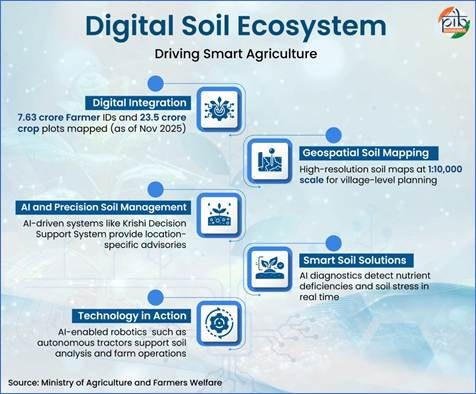
India's digital soil ecosystem integrates farmer IDs, geospatial mapping, AI-powered advisory systems, and agri-robotics into a data-driven precision agriculture platform — transforming soil management from field intuition to satellite-informed decision-making. (Source: Ministry of Agriculture & Farmers Welfare)
✎ Mains Practice Question
Soil health is no longer merely an agricultural concern but a climate, food security, and livelihood imperative. Critically examine India's institutional and technological approach to soil conservation and sustainable farming, and assess the gaps that remain. 15 marks · 250 words
Environment, Ecology & BiodiversityGeneral Studies Paper III
07
Maharashtra Approves India's First AI Bird Monitoring Centre at Thane Creek Flamingo Sanctuary
GS-III · Environment — Wetlands, Bird Conservation, Wildlife Sanctuaries, Eco-tourismPrelims + MainsTravel & Tourism News · PIB Maharashtra
Maharashtra has approved a ₹45-crore Eco-Nature Park at the Thane Creek Flamingo Sanctuary (TCFS) featuring India's first AI-powered bird detection and monitoring centre — an initiative that positions technology as a conservation tool and creates a new eco-tourism destination along one of India's most important coastal wetland ecosystems.
◈ Background & Context — Thane Creek Flamingo Sanctuary
The Thane Creek Flamingo Sanctuary (TCFS) is located along the eastern edge of Mumbai and Navi Mumbai — a rare urban-edge wildlife sanctuary that supports rich avian biodiversity within one of Asia's largest metropolitan areas.
- Protected status: Declared a Wildlife Sanctuary in 2015–16 under the Wildlife Protection Act, 1972.
- India's first flamingo sanctuary: TCFS is India's only notified flamingo sanctuary — a unique distinction given the species' significant winter congregation here.
- Avian richness: Hosts 200+ bird species annually; known for winter congregation of thousands of Greater Flamingos (Phoenicopterus roseus) and Lesser Flamingos (Phoeniconaias minor); also supports shorebirds, herons, egrets, and kingfishers.
- Flamingo biology: Flamingos obtain their distinctive pink colour from carotenoid pigments in the algae and crustaceans they filter-feed on; chicks are born grey-white. Greater Flamingo is the largest flamingo species; Lesser Flamingo is the world's most numerous flamingo species.
- Central Asian Flyway: TCFS forms an important waypoint on the Central Asian Flyway — one of the world's major migratory bird routes connecting breeding grounds in Siberia, Central Asia and Europe with wintering sites in South and Southeast Asia, the Indian subcontinent, and East Africa.
- Ecosystem type: Coastal wetland (mangroves, tidal flats, mudflats, creeks) — protected under the Coastal Regulation Zone (CRZ) Notification; critical for carbon sequestration, coastal protection, and nursery habitat for marine species.
- Ramsar relevance: While TCFS itself is not a Ramsar site, it falls within the Greater Mumbai region's coastal wetland complex; India has 85 Ramsar sites as of 2025.
Figure 4 — Flamingos at Thane Creek Flamingo Sanctuary
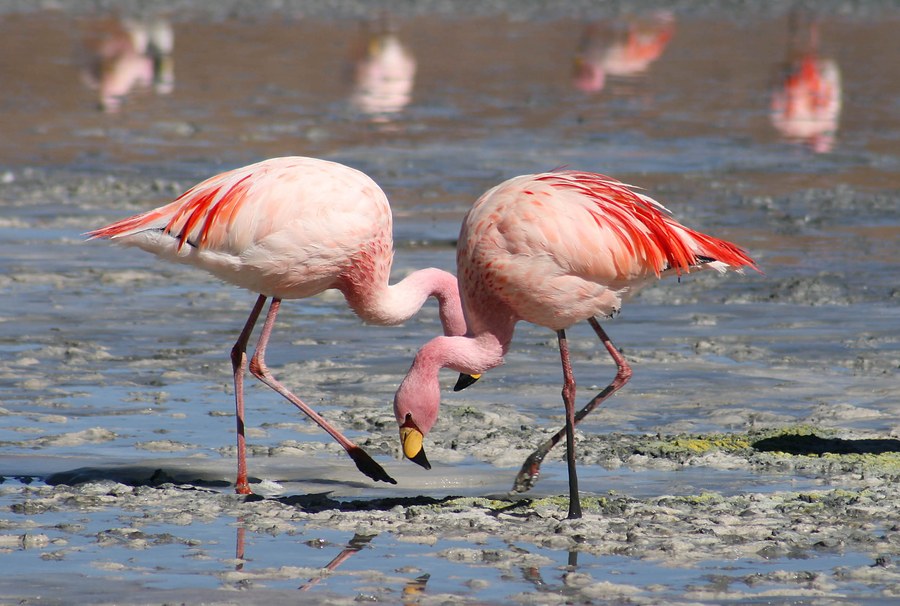
Flamingos foraging at a wetland; Thane Creek hosts thousands of Greater and Lesser Flamingos annually, making it India's most significant urban flamingo habitat and the only notified flamingo sanctuary in the country.
The ₹45-Crore AI Eco-Nature Park — Key Features
- AI bird detection centre (India's first): AI-enabled cameras and monitoring systems covering a 1.5-km stretch; real-time bird species identification and migration monitoring — replacing reliance on manual observation alone.
- Eco-tourism infrastructure: Nature trails, birdwatching facilities, educational exhibits, and interpretation centres designed around sustainable visitor experience.
- Conservation-tourism balance: Officials aim to strengthen biodiversity awareness among birdwatchers, students, and researchers without disturbing breeding or foraging behaviour.
- Maharashtra's sustainable tourism push: The project is part of the state's broader effort to promote eco-tourism alongside coastal wetland conservation — adding to Mumbai's existing flamingo boat safari and birdwatching economy.
Significance & Broader Wetland Context
- Wetland threats in India: Urban encroachment, reclamation, pollution, and invasive species remain major threats to India's coastal wetlands; TCFS faces pressures from Mumbai's rapid infrastructure expansion.
- Wildlife Protection Act 1972: Provides the legal framework for wildlife sanctuaries; Section 26A for sanctuary notification; the TCFS's gazette notification in 2015–16 gave it legal protection against development within its boundaries.
- AI in conservation: The TCFS AI centre is part of a global trend of applying computer vision and machine learning to wildlife monitoring — reducing observer bias, enabling 24/7 surveillance, and building longitudinal population databases.
✎ Mains Practice Question
Urban wildlife sanctuaries like the Thane Creek Flamingo Sanctuary face unique challenges at the intersection of conservation and development. Examine the role of technology-enabled eco-tourism in reconciling biodiversity conservation with the livelihood and recreational needs of urban populations. 10 marks · 150 words