

In-Depth News Analysis7 Items
Core TopicImportantConcise
Polity & GovernanceGS Paper II
01DPDP Act & Press Freedom — The Journalism Exemption Debate
EconomyGS Paper III
02Jio Platforms Listing — IPO & Market Capitalisation Explained03Youth Unemployment & the Neoliberal Debate04State Finances — RBI Urges Prudent Borrowing
Science & TechnologyGS Paper III
05Gene-Edited Rice, Apomixis & India’s Seed System06Carbon Capture, Utilisation & Storage (CCUS)
Environment & DisastersGS Paper I · III
07GRAP & Delhi’s Winter Air Pollution
Polity & GovernanceGeneral Studies Paper II
01
Does the Data Protection Law Constrain Journalism? Centre Says No, Signals Openness to an Explicit Exemption
ImportantGS-II · Polity — Freedom of Press, Right to Privacy, Right to InformationPrelims + MainsThe Hindu
The Union IT Minister said the Digital Personal Data Protection (DPDP) Act, 2023 does not infringe press freedom, after news publishers warned that the absence of a journalism exemption could hamper investigative reporting. Official sources indicated the law could be amended to protect journalistic activity explicitly if needed.
◈ Static Background — Three Rights in Tension
- Press freedom: part of Article 19(1)(a), subject to reasonable restrictions under Article 19(2).
- Privacy: a fundamental right under Article 21 (K.S. Puttaswamy, 2017), which also recognised that it must be balanced against other rights and legitimate interests.
- Right to information: the RTI Act, 2005; Section 44(3) of the DPDP Act amended Section 8(1)(j) of the RTI Act, removing the public-interest override for personal information — a change that transparency advocates have criticised.
- Lineage of the exemption: the Justice Srikrishna Committee’s draft (2018) and the Personal Data Protection Bill, 2019 exempted processing for journalistic purposes; the DPDP Act, 2023 does not contain such an exemption.
- Comparative practice: the EU’s GDPR (Article 85) requires member states to reconcile data protection with freedom of expression, including journalism.
- Publishers’ concerns: processing personal data without consent during investigations; obligations to erase or correct data; retention of information; and protection of confidential sources.
- Government’s position: journalistic freedom is guaranteed by the Constitution and the law does not intend to affect it; it has invited dialogue with editors.
- Analysis: constitutional protection is a shield in court, but explicit statutory language gives legal certainty to reporters before disputes arise; any exemption would need clear limits so that it is not misused by entities merely claiming to be media.
✎ Mains Practice Question
Privacy and press freedom are both constitutionally protected. Discuss how the Digital Personal Data Protection Act, 2023 should balance them, with reference to the debate on a journalism exemption. 10 marks · 150 words
EconomyGeneral Studies Paper III
02
Jio Platforms Lists as India’s Second-Most Valuable Company: Understanding IPOs, Market Capitalisation and Group Valuations
Core TopicGS-III · Economy — Capital Markets, Investment, Corporate FinancePrelims + MainsThe Indian Express
Jio Platforms, the telecom and digital arm of Reliance Industries (RIL), listed on the stock exchanges on 28 October, closing 26.6% above its issue price with a market capitalisation of about ₹13.05 lakh crore — second only to RIL. The Reliance group’s combined market value now exceeds that of the Tata and Adani groups.
◈ Key Terms Explained — From Basics
- Primary vs secondary market: in the primary market, a company issues securities to raise money; in the secondary market (stock exchanges), investors trade existing securities among themselves.
- Initial Public Offering (IPO): the first sale of a company’s shares to the public, after which it is listed on a stock exchange. An IPO can include a fresh issue (new shares; money goes to the company) and an Offer for Sale (OFS) (existing shareholders sell; money goes to them).
- Book building: the price is discovered from bids within a price band; anchor investors (large institutions) subscribe a day before the issue opens.
- Listing gain: the difference between the issue price and the price at which a share trades on listing — Jio’s first-day gain was 26.6%.
- Market capitalisation: share price × total number of shares outstanding — the stock market’s valuation of a company. It changes every trading day and is not the same as the company’s cash or assets.
- Free-float market capitalisation: counts only shares available for trading, excluding promoter and locked-in holdings; indices such as the Sensex and Nifty 50 use free-float weights.
- Promoter: the person or group in control of a company. Subsidiary: a company controlled by another (RIL holds about 64% of Jio Platforms after the IPO).
- Minimum public shareholding: listed companies must eventually have at least 25% of shares with the public; very large issuers get a longer, phased timeline.
- Regulator: the Securities and Exchange Board of India (SEBI) — statutory since 1992; IPOs are governed by the SEBI (ICDR) Regulations, 2018.
Figure 1 — India’s most valuable listed companies (market capitalisation, ₹ lakh crore, 28 October 2026)
Reliance Industries15.71Jio Platforms (new)13.05Bharti Airtel12.16HDFC Bank10.58ICICI Bank9.86TCS8.89SBI8.83
Bars drawn to scale. Chart recreated by Legacy IAS from figures reported by The Indian Express.
▤ Group Valuations
- Reliance group (RIL + Jio Platforms + Jio Financial Services): about ₹29.57 lakh crore.
- Tata group: about ₹25.1 lakh crore; Adani group: about ₹16.5 lakh crore.
- Stake dilution: RIL’s holding in Jio Platforms falls from 66.35% to about 64.41% after the IPO.
Reading the Numbers Correctly
- No double counting: RIL already owned most of Jio, so Jio’s value was partly reflected in RIL’s share price. Adding the two market caps overstates the group’s economic value — a holding-company issue.
- Sum-of-the-parts valuation: a separate listing gives investors a standalone price for Jio, which can lead them to re-rate RIL — the real test of value created.
- Notional wealth: changes in market capitalisation are paper gains that move with prices; they are not realised income.
- Wider significance: large listings deepen Indian capital markets, give domestic retail and institutional investors access to major businesses, and add weight to Indian indices in global portfolios.
- Concerns: concentration of market value in a few business groups, and governance questions around related-party transactions between listed group companies, are areas SEBI monitors.
✎ Mains Practice Question
Explain the difference between market capitalisation and the economic value created by a company. In this context, discuss the significance of large public listings for the development of India’s capital markets. 10 marks · 150 words
03
Why Are the Young Angry? A Heterodox Explanation of Youth Unemployment — and Its Critics
ImportantGS-III · Economy — Employment, Growth, Macroeconomic ThoughtGS-I · Society — YouthMains-orientedThe Hindu · Analysis
Two economists argue that youth protests across countries stem from neoliberal economic policy — reduced public spending, weaker labour bargaining power and costlier education — which, they say, has depressed demand and jobs. Youth unemployment in G7 countries is roughly twice the overall rate.
◈ Concepts to Know
- Involuntary unemployment: people willing to work at the prevailing wage cannot find jobs.
- Orthodox (mainstream) view: unemployment reflects rigid wages, inflexible labour laws or skill gaps; efficiency-wage theory explains why wages may stay above market-clearing levels.
- Keynesian view: employment depends on aggregate demand (consumption + investment + government spending); fiscal expansion can close a demand gap.
- Kalecki (1943), “Political Aspects of Full Employment”: business may resist permanent full employment because it weakens “the sack” as a disciplinary threat.
- Monetarism / neoliberalism: associated with Milton Friedman; emphasises markets, smaller government and control of inflation — influential in the U.S. and U.K. from the 1980s.
- Wage share: the share of national income going to labour; a falling wage share can reduce consumption — the “underconsumption” argument.
Figure 2 — The labour market and involuntary unemployment
Employment (L)WageDemandSupplyEABgap ABOrthodox readingWage stuck too high → cutwages, make marketsflexibleHeterodox readingLabour demand depends ondemand for goods → raiseinvestment / public spending
Same diagram, two diagnoses. Diagram drawn by Legacy IAS from the authors’ exposition.
The Authors’ Argument
- Demand, not supply: in ageing rich economies, fewer young people enter the labour force, yet youth unemployment rises — pointing to weak demand for labour.
- History: the “Golden Age” of 1945–1973 combined high growth with a rising wage share; the post-1980 shift reversed both.
- Double squeeze: slower growth plus labour-displacing technology (potentially AI) and rising education costs.
Counter-Views and Balance
- Mainstream responses: the 1970s inflation also reflected expansionary policies and wage–price spirals; market reforms coincided with gains in productivity and lower inflation in many economies; skill mismatches are documented in labour data.
- Multiple causes: youth unrest also reflects housing costs, inequality, governance and identity issues — not economics alone.
- India’s context: India is a young country; PLFS data show youth (15–29) unemployment around 10%, far above the overall rate, with high rates among educated youth — making both demand-side (investment, manufacturing jobs) and supply-side (skills, apprenticeships) policies relevant.
✎ Mains Practice Question
Is youth unemployment primarily a problem of skills or of insufficient demand for labour? Examine both perspectives with reference to India’s demographic dividend. 15 marks · 250 words
04
RBI Urges States to Borrow Prudently and Improve Quality of Spending
ConciseGS-III · Economy — Fiscal Federalism, Public DebtPrelims-orientedThe Hindu (PTI)
At the 36th Conference of State Finance Secretaries, the RBI Governor urged States to adopt prudent borrowing and cash-management strategies, improve the quality of expenditure, join the Unified Lending Interface (ULI) and use programmable CBDC for direct benefit transfers.
◈ Static Background — How States Borrow
- Article 293: States may borrow only within India; a State indebted to the Centre needs the Centre’s consent to borrow further.
- State Development Loans (SDLs): market borrowings by States, managed by the RBI as their debt manager and banker (by agreement).
- Ways and Means Advances (WMA): short-term RBI credit to cover temporary cash mismatches; overdraft beyond limits is regulated.
- Fiscal rules: every State has a Fiscal Responsibility Act; Finance Commissions recommend deficit ceilings (generally around 3% of GSDP).
- Other terms: SLBC — State Level Bankers’ Committee under the Lead Bank Scheme (1969); ULI — RBI’s platform for frictionless credit using consented data; programmable CBDC — digital rupee that can be restricted to specific uses.
✎ Mains Practice Question
Rising State debt can constrain development spending. Discuss the constitutional and institutional framework governing State borrowing in India and the measures needed to ensure fiscal sustainability. 10 marks · 150 words
Science & TechnologyGeneral Studies Paper III
05
Gene Editing and Apomixis: New Genetic Tools for India’s Rice and Wheat
Core TopicGS-III · S&T — Biotechnology; Agriculture — Seeds, Food SecurityPrelims + MainsThe Hindu · Science (op-ed by a senior scientist)
India became the first country to release genome-edited rice varieties to farmers in 2025. A leading biologist argues that newer tools such as apomixis could transform staple-crop breeding, and that India must revive fundamental plant-science research and adapt its public seed system to these changes.
◈ Static Background — From GM to Gene Editing
- Genetic modification (GM): inserting foreign genes (transgenes) from another species — e.g. Bt cotton (approved 2002, India’s only commercial GM crop) and GM mustard DMH-11 (environmental release approved 2022, contested in court).
- Gene editing (CRISPR-Cas9): precise changes to an organism’s own genes — the “molecular scissors” for which Charpentier and Doudna won the 2020 Chemistry Nobel.
- SDN categories: SDN-1 (small deletions/changes), SDN-2 (template-guided edits) and SDN-3 (inserting foreign DNA). In 2022, India exempted SDN-1 and SDN-2 plants without foreign DNA from GM biosafety rules under the Environment (Protection) Act; SDN-3 remains regulated like GM.
- Seed system: the National Seeds Corporation (1963), ICAR and State agricultural universities produce breeder seed, multiplied into foundation and certified seed; laws include the Seeds Act, 1966 and the Protection of Plant Varieties and Farmers’ Rights Act, 2001.
Figure 3 — Where gene editing sits in regulation
SDN-1Small changes,no templateExemptSDN-2Template-guidedsmall editsExemptSDN-3Foreign DNAinsertedRegulated as GMTransgenic GMe.g. Bt cotton,GM mustard, HB4 wheatGEAC approvalIndia’s gene-edited rice (2025) used SDN-1 edits; no residue of editing tools in the final seed— equivalent in outcome to conventional mutation breeding, but faster and precise
Diagram drawn by Legacy IAS from MoEFCC (2022) and DBT guidelines.
▤ India’s Genome-Edited Rice (released 2025)
- DRR Dhan 100 (Kamala): developed by ICAR-IIRR; an edit that partially reduces an enzyme degrading the hormone cytokinin, increasing grain number. Matures in about 130 days (vs 150), yields about 5.4 t/ha (~20% more), with lower water and labour use.
- Pusa DST Rice 1: developed by ICAR-IARI; deletes part of the DST gene, giving broader leaves, fewer stomata and better tolerance of salty and alkaline soils — yields 10–30% higher in such conditions.
- Public good: developed in public institutions; seeds not tied to restrictive patents or licensing.
The Next Frontier — Apomixis
- What it is: asexual seed formation that produces offspring genetically identical to the parent — so a hybrid’s vigour can be fixed and seeds saved, rather than bought every season.
- Breakthrough: “synthetic apomixis” in rice was demonstrated in 2018 by researchers at the University of California, Davis, including Indian-origin scientists; success rates have reached about 90% in rice.
- Significance for India: smallholders could get hybrid-level yields without annual seed costs; because no foreign genes are needed, regulation could be simpler.
- Global wheat: drought-tolerant HB4 wheat (a GM trait from sunflower) is grown in Argentina and was approved in the U.S. in 2024; CRISPR wheat trials are under way in Australia. India has not yet released gene-edited wheat.
Critical Assessment
- Talent pipeline: the author argues that polarised GM debates have driven young researchers away from plant science; reviving fundamental research is essential.
- Public vs private: public institutions dominate rice and wheat seed; as private firms enter, policy must protect farmers’ access and the public breeding system.
- Biosafety and trust: critics seek case-by-case evaluation, transparency and labelling; export-market acceptance also matters.
- Beyond seeds: gains depend equally on water, fertiliser and pricing policies — technology alone cannot fix rice–wheat sustainability.
✎ Mains Practice Question
India has released the world’s first genome-edited rice varieties. Distinguish gene editing from genetic modification and discuss the opportunities and regulatory challenges of new breeding technologies for India’s food security. 15 marks · 250 words
06
Carbon Capture, Utilisation and Storage: India’s Tool for Hard-to-Abate Industries
Core TopicGS-III · Environment — Climate Mitigation; S&T — Clean Technologies; EnergyPrelims + MainsPIB Backgrounder · 27 Oct 2026
With ₹20,000 crore earmarked over five years in the Union Budget 2026–27 for CCUS in power, steel, cement, refineries and chemicals, the Government is positioning Carbon Capture, Utilisation and Storage as a complement to renewables on the path to net zero by 2070.
◈ Static Background — Why CCUS?
- Hard-to-abate sectors: steel, cement, refineries, chemicals and fertilisers emit CO₂ not only from fuel but from chemical processes (e.g. limestone calcination in cement), which renewables cannot eliminate.
- Scale: emissions from these sectors and thermal power could reach nearly 2,300 million tonnes a year by 2030, according to the backgrounder.
- Existing assets: fossil sources still made up about 45% of installed power capacity in August 2026; plants built recently will run for decades.
- India’s climate pledges (“Panchamrit”, COP-26, 2021): 500 GW non-fossil capacity and 50% of energy needs from renewables by 2030, a 1 billion tonne cut in projected emissions, 45% lower emissions intensity, and net zero by 2070.
Figure 4 — The CCUS chain: from source to use or storage
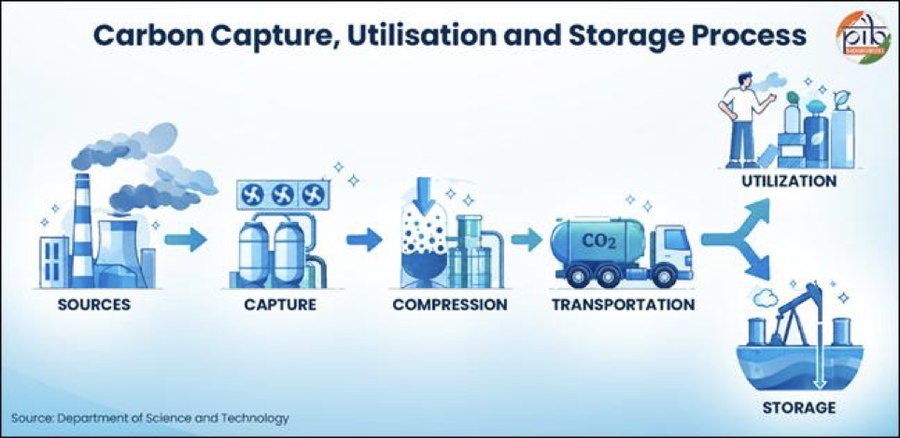
Capture separates CO₂ from flue or process gas; it is compressed, transported by pipeline or ship, then used or stored. Infographic courtesy PIB (source: Department of Science and Technology), 27 October 2026; reproduced with credit for educational use.
Utilisation and Storage Options
- Utilisation: enhanced oil recovery, urea, food and beverages, green methanol and synthetic fuels, polymers, concrete and aggregates, algae-based biofuels.
- Storage: injection into depleted oil and gas reservoirs, deep saline aquifers, and basalt formations, where CO₂ mineralises into rock — India’s Deccan basalts are seen as a potential site.
- Global precedents: Norway’s Sleipner project has stored CO₂ under the North Sea since 1996; Iceland’s CarbFix mineralises CO₂ in basalt.
- Blue hydrogen: hydrogen from natural gas or coal gasification with carbon capture — distinct from green (renewable electrolysis) and grey (no capture) hydrogen.
Figure 5 — Sectors where CCUS matters most
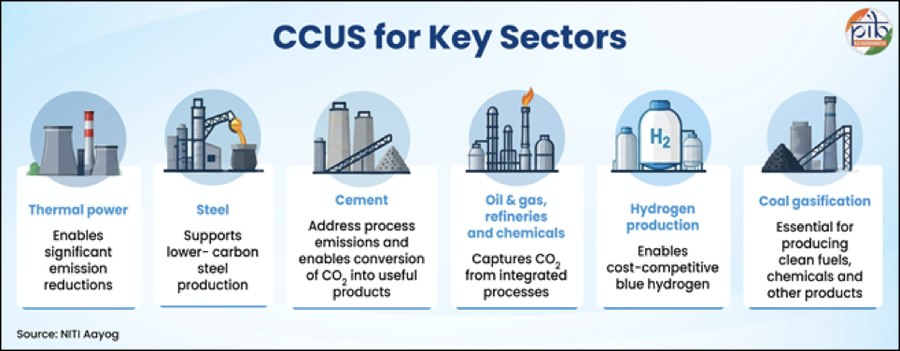
Infographic courtesy PIB (source: NITI Aayog), 27 October 2026; reproduced with credit for educational use.
▤ India’s CCUS Framework
- NITI Aayog Policy Framework (November 2022): sector-specific interventions for CCUS deployment.
- National CCUS Centres (2022): at IIT Bombay and JNCASR, Bengaluru, with DST support.
- DST CCUS R&D Roadmap (December 2025) and India’s participation in Mission Innovation.
- Budget 2026–27: ₹20,000 crore over five years for five sectors.
- Pipeline (April 2026): 3 operational carbon-capture-and-utilisation projects, 6 under execution and 16 proposed.
The Critical View
- Cost and energy penalty: capture is expensive and consumes a significant share of a plant’s energy; without a carbon price, projects struggle to be viable — the Carbon Credit Trading Scheme may help.
- Track record: globally, many CCS projects have underperformed their capture targets; utilisation often re-releases CO₂ (e.g. in urea or fuels), so only permanent storage gives lasting reductions.
- Moral hazard: critics warn CCUS could prolong fossil-fuel use and delay renewables; supporters see it as essential for unavoidable process emissions.
- Infrastructure and safety: CO₂ pipelines, storage mapping, long-term monitoring and liability rules are still to be developed in India.
✎ Mains Practice Question
Carbon Capture, Utilisation and Storage is often described as both a necessity and a distraction in climate policy. Evaluate its role in decarbonising India’s hard-to-abate sectors. 15 marks · 250 words
Environment & DisastersGeneral Studies Papers I & III
07
GRAP Stage I Invoked in Delhi-NCR: Is the Graded Response Action Plan Enough?
Core TopicGS-III · Environment — Air Pollution, Statutory BodiesGS-I · Geography — Winter MeteorologyPrelims + MainsThe Hindu · Text & Context
With Delhi’s air turning “poor”, the Commission for Air Quality Management (CAQM) invoked Stage I of the Graded Response Action Plan (GRAP). An analysis by the research body CREA finds no consistent improvement in Delhi’s winter air over four years despite GRAP.
◈ Static Background — Why Winter Air Worsens
- Meteorology: falling temperatures and calm winds lower the mixing height; temperature inversion traps pollutants near the ground across the Indo-Gangetic Plain, a landlocked basin bounded by the Himalaya.
- Sources: vehicles, road and construction dust, industry, waste burning, stubble burning in Punjab and Haryana (October–November) and festival firecrackers.
- National AQI (2014): based on up to eight pollutants; categories — Good (0–50), Satisfactory (51–100), Moderate (101–200), Poor (201–300), Very Poor (301–400), Severe (401–500).
- Laws and plans: Air (Prevention and Control of Pollution) Act, 1981; National Clean Air Programme (2019), targeting up to 40% lower particulate levels by 2025–26 in non-attainment cities.
Lineage — From EPCA to CAQM
- 1998 — EPCA: the Environment Pollution (Prevention and Control) Authority was set up under Supreme Court directions in the M.C. Mehta litigation, but lacked statutory backing.
- 2017 — GRAP notified by the MoEFCC, following Supreme Court directions for graded measures by AQI level.
- 2021 — CAQM Act: the Commission for Air Quality Management in NCR and Adjoining Areas replaced EPCA as a statutory body; its directions bind States, and it can act against non-compliant officers. GRAP has since been revised several times, including in 2022.
Figure 6 — GRAP stages and key measures (Delhi AQI)
Stage IPoor · 201–300Enforce existingnorms; no dieselgenerator sets asregular powerStage IIVery Poor · 301–400Tighter dust andtraffic controls;more publictransportStage IIISevere · 401–450Ban construction &demolition; ban BS-IIIpetrol & BS-IV dieselcars in Delhi & HVDStage IVSevere+ · >450Stricter constructionban; no truck entryexcept BS-VI, EV,CNG, LNGMeasures are cumulative and short-term — triggered by actual or forecast AQI
HVD — High Vehicle Density districts (Gurugram, Faridabad, Sonipat, Ghaziabad, Gautam Buddh Nagar). Diagram drawn by Legacy IAS from CAQM’s GRAP schedule as reported.
Figure 7 — Delhi’s mean winter AQI
300 → “Very Poor” above2802022–233042023–242852024–252952025–26Axis starts at 200 to show variation
No consistent downward trend since the 2022 GRAP revision. Chart recreated by Legacy IAS from CREA’s analysis (axis truncated at 200).
- New this winter: a Delhi government notification (June 2026) bans non-Delhi-registered vehicles below BS-VI from 1 November to 31 January (EVs, CNG and emergency vehicles exempt) and doubles parking charges from 1 November to 28 February — irrespective of AQI. GRAP prevails in case of conflict.
- Why GRAP falls short: it is an emergency, short-term tool; meteorology dominates day-to-day AQI, and regional sources (crop residue, industry, power plants) lie outside Delhi.
- What would work: airshed-level planning across the Indo-Gangetic Plain, cleaner public transport and electrification, enforcement on dust and waste burning, crop-residue alternatives (in-situ management, ex-situ use in power plants), and year-round action rather than winter crisis management.
✎ Mains Practice Question
The Graded Response Action Plan manages air pollution episodes but does not reduce pollution structurally. Critically examine this statement and suggest a long-term strategy for clean air in the Indo-Gangetic Plain. 15 marks · 250 words