

In-Depth News Analysis7 Items
Core TopicImportantConcise
Polity & GovernanceGS Paper II
01Ladakh: Proposed Article 371-K02Judicial Officers & High Court Elevation03SC on Women’s Safety in Delhi-NCR
Internal SecurityGS Paper III
04AFSPA Extended in Manipur, Nagaland & Arunachal
Health, Society & GenderGS Paper I & II
05NFHS-6: Contraception & the Gender Gap
Economy & InfrastructureGS Paper III
06India’s First LNG Train & Kavach Rollout
Ethics (GS-IV)GS Paper IV
07Case Study: Shared Responsibility in Family Planning
Polity & GovernanceGeneral Studies Paper II
01
A New Governance Model for Ladakh: Sixth Schedule Demand vs the Proposed Article 371-K
GS-II · Polity — Federalism, Union Territories, Special Provisions, Scheduled AreasPrelims + MainsThe Hindu · Explainer
Ladakh’s groups have long demanded Sixth Schedule status. The Ministry of Home Affairs has instead proposed inserting a new Article 371-K to give the Union Territory a directly elected legislative body — a sui generis model that raises new constitutional questions.
◈ Static Background — How Ladakh Got Here
- J&K Reorganisation Act, 2019: split the State into two UTs from 31 October 2019 — J&K with a legislature and Ladakh without one.
- UT administration (Article 239): a UT is governed by the President through an Administrator — in Ladakh, a Lieutenant Governor.
- Local bodies: the Ladakh Autonomous Hill Development Councils — Leh (1995) and Kargil (2003) — handle local development, but have no legislative powers.
- Population profile: over 90% of Ladakh’s people are Scheduled Tribes (Census 2011), with distinct languages and customary practices.
- Local concerns: protection of land, jobs, culture and language, and a meaningful political voice.
Figure 1 — The Union Territories of Jammu & Kashmir and Ladakh
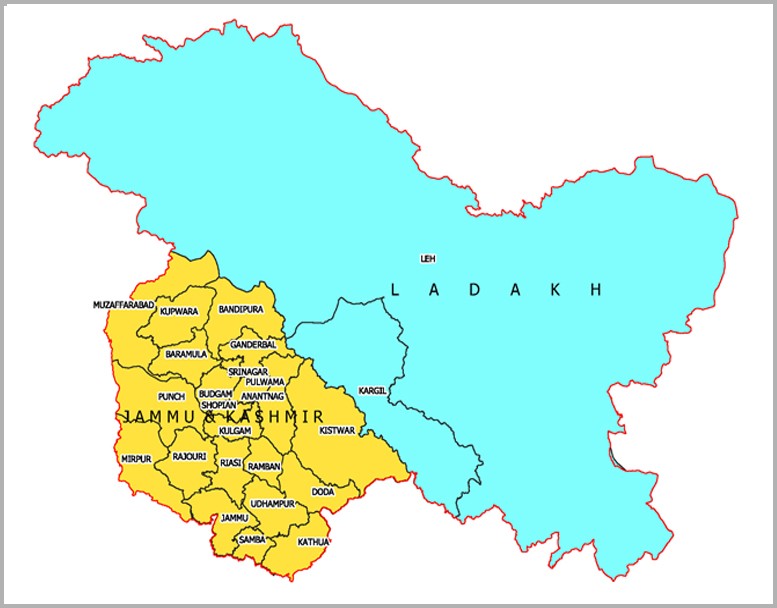
Ladakh (blue) comprises the Leh and Kargil districts and borders China and Pakistan-occupied areas — hence the Centre’s security concerns. Map supplied; depicts boundaries as per India’s official position. Reproduced for educational use.
◈ Static Background — Sixth Schedule and Article 371
- Sixth Schedule (Articles 244(2) and 275(1)): applies only to tribal areas of Assam, Meghalaya, Tripura and Mizoram — mostly “Excluded” or “Partially Excluded” areas of colonial Assam.
- Autonomous District Councils: up to 30 members (up to 26 elected, 4 nominated by the Governor); can make laws on land, forests, inheritance, marriage and customs. There are 10 such councils today.
- Governor’s role: can create, merge or alter Autonomous Districts by notification.
- Fifth Schedule (Article 244(1)): Scheduled Areas in other States, with a Tribes Advisory Council but no legislative autonomy.
- Article 371 series (371 to 371-J): special provisions for particular States — e.g., 371-A (Nagaland), 371-G (Mizoram), 371-J (Hyderabad–Karnataka region, 98th Amendment, 2012).
- UT precedents: Article 239A (legislature for Puducherry, 1962) and Article 239AA (Delhi, 69th Amendment, 1991).
Figure 2 — Three models for Ladakh
Current modelsince 2019• UT without legislature• Governed by the LG(Article 239)• Hill Councils in Lehand Kargil — no law-making powerWeak local voiceSixth Schedulelocal demand• Autonomous DistrictCouncils (Art. 244(2))• Laws on land, forests,customs, inheritance• So far used only infour north-eastern StatesCentre: security concernsArticle 371-KCentre’s proposal• Directly electedlegislative body• Placed above the HillCouncils; panchayats stay• LG’s role and financialpowers not yet definedNeeds amendment (Art. 368)
The proposal tries to give representation without the territorial autonomy of the Sixth Schedule.
Is the proposal constitutionally valid?
- Flexible federalism: the Supreme Court has described Indian federalism as flexible — federal in normal times, unitary in an emergency (State of Rajasthan v. Union of India, 1977).
- Precedent: Parliament has already created special arrangements for UTs through Articles 239A and 239AA, so a tailored model for Ladakh is permissible.
- Procedure: inserting Article 371-K needs a constitutional amendment under Article 368 by a special majority of Parliament.
Open questions
- Division of power: what will the elected body control, and what remains with the LG?
- Money: without financial autonomy, an elected body may have responsibility without resources.
- Protection of land and culture: will the body be able to legislate on land transfer and customary law — the core of the Sixth Schedule demand?
- Acceptance: the model will succeed only if Ladakh’s Leh and Kargil groups see it as meeting their concerns.
✎ Mains Practice Question
Examine whether the Sixth Schedule or a special provision under a new Article 371-K is better suited to address Ladakh’s demands for cultural protection and political representation, keeping in view its strategic location. 15 marks · 250 words
02
From Trial Courts to High Courts: Why Few Judicial Officers Make It to the Higher Bench
GS-II · Polity — Judiciary: Appointments, Subordinate Courts, CollegiumPrelims + MainsThe Hindu
The elevation of seven district judges to the Delhi High Court has drawn attention to a long-standing imbalance: judges promoted from the subordinate judiciary hold only about one-fifth of High Court posts, despite decades of trial experience.
◈ Static Background — Constitutional Framework
- Article 217: a High Court judge must have held judicial office for 10 years or been an advocate of a High Court for 10 years — two streams, Bar and Service, with no fixed ratio.
- Convention: about two-thirds from the Bar and one-third from the judicial service.
- Article 233: district judges are appointed by the Governor in consultation with the High Court.
- Article 235: the High Court controls the subordinate courts.
- Article 50 (DPSP): separation of the judiciary from the executive — the basis for independent State judicial services.
- Collegium system: from the Second Judges Case (1993) and Third Judges Case (1998); the NJAC was struck down in 2015.
- Retirement age: 62 for High Court judges and 65 for Supreme Court judges.
Figure 3 — Share of High Court judges drawn from the judicial service (%)
One-third norm (33.3%)Tripura40%Himachal Pradesh35.29%Delhi31.67%All High Courts*~20.9%Bombay17.02%Odisha15.15%Telangana11.90%Uttarakhand9.09%Chhattisgarh9.09%Sikkim0%
*All High Courts: 233 service judges against a sanctioned strength of 1,114. Only three High Courts meet or approach the one-third norm.
Why the bottleneck exists
- Slow climb: officers join as civil judges in their late twenties; about 10 years to become senior civil judge and another decade to become district judge.
- Late elevation: most enter the zone of consideration in their late fifties, leaving only a few years before retirement at 62.
- Supreme Court: no sitting Supreme Court judge today began in the trial judiciary; the last was appointed in August 2021 and retired in June 2025.
- Colonial legacy: trial courts were once run by executive officers; independent State judicial services developed only after the Constitution separated the judiciary from the executive.
- Supreme Court’s 2023 order: declined to fix a 50% service quota, but asked High Courts to recommend service-cadre names before vacancies arise.
Balanced view
- For more service judges: long records of judgments, integrity and performance are already available, making appointments faster; better career prospects would attract talent to trial courts.
- For the Bar stream: senior advocates bring constitutional and appellate experience and wider perspectives, and serve longer tenures.
- Possible reforms: earlier recommendation of eligible officers; a transparent ratio in the Memorandum of Procedure; raising the High Court retirement age to 65 (proposed in the 114th Amendment Bill, 2010, which lapsed); an All India Judicial Service under Article 312.
✎ Mains Practice Question
The under-representation of judicial officers in the High Courts affects both the morale of the subordinate judiciary and the quality of justice. Discuss the reasons and suggest reforms in the appointment process. 15 marks · 250 words
03
Supreme Court Takes Suo Motu Cognisance of Lapses in Women’s Safety in Delhi-NCR
GS-II · Polity — Fundamental Rights, Judicial Activism; Governance — PolicingGS-I · Society — Women’s IssuesPrelims + MainsThe Hindu
After a series of sexual assaults on minors and women in parks, buses and public spaces, the Supreme Court held that the right to live free from the fear of violence is part of Article 21, and directed the Delhi Police to act within four weeks.
◈ Static Background
- Suo motu cognisance: the court acts on its own, without a formal petition — rooted in its powers under Article 32 and Article 142 (complete justice), and the tradition of Public Interest Litigation.
- Article 21: the right to life includes the right to live with dignity (Francis Coralie Mullin, 1981).
- Vishaka v. State of Rajasthan (1997): guidelines on sexual harassment at work, later the POSH Act, 2013.
- Nirbhaya Fund (2013): finances women’s safety projects, including the Safe City Projects in eight cities, one of which is Delhi.
- Police: “police” and “public order” are State List subjects, but Delhi Police reports to the Union Ministry of Home Affairs.
What the Court directed
- Identify vulnerable pockets and step up patrolling.
- Audit lighting and CCTV coverage in public spaces within four weeks.
- File a detailed response on safety measures in parks, educational institutions and places frequented by women and children.
- Public spaces such as parks, buses and Metro stations must not become “zones of high risk” because of poor lighting and lax patrolling.
Significance and limits
- Right to safe public space: links safety to the fundamental right to life, not just to crime control.
- Prevention over punishment: focuses on environmental design — lighting, visibility, patrols — rather than only on harsher penalties.
- Limits: courts can direct but not run policing; lasting change needs police staffing, women personnel, last-mile transport and faster trials.
✎ Mains Practice Question
“Safety in public spaces is a precondition for women’s equal citizenship.” In the light of recent judicial directions, discuss the preventive measures needed to make Indian cities safer for women. 10 marks · 150 words
Internal SecurityGeneral Studies Paper III
04
AFSPA Extended for Six More Months in Parts of Manipur, Nagaland and Arunachal Pradesh
GS-III · Internal Security — Security Challenges in Border Areas, Role of Security ForcesGS-II · Fundamental RightsPrelims + MainsThe Indian Express · The Times of India
After reviewing the law-and-order situation, the Ministry of Home Affairs has extended the Armed Forces (Special Powers) Act, 1958, in specified areas of three north-eastern States for six months from 1 October 2026, to 31 March 2027, keeping the status quo on areas covered.
▤ Where AFSPA Now Applies
- Manipur: the whole State is “disturbed” except areas under 13 police stations in five districts.
- Nagaland: nine districts — Dimapur, Niuland, Chumoukedima, Mon, Kiphire, Noklak, Phek, Peren and Meluri.
- Arunachal Pradesh: certain districts, largely in the east bordering Myanmar and Assam.
- Related: the commander-in-chief of the banned United Kuki National Army was arrested in Aizawl in a joint operation by the Assam Rifles and the Subsidiary Intelligence Bureau.
◈ Static Background — AFSPA from Basics
- Origin: modelled on the Armed Forces Special Powers Ordinance, 1942; enacted in 1958 to deal with the Naga insurgency.
- Section 3: an area may be declared “disturbed” by the Centre or the Governor/Administrator; after 1972, the Centre too can declare it.
- Section 4: officers may fire after due warning, even causing death, against those breaking the law; arrest without warrant; and enter and search without a warrant.
- Section 6: no prosecution of personnel without the Centre’s sanction.
- J&K: covered under a separate AFSPA (J&K), 1990.
- Withdrawn: from Tripura (2015) and Meghalaya (2018); areas were cut back significantly in Assam, Nagaland and Manipur from April 2022.
Figure 4 — How AFSPA works, and the checks on it
Section 3Area declared “disturbed”by Centre or GovernorReviewed every 6 monthsSection 4Fire after warningArrest without warrantSearch without warrantSection 6No prosecution withoutthe Centre’s sanctionJudicial and expert checks• Naga People’s Movement (1997): upheld the Act; minimum force; Do’s and Don’ts binding• Jeevan Reddy Committee (2005): recommended repeal and folding powers into the UAPA• EEVFAM v. Union of India (2016): no absolute immunity — excessive force must be investigated
AFSPA is a law of exception: wide powers, balanced by periodic review and judicial scrutiny.
Balanced view
- Security case: continued ethnic violence in Manipur, armed groups operating across the porous Myanmar border, and the need to protect forces operating in hostile terrain.
- Rights case: allegations of extra-judicial killings and alienation of local people; a law meant to be temporary has lasted over six decades.
- Middle path: phased withdrawal tied to measurable improvement, stronger State police, time-bound decisions on prosecution sanction, and political dialogue with armed groups.
✎ Mains Practice Question
“The Armed Forces (Special Powers) Act has outlived its purpose in parts of the North-East, yet cannot be withdrawn everywhere.” Critically examine, suggesting a roadmap for its phased withdrawal. 15 marks · 250 words
Health, Society & GenderGeneral Studies Papers I & II
05
Family Planning Remains a Woman’s Burden: NFHS-6 Data and WHO’s Push for Male Contraceptives
GS-II · Health — Population Policy, Family PlanningGS-I · Society — Population, Women’s IssuesPrelims + MainsThe Hindu · Data Point
The WHO has issued new guidelines to widen contraceptive choices and, for the first time, a Target Product Profile for reversible male contraceptives. The timing matters for India, where NFHS-6 (2023–24) shows that men carry almost none of the contraceptive responsibility.
◈ Static Background — India’s Population Policy Journey
- 1952: India became the first country to launch a national family planning programme.
- 1975–77 (Emergency): coercive sterilisation drives — heavily targeting men — created a lasting backlash against vasectomy.
- 1996: shift to a target-free approach; ICPD, Cairo (1994) placed reproductive rights and choice at the centre.
- National Population Policy, 2000: aimed at replacement-level fertility (TFR 2.1) and long-term population stabilisation.
- Mission Parivar Vikas (2016): expanded access to contraceptives in high-fertility districts.
- NFHS: conducted by the Ministry of Health and Family Welfare with the International Institute for Population Sciences (IIPS), Mumbai as nodal agency.
- Terms: TFR = average children per woman; unmet need = women who wish to avoid pregnancy but use no method.
69.1%
Married women (15–49) using any method (66.7% in NFHS-5)
36.5%
Female sterilisation (37.9% in NFHS-5)
0.5%
Male sterilisation (0.3% in NFHS-5)
+6 pp
Rise in traditional methods — the largest change
Figure 5 — Contraceptive use among currently married women aged 15–49 (%)
NFHS-5 (2019–21)NFHS-6 (2023–24)Any method66.769.1Modern methods56.452.7Traditional methods*10.316.4Female sterilisation37.936.5Male sterilisation0.30.5
*Traditional = any method − modern method (rhythm/fertility awareness, withdrawal). Use has risen, but the shift is towards less reliable methods, and male sterilisation barely registers. Data: NFHS-5, NFHS-6.
Three decades of imbalance
Female sterilisation rose from 27.4% in NFHS-1 (1992–93) and has stayed at about 36–38% since NFHS-3. Male sterilisation fell from about 3.5% to just 0.5% over the same period.
Figure 6 — Female vs male sterilisation, NFHS-1 to NFHS-6
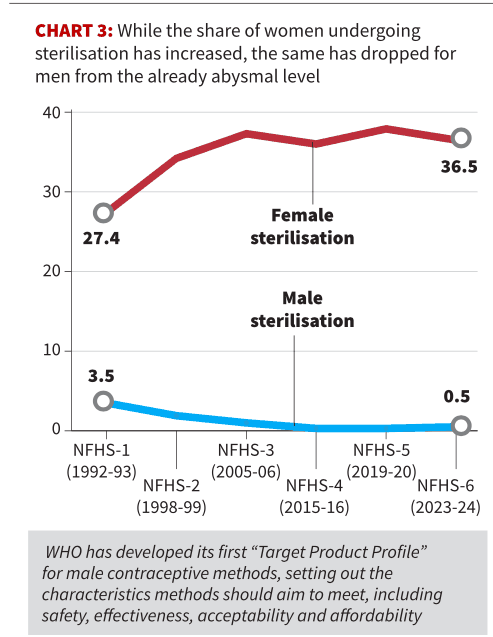
The gap has widened over 30 years. Image courtesy The Hindu Data Team; data: NFHS. Reproduced with credit for educational use.
State-wise picture
Male sterilisation rose in 22 States between NFHS-5 and NFHS-6, but only Telangana (2% → 3.6%) gained more than one percentage point. Even States that reached low fertility early did not break the pattern.
Figure 7 — The ten States with the largest rise in male sterilisation
Even the “top gainers” remain below 2%, except Telangana. Image courtesy The Hindu Data Team; data: NFHS. Reproduced with credit for educational use.
Why the gap persists
- Social norms: contraception is seen as a woman’s responsibility; myths link vasectomy to loss of strength or masculinity.
- Historical memory: the Emergency-era drives left deep distrust of male sterilisation.
- Programme design: incentives and camps have focused on tubectomy; few male health workers promote vasectomy.
- Medical fact: vasectomy — especially no-scalpel vasectomy — is simpler, done under local anaesthesia, and has fewer complications than female sterilisation.
Way forward
- Use the WHO Target Product Profile (safety, effectiveness, acceptability, affordability) to back Indian research on male methods such as RISUG.
- Counselling for couples, male outreach workers and awareness campaigns to counter myths.
- Expand reversible options for both partners, so the rise in traditional methods does not raise unintended pregnancies.
✎ Mains Practice Question
India has achieved replacement-level fertility, but the burden of contraception continues to fall almost entirely on women. Analyse the reasons and suggest measures to promote shared responsibility in family planning. 15 marks · 250 words
Economy & InfrastructureGeneral Studies Paper III
06
India’s First LNG-Powered Train and a ₹1,542-Crore Railway Package in Gujarat
GS-III · Infrastructure — Railways; Energy; Environment — EmissionsPrelims + MainsThe Times of India
A Union Minister flagged off India’s first LNG-powered train at Sabarmati, Gujarat, along with projects worth over ₹1,542 crore on safety, line capacity and freight.
◈ Static Background
- LNG (Liquefied Natural Gas): natural gas (mainly methane) cooled to about −162°C, shrinking to about 1/600th of its volume. It burns cleaner than diesel, with lower CO₂, NOx and particulate emissions.
- Railway electrification: Indian Railways has electrified nearly its entire broad-gauge network and targets net-zero emissions by 2030; diesel now serves mainly non-electrified and special services.
- Kavach: an indigenous Automatic Train Protection system developed by RDSO, certified to Safety Integrity Level 4 (SIL-4); it brakes automatically if the driver fails to act, preventing collisions and over-speeding.
- Automatic block signalling: divides a line into short sections with automatic signals, letting more trains run safely on the same track.
- WAG-12: a 12,000 HP electric freight locomotive built at Madhepura, Bihar, under Make in India.
~40%
Diesel that LNG can replace in the dual-fuel system
404 km
Kavach in Ahmedabad division (₹411 cr)
122.57 km
Automatic block signalling (₹118.83 cr)
300
WAG-12 locos served by new ₹700-cr shed
The package in brief
- LNG train: two 1,400 HP Driving Power Cars at the Sabarmati depot converted to a diesel–LNG dual-fuel system.
- Kavach: 157 km of Ahmedabad–Palanpur and 247 km of Ahmedabad–Samakhiyali.
- Line doubling: Sabarmati–Sarkhej (21 km, ₹313.27 crore) by March 2028, improving access towards the Dholera industrial region.
Assessment
- Transition fuel: LNG cuts emissions and cost on routes that cannot yet be electrified, but it is still a fossil fuel and largely imported.
- Safety first: Kavach coverage is still a small fraction of India’s network of over 68,000 route km; faster rollout is the real priority after recent accidents.
- Freight share: high-power locomotives and doubling help Railways regain freight share lost to roads.
✎ Mains Practice Question
Discuss how technology adoption — from alternative fuels to automatic train protection — can help Indian Railways meet its twin goals of safety and net-zero emissions. 10 marks · 150 words
Ethics, Integrity & AptitudeGeneral Studies Paper IV
07
Case Study: Promoting Vasectomy in a District Where No Man Opts for It
GS-IV · Gender Justice, Persuasion, Public Service ValuesMains-orientedThe Hindu · Data Point
As a District Health Officer, you are told to raise male participation in family planning. Almost all sterilisations in your district are tubectomies; men cite myths about weakness, and some local leaders oppose the campaign.
Ethical issues
- Gender justice: women bear the health risks of contraception almost alone.
- Autonomy vs targets: pressure to show numbers must not slide into coercion, as in the Emergency era.
- Informed consent: people must get accurate, complete information, including on reversibility and side-effects.
▤ Ethics toolkit
- Values: empathy, integrity, respect for autonomy, non-maleficence.
- Tools of persuasion: trusted local voices (men who have had the procedure), couple counselling, doctors’ outreach — not incentives that distort choice.
- Thinkers: Amartya Sen — development as expanding capabilities and freedoms; Kant — treat people as ends, never merely as means to a target.
✎ Mains Practice Question
As a District Health Officer tasked with increasing male participation in family planning, how would you balance programme targets with individual autonomy and informed consent? Identify the ethical issues and outline your strategy. 20 marks · 250 words