

In-Depth News Analysis6 Items
Core TopicImportantConcise
Polity & JudiciaryGS Paper II
01Collegium System — Transparency & Reform
International RelationsGS Paper II
0213th ADMM-Plus — India, ASEAN & Regional Security
Agriculture & NutritionGS Paper III
03Kufri Jamunia — Biofortified Purple Potato
Science & Technology — SpaceGS Paper III
04India’s New-Age Space Technologies
Geography, Environment & WaterGS Paper I · II · III
05Siang Upper Multipurpose Project — Strategy vs Livelihoods
Internal SecurityGS Paper III
06Punjab’s Drug Crisis — Geography & Economics
Polity & JudiciaryGeneral Studies Paper II
01
Concerns Over the Collegium: How Judges Are Appointed, and the Case for Reform
Core TopicGS-II · Polity — Judiciary, Appointments, Separation of PowersPrelims + MainsThe Hindu · Explainer
A retired Supreme Court judge has said that a former Chief Justice of India may have discussed proposed names for judgeship with the Union Government before the collegium met — describing it as seeking the executive’s “pre-approval”. The remark has revived debate on the collegium system and on making judicial appointments more transparent.
◈ Static Background — The Constitutional Text
- Article 124(2): Supreme Court judges are appointed by the President after consultation with the CJI (and such other judges as the President deems necessary).
- Article 217: High Court judges are appointed by the President after consulting the CJI, the Governor and the Chief Justice of the High Court.
- Article 222: transfer of High Court judges, after consulting the CJI.
- Why consultation: to protect judicial independence and ensure professional merit — judges are best placed to assess legal ability.
- The word that changed everything: the courts’ interpretation of “consultation” — whether it means advice the executive may disregard, or concurrence — is at the heart of the collegium story.
Figure 1 — The Judges cases: how “consultation” became “collegium”
1981First Judges(S.P. Gupta)Executive primacy1993Second Judges(SC AoR Assn.)Judicial primacy;collegium born1998Third Judges(Presidential reference)CJI + 4 senior-most201499th AmendmentNJAC created(Art 124A)2015Fourth Judges(NJAC case)NJAC struck downCollegium today: CJI + 4 senior-most judges (Supreme Court appointments);CJI + 2 senior-most judges (High Court appointments)Government may return a name once; if the collegium reiterates it, the appointment must be made
Diagram drawn by Legacy IAS from the Supreme Court’s judgments as summarised in the explainer.
▤ How the Process Works
- Memorandum of Procedure (MoP): prepared by the Union Law Ministry following the Second and Third Judges cases; the collegium initiates proposals and sends them to the Centre.
- Return and reiteration: the Centre may return a recommendation with objections; if the collegium reiterates it, the appointment should be made.
- NJAC (2014–15): the 99th Amendment proposed a National Judicial Appointments Commission of the CJI, two senior judges, the Union Law Minister and two eminent persons; the Supreme Court struck it down in 2015 as violating the basic structure (judicial independence).
- Revised MoP: agreed in principle after 2015 to improve transparency, but still not finalised after 11 years because of disagreements.
Comparative Practice
- United States: federal Supreme Court judges are nominated by the President and confirmed by the Senate.
- United Kingdom: an independent Judicial Appointments Commission (15 commissioners from the judiciary, legal profession and public) selects judges; UK Supreme Court appointments use a separate selection commission.
- South Africa: a Judicial Service Commission of 23 members — judiciary, legislature, executive, lawyers and academia — recommends names to the President.
- India’s distinctiveness: the collegium — judges appointing judges — has no close parallel in other major democracies.
Critical Assessment
- Strength: the collegium has insulated appointments from political favouritism.
- Weaknesses: opacity (criteria and reasons are rarely public), lack of accountability, delays, and allegations that relatives of judges are favoured.
- The present concern: informal prior consultation with the executive, if it occurred, would blur the formal process and could compromise the very independence the collegium was designed to protect.
- Reform options: in the short term, a finalised MoP with published criteria and timelines; in the long term, a broader commission — including legislature, Bar and academia — with a judicial veto to protect independence, as the explainer suggests.
✎ Mains Practice Question
The collegium system has preserved judicial independence but at the cost of transparency and accountability. Critically examine this statement and suggest reforms to the process of judicial appointments in India. 15 marks · 250 words
International RelationsGeneral Studies Paper II
02
At the 13th ADMM-Plus, India Offers Counter-Terrorism Expertise and Proposes an ASEAN–India Defence “Youth Bridge”
ImportantGS-II · IR — Regional Groupings (ASEAN), India’s Act East PolicyGS-III · Security — Terrorism, Maritime SecurityPrelims + MainsThe Hindu
At the 13th ASEAN Defence Ministers’ Meeting-Plus in Cebu, Philippines, India’s Defence Minister offered to share India’s counter-terrorism experience through exercises, training and intelligence sharing, proposed a defence “Youth Bridge” with ASEAN, and highlighted 2026 as the ASEAN–India Year of Maritime Cooperation.
Figure 2 — ASEAN members and when they joined
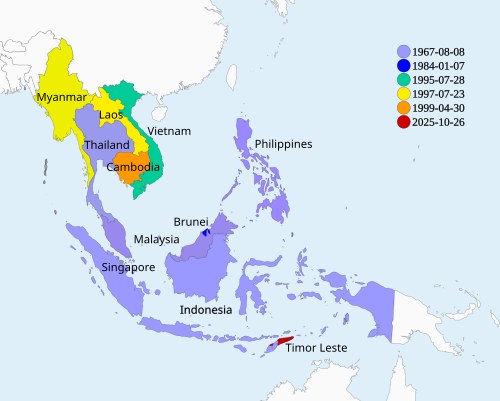
Timor-Leste became the 11th member in October 2025. Schematic map; not to scale. Map reproduced with credit for educational use.
◈ Static Background — ASEAN and Its Defence Track
- ASEAN: founded by the Bangkok Declaration on 8 August 1967 by Indonesia, Malaysia, the Philippines, Singapore and Thailand; joined by Brunei (1984), Vietnam (1995), Laos and Myanmar (1997), Cambodia (1999) and Timor-Leste (2025). Secretariat in Jakarta. The Philippines chairs ASEAN in 2026.
- ADMM (2006): the ASEAN Defence Ministers’ Meeting — the highest defence consultative mechanism in ASEAN.
- ADMM-Plus (2010, Hanoi): ASEAN defence ministers plus eight Dialogue Partners — Australia, China, India, Japan, New Zealand, the Republic of Korea, Russia and the United States. Practical cooperation runs through Experts’ Working Groups on areas such as counter-terrorism, maritime security, HADR, peacekeeping and cyber security.
- India and ASEAN: “Look East” (1991) became “Act East” (2014); relations upgraded to a Comprehensive Strategic Partnership in 2022.
▤ India at the 13th ADMM-Plus
- Counter-terrorism: India is co-chairing the Experts’ Working Group on Counter-Terrorism with Malaysia for 2024–2027; it offered “battle-tested” operational experience, citing recent operations against cross-border terrorism.
- Youth Bridge: a proposed defence initiative for institutional people-to-people links, digital innovation and capacity building for young people.
- Maritime: 2026 designated the ASEAN–India Year of Maritime Cooperation; the second ASEAN–India Maritime Exercise held; commitment to freedom of navigation and UNCLOS.
Why It Matters
- ASEAN centrality: India supports ASEAN as the hub of regional architecture in the Indo-Pacific; ADMM-Plus is one of the few forums where all major powers meet on defence.
- Maritime stakes: the South China Sea disputes and sea-lane security affect India’s trade, which largely passes through Southeast Asian waters.
- Limits: ADMM-Plus works by consensus and is consultative, not an alliance; divergent interests among members — especially on China — constrain collective positions.
✎ Mains Practice Question
Discuss the significance of ASEAN-led security forums such as the ADMM-Plus for India’s Act East Policy and its maritime interests in the Indo-Pacific. 10 marks · 150 words
Agriculture & NutritionGeneral Studies Paper III
03
Can the Purple-Fleshed Kufri Jamunia Potato Help Tackle Hidden Hunger?
ImportantGS-III · Agriculture — Crop Varieties, Food Security; S&T — BiotechnologyGS-II · Health — NutritionPrelims + MainsThe Hindu · Science
The ICAR–Central Potato Research Institute (CPRI) has developed Kufri Jamunia, a purple-skinned, purple-fleshed potato with more vitamin C, iron, zinc and anthocyanins than ordinary potatoes. The Government is promoting it against hidden hunger, but its yield, disease resistance and market acceptance remain open questions.
◈ Key Terms Explained — From Basics
- Hidden hunger: deficiency of micronutrients (iron, zinc, vitamin A, iodine) even when calorie intake is adequate.
- Fortification vs biofortification: fortification adds nutrients during processing (e.g. iodised salt, fortified rice); biofortification breeds crops that accumulate more nutrients as they grow — through conventional breeding, as in Kufri Jamunia, or biotechnology.
- Anthocyanins: natural purple-red pigments with antioxidant properties, also found in jamun and blueberries — hence the variety’s name.
- Marketable yield: the portion of the harvest that can actually be sold (excluding damaged or undersized tubers) — what determines farm income.
- Price premium: the extra price a farmer needs over a standard variety to earn the same revenue when yields are lower.
Figure 3 — Key features of Kufri Jamunia
Recommended for the North Indian plains; matures in about 90 days. Infographic courtesy PIB / Ministry of Agriculture and Farmers Welfare; reproduced with credit for educational use.
▤ Kufri Jamunia vs Regular Potato (per 100 g, as reported)
- Vitamin C: about 42.75 mg vs 23.15 mg.
- Iron: about 3.22 mg vs 0.57 mg; Zinc: about 2.28 mg vs 0.28 mg.
- Anthocyanins: about 42.05 mg; carotenoids vary widely by location in trials.
- Development: cross of a high-vitamin-C line and a purple-fleshed line (2015); multi-location trials 2021–23; notified in November 2024.
- Yield: about 32 t/ha on average in multi-location trials; marketable yield 29.19 t/ha vs 33.48 t/ha for another coloured variety, Kufri Neelkanth.
Questions That Remain
- Delivery: potatoes are eaten less consistently than rice or salt; nutrient retention depends on cooking — steaming preserves more than frying — and on how well iron and zinc are absorbed.
- Disease: moderately resistant to late blight (Phytophthora infestans, the cause of the 1840s Irish famine) in the lab, but susceptible in the field — fungicide is recommended.
- Economics: with lower marketable yield, farmers may need a premium of about 15% to match revenue; seed already makes up a large share of potato production costs.
- Consumers: acceptance depends on appearance, taste, awareness and price — the CPRI’s taste test of 64 people is too small to generalise.
- Context: India is the world’s second-largest potato producer; biofortified varieties of rice, wheat, pearl millet and other crops are also being promoted.
✎ Mains Practice Question
Distinguish between food fortification and biofortification. Discuss the factors that determine whether a biofortified crop variety can make a real difference to hidden hunger in India. 10 marks · 150 words
Science & Technology — SpaceGeneral Studies Paper III
04
India’s New-Age Space Technologies: From Reusable Rockets to In-Orbit Docking
Core TopicGS-III · S&T — Space Technology, Indigenisation; Economy — Space SectorPrelims + MainsPIB Backgrounder · 28 Oct 2026; The Indian Express
A PIB backgrounder outlines the technologies behind India’s next phase in space — a heavy-lift reusable launcher, electric propulsion, docking, advanced navigation and communication satellites, and new Earth observation tools — as the space economy targets $44 billion by 2033.
◈ Static Background — India’s Space Journey
- 1962: INCOSPAR set up under Vikram Sarabhai; first sounding rocket from Thumba, Kerala on 21 November 1963.
- 1969: ISRO formed on 15 August; brought under the Department of Space (1972).
- Reforms: NSIL (2019) as commercial arm; IN-SPACe (2020) to authorise and promote private actors; Indian Space Policy, 2023; liberalised FDI norms for the sector (2024).
- Key terms: LEO — Low Earth Orbit (up to ~2,000 km); GTO — geosynchronous transfer orbit; expendable vs reusable launchers; specific impulse — a measure of propulsion efficiency.
Figure 4 — The five technology pillars
Infographic courtesy PIB, 28 October 2026; reproduced with credit for educational use.
▤ Technologies at a Glance
- Next Generation Launch Vehicle (NGLV): approved September 2024, outlay ₹8,240 crore; up to 30 tonnes to LEO — about three times LVM3 — with a partially reusable variant; meant for the Bharatiya Antariksh Station, lunar and interplanetary missions.
- Reusable Launch Vehicle (RLV): the winged demonstrator Pushpak completed autonomous landing experiments LEX-01, 02, 03 (2023–24).
- Electric propulsion: a 300 mN stationary plasma thruster completed a 1,000-hour life test (2025); far higher specific impulse than chemical systems, saving propellant mass. To be validated on TDS-01.
- Green propulsion: ISROSENE (rocket-grade kerosene) for semi-cryogenic engines; a private start-up’s green monopropellant thruster demonstrated in orbit (2024).
- SpaDeX: India docked two satellites on 16 January 2025 — the fourth country after the U.S., Russia and China — and demonstrated undocking and power transfer.
- Communications: GSAT-N2 (GSAT-20), a ~48 Gbps high-throughput satellite (2024); CMS-03 / GSAT-7R for the Navy (2025).
- Commercialisation: NSIL has signed 118 technology-transfer agreements; investment in space start-ups about $618.5 million (March 2026).
Why It Matters
- Cost of access: reusability and heavier lift lower the cost per kilogram to orbit — essential for constellations, a space station and commercial competitiveness.
- Strategic autonomy: indigenous engines, clocks and thrusters reduce dependence on foreign suppliers, whose failures have hurt programmes such as NavIC.
- Human spaceflight: docking is a prerequisite for the Bharatiya Antariksh Station (targeted by 2035) and lunar sample return.
The Critical View
- Execution: delays in replacement navigation satellites and failed launches show that reliability and quality assurance matter as much as new technology.
- Global competition: private reusable rockets abroad have sharply cut launch prices; India must scale private participation to compete.
- Space debris and sustainability: more launches and constellations raise collision risks; India has committed to debris-free space missions by 2030.
✎ Mains Practice Question
Reusability, in-orbit docking and electric propulsion are reshaping the economics of space. Discuss how these technologies can help India achieve self-reliance and a larger share of the global space economy. 15 marks · 250 words
Geography, Environment & WaterGeneral Studies Papers I, II & III
05
Siang Upper Multipurpose Project: A Strategic Dam Meets Local Resistance in Arunachal Pradesh
Core TopicGS-I · Geography — Rivers, Himalayan DrainageGS-II · IR — India–China; Rights of Tribal CommunitiesGS-III · Energy, Environment, Disaster RiskPrelims + MainsThe Indian Express
Sections of the indigenous Adi community have protested the proposed 11,200 MW Siang Upper Multipurpose Project (SUMP), now at the pre-feasibility stage. The State government presents it as a national-security response to China’s 60,000 MW dam on the Yarlung Tsangpo upstream; residents fear loss of ancestral land and livelihoods.
Figure 5 — Location of the proposed project
The Yarlung Tsangpo enters India as the Siang, joins the Dibang and Lohit to form the Brahmaputra in Assam. Schematic; not to scale. Map courtesy The Indian Express; reproduced with credit for educational use.
◈ Static Background — The Brahmaputra System
- Course: rises near Mansarovar in Tibet as the Yarlung Tsangpo; takes a sharp U-turn — the Great Bend — near Medog, where China is building its dam; enters Arunachal as the Siang (Dihang); becomes the Brahmaputra in Assam and the Jamuna in Bangladesh.
- Major tributaries in India: Subansiri, Kameng, Manas, Dibang, Lohit (north bank); Dhansiri, Kopili (south bank).
- Institutions: the Brahmaputra Board (1980), which first proposed projects on the Siang and Subansiri in 1982.
- India–China water cooperation: no water-sharing treaty; China shares flood-season hydrological data under MoUs, and an Expert Level Mechanism (2006) exists — but data-sharing agreements have lapsed at times.
- Region: part of the Eastern Himalaya biodiversity hotspot and seismic Zone V; Arunachal has special provisions under Article 371H.
▤ The Project at a Glance
- Capacity: 11,200 MW — proposed as India’s largest hydropower project; multipurpose (power, storage, flood moderation).
- Evolution: smaller projects proposed in 1982; concerns over Chinese upstream projects raised in 2013; Siang Upper Stage-I and II merged in 2017 into SUMP; urgency rose after China approved its lower Yarlung Tsangpo project in December 2024.
- Status: pre-feasibility survey; the State has said the project will not proceed beyond feasibility without consultation, social and environmental impact assessments and a detailed project report.
- Strategic rationale: a large reservoir could act as a buffer against sudden releases or diversions upstream.
The Debate
- For: national security and water security; clean power; flood moderation downstream in Assam; establishing India’s prior use of the river’s waters.
- Against: displacement and loss of ancestral land, cultural and spiritual ties to the river, risks in a high-seismic zone, impacts on fisheries and riverine ecology, and doubts — raised by experts — about whether the “counter-China” logic is sound without details of China’s dam.
- Process concerns: residents seek written assurance that their consent will be decisive; trust deficits are heightened by past experience with large dams elsewhere in the North-East.
Way Forward
- Free, prior and informed consent of affected communities, with transparent sharing of survey findings.
- Robust environmental, seismic and cumulative impact assessments; compliance with the Dam Safety Act, 2021 and fair compensation under the Land Acquisition Act, 2013 (RFCTLARR).
- Diplomatic push for year-round hydrological data and transparency on China’s project; consideration of smaller, run-of-river alternatives.
✎ Mains Practice Question
Large dams in the Himalaya are increasingly justified on strategic grounds. Evaluate the Siang Upper Multipurpose Project in terms of national security, environmental risk and the rights of indigenous communities. 15 marks · 250 words
Internal SecurityGeneral Studies Paper III
06
The Geography and Economics of Punjab’s Long Drug Crisis
ImportantGS-III · Security — Border Management, Drug Trafficking, Narco-TerrorismGS-II · Health — Substance AbusePrelims + MainsThe Indian Express · Explained
The killing of an anti-drug activist and a suspected overdose death have again put Punjab’s drug problem in the spotlight. NCRB data for 2024 show Punjab led the country with 6,060 cases of drug possession for trafficking and recorded 106 overdose deaths — second only to Tamil Nadu (313).
◈ Static Background — Why Punjab Is Vulnerable
- Border: a 553-km border with Pakistan, close to the Golden Crescent (Afghanistan–Iran–Pakistan), a major heroin-producing region.
- Internal routes: heroin (“chitta”) crosses the border; opium and poppy husk come from Rajasthan and Madhya Pradesh, where poppy is grown legally under licence for medicinal use; cannabis products come from Himachal Pradesh.
- History: opium use had social acceptance in pre-Independence Punjab; the Royal Commission on Opium (1893–95) found consumption modest. Synthetic and pharmaceutical drugs are a newer wave.
- Border policing: in 2021, the BSF’s jurisdiction in Punjab was extended from 15 km to 50 km from the border.
▤ Key Trends (as reported)
- Pharma drugs: as border enforcement tightened, abuse of prescription drugs rose; about 57% of NDPS FIRs in Punjab in 2022 involved pharmaceutical drugs, mostly from manufacturing hubs in other States.
- Drones: BSF data show drone drops rising from 3 (2022) to over 200 (2025), concentrated in the Amritsar–Tarn Taran–Ferozepur–Gurdaspur belt; anti-drone systems have been deployed.
- Profitability: a gram of heroin can sell for ₹10,000–15,000; carriers earn thousands per consignment — attractive amid limited job opportunities.
- Women: arrests of women under the NDPS Act rose about 85% between 2015 and 2022; families are often drawn in together.
- State strategy: the EDP approach — Enforcement, De-addiction, Prevention; recent campaigns target traffickers’ finances and involve village volunteers in de-addiction.
Analysis
- Supply substitution: crackdowns on one route or substance shift use to another — heroin to pharma drugs, land routes to drones — so supply-side action alone has limited effect.
- Narco-terror nexus: drones also carry arms; cross-border trafficking links organised crime with security threats.
- Governance gaps: regulation of pharmacies and pharmaceutical supply chains, and cases of complicity by officials, need attention.
- Demand and rehabilitation: experts argue that prevention and treatment should lead, not follow, enforcement — along with jobs and skills for youth.
✎ Mains Practice Question
Punjab’s drug crisis reflects geography, economics and governance failures. Examine these dimensions and suggest a comprehensive strategy that balances enforcement with prevention and rehabilitation. 15 marks · 250 words