

In-Depth News Analysis6 Items
Core TopicImportantConcise
Polity & GovernanceGS Paper II
01Legislative Councils — How MLCs Are Elected02Theni Jailbreak — The Case for Prison Reform
EconomyGS Paper III
03World Bank — India’s Poverty Decline & Inequality
Science & TechnologyGS Paper III
04GSLV-F18 Launches NVS-03 — NavIC Restored
Geography, Environment & HeritageGS Paper I · III
054,600 Years of Monsoon History — Central Ganga Plain06UNESCO Tentative List — Baratang, Andaman Volcanoes & Sirpur
Polity & GovernanceGeneral Studies Paper II
01
The Intricate System of Electing MLCs: Legislative Councils, Special Electorates and the Single Transferable Vote
Core TopicGS-II · Polity — State Legislature, Elections, Electoral SystemsPrelims + MainsThe Indian Express · Experts Explain; Explained
Elections were held to 28 Legislative Council seats in four States. Unlike Assembly polls, MLC elections involve special electorates — MLAs, local-body members, graduates and teachers — and use preferential voting by ballot paper, not EVMs.
◈ Static Background — The Second Chamber in States
- Optional bicameralism: the Constitution mandates two Houses at the Centre but leaves the choice to States. Six States have Councils — Andhra Pradesh, Bihar, Karnataka, Maharashtra, Telangana and Uttar Pradesh. Jammu & Kashmir’s Council was abolished in 2019.
- Article 169 — creation or abolition: Parliament acts by ordinary law, on a resolution of the State Assembly passed by a special majority (majority of total membership and two-thirds of those present and voting). It is not treated as a constitutional amendment under Article 368.
- Article 171 — size: not fewer than 40 members and not more than one-third of the Assembly’s strength.
- Permanent House: members serve six years; one-third retire every two years. Minimum age: 30.
- Constituent Assembly debate: supporters saw a revising chamber representing diverse expertise; critics feared cost, delay and patronage. The compromise: optional Councils with limited powers — on money bills a Council can only delay for 14 days, and on ordinary bills it can delay but not block the Assembly.
Figure 1 — Composition of a Legislative Council (Article 171)
1/3 — elected by MLAs(not from among themselves)1/3 — local bodiesmunicipalities, district boards etc.1/121/12~1/6GraduatesTeachersNominated byGovernorGraduates: resident in the constituency, graduated at least 3 years earlierTeachers: taught at least 3 of the last 6 years in an institution not below secondary schoolNominees: literature, science, art, co-operative movement, social service
Bar widths drawn to proportion. Diagram drawn by Legacy IAS from Article 171 and the Representation of the People Act, 1950.
How the Voting Works
- Single transferable vote (STV): voters rank candidates (1, 2, 3…); a candidate reaching the quota is elected, surplus votes pass to next preferences, and the lowest candidates are eliminated in turn.
- Quota formula: [votes ÷ (seats + 1)] + 1. Example: 200 MLAs, 4 seats → 200 ÷ 5 = 40; quota = 41.
- Ballot papers, not EVMs: ranking preferences requires paper ballots; the same applies to Rajya Sabha, Presidential and Vice-Presidential elections.
- Open vs secret ballot: in Rajya Sabha polls, MLAs must show their ballot to their party’s agent (open ballot, introduced in 2003); in MLC polls they do not.
- Fresh rolls: graduates’ and teachers’ electoral rolls are prepared afresh before each election, with 1 November as the qualifying date.
- Historical roots: functional representation traces to the Government of India Act, 1935; in the Constituent Assembly, the idea of representing the province’s “intelligentsia” led to graduate and teacher seats.
▤ Ballot Papers Elsewhere in India
- Local body elections are run by State Election Commissions (Articles 243K, 243ZA), which may choose EVMs or ballots; a 2023 study found most States still use ballots for gram panchayat polls.
- Student union elections use either method, depending on the institution.
The Debate on Councils
- For: a revising chamber, space for expertise and functional constituencies, continuity as a permanent House.
- Against: limited powers, cost, potential use to accommodate those who lose direct elections; the graduates’ franchise is seen by some as elitist in a universal-suffrage democracy.
- Process concerns: several proposals by States to create or abolish Councils remain pending with Parliament, showing the dependence on central legislation.
✎ Mains Practice Question
Discuss the rationale for Legislative Councils in Indian States and examine whether they fulfil the role envisaged for them by the Constitution’s framers. 15 marks · 250 words
02
The Theni Jailbreak: Overcrowding, Understaffing and the Case for Prison Reform
ImportantGS-II · Governance — Criminal Justice, Prisons, Human RightsMains-orientedThe Hindu · In Focus
On 26 October, 17 remand prisoners escaped from the Theni district jail in Tamil Nadu after feigning a medical emergency and overpowering a warden; all were caught within 42 hours with the help of drones. Only 6 of 33 sanctioned staff were on duty, and prisons are reported to hold 80–100% more inmates than capacity.
◈ Static Background — Prisons in India
- Constitution: “Prisons, reformatories, borstal institutions” are a State subject (Entry 4, State List).
- Law: the colonial Prisons Act, 1894 still governs many States; the Centre circulated the Model Prisons and Correctional Services Act, 2023 and the Model Prison Manual, 2016 for States to adopt.
- Key terms: a remand (undertrial) prisoner is held in custody by court order pending trial; a convict has been sentenced.
- Scale (NCRB Prison Statistics, 2022): national occupancy above 130%; about three-fourths of inmates are undertrials.
- Reform history: Mulla Committee (1983); Justice Krishna Iyer Committee (1987) on women prisoners; Supreme Court in Re: Inhuman Conditions in 1382 Prisons (2016) on overcrowding and reform.
- Undertrial relief: Section 479, BNSS allows release of undertrials who have served half (one-third for first-time offenders) of the maximum sentence.
- What the escape revealed: chronic staff shortages, faulty alarms and poor lighting, inmates who could not furnish bail sureties, and mixing of occasional and habitual offenders.
- Expert view: prisons often function as punishment centres rather than correctional institutions; psychological support and staff training are needed.
- Reform priorities: reduce undertrial numbers through faster trials and legal aid; fill vacancies; modernise security and surveillance; classify inmates; adopt the 2023 model law; invest in rehabilitation and mental health.
✎ Mains Practice Question
Overcrowding and the high share of undertrial prisoners reflect deeper failures of the criminal justice system. Discuss, and suggest reforms to make Indian prisons correctional rather than merely custodial institutions. 15 marks · 250 words
EconomyGeneral Studies Paper III
03
World Bank Finds “Remarkable Progress” in Reducing Poverty — but Flags Wage Gaps and Geographic Concentration
Core TopicGS-III · Economy — Poverty, Inclusive Growth, EmploymentGS-II · Issues Relating to PovertyPrelims + MainsThe Hindu
The World Bank’s Poverty and Equity Brief for India (October 2026) reports that extreme poverty fell from 27.1% to 2.6% between 2011 and 2023, and that about 496 million people moved above the lower-middle-income poverty line — among the fastest declines in the world. It also notes wide wage gaps, poverty concentrated in an eastern belt, and rising youth unemployment.
◈ Key Terms Explained — From Basics
- Poverty line: a minimum level of income or consumption needed for basic needs; the poverty headcount ratio is the share of people below it.
- Purchasing Power Parity (PPP): an exchange rate that equalises what money can buy across countries — so “$3 a day” means what $3 buys in the U.S., converted to local prices.
- International lines (2021 PPP): $3.00/day — extreme poverty; $4.20/day — the poverty line for lower-middle-income countries (LMICs) such as India. The World Bank updated these lines in 2025.
- Multidimensional Poverty Index (MPI): measures deprivation in health, education and living standards (e.g. nutrition, schooling, cooking fuel, sanitation, housing), developed by OPHI (Oxford) and UNDP; India’s NITI Aayog publishes a national MPI.
- Inequality measures: the Gini coefficient (0 = perfect equality, 1 = maximum inequality) and earnings ratios, such as the top-10% to bottom-10% median.
Figure 2 — Share of India’s population below international poverty lines (%)
57.716.1$4.20/day (LMIC line)27.12.6$3.00/day (extreme)20112023
Bars drawn to scale. Chart recreated by Legacy IAS from the World Bank Poverty and Equity Brief as reported.
▤ Key Findings (as reported)
- Multidimensional poverty: fell from 53.8% (2005–06) to 16.4% (2019–21) on the OPHI measure; 15.5% in 2022–23 on the World Bank’s measure.
- Wage inequality: median earnings of the top 10% of workers were about 13 times those of the bottom 10% (2023).
- Geographic concentration: a contiguous belt from Uttar Pradesh to West Bengal holds about 57% of India’s poor.
- Jobs: employment rose by about 134 million between 2017 and 2023, nearly twice working-age population growth, driven largely by rural women entering paid work.
- Youth: youth unemployment rose from 14.6% to 15.9% between Q1 FY2026 and Q1 FY2027, especially among rural young women.
- Drivers cited: consumption growth, rising employment and expanded social transfers, including food subsidies.
Lineage — How India Has Measured Poverty
- Alagh Task Force (1979): calorie-based poverty lines.
- Lakdawala (1993) → Tendulkar (2009): shifted to a consumption basket including health and education; poverty at about 21.9% in 2011–12.
- Rangarajan (2014): higher lines (29.5% in 2011–12); not formally adopted.
- Since then: no official consumption-based poverty line; estimates rely on the Household Consumption Expenditure Survey (2022–23, 2023–24) and NITI Aayog’s national MPI.
Critical Assessment
- Methodology matters: changes in survey design between rounds and the choice of poverty line affect comparisons; experts urge caution in reading exact magnitudes.
- Vulnerability: many people have moved just above the line and remain vulnerable to shocks such as illness, crop failure or job loss.
- Inequality and regions: concentration of poverty in the eastern belt calls for region-specific strategies in jobs, infrastructure and human capital.
- Quality of jobs: employment growth driven by self-employment and unpaid-to-paid transitions may not mean secure, well-paid work; rising youth unemployment is a warning sign.
✎ Mains Practice Question
India has achieved one of the fastest reductions in extreme poverty, yet inequality and regional concentration of poverty persist. Examine the drivers of poverty decline and the challenges that remain. 15 marks · 250 words
Science & TechnologyGeneral Studies Paper III
04
GSLV-F18 Places NVS-03 in Orbit, Paving the Way to Restore NavIC
ImportantGS-III · S&T — Space Technology, Indigenisation; SecurityPrelims + MainsThe Hindu; The New Indian Express
ISRO’s GSLV-F18 lifted off from Sriharikota late on 30 October and placed the 2,250-kg NVS-03 satellite into a geosynchronous transfer orbit. Once raised to its final slot, it will take the number of working NavIC satellites to four — the minimum needed for positioning.
Figure 3 — GSLV-F18 on the second launch pad, Sriharikota
The 50-metre, three-stage GSLV has a lift-off mass of about 420 tonnes; this was its 20th flight. Photo reproduced with credit for educational use.
◈ Key Terms Explained — From Basics
- GSLV: Geosynchronous Satellite Launch Vehicle — a three-stage rocket whose upper stage is an indigenous cryogenic stage (liquid hydrogen and liquid oxygen), used for heavier satellites.
- Geosynchronous Transfer Orbit (GTO): an elliptical orbit with a low perigee (closest point) and high apogee (farthest point); the satellite then fires its own engine to climb to its final orbit. NVS-03’s GTO: about 170 km × 37,000 km, inclined 20.75°.
- Geostationary vs geosynchronous: both take one day per orbit at about 36,000 km; a geostationary satellite sits over the equator and appears fixed, while an inclined geosynchronous one traces a figure-of-eight over a region.
- PNT: positioning, navigation and timing services.
- Atomic clock: the heart of a navigation satellite; NVS-03 carries an indigenous rubidium atomic clock along with procured clocks.
▤ NVS-03 at a Glance
- Mission life: 12 years; final slot at 32.5° East after orbit-raising.
- Signals: L1 (compatible with consumer devices) in addition to L5 and S bands.
- Coverage: India and about 1,500 km beyond its boundaries.
- Context: the last working atomic clock on IRNSS-1F stopped in March 2026; NVS-02 (January 2025) failed to reach its orbit because of a valve problem, since corrected.
- ISRO’s 2026 launches: PSLV-C62 (January, failed), GSLV-F17 with EOS-05 (September, successful), and now GSLV-F18 — the shortest gap yet between two GSLV launches.
- Significance: restores an indigenous PNT service vital for defence, maritime safety, fishermen’s alerts, railways, aviation and precise timing (“One Nation, One Time”).
- The test ahead: successful orbit-raising, steady clock performance and wider integration of NavIC in phones and devices will determine whether the system regains user trust.
✎ Mains Practice Question
The repeated disruption of NavIC highlights the importance of reliability and indigenous components in strategic space systems. Discuss with reference to the NVS series of satellites. 10 marks · 150 words
Geography, Environment & HeritageGeneral Studies Papers I & III
05
Lake Sediments Reconstruct 4,600 Years of Monsoon and Farming History in the Central Ganga Plain
ImportantGS-I · Geography — Monsoon, Climate History; Ancient HistoryGS-III · Climate Change, AgriculturePrelims + MainsDD India / DST
Scientists at the Birbal Sahni Institute of Palaeosciences (BSIP), Lucknow used sediments from Karela Lake, an oxbow lake near the Hulas Khera archaeological site in Lucknow district, to reconstruct 4,600 years of changes in the Indian Summer Monsoon, vegetation and early agriculture.
Figure 4 — Study design and key climate phases
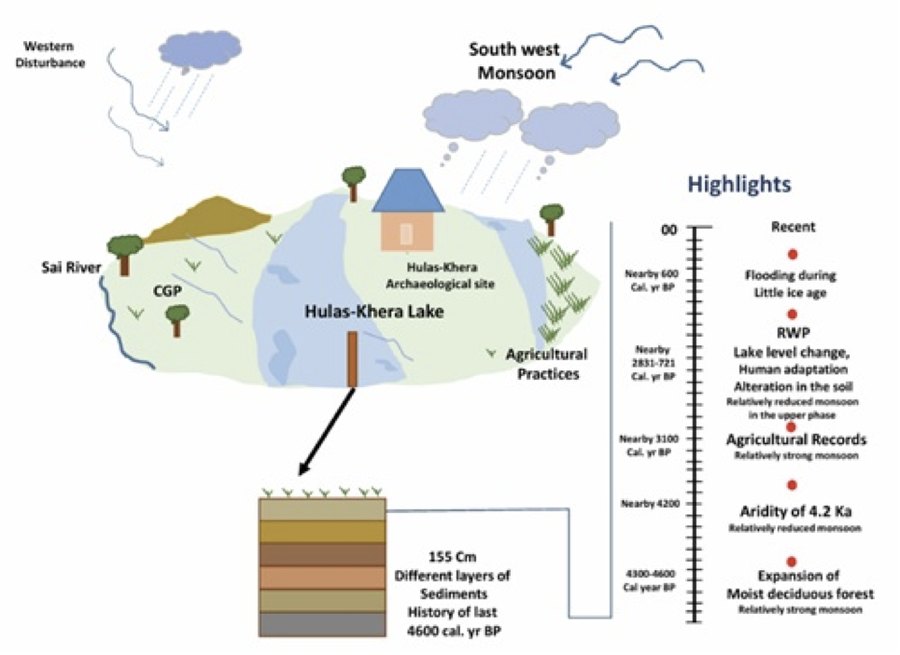
A 155-cm sediment core records ~4,600 calibrated years before present (cal yr BP). Graphical summary of the BSIP study; reproduced with credit for educational use.
◈ Key Terms Explained — From Basics
- Palaeoclimate proxies: natural records that preserve past climate — lake sediments, pollen, cave deposits (speleothems), tree rings, ice cores.
- Oxbow lake: a crescent-shaped lake formed when a meandering river cuts off a loop — common in the Ganga plain.
- AMS radiocarbon dating: measures carbon-14 atoms directly with an accelerator mass spectrometer, giving precise ages from tiny samples.
- C3 vs C4 plants: C3 plants (most trees, wheat, rice) prefer cooler, wetter conditions; C4 plants (many grasses, maize, millets) cope better with heat and dryness. Carbon isotopes in sediments reveal which dominated.
- Holocene: the current geological epoch, from about 11,700 years ago; its latest stage, the Meghalayan Age, begins with the 4.2 ka mega-drought, defined using a stalagmite from Mawmluh Cave, Meghalaya.
▤ The Four Phases Identified
- ~4,600–4,300 years ago: strong monsoon; expansion of moist deciduous forest.
- ~4,200 years ago: the 4.2 ka arid event — weak monsoon (also linked to the decline of the Indus Valley Civilisation).
- ~3,100 years ago: stronger monsoon; evidence of agriculture, including manure-based practices.
- Roman Warm Period (~2,800–700 years ago in the record): lake-level changes and human adaptation; later the Little Ice Age (~600 years ago onwards) brought flooding and moisture from westerlies.
- Why it matters: long records provide a baseline for climate models, show how societies adapted to monsoon swings, and support planning for water and food security in one of the world’s most densely populated regions.
- Conservation angle: small oxbow lakes are valuable natural archives — and fragile wetlands that need protection.
- Prelims caution: Hulas Khera (Lucknow district) is distinct from Hulas (Saharanpur district), a Late Harappan site.
✎ Mains Practice Question
How do palaeoclimate records help us understand the relationship between monsoon variability and the rise and decline of human settlements in the Indian subcontinent? 10 marks · 150 words
06
Mud Volcanoes, Andaman Subduction Volcanoes and Sirpur Added to India’s UNESCO Tentative List
ImportantGS-I · Art & Culture; Geography — Volcanoes, Plate TectonicsPrelims-orientedHindustan Times
Three Indian sites — the Karst–Mud Volcano Complex of Baratang, the Andaman Subduction Volcanoes (Barren and Narcondam islands) and the Sirpur Cultural and Archaeological Landscape (Chhattisgarh) — have been added to UNESCO’s World Heritage Tentative List, taking India’s tentative entries to 81.
◈ Static Background — How World Heritage Status Works
- World Heritage Convention (1972): adopted by UNESCO; India ratified it in 1977. Sites are inscribed by the intergovernmental World Heritage Committee.
- Tentative List: an inventory of sites a country intends to nominate; a site must be on it (generally for at least a year) before a nomination. Inclusion is not World Heritage status.
- Criteria: sites must show Outstanding Universal Value under at least one of ten criteria (six cultural, four natural), plus integrity and authenticity.
- Advisory bodies: ICOMOS evaluates cultural sites; IUCN evaluates natural sites.
- India’s count: India has over 40 inscribed World Heritage Sites, the latest including the Maratha Military Landscapes (2025).
The Three Sites
- Baratang (Middle Andaman): mud volcanoes, which emit mud, water and gases (mainly methane) rather than molten rock, alongside limestone caves formed from uplifted marine sediments.
- Andaman Subduction Volcanoes: Barren Island — South Asia’s only confirmed active volcano — and Narcondam, a dormant volcanic island and the only home of the Narcondam hornbill. Both lie on the volcanic arc formed as the Indian Plate subducts beneath the Burma microplate.
- Sirpur (Mahasamund, Chhattisgarh): on the Mahanadi; historically Shripura, capital of Dakshina Kosala under the Panduvamshi dynasty. Known for the brick Lakshmana Temple (7th century) and Buddhist viharas, reflecting coexisting Hindu, Buddhist and Jain traditions.
- Significance: two geo-heritage entries widen India’s natural-heritage portfolio beyond forests and wildlife; Sirpur highlights a lesser-known early-medieval urban and religious centre.
- Challenges: nomination dossiers need strong management plans, legal protection, and buffer-zone controls — especially on ecologically fragile islands with tourism pressure.
✎ Mains Practice Question
Geological heritage is as important as cultural heritage for a nation’s identity and science. Discuss with reference to recent additions to India’s UNESCO Tentative List. 10 marks · 150 words