

Editorials, Opinions & Explained2 Items
Core TopicImportantConcise
EditorialsGS Paper III
01Nobel Medicine 2026 — Optogenetics & Light-Gated Ion Channels
ExplainedGS Paper III
02Nobel Physics 2026 — IceCube & Astrophysical Neutrinos
EditorialsGeneral Studies Paper III · Science & Technology
01
Let There Be Light — Nobel Prize in Physiology or Medicine 2026 Honours the Science of Optogenetics
Core TopicEditorialGS-III · S&T — Biotechnology, Developments & Applications in HealthPrelims + MainsThe Hindu · Editorial
The 2026 Nobel Prize in Physiology or Medicine went jointly to Karl Deisseroth, Peter Hegemann and Georg Nagel “for their discoveries concerning light-gated ion channels and optogenetics”. The technique lets scientists switch specific nerve cells on or off with light. The editorial's larger point is that such breakthroughs must reach everyone who could benefit, not only those who can afford them.
▤ The Prize at a Glance
- Laureates: Peter Hegemann (Germany) — studied how the single-celled alga Chlamydomonas moves towards light; Georg Nagel (Germany) — identified the algal light-gated channel protein; Karl Deisseroth (USA) — turned it into a light switch for neurons.
- Key protein: channelrhodopsin — a light-gated ion channel that opens under blue light, letting positively charged ions into the cell.
- Awarding body: the Nobel Assembly at Karolinska Institutet, Stockholm.
- Rule to remember: a Nobel Prize can be shared by at most three laureates.
- Founding intent: Alfred Nobel's will (1895) aimed at those who have conferred the “greatest benefit to humankind”; prizes first awarded in 1901.
◈ Background — How Neurons Signal
Neurons communicate through electrical impulses (action potentials). These start when ion channels in the cell membrane open and charged ions rush in, depolarising the cell. The brain is the puppeteer and the body the marionette; the methods behind the puppeteer's skill were long hidden.
- Voltage-gated channels open in response to changes in membrane voltage.
- Ligand-gated channels open when a chemical such as a neurotransmitter binds.
- Light-gated channels (channelrhodopsins) open when struck by light — the discovery at the heart of this prize.
Figure 1 — How optogenetics works, in four steps
1 · The geneLight-sensitivechannel gene fromalga Chlamydomonaschannelrhodopsin2 · DeliveryHarmless viralvector carries geneinto chosen neuronscell-type specific3 · Blue lightPrecise light pulsesopen the channel;positive ions flow inmillisecond control4 · Read-outNeuron fires; effecton memory, emotionor behaviour observedcircuit mappedUnlike electrodes or drugs, light targets only the genetically marked cells
Optogenetics combines genetics (which cells) with optics (when, to the millisecond). That combination of precision is what made previously impossible brain mapping possible. Diagram drawn by Legacy IAS.
Why the discovery matters
- Cause, not correlation: earlier tools such as EEG and fMRI could observe brain activity; optogenetics lets researchers switch a circuit on or off and see what changes.
- Precision over older methods: deep brain stimulation and drugs affect all nearby cells; light acts only on cells carrying the gene.
- Mapping disorders: it has revealed circuits tied to specific memories, fear, reward and behaviours relevant to depression, addiction, Parkinson's and Alzheimer's.
- Toward therapy: in 2021, a patient with retinitis pigmentosa regained partial vision after optogenetic gene therapy combined with light-stimulating goggles — the first such clinical report.
The editorial's argument — science and equitable access
The editorial observes that technology is shortening the path from lab discovery to therapies, diagnostics and health practice. Nations must therefore ensure that the benefits reach people irrespective of location or station in life.
- Cost barrier: gene therapies are among the most expensive treatments; without public financing or tiered pricing, access will be skewed.
- Research base: India's Gross Expenditure on R&D (GERD) is about 0.64% of GDP (DST, 2020-21), well below the world's leading research economies; the Anusandhan National Research Foundation (ANRF) Act, 2023 aims to raise and steer research funding.
- Indigenous capability: India's first indigenous CAR-T cell therapy (NexCAR19, approved 2023) shows that home-grown development can sharply cut the cost of advanced therapies.
- Disease burden: the LASI-DAD study (2023) estimated dementia prevalence of about 7.4% among Indians aged 60+; neurological and mental-health care remains thin outside cities.
The critical view — limits and ethics
- Invasiveness: most applications need gene delivery and an implanted light source; human use is still largely confined to the eye, where light enters naturally.
- Safety: long-term effects of introducing a foreign algal protein and viral vectors into human tissue are still being studied.
- Neuroethics: technologies able to alter mood, memory or behaviour raise questions of consent, autonomy and possible misuse; the Mental Healthcare Act, 2017 and ICMR's ethical guidelines will need to keep pace.
▤ Terms to Know — Prelims Hooks
- Optogenetics: control of genetically modified cells using light.
- Channelrhodopsin: light-gated cation channel from green algae; opened by blue light.
- Chemogenetics: a related technique that switches cells using an engineered receptor and a designer drug instead of light — slower, but needs no implant.
- Viral vector: a disabled virus used to carry a gene into cells (e.g. adeno-associated virus, AAV).
- National Brain Research Centre (NBRC): autonomous institute of the Department of Biotechnology at Manesar, Haryana.
✎ Mains Practice Question
What is optogenetics? Discuss its significance for understanding brain function and treating neurological disorders. Also suggest measures to ensure that the benefits of frontier biomedical research reach all sections of society in India. 15 marks · 250 words
ExplainedGeneral Studies Paper III · Science & Technology
02
Ghost Particles in the Ice — Nobel Prize in Physics 2026 for the IceCube Neutrino Observatory
Core TopicExplainedGS-III · S&T — Space, Particle Physics, Indian Scientific ProjectsPrelims + MainsThe Indian Express · Explained
The 2026 Nobel Prize in Physics went to Francis Halzen (82, University of Wisconsin–Madison) “for decisive contributions to the IceCube Neutrino Observatory and the discovery of high-energy neutrinos of astrophysical origin”. His detector turned a cubic kilometre of Antarctic ice into a telescope for particles that cross the universe almost unhindered.
Figure 2 — The IceCube Neutrino Observatory and the Nobel citation
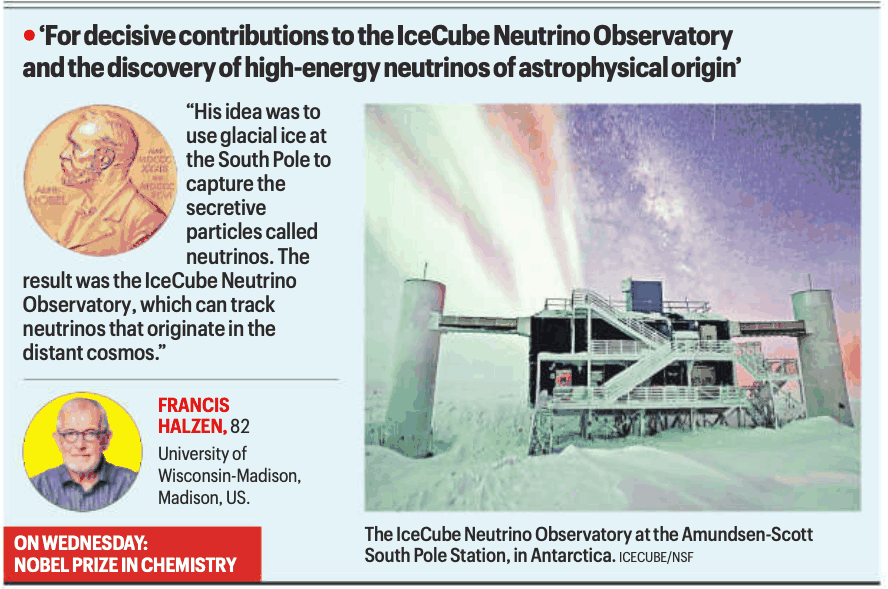
The surface laboratory of IceCube at the Amundsen–Scott South Pole Station; the sensors themselves lie deep in the ice below. Image courtesy The Indian Express, 7 October 2026 (photo: IceCube/NSF); reproduced with credit for educational use.
◈ Background — What Are Neutrinos?
Neutrinos are electrically neutral, nearly massless subatomic particles produced in nuclear reactions — in the Sun, in supernovae, in Earth's atmosphere and in reactors. After photons, they are the most abundant particles in the universe.
- Three flavours: electron, muon and tau neutrinos.
- “Ghost particles”: they interact with matter so rarely that about 65 billion solar neutrinos pass through every square centimetre each second unnoticed. The Nobel Committee called them the “shyest particle”.
- No electric charge: unlike cosmic-ray particles, they are not deflected by magnetic fields, so they point straight back to their source.
- Why detectors are huge and isolated: only a tiny fraction ever interacts, so observatories need vast volumes and shielding from other radiation — deep underground, under water or under ice.
How IceCube detects them
- Location: the South Pole, where the ice is deep, dark and exceptionally clear.
- Scale: about 1 cubic kilometre of ice instrumented with 5,000+ light sensors on long cables, at depths of roughly 1.5–2.5 km.
- Principle — Cherenkov radiation: when a neutrino strikes an atomic nucleus in the ice, it produces a charged particle that can travel faster than light travels in ice. This emits a faint bluish glow.
- Read-out: the pattern and timing of that glow across the sensors reveal the neutrino's energy and direction.
- Timeline: fully operational in 2011; first evidence of high-energy astrophysical neutrinos published in 2013; principally funded by the US National Science Foundation.
What IceCube found — and why it matters
- Beyond the Sun: earlier detectors recorded neutrinos mainly from the Sun and Earth's atmosphere; IceCube found high-energy neutrinos arriving from outside our galaxy.
- First identified source (2017): a neutrino traced to the blazar TXS 0506+056, coinciding with a gamma-ray flare seen by other telescopes.
- Later results: evidence of neutrino emission from the active galaxy NGC 1068 (2022) and from the Milky Way's galactic plane (2023).
- Seeing through the opaque: dense cosmic regions absorb or scatter light, but neutrinos pass straight through, revealing processes otherwise hidden from view.
▤ Multi-Messenger Astronomy — The Four Windows
- Electromagnetic radiation: from visible light to radio, X-rays and gamma rays.
- Cosmic rays: charged particles from space, bent by magnetic fields.
- Gravitational waves: first detected by LIGO in 2015 (Nobel 2017).
- Neutrinos: the window IceCube opened at high energies.
- Studying the same cosmic event through several of these signals is multi-messenger astronomy.
Figure 3 — The neutrino story: a century of discovery and its Nobel Prizes
1930Pauli proposes1956Cowan–Reinesfirst detectionNobel 19951965Kolar Gold Fields:atmosphericneutrinos (India)2002Davis & Koshibasolar, supernovaNobel 20022013IceCube: cosmicneutrino evidence2015Kajita & McDonaldoscillation = massNobel 20152017Blazar TXS0506+056 traced2026HalzenNobel 2026
Neutrino research has now produced Nobel Prizes in 1995, 2002, 2015 and 2026. India's Kolar Gold Fields experiment was among the first to detect atmospheric neutrinos. Timeline drawn by Legacy IAS.
The India angle — the India-based Neutrino Observatory (INO)
India has an early record in the field: in 1965, a TIFR-led team detected atmospheric neutrinos deep in the Kolar Gold Fields, Karnataka. When deep mining there ended, India lost that underground laboratory.
- The project: an underground lab with a 50,000-tonne magnetised Iron Calorimeter (ICAL) to study atmospheric neutrinos and the neutrino mass ordering; jointly backed by the Department of Atomic Energy and the Department of Science & Technology.
- Approval: cleared by the Union Cabinet in 2015.
- Site: proposed sites in the Nilgiris and later Bodi West Hills, Theni (Tamil Nadu) faced local and environmental opposition, including concerns about the nearby Western Ghats ecosystem; a new location is yet to be finalised.
- Cost of delay: as global detectors scale up, the scientific window the INO was designed for narrows, and the trained talent pool drifts to projects abroad.
The critical view
- Science vs. local concerns: the INO episode shows that big-science projects need early public engagement and transparent environmental assessment, not only technical clearance.
- Global participation: India can still contribute through international collaborations, as it does in LIGO-India (approved 2023, Hingoli, Maharashtra).
- Basic research funding: long-gestation fundamental science competes with applied priorities for limited R&D money.
▤ Other Neutrino Observatories — Prelims Hooks
- Super-Kamiokande (Japan): water-based Cherenkov detector in a mine.
- KM3NeT (Mediterranean Sea) and Baikal-GVD (Lake Baikal, Russia): deep-water neutrino telescopes.
- DUNE (USA, under construction): Deep Underground Neutrino Experiment led by Fermilab.
- Cherenkov radiation: the same blue glow seen in the cooling water of nuclear reactors.
✎ Mains Practice Question
What is multi-messenger astronomy? Explain the significance of neutrino observatories such as IceCube in advancing it, and examine the lessons from the delay of the India-based Neutrino Observatory for big-science projects in India. 15 marks · 250 words