

Editorials, Opinions & Explained2 Items
Core TopicImportantConcise
EditorialsThe Paper's Own View
01FRA Consent Rule & Gram Sabha Veto
OpinionsSigned Op-Ed & Ideas
02India–Japan Defence Cooperation
EditorialsThe Newspaper's Institutional View
01
Diluting Gram Sabha Consent Under the Forest Rights Act
Core TopicEditorialGS-II · Polity & Governance — Panchayati Raj, Statutory Bodies, Vulnerable SectionsPrelims + MainsThe Hindu · Editorial
A parliamentary committee's proposal to accept the consent of 70–75% of affected gram sabhas, instead of all of them, threatens to convert a rights-bearing village assembly into a mere corporate stakeholder.
◆ Background & Context
The Forest Rights Act (FRA), 2006 was enacted to undo the "historical injustice" done to forest-dwelling Scheduled Tribes and Other Traditional Forest Dwellers by recognising their individual and community rights over forest land.
- The FRA's spirit requires the informed consent of gram sabhas before forest land is diverted for non-forest (developmental) use.
- The Committee on Public Undertakings has suggested that consent from 70–75% of affected gram sabhas should suffice, rather than requiring every affected gram sabha to agree.
- The trigger is the push to fast-track stalled energy infrastructure, including the long-delayed Teesta-IV hydropower project.
Why the Threshold Matters
A majority-consent rule lets a project proceed even when the single gram sabha most directly affected — say, a village inside a proposed reservoir's submergence zone — withholds consent, so long as less-affected villages sign off.
- It reduces gram sabhas from democratic, rights-protecting bodies to stakeholders whose dissent can be statistically outvoted.
- It converges with the separate, ongoing political dispute over who counts as a "community member" — both trends make it easier for the state to engineer consent by reshaping who gets to vote in a gram sabha.
- The Tribal Affairs Ministry has declined to assert jurisdiction over the issue, leaving the Environment Ministry and the States to frame rules with no nodal check.
▦ The Regulatory Gap
- The FRA does not contain an explicit clause mandating a no-objection certificate from every affected gram sabha — but this does not mean gram sabha consent can lawfully be bypassed altogether.
- The vacuum lies in the space between the FRA and the Environment Ministry's clearance rules, which the Tribal Affairs Ministry has treated as someone else's problem.
The Editorial's Argument
If the government believes consent thresholds should change, it must amend the law or the rules openly, through Parliament or formal rule-making — not through a bureaucratic reinterpretation that lets one ministry recuse itself while another quietly rewrites practice.
Land is described as the foundation of forest-dependent communities' livelihood, culture, identity and political autonomy, which is why the piece calls for strengthening — not diluting — the powers already vested in gram sabhas under the Land Acquisition, Rehabilitation and Resettlement Act and PESA in Scheduled Areas.
✎ Mains Practice Question
The proposal to replace unanimous gram sabha consent with a majority threshold under the Forest Rights Act has been criticised as converting a rights-bearing institution into a mere stakeholder. Critically examine this concern in light of the constitutional and statutory basis of gram sabha authority over forest land. 15 marks · 250 words
OpinionsSigned Columns & Expert Commentary
02
India–Japan Defence Cooperation Breaks New Ground
Core TopicOpinionGS-II · IR — Bilateral Relations, India & its NeighbourhoodGS-III · Internal & External Security, Defence TechnologyPrelims + MainsThe Hindu · Ideas (Harsh V. Pant & Pratnashree Basu, Observer Research Foundation)
Japanese Defence Minister Shinjiro Koizumi's August 2026 visit to India signals a shift from a relationship rich in institutional vocabulary but thin in operational substance, towards concrete arrangements in maritime awareness, shipbuilding and equipment transfer.
◆ Background & Context
Over the past decade, India and Japan have built the institutional scaffolding of a defence partnership — annual defence ministerial dialogues, the 2+2 foreign-and-defence-minister mechanism, service-to-service exercises, logistics arrangements and technology talks.
- Both countries converge on opposing coercive attempts to alter the status quo, securing the maritime commons, and countering the militarisation of the Indo-Pacific.
- The authors argue that further declarations of strategic convergence now yield diminishing returns; the real test is converting convergence into interoperable capability.
Maritime Domain Awareness — Two Ends of One Theatre
India and Japan sit at opposite ends of the Indo-Pacific's principal maritime theatre — Japan's concerns centre on the East China Sea and Taiwan's waters, while India's geography anchors it in the Indian Ocean.
- A new maritime framework on information-sharing and Maritime Domain Awareness aims to link these two watch-areas into a more continuous strategic picture.
- Objective: greater awareness, interoperability and operational familiarity between the two navies, not just symbolic coordination.
▦ What Was Actually Agreed
- Naval shipbuilding: exploration of joint development, combining Japanese technology with Indian production capacity, and deepened talks on Japan using Indian facilities under ‘Make in India’.
- Ship repair: movement towards reciprocal repair-facility access for each other's navies.
- UNICORN system: transfer of Japan's integrated communications antenna system — billed as the first defence-equipment transfer between the two countries, though the underlying co-development MoU with Bharat Electronics Limited was already signed in November 2024.
- R&D linkage: deeper cooperation planned between India's DRDO and Japan's Acquisition, Technology and Logistics Agency (ATLA).
- Exercises: Japanese fighter aircraft joined exercise Veer Guardian in India for the first time (9–22 September 2026), alongside plans for greater exercise complexity, unmanned-systems integration, short-notice drills, and special-forces and theatre-command-level engagement.
Figure 1 — Japan and Its Immediate Maritime Neighbourhood
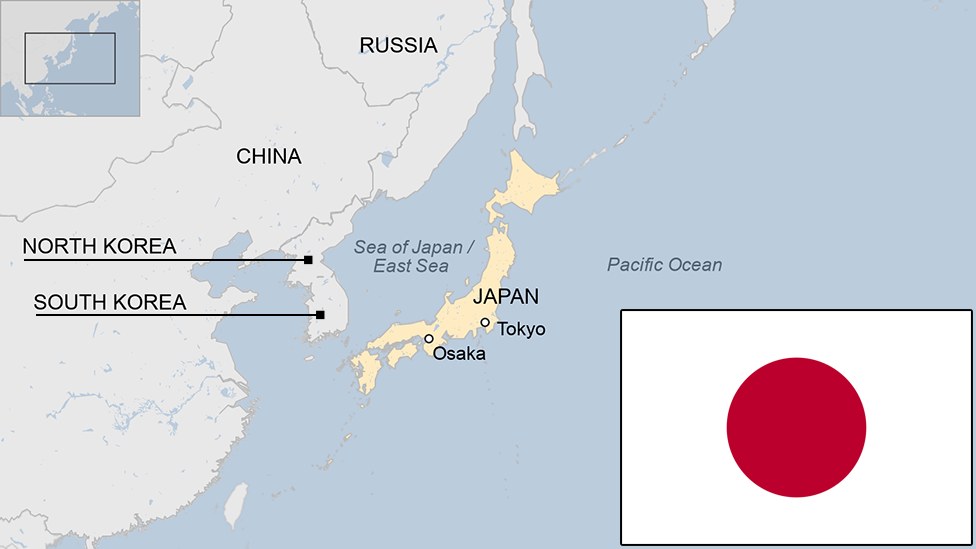
Japan's East China Sea and Taiwan-facing concerns sit at the opposite end of the Indo-Pacific from India's Indian Ocean focus — the strategic rationale for a shared Maritime Domain Awareness architecture.
Beyond the Bay of Bengal — the Western Seaboard
Mr. Koizumi's itinerary — the Western Naval Command in Mumbai and INS Chennai, ahead of New Delhi — extended the visit's geography beyond the familiar Bay of Bengal–Malacca Strait framing to India's western seaboard, which carries critical sea lanes, energy flows and India's expanding western Indian Ocean role.
A Wider, Not Only China-Centric, Agenda
The joint statement opposed unilateral attempts to alter the status quo through force or coercion, without naming China. The authors' central claim, however, is that the relationship's significance lies in moving beyond a purely China-centric frame.
- The August 2026 defence ministerial builds on the July 2026 Annual Summit, which had already expanded cooperation into economic security, critical technologies and resilient supply chains.
- Maritime security, defence-industrial capacity, logistics and third-country cooperation are converging into a broader regional security architecture, not a single-adversary containment strategy.
✎ Mains Practice Question
India-Japan defence cooperation has been described as "more developed institutionally than operationally." Discuss the recent measures aimed at translating this institutional convergence into operational capability, and evaluate their significance for India's Indo-Pacific strategy. 15 marks · 250 words