

Editorials, Opinions & Explained2 Items
Core TopicImportantConcise
OpinionsSigned Op-Eds
01AI in Healthcare — Optimising for Access, Not Deployment02India's Honey & Bee Economy — Sweet Revolution, Fragile Foundation
OpinionsSigned Op-Eds & Analysis
01
How AI Can Be Optimised for Better Healthcare — Bridging the Specialist Gap and Shifting Towards Preventive Care
Core TopicOpinionGS-III · S&T — Biotechnology & Health Technology | GS-II · Governance — Health PolicyPrelims + MainsThe Indian Express · Independence Day Special · 15 Aug 2026 · Suneeta Reddy, MD, Apollo Hospitals
Artificial Intelligence is moving out of healthcare innovation labs into routine clinical workflows — radiology, documentation, diagnostics, care management — but its true value, the author argues, lies not in deploying technology at scale but in reaching patients earlier, reducing specialist-access gaps, and shifting healthcare toward prevention rather than cure.
◈ Background & Context
India's healthcare system confronts a structural asymmetry: a large and growing disease burden concentrated in semi-urban and rural populations, with specialist capacity tightly clustered in metropolitan centres.
The doctor–population ratio in India stands at approximately 1:834 (WHO norm: 1:1,000), but this aggregate conceals extreme regional imbalance — rural India, which hosts over 65% of the population, has access to barely 35% of hospital beds and a fraction of specialists.
- By May 2026, over 100 crore health records had been linked to Ayushman Bharat Health Accounts (ABHA), double the February 2025 figure — providing the data spine on which AI tools can be trained and deployed.
- The Ayushman Bharat Digital Mission (ABDM) Scan and Share service cut outpatient registration wait times at participating hospitals from roughly one hour to 2–5 minutes — demonstrating that Digital Public Infrastructure (DPI) can remove friction from routine hospital processes.
- A January 2026 McKinsey analysis estimated that AI applied across healthcare revenue-cycle operations could reduce the cost-to-collect by 30–60% — freeing resources for clinical teams and equipment.
- The FDA (US) had, as of January 2025, authorised over 1,000 AI-enabled medical devices, predominantly in radiology and cardiology diagnostics.
- The UK NHS issued guidance in April 2025 for AI-enabled ambient scribing (real-time auto-documentation), with early evidence suggesting doctors gained up to a quarter more consultation time with patients.
Core Argument — Three Layers of AI's Healthcare Role
- Efficiency layer: AI can automate appointment scheduling, clinical documentation, insurance claims, inventory planning, and discharge management — tasks that currently consume clinician time disproportionate to their diagnostic value.
- Access layer: Virtual specialist support can connect smaller district hospitals with expertise located in metros; diagnostics (radiology, pathology AI) can be taken closer to communities; remote monitoring can extend care beyond discharge, maintaining the patient–provider relationship continuously rather than episodically.
- Prevention layer: Risk-based predictive models can identify high-risk individuals before symptoms become severe — enabling pre-emptive intervention in diabetes, cardiac disease and cancer management. This is where the author identifies the greatest value: the economic return on AI in healthcare is measured not by systems deployed but by "lives touched and impact on human life and happiness."
Static Background — India's Healthcare Policy Architecture
Ayushman Bharat, launched in 2018, has two components: Pradhan Mantri Jan Arogya Yojana (PM-JAY) — health insurance covering ₹5 lakh per family per year for 55 crore beneficiaries — and the Health and Wellness Centres (HWCs) (now rebranded Ayushman Arogya Mandirs), targeting 1.5 lakh sub-centres to be upgraded into comprehensive primary care facilities.
- National Digital Health Mission (NDHM), later expanded as ABDM (2021): creates an interoperable digital health ecosystem — ABHA ID (Ayushman Bharat Health Account), Health Facility Registry, Healthcare Professionals Registry, and ABDM-enabled health records exchange.
- IndiaAI Mission (February 2024, ₹10,372 crore): includes a specific vertical for AI in healthcare, with focus on diagnostics tools, drug discovery, and clinical decision support — nodal Ministry: MeitY in coordination with MoHFW.
- National Health Policy 2017: set a target to raise public health expenditure to 2.5% of GDP by 2025; India's actual spend has stayed around 1.6–1.9% of GDP, driving the continued dependence on private care.
- Telemedicine Practice Guidelines 2020: established the legal and regulatory framework for teleconsultation — a prerequisite for AI-assisted remote care.
- AI regulatory landscape: India's Digital Personal Data Protection Act 2023 (DPDPA) is the foundational framework governing patient data used in AI training, but health-data-specific AI regulations are yet to be formalised — unlike the FDA's Software as a Medical Device (SaMD) framework in the US.
The Author's Caution: Restraint and Validation
- The author explicitly warns against indiscriminate AI deployment — a system validated in one hospital or population may not perform equally across India's diversity of disease patterns, demographics and care settings.
- The FDA's September 2025 call for better real-world evaluation methods reflects a concern that "performance at launch does not guarantee performance over time" — model drift (degradation of AI performance as populations and disease patterns shift) is a known challenge.
- Algorithmic bias is a structural risk: if training data is drawn disproportionately from urban, English-speaking, or insured populations, the AI will systematically underperform for the very populations that need it most — rural, low-income, multilingual.
- The article frames healthcare as belonging within the architecture of economic development — health, longevity and productivity of the population are the foundation of national economic strength, making healthcare investment a macroeconomic, not merely a welfare, priority.
Critical View
- The op-ed reflects a healthcare industry perspective (Apollo Hospitals MD); the efficiency and revenue-cycle gains highlighted are real but may not be the primary entry point for public health reform in India, where the challenge is structural under-investment, not operational inefficiency.
- Data sovereignty and patient privacy deserve fuller treatment — the ABHA database, once linked to AI systems, creates concentration risks and potential for surveillance.
- The positive global examples (FDA, NHS) are from high-income systems with strong regulatory capacity; India's regulatory bandwidth for AI oversight in healthcare is currently thin.
Figure 1 — AI's Three-Layer Value Pyramid in Healthcare
EFFICIENCYScheduling · Documentation · Claims · Inventory · DischargeACCESSRemote monitoring · Virtual specialist · Community diagnosticsPREVENTIONPredictive risk · Early detection · Continuous managementBroad reachHigh impactHighest value100 cr+ ABHA records + ABDM DPI backbone = data foundation for all three layers
AI in healthcare creates greatest value at the prevention apex — identifying risk before symptoms emerge — not just at the efficiency base.
Terms & Institutions to Know (Prelims)
- ABHA — Ayushman Bharat Health Account; unique digital health ID
- ABDM — Ayushman Bharat Digital Mission; interoperable national digital health ecosystem
- PM-JAY — Pradhan Mantri Jan Arogya Yojana; ₹5 lakh/family health cover; 55 crore beneficiaries
- DPDPA 2023 — Digital Personal Data Protection Act; governs health data use in AI
- Telemedicine Guidelines 2020 — legalised teleconsultation; issued by MoHFW + NMC
- Model drift — degradation of AI performance as real-world conditions diverge from training data
- SaMD — Software as a Medical Device; FDA framework for AI/ML-based diagnostic tools
- NHP 2017 — National Health Policy; target: 2.5% of GDP on public health
✎ Mains Practice Question
Artificial Intelligence has transformative potential for India's healthcare system, but its benefits risk accruing disproportionately to urban, insured and high-income populations. Critically examine the opportunities and structural risks of AI-driven healthcare in India, and suggest a regulatory and policy framework to ensure equitable access. 15 marks · 250 words
02
India's Sweet Revolution Depends on This: Safeguard the Bee, Sustainability is Key — Apiculture, Pollination Economics, and the Path to Premium Global Markets
ImportantOpinionGS-III · Economy — Agriculture, Allied Sectors, Export CompetitivenessGS-III · Environment — Ecosystem Services, BiodiversityPrelims + MainsThe Indian Express · 15 Aug 2026 · Gulati, Rath & Adhikary, ICRIER
India has emerged as the second-largest honey producer and third-largest honey exporter in the world, but its export value is constrained by low unit realisation, dangerous market concentration (76% in the US), and failure to leverage India's unique multifloral and organic honey varieties — while the ecological foundation of this entire economy, the honeybee, faces mounting threats from pesticides and unsustainable beekeeping practices.
◈ Background & Context
Bees are a keystone species in global food systems.
The UN Food and Agriculture Organisation (FAO) estimates that bees as pollinators contribute to almost one-third of global crop output, enhancing yields for 87 of 115 leading food crops — including mustard, apple, sunflower, and most oilseeds.
This pollination service is an unpriced ecological externality that underwrites hundreds of billions of dollars of agricultural output annually, making bee health simultaneously an agricultural, ecological, and economic policy issue.
- India's honey production has nearly doubled over the last decade: from approximately 76,150 MT in 2013–14 to approximately 1,51,690 MT in 2024–25 (Source: MoAFW 2026).
- Export volume has grown from 28,400 MT (2013–14) to approximately 1,14,570 MT (2025–26); export value reached US07.97 million in 2025–26 (Source: DGFT 2026).
- India accounts for approximately 8.4% of global honey exports by volume; however, India's unit value realisation of approximately US,858/MT is well below the world average and far below premium categories like New Zealand's Manuka honey.
- India's per capita honey consumption is a very low ~37 grams per year — indicating a large, largely untapped domestic market.
- The global bee products market (honey, beeswax, propolis, royal jelly, pollen) was valued at approximately US2.7 billion in 2023 and is projected to grow.
Figure 2 — India's Honey Production and Export Trends (2013–14 to 2025–26)
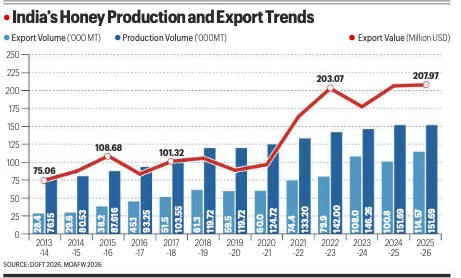
India's production (blue bars) and export volume (orange bars) have grown steadily; export value (red line) shows stronger growth post-2020, reaching US07.97 million in 2025–26. Source: DGFT 2026, MoAFW 2026; chart courtesy The Indian Express; reproduced with credit for educational use.
Static Background — Apiculture Policy, NBHM & Key Schemes
India's apiculture sector is supported by a dedicated national mission and several institutional frameworks. Honey production areas are concentrated in Uttar Pradesh, Rajasthan, Punjab, Himachal Pradesh, Assam and the Northeast, corresponding to major agroclimatic zones (mustard belt, apple orchards, lychee groves, rainforests).
- National Beekeeping and Honey Mission (NBHM), 2020: Launched under the AtmaNirbhar Bharat Abhiyan; aims to triple honey production and double the number of bee colonies by 2025; nodal agency — National Bee Board (NBB), under MoAFW; outlay: ₹500 crore over 2020–23.
- National Bee Board (NBB): Established under MoAFW; functions include standardisation, training, development of beekeeping as an additional income source for farmers.
- APEDA (Agricultural and Processed Food Products Export Development Authority): Under MoC&I; drives export promotion for honey; develops traceability standards and quality certification for export markets.
- NMR Testing (Nuclear Magnetic Resonance): Gold standard for honey authenticity testing — detects adulteration, adulterant sugars (rice syrup, C4 sugars), and confirms floral origin. The article calls for India to invest in NMR-capable testing labs to meet EU and East Asian import requirements.
- GI (Geographical Indication) branding: Specific varieties like Sundarbans honey (mangrove monofloral) and Ramban Sulai honey (Kashmir) have GI tag potential that could command significant premium over bulk commodity pricing.
- Farmer Producer Organisations (FPOs): Cluster-based FPO models can lower compliance costs for quality certification, enable collective bargaining with buyers, and provide market linkage for small-scale beekeepers.
The US Tariff Shock — Trade Risk and Diversification Response
- India's honey export basket was dangerously concentrated: the US absorbed ~76% (US57.8 million) of India's honey exports in 2025–26. When the US imposed high tariffs on Indian goods (as part of broader trade friction), this concentration became a severe vulnerability for Indian honey exporters and farmers.
- India's response has been market diversification — shipments to the Netherlands, Belgium, Germany and Israel have increased, targeting EU consumers willing to pay a premium for traceable, naturally sourced, organic honey.
- This mirrors a classic economic lesson the authors highlight: trade barriers compel resilience and innovation — forced diversification builds stronger long-term foundations than dependence on a single large buyer.
- Upgrading from bulk unbranded wholesale volumes to branded retail packs can significantly improve unit value realisation — a structural shift the sector needs for sustainable premium market access.
Pollinator Health — The Ecological Imperative
- Globally, honeybee populations face threats from: Colony Collapse Disorder (CCD) (linked to neonicotinoid pesticides), Varroa mite infestations, habitat loss, monoculture farming (reduced floral diversity), and climate change-induced phenological mismatches (flowering and pollinator cycles de-synchronising).
- India's rapid expansion of BT cotton and other pesticide-intensive crops in key beekeeping zones poses direct threats to colony health.
- The authors call for scientific beekeeping, pesticide management protocols, and support for pollination services as a recognised agri-ecosystem service — analogous to how carbon sequestration is being valued.
- Target proposed: Double bee colonies by 2030 and double India's share in global honey markets by that year.
Critical View
- The NBHM's stated targets (tripling production, doubling colonies by 2025) were ambitious — production growth has been substantial but the colony-doubling target requires verification; quality infrastructure (NMR labs, cold chains) has lagged behind raw production growth.
- The domestic market remains underdeveloped — at 37 gm/person/year, India's consumption is a fraction of European levels. Domestic demand stimulation through "Honey for Health" campaigns would simultaneously stabilise farm prices and reduce export-only dependence.
- The unpriced pollination service is the article's most important insight for UPSC: bee value extends far beyond honey — pollination contributions to Indian agriculture (oilseeds, fruits, vegetables) are estimated to be many times the honey economy's value, yet receive no policy protection as such.
Terms & Institutions to Know (Prelims)
- NBHM — National Beekeeping and Honey Mission (2020); ₹500 crore; nodal: NBB under MoAFW
- NBB — National Bee Board; under MoAFW
- APEDA — Agricultural and Processed Food Products Export Development Authority; under MoC&I
- NMR testing — Nuclear Magnetic Resonance; gold standard for honey authenticity and floral origin verification
- CCD — Colony Collapse Disorder; mass die-off of worker bees; linked to neonicotinoid pesticides
- GI tag — Geographical Indication; confers legal protection and premium-market access for origin-specific products
- Ecosystem service — benefit provided by natural systems to human economies; pollination is an unpriced ecosystem service
- AtmaNirbhar Bharat Abhiyan — self-reliance economic package under which NBHM was launched (2020)
✎ Mains Practice Question
India's apiculture sector has seen remarkable production growth, but remains constrained by low unit value realisation, export market concentration, and neglect of the unpriced pollination services that underpin Indian agriculture. Analyse the structural challenges and opportunities for India's honey economy, and discuss the policy interventions needed to achieve sustainable growth. 15 marks · 250 words