

Editorials, Opinions & Explained2 Items
Core TopicImportantConcise
EditorialsGS Paper II & III
01Weapons in Orbit & Space Governance
OpinionsGS Paper II · IR
02Malacca-Singapore Model for the Strait of Hormuz
EditorialsThe newspaper’s own arguments
01
Unsafe Space: Deployment of Orbital Weapons and the Case for Multilateral Space Governance
Core TopicEditorialGS-II · IR — International Treaties & Global CommonsGS-III · Security & Space TechnologyPrelims + MainsThe Hindu · Editorial
The United States has acknowledged deploying “on-orbit space control weapons”. The editorial argues that the absence of clarity on what these systems can do, and when they may be used, exposes the inadequacy of a space law regime designed in the 1960s–70s.
1. Issue in Brief
- The development: on 14 September 2026, the U.S. Air Force Secretary stated — and the Space Force chief confirmed — that the U.S. has deployed on-orbit weapons to “defend against hostile adversary action”.
- The concern: the editorial notes that U.S. doctrine defines “space control” as covering both offensive and defensive operations, so a “defensive” label does not settle what the systems can do.
- The editorial’s prescription: disclosure of the weapons’ particulars by the U.S., and a multilateral arrangement defining thresholds of action and escalation, using the UN Open-Ended Working Group on preventing an arms race in outer space.
◈ 2. Static Background — Why Space Became a Security Domain
Satellites now underpin navigation, communication, weather forecasting, power-grid timing and banking transactions. Because the same satellites often serve civilian and military users, they are described as dual-use assets — and therefore as potential military targets.
- Counter-space capabilities are means to deny, degrade or destroy an adversary’s space assets. They range from kinetic (missiles, co-orbital interceptors) to non-kinetic (lasers, jamming, spoofing and cyber-attacks).
- Direct-ascent anti-satellite (ASAT) tests: the U.S. (2008), China (2007), India (Mission Shakti, 27 March 2019, DRDO) and Russia (2021) have destroyed their own satellites with ground-launched missiles.
- Debris risk: kinetic strikes create debris clouds; the Kessler syndrome describes a cascade of collisions that could make some orbits unusable for decades.
- Co-orbital systems: manoeuvrable satellites that approach others for inspection or servicing (“rendezvous and proximity operations”) are hard to distinguish from weapons — the core ambiguity the editorial highlights.
- Institutional shift: the U.S. created a separate Space Force in December 2019; India set up a tri-service Defence Space Agency in 2019.
◈ 2. Static Background — The International Law of Outer Space
Space law was negotiated largely under the UN Committee on the Peaceful Uses of Outer Space (COPUOS), set up in 1959. Five UN treaties form its core; India is a party to the first four and has signed, but not ratified, the Moon Agreement.
- Outer Space Treaty (OST), 1967 — the “constitution” of space law: space is free for exploration by all and not subject to national appropriation.
- OST Article IV: bans placing nuclear weapons or other weapons of mass destruction (WMD) in orbit; the Moon and celestial bodies are for exclusively peaceful purposes. It does not ban conventional weapons in orbit.
- OST Article III: space activities must conform to international law, including the UN Charter; Article VI makes States responsible for national activities, including those of private companies.
- Rescue Agreement (1968), Liability Convention (1972), Registration Convention (1975) and Moon Agreement (1979) complete the set.
- Liability Convention: absolute liability for damage caused on Earth’s surface or to aircraft, but fault-based liability for damage caused in space; its only formal invocation followed the Soviet Kosmos 954 crash in Canada (1978).
Figure 1 — Space law was written before space warfare became plausible
Treaty-making (1967–1979)Weaponisation & response (2007–2028)1967Outer Space Treaty1968 Rescue1972Liability Conv.1975 Registration1979Moon Agreement2007 ChinaASAT test2008 U.S.2019 IndiaMission Shakti2021 Russia2024–28PAROS OEWG
All five UN space treaties predate the ASAT tests and today’s dual-use satellite economy — the gap the editorial calls “too coarse”.
3. Key Dimensions
- Doctrinal ambiguity: when two steerable satellites approach each other without knowing each other’s intent, the editorial argues that misreading can trigger escalation — a risk that grows as satellites run onboard artificial intelligence.
- Undefined triggers: neither “hostile action” nor the weapon’s capability has been publicly defined, leaving other States to plan for the worst case.
- A “fluid line” under Article IV: the editorial points out that conventional weapons can cause mass disruption by disabling networks society depends on, blurring the treaty’s WMD distinction.
- Humanitarian law strain: the principle of distinction in international humanitarian law (IHL) protects civilian objects, but a commercial satellite also serving militaries may lose that protection — endangering civilian services.
- Accountability gap: if an autonomous, dual-use satellite run by a private company initiates an unwanted strike, the editorial notes that the Liability Convention cannot readily assign responsibility or prove “fault”.
- Multilateral forum: the UN Open-Ended Working Group (OEWG) on the Prevention of an Arms Race in Outer Space (PAROS) in all its aspects (2024–2028, Geneva) is the venue the editorial proposes.
◈ Two Rival Approaches to Space Arms Control
- Legally binding treaty approach: China and Russia tabled a draft Treaty on the Prevention of the Placement of Weapons in Outer Space (PPWT) at the Conference on Disarmament in 2008 and updated it in 2014; critics note it does not cover ground-based ASAT missiles and lacks verification.
- Norms-of-behaviour approach: Western States have favoured political commitments on responsible behaviour, such as the U.S.-initiated moratorium on destructive direct-ascent ASAT tests (2022).
- Convergence: the 2024–2028 OEWG merged two earlier working groups reflecting these approaches, which is why the editorial sees it as the natural forum.
4. Critical Analysis — In favour of the editorial’s position
- Transparency reduces misperception: declared thresholds and capabilities, like nuclear-era hotlines, lower the risk of accidental escalation between manoeuvring satellites.
- Shared vulnerability: debris does not respect borders; a conflict in orbit would harm all space users, including developing States with fewer assets.
- Legal modernisation is overdue: the treaty framework did not anticipate private constellations, dual-use assets or autonomous decision-making.
4. Critical Analysis — Against, or complicating factors
- Security dilemma: States argue that detailed disclosure would reveal vulnerabilities; the U.S. frames its systems as a response to rivals’ existing counter-space programmes.
- Verification problem: a satellite’s intent cannot be inspected; a robotic arm for servicing can also disable a satellite, making binding definitions difficult.
- Consensus deficit: the Conference on Disarmament has been largely deadlocked for decades, and major powers remain divided over binding versus voluntary instruments.
- Dual-use dependence: militaries increasingly rely on commercial satellites, so restricting targeting of such assets conflicts with operational practice.
5. Way Forward
- Confidence-building measures: advance notification of manoeuvres near other States’ satellites, keep-out zones and crisis communication channels.
- Layered instruments: pair political norms (no destructive tests, no first placement) with gradually binding commitments negotiated at the OEWG.
- Clarify liability: update interpretation of Article VI of the OST and the Liability Convention for private and autonomous operators.
- India’s role: as a demonstrated ASAT power and a major user of space for development, India can bridge the binding-treaty and norms camps.
▤ 6. Data & Key Facts
- 1959: COPUOS set up; 1967: Outer Space Treaty opened for signature.
- 27 March 2019: Mission Shakti — India became the fourth country to test a direct-ascent ASAT, at a low altitude of about 300 km.
- 2024–2028: PAROS OEWG, created by UNGA decision 79/512, meeting in Geneva.
- 2008 / 2014: Sino-Russian PPWT draft and its updated version.
▤ 7. Prelims Pointers
- OST Art. IV bans nuclear/WMD in orbit — not conventional weapons.
- OST Art. VI: State responsibility covers private space actors.
- Liability Convention: absolute liability on Earth; fault liability in space.
- Kessler syndrome: cascading collisions from orbital debris.
- PPWT: China–Russia draft treaty at the Conference on Disarmament.
- Defence Space Agency (2019): India’s tri-service space body.
✎ 8. Mains Practice Question
“The existing international space law regime is ill-equipped for an era of dual-use satellites and on-orbit weapons.” Critically examine this statement and suggest a governance framework to prevent an arms race in outer space. 15 marks · 250 words
- Introduction: the 2026 U.S. disclosure and the dependence of civilian life on satellites.
- Body: the OST, Liability Convention and IHL gaps; dual-use and autonomy; counter-arguments on security and verification.
- Conclusion: layered norms plus binding measures through the PAROS OEWG, with a role for India.
OpinionsSigned op-eds
02
A Malacca-Singapore Model for Resolving the Strait of Hormuz Crisis
Core TopicOpinionGS-II · IR — Law of the Sea, West AsiaGS-I · Geography — Straits & ChokepointsPrelims + MainsThe Hindu · Opinion
With shipping through the Strait of Hormuz disrupted, the author asks whether the way Indonesia, Malaysia and Singapore settled the status of the Malacca-Singapore Straits during the drafting of the law of the sea can guide a solution in the Gulf.
1. Issue in Brief
- Context: since the conflict involving the U.S., Israel and Iran began on 28 February 2026, Iran has exercised de facto control over traffic through Hormuz, while the U.S. has maintained a naval blockade of Iranian ports.
- Latest position: Iran and Oman reported in September 2026 an agreement on new entry and exit routes, but the Strait has not reopened and, as the author notes, the U.S. has not accepted the arrangement.
- The author’s argument: the two cases share technical features — overlapping territorial seas — but differ in context; Malacca turned on navigational safety, Hormuz turns on Iran’s security.
Figure 2 — Location of the Strait of Hormuz
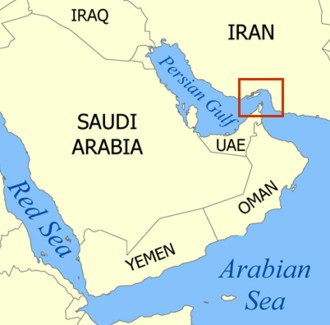
The red box marks the Strait of Hormuz, linking the Persian Gulf to the Gulf of Oman and the Arabian Sea, with Iran to the north and Oman’s Musandam peninsula to the south.
◈ 2. Static Background — Maritime Zones under UNCLOS
The United Nations Convention on the Law of the Sea (UNCLOS) was adopted in 1982 at Montego Bay and entered into force in 1994; India ratified it in 1995. It divides the sea into zones measured from a coastal baseline, each with different rights for the coastal State and for foreign ships.
- Territorial sea (up to 12 nautical miles): full sovereignty of the coastal State, subject to foreign ships’ right of innocent passage.
- Contiguous zone (up to 24 nm): limited control for customs, fiscal, immigration and sanitary laws.
- Exclusive Economic Zone (EEZ, up to 200 nm): sovereign rights over resources; other States keep freedom of navigation.
- High seas: beyond national jurisdiction, open to all.
- Key geometry: where a strait is narrower than 24 nm, the 12-nm territorial seas of the two shores meet, leaving no high-seas corridor — the situation in both Malacca-Singapore and Hormuz.
Figure 3 — Why narrow straits become territorial waters
Strait wider than 24 nm12 nm TSHigh seas /EEZ corridor12 nm TSShips use the free corridorStrait narrower than 24 nmState AState BSeas meet at a median line — no free corridor
Once both shores claim 12-nm territorial seas, the two zones meet at a median line and a narrow strait becomes entirely territorial water — the problem that transit passage was designed to solve.
◈ 2. Static Background — Three Passage Regimes
- Innocent passage (Articles 17–19): passage that is not prejudicial to the coastal State’s peace, good order or security; submarines must surface and show their flag, and the coastal State may temporarily suspend it for security.
- Transit passage (Part III, Articles 37–44): for straits used for international navigation between two parts of the high seas or EEZs; ships and aircraft, including warships and submerged submarines, may pass “continuously and expeditiously”. It cannot be suspended.
- Archipelagic sea lanes passage (Part IV): through designated lanes in the waters of an archipelagic State such as Indonesia or the Philippines.
- Earlier precedent: the International Court of Justice’s Corfu Channel case (1949) recognised peacetime passage of warships through international straits.
- Article 43: encourages user States and strait States to cooperate on navigational aids and pollution control — the legal basis for the Malacca Cooperative Mechanism.
3. Key Dimensions — How the Malacca-Singapore question was settled
- Geography: the Strait of Malacca runs about 800 km between the Malay Peninsula and Sumatra; the Strait of Singapore (about 105 km) connects it to the South China Sea.
- Archipelagic claim (1957): Indonesia’s Djuanda Declaration treated all waters between its islands as Indonesian waters, reflecting post-colonial security concerns.
- 1971 joint statement: Indonesia, Malaysia and Singapore rejected treating the Straits as “international”, while Singapore — a trade-dependent State — focused on navigational safety.
- Great-power position: the U.S. and the Soviet Union, otherwise rivals, both sought unimpeded transit; Japan chose cooperation through the Japan-funded Malacca Strait Council.
- The UNCLOS bargain: the United Kingdom’s transit passage proposal was accepted; Indonesia traded acceptance for recognition of the archipelagic regime, and Malaysia focused on environmental safety and vessel draught.
- 2007 Cooperative Mechanism: littoral and user States, with industry, jointly fund safety measures through an Aids to Navigation Fund; the littoral States levy no tolls or fees on transit.
3. Key Dimensions — Why Hormuz is different
- Geography: Hormuz links the Persian Gulf with the Gulf of Oman; at its narrowest it is about 21 nautical miles, so the territorial seas of Iran and Oman overlap.
- Treaty status: Iran has signed but not ratified UNCLOS, and its 1993 maritime law requires foreign warships to seek prior authorisation — which the author calls a continuing sore point. Oman has ratified; the U.S. is not a party but treats the navigation rules as customary law.
- Nature of the dispute: Malacca was about safety of navigation and the marine environment; Hormuz, the author argues, is about Iran’s security amid active conflict.
- Timing: the Malacca settlement was part of the package deals that made UNCLOS possible; no comparable global negotiation now exists to absorb trade-offs.
- Regional diplomacy: Qatar has supported the Iran-Oman talks and, the author notes, suggested the Malacca-Singapore model; the U.S. position remains decisive.
4. Critical Analysis — In favour of the Malacca model
- Proven cooperative design: littoral-led management with user-State funding has kept one of the world’s busiest waterways open for decades without tolls.
- Balances sovereignty and access: coastal States gain a formal role while user States retain non-suspendable transit.
- Technical fit: traffic separation schemes, hydrographic surveys and navigational aids are directly transferable to Hormuz.
4. Critical Analysis — Against, or limits of the analogy
- Security, not safety: an arrangement built on navigational cooperation cannot by itself resolve a dispute rooted in war, sanctions and blockades.
- Legal asymmetry: Iran’s non-ratification of UNCLOS weakens a transit-passage framework, since Iran contests that non-parties can claim its benefits.
- Control vs cooperation: the reported Iran-Oman routes place the entry lane within Iranian territorial waters, which user States may read as control rather than joint stewardship.
- Great-power acceptance: the Malacca model worked because major powers endorsed it; the author notes the U.S. may not accept even a Gulf-wide framework.
5. Way Forward
- Separate tracks: pair a technical navigation arrangement for Hormuz with a political track on sanctions, blockade and security guarantees.
- Include user States: a Malacca-style forum where major importers such as India, China, Japan and the EU fund safety without tolls could widen legitimacy.
- Anchor in UNCLOS principles: keep passage non-discriminatory and non-suspendable, whatever the institutional form.
- India’s interest: India, a large importer of Gulf crude and LNG with a large diaspora in the region, has a stake in any durable regime; its Navy has run Operation Sankalp since 2019 to escort Indian-flagged ships in the Gulf.
▤ 6. Data & Key Facts
- Malacca: about 800 km long; Singapore Strait: about 105 km.
- Hormuz: about 21 nautical miles at its narrowest; commonly estimated to carry around one-fifth of global oil consumption in normal times.
- UNCLOS: adopted 1982, in force 1994; Iran signed, not ratified; Oman ratified; U.S. not a party.
- 1971: Indonesia–Malaysia–Singapore joint statement; 2007: Cooperative Mechanism.
▤ 7. Prelims Pointers
- Transit passage: cannot be suspended; applies to warships and submerged submarines.
- Innocent passage: may be temporarily suspended; submarines must surface.
- Djuanda Declaration (1957): Indonesia’s archipelagic waters claim.
- Corfu Channel case (1949): first ICJ judgment; passage through straits.
- Aids to Navigation Fund: voluntary contributions, not tolls.
- Musandam peninsula: Omani exclave on the southern shore of Hormuz.
✎ 8. Mains Practice Question
Examine the relevance of the Malacca-Singapore Straits cooperative arrangement as a model for managing the Strait of Hormuz. What are its limitations in the present geopolitical context, and what are the implications for India? 15 marks · 250 words
- Introduction: overlapping territorial seas in both straits and the current disruption at Hormuz.
- Body: UNCLOS passage regimes; the Malacca settlement and 2007 mechanism; differences in legal status and nature of dispute.
- Conclusion: a technical framework linked to a political settlement, with India’s energy-security stake.