

Editorials, Opinions & Explained2 Items
Core TopicImportantConcise
Opinions & IdeasGS Papers II & III
01Quality Control Orders & manufacturing scale02BRICS, the Delhi summit & India's multi-alignment
Opinions & IdeasGeneral Studies Papers II & III
01
Quality Control Orders and manufacturing scale: the case for extending the reassessment to intermediate inputs
Core TopicOpinionGS-III · Economy — Industrial Policy, Standards, MSMEs; GS-II · IR — Trade PolicyPrelims + MainsThe Hindu · Opinion
The authors argue that mandatory quality regulation has expanded faster than its effects on supply chains have been assessed, and that the current reassessment exercise should be carried further — particularly for the intermediate goods that feed downstream manufacturing.
◈ The basics — what a Quality Control Order is
A QCO is the legal instrument that converts a voluntary Indian Standard into a mandatory requirement. Once a product is covered, it cannot be manufactured, imported, stored or sold in India without the BIS Standard Mark.
- Statutory basis: issued by the administrative ministry concerned under the BIS Act, 2016, read with the powers of the Central Government; certification and enforcement rest with the Bureau of Indian Standards, the national standards body under the Ministry of Consumer Affairs, Food and Public Distribution.
- Why they are used: to keep sub-standard and unsafe goods — often low-cost imports — out of the domestic market, and to protect consumers where the buyer cannot judge quality before purchase.
- Certification schemes: Scheme-I of the BIS (Conformity Assessment) Regulations, 2018 is the product-certification licence granted to a manufacturer for a factory; Scheme-II is the certificate of conformity applicable to a batch or consignment. The distinction matters for the new order below.
- Trade dimension: because a QCO applies equally to imports, trading partners treat it as a technical barrier to trade, governed at the WTO by the TBT Agreement, which requires such measures to be non-discriminatory and no more trade-restrictive than necessary.
Figure 1 — The expansion and the reset
201988Dec 2024765End-2025 onwardpace slowsrevocations& suspensionsProducts coveredOver 600 covered products remain to be reassessed, many of them intermediate inputs.
A near nine-fold expansion in five years, followed by a policy correction concentrated on intermediate goods.
▤ The record as the authors set it out
- Coverage: from 88 products in 2019 to 765 by end-December 2024; expansion slowed considerably towards the end of 2025, with several QCOs revoked or suspended — particularly those on intermediate goods, where mandatory certification had raised concerns about input availability, cost and supply-chain disruption.
- The new instrument: the Transition Facilitation (Quality Control) Order, 2026, notified by DPIIT on 25 June 2026. It permits eligible firms that face difficulty obtaining BIS Scheme-I certification to source temporarily from Scheme-II-licensed suppliers in specified sectors — toys, footwear and air conditioners among them — subject to eligibility criteria and approval by a DPIIT-constituted committee.
- What remains: more than 600 QCO-covered products are yet to be reassessed, including critical intermediate inputs used in chemicals, steel, textiles, machinery and electronics, and rubber and plastics.
- External scrutiny: QCOs and other non-tariff measures were raised at the WTO's eighth Trade Policy Review of India in July 2026 — by the European Union and the United States, and also by fellow BRICS members including Brazil, China and Indonesia.
The CSEP study on chemical inputs
- Exposure: the first QCO for a chemical product came in 2018; coverage rose to 52 chemical products by 2024. The share of chemical-using firms facing regulation on the input side rose from 11.8% in 2019 to 56.6% in 2024.
- Larger firms: input QCOs are associated with a 9.6% increase in production alongside a 37% decline in gross value added — output sustained, value addition compressed, consistent with higher input costs partly passed on through output prices.
- Smaller firms: no statistically significant effect on production or GVA, but a 47.6% decline in profitability — limited ability to absorb higher input costs and the compliance costs of certification.
- The authors read this as evidence that the burden is not confined to small firms: even large firms able to sustain output can see value addition fall.
Figure 2 — Where the burden lands, by firm size
Estimated effects of QCOs on chemical inputs, downstream user firmsLarger firmsProduction ▲ 9.6%Gross value added ▼ 37%Output held, value addition squeezedSmaller firmsProduction / GVA: no significant effectProfitability ▼ 47.6%Costs absorbed out of marginsSource: CSEP study cited in the column; estimates are associations, not established causation.
The same regulation transmits differently depending on a firm's capacity to absorb cost.
What the authors recommend
- Focus the next phase of rationalisation on intermediate goods, assessing not only product quality but input availability, cost, competitiveness and domestic value addition.
- Make supply-chain implications an integral part of both the design of new QCOs and the reassessment of existing ones.
- Give MSMEs dedicated assistance with certification and compliance, with appropriately designed exemptions or transition periods where costs are particularly burdensome.
- Judge the regime not by the number of products brought under mandatory regulation, but by whether it improves quality without constraining scale, efficiency and competitiveness.
◈ The other side of the argument
A balanced answer should register the case for the regime, which the column does not develop.
- Consumer and safety rationale: mandatory standards address information asymmetry in goods whose quality cannot be inspected at purchase — helmets, pressure cookers, toys, electrical fittings.
- Import surge management: QCOs have been used to restrain low-priced imports of uncertain quality, and are one of the few WTO-consistent instruments available once tariffs are bound.
- Standards as an export enabler: firms that meet demanding domestic standards are better placed for regulated export markets, which is the usual argument for standards-led upgrading.
- The counterpoint stands nonetheless: standards bind only if certification capacity — testing laboratories, NABL-accredited facilities, BIS inspection bandwidth — keeps pace, otherwise the regulation becomes a queue rather than a quality filter.
✎ Mains Practice Question
Mandatory quality standards are intended to raise product quality, but may also raise input costs for downstream industry. Examine this trade-off in the Indian context, and suggest principles for the design of quality regulation consistent with manufacturing competitiveness. 15 marks · 250 words
02
BRICS after the Delhi summit: internal divisions, external convergence, and India's case for multi-alignment
Core TopicOpinionGS-II · IR — Groupings and Agreements Involving India, Bilateral RelationsPrelims + MainsThe Hindu · Opinion
Writing after the 18th BRICS summit hosted by India in New Delhi on 12–13 September 2026, the authors argue that the grouping's internal contradictions and its members' external convergence are not in tension but are together the reason the platform retains value for India.
◈ The basics — what BRICS is
- Origin: the term "BRIC" was coined by Jim O'Neill of Goldman Sachs in 2001; the countries began meeting as a group in 2006 and held their first standalone summit at Yekaterinburg in 2009. South Africa joined in 2010, making it BRICS.
- Nature: an informal plurilateral grouping — no charter, no secretariat, no headquarters; the chair rotates annually and decisions are by consensus.
- Institutional outputs: the New Development Bank (Fortaleza Agreement, 2014; headquartered in Shanghai, first president K.V. Kamath) and the Contingent Reserve Arrangement, a currency-swap facility.
- Expansion: membership was enlarged following the Johannesburg summit of 2023; the infographic below reflects the membership as presented for the India-hosted 2026 edition.
Figure 3 — BRICS member countries, 2026
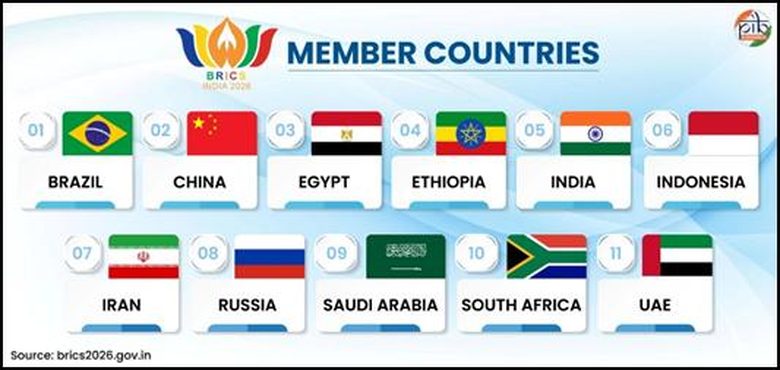
Eleven members as listed for the 2026 summit. Image courtesy Press Information Bureau / brics2026.gov.in; reproduced with credit for educational use.
The three positions the authors identify in Indian debate
- Optimists: BRICS can function as an institution capable of multipolarising the global order, or of hastening that transition.
- Sceptics: the grouping's internal divisions leave it vulnerable to domination by Russia and China.
- Dismissers: it is an annual gathering generating strategic noise; India should instead concentrate on the partnership with the United States.
▤ The authors' reading of the Delhi summit
- Consensus among 11 members — including the UAE and Iran, described as being in an undeclared conflict — is treated as an achievement in itself, and the Delhi Declaration as evidence that members continue to value a shared worldview oriented towards a more representative global order.
- A platform for managing rivalry: with border problems with China unresolved, multilateral forums let India and China remain engaged when high-level bilateral visits are not taking place — creating, in the authors' phrase, guardrails for competitive coexistence. The absence of any comparable channel between Ukraine and Russia is offered as the counter-example.
- Convergence despite difference: on AI regulation, trade and financial rules, climate change, border conflicts and the status of multilateral bodies, members differ in approach but converge on opposition to unilateralism by any bloc or power.
- India's balancing: the authors describe India as having repositioned itself as a balancer in West Asia after an initial period of reticence, using SCO and BRICS platforms to do so without damaging its bilateral relationships.
The argument on strategic autonomy
- The authors do not argue for downgrading relations with the United States, which they call extremely important for India's progress; their claim is narrower — that India should not become a frontline in US–China competition.
- They read BRICS as enabling that path without requiring India to champion an anti-US agenda.
- They contrast the formulation of "sabka saath" or multi-alignment with the reading of Indian foreign policy as a tilt towards Washington, and hold that India has not abandoned what they call the hesitations of its strategic realism.
- The structural claim: BRICS is unlike the G-7, where American primacy and the Western order are accepted by all members; its internal divisions themselves prevent domination by any single member, while external convergence — a shared belief that the post-war international system is unfair — holds it together.
◈ Static background and counter-arguments for a balanced answer
- India's other affiliations pull in different directions and should be named together: the Quad with the US, Japan and Australia; the SCO with Russia, China, Pakistan and the Central Asian states; the I2U2 and IMEC in West Asia; the G-20, which India chaired in 2023. Multi-alignment is the label for holding these simultaneously.
- Strategic autonomy is the successor concept to non-alignment: not equidistance, but the retention of independent decision-making across issues.
- The de-dollarisation question: proposals for BRICS local-currency settlement and a common unit of account are frequently discussed; India has publicly distanced itself from any project aimed at replacing the US dollar, favouring trade in national currencies for efficiency rather than as a political programme.
- Counter-arguments the column does not press: enlargement dilutes coherence and may amplify the China–Russia axis; consensus decision-making can reduce declarations to lowest-common-denominator language; and the grouping has limited enforcement capacity, with the New Development Bank still small relative to the Bretton Woods institutions.
- A caution on sourcing: the column's account of the war in West Asia, the Bishkek resolution and the September 2026 sanctions legislation reflects the authors' framing and the record as reported; examiners will expect the events to be described neutrally and attributed, not adopted as editorial judgement.
✎ Mains Practice Question
"The internal contradictions of BRICS are not an argument against the grouping but a condition of its survival." Critically examine this proposition with reference to India's pursuit of strategic autonomy in a polarised international order. 15 marks · 250 words