

Editorials, Opinions & Explained2 Items
Core TopicImportantConcise
OpinionsGS II · GS III
01India & the Emerging Global Energy Order02Women’s Reservation & Delimitation
OpinionsSigned op-eds · General Studies Papers II & III
01
India’s Place in the Emerging Global Energy Order — Security, Transition and the Hormuz Shock
Core TopicOpinionGS-III · Economy — Infrastructure: Energy; Environment — Climate ChangeGS-II · IR — West Asia, Effect of Policies of Other Countries on IndiaPrelims + MainsThe Hindu · Opinion
Written by a retired Indian Ambassador specialising in West Asia, the piece argues that the 2026 Strait of Hormuz crisis has exposed a fragile, fossil-fuel-based energy order — and that India, the world’s largest driver of energy-demand growth, must balance rising demand with security and sustainability.
◈ From the Basics — Key Concepts
- Primary energy is energy in its raw form (crude oil, coal, natural gas, uranium, sunlight, wind); final energy is what reaches the user (petrol, electricity, LPG) after conversion and losses.
- Energy security (IEA definition): the uninterrupted availability of energy sources at an affordable price. It has a long-term dimension (timely investment) and a short-term one (quick response to sudden supply shocks).
- It is often summarised as the “4 As” — Availability, Accessibility, Affordability, Acceptability (environmental and social). The World Energy Council’s “Energy Trilemma” frames the same tension as security, equity and sustainability.
- Electrification = rising share of electricity in final energy use (EVs, heat pumps, induction cooking). Electricity can be generated from domestic renewables, so electrification is now treated as an energy-security tool, not just a climate tool.
◈ Static Anchor — Oil Shocks, the IEA and Strategic Reserves
The modern energy-security architecture was born of crisis. The 1973 oil shock (OAPEC embargo during the Yom Kippur War) quadrupled crude prices; the 1979 shock followed the Iranian Revolution.
- The International Energy Agency (IEA) was created in 1974 within the OECD framework, headquartered in Paris. Members must hold emergency oil stocks equal to 90 days of net imports.
- India joined as an Association country in 2017; it is not a full member (full membership requires OECD membership).
- The IEA’s flagship annual report is the World Energy Outlook (WEO); its scenarios include the Stated Policies Scenario (STEPS) and Net Zero Emissions by 2050 (NZE).
- India’s Strategic Petroleum Reserves (managed by ISPRL) hold 5.33 MMT in underground rock caverns at Visakhapatnam (1.33), Mangaluru (1.5) and Padur (2.5) — roughly 9–10 days of crude needs; Phase II plans Chandikhol (Odisha) and an expanded Padur.
◈ Geography Anchor — The Strait of Hormuz
- Links the Persian Gulf to the Gulf of Oman and the Arabian Sea; bounded by Iran to the north and Oman’s Musandam Peninsula to the south.
- About 33 km (21 nautical miles) wide at its narrowest; usable shipping lanes are only about 3 km in each direction, separated by a buffer.
- In normal times it carries roughly one-fifth of global oil and LNG trade, including exports of Saudi Arabia, Iraq, the UAE, Kuwait, Qatar and Iran.
- Legal regime: Hormuz is a strait used for international navigation; UNCLOS (1982), Part III grants ships the right of transit passage, which coastal States may not suspend. Iran has signed but not ratified UNCLOS.
- Bypass routes are limited: Saudi Arabia’s East–West (Petroline) pipeline from Abqaiq to Yanbu on the Red Sea, and the UAE’s Habshan–Fujairah (ADCOP) pipeline to the Gulf of Oman.
Figure 1 — The Hormuz chokepoint, Gulf energy hubs and the bypass routes
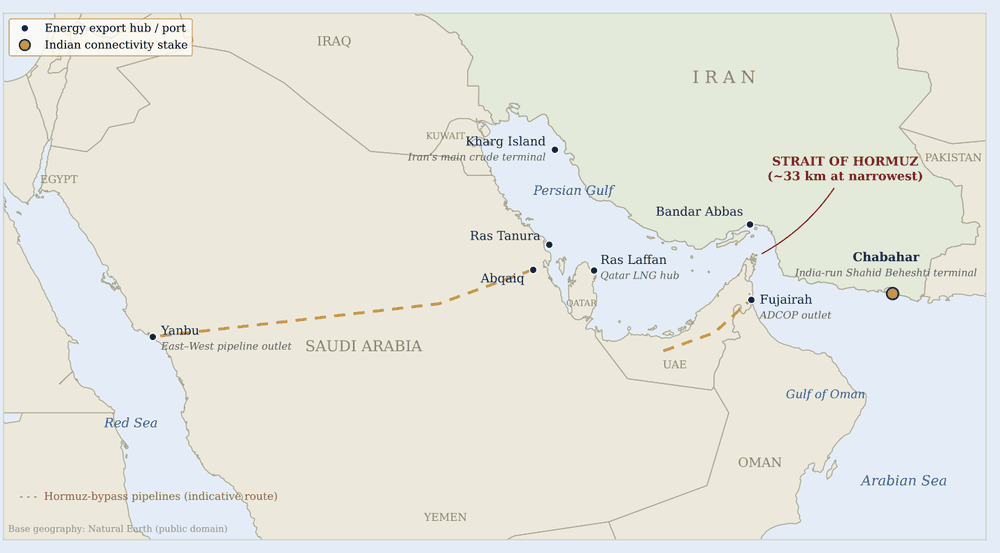
Almost every Gulf producer depends on one 33-km-wide passage; only Saudi Arabia and the UAE have pipelines that partly bypass it. India’s Chabahar stake lies just outside the strait. Base geography: Natural Earth 1:10m, public domain; pipeline routes indicative.
The Current Hook — The 2026 Shock and WEO-2026
The crisis began with the US–Israeli strikes on Iran on 28 February 2026. Shipping through Hormuz was effectively halted, and Qatar’s Ras Laffan — the world’s largest LNG liquefaction facility — was knocked offline after an attack on 2 March.
- The IEA’s World Energy Outlook 2026, released on 19 November 2026 while COP31 was under way in Antalya, Türkiye, called the Hormuz crisis the “largest threat to energy security in history”, larger than the 1970s oil shocks.
- The conflict has caused cumulative losses of about 2.8 billion barrels of oil and 60 bcm of natural gas.
- Three-quarters of the world’s population live in oil- and gas-importing countries, and over 4 billion people live in countries that depend on Hormuz for more than 30% of their oil supply.
- Before the war, most Hormuz hydrocarbons went to Asia; the rest largely met Africa’s basic needs. Both continents’ transport and agriculture (fertiliser, diesel) were hit.
- As of mid-November, Hormuz traffic was still roughly 65% below pre-conflict levels despite a ceasefire.
The Fault Lines of Today’s Energy Order
The author identifies four cross-currents that destabilised the system this decade: the COVID-19 pandemic, the El Niño effect and climate change, wars in Ukraine and the Gulf, and the US shale phenomenon. Underneath them lie three structural fault lines.
- Inequality: global energy demand has tripled in 50 years, yet about 720 million people lack electricity and nearly 2 billion cook on polluting fuels — while gigawatt-scale data centres mushroom and the world now spends more energy on cooling than heating.
- Fossil concentration: fossil fuels still met 86.2% of global primary energy in 2025 (Energy Institute Statistical Review of World Energy 2026), sourced from a few geographies — creating bottlenecks, the “resource curse”, pollution and climate risk.
- Climate gap: warming beyond 1.5°C risks irreversible damage, yet current trends point to about 2.5°C by 2100; the author notes the failure of COP31 to agree on fossil-fuel phase-out and clean-technology finance.
Figure 2 — Global primary energy mix, 2025 (%)
Fossil fuels 86.2% · Low-carbon 13.8%Oil33.5Coal27.7Natural gas25.1Renewables*5.9Nuclear5.2Hydro2.7*Solar, wind, geothermal, biomass, biofuels (excl. hydro). Source: Energy Institute, Statistical Review of World Energy 2026 (data for 2025).
Five decades after the first oil shock, oil, coal and gas still supply six of every seven units of the world’s primary energy.
Signs of a New Order — Two Transitions
The piece finds hope in two trends that energy-security fears are now accelerating rather than slowing.
- Electrification: electricity is 23% of global final energy today; the WEO expects about 30% by 2035, bringing efficiency gains in generation and end-use appliances. (The COP31 Presidency’s voluntary “35-by-35” pledge targets 35%.)
- Renewables as force-multiplier: their share in global electricity is projected to rise from about one-third to one-half by 2035; energy importers have invested about $500 billion a year in renewables and efficiency since 2022.
- Nuclear revival: about 90 GW of nuclear capacity is under construction globally, reversing a long decline.
- Grids are the bottleneck: the next decade needs about 25 million km of new lines and upgrades to 16 million km of existing ones.
- Upstream paradox: about $540 billion a year goes into oil and gas upstream, but ~90% only offsets natural decline in existing fields — so localised gas shortages may persist even if an oil glut appears.
- The IEA judges many crisis-driven steps to be irreversible and repeats that global oil demand may peak by 2035 — but warns even vigorous short-term action may not halt climate deterioration.
India’s Rising Energy Appetite
3rd
largest primary energy consumer (≈6.1% of world)
~3×
India’s demand growth vs global average to 2035
~90%
of crude oil needs imported (≈50% of gas)
1,460 kWh
per-capita electricity use, 2024-25 (Ministry of Power)
- India is the second-largest consumer of coal, the third-largest power producer and crude-oil consumer, and among the world’s top holders of renewable capacity.
- Yet the average Indian is energy-thrifty: per-capita electricity use is a fraction of the world average. (The article puts it at about a third; official data show 1,460 kWh in 2024-25, up from 957 kWh in 2013-14.)
- Demand is projected to grow about 2.5% a year to 2035, driven by incomes, urbanisation, industry, transport (about 12,000 new cars a day) and cooling (about 200 million new air-conditioners). The IEA calls India the world’s largest driver of energy-demand growth to 2035.
- India imports about 40% of its total energy; electricity is 22% of final energy use and may double by 2047.
- The capacity–generation gap: non-fossil sources crossed 50% of installed power capacity in 2025 — five years ahead of the 2030 NDC goal — but about 70% of electricity generated still comes from fossil fuels, mainly coal.
- Over 2025–35, oil demand may rise by 1.3 mb/d (26%), coal output by nearly 30%, and annual energy investment to about $200 billion — 85% above 2025.
▤ India’s Policy Anchors (Prelims-ready)
- Energy independence by 2047 — the stated national ambition (announced on Independence Day, 2021).
- Panchamrit (COP26, Glasgow, 2021) and the updated NDC (2022): 45% cut in emissions intensity of GDP from 2005 levels and 50% cumulative non-fossil power capacity by 2030; net zero by 2070.
- National Green Hydrogen Mission (2023): 5 MMT green hydrogen production capacity a year by 2030.
- E20 (20% ethanol blending in petrol) achieved in 2025, cutting crude import needs.
- SHANTI Act, 2025 opens nuclear power to private participation towards the target of 100 GW nuclear by 2047.
- Bureau of Energy Efficiency (BEE) under the Energy Conservation Act, 2001; PAT scheme for energy-intensive industry; Carbon Credit Trading Scheme, 2023.
- International Solar Alliance (launched at COP21, Paris, 2015; HQ Gurugram).
Figure 3 — Four levers of an energy-security strategy
ENERGY SECURITYavailable · affordable · sustainableREDUCEEfficiency firstBEE · PAT schemeAppliance labelsPublic transportCool-roof / ECBCDIVERSIFYMore supplier nationsLong-term LNG dealsRoutes: Chabahar,IMEC, INSTCOverseas equity (OVL)SUBSTITUTESolar · wind · storageGreen hydrogenNuclear (100 GW)EVs · e-cookingEthanol · CBGBUFFERStrategic reservesISPRL 5.33 MMTPhase II cavernsGas storageGrid-scale batteries
The 2026 shock rewards the two levers that need no imports — efficiency and domestic electricity — while reserves only buy time.
Critical View — Where the Strategy Strains
- Coal lock-in vs climate: coal is India’s most “secure” fuel (domestic reserves) but its dirtiest; rising coal output collides with the 2070 net-zero path and air-quality goals.
- Intermittency and storage: solar and wind need batteries, pumped storage and transmission; capacity added without these is often curtailed.
- New dependencies: lithium, cobalt, rare earths and solar modules are concentrated in a few countries — critical-mineral security may replace oil security as the next chokepoint.
- DISCOM finances: loss-making distribution companies weaken the investment chain on which electrification depends.
- Just transition: coal districts of Jharkhand, Odisha and Chhattisgarh depend on mining jobs and royalties.
- Affordability: price shocks pass through to diesel, fertiliser and LPG; subsidies strain the fiscal deficit.
Way Forward
- De-emphasise oil and gas over time; accelerate electrification and dramatically improve efficiency, as the author recommends.
- Expand strategic reserves (Phase II) and diversify sources and routes that avoid single chokepoints.
- Pair renewable capacity with storage and grid investment; reform DISCOMs.
- Build a critical-minerals strategy through KABIL, the Minerals Security Partnership and recycling.
- Use energy diplomacy in West Asia — India’s ties with both Iran and the Gulf States give it a voice for keeping sea lanes open.
Done well, the author concludes, a comprehensive energy strategy would not only deliver energy independence but also drive economic growth and help clean up the environment.
✎ Mains Practice Question
The 2026 disruption in the Strait of Hormuz has exposed the limits of an import-dependent energy model. Critically examine India’s energy-security strategy and suggest how the goal of “energy independence by 2047” can be reconciled with its climate commitments. 15 marks · 250 words
02
Women’s Reservation and Delimitation — Two Routes to Political Equality
Core TopicOpinionGS-II · Polity — Parliament & State Legislatures, Constitutional Amendments, FederalismGS-I · Society — Women’s EmpowermentPrelims + MainsThe Indian Express · Opinion
As Parliament reconvenes on 30 November for a special session, the Union Government will try again to pass the Constitution (131st Amendment) Bill, 2026. The author argues that delimitation and women’s reservation both serve one value — equality of representation.
◈ From the Basics — What is Delimitation?
Delimitation means fixing the number of seats and the boundaries of constituencies on the basis of population, so that each vote carries roughly equal weight — the principle of “one person, one vote, one value.”
- Article 82 (Lok Sabha) and Article 170 (State Assemblies) require readjustment after every Census. Article 81 caps the Lok Sabha at 550 members (530 from States, 20 from UTs); its present strength is 543.
- The work is done by a Delimitation Commission set up under a Delimitation Act of Parliament. Its orders have the force of law and cannot be challenged in court (Article 329(a)).
- Commissions so far: 1952, 1963, 1973 and 2002 (the last chaired by Justice Kuldip Singh; its boundaries took effect in 2008).
- Article 330 and Article 332 reserve seats for SCs and STs in proportion to their population.
◈ Static Anchor — Why Seats Have Been Frozen Since 1976
- The 42nd Amendment (1976) froze the inter-State allocation of seats on the 1971 Census until 2001, so that States which succeeded in population control would not lose seats.
- The 84th Amendment (2001) extended the freeze until the first Census after 2026. It allowed boundaries within States to be redrawn; the 87th Amendment (2003) set the 2001 Census as the basis.
- As a result, a single Lok Sabha MP now represents very different populations in different States — the core “unequal vote” problem the author highlights.
Figure 1 — Delimitation and women’s reservation: the timeline
19521st Commission19632nd Commission19733rd (1971 Census)197642nd Amdt:freeze to 2001199273rd/74th: 1/3for women in PRIs200184th Amdt: freezeto post-2026 Census2002–084th Commission2023106th Amdt:1/3 for womenApr 2026131st Bill fallsshort in Lok SabhaNov 2026Special session(from 30 Nov)Blue = Delimitation Commissions · Maroon = seat freeze · Green = women’s reservation · Gold = the 2026 package
Inter-State seat shares have not changed in half a century; the 2026 package seeks to end the freeze and start women’s reservation together.
◈ Lineage of Women’s Reservation
- 73rd and 74th Amendments (1992): one-third reservation for women in Panchayats (Article 243D) and Municipalities (Article 243T); about 21 States have since raised it to 50% in panchayats.
- Legislative quota Bills of 1996 (examined by a Joint Committee chaired by Geeta Mukherjee), 1998, 1999 and 2008 failed; the 2008 Bill passed the Rajya Sabha in 2010 but lapsed in 2014.
- 106th Amendment Act, 2023 (Nari Shakti Vandan Adhiniyam) — passed in September 2023 as the 128th Amendment Bill — inserted Articles 330A (Lok Sabha), 332A (State Assemblies) and amended 239AA (Delhi).
- It reserves one-third of seats for women, including within SC/ST seats, for 15 years (Article 334A), with rotation after each delimitation. It does not cover the Rajya Sabha or State Legislative Councils, and has no OBC sub-quota.
- The catch: reservation begins only after delimitation following the first Census after 2023. With the Census still under way, it could not apply in 2029 on the original timeline.
The Current Hook — The 2026 Package
Three Bills were introduced on 16 April 2026: the Constitution (131st Amendment) Bill, the Delimitation Bill and the Union Territories Laws (Amendment) Bill.
- Raises the Lok Sabha’s maximum strength from 550 to 850 — up to 815 from States and 35 from UTs. About 272 of 815 State seats would go to women.
- Removes the constitutional freeze: Parliament would decide by ordinary law when delimitation happens and which Census is used. The Delimitation Bill uses the latest published Census — i.e. 2011.
- Replaces Article 334A so that women’s reservation starts immediately after this delimitation, without waiting for the next Census.
- The Commission would be chaired by a serving or retired Supreme Court judge, with the Chief Election Commissioner (or nominee) and the relevant State Election Commissioner.
- On 17 April 2026 the Bill got 298 votes for and 230 against — short of the two-thirds of members present and voting that Article 368 requires. The Delimitation Bill was then withdrawn.
▤ Prelims Trap — How the Constitution is Amended Here
- Special majority (Article 368(2)): a majority of the total membership of each House and two-thirds of members present and voting, in each House separately. No joint sitting is allowed for amendment Bills.
- Because the Bill changes the “representation of States in Parliament”, the proviso to Article 368(2) also requires ratification by at least half of the State Legislatures.
- Delimitation Commission orders are final; Article 329(a) bars courts from questioning them.
The Author’s Case — Representation as Equality
- Equal vote: delimitation is a basic feature of any working democracy; it keeps constituency populations roughly equal, so each vote has the same weight.
- Historical exclusion: during the first general election (1951-52), many women were enrolled only as “wife of” or “daughter of”; the Election Commission under Sukumar Sen removed about 28 lakh such entries.
- Voters but not legislators: in 2019, women’s turnout (67.18%) exceeded men’s for the first time, and some States had more women than men on the rolls. Yet women hold only 74 of 543 seats (~13.6%) in the 18th Lok Sabha, against a global average of about 27%.
- Legitimacy: drawing on political theorist Iris Marion Young, the author argues that the presence of women itself strengthens the democratic legitimacy of institutions — a corrective to structural exclusion.
- Evidence from panchayats: economists Raghabendra Chattopadhyay and Esther Duflo (2004) found that women heads of reserved panchayats in West Bengal and Rajasthan invested more in public goods women prioritised, such as drinking water.
- The author urges moving past North–South and ruling–opposition binaries, and sees the reform as benefiting future generations, especially Gen Z women.
Figure 2 — How seat shares could shift on the 2011 Census (if the Lok Sabha stayed at 543)
3932Tamil Nadu2015Kerala8089Uttar Pradesh4046Bihar2530RajasthanSeats todayProjected (loss)Projected (gain)Source: PRS Legislative Research, analysis of the Constitution (131st Amendment) Bill, 2026 — projection with total seats unchanged.
Re-allocating a fixed House by population shifts weight northward; enlarging the House to 815 is meant to let no State lose seats in absolute terms, though relative shares still change.
Critical View — Why the Package is Contested
- Federal fairness: southern and some north-eastern States that stabilised population fear a lower relative voice — the very concern the 1976 freeze addressed.
- An old Census: delimitation on 2011 data in the late 2020s would rest on figures about 15 years old.
- Executive discretion: letting Parliament fix the timing and Census by ordinary law, with a simple majority, removes a constitutional safeguard (a point flagged by PRS).
- Bicameral balance: with the Rajya Sabha capped at 250, the Lok Sabha–Rajya Sabha ratio would move from about 2.2:1 to 3.3:1, lowering the Upper House’s weight in joint sittings and in presidential and vice-presidential elections.
- Linkage: critics argue the quota could apply within the existing 543 seats, and that tying it to delimitation delays an agreed reform.
- Other gaps: no OBC sub-quota; no quota in the Rajya Sabha; the 15% cap on the Council of Ministers (Article 75(1A)) would allow about 122 ministers; and MPs in a larger House would get less floor time.
- Substantive vs symbolic: the “proxy” (pradhan-pati) problem in panchayats shows that seats alone do not ensure real agency.
Way Forward
- Separate the two questions where possible: secure women’s reservation on a clear timeline while delimitation is negotiated through broad consensus.
- Protect relative shares through formulas such as proportional expansion or a population cap, and compensate population-stabilising States through fiscal federalism (Finance Commission criteria).
- Use the latest Census and an independent, transparent Commission with public hearings.
- Strengthen the Rajya Sabha as the House of States if the Lok Sabha expands.
- Pair quotas with party-level nomination norms, leadership training and action against proxy representation.
The author’s closing argument: if delimitation equalises the vote and reservation equalises the voice, together they can bring India’s institutions closer to the constitutional promise of substantive equality.
✎ Mains Practice Question
“Delimitation seeks equality of the vote; women’s reservation seeks equality of representation.” In the light of the Constitution (131st Amendment) Bill, 2026, discuss whether linking the two strengthens Indian democracy or strains its federal balance. 15 marks · 250 words