
In-Depth PIB Analysis2 Items
Core TopicImportantConcise
Social Justice & GovernanceGS Paper II · III
01India’s Social Security Coverage — EPFO Reforms & the Social Security Code
Science & TechnologyGS Paper III
02GSLV-F18 / NVS-03 & the NavIC Constellation
Social Justice & GovernanceGeneral Studies Paper II · Paper III
01
India’s Social Security Coverage: EPFO Reforms, the Social Security Code and the Road to Universal Protection
Core TopicGS-II · Social Justice — Welfare Schemes, Vulnerable SectionsGS-III · Inclusive Growth & EmploymentPrelims + MainsPIB Backgrounder · Ministry of Labour & Employment · 31 Oct 2026
A PIB backgrounder puts India’s social protection coverage at 68.4% in 2026, up from 19% in 2015, and sets out the EPFO reforms behind the expansion — a higher ₹25,000 wage ceiling, liberalised PF withdrawals and the EPFO 3.0 core-banking platform. The examinable question is how far wider coverage has become adequate protection.
◈ From the Basics — What Is Social Security?
Social security protects people against loss of income from old age, sickness, disability, maternity, employment injury, unemployment or the death of a breadwinner. Article 22 of the UDHR (1948) recognises it as a right, and SDG target 1.3 asks every country to build social protection systems and floors for all.
- Social insurance is contributory: workers and employers pay in, and benefits are linked to contributions — e.g. EPF, EPS and ESI.
- Social assistance is non-contributory and tax-funded — e.g. old-age, widow and disability pensions under NSAP.
- Constitutional base: Article 41 (public assistance in old age, sickness, disablement and unemployment), Article 42 (just and humane work conditions and maternity relief) and Article 43 (living wage) — all Directive Principles, so not justiciable.
- Who legislates: Concurrent List Entry 23 (social security and social insurance; employment and unemployment) and Entry 24 (welfare of labour, incl. provident funds, old-age pensions, maternity benefits) — both Parliament and States can legislate.
Figure 1 — India’s social security architecture
CONSTITUTIONAL BASEDPSP Articles 41 · 42 · 43 | Concurrent List Entries 23 & 24Code on Social Security, 20209 central Acts merged · in force from 21 November 2025FORMAL WORKERSContributory social insurance• EPFO: EPF · EPS · EDLI• ESIC: health & cash benefits• Wage ceiling ₹25,000 (2026)• Gratuity · maternity benefitUNORGANISED & GIGRegistration + voluntary schemes• e-Shram: 31.89 crore workers• PM-SYM: ₹3,000/month at 60• Gig & platform worker fund• Aggregator levy 1–2% turnoverSOCIAL ASSISTANCENon-contributory, tax-funded• PM Samajik Sahayata Yojana(revamped NSAP, 2026–31)• Old-age · widow · disability• Family benefit ₹20,000DIGITAL RAILSUAN · Aadhaar seeding · UMANG · CPPS · Digital Life Certificate · EPFO 3.0
Contributory insurance covers formal workers, registration and voluntary schemes target the unorganised, and tax-funded assistance protects the most vulnerable — all now anchored in one Code.
▤ EPFO at a Glance
- Nature: statutory body under the Employees’ Provident Funds and Miscellaneous Provisions Act, 1952; administrative Ministry of Labour & Employment; governed by a tripartite Central Board of Trustees (CBT) chaired by the Union Labour Minister.
- Three pillars (re-notified in 2026 under the Code): EPF 2026 (retirement savings, replacing the EPF Scheme, 1952), EPS 2026 (monthly pension, replacing EPS 1995) and EDLI 2026 (death-in-service insurance up to ₹7 lakh, no member premium, replacing EDLI 1976).
- Mandatory wage ceiling: ₹6,500 → ₹15,000 (September 2014) → ₹25,000 (approved September 2026); the Government expects over 51 lakh more employees to come under mandatory cover (government projection).
- Scale: 7.98 crore contributing members (16 Sept 2026) against 3.49 crore in 2014-15; 7.68 lakh contributing establishments; ~82 lakh pensioners (from 51.04 lakh); 6.42 crore claims settled in a year (from 1.30 crore).
- Funding: contributory — a statutory share of wages from both employee and employer, with part of the employer’s share routed to the pension fund.
Figure 2 — The scale-up, 2014-15 vs 2026
EPFO contributingmembers (crore)3.497.982014-152026EPS pensioners(lakh)51.04~822014-152026Claims settledin a year (crore)1.306.422014-152026Social protectioncoverage (%)1968.420152026Each panel has its own scale. 2026 values: members as on 16 Sept; pensioners till Sept; claims for the year to Oct.
EPFO membership has more than doubled and annual claims have roughly quintupled since 2014-15. Data: Ministry of Labour & Employment (PIB backgrounder, 31 Oct 2026), recreated in the Legacy palette.
Lineage — From Scattered Acts to One Code
- 1923 Workmen’s (now Employees’) Compensation Act — employment injury; 1948 ESI Act — health insurance and cash benefits through ESIC.
- 1952 EPF & MP Act creates the provident fund and EPFO; EDLI added in 1976; EPS 1995 replaces the Family Pension Scheme, 1971.
- 1961 Maternity Benefit Act (leave raised to 26 weeks in 2017); 1972 Payment of Gratuity Act; 1995 NSAP launched for social assistance.
- 2002 the Second National Commission on Labour recommends grouping labour laws into codes; 2008 Unorganised Workers’ Social Security Act.
- 2020 the Code on Social Security merges nine central Acts; all four labour codes come into force on 21 November 2025, with central rules following in May 2026; EPF, EPS and EDLI are re-issued as 2026 schemes.
The EPFO Reforms, Decoded
Most of the backgrounder concerns EPFO and falls into three buckets: making money easier to withdraw, making disputes easier to settle, and moving services onto digital platforms.
- Partial withdrawals (October 2025): 13 provisions merged into 3 categories — Essential Needs (illness, education, marriage), Housing Needs and Special Circumstances; up to 10 withdrawals for education and 5 for marriage (earlier 3 combined); up to 75% of the PF balance, incl. employer share; minimum service standardised at 12 months.
- Faster claims: auto-settlement limit raised to ₹5 lakh; no upload of cheque leaf or attested passbook for eligible online claims.
- VISHWAS 2026: one-time digital settlement of disputes over damages or penalties under the 1952 Act and the Code; reduced monthly damages of 0.25%, 0.50% or 1% for defaults before 14 June 2024; fraud, misappropriation and falsification excluded.
- AMNESTY 2026: lets establishments with PF trusts recognised under the Income Tax Act, 1961 but lacking formal exemption regularise them retrospectively; open till 28 December 2026.
Going Digital
- Enrolment: automatic EPFO registration for new companies through the MCA forms SPICe+ and AGILE-PRO (since February 2020); self-generated UAN (since November 2019), and since April 2025 through Aadhaar face authentication on UMANG — 1.74 crore self-generated UANs by October 2026.
- Aadhaar seeding and correction through the UAN Member Portal (since August 2025), with employer approval where details match.
- Pensions: the Centralised Pension Payment System (CPPS) pays through any bank branch, so pensioners moving home need no PPO transfer; doorstep Digital Life Certificates through India Post Payments Bank, with EPFO bearing the ₹50 fee.
- EPFO 3.0: a core-banking, cloud-native, API-first platform; the Government expects risk-validated claims to settle in under 3 days instead of up to 20 days, for over 30 crore members (government projection).
Figure 3 — EPFO’s digital service stack
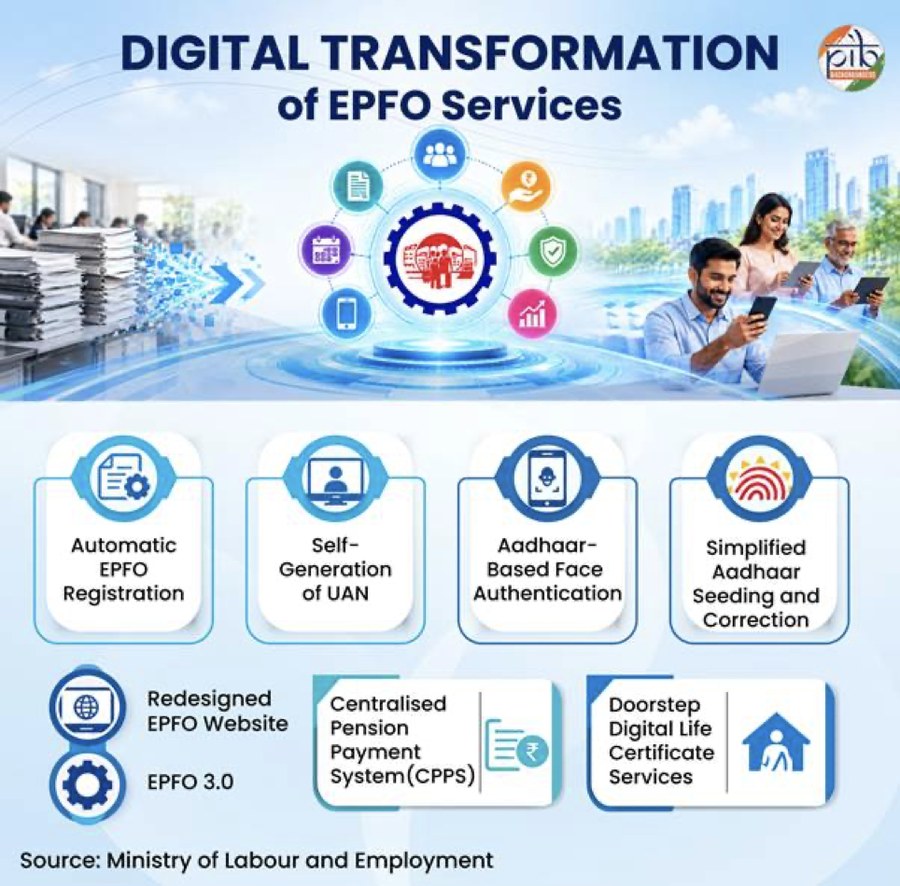
Eight digital reforms cover the full member journey — from enrolment and identity to claims and pension continuity. Image courtesy PIB / Ministry of Labour and Employment, 31 October 2026; reproduced with credit for educational use.
Beyond EPFO — The Unorganised and the Vulnerable
- Pradhan Mantri Samajik Sahayata Yojana (revamped NSAP, October 2026; 2026-27 to 2030-31): old-age pension ₹200 (60–79) and ₹500 (80+); widow pension ₹300 (40–79) and ₹500 (80+); disability pension ₹375 (below 80) and ₹625 (80+), with the disability threshold cut from 80% to 40% and no minimum age; one-time family benefit of ₹20,000 on the death of a breadwinner aged 18–59.
- Code on Social Security, 2020: recognises gig and platform workers and creates a Social Security Fund for them, financed partly by aggregators (1–2% of annual turnover, capped at 5% of payments to such workers); gratuity for fixed-term employees after one year; 26 weeks of maternity benefit, work from home where feasible and crèches.
- e-Shram (August 2021): India’s first Aadhaar-seeded National Database of Unorganised Workers, with 31.89 crore registrations (August 2026); its One-Stop Solution (October 2024) links 15 welfare schemes plus the National Career Service, Skill India Digital Hub and myScheme.
- PM-SYM (2019): a voluntary, contributory pension for unorganised workers aged 18–40 earning up to ₹15,000 a month — ₹3,000 a month after 60, with contributions of ₹55–200 matched 1:1 by the Centre.
Why It Matters
- Work is changing: gig, platform and informal work bring irregular incomes and no employer-linked pension, so protection must follow the worker, not the job.
- India is ageing: the UNFPA India Ageing Report 2023 projects the elderly share to cross 20% by 2050, making old-age income security a fiscal and social priority.
- The informal economy is large: the Government puts the unorganised sector’s contribution at about 50% of GDP, while most workers remain outside contributory schemes.
The Critical View
- Coverage is not adequacy: the headline measure (SDG indicator 1.3.1) counts anyone covered by at least one benefit. The central old-age pension of ₹200 a month for those aged 60–79 has stayed at that level for nearly two decades, and State top-ups vary widely.
- Registration is not protection: 31.89 crore e-Shram registrants far outnumber ~8 crore EPFO contributors; the database is valuable only if it delivers benefits.
- Voluntary schemes struggle: contributory schemes such as PM-SYM depend on steady monthly payments that workers with irregular incomes find hard to sustain.
- Gig workers: the Social Security Fund depends on aggregator levies and scheme design that are still being operationalised, and worker classification remains contested.
- Pension adequacy and federal gaps: the EPS minimum pension has stood at ₹1,000 a month since 2014; as a Concurrent subject, outcomes depend on State rules, and portability for inter-State migrants is uneven.
- Digital exclusion: Aadhaar and face-authentication failures can lock out the elderly; doorstep Digital Life Certificates are a partial answer.
▤ Institutions & Terms to Know
- EPFO (statutory, 1952, tripartite CBT) vs ESIC (statutory, 1948, health insurance) — a frequent Prelims pairing.
- UAN — Universal Account Number, a single portable PF identity for a worker across jobs; e-Shram also issues a UAN to unorganised workers.
- Gig worker — works outside a traditional employer–employee relationship; platform worker — a gig worker who finds work through an online platform; aggregator — the digital intermediary.
- Fixed-term employment — a contract for a set period, now carrying pro-rata gratuity after one year.
- CPPS, ECR, DLC — Centralised Pension Payment System; Electronic Challan-cum-Return (employer filing); Digital Life Certificate (Jeevan Pramaan).
✎ Mains Practice Question
India’s social protection coverage has risen sharply over the last decade, yet wider coverage does not by itself mean adequate protection. Critically examine this statement in the context of the Code on Social Security, 2020 and recent EPFO reforms. 15 marks · 250 words
Science & TechnologyGeneral Studies Paper III
02
GSLV-F18/NVS-03: Third Second-Generation Satellite Strengthens NavIC, India’s Regional Navigation System
Core TopicGS-III · S&T — Space Technology, IndigenisationGS-III · Security — Strategic InfrastructurePrelims + MainsPIB · Department of Space / ISRO · 01 Nov 2026
ISRO’s GSLV-F18 placed NVS-03, the third of five second-generation NavIC satellites, into a geosynchronous transfer orbit on 30 October 2026. It is headed for the 111.75° E slot that NVS-02 could not reach after its 2025 orbit-raising failure, so the launch restores a missing piece of India’s own navigation constellation.
◈ From the Basics — How Satellite Navigation Works
A navigation satellite continuously broadcasts its position and the exact time. A receiver measures how long each signal took to arrive and converts that into distance: range = speed of light × travel time.
- Trilateration: three ranges fix a position in three dimensions; a fourth satellite is needed because the receiver’s cheap clock is not synchronised — so at least four satellites must be in view.
- Why atomic clocks: light travels about 30 cm in one nanosecond, so a timing error of one microsecond shifts a range by about 300 m; rubidium atomic clocks keep satellite time stable.
- Why two frequencies: the ionosphere delays signals by different amounts at different frequencies; receivers comparing two bands (NavIC’s L5 and S) can cancel most of that error.
- Global vs regional: GNSS constellations cover the whole Earth — GPS (US), GLONASS (Russia), Galileo (EU), BeiDou (China); regional systems cover one area — NavIC (India), QZSS (Japan).
Figure 4 — How a navigation fix is computed
1234ReceiverEach satellite broadcasts position + timed = c × tRange = speed of light × timec ≈ 3 × 10⁸ m per second, so1 ns of clock error ≈ 30 cm of rangeWhy a fourth satellite?Three ranges fix x, y and z; the fourthsolves the receiver’s own clock errorWhy two bands (L5 + S)?Ionospheric delay depends on frequency;comparing two bands cancels most of it
Positioning is really timing: precise on-board clocks and multiple frequencies are what make a navigation fix accurate.
▤ Mission at a Glance
- Launch: 30 October 2026, 23:51 hrs, Satish Dhawan Space Centre (SDSC SHAR), Sriharikota.
- Vehicle: GSLV-F18, the 20th GSLV flight — a three-stage rocket with a solid core and four liquid strap-ons, a Vikas-powered liquid second stage and an indigenous cryogenic upper stage.
- Orbit: injected into GTO; first orbit-raising manoeuvre on 31 October 2026; final slot 111.75° E in inclined geosynchronous orbit.
- Satellite: NVS-03, third of the five-satellite NVS series (NVS-01 to NVS-05).
- Payloads: navigation signals in the L1, L5 and S bands; an indigenous atomic clock alongside procured ones.
- Service area: Indian landmass plus about 1,500 km beyond its boundary.
- Services: Standard Positioning Service (SPS) — open and interoperable with GPS, GLONASS, Galileo and BeiDou; Restricted Service (RS) — encrypted, for strategic users.
Figure 5 — GSLV-F18 on the launch pad, Sriharikota
The 20th GSLV flight carried NVS-03 into a geosynchronous transfer orbit on 30 October 2026. Image courtesy ISRO via PIB, 1 November 2026; reproduced with credit for educational use.
Lineage — From IRNSS to NavIC to NVS
NavIC began as the Indian Regional Navigation Satellite System (IRNSS), designed as seven satellites — three in geostationary orbit and four in inclined geosynchronous orbit — backed by round-the-clock ground stations. The NVS series replaces ageing first-generation satellites and keeps services running.
Figure 6 — The NavIC journey, 2006–2026
2006IRNSS approvedby Government20167th satellite (1G);system named NavIC2020IMO recognises NavICfor maritime navigation2025NVS-02 stranded:oxidiser valves fail2013IRNSS-1A, the firstsatellite (PSLV-C22)2017–181H lost (heat shield);1I replaces it in 20182023NVS-01: L1 band +indigenous clock2026NVS-03 on GSLV-F18for slot 111.75° EMilestoneSetbackCurrent mission
Two satellite losses — IRNSS-1H in 2017 and NVS-02 in 2025 — explain why each replacement launch matters for constellation health.
- 2006 IRNSS approved; 1 July 2013 IRNSS-1A launched on PSLV-C22; April 2016 the seventh satellite, IRNSS-1G, completes the constellation, which is named NavIC.
- Setbacks: the imported rubidium clocks on IRNSS-1A failed; its replacement IRNSS-1H was lost in August 2017 when the PSLV-C39 heat shield did not separate; IRNSS-1I succeeded in April 2018.
- 2020: the International Maritime Organization (IMO) recognised NavIC as part of the World-Wide Radio Navigation System.
- NVS-01 (29 May 2023, GSLV-F12): first second-generation satellite — adds L1, carries an indigenous rubidium clock from SAC Ahmedabad, ~2,232 kg, 12-year life.
- NVS-02 (29 January 2025, GSLV-F15, ISRO’s 100th launch from Sriharikota): stranded after the oxidiser valves failed to open; it was meant to replace IRNSS-1E at 111.75° E. NVS-04 and NVS-05 are in the pipeline.
Why It Matters
- Strategic autonomy: the encrypted Restricted Service gives the armed forces a PNT source India controls; the often-cited Kargil (1999) episode, when access to foreign GPS data was reportedly restricted, is the standard illustration.
- Timing backbone: power grids, telecom networks, banking and stock exchanges depend on precise time-stamps — a less visible but critical use of navigation satellites.
- L1 means mass adoption: L1 (1575.42 MHz) is the civil band most consumer chipsets already use for GPS, so adding it makes NavIC easier to build into smartphones and devices.
- Civil uses: vehicle tracking, maritime and aviation support, disaster alerts for fishermen beyond mobile coverage, precision agriculture and surveying.
The Critical View
- Constellation health: first-generation clock failures and ageing satellites have reduced the number of fully functional satellites, and the loss of NVS-02 delayed replenishment.
- Small faults, big losses: a valve failure cost a full satellite in 2025, so launch cadence and quality assurance for NVS-04 and NVS-05 matter.
- Clock dependence: NVS-03 still flies procured atomic clocks alongside the indigenous one; full self-reliance in this core component is incomplete.
- Receiver ecosystem: NavIC is useful only if chipsets and devices support it; uptake beyond mandated segments has been gradual.
- Regional limits: NavIC serves India and its neighbourhood only; global coverage would need a much larger constellation.
▤ Institutions & Terms to Know
- GEO vs IGSO: a geostationary satellite sits over the equator and appears fixed; an inclined geosynchronous satellite has the same 24-hour period but traces a figure-of-eight ground track.
- GTO — Geosynchronous Transfer Orbit, the elliptical orbit from which the satellite’s own engine raises it to its final slot.
- PNT — Positioning, Navigation and Timing; SPS (open) vs RS (encrypted).
- NavIC vs GAGAN: GAGAN (GPS Aided GEO Augmented Navigation, by ISRO and AAI) is a satellite-based augmentation system that corrects GPS for aviation; NavIC is an independent constellation — a classic Prelims trap.
- SAC, Ahmedabad — Space Applications Centre, developer of the navigation payload and the indigenous rubidium clock.
✎ Mains Practice Question
Discuss the strategic and economic significance of NavIC for India. What challenges have constrained the system so far, and how does the NVS series seek to address them? 15 marks · 250 words