
In-Depth PIB Analysis2 Items
Core TopicImportantConcise
Economy, Social Justice & GovernanceGS Paper II & III
01PM-VBRY — Pradhan Mantri Viksit Bharat Rojgar Yojana
Internal Security, Society & GovernanceGS Paper II & III
02Left Wing Extremism — India achieves Naxal-Free status
₹Economy, Social Justice & GovernanceGeneral Studies Paper II & III
01
PM-VBRY Completes One Year: Formalising Employment Through EPFO-Linked Incentives
GS-III · Economy — Employment, Labour Reforms, Social SecurityPrelims + MainsPIB · Ministry of Labour & Employment · 3 August 2026
The Pradhan Mantri Viksit Bharat Rojgar Yojana (PM-VBRY) completes its first year of implementation on 1 August 2026, with the Government reporting that over 72 lakh first-time employees have been registered under the Employees' Provident Fund Organisation (EPFO) since the scheme's launch.
◈ Background & Context
India's labour market has long been characterised by a large informal sector. In 2024, the Periodic Labour Force Survey estimated that roughly 90% of India's workers remained outside formal employment — without Provident Fund coverage, pension security or employee-state insurance.
This structural gap has persisted despite successive employment-linked incentive (ELI) schemes dating back to the Rajiv Gandhi Shramik Kalyan Yojana (2005) and the Pradhan Mantri Rojgar Protsahan Yojana (PMRPY, 2016–2022).
- PMRPY precedent: The earlier PMRPY (2016–2022) covered the employer's EPF contribution (12%) for three years for new hires earning under ₹15,000/month. It registered roughly 1.21 crore beneficiaries but was criticised for limited coverage of the lowest-wage informal workers and for not targeting the employee's own savings.
- Budget 2024-25 origin: PM-VBRY was announced in the Union Budget 2024–25 as an Employment Linked Incentive package (originally ELI Scheme), subsequently redesigned and launched as PM-VBRY in August 2025.
- Demographic dividend pressure: India adds roughly 7–8 million new labour force entrants annually. A significant share enters informal employment, reducing productivity and tax-base expansion. PM-VBRY directly targets this cohort — first-time employees — rather than the broad salaried workforce.
▤ Scheme at a Glance
- Official Name: Pradhan Mantri Viksit Bharat Rojgar Yojana (PM-VBRY)
- Launch / Operative Period: 1 August 2025 to 31 July 2027 (two years)
- Total Outlay: ₹99,446 crore
- Nodal Ministry: Ministry of Labour & Employment
- Implementing Body: Employees' Provident Fund Organisation (EPFO)
- Approving Authority: Union Cabinet
- Stated Target: Employment for over 3.5 crore people, including 1.92 crore first-time employees (government projection)
- Eligibility — Part A: First-time employees earning up to ₹1,00,000 per month
- Eligibility — Part B: Employers, for each additional employee (salary up to ₹1,00,000/month) retained for at least six months
Figure 1 — PM-VBRY: Key Parameters at a Glance
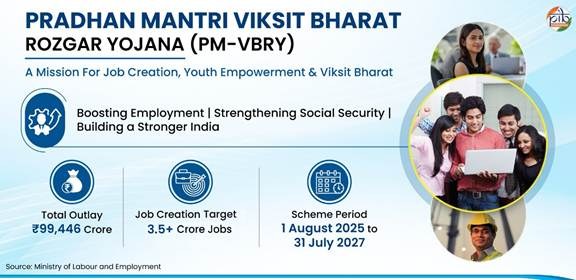
PM-VBRY at a glance: outlay, job creation target and operative period. Image courtesy PIB / Ministry of Labour & Employment; reproduced with credit for educational use.
Incentive Architecture — Two-Part Structure
- Part A — Employee Incentive: A one-time incentive equivalent to one month's EPF wage, capped at ₹15,000, paid in two instalments — the first after six months of continuous service and the second after twelve months, contingent on completion of a prescribed financial literacy programme. A portion is locked in a savings instrument, withdrawable later.
- Part B — Employer Support: Up to ₹3,000 per month per additional eligible employee for two years, conditional on that employee being retained for at least six months. In the manufacturing sector — identified as high-employment-potential — employer support is extended to the third and fourth years as well.
- The manufacturing preference reflects policy intent under the National Manufacturing Mission to deepen formal job creation in labour-intensive industries such as textiles, footwear, food processing and light engineering.
Digital Delivery Architecture
- The scheme operates on a fully digital EPFO-linked platform — no physical intermediaries.
- Verification uses Aadhaar-based authentication, Universal Account Numbers (UANs) and Electronic Challan-cum-Return (ECR) filings. Benefits are released only after UAN authentication via Face Authentication Technology on the UMANG App.
- Incentives are credited directly to Aadhaar-linked bank accounts through Direct Benefit Transfer (DBT), reducing leakage and enabling real-time tracking.
- Cross-Functional Teams comprising officials from EPFO, ESIC and the Chief Labour Commissioner (CLC) support grassroots outreach.
First-Year Reported Outcomes (as of August 2026)
- Over 72 lakh first-time employees registered under EPFO since August 2025 — against a two-year stated target of 1.92 crore.
- Approximately 30% of beneficiaries are women, suggesting meaningful female labour formalisation.
- More than 15 lakh beneficiaries have received at least one employment-linked incentive instalment.
Lineage — From PMRPY to PM-VBRY
- PMRPY (2016–22): Covered only the employer side — Government paid the employer's 12% EPF share for three years for new hires under ₹15,000/month. No employee-side incentive; narrower salary cap; closed in 2022.
- ELI Scheme (Budget 2024-25): Proposed three sub-schemes — one for first-time employees, one for manufacturing sector, one for all sectors — before being consolidated into PM-VBRY.
- PM-VBRY innovations over predecessors: Dual-sided incentive (both employee and employer); higher salary ceiling (₹1,00,000/month vs. ₹15,000); financial literacy linkage; manufacturing sector extended incentive; fully Aadhaar-UAN-DBT digital pipeline.
Critical View
- Additionality vs. registration gaming: A core challenge with ELI schemes is whether they generate new jobs or simply incentivise formal registration of existing informal employment. The PMRPY faced this critique, and PM-VBRY's reliance on new EPFO registrations alone does not resolve it.
- First-time employee verification: Defining and verifying "first-time employee" status through EPFO records assumes all prior formal employment was EPFO-covered — a questionable assumption given the scale of the informal economy.
- Instalment conditionality: The two-part instalment structure (six months + twelve months) and the financial literacy requirement add verification burden and may create delays for genuinely eligible workers.
- Fiscal scale: At ₹99,446 crore, this is one of the largest employment-linked fiscal commitments in India's history. Absorption and implementation efficiency over two years remain to be demonstrated.
- Women's participation quality: A 30% female share is reported, but whether these are new labour market entrants or existing workers being formalised is not disaggregated in available data.
Figure 2 — PMRPY (2016–22) vs PM-VBRY (2025–27): Key Design Differences
ParameterPMRPY (2016–22)PM-VBRY (2025–27)Salary capEmployee incentiveEmployer incentiveMfg. extensionDeliveryFinancial literacy₹15,000/monthNone12% EPF share, 3 yrsNoDBTNo₹1,00,000/month≤₹15,000 one-time₹3,000/month, 2 yrsYes (Yr 3 & 4)Aadhaar-UAN-DBTMandatory (Instalment 2)
PM-VBRY introduces a dual-sided incentive structure with a significantly higher salary ceiling and manufacturing sector extension — key departures from its predecessor PMRPY.
Key Terms & Institutions (Prelims Hooks)
- EPFO — Employees' Provident Fund Organisation; a statutory body under the Ministry of Labour & Employment, administers EPF, EPS and EDLI schemes under the Employees' Provident Funds & Miscellaneous Provisions Act, 1952.
- UAN (Universal Account Number) — A 12-digit number assigned to each EPF member for life; remains constant even when the member changes employers.
- UMANG App — Unified Mobile Application for New-age Governance; used here for Aadhaar Face Authentication to verify beneficiary identity before benefit release.
- DBT (Direct Benefit Transfer) — Framework for transferring government subsidies and scheme benefits directly to beneficiary bank accounts, reducing intermediary leakage.
- ECR (Electronic Challan-cum-Return) — Monthly compliance filing by EPFO-registered employers; the primary data source for verifying employment continuity under PM-VBRY.
- National Manufacturing Mission — The Government's overarching framework (announced in Budget 2024-25) to strengthen India's manufacturing sector; PM-VBRY's extended employer incentive for manufacturing aligns with this mission.
✎ Mains Practice Question
The Pradhan Mantri Viksit Bharat Rojgar Yojana (PM-VBRY) represents a significant evolution in India's employment-linked incentive architecture. Critically analyse its design innovations, implementation challenges, and potential to bridge India's formal-informal employment divide. 15 marks · 250 words · GS-III
⚑Internal Security, Society & GovernanceGeneral Studies Paper III (Security)
02
India Achieves Naxal-Free Status: Anatomy of a Six-Decade Insurgency and Its Resolution
GS-III · Internal Security — LWE, Insurgency, Counter-TerrorismPrelims + MainsPIB · Ministry of Home Affairs · 3 August 2026
On 31 March 2026, the Government declared India effectively free from Left-Wing Extremism (LWE) — ending a near-six-decade insurgency that at its peak in 2010 recorded 1,936 violent incidents and 1,005 fatalities in a single year across 126 districts in 10 states.
◈ Background & Static Context: Origins and Spread of LWE in India
Left-Wing Extremism in India traces its origin to the Naxalbari uprising of May 1967 in Darjeeling district, West Bengal, where a section of the Communist Party of India (Marxist) led by Charu Mazumdar and Kanu Sanyal organised tenant farmers in a violent land seizure.
The Naxalbari movement gave rise to the term "Naxalism." The CPI (Marxist-Leninist) was formed in 1969 as its political crystallisation.
Subsequent decades saw the movement spread into the forest and tribal belts of central India — the "Red Corridor" — driven by structural grievances: denial of forest rights, displacement from mining and development projects, absence of state institutions, and police impunity.
- Ideological basis: Maoist doctrine of "protracted people's war" — rural guerrilla warfare as the path to seizing state power. Inspired by the Chinese Cultural Revolution and Mao Zedong's writings.
- CPI (Maoist) formation (2004): Two major LWE groups — People's War Group (PWG) and Maoist Communist Centre (MCC) — merged to form CPI (Maoist), creating the most organised and lethal LWE organisation India has faced. This consolidation led to a sharp escalation in violence from 2005 onwards.
- Geographic spread: At peak extent (2009–10), LWE affected 223 districts across Chhattisgarh, Jharkhand, Odisha, Bihar, Maharashtra, Andhra Pradesh, Madhya Pradesh, West Bengal, Uttar Pradesh and Kerala. The "Red Corridor" — a contiguous forest belt from Nepal border to northern Andhra Pradesh — was the operational heartland.
- Financing model: LWE operations were sustained through extortion (from contractors, mining companies, forest produce traders), levies on government development works, and weapon seizures from police armouries. Nearly 92% of Naxalite weapons were reportedly looted from security forces.
- Pre-2014 policy failure: Central government acknowledged LWE as India's biggest internal security challenge in 2009 — surpassing even the Northeast in geographic spread. But policy was fragmented: state-level responses differed; no unified national framework; security and development operated in silos.
Figure 3 — From Naxalbari to Naxal-Free India: Key Milestones (1967–2026)
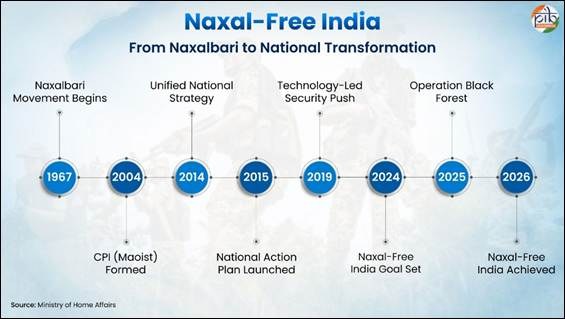
From insurgency to resolution: the six-decade arc of LWE in India, with CPI (Maoist) formation in 2004 marking the peak consolidation and the 2015 National Action Plan as the turning-point policy. Image courtesy PIB / Ministry of Home Affairs; reproduced with credit for educational use.
▤ LWE at a Glance — Key Numbers
- Peak violence (2010): 1,936 incidents; 1,005 fatalities (civilian + security forces)
- 2004–14 decade total: 17,542 violent incidents; 1,913 security force deaths; 5,019 civilian deaths
- Districts affected: 126 (2014) → 0 (March–April 2026)
- Most-affected districts: 35 (2014) → 0 (2026)
- 2026 violence (as on 29 July 2026): 33 incidents; 11 fatalities
- Fortified police stations: 66 (pre-2014) → 663 (2026)
- New CAPF camps established (7 years): 408
- Roads built (RRP + RCPLWEA): 15,189 km
- Mobile towers commissioned: 9,497; 96% of villages now connected
- Surrenders (2025 alone): 2,337 cadres; 3,927 between 2024 and March 2026
- Security Related Expenditure released (since 2014-15): ₹3,805.04 crore
- Special Central Assistance (since 2017): ₹4,289.20 crore released
- NIA cases (as of June 2026): 112 cases; 100 charge sheets filed
The Policy Turning Point: National Policy and Action Plan (2015)
- Prior to 2015, the Central Government's response was incident-driven and uncoordinated, with states operating independently. The National Policy and Action Plan to address LWE (2015) was the first comprehensive, whole-of-government framework.
- It established a three-pronged strategy: Dialogue (rehabilitation and surrender frameworks), Security (coordinated operations, specialised forces, infrastructure), and Coordination (inter-agency and Centre-State synchronisation under Ministry of Home Affairs).
- The Government of India set a formal deadline of 31 March 2026 on 24 August 2024 — and achieved it on schedule.
Security Architecture: What Was Built
- Fortified Police Stations: From 66 to 663 — a tenfold increase, expanding the permanent state footprint into previously ungoverned territory.
- CAPF camps: 408 new camps established over seven years, providing operational bases for continuous area domination in deep forest zones.
- Night-landing helipads: 68 built for rapid force deployment, casualty evacuation and surveillance in terrain inaccessible by road.
- Specialised forces integration: CoBRA (Commando Battalion for Resolute Action) — a CRPF unit specifically trained in jungle warfare and IED detection — along with District Reserve Guard (DRG) units comprising local tribal recruits, and state elite units like Andhra Pradesh's Greyhounds and Jharkhand Jaguar, operated under a unified command.
- Technology deployment: UAVs, drones, satellite imagery, AI-based data analysis, social media monitoring, and scientific call-log analysis were operationalised — enabling intelligence-driven, precision operations.
Major Operations: "Trace, Target, Neutralise"
- Operation Black Forest (April 2025): Dismantled a key Maoist stronghold; elimination of over 30 Maoists; triggered sharp rise in arrests and surrenders.
- Operation Octopus, Double Bull & Chakrabandha (September 2022): Joint multi-state operations; Double Bull resulted in Gumla, Lohardaga and Latehar (Jharkhand) becoming Naxal-free.
- Operation Thunderstorm (June 2022): Extended area domination campaign.
- Operation Bhimbarg (March 2026): Final phase operation coinciding with the deadline.
- The government's "All-Agency" approach extended beyond armed operations: NIA targeted financing networks (assets worth ₹40+ crore seized by December 2025); Enforcement Directorate attached ₹12 crore; state agencies another ₹40 crore.
Figure 4 — Major Anti-Naxal Operations Post-2022
Post-2022 operations combined intelligence-led targeting with rehabilitation outreach — Operation Black Forest (2025) is the single most consequential operation of the final phase. Image courtesy PIB / Ministry of Home Affairs; reproduced with credit for educational use.
Rehabilitation: The "Red Carpet" Policy
- Surrendering cadres receive an immediate grant: ₹5 lakh for higher-ranked cadres; ₹2.5 lakh for others; plus ₹10,000/month stipend for 36 months.
- A ₹50,000 additional incentive for surrender, doubled in group surrenders; extra compensation for weapon deposition.
- Rehabilitation pathways include skill development, livelihood assistance, housing under Pradhan Mantri Awas Yojana, and children's education up to Class XII — free of cost.
- 2,337 surrenders in 2025; 3,927 between 2024 and March 2026 underscores the policy's operational effectiveness when security pressure is combined with credible rehabilitation alternatives.
Development as the Third Strand: Infrastructure, Welfare and Tribal Rights
- Roads: 15,189 km under Road Requirement Plan (RRP) and Road Connectivity Project for LWE Areas (RCPLWEA).
- Mobile connectivity: 9,497 towers commissioned; 96% of villages (44,728 of 46,592) in the most-affected areas now connected.
- Financial inclusion (April 2015–March 2026): 1,804 bank branches, 1,321 ATMs, 74,720 banking correspondents, 6,025 post offices opened in LWE-affected districts.
- Education: 259 Eklavya Model Residential Schools (EMRS) sanctioned; 179 functional; 47 ITIs and 49 Skill Development Centres developed; skill training for 90,000+ youth and women.
- PM-JANMAN: Focused on Particularly Vulnerable Tribal Groups (PVTGs) — housing, safe drinking water, healthcare, education and connectivity.
- Dharti Aaba Janjatiya Gram Utkarsh Abhiyan: Converges multiple ministries to bridge infrastructure gaps in tribal villages.
- Bastar case study: 3,240 km of roads, 889 mobile towers, Bastariya Battalion (1,143 local recruits including tribal youth), and the Shaheed Veer Gunda Dhur Seva Dera initiative (converting 70 CAPF camps into citizen service centres).
Lineage of Counter-LWE Policy — A Chronological View
- 1967: Naxalbari uprising — origin of Indian Naxalism.
- 2004: CPI (Maoist) formed — peak organisational consolidation.
- 2009: Government publicly acknowledges LWE as biggest internal security challenge.
- 2010: Peak violence — 1,936 incidents, 720 civilian deaths.
- 2014: Policy shift; 126 districts affected; SRE, SIS and SCA schemes activated.
- 2015: National Policy and Action Plan launched — first structured whole-of-government framework.
- 2017: Bastariya Battalion raised; SCA Scheme launched.
- 2019: Technology-led security push operationalised (UAVs, AI analytics).
- August 2024: Formal deadline set — Naxal-Free India by 31 March 2026.
- April 2025: Operation Black Forest — single most impactful final-phase operation.
- 31 March 2026: India declared effectively free from LWE.
Figure 5 — LWE Violence Trend: Incidents and Fatalities (2010–2026)
LWE Incidents vs Fatalities: Decline (2010–2026)050010001500200020102014201620182020202220242026*1,93687072283366533828733Violent Incidents2026 (as on 29 July)
LWE violent incidents declined from 1,936 in 2010 to just 33 as of 29 July 2026 — a 98% reduction. The policy shift of 2014–15 and the introduction of specialised operations post-2022 are the two most visible inflection points.
Critical View
- Structural grievances remain unresolved: LWE's ideological roots lay in tribal land alienation, forest rights denial, displacement from extractive industries, and state absence. While violence has been suppressed, scholars of tribal rights and forest governance have cautioned that these structural conditions — displacement for mining, scheduled area governance deficits, PESA non-implementation — have not been systemically addressed. The Forests Rights Act, 2006 remains partially implemented in several LWE-affected states.
- Surrender data and voluntariness: Large-scale surrenders are a reported metric, but independent verification of whether surrenders are voluntary or coerced under security pressure is limited. Rehabilitation outcomes for surrendered cadres — quality of skill training, actual employment, housing completion — are not systematically monitored in available public data.
- Residual cadres and ideological continuity: The declaration of Naxal-Free status pertains to organised armed violence and district-level affectedness. Ideological networks, urban Naxal linkages (a contested and legally sensitive category), and financing channels may persist even when armed operations decline.
- Federalism and credit attribution: The success is the product of Centre-State cooperation — state police (Greyhounds, DRG, Jaguar), state administration, and local bodies contributed alongside central forces. Policy attribution needs to be appropriately distributed.
- Long-term peace durability: Historical experience in insurgency resolution (Punjab, Tripura, Mizoram) suggests that peace is durable when political accommodation and economic integration follow — not just security dominance. The Bastar model's conversion of CAPF camps into service centres is promising but at early stage.
Key Terms & Institutions (Prelims Hooks)
- CPI (Maoist): Unlawful organisation under the UAPA (Unlawful Activities Prevention Act); formed by merger of PWG and MCC in 2004.
- CoBRA (Commando Battalion for Resolute Action): Specialised CRPF battalion for jungle warfare and IED neutralisation in LWE-affected areas.
- DRG (District Reserve Guard): State-level counter-insurgency units comprising former LWE cadres and tribal youth — critical for local intelligence and operations.
- SRE Scheme (Security Related Expenditure): Central government scheme funding operational needs, training, rehabilitation and ex gratia for security forces/civilians in LWE-affected areas.
- SCA (Special Central Assistance): Funds critical infrastructure (roads, connectivity, banking) in LWE-affected districts; ₹4,289 crore released since 2017.
- RCPLWEA: Road Connectivity Project for LWE-Affected Areas — one of two LWE-specific road schemes (alongside RRP).
- EMRS (Eklavya Model Residential Schools): Quality residential schools for Scheduled Tribe children in tribal areas; 179 functional in LWE-affected regions.
- PESA (Panchayats Extension to Scheduled Areas Act, 1996): Extends panchayati raj institutions to Fifth Schedule tribal areas; customary governance rights of tribal communities; frequently cited in LWE root-cause analysis.
- NIA (National Investigation Agency): Statutory body under MHA; dedicated LWE vertical for targeting financing networks, chargesheeted in 112 LWE cases as of June 2026.
- Aspirational Districts Programme: Niti Aayog's convergence framework for multi-scheme delivery in India's 112 most under-developed districts — significant overlap with LWE-affected geography.
✎ Mains Practice Question
India's declaration of a Naxal-Free status in 2026 reflects a multi-dimensional counter-insurgency strategy combining security, infrastructure and welfare. Critically examine the structural factors that gave rise to Left-Wing Extremism, the policy architecture that addressed it, and the challenges that remain for durable peace in India's tribal heartland. 15 marks · 250 words · GS-III