

In-Depth PIB Analysis2 Items
Core TopicImportantConcise
Polity, Governance & InfrastructureGS Paper II & III
01Bharatiya Vayuyan Niyam, 2026 — New Civil Aviation Rulebook
Economy, Resources & Strategic SecurityGS Paper III
02Capex Support Scheme for Critical Mineral Processing (Lithium & Nickel)
Polity, Governance & InfrastructureGeneral Studies Papers II & III
01
Bharatiya Vayuyan Niyam, 2026: India Replaces the Aircraft Rules, 1937 With a New Civil Aviation Rulebook
Core TopicGS-III · Infrastructure — Civil Aviation, AirportsGS-II · Governance — Regulation, Delegated LegislationPrelims + MainsPIB Backgrounder · Ministry of Civil Aviation · 04 Nov 2026
The Centre has notified the Bharatiya Vayuyan Niyam, 2026 under the Bharatiya Vayuyan Adhiniyam, 2024. From 1 January 2027, these 220 rules replace the colonial-era Aircraft Rules, 1937 as the operating manual for everything from aircraft design to airfares.
◈ From the Basics: Act, Rules and the Regulator
An Act of Parliament lays down the broad legal framework; the detailed, technical requirements are filled in by Rules that the executive frames under powers given by that Act. This is called delegated (subordinate) legislation.
Rules are laid before Parliament and scrutinised by the Committee on Subordinate Legislation of each House.
- Parent law (old): the Aircraft Act, 1934 — amended many times over nine decades and replaced by the Bharatiya Vayuyan Adhiniyam, 2024, which came into force on 1 January 2025.
- Rulebook (old): the Aircraft Rules, 1937, framed under the 1934 Act, remained the principal set of operating rules for nearly 90 years, amended piecemeal.
- Rulebook (new): the Bharatiya Vayuyan Niyam, 2026, framed under the 2024 Act — it also replaces Part IX of the Aircraft Rules, 1920 and repeals the Radio Telephone Operator (Restricted) Certificate and Licence Rules, 2025, with savings clauses.
- The regulator: the Directorate General of Civil Aviation (DGCA), an attached office of the Ministry of Civil Aviation, became a statutory body through the Aircraft (Amendment) Act, 2020 — along with the Bureau of Civil Aviation Security (BCAS) and the Aircraft Accident Investigation Bureau (AAIB).
Figure 1 — Bharatiya Vayuyan Niyam, 2026 at a glance
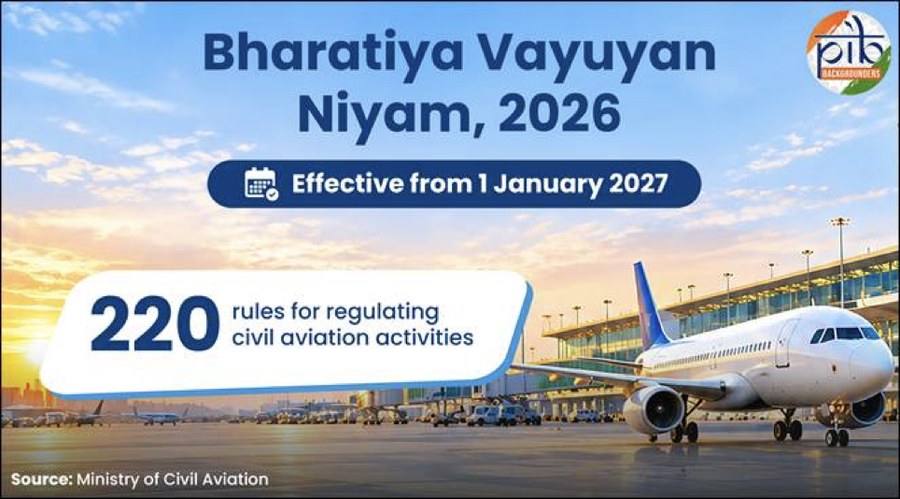
A single, consolidated rulebook of 220 rules comes into force on 1 January 2027. Image courtesy PIB Backgrounders / Ministry of Civil Aviation; reproduced with credit for educational use.
▤ Rulebook at a Glance
- Instrument: Bharatiya Vayuyan Niyam, 2026 — Rules notified by the Central Government under the Bharatiya Vayuyan Adhiniyam, 2024.
- Nodal Ministry: Ministry of Civil Aviation; principal enforcing body — DGCA.
- In force from: 1 January 2027.
- Structure: 220 rules in 8 chapters and 6 schedules.
- Coverage: aircraft registration, airworthiness, personnel licensing (23 categories of licences, ratings and certificates), aerodrome operations, air navigation services, aircraft operations, oversight, enforcement and penalties.
- Penalty architecture: 21 punishable offences (up to 2 years' imprisonment and/or fine up to ₹1 crore); 18 compoundable offences; a 10-level graded penalty scale from ₹10,000 to ₹1 crore.
- Sector context: operational airports rose from 74 (2014) to 166 (October 2026).
220Rules
8 + 6Chapters + Schedules
23Licence categories
74 → 166Airports, 2014 → 2026
Lineage: Nine Decades of Aviation Law
India's aviation rules were written for a world of propeller aircraft and a handful of aerodromes. The international layer came later, with the Chicago Convention, and the commercial layer only after the sector was opened to private airlines in 1994. The 2026 Rules attempt to fold all three into one code.
Figure 2 — Legislative lineage of Indian civil aviation
1934Aircraft Act(parent law)1937Aircraft Rules(old rulebook)1944ChicagoConvention;ICAO (1947)1994Air CorporationsAct repealed;private airlines2008India accedes toCape TownConvention2020DGCA, BCAS,AAIB madestatutory2024–25VayuyanAdhiniyam 2024;Aircraft ObjectsAct 20251 Jan 2027Vayuyan Niyam,2026 in forceMaroon = domestic law · Blue = international law · Green = market opening · Gold = new rulebook
The 2026 Rules close a gap between a 1930s domestic code and the international obligations India has accumulated since 1944.
Static Anchor: The International Framework
- Chicago Convention (1944): the Convention on International Civil Aviation created the International Civil Aviation Organization (ICAO), a UN specialised agency headquartered in Montreal. India is a founding member. Its technical standards sit in 19 Annexes as SARPs (Standards and Recommended Practices).
- Annexes mirrored in the new Rules: Annex 1 (personnel licensing), Annex 7 (nationality and registration marks), Annex 8 (airworthiness), Annex 11 (air traffic services), Annex 14 (aerodromes), Annex 16 (noise and environment) and Annex 19 (safety management).
- Cape Town Convention (2001): the Convention on International Interests in Mobile Equipment and its Aircraft Protocol, adopted under UNIDROIT and ICAO, protects lessors and financiers of aircraft. India acceded in 2008 but lacked a domestic law giving it effect until the Protection of Interests in Aircraft Objects Act, 2025.
- ICAO safety audits: under the Universal Safety Oversight Audit Programme (USOAP), India's Effective Implementation score rose to about 85.5% in the 2022 audit — a measure of how well national rules and oversight match ICAO standards.
Figure 3 — The six regulatory pillars of the new Rules
The six pillars broadly track the ICAO Annex structure — registration, airworthiness, licensing, aerodromes, air navigation and operations. Image courtesy PIB Backgrounders / Ministry of Civil Aviation; reproduced with credit for educational use.
Key Provisions, Pillar by Pillar
1. Aircraft design and airworthiness. Airworthiness means an aircraft conforms to its approved design and is in a condition for safe operation. A type certificate approves the design of an aircraft model, engine or propeller; the country whose authority issues it is the "State of Design".
- DGCA may issue type certificates where India is the State of Design, and validate or accept foreign type certificates — a building block for indigenous civil aircraft programmes.
- Airworthiness Directives are issued when an unsafe condition is likely to recur across a type design; drafts are ordinarily published for 30 days of public comment.
- Indian Technical Standard Orders govern components; DGCA may authorise component design and manufacture and approve design, manufacturing and maintenance organisations, including foreign MRO (maintenance, repair and overhaul) organisations.
- Civil aircraft operations that generate sonic booms over India are prohibited.
2. Registration and identification. Every aircraft must carry India's nationality mark "VT", followed by a hyphen and three capital letters — a prefix inherited from the pre-Independence radio call-sign allocation.
Aircraft may be registered under Category A or B, depending on ownership, citizenship, business registration and leasing.
- Change in ownership or lessor must be reported immediately; further flying is barred until registration is updated, unless DGCA permits in writing.
- IDERA applications for deregistration must be processed within five working days (explained below).
- DGCA may issue a Mode-S address — a unique 24-bit code broadcast by a Mode-S transponder that lets air traffic radar identify an aircraft individually.
3. Personnel licensing. The Rules list 23 categories of licences, ratings and certificates for pilots, flight engineers, aircraft maintenance engineers, air traffic controllers (ATCOs) and radio-telephone operators.
- ATCOs may exercise specified licence privileges only up to 60 years of age.
- Cabin crew: minimum 1 crew member for aeroplanes with 10–50 seats (helicopters 20–50); 2 above 50 seats; and one more for every 50 seats or part thereof beyond 99. The manufacturer's figure applies if higher; no crew member may serve on more than three aircraft types.
4. Aerodromes. Aerodromes may be licensed for public or private use, and must maintain an aerodrome manual. Several rules address hazards that originate outside the airport fence.
- Laser use within 10 nautical miles needs the aerodrome operator's written permission; misleading lights are regulated within 5 nautical miles.
- Wildlife hazard: slaughter, garbage dumping and other bird-attracting activities are restricted within 10 km — bird strikes are a persistent safety risk.
- Tariffs must treat Indian aircraft and those of other Chicago Convention contracting States equally (the non-discrimination principle); User Development Fees and passenger service fees may be levied.
5. Air navigation services. These cover air traffic management, communications, navigation and surveillance (CNS), aviation meteorology, instrument flight procedure design and search and rescue agreements with neighbouring States.
- Duty-time and minimum-rest norms for ATCOs; meteorological records to be kept for at least 30 days for investigations.
- Instrument flight procedures (the published paths aircraft follow in low visibility) need prior DGCA approval to be published, changed or withdrawn.
6. Aircraft operations and the passenger. This pillar touches the traveller most directly — fatigue, conduct on board and fares.
- Fatigue management: flight and duty-time limits and minimum rest; crew may not consume alcohol or specified intoxicants within 12 hours before a flight.
- Pilot-in-command has final authority over the aircraft; alcohol consumption is prohibited on domestic air transport services.
- Airfares: airlines set tariffs based on factors such as operating cost and must publish them digitally; scheduled operators file them with DGCA for monitoring. Booking sites and tickets must show the total payable amount with a breakdown of fare, taxes and fees.
- Emergency power: in extraordinary situations, the Centre may issue proportionate, time-bound directions in the public interest.
- Regional Air Connectivity Fund: statutory basis for viability gap funding (VGF) of regional routes through a levy on domestic scheduled flights, with possible State contributions — the financing mechanism behind RCS-UDAN (launched 2016 under the National Civil Aviation Policy, 2016).
Explained: Leasing, Cape Town and IDERA
Most commercial aircraft flying in India are leased, largely from lessors based abroad. A lessor's biggest fear is being unable to repossess an aircraft when an airline defaults. Where that risk is high, lessors charge a risk premium, which raises leasing costs and, indirectly, fares.
- IDERA (Irrevocable De-registration and Export Request Authorisation) is a document an airline signs in favour of the lessor/financier at the start of a lease. It is lodged with the aviation regulator and lets the holder seek deregistration and export of the aircraft on default.
- Why it became urgent: during the 2023 insolvency of Go First, the moratorium under the Insolvency and Bankruptcy Code, 2016 blocked lessors from taking back aircraft for months, heightening lessor concern about India.
- The new Rules require DGCA to process eligible IDERA applications within five working days, giving effect to the Protection of Interests in Aircraft Objects Act, 2025.
Figure 4 — How the IDERA mechanism works
Step 1Lease signed;airline issuesIDERA to lessorStep 2Airline defaultsor becomesinsolventStep 3IDERA holderapplies to DGCAto deregisterStep 4DGCA cancelsregistration in5 working daysStep 5Aircraftexported /repossessedExpected effect (Government's assessment): lower lessor risk → lower leasing and acquisition costs → less pressure on fares
A predictable, time-bound exit route for lessors is the core of the Cape Town bargain: certainty for creditors in exchange for cheaper finance.
Other Terms Worth Knowing
- Fractional ownership: several owners jointly buy one aircraft and share its use and cost, like a timeshare. The Rules recognise this, provided responsibility for operation and maintenance is clearly assigned to an identified entity.
- Safety Management System (SMS): a structured, organisation-level process to identify hazards and manage risk before accidents occur (ICAO Annex 19). Mandatory for specified operators, aerodromes, MROs, training organisations and air traffic service providers.
- State Safety Programme (SSP): the national-level counterpart of SMS, which DGCA must formulate and oversee.
- Non-punitive voluntary reporting: lets pilots, engineers and controllers report errors confidentially without fear of punishment — a cornerstone of a "just culture" in aviation safety.
- DGCA instruments: Civil Aviation Requirements (CARs), NOTAMs (Notices to Airmen — time-critical alerts), Aeronautical Information Publications (AIPs) and Circulars (AICs). Draft CARs are ordinarily published for 30 days of consultation, which may be shortened or waived in the public interest.
- Compoundable offence: one that can be settled by paying a sum instead of facing prosecution — part of the broader decriminalisation push seen in the Jan Vishwas (Amendment of Provisions) Act, 2023.
Why It Matters
- Consolidation: one code replaces a patchwork of 1920, 1937 and 2025 rules, improving legal certainty for airlines, lessors and manufacturers.
- Global alignment: explicit links to the Chicago Convention Annexes and the Cape Town regime should help in ICAO audits and in lessors' assessment of India.
- Manufacturing ambition: a defined pathway for India as a State of Design supports indigenous civil aircraft and component manufacture under Make in India.
- Leasing hub: faster deregistration complements the effort to build an aircraft-leasing ecosystem at GIFT City (IFSC).
- Passenger focus: mandatory fare breakdowns, fatigue rules and a statutory emergency power respond to recurring complaints about opaque pricing and fare spikes.
The Critical View
- Transparency is not fare regulation: airfares remain market-determined. With a highly concentrated domestic market, disclosure alone may not curb price spikes; the emergency power is limited to "extraordinary" situations.
- Wide executive discretion: much of the operative detail will flow through CARs and directions, and the 30-day consultation can be waived — raising questions of parliamentary oversight over delegated legislation.
- Regulator capacity: stronger rules depend on DGCA staffing, inspector expertise and independence — concerns repeatedly raised by parliamentary committees and sharpened after the June 2025 Ahmedabad crash.
- Deterrence vs decriminalisation: a ₹1 crore ceiling may be modest relative to a large airline's revenues, though the graded scale by offender size partly addresses this.
- Fatigue rules in practice: the 2025 rollout of revised Flight Duty Time Limitation (FDTL) norms caused large-scale cancellations — showing that safety rules need realistic crew-planning timelines.
Way Forward
- Strengthen DGCA as a functionally autonomous, adequately staffed regulator — on the lines of the long-proposed Civil Aviation Authority model.
- Publish fare-monitoring data periodically and define "extraordinary circumstances" clearly to keep the emergency power predictable.
- Ensure timely, transparent CAR consultations and stable IDERA implementation to rebuild lessor confidence.
✎ Mains Practice Question
The Bharatiya Vayuyan Niyam, 2026 seeks to balance ease of doing business, aviation safety and passenger protection. Examine how far the new rules align India's civil aviation framework with its international obligations, and identify the gaps that remain. 15 marks · 250 words
Economy, Resources & Strategic SecurityGeneral Studies Paper III
02
Cabinet Approves ₹2,814 Crore Capex Support Scheme for Lithium and Nickel Processing
Core TopicGS-III · Economy — Mineral Resources, Industrial Policy, Energy SecurityPrelims + MainsPIB · Union Cabinet · Ministry of Mines · 04 Nov 2026
The Union Cabinet has approved a ₹2,814 crore scheme that offers a 30% capital subsidy for four plants to refine lithium and nickel into battery-grade compounds — targeting the processing stage, where India's dependence on imports is greatest.
◈ From the Basics: What Are Critical Minerals?
Critical minerals are minerals that are essential for economic development and national security, but whose supply is at risk because reserves are scarce or because extraction and processing are concentrated in a few countries.
They are the raw material of the energy transition — batteries, solar panels, wind turbines and electronics.
- India's list: in June 2023, the Ministry of Mines identified 30 critical minerals, including lithium, nickel, cobalt, graphite, rare earth elements (REEs), and the fertiliser minerals phosphorus and potash.
- Lithium: the lightest metal; the core of lithium-ion batteries. Used as lithium carbonate or lithium hydroxide of very high purity.
- Nickel: used in stainless and specialty steel and in high-energy NMC (nickel-manganese-cobalt) battery cathodes, as nickel sulphate.
- Cobalt: rarely mined on its own; mostly recovered as a by-product of copper and nickel — which is why the scheme expects cobalt from nickel plants.
Why Processing Is the Chokepoint
Ore dug out of the ground is of little use to a battery maker. It must first be concentrated (beneficiation) and then chemically refined into compounds of 99.5%+ purity. This midstream stage is capital-heavy and technology-intensive, and it is where global supply is most concentrated.
- China refines roughly two-thirds of the world's lithium and around three-quarters of its cobalt, as per International Energy Agency (IEA) estimates — far higher than its share of mining.
- Indonesia, after banning nickel ore exports from 2020, now mines more than half of the world's nickel and processes much of it at home — a case study in resource nationalism and downstreaming.
- Concentration exposes importers to export controls, price volatility and supply restrictions. In 2025, China moved to restrict exports of certain battery-material and lithium-processing technologies.
- India imports nearly all of its refined lithium, nickel and cobalt needs, including as finished lithium-ion cells.
Figure 5 — The battery-mineral value chain and where Indian policy intervenes
Exploration& MiningoreBeneficiationconcentrateRefining /Processinghigh-puritycompoundsCathode /Anode materialsprecursorsCell & BatterymanufacturingACC cells, packsEnd useEVs, BESS,defence, steelNCMM (2025)MMDR Amdt 2023KABIL (overseas)NCMMprocessing parksTHIS SCHEME₹2,814 cr · 30%capex subsidyLargely import-dependent todayPLI-ACC (2021)₹18,100 cr50 GWhPM E-DRIVE;BESS VGFRecycling loop — ₹1,500 cr recycling incentive scheme (2025)Upstream (mining) and downstream (cells, EVs) had schemes; the midstream refining gap is what this scheme targets
Policy so far covered mining and battery manufacturing; the refining link in between was the missing piece.
▤ Scheme at a Glance
- Name: Capex Support Scheme to Promote Critical Mineral Processing.
- Outlay: ₹2,814 crore.
- Tenure: FY 2026-27 to 2030-31 (five years).
- Nodal Ministry: Ministry of Mines.
- Approving authority: Union Cabinet.
- Coverage: four plants — two lithium plants (minimum 30 kt each) and two nickel plants (minimum 50 kt each); cobalt expected as a by-product of nickel processing.
- Benefit structure: 30% capital subsidy on eligible investment, capped at ₹500 crore per lithium beneficiary and ₹900 crore per nickel beneficiary.
- Selection: two-stage — technical qualification, then financial bidding; two winners per mineral on the least-cost criterion (lowest capex support sought).
- Disbursal: in three tranches linked to project milestones.
- Target sectors: electric mobility, Battery Energy Storage Systems (BESS), electronics, defence and specialty steel.
Figure 6 — Maximum capital support per plant (₹ crore)
Lithium plant 1 (≥30 kt)₹500 crLithium plant 2 (≥30 kt)₹500 crNickel plant 1 (≥50 kt)₹900 crNickel plant 2 (≥50 kt)₹900 crCaps total ₹2,800 cr of the ₹2,814 cr outlay · subsidy rate 30% of eligible investment
At a 30% rate, the caps bind for investments above roughly ₹1,667 crore (lithium) and ₹3,000 crore (nickel) — a simple arithmetic reading of the scheme's terms.
Key Concepts Explained
- Capex subsidy vs PLI: a capital-expenditure subsidy pays a share of the upfront cost of building a plant. A Production Linked Incentive (PLI) pays per unit of output sold. Capex support suits sectors where the main barrier is high initial investment and long gestation, as in refining.
- Least-cost bidding: a reverse auction in which bidders compete to ask for the least subsidy; it limits fiscal cost and lets the market reveal how much support is actually needed.
- Milestone-linked tranches: money is released only as construction and commissioning targets are met — reducing the risk of paying for plants that never get built.
- kt (kilotonne): 1,000 tonnes of annual processing capacity.
Lineage: India's Critical-Mineral Policy Stack
- MMDR Act, 1957 → Mines and Minerals (Development and Regulation) Amendment Act, 2023: removed six minerals, including lithium, from the restricted atomic-minerals list, opening them to private miners. It empowered the Centre to auction 24 critical and strategic minerals (Part D, First Schedule) and introduced the exploration licence.
- KABIL (2019): Khanij Bidesh India Ltd, a joint venture of NALCO, HCL and MECL, acquires mineral assets abroad — including lithium blocks in Argentina's Catamarca province (2024).
- Domestic find: the GSI reported 5.9 million tonnes of inferred lithium resources in Reasi, J&K (2023) — at an early (G3) exploration stage; auction attempts have drawn a weak response.
- PLI for Advanced Chemistry Cell (ACC) batteries (2021): ₹18,100 crore for 50 GWh of cell capacity — the downstream anchor.
- National Critical Mineral Mission (NCMM, January 2025): ₹16,300 crore in government outlay plus an expected ₹18,000 crore from PSUs, covering exploration, overseas acquisition, processing parks, recycling and stockpiling.
- 2025 follow-ons: a ₹1,500 crore critical-mineral recycling incentive scheme and a scheme for sintered rare earth permanent magnets.
- Today's scheme fills the midstream refining gap between these upstream and downstream measures.
International Partnerships (Prelims Hooks)
- Minerals Security Partnership (MSP): a US-led grouping to diversify critical-mineral supply chains; India joined in June 2023.
- Quad Critical Minerals Initiative (2025) and bilateral partnerships with Australia (a major spodumene, i.e., lithium-ore, producer) — important for feedstock, since India has no commercial lithium mining yet.
Why It Matters
- Energy security: the energy transition swaps dependence on imported oil for dependence on imported minerals and cells; domestic refining reduces this exposure.
- Value addition: refining captures far more value than exporting or importing ore, and anchors downstream cathode and cell manufacturing.
- Demand linkage: on the same day, the Cabinet approved a ₹14,500 crore viability gap funding scheme for 92 GWh of grid-scale energy storage — creating demand that domestic battery materials could serve.
- Strategic sectors: nickel and cobalt matter for defence alloys, aerospace and specialty steel, not just batteries.
The Critical View
- Feedstock dependence remains: without domestic lithium or nickel mining at scale, plants will run on imported concentrate. Dependence shifts from refined products to raw inputs rather than disappearing.
- Scale is modest: four plants are a start, not a value chain; graphite and cobalt (as a primary product) are not covered.
- Price and technology risk: lithium prices fell sharply after their 2022 peak, squeezing refinery margins worldwide; process know-how is concentrated and increasingly subject to export restrictions.
- Chemistry shift: the rise of LFP (lithium iron phosphate) batteries, which use no nickel or cobalt, makes nickel demand from batteries uncertain.
- Environmental footprint: refining is water-, energy- and chemical-intensive and generates waste; it will need strict EIA and effluent norms.
- Market concentration: least-cost bidding for only four slots may favour large incumbents.
Way Forward
- Secure long-term feedstock through KABIL assets and offtake agreements with partners such as Australia, Argentina and Chile.
- Invest in R&D on refining and recycling technologies through national laboratories and industry consortia.
- Build a strategic stockpile and pair processing plants with assured domestic demand from cell makers.
✎ Mains Practice Question
India's critical-mineral vulnerability lies less in mining than in processing. Examine this statement in the light of recent policy initiatives, and suggest measures to build a resilient domestic value chain for battery minerals. 15 marks · 250 words