

In-Depth PIB Analysis2 Items
Core TopicImportantConcise
International Relations & External TradeGS Paper II & III
01India–EU FTA & the Belgium Dialogue
Environment, Energy & EcologyGS Paper III
02Geothermal Energy & the Puga Milestone
International Relations & External TradeGeneral Studies Paper II & III
01
India–EU Free Trade Agreement: the Belgium High-Level Dialogue and what the deal actually contains
GS-II · IR — Bilateral & Regional Groupings, Agreements Affecting India’s InterestsGS-III · Economy — External Sector, Trade PolicyPrelims + MainsPIB · Ministry of Commerce & Industry · Release ID 2306782
India’s largest-ever trade agreement is now in the gap between political conclusion and legal force — and this Mumbai dialogue with the Belgian Prime Minister is essentially a preview of how that gap will be worked.
◈ Background & Context
The Union Minister of Commerce and Industry addressed the India–Belgium High-Level Dialogue on the India–EU FTA in Mumbai, with the Prime Minister of Belgium and the Chief Minister of Maharashtra present.
- The Minister said the agreement opens opportunities for farmers, fishermen, MSMEs, innovators, startups, women entrepreneurs, manufacturers and service providers on both sides, and that sensitive sectors were protected in the negotiation.
- He described the combined market as 2 billion people, about a quarter of global GDP, a third of world trade and roughly USD 24 trillion in size.
- He noted that all 27 EU member states were on board and keen to complete formalities early — unanimity he described as uncommon in the European context.
- India–EU trade has roughly doubled over the last decade to nearly USD 140 billion.
The static spine: how a 19-year negotiation reached conclusion
- 2007 — Negotiations launched, then called the Broad-based Trade and Investment Agreement (BTIA). That is the name UPSC has historically used for this file.
- 2013 — Talks effectively froze over automobile tariffs, wines and spirits, dairy access, services mobility (Mode 4) and India’s Bilateral Investment Treaty regime.
- June 2022 — Negotiations relaunched, on three parallel tracks: the FTA, an Investment Protection Agreement and a standalone Geographical Indications agreement. The India–EU Trade and Technology Council (TTC), set up in 2022, ran alongside as the non-trade rail.
- 27 January 2026 — Negotiations concluded and announced at the India–EU Summit in New Delhi, the day after the European Council President and the European Commission President attended the Republic Day celebrations as chief guests.
- Now — legal scrubbing and translation into all official EU languages, then Council decision and signature, then European Parliament consent. Entry into force is widely expected around 2027.
Figure 1 — From BTIA to entry into force: the negotiation timeline
2007BTIA talkslaunched2013Talks stall —autos, dairy,Mode 4, BITJun 2022Relaunched onthree tracks;TTC created27 Jan 2026Negotiationsconcluded,New Delhi Summit2026Legal scrubbing,Council signature,EP consent2027Expectedentry intoforceNegotiated phase — 19 years, three formal rounds of revivalRatification phase — pendingPolitical conclusion is not legal force: until ratification is complete, the terms are prospective, not operational.
The exam-relevant distinction: “concluded” (January 2026) is a political milestone; the treaty binds only after signature and ratification.
▤ Agreement at a Glance
- Parties: India and the European Union (27 member states).
- Original framework: Broad-based Trade and Investment Agreement (BTIA), launched 2007.
- Conclusion of negotiations: 27 January 2026, India–EU Summit, New Delhi.
- Combined market: ~2 billion people; ~25% of global GDP; ~⅓ of world trade (as stated by the Government).
- Current bilateral trade: nearly USD 140 billion, roughly doubled in a decade. The EU is among India’s largest goods-trade partners.
- Tariff coverage: the European Commission has described elimination or reduction covering roughly 96–97% of tariff lines on both sides, phased over about seven years.
- Indian export gains: textiles and apparel, leather and footwear, marine products, gems and jewellery, engineering goods, pharmaceuticals — sectors that faced EU duties of up to 12–26%.
- EU export gains: automobiles (phased duty reduction under a quota), machinery, chemicals, medical devices, wines and spirits, olive oil and processed foods.
- Excluded / protected on India’s side: dairy, rice, sugar, wheat; limited opening in public procurement.
- Excluded on the EU side: beef, poultry, rice, sugar — the sensitivities that stalled the EU–Mercosur deal.
- Not included: the Investment Protection Agreement and the Geographical Indications agreement are separate, still-live negotiations.
The Belgium layer — why this particular bilateral dialogue
Belgium is not an incidental partner in an EU trade conversation. It hosts the EU institutions, and the Port of Antwerp-Bruges is Europe’s second-largest seaport — the physical channel through which a large share of Indian cargo would enter the single market.
- Gems and jewellery: the Minister proposed co-creation and design including lab-grown diamonds, and mutual recognition in technology and certification, anchored on the Antwerp–Mumbai–Surat triangle. Antwerp is the historic global rough-diamond trading hub; Surat cuts and polishes the overwhelming majority of the world’s diamonds.
- Semiconductors: pairing Belgian micro-electronics research with Indian scale to build a design-to-fabrication ecosystem. Belgium hosts imec, one of the world’s leading nanoelectronics R&D centres.
- Green hydrogen: the Minister suggested the National Green Hydrogen Mission could supply Europe through Antwerp-Bruges’ bunkering and green-shipping infrastructure.
- Defence and advanced manufacturing: MoUs were exchanged with John Cockerill; areas named included counter-drone systems, electronic warfare, precision munitions and Western export corridors for India-designed BrahMos and Pinaka systems.
- Agriculture and food processing: potato processing, cold chains and sustainable agri-value chains.
- Diplomatic lineage: Belgium was among the first European states to establish diplomatic relations with independent India, in 1947.
Claims made about India’s own capability — recorded as stated
- Semicon India was described as fully subscribed, with Semicon India 2.0 launched at a stated outlay of USD 14 billion, expected by the Government to catalyse around USD 70 billion of investment.
- The nuclear programme was described as opened to the private sector after six decades through the Shanti Act, with a stated plan of 100 GW of nuclear capacity over twenty years as baseload.
- The space sector, put at USD 8.5 billion today, is projected by the Government to reach USD 44 billion in eight years.
- A USD 12 billion research and innovation fund was cited, which the Minister argued delivers PPP-adjusted innovation output far above its nominal value.
- Read the economy figures with care: the Minister’s USD 4 trillion refers to India’s nominal GDP, while the “third-largest economy at USD 20 trillion” refers to the purchasing-power-parity measure. The two are different scales and should not be conflated in an answer.
The critical view
- CBAM was not resolved. India did not secure an exemption from the EU’s Carbon Border Adjustment Mechanism, in force in its definitive phase from January 2026. For Indian steel, aluminium, cement and fertiliser exporters, the carbon charge can offset much of the tariff gain. The FTA reportedly opens only a technical dialogue, alongside EU support of about €500 million for Indian industrial decarbonisation.
- Non-tariff barriers now bind harder than tariffs. EU Sanitary and Phytosanitary standards, pesticide-residue limits, the Deforestation Regulation and the corporate sustainability due-diligence rules apply regardless of tariff lines, and Indian agri and MSME exporters have historically struggled with them.
- Data adequacy is unresolved. Despite the DPDP Act, 2023, India has not been granted GDPR adequacy status, so Indian IT and ITES firms continue to carry compliance costs on European data.
- Ratification is not automatic. Consent of the European Parliament is required, and agricultural and labour-standards lobbies have delayed comparable agreements. The Mercosur experience is the standing cautionary example, though the India deal excludes the farm products that made Mercosur toxic.
- Asymmetry within India. Gains concentrate in textiles, leather, marine products and gems — labour-intensive and welcome — but automobile, wine and spirits liberalisation exposes domestic segments, and public procurement and dairy were shielded precisely because the domestic cost would have been political.
- Strategic reading. The timing is inseparable from tariff turbulence in US trade policy and from both partners’ China-plus-one diversification. This is de-risking as much as it is commerce.
Institutions & terms for Prelims
- BTIA — the 2007 name of these negotiations.
- India–EU TTC — Trade and Technology Council, 2022; the EU has only one other such council, with the United States.
- CBAM — EU carbon border levy; transitional phase from October 2023, definitive phase from January 2026.
- Mode 4 — movement of natural persons under GATS; the professional-mobility chapter is India’s long-standing ask.
- TKDL — Traditional Knowledge Digital Library, relevant to the IP and traditional-knowledge provisions.
- Ratification path (EU): Council decision by qualified majority + European Parliament consent. (India): approval by the Union Council of Ministers — trade treaties are not ratified by Parliament in India.
✎ Mains Practice Question
“The India–EU Free Trade Agreement resolves the tariff question but leaves the regulatory question open.” Examine this statement with reference to the Carbon Border Adjustment Mechanism, sanitary and phytosanitary standards, and data adequacy. 15 marks · 250 words
Environment, Energy & EcologyGeneral Studies Paper III
02
Geothermal Energy: the science, the resource base, and India’s first wells at Puga Valley
GS-III · Environment & Energy — Renewable Sources, Energy SecurityGS-I · Geography — Earth’s Interior, TectonicsPrelims + MainsPIB Backgrounder · Ministry of New & Renewable Energy · Release ID 2306688
Geothermal is the one renewable that runs round the clock without storage — and after decades of assessment, India has finally drilled the wells that could turn a mapped resource into a working megawatt.
◈ Background & Context
A PIB backgrounder sets out India’s geothermal position following two policy-and-project milestones: the National Policy on Geothermal Energy notified in September 2025, and the commissioning of the country’s first two geothermal wells at Puga Valley, Ladakh, in July 2026.
- The Ministry of New and Renewable Energy (MNRE) is the nodal ministry for the policy.
- The wells were drilled by the ONGC Energy Centre, the R&D arm of ONGC, in collaboration with the Ladakh Administration and the LAHDC-Leh.
- Unlike solar and wind, geothermal supplies baseload power — it is not weather-dependent and needs no storage to be firm.
The basics: where the heat comes from
Earth’s interior is layered into a solid crust, a semi-solid mantle, and a core with a dense liquid outer part and a solid inner part. Temperature rises with depth — the mantle reaches about 3,700°C at the core boundary; the core itself runs to roughly 5,000–6,000°C.
- Two heat sources: radioactive decay of uranium, thorium and potassium in the crust and mantle, plus residual primordial heat from planetary formation.
- Transport mechanism: this heat drives mantle convection currents — the same currents that drive plate tectonics, earthquakes, volcanism and mountain building. Geothermal energy and seismicity share a single cause, which is why the two maps overlap.
- Trapping: in tectonically active zones, faults and fractures let hot material rise near the surface. Meteoric water percolating down is superheated and held in permeable reservoir rock under an impermeable cap — surfacing as hot springs, geysers and fumaroles where the seal leaks.
- India’s tectonic setting: the Himalayan geothermal belt owes its heat to the Indian plate’s collision with the Eurasian plate along the Indus Suture Zone, which is precisely why Puga and Chumathang are the country’s most promising sites.
Figure 2 — Geothermal power generation, end to end
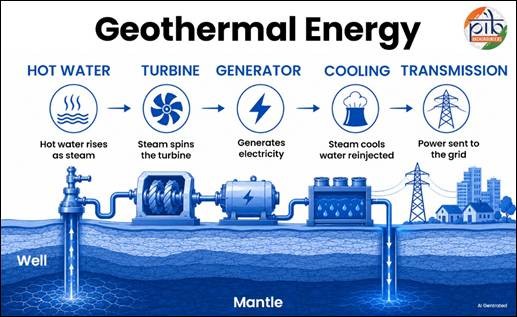
Five stages worth memorising in sequence — well and hot water, turbine, generator, cooling and reinjection, transmission. Image courtesy Press Information Bureau / MNRE, 4 September 2026; reproduced with credit for educational use.
Figure 3 — The closed loop: how geothermal heat becomes electricity
SurfaceGeothermal reservoir — hot water and steam in permeable rockHeat source — radioactive decay (U, Th, K) + residual primordial heatProduction wellSeparatorsteam / brine splitTurbine +GeneratorCondensercoolingReinjection wellSame cycle as a thermal plant — heat replaces combustionClosed loop: water reinjected
Reinjection is what makes the resource renewable — spent fluid is returned to replenish reservoir pressure rather than discharged.
Two ways to use the heat
- Power generation: deep wells bring hot water and steam to the surface; steam drives a turbine coupled to a generator; the spent fluid is condensed and reinjected into the reservoir. The cycle mirrors a thermal power plant, with underground heat substituting for fuel combustion.
- Direct-use applications: district heating, agriculture and greenhouse heating, aquaculture, and space heating and cooling — often the more economical route at moderate temperatures. Ground Source Heat Pumps (GSHPs) exploit near-surface stable temperatures for building heating and cooling.
- Frontier technologies: Enhanced Geothermal Systems (EGS) engineer permeability into hot dry rock by fracturing, and Advanced Geothermal Systems (AGS) use closed-loop circulation. Both decouple geothermal from naturally permeable reservoirs, widening the geography of what is exploitable.
▤ India’s Geothermal Resource Base — the numbers to remember
- Hot springs mapped by the Geological Survey of India: 381.
- Geothermal provinces identified: 10.
- Theoretical potential: about 10.6 GW (≈10,600 MW).
- Sites assessed as promising for power generation and direct use: 42.
- Installed commercial geothermal capacity in India: effectively nil — no commercial-scale plant yet operates.
- The 10 provinces: Himalayan; Naga-Lushai; Andaman & Nicobar Islands; Son-Narmada-Tapi (SONATA); West Coast; Cambay Graben; Aravalli; Mahanadi; Godavari; South Indian Cratonic.
- Global installed capacity (end-2025): 15.67 GW. Indonesia, the United States, the Philippines, Türkiye and New Zealand together hold roughly 67%.
Figure 4 — GSI-identified geothermal sites across India
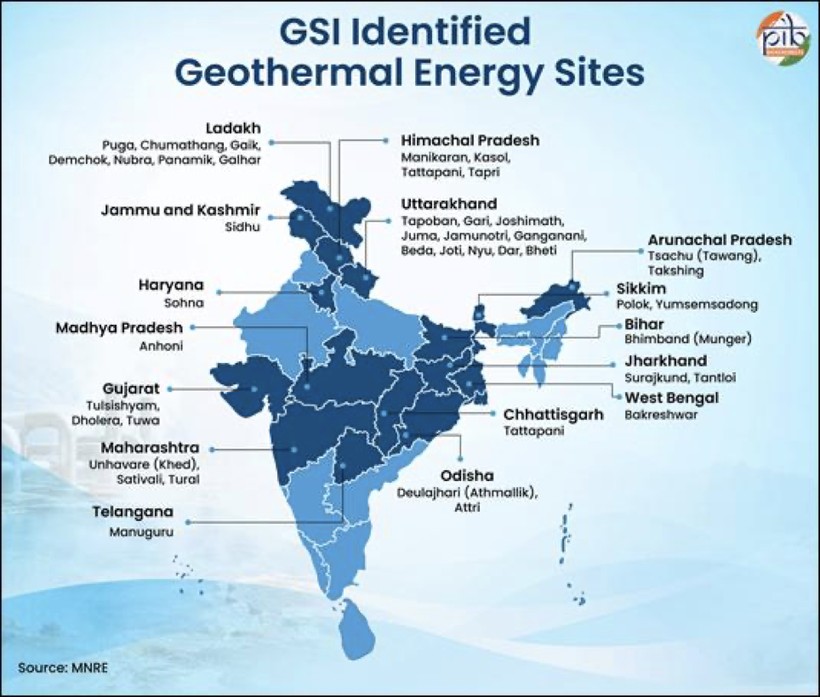
Note the clustering along the Himalayan arc and the west-coast and SONATA rift belts — geology, not administrative geography, decides the map. Image courtesy Press Information Bureau / MNRE, 4 September 2026; reproduced with credit for educational use.
Named sites worth memorising
- Ladakh: Puga, Chumathang, Gaik, Demchok, Nubra, Panamik.
- Himachal Pradesh: Manikaran, Kasol, Tattapani, Tapri. Uttarakhand: Tapoban, Joshimath, Gaurikund-area springs, Yamunotri.
- Chhattisgarh: Tattapani (Balrampur) — long studied as a candidate for an early demonstration plant. Note the name clash with Tattapani in Himachal; UPSC has used exactly this kind of duplication before.
- Jharkhand: Surajkund, Tantloi. West Bengal: Bakreshwar. Bihar: Bhimband (Munger). Odisha: Athmallik (Deulajhari), Attri.
- Maharashtra: Unhavare (Khed), Sativali, Tural. Gujarat: Tulsishyam, Dholera, Tuwa. Telangana: Manuguru. Madhya Pradesh: Anhoni. Haryana: Sohna.
- North-East: Tsachu (Tawang) and Takshing in Arunachal Pradesh; Polok and Yumthang-area springs in Sikkim.
The Puga milestone — what was actually achieved
- Two wells, each 1,000 metres deep, drilled at over 14,000 feet altitude in Puga Valley, in Ladakh’s south-eastern Changthang region — among the highest-altitude geothermal drilling campaigns anywhere.
- Temperature recorded: up to 135°C at 400 metres, with deeper testing under way to establish commercial viability.
- Purpose: reservoir evaluation, and the technical basis for India’s first 1 MW demonstration geothermal power project.
- Institutional frame: a tripartite MoU of February 2021 between the Ladakh Administration, LAHDC-Leh and the ONGC Energy Centre, extended for five years in 2026. Phase II envisages surveys at Chumathang and a DPR for commercial-scale development.
- Why Ladakh: the UT’s carbon-neutrality goal, extreme winter heating demand, weak grid connectivity and the seasonal collapse of solar output make firm local baseload unusually valuable there.
▤ National Policy on Geothermal Energy, 2025 — at a glance
- Notified: September 2025. Nodal ministry: MNRE.
- Objective: establish geothermal as a mainstream renewable pillar through systematic exploration and deployment.
- Priorities: research, drilling, reservoir management and direct-use applications, including Ground Source Heat Pumps.
- Regulatory design: a clear framework to draw in both public and private participation.
- Distinctive provision: repurposing abandoned oil and gas wells for geothermal use — an asset-reuse route that lowers the sector’s biggest cost, drilling.
- Institutional build-out: a national geothermal data repository, pilot projects and Centres of Excellence.
- Stated applications: power, heating and cooling, agriculture and desalination; technology focus on geo-solar hybrids, EGS and AGS (government statement of intent).
- Related programme: the Renewable Energy Research and Technology Development (RE-RTD) scheme; MNRE sanctioned five geothermal R&D projects between July and August 2025.
- International cooperation: geothermal identified as a focus area with Australia, Iceland and the Kingdom of Saudi Arabia. Icelandic expertise (ÍSOR) has advised on the Puga drilling.
Global context for comparison
- The world’s first geothermal electricity was generated at Larderello, Italy, in 1904 — the technology is over a century old, which is why it is described as proven rather than emerging.
- Iceland draws a large share of its primary energy and almost all of its space heating from geothermal; Kenya, through the Olkaria fields in the Rift Valley, gets a substantial share of its electricity from it. Both are rift or plate-boundary settings.
- Geothermal’s capacity utilisation factor typically exceeds 70–90%, against roughly 20% for solar PV and 25–30% for wind in India — the single strongest argument for it in a grid that is accumulating variable renewables.
The critical view
- Potential is theoretical, not proven. The 10.6 GW figure is a resource estimate, not a bankable reserve. Most Indian springs are low-to-medium enthalpy — suited to binary-cycle or direct-use applications rather than conventional flash-steam power.
- The history is one of delay. Sites such as Tattapani and Puga have been under study since the 1970s; announcements have repeatedly outrun drilling. Even the current Puga MoU needed a five-year extension. Judge the sector by wells drilled, not policies notified.
- Cost structure is front-loaded and risky. Exploration drilling is expensive and can come up dry; without risk-mitigation instruments or a viability gap facility, private capital will not enter ahead of proven reservoirs.
- Environmental and social costs are real. Land use in fragile high-altitude ecology, induced seismicity associated with EGS fracturing, hydrogen sulphide and dissolved-solids emissions, and effects on hot springs that carry religious and tourism value — Manikaran and Puga are both culturally significant sites.
- Scale is the honest caveat. Against India’s renewable capacity in the hundreds of gigawatts, a 1 MW pilot is a technology demonstration. Its value is in de-risking, generating field data and building drilling capability — not in near-term generation.
- The strongest near-term case may not be electricity at all. Direct heat and GSHP applications in cold high-altitude regions and in industrial process heat could deliver more energy displacement per rupee than power generation.
✎ Mains Practice Question
Geothermal energy offers round-the-clock renewable power, yet India’s installed geothermal capacity remains negligible despite a mapped potential of over 10,000 MW. Analyse the geological, technological and economic reasons for this gap, and assess whether the National Policy on Geothermal Energy, 2025 adequately addresses them. 15 marks · 250 words