
Published on Apr 6, 2026
Daily PIB Summaries
PIB Summaries 06 April 2026
Content
- India’s Resilient Production Systems in Agriculture
- BRO’s Project Chetak celebrates 47th Raising Day
India’s Resilient Production Systems in Agriculture
Why in News ?
- PIB highlights record foodgrain (357.73 MMT) and horticulture output (362.08 MT) in 2024–25, indicating structural resilience.
- Rising exports (USD 51.1 billion in FY25) and policy push towards value addition and climate-resilient agriculture.
Relevance
GS III (Agriculture & Economy)
- Structural transformation: foodgrain → diversified, high-value agriculture.
- Role of technology (Soil Health Cards, mechanisation, seed villages).
- Climate-resilient agriculture: millets, natural farming.
- Agri-exports and value chains → doubling farmers’ income debate.
GS II (Governance)
- DBT architecture (PM-KISAN), insurance (PMFBY), food security (NFSA).
- Cooperative federalism: Centre–State coordination in irrigation, procurement.
Practice Question
- “India’s agricultural growth is increasingly driven by diversification, technology, and policy support rather than mere expansion of cultivated area.”Critically analyse in the context of emerging resilient production systems. (250 words)
Static Background
- Agriculture contributes ~18–20% of GVA, employs 46.1% workforce, supports ~55% population.
- Shift from input-intensive Green Revolution model → resilience-based, diversified, technology-driven agriculture.
- Key pillars: productivity, diversification, risk management, market integration.
Overview
- Production & Food Security Dimension
- Record 357.73 MMT foodgrain; increase of ~25.43 MMT over previous year indicates productivity gains.
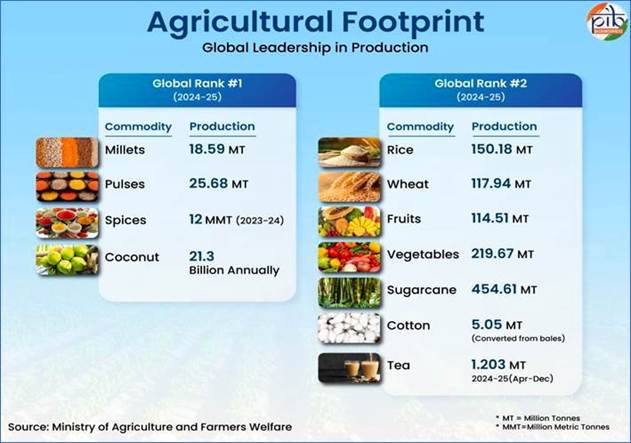
- India among top global producers: Rice (150.18 MT), Wheat (117.94 MT), Pulses (25.68 MT), Millets (18.59 MT).
- Strengthens buffer stocks, PDS supply, and global food security role.
- Diversification & High-Value Agriculture
- Horticulture output (362.08 MT) surpasses foodgrain → shift towards high-value crops (fruits, vegetables, spices).
- Budget 2026–27 promotes region-specific crops (coconut, nuts, NE agarwood) → agro-climatic optimisation.
- Processed food share increased to 20.4% of exports, signalling value-chain deepening.
- Economic & Trade Dimension
- Agri exports rose from USD 34.5 bn (FY20) to USD 51.1 bn (FY25), CAGR ~8.2%.
- Rice exports alone USD 12.95 bn; spices USD 4.52 bn → global competitiveness.
- Enhances farm incomes, forex earnings, and rural industrialisation via food processing.
- Governance & Policy Architecture
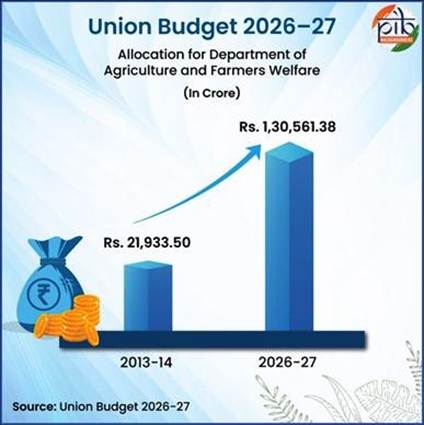
- Budget allocation increased from ₹21,933 crore (2013–14) to ₹1.30 lakh crore (2026–27) → sustained policy priority.
- Mission-mode schemes: NFSM, NMEO, Pulses Mission → reduce import dependence.
- Institutional convergence across MoA&FW, Food Processing, Cooperation Ministry.
- Income Security & Risk Management
- PM-KISAN: ₹4.27 lakh crore disbursed → direct income stabilisation.
- PMFBY: ₹1.90 lakh crore claims; coverage 6.2 crore hectares → climate risk mitigation.
- MSP at 1.5× cost ensures price assurance for 22 crops.
- Technology & Input Efficiency
- 25.55 crore Soil Health Cards → site-specific nutrient management.
- 6.85 lakh seed villages → quality seed supply (1649 lakh quintals).
- 27,554 Custom Hiring Centres → mechanisation access for small farmers.
- Water & Resource Management
- Irrigation coverage increased to 55.8% under PMKSY → improved water-use efficiency.
- Promotion of micro-irrigation (drip/sprinkler) reduces water stress.
- Sustainability & Climate Resilience
- Natural farming: 6.39 lakh hectares, 15.79 lakh farmers → reduced chemical dependency.
- Millets promotion → climate-resilient, low-water crops (Shree Anna).
- Ethanol blending saved ₹1.44 lakh crore forex, linking agriculture with energy security.
- Market Reforms & Value Chain Integration
- e-NAM: 1.8 crore farmers, 1,656 mandis → digital price discovery.
- 10,000 FPOs formed → collectivisation, bargaining power.
- PMKSY (Food Processing): 1185 projects → reduced post-harvest losses.
- Food Security & Distribution
- NFSA covers 81.35 crore beneficiaries → largest food security programme globally.
- ONORC ensures portability; 99.8% Aadhaar seeding → improved inclusion.
- Procurement: 832 LMT paddy, 300 LMT wheat ensures buffer stock stability.
- Cooperative & Institutional Dimension
- 67,930 PACS digitisation; 54,150 onboarded ERP → transparency and efficiency.
- 18,183 new cooperatives → decentralised rural economy strengthening.
Data & Evidence
- Agriculture growth ~4.4% annually (last 5 years) → stable sectoral performance.
- Credit disbursement ₹28.67 lakh crore (FY25); 7.72 crore KCC accounts operational.
- Food processing employs 12.91% of manufacturing workforce → rural industrialisation driver.
Challenges
- Climate Vulnerability: Erratic monsoons, heatwaves threaten productivity gains.
- Small Landholdings: ~86% farmers small/marginal → limits economies of scale.
- Low Value Addition: Processing share still limited compared to developed economies.
- Market Inefficiencies: APMC distortions, price volatility persist.
- Water Stress: Over-extraction in Punjab, Haryana → sustainability concerns.
- Regional Imbalances: Eastern India underutilised despite high potential.
Way Forward
- Scale up climate-smart agriculture (CSA) and millet-based systems.
- Promote agri-value chains and food processing clusters (Mega Food Parks).
- Expand digital agriculture (AI, precision farming, ONDC integration).
- Strengthen FPOs and cooperatives for aggregation and bargaining power.
- Rationalise MSP towards income support + diversification incentives.
- Improve water governance (crop diversification, micro-irrigation expansion).
Prelims Pointers
- India: largest producer of millets, pulses, spices, coconut.
- e-NAM → pan-India agricultural trading platform.
- PMFBY → covers natural disasters, pests, diseases.
- NFSA → covers 75% rural, 50% urban population.
- ONORC → nationwide portability of ration cards.
BRO’s Project Chetak celebrates 47th Raising Day
Why in News ?
- Project Chetak of Border Roads Organisation celebrated its 47th Raising Day (April 2026) at Bikaner.
- Highlights India’s continued push for border infrastructure strengthening in western sector (Rajasthan–Punjab–Gujarat).
Relevance
GS III (Internal Security)
- Border infrastructure → force mobility, logistics, deterrence.
- Role in western border (IB) vs northern LAC dynamics.
GS Paper III (Infrastructure)
- Strategic infrastructure as dual-use (defence + development).
- Integration with PM Gati Shakti.
Practice Question
- “Border infrastructure development is a force multiplier in India’s national security architecture.”Examine with reference to BRO’s role in western India. (250 words)
Static Background
- BRO (1960): Premier organisation under Ministry of Defence for border infrastructure development.
- Executes projects in strategic areas (LAC, IB, coastal belts); critical for military logistics and connectivity.
- Project Chetak (1980): Focused on western desert sector, unlike eastern BRO projects (e.g., Project Dantak, Himank).
Overview
- Security / Strategic Dimension
- Maintains feeder roads to International Border (IB) → ensures rapid troop mobilisation and logistics.
- Construction of 214 km Ditch-cum-Bund (DCB) acts as anti-infiltration and defensive barrier.
- Enhances border surveillance and deterrence capacity in desert terrain.
- Governance & Administrative Dimension
- Operates under Ministry of Defence with civil-military coordination.
- Works with state governments for land acquisition, clearances → example of cooperative federalism in security infrastructure.
- Continuous upgradation to NH double-lane specifications reflects integration with national infrastructure planning.
- Economic Dimension
- Over 4,000 km road network improves connectivity in backward desert regions.
- Facilitates trade, tourism (Thar region), and logistics efficiency.
- Border roads reduce regional disparity and transaction costs in remote areas.
- Social Dimension
- Enhances access to healthcare, education, and markets in sparsely populated border villages.
- Promotes border area development → reduces migration and strengthens local resilience.
- Environmental Dimension
- Construction in arid ecosystems (Thar Desert) requires climate-resilient engineering.
- Challenges include sand dune mobility, extreme temperatures, and water scarcity.
- Increasing adoption of green road technologies and sustainable materials.
- Technological Dimension
- Use of advanced road construction techniques for desert terrain stabilisation.
- Integration of GIS mapping, satellite monitoring, and mechanised equipment for efficiency.
Data & Evidence
- Project Chetak covers 4000+ km roads + 214 km DCB → one of BRO’s largest western projects.
- BRO handles ~60,000 km road network across India (approx.), key for border management.
- Border infrastructure identified as critical under India’s defence modernisation and logistics doctrine.
Challenges
- Harsh Terrain Constraints: Sandstorms, shifting dunes increase maintenance costs.
- Land Acquisition Delays: Coordination issues with states slow project execution.
- Environmental Concerns: Desert ecology disturbance and water stress.
- Funding & Capacity: High capital-intensive projects with limited specialised manpower.
- Strategic Vulnerability: Infrastructure may be targeted during conflicts.
Way Forward
- Deploy climate-resilient road technologies (geo-textiles, dune stabilisation techniques).
- Strengthen border infrastructure under PM Gati Shakti framework for integrated planning.
- Enhance public-private partnerships for logistics and maintenance.
- Expand smart surveillance integration (roads + sensors + drones).
- Promote border area development programmes alongside infrastructure expansion.
Prelims Pointers
- BRO established 1960, under Ministry of Defence.
- Project Chetak → western sector (Rajasthan, Punjab, Gujarat).
- Ditch-cum-Bund (DCB) → defensive earthwork barrier along borders.
- BRO operates in both domestic and friendly foreign countries (e.g., Bhutan).