
Contents01
LokOS: A Digital Backbone for Rural Livelihoods
Ministry of Rural Development · DAY-NRLM Digital Governance
GS 2GS 3
02
Viksit UDAN: Next Phase of Regional Air Connectivity
Ministry of Civil Aviation · Jodhpur New Terminal Building
GS 3GS 2
Article 01
Article 01
LokOS: A Digital Backbone for Rural Livelihoods
Ministry of Rural Development · DAY-NRLM Digital Governance Initiative
Relevance: GS 2 (governance, e-governance, welfare schemes) · GS 3 (inclusive growth, financial inclusion, rural livelihoods).
GS 2GS 3
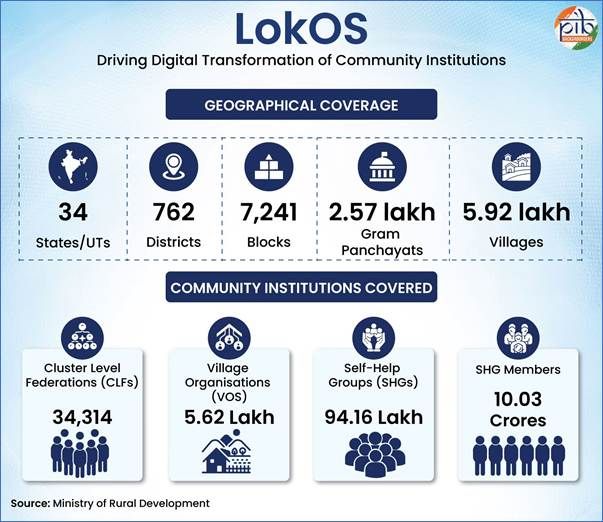
Image: LokOS digital platform for Self-Help Group governance under DAY-NRLM. [Replace src with image URL]
Key Data at a Glance
34States/UTs covered by LokOS (762 districts, 7,241 blocks)
94.16 lakhSelf-Help Groups (SHGs) digitised on the platform
10.03 crSHG members with Aadhaar- and bank-linked digital IDs
₹2 lakh crannual SHG financial transactions captured on LokOS
18.50 crDigital Aajeevika Registers (DARs) maintained
29 Jun 2026launch date of SHE-LEAPS women's enterprise platform
Issue in Brief
- LokOS (Lok = People, OS = Operating System) is a web-and-mobile platform under DAY-NRLM for end-to-end digitisation of Self-Help Groups (SHGs) and their federations, covering records, savings, lending and convergence.
- SHE-LEAPS (Self-Help Entrepreneur-Livelihoods and Enterprise Application for Prosperity and Sustainability), launched 29 June 2026 under LokOS, is a dedicated platform for women-led farm and non-farm enterprise creation and tracking.
Static Background
- DAY-NRLM was launched as Aajeevika – National Rural Livelihoods Mission (NRLM) by the Ministry of Rural Development in June 2011, restructuring the earlier Swarnjayanti Gram Swarozgar Yojana (SGSY), 1999, which had limited reach and weak financial linkages.
- NRLM adopted a demand-driven strategy (replacing SGSY's allocation-based model) and used Participatory Identification of Poor (PIP) instead of BPL lists to select beneficiaries.
- The mission was renamed Deendayal Antyodaya Yojana-NRLM (DAY-NRLM) in November 2015, honouring Pandit Deendayal Upadhyaya's Antyodaya philosophy of uplifting the poorest first; it is partly World Bank-supported.
- DAY-NRLM mobilises rural households — especially women — into a three-tier institutional architecture: SHGs → Village Organisations (VOs) → Cluster Level Federations (CLFs).
Key Dimensions
- LokOS coverage: 34 States/UTs, 762 districts, 7,241 blocks, 2.57 lakh Gram Panchayats, 5.92 lakh villages — among the largest digital community-institution platforms globally.
- Institutions digitised: 34,314 CLFs, 5.62 lakh VOs, 94.16 lakh SHGs, and 10.03 crore SHG members, each assigned Aadhaar- and bank-linked digital IDs.
- Financial footprint: captures ₹2 lakh crore/year in SHG transactions; tracks ₹9,718.41 crore Revolving Fund, ₹64,607.66 crore Community Investment Fund, and ₹38.34 crore Community Enterprise Fund.
- Lakhpati Didi support: enables 6,611 Master Trainers, 4.09 lakh Community Resource Persons, and monitoring of 3.87 crore Potential Lakhpati Didis, backed by 18.50 crore Digital Aajeevika Registers (DARs).
- The web app serves administrators, e-bookkeepers and transaction approvers for institution creation/approval; the mobile app supports field-level recording of CBO activity.
Critical Analysis — Strengths
- Digitisation of records and real-time tracking reduces manual bookkeeping errors, curbs leakages, and gives a data-driven, auditable trail for one of the world's largest SHG networks.
- Unique digital IDs and role-based administration improve traceability from village to national level, aiding convergence with other government schemes.
Critical Analysis — Structural Questions
- Platform effectiveness depends on last-mile digital literacy and connectivity among SHG members, many of whom are first-generation digital users in remote areas.
- Scale (10+ crore members) raises data privacy and grievance-redressal questions that require robust safeguards, especially with Aadhaar-linked financial data.
- SHE-LEAPS, being newly launched, has no track record yet; enterprise viability will depend on market linkages, not digitisation alone.
Way Forward
- Strengthen digital literacy training for SHG members and CRPs to ensure genuine usage, not just top-down data entry by administrators.
- Build strong data-protection protocols given the scale of Aadhaar- and bank-linked personal and financial data being centralised.
- Link SHE-LEAPS enterprises to market platforms (e-NAM, GeM, ONDC) so digitisation translates into real income gains for entrepreneurs.
Prelims Pointers
DAY-NRLM: launched 2011 as Aajeevika-NRLM; renamed DAY-NRLM in Nov 2015; restructured version of SGSY (1999); partly World Bank-funded.
LokOS: digital platform for SHGs/CBOs under DAY-NRLM; covers savings, lending, repayments, livelihoods.
SHE-LEAPS: launched 29 June 2026; women's enterprise platform under LokOS.
Institutional tiers: SHG → Village Organisation (VO) → Cluster Level Federation (CLF).
Lakhpati Didi: flagship initiative for household income above ₹1 lakh/year, tracked via LokOS.
DAR: Digital Aajeevika Register — 18.50 crore maintained under LokOS.
Practice Mains Question
Digital platforms are transforming the governance of India's Self-Help Group ecosystem. Discuss the significance of LokOS under DAY-NRLM, and examine the challenges in ensuring its benefits reach the last-mile beneficiary.
GS Paper 2 · 250 words · 15 marks
Practice MCQ
Q1. Consider the following statements regarding LokOS: (1) It is implemented under DAY-NRLM. (2) It digitises records only at the Cluster Level Federation level. (3) It generates Aadhaar- and bank-linked digital IDs for SHG members. Which of the statements given above is/are correct?
A) 1 and 3 onlyB) 2 onlyC) 1, 2 and 3D) 2 and 3 only
Article 02
Article 02
Viksit UDAN: Next Phase of Regional Air Connectivity
Ministry of Civil Aviation · Modified UDAN Scheme & Jodhpur New Terminal Building
Relevance: GS 3 (infrastructure, civil aviation, economy) · GS 2 (government policies and schemes for regional development).
GS 3GS 2
Key Data at a Glance
₹29,000 crModified UDAN Scheme outlay over the next 10 years
100aerodromes to be developed from unserved airstrips (₹12,159 cr)
200modern helipads planned under the scheme (₹3,661 cr)
₹480 crcost of the Jodhpur New Terminal Building (AAI)
20 lakhannual passenger capacity of the new Jodhpur terminal
669routes operationalised under UDAN since 2016 (1.66 cr+ passengers)
Issue in Brief
- The Prime Minister launched the next phase of UDAN ("Viksit UDAN") and inaugurated the New Terminal Building (NTB) at Jodhpur Airport, reaffirming the push for regional air connectivity infrastructure.
- The Union Cabinet approved the Modified UDAN Scheme on 25 March 2026 with an outlay of ~₹29,000 crore over 10 years, aligned with Viksit Bharat 2047.
Static Background
- UDAN (Ude Desh ka Aam Nagrik) is the operational arm of the Regional Connectivity Scheme (RCS), a key component of the National Civil Aviation Policy (NCAP), 2016.
- Launched by the Ministry of Civil Aviation on 21 October 2016, its first flight ran Shimla–Delhi on 27 April 2017, embodying PM Modi's "Hawai Chappal se Hawai Jahaz" vision.
- UDAN uses Viability Gap Funding (VGF) — financed via the Regional Connectivity Fund, built from a levy on non-RCS flights — plus fare caps and tax concessions to make regional flying viable for airlines.
- Originally conceived with a 10-year (2016–2026) vision, the scheme has since been extended for another decade as the Modified UDAN Scheme, taking it toward 2036.
- Since 2016, UDAN has operationalised 669 routes and connected 95 airports/heliports/water aerodromes, benefiting over 1.66 crore passengers.
Key Dimensions
- Modified UDAN allocations: ₹12,159 crore for developing 100 aerodromes from unserved airstrips; ₹2,577 crore for Operations & Maintenance support; ₹3,661 crore for 200 modern helipads; ₹10,043 crore as continued VGF.
- Atmanirbhar push: scheme promotes induction of indigenous aircraft/helicopters — including HAL Dhruv and Dornier platforms — for underserved and remote-region operations.
- Jodhpur New Terminal Building: built by the Airports Authority of India at ₹480 crore, spread over 23,342 sq. m, handling 1,500 passengers/peak hour and 20 lakh passengers/year (up from the old terminal's ~4 lakh/year capacity).
- Terminal features: 20 check-in counters, six aerobridges, apron for 11 A-321 + 1 ATR-72 aircraft, ~320-car parking, and a target 5-Star GRIHA rating for sustainability.
- Design draws on Marwar's royal Rajasthani architecture — arches and jharokhas — reflecting Jodhpur's identity as gateway to the Thar Desert.
Critical Analysis — Strengths
- A 10-year scheme extension with near-₹29,000 crore outlay signals long-term commitment rather than a one-off scheme, giving airlines and airports planning certainty.
- Combining helipad expansion, indigenous aircraft induction, and O&M support addresses earlier UDAN criticisms of route discontinuation due to poor aftercare and infrastructure gaps.
Critical Analysis — Structural Questions
- Past UDAN rounds saw route discontinuation from low demand and delayed VGF disbursal to airlines; whether the Modified Scheme resolves these structural issues remains to be seen.
- Reliance on indigenous aircraft (HAL Dhruv, Dornier) for remote operations depends on adequate manufacturing scale-up and maintenance ecosystems, which have historically lagged demand.
- Terminal upgrades address capacity, but sustained traffic growth needs matching last-mile surface connectivity to smaller cities like Jodhpur.
Way Forward
- Ensure timely VGF disbursal and route-viability monitoring so airlines sustain operations beyond the initial subsidy period.
- Scale up domestic manufacturing and maintenance capacity for indigenous aircraft platforms to support remote-route expansion sustainably.
- Integrate new terminals like Jodhpur's with multi-modal connectivity (rail, road) to maximise tourism and trade benefits from expanded capacity.
Prelims Pointers
UDAN: launched 21 Oct 2016; part of NCAP 2016; first flight Shimla–Delhi, 27 Apr 2017.
VGF: Viability Gap Funding, financed via the Regional Connectivity Fund (levy on non-RCS flights).
Modified UDAN: Cabinet-approved 25 March 2026; ~₹29,000 crore over 10 years.
Jodhpur NTB: built by AAI; ₹480 crore; target 5-Star GRIHA rating.
Indigenous platforms promoted under Modified UDAN: HAL Dhruv, Dornier.
UDAN tagline: "Ude Desh ka Aam Nagrik"; PM's vision — "Hawai Chappal se Hawai Jahaz."
Practice Mains Question
UDAN has been described as transforming regional air connectivity in India. Critically examine the achievements and persistent challenges of the scheme as it enters its modified, extended phase.
GS Paper 3 · 250 words · 15 marks
Practice MCQ
Q2. (Assertion–Reasoning) Assertion (A): The Modified UDAN Scheme continues Viability Gap Funding for regional airline operations. Reason (R): VGF is financed through general Union Budget allocations rather than any sector-specific levy.
A) Both A and R are true, and R is the correct explanation of AB) Both A and R are true, but R is NOT the correct explanation of AC) A is true, R is falseD) A is false, R is true