

In-Depth PIB Analysis2 Items
Core TopicImportantConcise
Economy & Consumer ProtectionGS Paper II & III
01BIS Hallmarking of Gold & Silver — HUID & Traceability
Science & TechnologyGS Paper III
02Space Debris & Active Debris Removal — DFSM 2030
Economy & Consumer ProtectionGeneral Studies Papers II & III
01
Hallmarking in India: From a Voluntary Mark to a Digitally Traceable Purity Regime
GS-II · Governance — Consumer Protection, Statutory BodiesGS-III · Economy — Gold Market, Standards & QualityPrelims + MainsPIB Backgrounder · Ministry of Consumer Affairs, Food & Public Distribution · 05 Nov 2026
A PIB Backgrounder reviews five years of mandatory gold hallmarking: over 65 crore gold articles now carry a Hallmark Unique Identification (HUID), and new digital checks aim to make every piece traceable from the testing centre to the buyer.
◈ The Basics — Why Gold Needs a Purity Mark
Pure gold is too soft for daily-wear jewellery, so it is alloyed with metals such as copper, silver and zinc. The alloy content cannot be judged by eye, which creates room for under-karatage — selling lower-purity gold at a higher-purity price.
- Carat (K) measures purity in parts per 24: 24K is (nearly) pure gold; 22K = 22/24 ≈ 91.6% gold.
- Fineness expresses the same thing in parts per thousand — hence the mark 22K916 on 22-carat jewellery.
- Hallmarking is a third-party conformity assessment: an independent, accredited centre tests the article and certifies its purity against a national standard.
- The word comes from Goldsmiths’ Hall, London, where articles were assayed and marked; English hallmarking traces back to a statute of 1300 — among the oldest consumer-protection laws in the world.
Purity matters beyond the shop counter. Indian households hold gold as a store of value and a hedge against inflation, and pledge it for gold loans, where the lender values the collateral by its gold content.
Static Anchor — the Bureau of Indian Standards (BIS)
- Origin: successor to the Indian Standards Institution (ISI), set up in 1947; BIS was created under the BIS Act, 1986 and became functional on 1 April 1987.
- Present law: the BIS Act, 2016 (in force from October 2017) made BIS the National Standards Body of India and empowered the Centre to make hallmarking mandatory for precious-metal articles.
- Administrative ministry: Department of Consumer Affairs, Ministry of Consumer Affairs, Food & Public Distribution; headquartered in New Delhi.
- Global links: BIS represents India at the International Organization for Standardization (ISO) and the International Electrotechnical Commission (IEC).
- Not the ISI mark: the ISI mark certifies industrial products under product certification; the hallmark is a separate BIS scheme only for gold and silver articles.
▤ Scheme at a Glance — BIS Hallmarking Scheme
- Launched: 2000 for gold (voluntary); 2005 for silver (voluntary).
- Sole operating agency: Bureau of Indian Standards.
- Mandatory for gold: from 23 June 2021 in 256 districts; now 392 districts, as the network of testing centres has grown.
- Gold standard: IS 1417 — 7 grades: 9K (375), 14K (585), 18K (750), 20K (833), 22K (916), 23K (958), 24KS (995).
- Silver standard: revised IS 2112:2025 — 8 grades: 800, 835, 900, 925, 958, 970, 990, 999. Silver hallmarking stays voluntary, but every hallmarked silver article must carry an HUID from 1 September 2025.
- HUID: a six-digit alphanumeric code, generated by the BIS server, unique to each article.
- Jeweller registration: online via the National Single Window System (NSWS) or Manak Online; instant, free and valid for life.
- Consumer tool: BIS CARE App — free on Android and iOS, in 12 languages.
Figure 1 — Gold caratage under IS 1417: carat versus fineness
GradeFineness (parts of gold per 1,000)9K375 · 37.5%14K585 · 58.5%18K750 · 75.0%20K833 · 83.3%22K916 · 91.6%23K958 · 95.8%24KS995 · 99.5%Bar length proportional to fineness · 22K916 is the usual grade for Indian jewellery
The number after “K” in a hallmark is the fineness: 22K916 means 916 parts of gold in every 1,000.
Lineage — How the Regime Evolved
- 2000: voluntary gold hallmarking begins, with BIS as the sole agency; the twin aims were consumer protection and export competitiveness.
- 2005: voluntary hallmarking extended to silver.
- 2016–17: the BIS Act, 2016 provides the legal basis for compulsory hallmarking.
- January 2020: the Hallmarking of Gold Jewellery and Gold Artefacts Order, 2020 is notified; enforcement begins on 23 June 2021 in 256 districts.
- 1 April 2023: only gold articles bearing a six-digit HUID may be sold. This replaced the older format, in which separate testing-centre and jeweller identification marks were stamped.
- 1 September 2024: API integration of XRF machines ends manual entry of test results.
- 1 September 2025: HUID made compulsory for all hallmarked silver.
- 1 June 2026: Transfer HUID (Phase 1); 8 June 2026: photographs and weights of each article uploaded to Manak Online and shown on the BIS CARE App.
Figure 2 — The three marks on hallmarked gold and silver
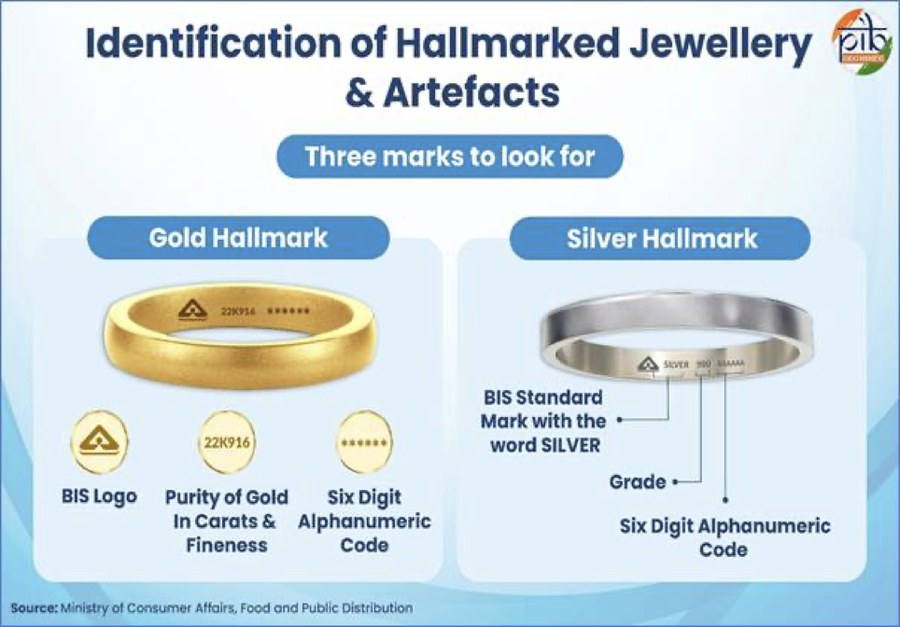
Gold carries the BIS logo, a purity mark such as 22K916 and the HUID; silver adds the word SILVER to the BIS mark. Image courtesy PIB / Ministry of Consumer Affairs, Food & Public Distribution, 05 Nov 2026; reproduced with credit for educational use.
How Hallmarking Works — Request to Verification
- Registration: jewellers register with BIS. Assaying and Hallmarking Centres (AHCs) are recognised only after BIS verifies their infrastructure, equipment and qualified staff.
- Digital request: the jeweller logs the category, quantity, weight, declared purity and chosen AHC on Manak Online. This creates a record of every consignment.
- Testing: the AHC checks weight and purity, typically using X-ray fluorescence (XRF), a non-destructive surface test. Balances, XRF and laser-marking machines must transfer data directly to BIS software.
- Marking: the BIS server generates the HUID. The article is laser-marked with the HUID, the BIS Standard Mark and the purity mark, then photographed.
- Traceability: time-stamps for each AHC step allow real-time monitoring and show whether testing preceded marking. Transfer HUID records a change of hands between jewellers to prevent duplicate or fraudulent hallmarks.
- Oversight: BIS samples hallmarked articles from retail outlets, conducts surveillance audits of AHCs and carries out enforcement raids on complaints. There were 30+ enforcement actions in 2025–26.
- Verification: a buyer enters the HUID in the BIS CARE App to see the purity, product type, jeweller, AHC, photographs and recorded weight.
Figure 3 — The hallmarking process in six steps
A paper-and-stamp system has become a digital chain of custody, ending with the consumer’s own check on the BIS CARE App. Image courtesy PIB / Ministry of Consumer Affairs, Food & Public Distribution, 05 Nov 2026; reproduced with credit for educational use.
▤ The Numbers (since mandatory hallmarking, 2021)
65 crore+Gold articles with HUID (as of 15 Oct 2026)
43,153 → 2,36,624BIS-registered jewellers
948 → 1,565Recognised AHCs
90 lakh+Silver articles with HUID (since Sept 2025)
- District coverage: 256 → 392 districts under mandatory gold hallmarking.
- Awareness: 1,582 consumer-awareness programmes held by BIS offices between 1 April and 31 October 2026, including Gram Panchayat sensitisation.
Why It Matters
- Information asymmetry: the seller knows the purity and the buyer does not, a textbook market failure. A verifiable third-party mark corrects it.
- Formalisation: the five-fold rise in registered jewellers brings a historically cash-heavy, informal trade into a digital, auditable system.
- Financial inclusion: certified purity makes gold-backed lending fairer and faster to value.
- Exports and brand India: uniform standards support the gems and jewellery sector, a major export earner and employer.
- Consumer rights: the regime complements the Consumer Protection Act, 2019, which recognises the right to be informed about quality and purity.
The Critical View
- Coverage gaps: mandatory hallmarking covers 392 districts, roughly half the country. Rural and remote buyers, often the most vulnerable, may still buy unmarked jewellery.
- Exemptions: jewellers with annual turnover up to ₹40 lakh, articles under 2 grams and certain traditional forms such as Kundan, Polki and Jadau are outside the mandate, leaving a sizeable small-trade segment uncovered.
- Testing limits: XRF reads the surface. Plated or core-filled articles need the destructive fire assay, so periodic BIS sampling remains essential.
- Enforcement intensity: about 30 enforcement actions in a year, against 2.3 lakh+ registered jewellers, suggests deterrence still rests largely on the digital trail rather than on inspection.
- Silver remains voluntary even though silver buying, especially in rural markets, is substantial.
- Legacy stock: households hold vast quantities of pre-HUID jewellery. Old hallmarked jewellery remains valid, but consumers need awareness of how to get un-hallmarked items tested at an AHC.
◈ Prelims Hooks — Quality Marks in India
- Hallmark — gold and silver purity; BIS.
- ISI mark — industrial products; BIS product certification.
- Agmark — agricultural produce; under the Agricultural Produce (Grading and Marking) Act, 1937; Directorate of Marketing & Inspection.
- Ecomark — environment-friendly products; launched 1991.
- BEE Star Label — energy efficiency of appliances; Bureau of Energy Efficiency under the Energy Conservation Act, 2001.
✎ Mains Practice Question
“Mandatory hallmarking has moved India’s gold jewellery market from caveat emptor towards verifiable trust.” Examine the role of digital traceability in consumer protection in this sector, and identify the gaps that remain. 15 marks · 250 words
Science & TechnologyGeneral Studies Paper III
02
Space Debris and India’s Push for Active Debris Removal: Private Capability Meets the Debris-Free Space Mission 2030
GS-III · S&T — Space Technology, Awareness in SpaceGS-II · IR — Outer Space Law & Global CommonsPrelims + MainsPIB · Department of Space · 05 Nov 2026
A Hyderabad start-up has opened Base 1, which it describes as India’s first private facility for Active Debris Removal (ADR) and in-orbit servicing. The Union Government links it to the goal of debris-free space missions by 2030.
◈ The Basics — What Is Space Debris?
The UN COPUOS Space Debris Mitigation Guidelines define space debris as all man-made objects, including fragments, in Earth orbit or re-entering the atmosphere, that are non-functional. The guidelines were endorsed by the UN General Assembly in 2007.
- What it includes: dead satellites, spent rocket upper stages, mission-related objects (lens caps, bolts) and, above all, fragments from explosions and collisions.
- Why tiny pieces matter: objects in Low Earth Orbit (LEO) travel at about 7–8 km per second, so even a centimetre-sized fragment can disable a satellite.
- Kessler Syndrome (1978): NASA scientist Donald Kessler warned that above a critical density, each collision creates debris that causes further collisions — a self-sustaining cascade that could make some orbits unusable.
- Most crowded zone: LEO (up to ~2,000 km), home to Earth-observation satellites, the International Space Station and mega-constellations. Geostationary orbit (35,786 km) is a scarce, high-value ring where dead satellites are pushed into a higher “graveyard orbit”.
Static Anchor — Landmark Debris Events
- 2007: China’s anti-satellite (ASAT) test on the Fengyun-1C weather satellite — the largest single debris-generating event on record.
- 2009: the first accidental collision between two intact satellites — Iridium 33 and the defunct Cosmos 2251.
- 27 March 2019: India’s Mission Shakti ASAT test destroyed Microsat-R at roughly 300 km. The low altitude was chosen so that most fragments would decay quickly.
- 2021: Russia’s ASAT test on Cosmos 1408 forced the ISS crew to take shelter, which renewed calls for a moratorium on destructive ASAT tests.
The Legal Framework — Who Is Responsible?
- Outer Space Treaty, 1967: Art. VI makes states responsible for national activities, including private actors. Art. VII makes the launching state liable for damage. Art. VIII keeps jurisdiction and ownership with the state of registry, so debris cannot be removed without that state’s consent.
- Liability Convention, 1972: absolute liability for damage on Earth or to aircraft; fault-based liability for damage in space.
- Registration Convention, 1975: space objects must be registered with the UN.
- Soft law: the IADC Mitigation Guidelines (2002), the UN COPUOS Mitigation Guidelines (2007) and the Long-Term Sustainability (LTS) Guidelines (2019). None of them is binding.
- IADC — the Inter-Agency Space Debris Coordination Committee, set up in 1993 — brings together the major space agencies; ISRO is a member.
▤ At a Glance — Base 1 and the Debris-Free Space Mission
- Facility: Base 1, Gachibowli, Hyderabad; about 14,800 sq ft.
- Capabilities: orbital rendezvous and capture labs, space-robotics labs, microgravity simulation, satellite-integration clean rooms and mission control. Space robots can be designed, built, tested under space conditions and operated in one place.
- Track record: Mission EMBRACE tested soft robotic “petals” for capturing objects in space in July 2026, within a year of the company’s founding.
- Partners: Pixel (satellite systems), Dhruv Aerospace, Netherlands (propulsion) and Skyroot Aerospace (launch).
- Funding: reported US$ 6 million seed round; the company is targeting commercial operations by 2028 (company target, as reported).
- National goal: Debris Free Space Missions (DFSM), announced by ISRO in 2024, aims for zero debris creation by all Indian space actors — government and private — by 2030 (government target).
- Baseline: according to a reply in Parliament, 129 trackable debris pieces from Indian missions were in orbit as of March 2026.
◈ Read the 2030 Goal Correctly
“Debris-free space by 2030” does not mean cleaning up all of orbit. DFSM is a commitment that Indian missions will leave no new debris. Active removal by firms such as this start-up is a separate, complementary capability that deals with debris already in orbit.
Figure 4 — Space sustainability: prevent, monitor, remove
1 · PREVENTMitigation• Passivate spent stages• Keep fuel for de-orbit• Post-mission disposal• Design for demiseIndia:PSLV POEM-3 re-entry (2024)Megha-Tropiques-1 controlledre-entry (2023)2 · MONITORSpace Situational Awareness• Track objects in orbit• Predict close approaches• Collision-avoidancemanoeuvresIndia:Project NETRAIS4OM (2022)Annual ISSAR report3 · REMOVEActive Debris Removal• Rendezvous & approach• Capture: arm, net,soft gripper• De-orbit or relocateIndia:SpaDeX docking (2025)EMBRACE capture test (2026)Base 1 ADR facilityDFSM-2030: zero new debris from all Indian actors, government and private
Mitigation stops new debris and tracking avoids collisions; only active removal reduces what is already in orbit.
India’s Space-Sustainability Toolkit
- Project NETRA (Network for space object Tracking and Analysis) — India’s own Space Situational Awareness (SSA) capability, so it depends less on foreign tracking data.
- IS4OM — ISRO System for Safe and Sustainable Space Operations Management, operational since 2022.
- ISSAR — the annual Indian Space Situational Assessment Report, which records collision-avoidance manoeuvres and debris status.
- PSLV Orbital Experimental Module (POEM) — the spent PSLV fourth stage is reused as a short-lived platform and then de-orbited. The PSLV-C58 mission left practically zero debris in orbit (2024).
- SpaDeX (January 2025) — India became the fourth country to demonstrate space docking. The same rendezvous technology underpins ADR and satellite refuelling.
The Enabling Ecosystem — Lineage of Space Reforms
- 2019: NewSpace India Limited (NSIL) set up as ISRO’s commercial arm.
- June 2020: space sector opened to private players; IN-SPACe created as the single-window authoriser and promoter.
- April 2023: Indian Space Policy, 2023 defines the roles of ISRO, NSIL, IN-SPACe and private firms.
- The Government puts the space economy at about US$ 9 billion and expects US$ 40–45 billion in the coming decade (government projection). It says the number of space start-ups has grown from single digits to about 450.
▤ Global Context — Who Else Is Doing ADR?
- Japan (Astroscale): ELSA-d (2021) demonstrated magnetic capture. ADRAS-J (2024) carried out close inspection of a spent H-IIA rocket stage — a real piece of debris.
- Europe (ESA): ClearSpace-1, a planned mission to capture and de-orbit a piece of debris.
- Capture techniques: robotic arms, nets, harpoons, tethers, magnetic plates and soft grippers — each suited to different object shapes and spin rates.
Why It Matters
- Protecting national assets: navigation (NavIC), communication, Earth-observation and the planned Bharatiya Antariksh Station all depend on usable orbits.
- Human spaceflight: Gaganyaan crews face direct risk from debris in LEO.
- Commercial opportunity: in-orbit servicing (refuelling, repair, life extension) and ADR are emerging global markets in which Indian firms can compete on cost.
- Norm-shaping: credible capability strengthens India’s voice at UN COPUOS and the IADC as rules for space traffic management are written.
The Critical View
- Dual-use concern: a spacecraft that can approach and grab debris can, in principle, approach and disable a working satellite. ADR therefore needs transparency and confidence-building measures.
- Legal gaps: under Art. VIII, removing another country’s debris needs its consent. Liability for an ADR mishap and the question of who pays for clean-up (there is no “polluter pays” rule) remain unsettled.
- Domestic law: India still lacks a comprehensive national space activities law to license private missions, fix liability and require insurance. Policy instruments currently fill this role.
- Scale problem: removing a handful of large objects matters, but global debris growth driven by mega-constellations and ASAT tests cannot be solved by one country.
- Claims versus capability: statements of global “pioneership” should be measured against demonstrated capture of real debris. The Government frames the 2030 goal as a vision, and the company’s commercial timeline is a target.
✎ Mains Practice Question
Space debris is often described as a “tragedy of the commons” in orbit. Discuss the threats it poses to space activities, and evaluate India’s approach to space sustainability, including the role of private players in active debris removal. 15 marks · 250 words