
Published on Apr 7, 2026
Daily PIB Summaries
PIB Summaries 07 April 2026
Content
- Launch of Annual Survey of Incorporated Services Sector Enterprises (ASISSE)
- Advancing India’s Fisheries Sector: Institutions, Investment, Inclusion
Launch of Annual Survey of Incorporated Services Sector Enterprises (ASISSE)
Why in News?
- NSO (MoSPI) launched first-ever ASISSE (April 2026) covering FY 2024–25, marking a major statistical reform to strengthen services sector data architecture in India.
- Release of “Know Your Survey” User Guide enhances transparency, compliance, and stakeholder awareness, aligning with global statistical best practices.
Relevance
- GS II (Governance)
- Evidence-based policymaking, statistical systems, data governance, transparency
- GS III (Economy)
- Services sector growth, GDP estimation, formalization, digital economy
Practice Questions
Q1.“Reliable and granular data is the backbone of effective economic governance.”In this context, examine the significance of the Annual Survey of Incorporated Services Sector Enterprises (ASISSE) in strengthening India’s statistical architecture.(250 Words)
Static Background
Indian Statistical System
- National Statistical Office (NSO) under MoSPI responsible for macroeconomic data, surveys, and national accounts estimation in India.
- Operates under Collection of Statistics Act, 2008 (amended 2017) ensuring legal backing, confidentiality, and data reliability.
Existing Surveys Architecture
- Annual Survey of Industries (ASI): Covers registered manufacturing sector, key for IIP and GDP estimation.
- Annual Survey of Unincorporated Sector Enterprises (ASUSE): Captures informal non-agricultural sector (excluding construction).
- ASISSE completes the triad, enabling holistic coverage of non-agricultural economy.
Services Sector Significance
- Contributes >50% of India’s GDP, largest sector in employment generation and exports (IT, tourism, logistics).
- Historically data-deficient, especially for incorporated enterprises, affecting policy precision.
Key Features of ASISSE
- Covers incorporated enterprises under Companies Act 1956/2013 & LLP Act 2008.
- Sample size: ~1.21 lakh enterprises, making it one of the largest enterprise-level surveys globally.
- Uses GSTN database as sampling frame, improving coverage, accuracy, and formal sector mapping.
- Covers sectors: trade, transport, hospitality, IT, education, healthcare, representing core service economy.
- Data collection via secure web-based portal, promoting digitization and real-time validation.
Dimensions
1. Constitutional / Legal Dimension
- Backed by Collection of Statistics Act, 2008 ensuring mandatory data provision and confidentiality safeguards.
- Strengthens evidence-based governance, aligning with Directive Principles (Article 38 – welfare state through informed policy).
2. Governance / Administrative Dimension
- Enables granular, enterprise-level data for sectoral policy formulation and monitoring.
- Improves Centre-State coordination via state-level service sector indicators.
- User Guide initiative enhances ease of compliance, trust, and participatory governance.
3. Economic Dimension
- Addresses critical data gaps in services sector, improving GDP estimation accuracy and productivity analysis.
- Facilitates investment planning, sectoral incentives, and industrial policy design.
- Supports formalization trends analysis using GST-linked sampling, aiding tax and compliance policy.
4. Social / Ethical Dimension
- Better data on health, education, hospitality sectors improves public service delivery planning.
- Ensures data transparency and accountability, strengthening citizen trust in official statistics.
- Ethical concerns: data privacy, enterprise burden, and compliance costs.
5. Technological / Data Governance Dimension
- Integration with GSTN database reflects data convergence and digital governance evolution.
- Use of web-based portal enhances efficiency, reduces errors, enables real-time analytics.
- Aligns with global standards (UN SDMX, OECD practices) in statistical communication and dissemination.
Challenges & Criticisms
- Coverage bias risk: excludes unincorporated services sector, still dominant in India’s economy.
- Data reliability concerns due to self-reporting and compliance fatigue among enterprises.
- Coordination issues between GSTN, MCA database, and NSO datasets may affect consistency.
- Capacity constraints at NSO in handling big data analytics and survey management.
- Privacy concerns with increased data integration across government databases.
Way Forward
- Integrate ASISSE + ASI + ASUSE datasets into a unified enterprise data ecosystem for real-time policymaking.
- Strengthen data validation using AI/ML tools, reducing reporting errors and inconsistencies.
- Expand coverage to include platform economy and gig services sector, currently underrepresented.
- Enhance data dissemination dashboards for researchers, policymakers, and states.
- Ensure robust data protection frameworks aligned with Digital Personal Data Protection Act, 2023.
Prelims Pointers
- ASISSE launched by NSO under MoSPI.
- Covers incorporated services sector only (Companies + LLPs).
- Uses GSTN database as sampling frame.
- Complements ASI (manufacturing) + ASUSE (unincorporated sector).
- Conducted under Collection of Statistics Act, 2008 (amended 2017).
Advancing India’s Fisheries Sector: Institutions, Investment, Inclusion
Why in News?
- Union Budget 2026–27 allocated ₹2,761.80 crore (highest ever) for fisheries, signaling policy prioritisation of Blue Economy and rural livelihoods.
- Launch of institutional, digital, and sustainability reforms (NFDP, EEZ Rules 2025, MFC 2025) reflects transition toward data-driven and sustainable fisheries governance.
Relevance
- GS III (Economy)
- Agriculture allied sectors, Blue Economy, exports, infrastructure
- GS II (Governance)
- Welfare schemes, institutional reforms, cooperative federalism
Practice Questions
Q1.“Fisheries sector holds the key to India’s transition from Blue Revolution to Blue Economy.”
Critically analyse the role of institutional and investment reforms in achieving this transformation.(250 Words)
Static Background
Sectoral Importance
- India is 2nd largest fish producer globally, contributing ~8% of global output, highlighting strategic economic significance.
- Fisheries contribute 7.43% of Agricultural GVA (highest among allied sectors), underpinning income diversification and food security.
- Supports ~3 crore livelihoods, especially among coastal, tribal, and rural communities.
Blue Revolution to Blue Economy
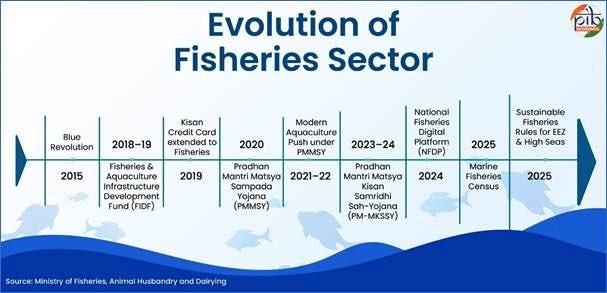
- Blue Revolution (2015) shifted focus from subsistence fishing to commercialization, infrastructure, and value chains.
- Evolution toward Blue Economy framework, integrating sustainability, exports, and ecosystem conservation (SDG-14).
Data & Facts
- Fish production increased from 95.79 lakh tonnes (2013–14) → 197.75 lakh tonnes (2024–25) (106% growth).
- Seafood exports reached ₹62,408 crore (2024–25), with frozen shrimp dominating exports.
- PMMSY allocation: ₹2,500 crore (2026–27); cornerstone scheme for sector transformation.
- KCC coverage: 4.39 lakh fishers, Insurance: 3.3 million beneficiaries, Livelihood support: 7.44 lakh families.
- FIDF: 225 projects worth ₹6,685.78 crore, generating ~2.5 lakh jobs.
Dimensions
1. Institutional Dimension
- Establishment of 2,195 FFPOs with ₹544 crore investment strengthens collective bargaining and market access.
- NFDP (2024) creates digital identities + unified database, improving targeting, transparency, and governance efficiency.
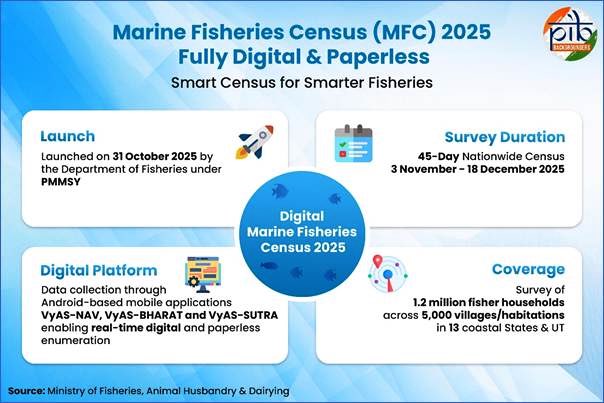
- Marine Fisheries Census 2025 enables geo-referenced, real-time socio-economic profiling, enhancing policy precision.
- EEZ Sustainable Fisheries Rules (2025) institutionalize regulatory compliance and conservation standards.
2. Investment & Infrastructure Dimension
- Budget allocation ₹2,761.80 crore reflects capital-intensive push toward fisheries modernization and value addition.
- FIDF (2018–26) addresses critical infrastructure gaps (harbours, cold chains, landing centres) improving post-harvest efficiency.
- PMMSY infrastructure expansion:
- 23,285 ha ponds, 52,058 cages, 27,189 transport units, 634 processing units.
- Investment in cold-chain logistics and processing reduces post-harvest losses (~20–25%), enhancing farmer incomes.
3. Economic Dimension
- Fisheries driving export-led growth, with US & China as key markets, strengthening external sector resilience.
- Promotes value-chain integration (production → processing → export) increasing value realisation.
- Enhances rural non-farm employment, generating 74.66 lakh jobs since 2014–15.
- Supports diversification from agriculture, reducing agrarian distress risks.
4. Social / Inclusion Dimension
- KCC expansion (limit raised to ₹5 lakh) improves institutional credit access for fishers and allied workers.
- Insurance coverage to 3.3 million beneficiaries enhances risk mitigation against climate and livelihood shocks.
- Lean-period support to 4.33 lakh families (₹1,681.21 crore) ensures income stability and social protection.
- Inclusion of women SHGs, startups, FFPOs promotes entrepreneurship and equitable growth.
5. Technological Dimension
- Adoption of RAS (12,081 units; ₹902.97 crore) enables high-density, water-efficient aquaculture systems.
- Bio-floc technology (4,205 units; ₹523.30 crore) improves feed efficiency and water quality via microbial systems.
- NFDP integration with 12 banks enables digital credit access, traceability, and incentive delivery.
- Digital tools (VyAS apps) ensure real-time monitoring, geo-tagging, and data validation.
6. Environmental & Sustainability Dimension
- EEZ Rules 2025 promote responsible fishing, stock conservation, and international compliance (UNCLOS norms).
- Integration with Mission Amrit Sarovar (1,222 water bodies) supports eco-restoration and inland fisheries expansion.
- Promotion of sustainable aquaculture (RAS, Bio-floc) reduces water usage and ecological footprint.
- Aligns with SDG-14 (Life Below Water) and blue economy sustainability goals.
Challenges / Gaps
- Overfishing and stock depletion in marine areas due to weak enforcement and open-access regime.
- Fragmented value chain with dominance of intermediaries, reducing price realisation for fishers.
- Climate change impacts: ocean warming, cyclones, affecting fish migration and livelihoods.
- Limited cold-chain penetration leading to high post-harvest losses (20–25%).
- Digital divide and low awareness limiting NFDP adoption among small-scale fishers.
- Regulatory overlaps between Centre–State maritime jurisdictions.
Way Forward
- Strengthen co-management fisheries governance models involving local communities and states.
- Expand deep-sea fishing and mariculture to reduce pressure on coastal ecosystems.
- Develop integrated cold-chain corridors under PM Gati Shakti for efficient logistics.
- Enhance climate-resilient fisheries (early warning systems, insurance expansion).
- Promote export diversification beyond shrimp to high-value species and processed products.
- Improve last-mile digital literacy and NFDP adoption through capacity-building programs.
Prelims Pointers
- PMMSY launched in 2020; umbrella scheme for fisheries sector.
- FIDF launched in 2018–19 for infrastructure financing.
- NFDP launched in 2024 for digital governance.
- RAS & Bio-floc are water-efficient aquaculture technologies.
- EEZ Rules 2025 regulate fishing in Exclusive Economic Zone (~24 lakh sq km).